Analysing Prose Non-Fiction Texts (DP IB English A: Literature: HL): Revision Note

Analysing Prose Non-Fiction Texts
Paper 1 asks you to analyse unseen literary texts. A literary text broadly means a text that belongs to a literary form such as poetry, prose fiction, prose non-fiction or drama. While you cannot predict what type of text will come up in the exam, it is a good idea to practise analysing common literary forms so that you are familiar with typical features and conventions of a variety of texts. One type of text you may be asked to analyse is prose non-fiction.
Here we will cover these aspects of analysing prose non-fiction:
Overview of prose non-fiction
Prose non-fiction: form and genre
Non-fiction prose techniques
How to annotate a prose non-fiction extract
Prose non-fiction: Paper 1 model answer
Overview of prose non-fiction
Prose non-fiction is writing that is based on real events, people, or ideas, rather than invented narratives. It is often written to inform, persuade, reflect, or argue a point of view. Unlike fiction, prose non-fiction is grounded in reality, but it still uses language and structure creatively to shape meaning.
In order to convincingly analyse a prose non-fiction text, you need to assess what the writer is trying to convey and how language, tone and structure are used to influence the reader.
Purpose
The purpose of a prose non-fiction text is the reason it was written and what it seeks to convey. To effectively identify purpose, ask yourself:
What is the writer trying to explain or argue?
What viewpoint is being presented?
How is the reader being positioned?
What message or insight is being conveyed?
While non-fiction often aims to inform or persuade, other purposes include:
Sharing personal experience or reflection
Critiquing society or institutions
Arguing a political or moral position
Reporting events or observations
Exploring ideas or cultural issues
Persuading the reader to adopt a viewpoint
Prose non-fiction: form and genre
Prose non-fiction is a broad category that includes many different forms and styles. Form refers to the overall type of text, while genre refers to its conventions and typical features.
Some common forms of prose non-fiction include:
Autobiography/memoir |
|
Speech |
|
Essay |
|
Travel writing |
|
Journalism/reportage |
|
Non-fiction prose techniques
Criterion B in Paper 1 assesses your ability to analyse how a text creates meaning. In prose non-fiction texts, writers use a range of techniques to shape the reader’s response and convey ideas effectively.
Voice and perspective |
|
Tone |
|
Rhetorical devices |
|
Imagery and description |
|
Structure |
|
Contrast and juxtaposition |
|
Examiner Tips and Tricks
When analysing prose non-fiction texts, focus not just on what is said but how it is presented. Focus on:
Choice of voice
Use of emotive or persuasive language
Structural shifts in argument or focus
How the writer positions the reader
How tone changes throughout the text
How to annotate a prose non-fiction extract
Before you write an answer to any Paper 1 question, it is important that you select the best evidence from your source text. A great way to do this is to identify the focus of the guiding question and then annotate your text with this focus in mind.
Here is an example of how you might annotate a prose non-fiction extract in the exam:
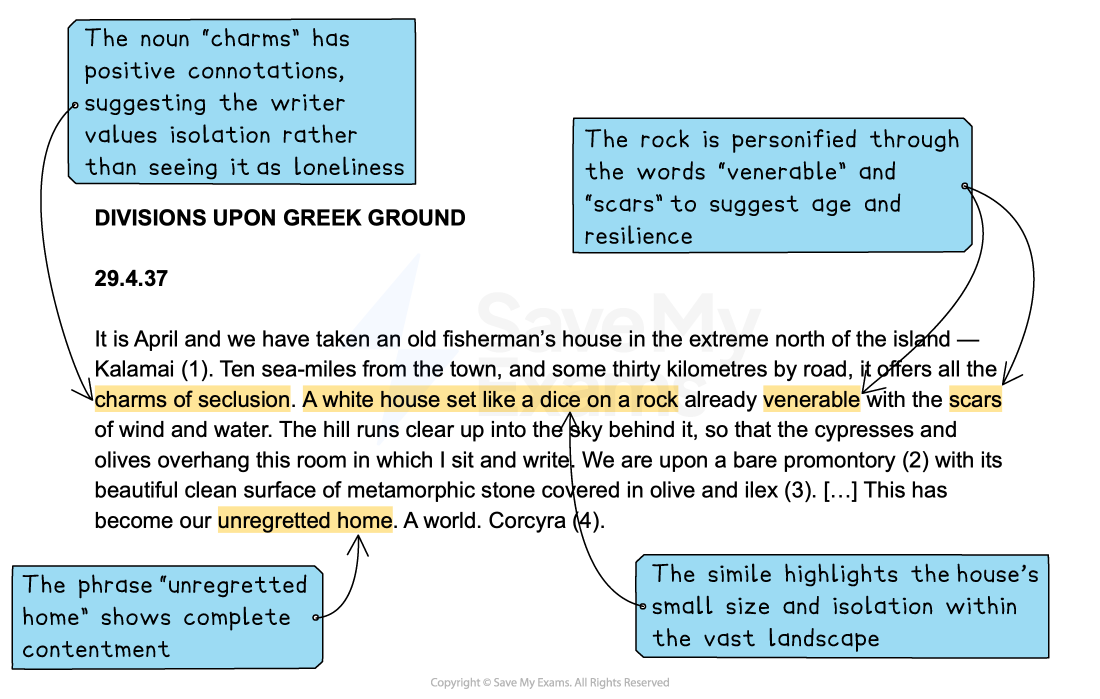
Remember that non-fiction is designed to communicate ideas clearly and effectively, so always consider the writer’s intention.
Prose Non-Fiction: Paper 1 model answer
Below is a top-mark answer for a Paper 1 question on a prose non-fiction extract. The commentary shows how it meets the assessment criteria.
Task: Write a guided analysis of the following text.
This is an extract from Prospero’s Cell, a non-fiction work by Lawrence Durrell.
DIVISIONS UPON GREEK GROUND 29.4.37 It is April and we have taken an old fisherman’s house in the extreme north of the island — Kalamai (1). Ten sea-miles from the town, and some thirty kilometres by road, it offers all the charms of seclusion. A white house set like a dice on a rock already venerable with the scars of wind and water. The hill runs clear up into the sky behind it, so that the cypresses and olives overhang this room in which I sit and write. We are upon a bare promontory (2) with its beautiful clean surface of metamorphic stone covered in olive and ilex (3). […] This has become our unregretted home. A world. Corcyra (4). 5.5.37 The books have arrived by water. Confusion, adjectives, smoke, and the deafening pumping of the wheezy Diesel engine. Then the caique (5) staggered off in the direction of St. Stephano and the Forty Saints where the crew will gorge themselves on melons and fall asleep in their coarse woollen vests, one on top of the other, like a litter of cats, under the ikon of St. Spiridion of Holy Memory. We are depending upon this daily caique for our provisions. 6.5.37 Climb to Vigla (6) in the time of cherries and look down. You will see that the island lies against the mainland roughly in the form of a sickle. On the landward side you have a great bay, noble and serene, and almost completely landlocked. Northward the tip of the sickle almost touches Albania and here the troubled blue of the Ionian is sucked harshly between the ribs of limestone and spits of sand. Kalamai fronts the Albanian foothills, and into it the water races as into a swimming-pool: a milky ferocious green when the north wind curdles it. 1. Kalamai: village on Corfu, Greece 2. promontory: a rocky ridge 3. ilex: holly 4. Corcyra: an alternative name for Corfu 5. caique: a fishing boat 6. Vigla: village on Corfu, Greece |
Question |
How does the author use descriptive language to create atmosphere? |
Model answer
At the beginning of the extract, Durrell creates a strong sense of isolation. The house is placed “in the extreme north of the island” and “ten sea-miles from the town” which shows how far away it is from civilisation. This immediately creates a feeling of seclusion. The simile “a white house set like a dice on a rock” suggests the house is small and almost randomly placed in a huge landscape, which makes it seem fragile. The contrast between the “white house” and the “scars of wind and water” shows how nature has shaped and worn down the land over time. The word “venerable” also gives the landscape a sense of importance.
Durrell also builds atmosphere through the way the speaker describes the surroundings. The phrase “the cypresses and olives overhang this room” suggests that nature is almost closing in on the house. The verb “overhang” makes it feel like the natural world is surrounding the narrator. This creates a calm but slightly overwhelming mood. The description of the “bare promontory” helps the reader picture the rough, untouched landscape and conveys how natural and wild the setting is. In contrast, the arrival of the books by sea brings noise and disruption. The list “confusion, adjectives, smoke” feels chaotic and broken up. Further, the “deafening pumping of the wheezy Diesel engine” uses sound to show the harshness of the machinery. The word “wheezy” suggests something weak and old, which contrasts with the strength of the natural world. The caique that “staggered off” is described as if it is struggling and the comparison of the crew to “a litter of cats” makes them seem small and unimportant.
The extract then moves to a wider view of the island. The instruction “Climb to Vigla” directly involves the reader and creates a sense of looking out over the landscape. The island being shaped “in the form of a sickle” is a strong image because it is clear and suggests both beauty and danger. Durrell also uses contrast when he describes “a great bay, noble and serene” alongside the “troubled blue of the Ionian”. This shows that the sea can be both calm and violent, helping to create an unpredictable atmosphere. This is made stronger by the colour imagery in “a milky ferocious green when the north wind curdles it”. The contrast between “milky” and “ferocious” shows that nature can be both gentle and aggressive at the same time. The verb “curdles” also personifies the wind, making it seem powerful and active, as if it is controlling the sea, which helps to show how nature is always changing.
Examiner commentary
Maintains a clear focus on how descriptive language creates atmosphere throughout the extract
Selects relevant quotations from across the passage to support interpretations
Analyses a range of language features, including simile, personification, imagery, sound effects and contrast
Explores how descriptions of the landscape create feelings of isolation, beauty and awe

Unlock more, it's free!
Join the 100,000+ Students that ❤️ Save My Exams
the (exam) results speak for themselves:

Was this revision note helpful?