Analysing Prose Fiction Texts (DP IB English A: Literature: HL): Revision Note

Paper 1 asks you to analyse unseen literary texts. A literary text broadly means a text that belongs to a literary form such as poetry, prose fiction, prose non-fiction or drama. While you cannot predict what type of text will appear in the exam, it is a good idea to practise analysing common literary forms so that you are familiar with typical features and conventions. One type of text you may be asked to analyse is prose fiction.
Here we will cover these aspects of analysing prose fiction:
Overview of prose fiction
Prose fiction: form and genre
Narrative techniques
How to annotate a prose fiction extract
Prose fiction: Paper 1 model answer
Overview of prose fiction
Prose fiction is a literary form that tells an imagined narrative through prose rather than verse. It uses characters, settings, events and narrative techniques to explore ideas. Unlike poetry, which often condenses meaning into relatively few words, prose fiction develops meaning through narrative progression, characterisation and description.
In order to convincingly analyse a prose fiction extract, you need to assess both what the writer is trying to convey and how the narrative techniques create meaning and shape the reader’s response.
Purpose
The purpose of a prose fiction text is the reason it was written and what it seeks to convey. To effectively identify the purpose of an extract, ask yourself:
What is the writer exploring through the narrative?
What ideas are presented?
How are readers encouraged to respond to the characters or events?
What themes or issues are being examined?
While prose fiction often focuses on individual experiences, other possible purposes include:
Exploring identity and self-discovery
Examining relationships
Presenting conflict or tension
Critiquing society or culture
Investigating memory and the past
Exploring moral dilemmas
Reflecting on universal aspects of human life
Prose fiction: form and genre
Prose fiction is a broad literary form that includes many genres and narrative traditions. A text’s form refers to its overall structure, while genre refers to a category of fiction that shares particular conventions and characteristics. Understanding a text’s form or genre can help readers recognise how a writer follows or challenges reader expectations.
Some common prose fiction forms and genres include:
Novel |
|
Short Story |
|
| |
Historical Fiction |
|
Gothic Fiction |
|
Realism |
|
Narrative techniques
Criterion B in Paper 1 assesses your ability to analyse how a text creates meaning. While many literary techniques appear across literary forms, some are particularly common in prose fiction.
Not every extract will contain all of these features, but they are useful elements to consider when annotating an unseen extract.
Narrator and narrative voice |
|
| |
Setting |
|
Imagery and description |
|
Dialogue |
|
Structure |
|
Examiner Tips and Tricks
Rather than simply identifying techniques, look for patterns. Consider how narrative voice, characterisation, language and structure work together to convey meaning. Always ask:
Why has the writer made this choice?
What effect does it have on the reader?
How to annotate a prose fiction extract
Before you write an answer to any Paper 1 question, it is important that you select the best evidence from your source text. A great way to do this is to identify the focus of the guiding question and then annotate your text with this focus in mind.
Here is an example of how you might annotate a prose fiction extract in the exam:
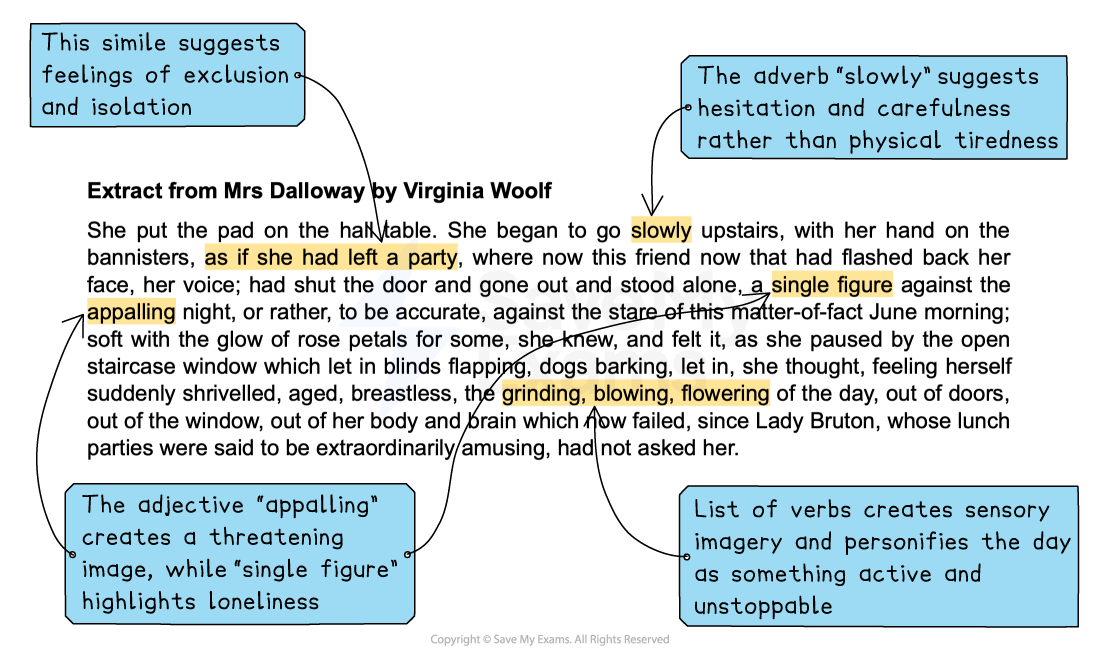
As you annotate, look for patterns rather than isolated techniques. Consider how language, characterisation, imagery, dialogue and structure work together to convey meaning. Ask yourself why the writer has made a particular choice and what effect it might have on the reader.
Prose fiction: Paper 1 model answer
Below is a top-mark answer to a Paper 1 question on a dramatic extract. We’ve included how the answer has met the assessment criteria to show exactly why it would achieve high marks.
Task: Write a guided analysis of the following text.
The following text is an extract taken from the novel Mrs Dalloway by Virginia Woolf.
“What are they looking at?” said Clarissa Dalloway to the maid who opened her door. The hall of the house was cool as a vault. Mrs. Dalloway raised her hand to her eyes, and, as the maid shut the door to, and she heard the swish of Lucy’s skirts, she felt like a nun who has left the world and feels fold round her the familiar veils and the response to old devotions. The cook whistled in the kitchen. She heard the click of the typewriter. It was her life, and, bending her head over the hall table, she bowed beneath the influence, felt blessed and purified, saying to herself, as she took the pad with the telephone message on it, how moments like this are buds on the tree of life, flowers of darkness they are, she thought (as if some lovely rose had blossomed for her eyes only); not for a moment did she believe in God; but all the more, she thought, taking up the pad, must one repay in daily life to servants, yes, to dogs and canaries, above all to Richard her husband, who was the foundation of it—of the gay sounds, of the green lights, of the cook even whistling, for Mrs. Walker was Irish and whistled all day long—one must pay back from this secret deposit of exquisite moments, she thought, lifting the pad, while Lucy stood by her, trying to explain how. “Mr. Dalloway, ma’am”— Clarissa read on the telephone pad, “Lady Bruton wishes to know if Mr. Dalloway will lunch with her to-day.” “Mr. Dalloway, ma’am, told me to tell you he would be lunching out.” “Dear!” said Clarissa, and Lucy shared as she meant her to her disappointment (but not the pang); felt the concord between them; took the hint; thought how the gentry love; gilded her own future with calm; and, taking Mrs. Dalloway’s parasol, handled it like a sacred weapon which a Goddess, having acquitted herself honourably in the field of battle, sheds, and placed it in the umbrella stand. “Fear no more,” said Clarissa. Fear no more the heat o’ the sun; for the shock of Lady Bruton asking Richard to lunch without her made the moment in which she had stood shiver, as a plant on the river-bed feels the shock of a passing oar and shivers: so she rocked: so she shivered. Millicent Bruton, whose lunch parties were said to be extraordinarily amusing, had not asked her. No vulgar jealousy could separate her from Richard. But she feared time itself, and read on Lady Bruton’s face, as if it had been a dial cut in impassive stone, the dwindling of life; how year by year her share was sliced; how little the margin that remained was capable any longer of stretching, of absorbing, as in the youthful years, the colours, salts, tones of existence, so that she filled the room she entered, and felt often as she stood hesitating one moment on the threshold of her drawing-room, an exquisite suspense, such as might stay a diver before plunging while the sea darkens and brightens beneath him, and the waves which threaten to break, but only gently split their surface, roll and conceal and encrust as they just turn over the weeds with pearl. She put the pad on the hall table. She began to go slowly upstairs, with her hand on the bannisters, as if she had left a party, where now this friend now that had flashed back her face, her voice; had shut the door and gone out and stood alone, a single figure against the appalling night, or rather, to be accurate, against the stare of this matter-of-fact June morning; soft with the glow of rose petals for some, she knew, and felt it, as she paused by the open staircase window which let in blinds flapping, dogs barking, let in, she thought, feeling herself suddenly shrivelled, aged, breastless, the grinding, blowing, flowering of the day, out of doors, out of the window, out of her body and brain which now failed, since Lady Bruton, whose lunch parties were said to be extraordinarily amusing, had not asked her. |
Question |
How does Woolf explore Clarissa’s anxieties about time and ageing in this passage? |
Model answer
In this extract, Woolf explores Clarissa’s anxieties about time and ageing by contrasting moments of happiness with sudden reminders of loss. At the beginning of the extract, Clarissa experiences a feeling of belonging: the hall is described through the simile “cool as a vault” and through the religious imagery of a “nun”, Woolf presents home life as comforting and somewhat spiritual. The reader is drawn directly into Clarissa’s thoughts through further metaphorical language, such as the “buds on the tree of life” and the “flowers of darkness”. These images suggest that Clarissa treasures private moments of happiness and sees them as precious experiences that give meaning to life. Further, the sensory details of the “gay sounds” and “green lights” create an atmosphere of fulfilment.
However, this sense of stability is disrupted by the seemingly insignificant news that Lady Bruton has invited Richard to lunch without her. Although Clarissa insists that she has “no vulgar jealousy”, she begins to experience deeper fears about her place in society and her changing identity. The parenthetical phrase “disappointment (but not the pang)” shows that Clarissa is more upset than she lets other people see. While Lucy understands that Clarissa is disappointed, she does not understand the deeper pain she feels. The word “pang” suggests a sudden feeling of hurt. This moment reveals that the invitation makes her think about her own insecurities and fears, especially about getting older and becoming less important.
Woolf uses Lady Bruton as a symbol of the passage of time as Clarissa reads on her face “the dwindling of life” and recognises that her own “share was sliced” away year after year. The verb “sliced” suggests that youth is being gradually taken from her. Further, Woolf’s long and flowing sentences reflect the way Clarissa’s thoughts move from one idea to another. Through the stream of consciousness narrative style, the reader follows her mind as it drifts from a lunch invitation to reflections on ageing and mortality. The repetition of water imagery further illustrates these fears as Clarissa compares herself to a diver about to plunge into the sea. Through the description of the sea that “darkens and brightens”, Woolf symbolises the joys and uncertainties of life. The diver is suspended which reflects Clarissa’s awareness that she is caught between her youthful past and the inevitability of ageing. At the same time, the sea suggests an unknown future that awaits her.
Towards the end of the extract, Clarissa’s anxieties increase. Standing by the window, she suddenly feels “shrivelled, aged, breastless”. The abrupt listing of adjectives contrasts sharply with the previous imagery of blossoming flowers and growth. This shift reflects how quickly her perception of herself changes after Lady Bruton’s rejection. This is also juxtaposed with the imagery outside the window, where the day is described as “grinding, blowing, flowering”. The contrast between the outside world and Clarissa’s thoughts reinforces her fear that life is continuing while she is becoming less capable of participating in it.
Examiner commentary
Maintains a clear focus on Clarissa’s anxieties about time and ageing throughout
Analyses key stylistic features, including stream of consciousness, imagery, symbolism and metaphor
Integrates relevant textual evidence to support interpretations
Links Woolf’s language and narrative methods to their effects on the reader

Unlock more, it's free!
Join the 100,000+ Students that ❤️ Save My Exams
the (exam) results speak for themselves:

Was this revision note helpful?