Guided Literary Analysis Model Answers (DP IB English A: Literature: HL): Revision Note

For your Paper 1 analytical essay on the IB Diploma Language A: Literature (HL) exam, it is important to understand how your essay is assessed and what a high-level response looks like in practice.
This section includes:
Overview
Marking criteria
Model answer
Top tips
Overview
Paper 1 is marked out of 20 and is assessed using four criteria. Each criterion focuses on a different aspect of your analytical essay.
There are four assessment criteria.
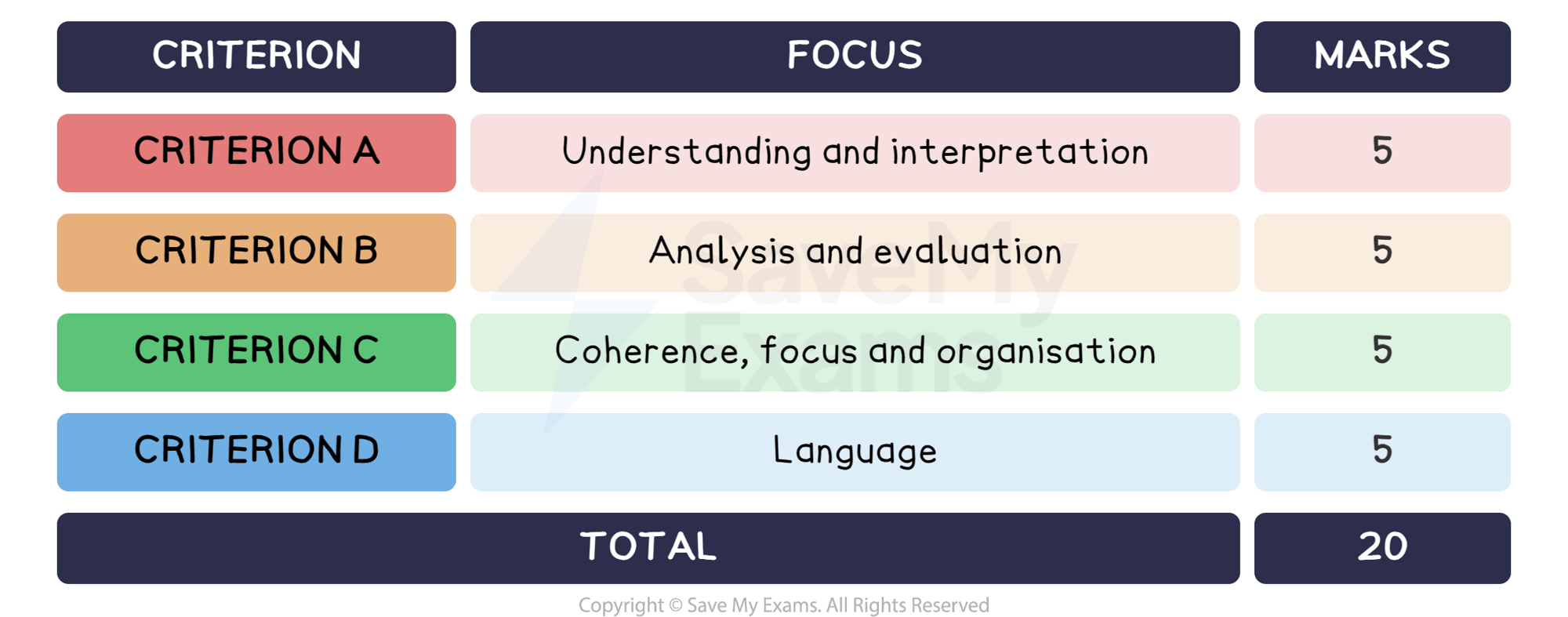
Understanding how these criteria work will help you structure your essay clearly and develop a focused argument. It is important to know the meaning of each of the terms so that you are confident that you know what the differences are between “knowing”, “understanding”, “interpreting”, “analysing” and “evaluating”. Examiners consider all elements of the descriptors when determining your mark for each criterion.
Marking criteria
Criterion A: Understanding and interpretation
To do well in Criterion A, you need to demonstrate an accurate and relevant understanding of the unseen literary text in terms of its genre, form, structure, language and themes.
Criterion A also assesses if you have supported your claims with references from the text.
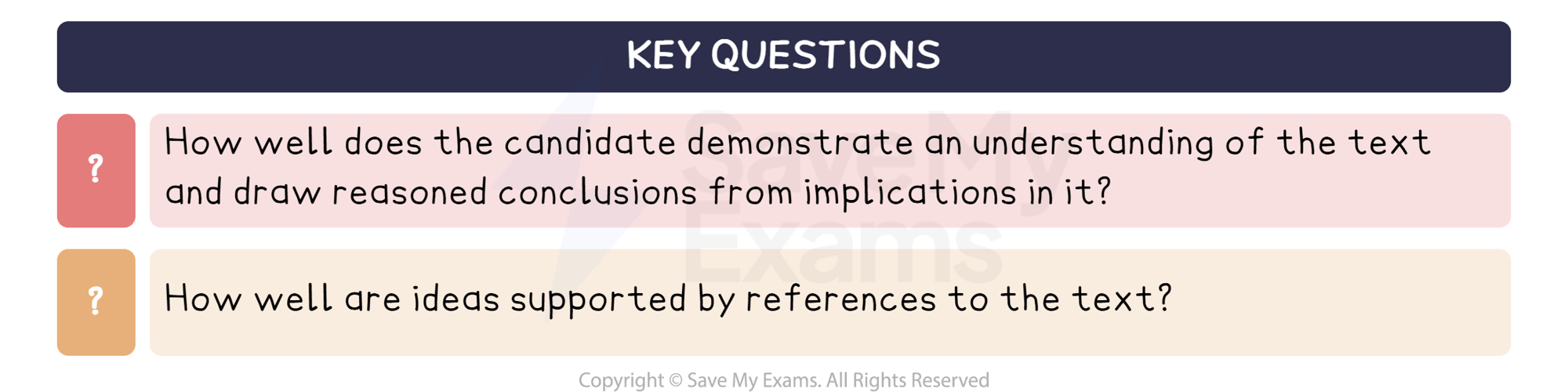
To gain top marks, you need to meet the following descriptor. The key words are highlighted in bold.
Marks | Descriptor |
5 |
|
Here are some common mistakes to avoid based on IB examiner feedback on Criterion A:
Common mistakes to avoid | |
Misunderstanding the text |
|
Making general comments without evidence |
|
Describing or summarising instead of interpreting and analysing |
|
Focusing on understanding instead of interpretation |
|
Overusing quotations |
|
Criterion B: Analysis and evaluation
To do well in Criterion B, you need to analyse how the writers construct meaning and evaluate why those choices are significant.

To gain top marks, you need to meet the following descriptor. The key words are highlighted in bold.
Marks | Descriptor |
5 |
|
Examiner Tips and Tricks
Marks are not awarded based on quantity. Therefore, simply listing textual features in your response, without any analysis, is likely to remain in the 1–2 mark bands for Criterion B. What matters most is the quality and depth of your analysis. Stronger responses go beyond summarising and provide an in-depth evaluation of how effectively the features have an effect on the audience and/or allow the writer to achieve their purpose.
Here are some common mistakes to avoid based on IB examiner feedback on Criterion B:
Common mistakes to avoid | |
Identifying techniques without analysing them |
|
Ignoring some important authorial choices |
|
Not including evaluation |
|
Criterion C: Focus and organisation
To do well in Criterion C, you need to present a focused and coherent argument that consistently remains focused on the question while also maintaining a balance between both texts. “Focus” and “coherence” are key.

To gain top marks, you need to meet the following descriptor. The key words are highlighted in bold.
Marks | Descriptor |
5 |
|
Here are some common mistakes to avoid based on IB examiner feedback on Criterion C:
Common mistakes to avoid | |
Losing focus on the text and/or guiding question |
|
Lack of a clear argument |
|
Over-reliance on memorised formats |
|
Criterion D: Language
To do well in Criterion D, you need to use accurate and formal language to support your argument and communicate your ideas effectively.
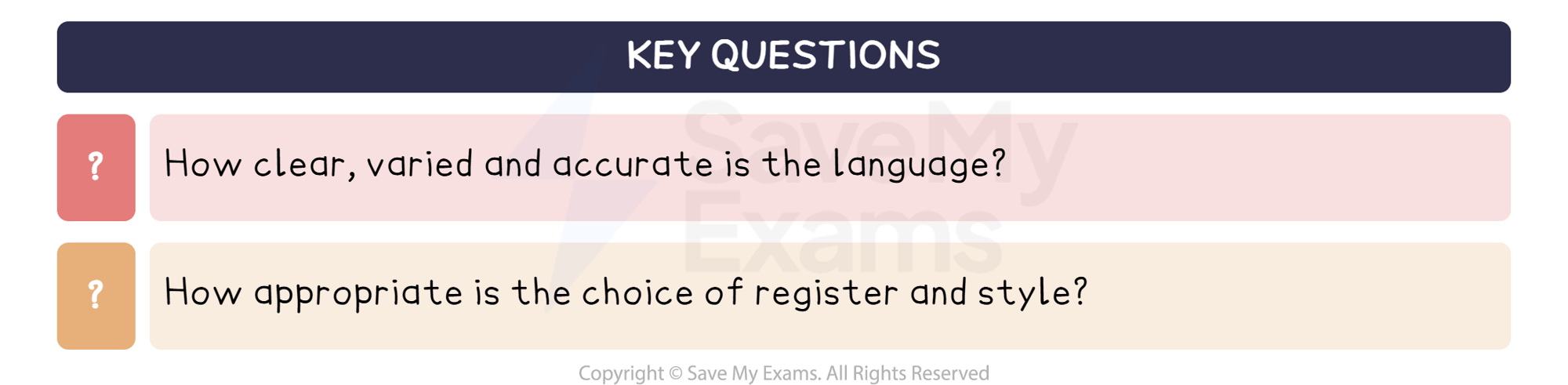
To gain top marks, you need to meet the following descriptor. The key words are highlighted in bold.
Marks | Descriptor |
5 |
|
Here are some common mistakes to avoid based on IB examiner feedback on Criterion D:
Common mistakes to avoid | |
Using an informal or inappropriate register |
|
Unclear or awkward expression |
|
Frequent grammar and syntax errors |
|
Lack of sentence variety |
|
Model answers
We will now explore how you can create a convincing and insightful analysis using an example of a question from a sample Paper 1 (opens in a new tab). Read through the question below:
Exam question |
How is the relationship between the two characters established in this extract? |
Here is a model paragraph using an extract from Alan Ayckbourn’s play Absent Friends.
Diana and Evelyn’s relationship in this extract from Absent Friends is established as socially polite but distant. This underlying tension is suggested through dialogue, stage directions and the controlled use of humour. Ayckbourn uses the carefully described setting of a “modern executive-style house” filled with “wrought iron” and “frosted glass” to reflect the lack of warmth between the two women.The setting is described as affluent (“it all cost a great deal of money”) but also quite cold and empty, which suggests that the relationship between Diana and Evelyn takes place on a superficial level, rather than representing real closeness. This idea is reinforced through their dialogue. Diana speaks in longer, more polite and conversational sentences, while Evelyn replies with monosyllabic statements like “Yes” and “He’s all right”. This juxtaposition shows that Diana is trying to keep the conversation going and build a connection, whereas Evelyn seems distant and uninterested. As Evelyn does not give much detail in her responses, it makes the conversation feel awkward and one-sided. Ayckbourn also develops their relationship through how they talk about their husbands. Diana complains about Paul’s obsession with “squash”, repeating the word “Squash, squash, squash” which makes her sound slightly frustrated, even though she presents it in a humorous way. This hints there may be tension in her marriage. In contrast, Evelyn gives very little information about John, saying only “He doesn’t play anything” which shows she does not engage much in personal discussion. The humour in Diana’s speech, especially when she talks about her father, makes the conversation feel light on the surface, but it also highlights how uncomfortable and unnatural their interaction really is. Even Evelyn’s actions, such as chewing and singing to herself, suggest she is not fully engaged in the conversation, which further adds to the distance between the two women. |
Examiner Tips and Tricks
Focus on developing your ability to think critically about a range of text types and contexts. You cannot predict what text type will come up in your exam, so instead of trying to learn formulaic responses and lists of features, practise, practise, practise by reading and analysing regularly.
Top tips
Maintain a clear focus on the text under analysis and the guiding question
Understand different text types and their norms
Use precise literary terminology
You are expected to interpret, analyse and evaluate:
Do not describe or summarise

Unlock more, it's free!
Join the 100,000+ Students that ❤️ Save My Exams
the (exam) results speak for themselves:

Was this revision note helpful?