Analysing Poetry Texts (DP IB English A: Literature: HL): Revision Note

Paper 1 asks you to analyse unseen literary texts. A literary text broadly means a text that belongs to a literary form such as poetry, prose fiction, prose non-fiction or drama. While you cannot predict what type of text will come up in the exam, it is a good idea to practise analysing common literary forms so that you are familiar with typical features and conventions of a variety of texts. One type of text you may be asked to analyse is poetry.
Here we will cover these aspects of analysing poetry:
Overview of poetry
Poetry: form and genre
Poetic techniques
How to annotate a poem
Poetry: Paper 1 model answer
Overview of poetry
Poetry is a literary form that uses carefully crafted language to communicate ideas. Poems encourage readers to engage with language in a deeper way by creating layers of meaning through imagery, symbolism, sound and structure.
In order to convincingly analyse a poem, you need to be able to assess what the poet is trying to convey and how they achieve this.
Purpose
The purpose of a poem is the reason it was written and what it seeks to convey. To effectively identify the purpose of a poem, ask yourself:
What is the poet trying to explore?
What is the poet trying to make the reader think, feel or reflect upon?
What ideas, emotions or experiences are being presented?
While poems often explore personal experiences and emotions, other possible purposes to consider include:
Reflecting on identity
Exploring memory
Examining relationships
Celebrating people or places
Challenging assumptions or beliefs
Critiquing society or culture
Exploring universal human experiences
Poetry: form and genre
Poetry is a broad literary form that contains many different genres and traditions. A poem’s form refers to its overall structure and organisation, while genre refers to poetry that shares particular characteristics and conventions. Understanding a poem’s form or genre can help readers recognise how a poet is using or challenging established conventions.
Some common poetic forms and genres include:
| |
| |
| |
| |
|
Poets may choose a particular form because it suits the ideas they wish to explore. In some cases, poets deliberately follow traditional conventions, while in others they may adapt or subvert them to create particular effects. Contemporary poetry often experiments with form and genre and some poems may combine elements from different traditions.
Poetic techniques
Criterion B in Paper 1 assesses your ability to analyse how a text creates meaning. While many literary features can be found across literary forms, some are particularly common in poetry. Here, we will examine some poetic techniques that are frequently found in poems. Not all of these stylistic features are found in all poems, but it is a good idea to look out for them as you begin to annotate and analyse poetry.
Speaker
|
|
Imagery
|
|
|
|
Tone |
|
Sound devices
|
|
Structure | |
Contrast and juxtaposition |
|
How to annotate a poem
Before you write an answer to any Paper 1 question, it is important that you select the best evidence from your source text. A great way to do this is to identify the focus of the guiding question and then annotate your text with this focus in mind.
Here is an example of how you might annotate a poem in the exam:
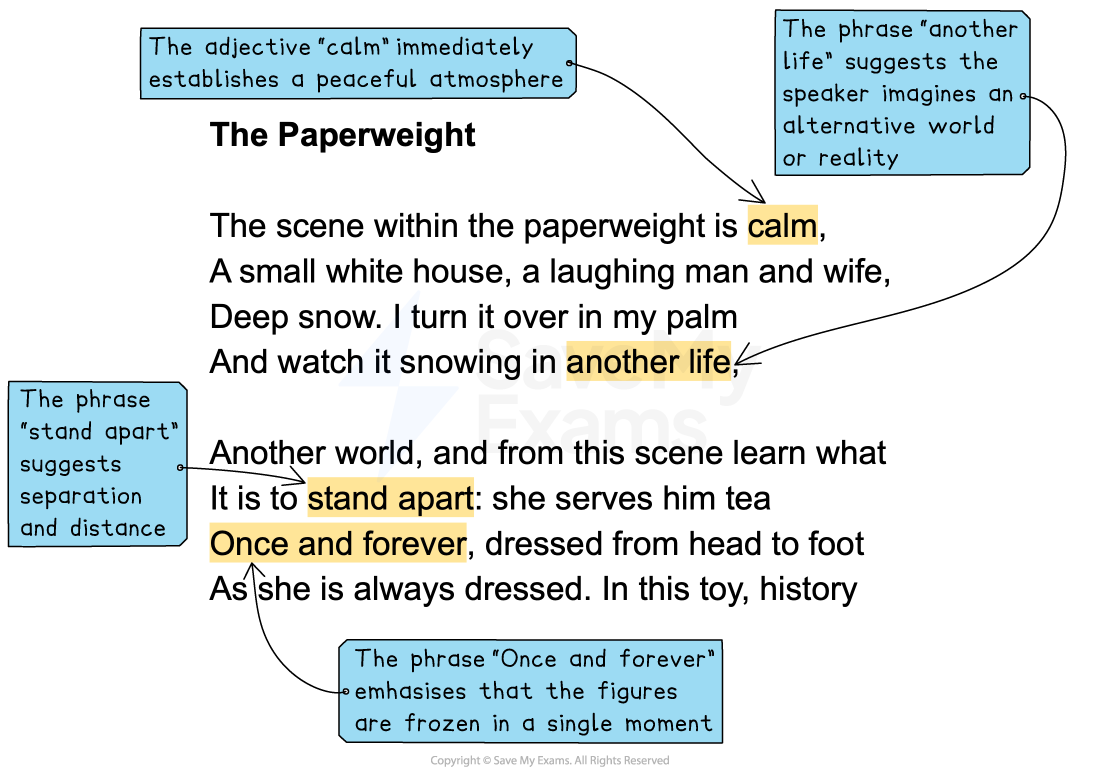
As you annotate, look for patterns rather than isolated techniques. Consider how language, imagery, tone and structure work together to convey meaning. Ask yourself why the poet has made a particular choice and what effect it might have on the reader.
Poetry: Paper 1 model answer
Below is a top-mark answer to the following Paper 1 question on a poem. We’ve included how the answer has hit the assessment criteria to show you exactly why it would achieve full marks.
Task: Write a guided analysis of the following text.
The following text is a poem written by Gjertrud Schnackenberg and published in the collection The Zoo of the New.
The Paperweight*
The scene within the paperweight is calm, A small white house, a laughing man and wife, Deep snow. I turn it over in my palm And watch it snowing in another life,
Another world, and from this scene learn what It is to stand apart: she serves him tea Once and forever, dressed from head to foot As she is always dressed. In this toy, history
Sifts down through the glass like snow, and we Wonder if her single deed tells much Or little of the way she loves, and whether he Sees shadows in the sky. Beyond our touch,
Beyond our lives, they laugh, and drink their tea. We look at them just as the winter night With its vast empty spaces bends to see Our isolated little world of light,
Covered with snow, and snow in clouds above it, And drifts and swirls too deep to understand. Still, I must try to think a little of it, With so much winter in my head and hand.
*Paperweight: a heavy, ornamental object used to hold loose papers down |
Question |
How, and to what effect, are perspectives considered in this poem? |
Model answer
In The Paperweight, Gjertrud Schnackenberg explores multiple perspectives through the image of a miniature snow-covered world enclosed within a paperweight. By shifting between the observer’s viewpoint and the imagined lives of the figures inside the globe, the poet encourages readers to consider the limitations of perception and the difficulty of understanding others.
The poem opens with a peaceful perspective. The scene inside the paperweight is described as “calm” containing “A small white house, a laughing man and wife”. These positive images create an impression of harmony. However, the speaker is immediately positioned as an observer looking into “another life” and “Another world”. The paperweight therefore becomes a symbol of separation between the observer and the observed and although the speaker can see the scene, they cannot fully understand it. This sense of distance is reinforced through the poem’s structure and use of enjambment. The transition between the first and second stanzas suggests that the paperweight contains a reality of its own. The continuous movement across line breaks reflects the speaker’s attempt to move beyond the boundaries of the object and imagine the lives within it. At the same time, the phrase “learn what/It is to stand apart” highlights the gap between their perspectives as the speaker can only speculate about the couple’s relationship.
As the poem develops, the figures inside the paperweight become increasingly human. Initially described as a generic “man and wife” they later become “she” and “he”. This shift personalises them and illustrates the speaker’s growing interest in them. However, the speaker’s perspective is uncertain and they wonder whether the woman’s act of serving tea reveals “much/Or little of the way she loves”. Similarly, the possibility that he “Sees shadows in the sky” introduces a more ominous tone.
In the final stanzas, the speaker’s perspective broadens beyond the paperweight itself. The comparison between the observers looking at the globe and the “winter night” bending to see “Our isolated little world of light” creates a striking parallel. In the same way that the speaker observes the miniature world, a larger force may be observing humanity. This shift encourages readers to recognise the fragility of existence. This is echoed in the final line, “so much winter in my head and hand” which reveals the speaker’s connection to the object and its significance, as they seem to perhaps contemplate their own life.
Examiner commentary
Maintains a clear focus on perspectives throughout the response
Establishes a strong central argument and develops it consistently
Analyses literary techniques such as symbolism, imagery, structure and enjambment
Explains the effect of poetic techniques on the reader

Unlock more, it's free!
Join the 100,000+ Students that ❤️ Save My Exams
the (exam) results speak for themselves:

Was this revision note helpful?