Analysing Drama Texts (DP IB English A: Literature: HL): Revision Note

Paper 1 asks you to analyse unseen literary texts. A literary text broadly means a text that belongs to a literary form such as poetry, prose fiction, prose non-fiction or drama. While you cannot predict what type of text will come up in the exam, it is a good idea to practise analysing common literary forms so that you are familiar with typical features and conventions of a variety of texts. One type of text you may be asked to analyse is drama.
Here we will cover these aspects of analysing drama:
Overview of drama
Drama: form and genre
Dramatic techniques
How to annotate a drama extract
Drama: Paper 1 model answer
Overview of drama
Drama is a literary form written to be performed. Unlike other literary forms, dramatic texts create meaning through dialogue, action, character interactions, staging and performance choices. A dramatic text may convey ideas through what characters say, how they behave and how the playwright structures events on stage.
In order to convincingly analyse a dramatic text, you need to assess what the playwright is trying to convey and how dramatic techniques help communicate these ideas to an audience.
Purpose
The purpose of a dramatic text is the reason it was written and what it seeks to communicate. To effectively identify the purpose of a dramatic extract, ask yourself:
What is the playwright trying to explore?
What is the audience encouraged to think or reflect upon?
What ideas are being presented?
What message or perspective emerges through the action on stage?
While drama often explores human relationships and conflict, other possible purposes include:
Exploring identity
Examining power and authority
Presenting social or political issues
Critiquing cultural values
Exploring family dynamics
Challenging assumptions and beliefs
Investigating moral dilemmas
Reflecting on universal human experiences
Drama: form and genre
Drama is a broad literary form that contains many different genres and traditions. A play’s form refers to its overall structure and organisation, while genre refers to plays that share particular characteristics and conventions. Understanding a play’s form or genre can help readers recognise how a playwright is using or challenging established dramatic conventions.
Some common dramatic forms and genres include:
Tragedy |
|
Comedy |
|
Tragicomedy |
|
Realist drama |
|
Absurdist drama |
|
Political drama |
|
Playwrights may choose a particular form because it suits the ideas they wish to explore. In some cases, playwrights follow established conventions, while in others they deliberately challenge or subvert them. Contemporary drama often combines elements from different dramatic traditions.
Dramatic techniques
Criterion B in Paper 1 assesses your ability to analyse how a text creates meaning. While many literary features can be found across literary forms, some are particularly common in drama. Here, we will examine dramatic techniques that are frequently found in dramatic texts.
| |
Dialogue |
|
Stage directions |
|
Conflict |
|
| |
Structure |
|
Examiner Tips and Tricks
Dialogue is one of the most important ways playwrights create meaning. When analysing a dramatic extract, look beyond what characters say and consider how they say it.
Focus on:
Interruptions
Questions
Pauses and silences
Differences in language between characters
How to annotate a dramatic extract
Before you write an answer to any Paper 1 question, it is important that you select the best evidence from your source text. A great way to do this is to identify the focus of the guiding question and annotate your extract with this focus in mind.
Here is an example of how you might annotate a drama extract in the exam:
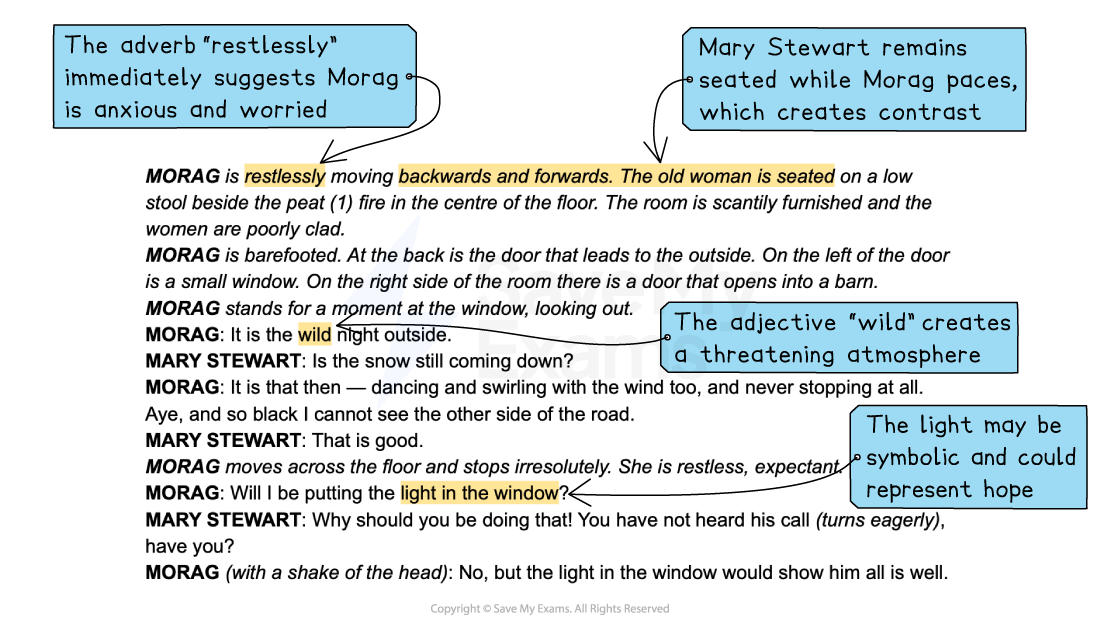
As you annotate, look for patterns rather than isolated techniques. Consider how dialogue, characterisation, stage directions, conflict and structure work together to create meaning.
Ask yourself:
What is happening on stage?
What does the audience learn from this moment?
How do dramatic techniques shape the audience’s response?
Why has the playwright made these choices?
Remember that drama is intended for performance, so always consider the effect on an audience.
Drama: Paper 1 model answer
Below is a top-mark answer to a Paper 1 question on a dramatic extract. We’ve included how the answer has met the assessment criteria to show exactly why it would achieve high marks.
Task: Write a guided analysis of the following text.
The following extract is the opening of a one-act play Campbell of Kilmohr by J.A. Ferguson. It is set in a poor cottage in 18th-century Scotland, where the two women are waiting for the older one’s son who is a rebel on the run.
MORAG is restlessly moving backwards and forwards. The old woman is seated on a low stool beside the peat (1) fire in the centre of the floor. The room is scantily furnished and the women are poorly clad. MORAG is barefooted. At the back is the door that leads to the outside. On the left of the door is a small window. On the right side of the room there is a door that opens into a barn. MORAG stands for a moment at the window, looking out. MORAG: It is the wild night outside. MARY STEWART: Is the snow still coming down? MORAG: It is that then — dancing and swirling with the wind too, and never stopping at all. Aye, and so black I cannot see the other side of the road. MARY STEWART: That is good. MORAG moves across the floor and stops irresolutely. She is restless, expectant. MORAG: Will I be putting the light in the window? MARY STEWART: Why should you be doing that! You have not heard his call (turns eagerly), have you? MORAG (with a shake of the head): No, but the light in the window would show him all is well. MARY STEWART: It would not then! The light was to be put there after we had heard the signal. MORAG: But on a night like this he may have been calling for long, and we never heard him. MARY STEWART: Do not be so anxious, Morag. Keep to what he says. Put more peat on the fire now and sit down. MORAG (with increasing excitement): I canna (2), I canna! There is that in me that tells me something is going to befall us this night. Oh, that wind, hear to it, sobbing round the house as if it brought some poor lost soul up to the door, and we refusing it shelter. MARY STEWART: Do not be fretting yourself like that. Do as I bid you. Put more peats on the fire. MORAG (at the wicker peat-basket): Never since I… What was that? (Both listen for a moment.) MARY STEWART: It was just the wind; it is rising more. A sore night for them that are out in the heather. MORAG puts peat on the fire. 1. peat: turf used as fuel 2. canna: cannot (Scottish dialect) |
Question |
In what ways does the relationship between the two women help to create the mood of this opening to the play? |
Model answer
In this opening extract from Campbell of Kilmohr, Ferguson uses the relationship between Morag and Mary Stewart to create a mood of tension and anticipation.
As an opening to a play, the scene immediately creates a secretive and dangerous tone. The audience learns that the women are waiting for “the older one’s son who is a rebel on the run”, suggesting that they are involved in something forbidden and potentially dangerous. The stage directions reinforce this atmosphere since the cottage is described as “scantily furnished” and the women are “poorly clad” and Morag is “barefooted”. These directions suggest hardship and vulnerability which creates sympathy for the characters. It also conveys their isolation. The audience is therefore introduced to a setting where uncertainty and danger already seem to be present.
The relationship between the two women is central to the mood of the scene because they respond very differently to their circumstances. Morag is presented as anxious, whereas Mary Stewart appears calm and practical and this contrast creates dramatic tension. In Morag’s first dialogue she states, “It is the wild night outside” which immediately focuses attention on the threatening weather. Her description of the snow “dancing and swirling with the wind” personifies the storm and makes it seem uncontrollable. In contrast, Mary Stewart’s response, “That is good”, is surprisingly calm. Her response suggests that she sees the weather as protection for the rebel rather than a threat. Morag repeatedly focuses on the darkness and violence of the storm, describing it as “so black I cannot see the other side of the road”. The darkness symbolises uncertainty and danger, mirroring her fears about what may happen. She imagines the wind “sobbing round the house as if it brought some poor lost soul up to the door”. The personification of the wind as a grieving figure creates a haunting atmosphere and suggests that Morag fears something tragic may happen. Through this imagery, Ferguson allows the audience to experience Morag’s fears while also building a foreboding mood.
The interactions between the women further reveal their relationship and contribute to the mood of anticipation. Mary Stewart repeatedly attempts to control Morag through her commanding dialogue: “Do not be so anxious, Morag” and “Do as I bid you”. Morag, however, struggles to follow her orders as evidenced through her repetitive dialogue: “I canna, I canna!” which reveals her panic. Similarly, much of the dialogue focuses on whether the signal has been heard and whether the light should be placed in the window. The discussion of these secret arrangements reinforces the atmosphere of danger and secrecy and the audience is encouraged to anticipate the arrival of the son while also fearing what might happen to him.
Examiner commentary
Maintains a clear focus on the relationship between the women throughout
Analyses dramatic techniques (stage directions, dialogue, contrast, imperatives, repetition)
Explains the effect on the audience
Links individual dramatic techniques back to the development of mood rather than simply identifying features

Unlock more, it's free!
Join the 100,000+ Students that ❤️ Save My Exams
the (exam) results speak for themselves:

Was this revision note helpful?