Structuring the HL Essay (DP IB English A: Literature: HL): Revision Note

This section is designed to help you understand how to structure your response for the IB English A: Literature HL Essay. A strong structure ensures your argument develops logically so that your analysis remains focused on your line of inquiry throughout.
It consists of:
Planning your HL Essay
Writing an effective introduction
Analytical writing framework
Constructing analytical paragraphs
Writing a clear conclusion
Planning your HL Essay
As you begin planning your HL Essay, you should consider what type of approach your line of inquiry requires. Some questions may require you to refer to sources or conduct some research and this will influence how you organise your time and focus your preparation.
Strong lines of inquiry often explore what texts reveal about the context in which they were produced. If your essay focuses on context, you may need to research areas such as the:
Historical period in which the text was created
The author’s background
Social or cultural context surrounding the text
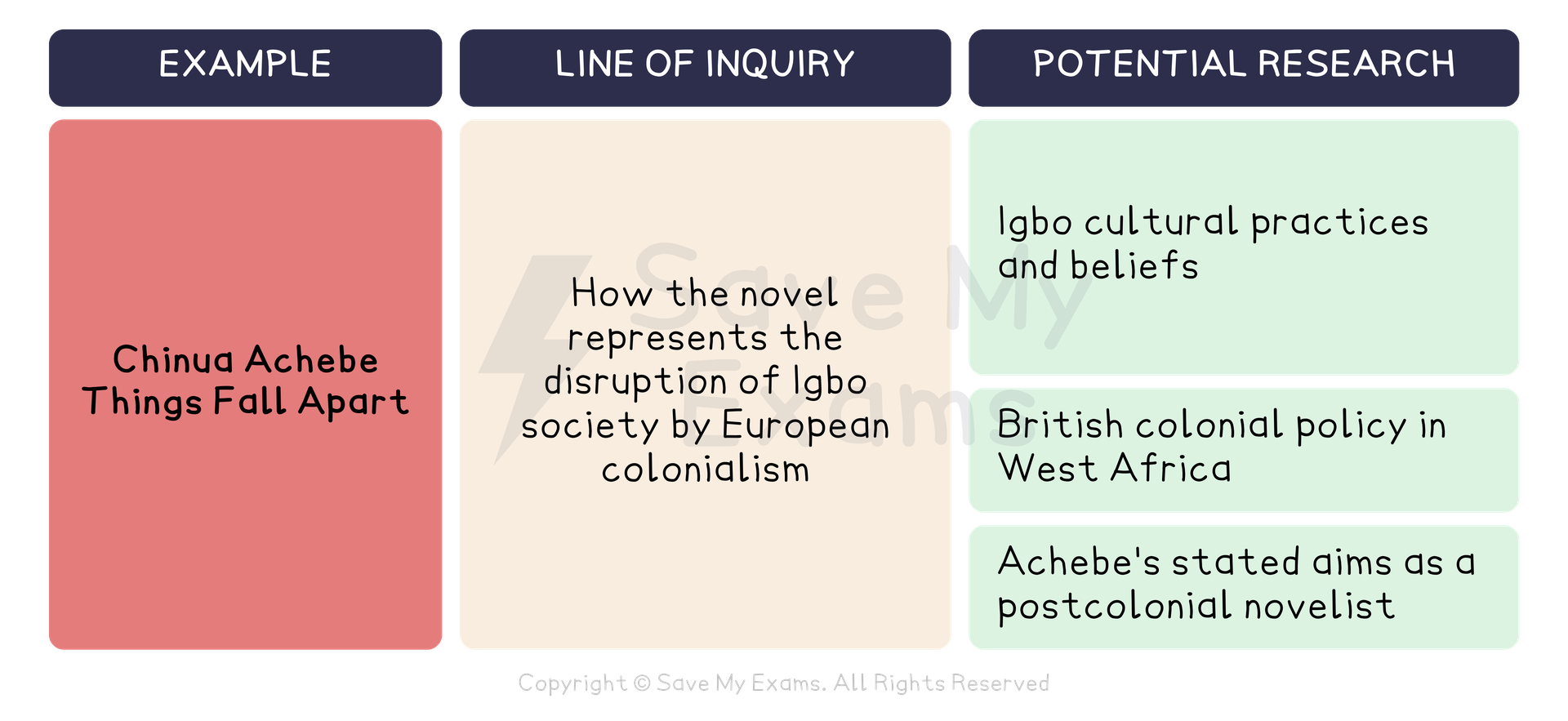
You may also need to complete some research if your line of inquiry focuses on intertextual analysis. In this case you may need to research:
Other texts being referenced
The conventions of a particular genre or narrative form
Examiner Tips and Tricks
Remember, research is not a formal requirement of the HL Essay. Many essays can rely entirely on close analysis of the text itself.
When planning and writing your HL Essay, it is useful to keep the assessment criteria in mind. In particular, Criterion C: focus, organisation and development, as this rewards essays that are clearly structured and logically organised. To achieve the highest band in this criterion, your essay must be effectively organised and cohesive. As each line of inquiry is different, the most effective structure will vary.
Writing an effective introduction
A strong introduction signals to the examiner that you have a clear and purposeful argument and it should clearly establish the direction of your essay. It should present your line of inquiry, introduce the text and give a focused thesis that will guide the development of your analysis.
Your introduction should:
Clearly introduce the text or work
Establish the central focus of your line of inquiry
Present a clear thesis
Identify the authorial choices you will analyse
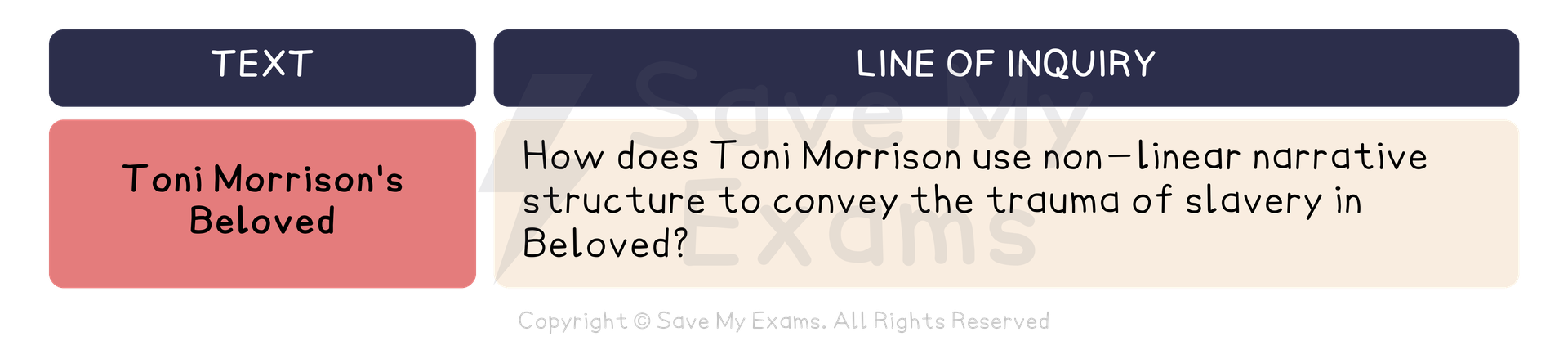
Example |
Toni Morrison's Beloved tells the story of a trauma that resists chronological telling. Rather than narrate Sethe's history in sequence, Morrison fractures and re-orders the novel's timeline: events are withheld, returned to, and presented through different characters' perspectives. From the disorienting opening at 124 Bluestone Road, through the deferred revelation of Sethe's killing of her daughter, to the repeated idea of “rememories” that destabilise past and present, Morrison's non-linear structure does not simply describe the trauma of slavery — it mirrors it, asking the reader to experience disorientation and partial knowledge alongside the characters. |
Examiner Tips and Tricks
Success in your HL Essay depends on three key elements:
A carefully chosen text
A sharply defined line of inquiry
Consistent focus on authorial choices
Analytical writing framework
When analysing your text or work, it is important to explain how specific authorial choices shape meaning. Using this sentence structure can help you to understand the link between techniques and the writer’s ideas.

Author | Verb phrase | Technique | Purpose | Idea |
Tennessee Williams | uses | stage directions | to emphasise | the fragility of Blanche’s identity |
Marjane Satrapi | employs | visual contrast | to explore | childhood innocence during political upheaval |
Toni Morrison | disrupts | chronological narrative | to convey | the lasting trauma of slavery |
George Orwell | develops | narrative perspective | to illustrate | the abuse of political power |
This framework is useful as it ensures your analysis is always focused on meaning rather than just identifying techniques. Each point in your essay should show a clear link between what the writer does and what it reveals about ideas, characters or themes, etc.
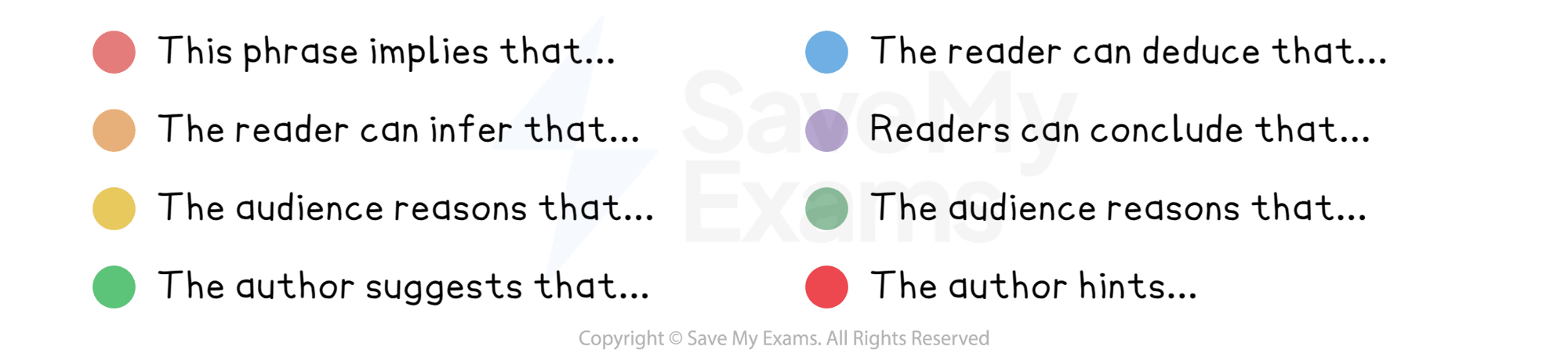
Try using some of these phrases to develop your analysis further:
Examiner Tips and Tricks
Remember that this is a literature course, not global politics or sociology. Your focus must be on the themes and ideas of the text, followed by an analysis of authorial choices, not a discussion of your political opinions.
Constructing analytical paragraphs
Each paragraph of your essay should develop a specific aspect of your argument through close analysis of authorial choices. A strong essay remains securely focused on its line of inquiry throughout. This ensures your argument remains precise and sustained.
Each paragraph should:
Begin with a clear topic sentence linked directly to your thesis
Focus on a specific authorial choice
Include selected textual evidence
Analyse how that evidence constructs meaning
Link back to your line of inquiry

Examiner Tips and Tricks
Your line of inquiry must drive your analysis; it should not be formulated in a way which suggests a descriptive or narrative approach. If your line of inquiry predominantly focuses on an approach that is more contextual, historical, political, philosophical or sociological it will limit your ability to do well.
Here is an outline showing how you can structure your paragraphs so that your ideas are logical and integrated throughout your essay. It uses the novel Beloved by Toni Morrison as an example.
Paragraph topic | Example | Authorial choices |
A disorienting opening to the novel | The opening: “124 was spiteful” |
|
Withholding of central plot points | The gradual revelation of Sethe's killing of Beloved |
|
Rememory and repeated ideas | Sethe's explanation of “rememory” to Denver |
|
Establishment of community in the climax | The thirty women's collective voices on the porch |
|
Here is an example of how you might use one of these points to write a paragraph.
Example |
Morrison's non-linear structure is established before the novel has properly begun. The opening line — “124 was spiteful. Full of a baby's venom” — plunges the reader directly into a present state of haunting without preamble. The numerical address “124” is used as a proper noun, withholding the more familiar “house at 124 Bluestone Road” until much later; the result is that the reader is positioned as someone arriving in the middle of an already-disturbed history, with no orienting context. The two short sentences refuse to provide the background information a conventional opening would supply. Morrison's grammar is unsettling too: “was spiteful” suggests something completed, but the second sentence has no verb at all, which leaves the spite feeling ongoing rather than in the past. From the very first lines, then, the novel resists a straightforward sense of time. The reader, like the characters, will have to piece Sethe's story together from moments that arrive out of order. |
Examiner Tips and Tricks
Connecting ideas between sentences and paragraphs plays an important role in maintaining clarity throughout your essay. Use effective transitions to help guide the examiner through your argument. For example, words and phrases such as “similarly”, “in contrast” and “however” can help indicate how one point relates to the next.
Writing a purposeful conclusion
Rather than repeating your introduction, your conclusion should synthesise your ideas and indicate the broader significance of your analysis.
Your conclusion should:
Reinforce your line of inquiry
Draw together your key interpretations
Example |
Morrison's non-linear structure does more than represent the trauma of slavery; it enacts it. By fracturing chronology, withholding key events, and looping back through “rememory”, the novel asks readers to inhabit the same disorienting experience as its characters. The convergence of voices in the final scenes does not resolve the story so much as gesture towards a collective form of bearing witness. By telling its story out of order, Beloved makes the form of the novel part of its message: this is a past that resists easy telling, but one that Morrison insists we must keep returning to. |
Remember, your line of inquiry should be explicitly stated in the essay in your introduction, consistently developed throughout the main body of your essay and effectively addressed again in your conclusion.
To achieve the highest bands in your HL Essay, your essay should demonstrate:
A clear conceptual argument running through every paragraph
Continuous focus on authorial choices
A developed understanding of how techniques create meaning
A sustained critical voice
Examiner Tips and Tricks
Any form of essay structure will be rewarded if it is effective and coherent, i.e., if ideas are logically organised. Different approaches (including linear, topical, thematic, stylistic, holistic, circular) are acceptable and will be given credit.
However, do not include sub-headings in your essay as this is not appropriate for a formal academic essay.

Unlock more, it's free!
Join the 100,000+ Students that ❤️ Save My Exams
the (exam) results speak for themselves:

Was this revision note helpful?