Structuring the Individual Oral (DP IB English A: Literature: HL): Revision Note

This section is designed to help you understand how to structure your Individual Oral as part of your IB Diploma English A: Literature (HL) course. It consists of:
Structuring the Individual Oral: an overview
Introduction
Main body text: analysing your extracts
Conclusion
Structuring the Individual Oral: an overview
There are many ways to organise and structure your Individual Oral. It is helpful to structure your presentation in a similar way to an essay:

As you need to discuss two texts during your presentation, you have different ways that you can approach this. You may choose to:
Analyse each text separately
Compare and/or contrast the texts
Here are some possible approaches:
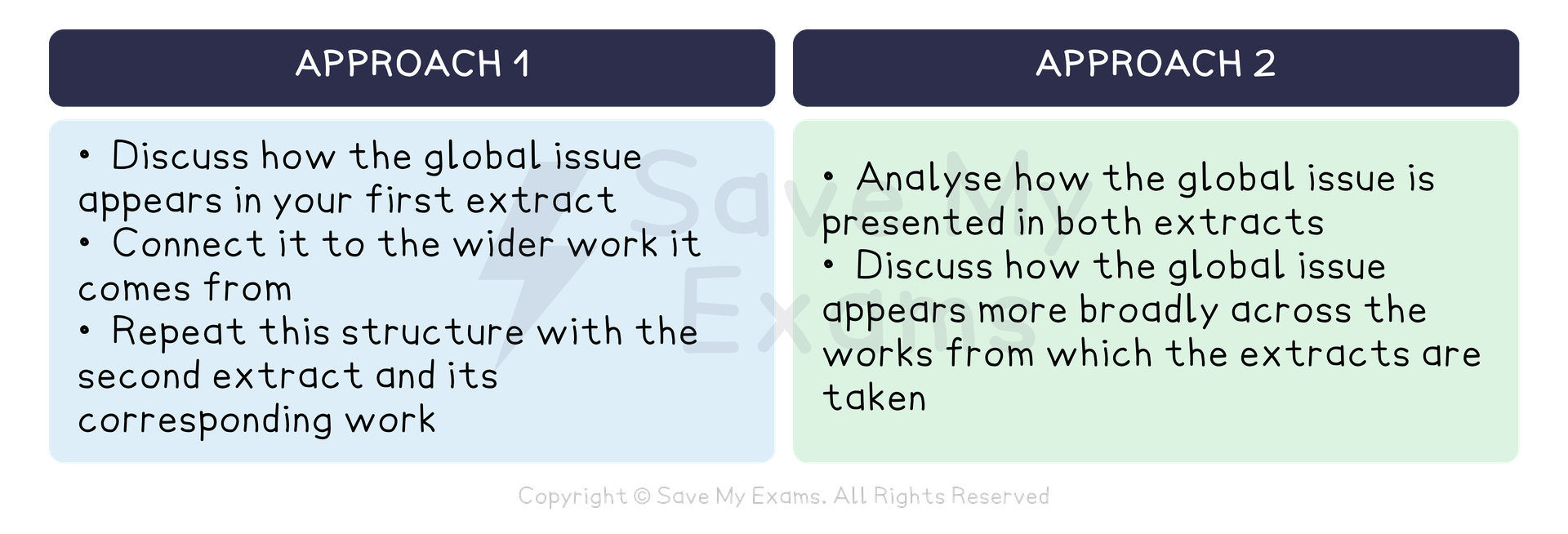
Whichever structure you choose for your Individual Oral, make sure that you:
Spend an equal amount of time discussing each text
Balance your analysis by spending time exploring how the global issue is presented in each extract and how it appears more broadly across the whole work
Examiner Tips and Tricks
Remember, comparison is not a required part of your Individual Oral. You will not lose marks if you choose not to compare your texts and you will not gain extra marks simply for including a comparison.
A key part of the Individual Oral is showing the connection between the extract and the work as a whole that it comes from. This connection is important as it is assessed in Criteria A and B so it should be clearly explored in your presentation.
Explain how the extract connects to the wider ideas, themes or techniques in the wider text or work. Showing this relationship helps demonstrate a deeper understanding of the text and how the global issue is developed throughout it.
Examiner Tips and Tricks
A key requirement of the assessment criteria is that you must make a clear connection between the extract and the larger text. If you cannot clearly establish a connection, you should choose a different text for your Individual Oral.
Zoom in (extract) | Zoom out (whole text) | Compare through the Global Issue |
Here is one possible way to structure your presentation.
Section | Approx. timing | What to include |
Introduction | 1 minute |
|
Extract analysis: Text 1 | 2 minutes |
|
Whole text discussion: Text 1 | 2 minutes |
|
Extract analysis: Text 2 | 2 minutes |
|
Whole text discussion: Text 2 | 2 minutes |
|
Conclusion | 1 minute |
|
Introduction
You should begin your analysis of each extract with a brief introduction that identifies your chosen global issue and explains how it is relevant to the extract. You may decide to introduce the global issue first and then link it to the extract or you may decide to begin with the extract and then highlight the global issue it connects to.
While your introduction should demonstrate your knowledge of both texts, the majority of your presentation should focus on your analysis.
Example |
The first text I have selected is the opening of George Orwell’s 1984, a dystopian novel published in 1949. Orwell wrote the novel in the immediate aftermath of the Second World War, drawing on the rise of totalitarianism in Stalinist Russia and Nazi Germany. The novel explores the global issue of surveillance and state control and how political regimes use ideology and constant observation to suppress individual freedom, thought and identity. |
Identifies the extract
Provides brief overview of its context
Global issue is clearly stated
Zooms in on how the work presents the global issue
Main body text: analysing your extracts
The main section of your Individual Oral is where you should develop a detailed analysis of each extract in relation to your chosen global issue.
Examiner Tips and Tricks
Avoid focusing too heavily on historical, biographical or cultural contexts if it does not link directly to how the global issue is presented in your texts. Although context can be useful, your analysis should primarily focus on the content and form of the extracts and how they
During this part of the oral, you should demonstrate a clear understanding of how the creator’s choices convey the global issue (Criterion B). As you will have the extracts in front of you, you should refer to them directly by highlighting key ideas and specific authorial choices. These references should be used to support your interpretations.
Example |
This extract, from the opening chapter ‘The Veil’ of Marjane Satrapi’s graphic memoir Persepolis, introduces us to ten-year-old Marji and her classmates in post-revolutionary Tehran, which immediately establishes a tone of disorientation and quiet resistance. Through the stark black-and-white panels, Satrapi refrains from visual flourishes so that what remains is the text’s political message, conveyed through bodies and clothing. The deliberate close framing of the regimented row of veiled schoolgirls draws our focus to their identical appearance, which Satrapi uses to highlight how political regimes attempt to impose conformity from a young age. Furthermore, the playful gestures of the children using their veils as toys conveys the disconnect between official ideology and the lived experience of children. Satrapi’s decision to depict her own face slightly cut off in the second panel visually mirrors the partial erasure of personal identity under the new regime. In contrast, the wide expanses of unbroken black space behind the figures suggest the oppressive weight of state authority that surrounds them. Here Satrapi conveys how political regimes shape individual identity through the control of public expression, while also showing how individuals — even children — find small ways to resist this control. |
Examiner Tips and Tricks
Do not be tempted simply to summarise or describe the extracts. Focus on how the text is constructed and how the creator’s choices reinforce the global issue. A key aspect of Criterion B is your ability to analyse and evaluate the author’s craft. This means examining the technical and stylistic features of the text and explaining how these choices shape meaning.
Conclusion
The conclusion is your opportunity to synthesise your analysis rather than simply repeat what you have already said. You should draw together your key ideas and show how they support your global issue.
A strong conclusion should:
Reinforce your global issue and its relevance
Summarise your key points
Offer a final insight into the writers’ purpose or message

Unlock more, it's free!
Join the 100,000+ Students that ❤️ Save My Exams
the (exam) results speak for themselves:

Was this revision note helpful?