Solving Equations from Graphs (Edexcel IGCSE Maths A: Higher): Revision Note
Exam code: 4MA1

Solving equations using graphs
How do I find the coordinates of points of intersection?
Plot two graphs on the same set of axes
The points of intersection are where the two lines meet
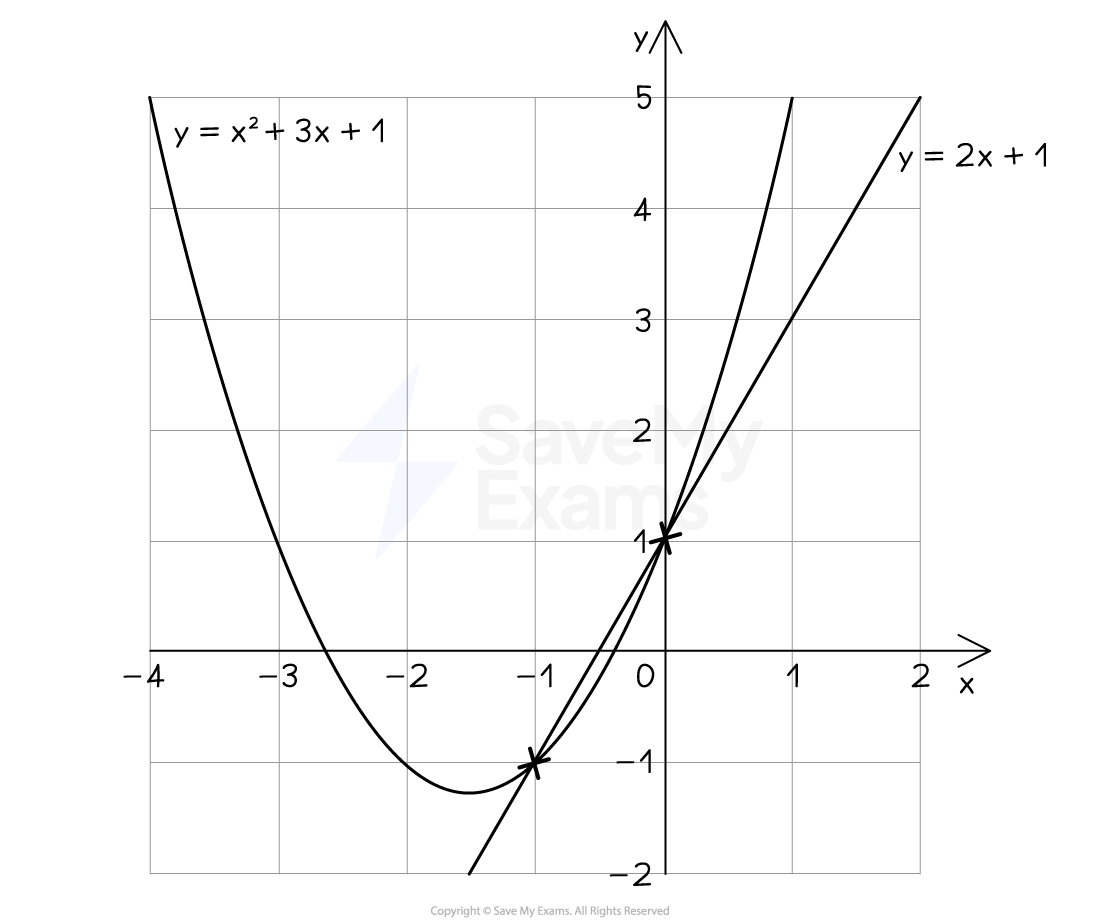
For example, plot y = x2 + 3x + 1 and y = 2x + 1 on the same axes
They meet twice, as shown
The coordinates of intersection are (-1, -1) and (0, 1)
How do I solve simultaneous equations graphically?
The x and y solutions to simultaneous equations are the x and y coordinates of the point of intersection
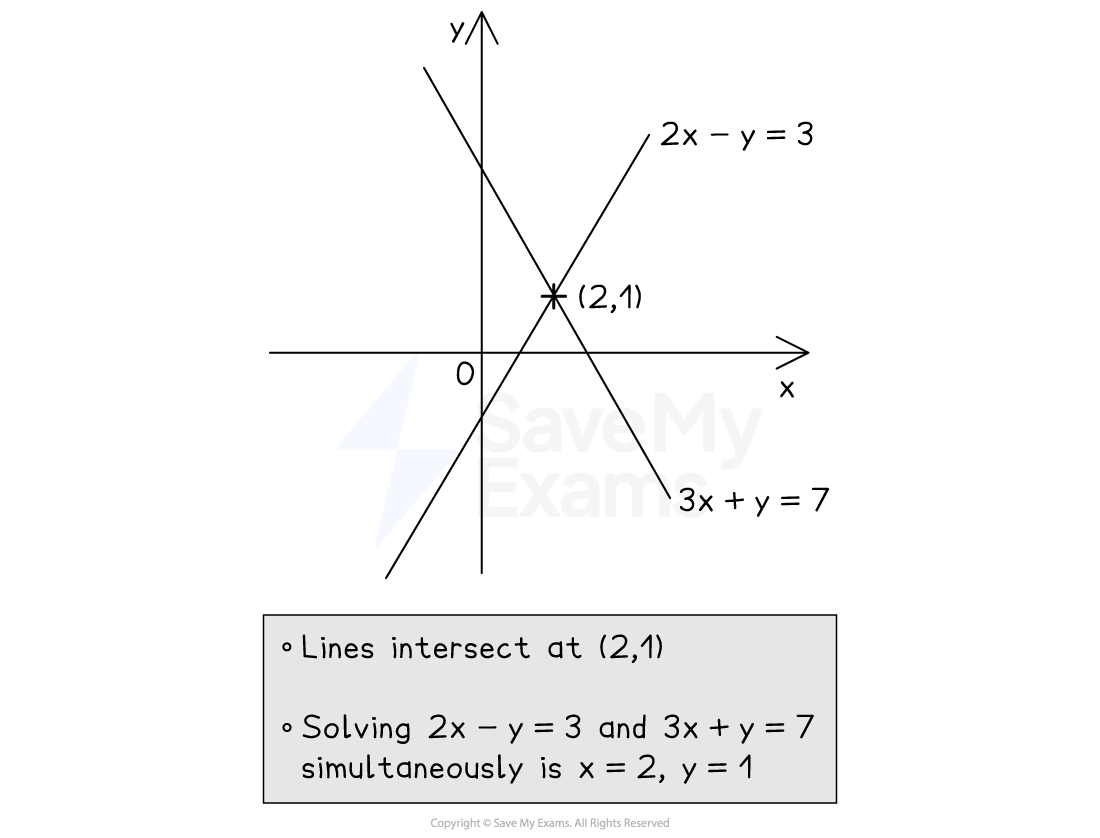
For example, to solve 2x - y = 3 and 3x + y = 7 simultaneously
Rearrange them into the form y = mx + c
y = 2x - 3 and y = -3x + 7
Use a table of values to plot each line
Find the point of intersection, (2, 1)
The solutions are therefore x = 2 and y = 1
How do I use graphs to solve equations?
This is easiest explained through an example
You can use the graph of
 to solve the following equations

The solutions are the two x-intercepts
This is where the curve cuts the x-axis (also called roots)

The solutions are the two x-coordinates where the curve intersects the horizontal line


The solutions are the two x-coordinates where the curve intersects the straight line

The straight line must be plotted on the same axes first
To solve a different equation like
 , if you are already given the graph of an equation, e.g.

add / subtract terms to both sides to get "given graph = ..."
For example, subtract 5 from both sides

You can now draw on the horizontal line
 and find the x-coordinates of the points of intersection
Examiner Tips and Tricks
When solving equations in x, only give x-coordinates as final answers.
Include the y-coordinates if solving simultaneous equations.
Worked Example
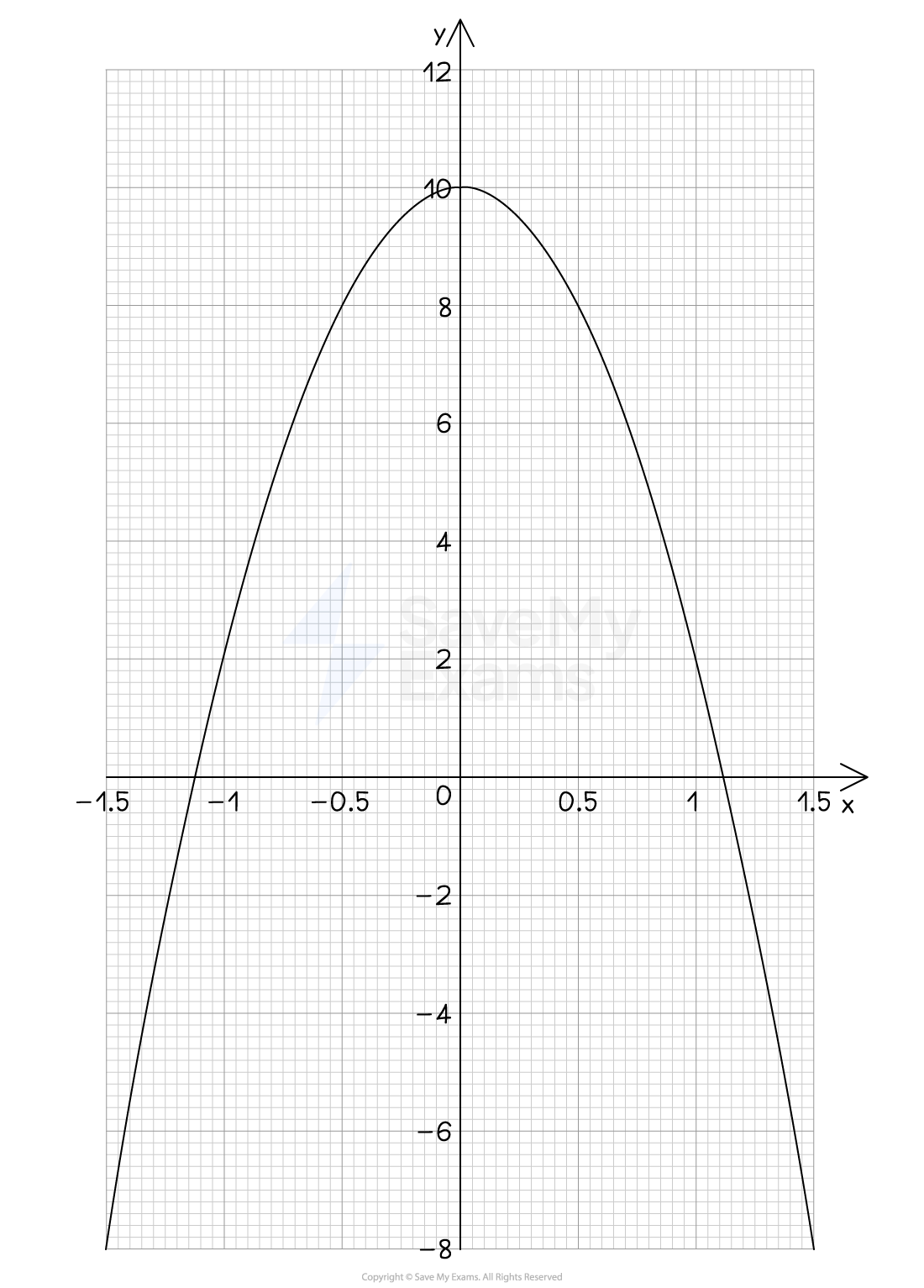
Use the graph of  shown to estimate the solutions of each equation given below.
(a) 
Answer:
The function equals zero, so the x-intercepts of its graph are the solutions
Read off the values where the curve cuts the x-axis
Use a suitable level of accuracy (no more than 2 decimal places from the scale of this graph)
-1.12 and 1.12
These are the two solutions to the equation
x = -1.12 and x = 1.12
A range of solutions are accepted, such as "between 1.1 and 1.2"
Solutions must be ± of each other (due to the symmetry of quadratics)
(b) 
Answer:
The function equals 8, so draw the horizontal line y = 8
Find the x-coordinates where this cuts the graph
-0.5 and 0.5
These are the two solutions to the original equation
x = -0.5 and x = 0.5
Worked Example
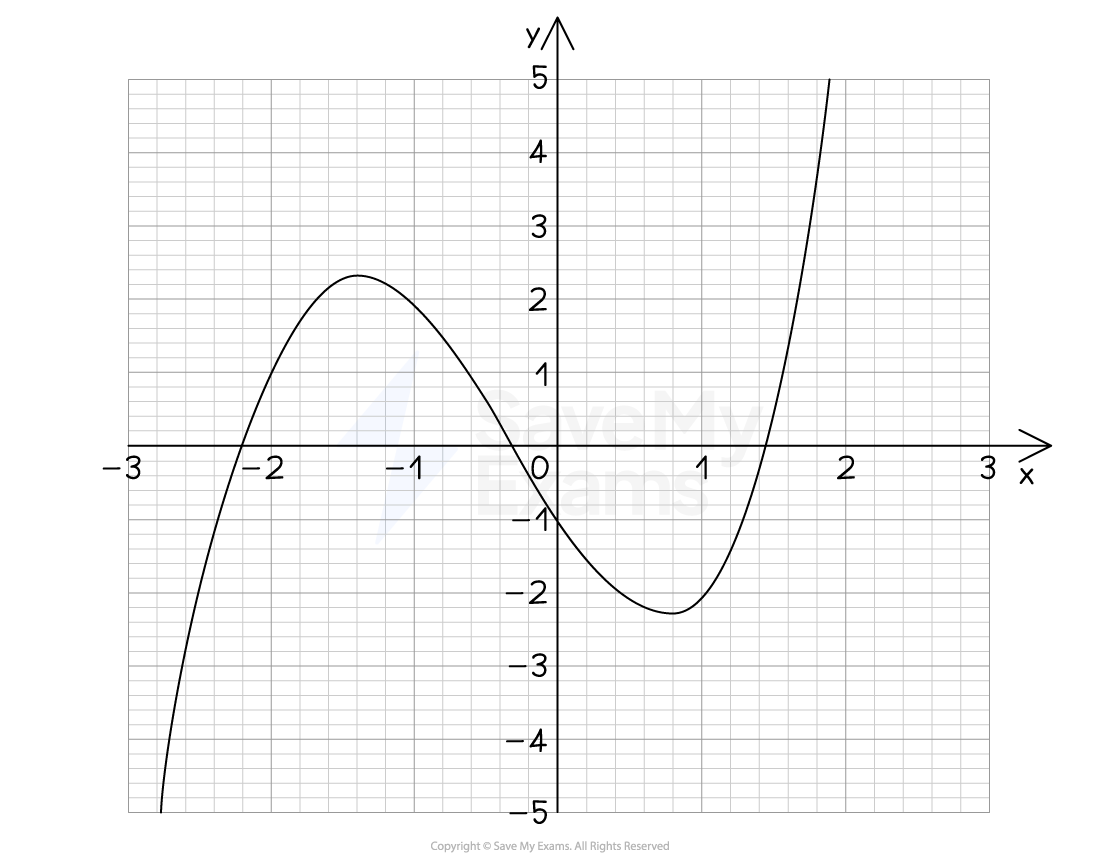
The graph of  is shown below.
Use the graph to estimate the solutions of the equation  .
Give your answers to 1 decimal place.
Answer:
We are given a different equation to the one plotted so we must rearrange it to  , in this case


Now plot  on the same axes
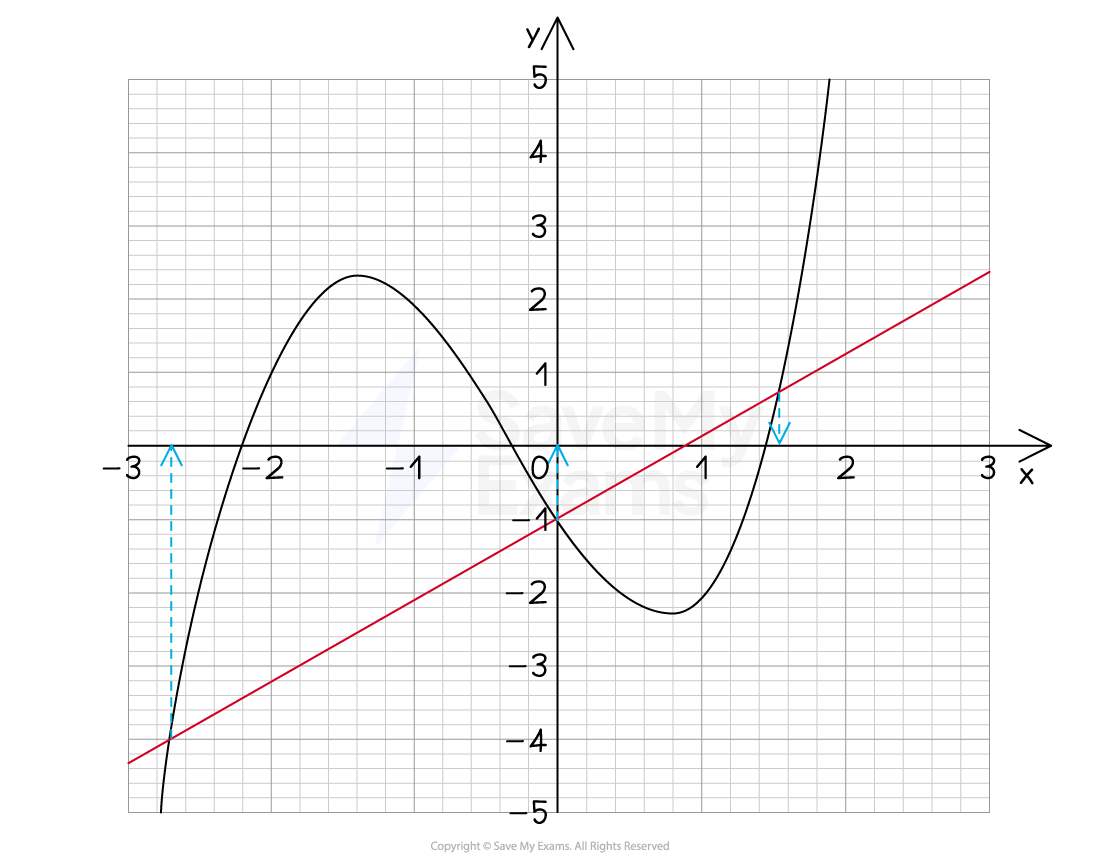
The solutions are the  -coordinates of where the curve and the straight line intersect


Unlock more, it's free!
Join the 100,000+ Students that ❤️ Save My Exams
the (exam) results speak for themselves:

Was this revision note helpful?
Build on this topic
Questions students ask about Solving Equations from Graphs
Real questions from students revising this topic on Save My Exams
How do you use an existing quadratic graph to solve a different quadratic equation?
Rearrange the new equation until the expression you already have a graph of is on one side, then draw the other side as a straight line and read off the x-coordinates where they cross.
Steps
- Add or subtract terms on both sides until one side matches the given graph exactly
- Whatever is left on the other side is the line you draw
- Plot it on the same axes as the curve
- The solutions are the x-coordinates of the intersection points
Example: you have the graph of y = x² − 4x − 2 and need to solve x² − 5x − 3 = 0
- Add x to both sides: x² − 4x − 3 = x
- Add 1 to both sides: x² − 4x − 2 = x + 1
- So draw the line y = x + 1
- It meets the curve at x ≈ −0.5 and x ≈ 5.5
Quick check: subtracting the new equation from the graph's expression gives x + 1, which is exactly the line you need.
How do I rearrange an equation to match a given graph?
Add or subtract terms on both sides until one side is exactly the expression that has been plotted; whatever is left on the other side is the line you draw.
- Write down the equation you have been asked to solve.
- Compare it term by term with the equation of the given graph.
- Add or subtract x terms and number terms on both sides until that side reads "given graph".
- The other side is now of the form mx + c — plot that line on the same axes and read off the x-coordinates where it crosses the curve.
On this page you are given the graph of y = x³ + x² − 3x − 1 and asked to solve x³ + x² − 4x = 0:
- start from x³ + x² − 4x = 0
- you need −3x, so add x to both sides: x³ + x² − 3x = x
- you need −1, so subtract 1: x³ + x² − 3x − 1 = x − 1
- the left now matches the graph, so plot y = x − 1 and read off the intersections: x = −2.6, x = 0 and x = 1.6
Give only x-coordinates as your final answers.
Do you draw both equations on the same axes to find graphical solutions?
Yes — both graphs go on one set of axes, because the points where they cross are the values that satisfy both equations at once.
- "Axes" is just the plural of "axis": the same grid, with the same x and y scales, and both graphs drawn on it
- An intersection point lies on both graphs, so its coordinates work in both equations
Page examples
- y = x² + 3x + 1 and y = 2x + 1 on the same axes meet at (−1, −1) and (0, 1)
- Check: x² + 3x + 1 = 2x + 1 gives x² + x = 0, so x(x + 1) = 0 and x = 0 or x = −1
- Simultaneous equations 2x − y = 3 and 3x + y = 7: rearrange to y = 2x − 3 and y = −3x + 7, plot both, and they cross at (2, 1), so x = 2 and y = 1
What to write down
- Solving an equation in x: give only the x-coordinates
- Solving simultaneous equations: give both x and y