Elizabeth I: Religion - The Puritan Challenge (AQA A Level History: Component 1: Breadth study): Revision Note
Exam code: 7042

Summary
Puritans were Protestants who felt the Elizabethan Settlement had not gone far enough in removing Catholic elements from the Church
They ranged from moderate reformers to radical Separatists who broke away from the national Church entirely
The Vestiarian Controversy (1566) and the Admonition to Parliament (1572) marked the early peaks of Puritan pressure on the Settlement
Archbishop Whitgift, appointed in 1583, used the Three Articles and the Court of High Commission to weaken and disrupt organised Puritanism within the Church
The Marprelate Tracts (1588–1589) were anonymous satirical attacks on bishops that backfired, alienating moderate supporters and justifying harsher repression
The Settlement survived structurally unchanged throughout the reign:
Puritans never won any significant structural concessions, though their challenge shifted and evolved across the decades
Who Were the Puritans & What Did They Want?
"Puritan" was a term of abuse, not a name any group gave itself
There was no single organised Puritan movement
Puritans ranged from moderates who worked within the Church to radicals who rejected it entirely
What they shared was the belief that the 1559 Settlement had kept too many Catholic elements
Puritanism had its roots among Protestants who had fled to Europe during Mary I's reign
Many had encountered Calvinist churches in Geneva and Zurich that went much further than the English Settlement
They came back expecting Elizabeth to lead a more thorough Protestant Church
Elizabeth's deliberate compromise deeply disappointed them
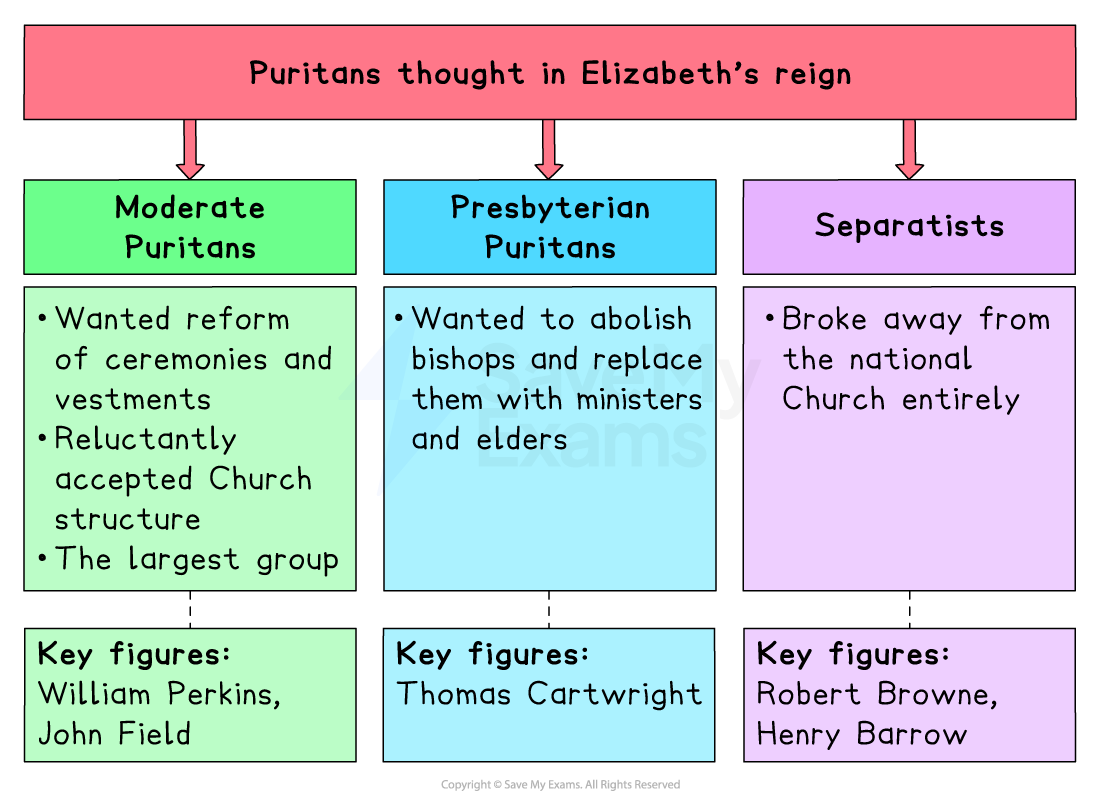
The three strands of Puritan thought
The table outlines the three main strands of Puritan thought across the reign
Strand | Key features |
|---|---|
Moderate Puritans |
|
Presbyterian Puritans |
|
Separatists |
|
What did Puritans want?
All Puritans shared a set of core demands; however, they differed on structure
Removal of "popish" elements: vestments, ceremonies, crucifixes and, in some cases, organ music
A better-educated and preaching clergy, not just ministers who read services
Stricter observance of the Sabbath
A Church guided by Scripture alone, not by tradition or royal decree
Puritanism had support in significant places
Some educated merchants, lawyers and gentry formed the Puritan social base
Puritan patrons at court included the Earl of Leicester and Francis Walsingham
This gave the movement political protection for much of the reign
Many Puritan MPs pushed for reform through Parliament
Puritans were not a threat to Elizabeth's person or throne
Unlike some Catholics, Puritans were not plotting to assassinate or replace her
Their challenge was to the character of the Settlement, not to the queen herself
This made them a fundamentally different kind of threat from Catholicism
Examiner Tips and Tricks
It is worth being clear from the outset that Puritans were not a unified movement and were not trying to overthrow Elizabeth. The question asks how far they threatened the Settlement, not the Crown. Keeping that distinction in mind will sharpen any answer on this topic.
The Vestments Controversy & the Admonition to Parliament
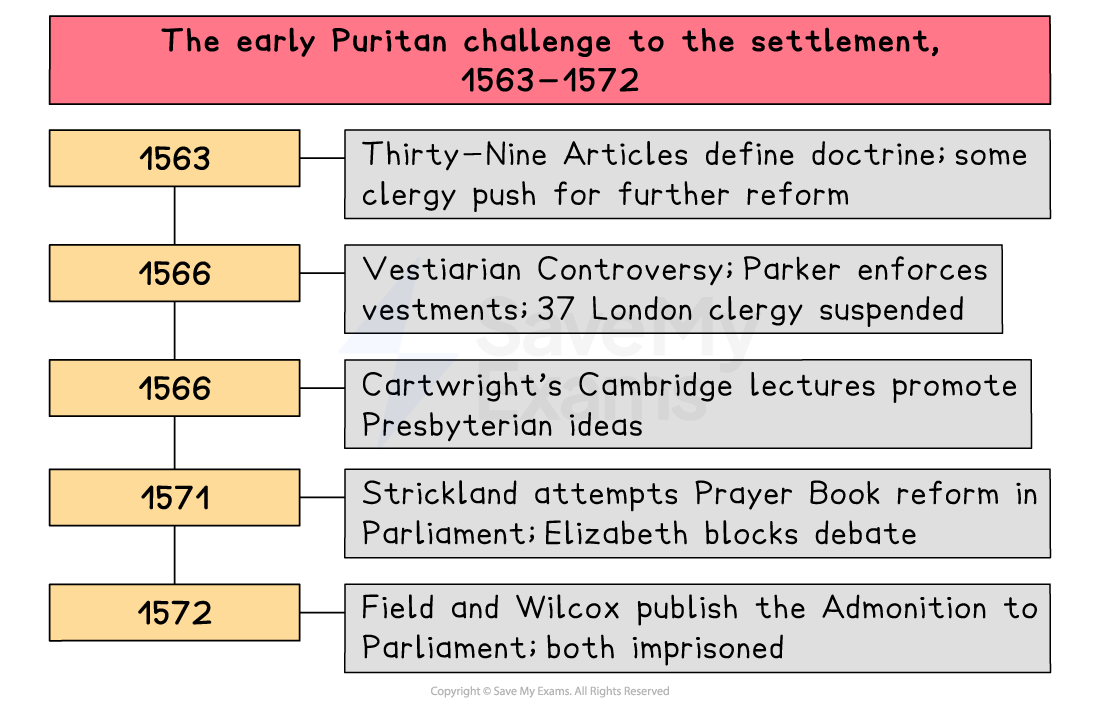
The Vestiarian Controversy, 1566
The first major clash between the Crown and Puritan clergy arose over vestments
Vestments were the special clothes worn by clergy during services
Many Puritan clergy refused to wear the surplice, arguing it had no scriptural authority
They also saw vestments as associated with Catholic Mass and, therefore, offensive
Elizabeth ordered Archbishop Parker to enforce compliance
Parker issued the Book of Advertisements in 1566, setting out expected clerical dress
Around 37 London clergy were suspended for refusing to comply
Parker was himself uncomfortable with this level of enforcement, but had no choice
The controversy was about more than clothes
It showed that Elizabeth would not tolerate clergy picking and choosing which parts of the Settlement to follow
It also revealed how many clergy had Puritan sympathies that the Settlement had not addressed
Thomas Cartwright and presbyterian demands, 1570
Thomas Cartwright brought the most radical version of Puritan thought to national attention
In 1570, he gave lectures at Cambridge University arguing the Church should be restructured along Presbyterian lines
He called for ministers, elders and deacons to replace the existing hierarchy of bishops
He argued this was the only structure sanctioned by Scripture
Elizabeth was alarmed:
Presbyterianism in Scotland had been associated with resistance to royal authority and the deposition of Mary Queen of Scots in 1567
Cartwright was removed from his Cambridge professorship and eventually left England
The Admonition to Parliament, 1572
John Field and Thomas Wilcox took the argument public in print
They published the Admonition to Parliament in 1572, a fierce attack on the Church Settlement
It argued that a Presbyterian Church structure was the only one approved by Scripture
Field also attacked the Prayer Book in highly colourful language
Both men were imprisoned for a year as a result
Cartwright wrote a second Admonition, extending the argument further
“[The Book of Common Prayer] is an unperfect book, culled and picked out of that popish dunghill, the Mass book, full of all abominations… In this book we are enjoined to receive the Communion kneeling, which has in it a show of popish idolatry… marking the child in the forehead with a cross.”
John Field, A View of Popish Abuses yet Remaining in the English Church, 1572
Field was a leading Presbyterian Puritan and one of the most energetic organisers of the movement. His attack on the Prayer Book as rooted in Catholic tradition captures the core Puritan complaint: the Settlement had not broken clearly enough with Rome.
The Admonition had limited practical impact
Parliament had no appetite to act on it; no structural reform of the Church followed
The wider Puritan community was not united behind the Presbyterian programme
But the episode showed the Puritan movement was willing to go beyond polite lobbying
Examiner Tips and Tricks
The Vestiarian Controversy and the Admonition are sometimes treated as very separate events. It is worth seeing them as part of the same pattern: Puritans pushing for reform through available channels (the clergy, the press, Parliament) and Elizabeth refusing every time. The consistency of her refusal is itself a significant point.
Archbishop Whitgift & the Suppression of Puritanism
Archbishop Grindal and the prophesyings, 1576
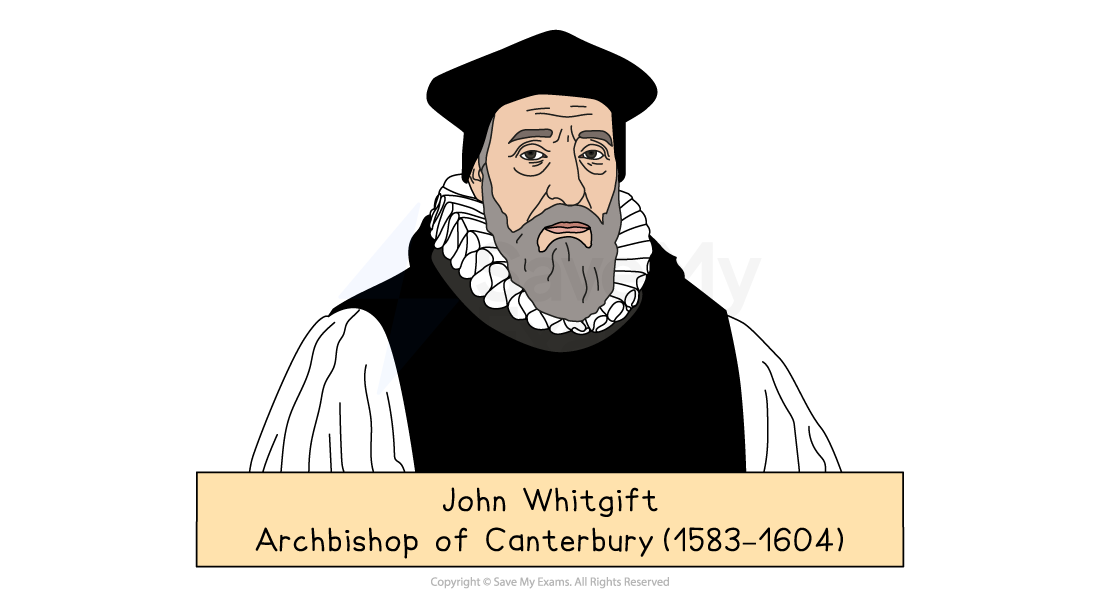
John Whitgift was appointed Archbishop of Canterbury in 1583 and became the key figure in suppressing Puritanism
Before Whitgift, Elizabeth faced a very different problem with Archbishop Grindal
Prophesyings were organised meetings of clergy for preaching practice and biblical discussions
They spread rapidly and were associated with Puritan clergy looking to improve the ministry
Elizabeth saw them as a vehicle for Puritan ideas and ordered Grindal to suppress them in 1576
Grindal refused to obey, and defended the prophesyings directly to Elizabeth
He argued they improved the quality and knowledge of the clergy
Elizabeth suspended him from exercising full authority as Archbishop; he remained out of favour until his death in 1583
The prophesyings were eventually suppressed by her direct orders to the bishops
“I and others of your Bishops have found by experience that these profits come from these exercises [prophesyings]:
1. The ministers of the Church are more skilful and ready in the Scriptures, and apter to teach their flocks.
2. It withdraweth their flocks from idleness, wandering, gaming etc.
3. Some suspected of doctrinal error are brought to open confession of the truth.
4. Ignorant ministers are driven to study, if not for conscience then for shame and fear of discipline.
5. The opinion of laymen about the idleness of the clergy is removed.
6. Nothing beateth down Popery more than that ministers grow to such a good knowledge by means of these exercises.”
Archbishop Edmund Grindal, letter to Queen Elizabeth I, 1576
Grindal was defending prophesyings as a tool for improving the quality and knowledge of the clergy. His letter shows how a senior churchman with moderate Puritan sympathies could argue that these gatherings strengthened, rather than threatened, the Church of England.
Whitgift appointed Archbishop of Canterbury, 1583
Grindal died in 1583 and Elizabeth appointed John Whitgift as his replacement
Whitgift’s views aligned closely with Elizabeth’s
He had no sympathy with Puritanism
He was determined to enforce uniformity across the Church
Elizabeth referred to Whitgift as "my little black husband", reflecting both his clerical appearance and his close working relationship with her
The nickname suggests a high degree of royal favour and trust
The Three Articles, 1583
Whitgift immediately issued the Three Articles, requiring all clergy to subscribe
Article 1: acceptance of the royal supremacy over the Church
Article 2: that the Prayer Book contained nothing contrary to Scripture
Article 3: that the Thirty-Nine Articles were agreeable to Scripture
The Three Articles caused immediate uproar
Around 300 ministers were suspended, particularly in the south of England, within weeks
Many were reinstated after pressure from sympathetic local gentry
Even William Cecil (Lord Burghley) objected to the harshness of the subscription campaign
But Elizabeth backed Whitgift; the campaign continued
"That none be permitted to preach, read, minister the sacraments, or to execute any other ecclesiastical function unless he consent and subscribe to these Articles following:
That her Majesty, under God, hath, and ought to have, the sovereignty and rule over all manner of persons born within her realms, either ecclesiastical or temporal, soever they be.
That the Book of Common Prayer containeth in it nothing contrary to the word of God, and that he himself will use the form of the said book prescribed in public prayer and administration of the sacraments, and none other.
That he alloweth the book of Articles, agreed upon by the archbishops and bishops of both provinces (Canterbury and York), and that he believeth all the Articles therein contained to be agreeable to the word of God."
From the Three Articles issued by Archbishop Whitgift, 1583
Whitgift's Three Articles required every minister to subscribe to three things as a condition of holding office: royal supremacy over the Church, the Prayer Book and the Thirty-Nine Articles. The requirement was absolute, subscribe in full or lose the right to preach and administer the sacraments. This explains why around 300 ministers were suspended almost immediately, and why even Cecil (Burghley) objected to the harshness of the campaign.
The subscription campaign and the classis movement
Whitgift used the ex officio oath to enforce subscription
It required ministers to answer questions under oath without knowing the charges against them
This was seen as unjust and contrary to English legal tradition
But the Court of High Commission, which oversaw Church discipline, had the power to enforce it
The classis movement posed the most organised internal challenge to the Settlement
In the 1580s, Puritan clergy set up local "classes": informal regional meetings
These classes resembled a Presbyterian shadow structure growing inside the national Church
John Field was the key organiser, networking classes across several counties
Whitgift and the High Commission targeted the classes
By the early 1590s, the movement had been broken up
Examiner Tips and Tricks
Whitgift’s appointment in 1583 is a clear turning point in the Puritan story. Before 1583, the movement had court patrons, sympathetic bishops and room to manoeuvre. After 1583, all of that changed. Showing how the situation changed when Whitgift arrived strengthens any answer on how the threat was dealt with.
The Martin Marprelate Tracts & the Puritan Underground
The Marprelate Tracts, 1588–1589
From 1588, a series of anonymous pamphlets began appearing across England
They were signed "Martin Marprelate", a pseudonym; the real authors were never publicly confirmed
Job Throckmorton and John Penry were strongly suspected of involvement
Seven tracts appeared in total between 1588 and 1589
The tracts attacked bishops in witty, colourful and deliberately provocative language
They mocked individual bishops by name
They argued the entire episcopate was corrupt, unscriptural and should be abolished
The tone was unusual: satirical and entertaining rather than scholarly
The tracts were printed on a secret, moveable press
The press was moved from house to house to avoid detection
Government agents tracked it across the Midlands and into Wales before seizing it in 1589
This was a remarkable feat of underground organisation for the period
Why the tracts backfired
The Marprelate Tracts alienated more supporters than they won
Many moderate Puritans were embarrassed by the abusive tone
The tracts gave the government grounds to claim the Puritan movement was seditious
Elizabeth authorised counter-propaganda, including plays mocking the Puritans
The episode ended with the movement weaker, not stronger, than before
The Act against Seditious Sectaries, 1593
The government moved against the separatist fringe with new legislation in 1593
The Act required conformity to the national Church or exile
Henry Barrow and John Greenwood, who had founded a separatist congregation in London, were arrested in 1592 and hanged in 1593
John Penry, who had fled to Scotland after the press was seized, was arrested on his return and executed in 1593
After 1593, organised separatist activity in England collapsed
By the mid-1590s, Puritan pressure had subsided significantly
The classis movement was broken
The separatist fringe had been suppressed
Puritan patrons at court, including Leicester, were dead
The movement continued to exist, but as a diffuse tendency within the Church rather than as an organised force
Examiner Tips and Tricks
The Marprelate Tracts are a good example of a tactic that made things worse for the people using it. The tracts were clever and popular, but they shifted public perception of Puritanism away from godly reform and towards sedition. It’s worth thinking about why a movement might choose tactics that end up harming its own cause.
How Far Did Puritans Threaten the Elizabethan Settlement?
Use the specific evidence below to build and support your own argument
The case that Puritan challenge was a significant threat
The Settlement faced sustained pressure from within the Church for four decades
The Vestiarian Controversy, the Admonition, the classis movement and the Marprelate Tracts were not isolated incidents
They represented a continuous thread of challenge to the Settlement’s character
The classis movement showed that a Presbyterian structure was developing inside the Church itself
Field’s network of classes in the 1580s spanned several counties
This was not simply a matter of individuals complaining; it was an organised attempt to reshape Church governance from within
The movement had powerful court backing for much of the reign
Leicester and Walsingham gave the Puritan movement political protection until their deaths
This meant Elizabeth could not simply suppress it by force in the early decades
Grindal refused to suppress the prophesyings because he believed they improved the quality of preaching and strengthened the Church
Grindal’s refusal to obey Elizabeth showed how deeply sympathetic clergy were to the Puritan cause
If even the Archbishop could not be relied on, the Settlement’s uniformity was genuinely fragile
The Marprelate Tracts showed the movement could evade government suppression for over a year
The secret press demonstrated a level of underground organisation that alarmed the authorities
The case that the Puritan challenge was limited and manageable
Puritans never won a single concession on Church structure
Elizabeth refused every Puritan demand throughout the reign
The Settlement of 1559 remained intact at her death in 1603
The Puritan challenge posed no threat to Elizabeth personally
Puritans were not plotting to kill or replace her
Their challenge was to the form of the Church, not to the monarchy or the political order
The Presbyterian and Separatist wings had very limited popular support
Most Puritans were moderate reformers who worked within the Church
The call for full Presbyterian restructuring attracted few followers beyond a committed minority
Separatists were a tiny fringe even within Puritanism
Whitgift broke the organised Puritan challenge within a decade of taking office
The classis movement was dismantled by the early 1590s
The Marprelate Tracts backfired and alienated moderate Puritan support
By the mid-1590s, Puritanism had no organised presence capable of threatening the Settlement
Events in Europe actually helped Elizabeth contain Puritanism
The St Bartholomew’s Day Massacre in France (1572) horrified English Protestants and created a common cause against Catholicism
The threat from Spain united different Protestant factions and reduced pressure for internal Church reform
Examiner Tips and Tricks
The key question rewards answers that think about the Puritan challenge across the whole reign, not just one episode. It also rewards answers that are precise about what kind of threat Puritanism posed: it was a challenge to the Settlement’s character, not to the Crown. Whether that counts as a serious threat depends on how you define the term, which is itself a good analytical point to make.

Unlock more, it's free!
Join the 100,000+ Students that ❤️ Save My Exams
the (exam) results speak for themselves:

Was this revision note helpful?
