Elizabeth I: The Last Years (AQA A Level History: Component 1: Breadth study): Revision Note
Exam code: 7042

Summary
The last decade of Elizabeth's reign was shaped by a combination of faction, war, economic hardship and religious tension rather than any single cause
The cost of the wars against Spain (from 1585) and in Ireland (especially after 1598) pushed the Crown's finances to breaking point by 1603
Religious divisions had not been resolved:
Catholics survived in gentry households
Puritan ideas survived, though organised movements had been broken up
The quality of conformist clergy was uneven
The Poor Laws of 1597 and 1601 were the government's most significant social response to the 1590s crisis, creating a lasting framework for poor relief
James VI of Scotland succeeded smoothly in 1603 helped by Robert Cecil's secret diplomatic groundwork
The transfer of power itself was untroubled despite the problems Elizabeth left behind
Historians debate the Tudor legacy:
Brigden argues Elizabeth left James a potentially strong monarchy
Others point to stored-up problems that would define the 17th century
Political Problems in Elizabeth’s Last Years: Faction, War & Succession
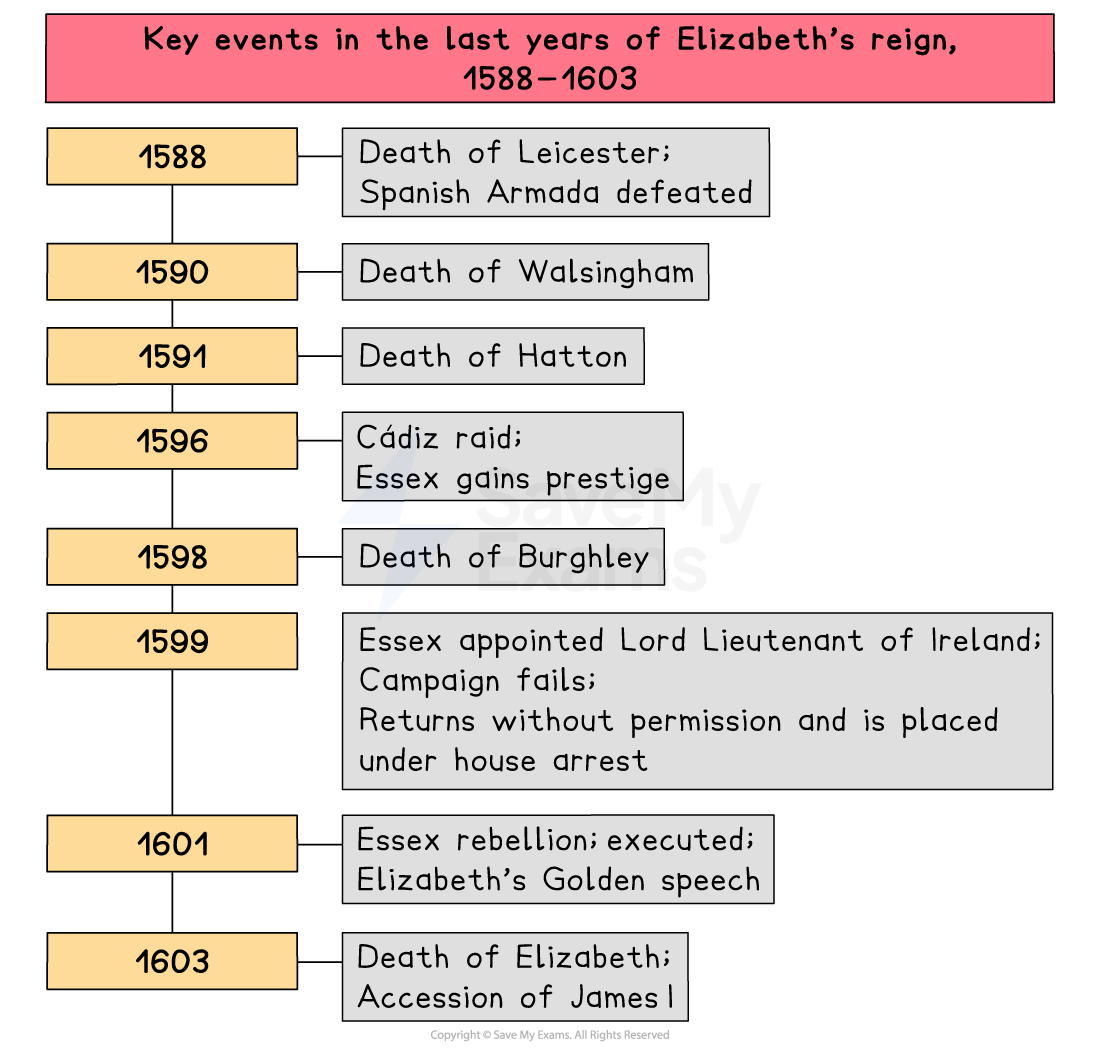
The death of the old guard
The political crisis of the 1590s was rooted partly in the loss of Elizabeth's most trusted ministers
Leicester died in 1588, Walsingham in 1590, Hatton in 1591
Cecil (Burghley) became increasingly incapacitated from 1592 and died in 1598
These men provided a stable, experienced core of government for 30 years
Their deaths left a vacuum that was filled by a younger, more competitive generation
See the Factional Rivalries and the Essex Rebellion revision note for further information
Faction-fighting became more serious in the 1590s than at any earlier point in the reign
The Earl of Essex competed with Robert Cecil for patronage and influence
Essex's failed campaign in Ireland (1599) fatally damaged his position
His rebellion in 1601 was quickly crushed; he was executed in February 1601
The rebellion was one of the most serious domestic political crisis of the whole reign, alongside the Northern Rebellion of 1569
The war with Spain added to the political strain of the last years
Elizabeth was forced to call Parliament more frequently to vote subsidies for the war
The monopolies controversy of 1601 showed how Parliament’s patience with royal financial expedients had worn thin
The succession problem
Elizabeth never named a successor, creating uncertainty throughout the reign
She had always refused to discuss the question publicly, seeing it as undermining her authority
By the late 1590s, she was ageing visibly and the question was becoming urgent
Robert Cecil worked secretly to prepare the way for James VI of Scotland
James was the great-great-grandson of Henry VII through Margaret Tudor and had been raised in the Calvinist-influenced Scottish Church
Examiner Tips and Tricks
Political problems in the last years are best understood as interconnected rather than separate. Faction, war costs and the succession question all fed into each other. The death of the old guard removed experienced managers who kept conflict contained; without them, problems that had been managed became harder to control.
Economic Problems in Elizabeth’s Last Years: The Cost of War
The wars with Spain and in Ireland were the key drivers of the Crown's financial crisis
War with Spain began in 1585 and continued until 1604, one year after Elizabeth's death
The Nine Years' War in Ireland (1593–1603) added a second major drain on Crown finances
It has been estimated that Elizabeth was spending around twice her revenues by the 1590s
See the Economy, Prosperity and Depression revision notes for the full picture
The Crown used increasingly problematic methods to raise money
Parliamentary subsidies were voted more frequently but were resented and often under-assessed
The sale of Crown lands raised short-term cash but permanently reduced future royal income
Monopolies granted exclusive trading rights to individuals in return for fees
By 1601, they had become deeply unpopular
The war with Spain also damaged trade
Legitimate commerce with Spain and the Spanish Netherlands was disrupted from 1585
Privateering raids brought some return but were unreliable and created diplomatic problems
The cloth trade faced renewed disruption after its earlier recovery from the Antwerp Crisis of 1563–1564
The combined burden of war, depression and poor harvests fell hardest on ordinary people
Four successive harvest failures between 1594 and 1597 pushed food prices up by over a third
Real wages fell to their lowest levels since the Black Death
Plague outbreaks in 1592–1593 killed thousands and compounded the food crisis
See Economy: Prosperity and Depression, and the Society: Continuity, Change and Rebellion revision notes for full details
Examiner Tips and Tricks
Economic problems in the last years need to be distinguished from long-term structural problems. Inflation had been rising throughout the Tudor period. What made the 1590s particularly bad was the combination of war costs, harvest failures and recurrent plague outbreaks all happening at the same time. Being precise about this distinction strengthens exam answers considerably.
Religious Tensions by 1603: Catholics, Puritans & Conformists
Catholics by 1603
Catholicism had survived but was reduced to a small and largely private practice
Around 2% of the population were active recusants by 1603
Catholicism survived mainly in gentry households in Lancashire, Yorkshire and the Welsh Marches
Seminary priests and Jesuits maintained the faith in these communities, moving between safe houses
English Catholics had overwhelmingly rejected support for Spain during the Armada crisis of 1588
The plots and the Armada had discredited Catholicism as a political force
Most English Catholics were loyal to the Crown
See the Catholic Threat revision notes for full coverage of recusancy, the missions and the penal laws
Puritans by 1603
The organised Puritan challenge within the Church had been broken by Whitgift
The classis movement was dismantled by the early 1590s
The Act against Seditious Sectaries (1593) had crushed separatism
But hopes for further Puritan reform survived among many educated and devout Protestants
James had been raised in the Calvinist-influenced Scottish Kirk, leading some Puritans to hope for further reform
This hope drove the Millenary Petition of 1603, presented to James on his way south
See the Puritan Challenge revision notes for the full account of Puritanism across the reign
Conformists: the broad middle
The majority of English people fell into a broad middle category by 1603
They attended Church of England services, as the law required
They ranged from genuinely Protestant in conviction to merely compliant in practice
Most cared more about the familiarity of church life than about theological detail
The Settlement's conservative, Catholic-looking appearance had made it broadly acceptable to this majority
Examiner Tips and Tricks
The religious spectrum by 1603 is a useful way to structure answers on how successfully the Settlement had worked. It shows that the Settlement had succeeded in containing the extremes without converting everyone: Catholics survived at the margins, Puritans were driven underground but not eliminated and the broad middle accepted the Church because it was familiar rather than because it was theologically satisfying.
The State of the English Church by 1603: How Protestant was England?
The survival of the Settlement
The Church of England had survived 44 years of pressure from both sides
Neither Catholic nor Puritan pressure had forced any change to the 1559 Settlement's structure
The licensing system and the Court of High Commission had maintained basic conformity
Two generations of English people had grown up knowing no other national church
See the Church: Archbishops, Injunctions and Enforcement revision notes for full coverage of how the Settlement was managed
Whitgift's campaign had secured the Settlement institutionally
The classis movement had been broken; the Marprelate Tracts had backfired on the Puritan cause
The Church of England had a coherent intellectual defence in Richard Hooker's Of the Laws of Ecclesiastical Polity (1593)
Hooker argued the Settlement was a credible Anglican middle way, not a mere compromise
The weaknesses that remained
The quality of the clergy remained a serious and persistent problem
“Mr Ocklei, parson of Much Bursead: a gamester.
Mr Durdent, vicar of Stebbing: a drunkard and a gamester and a very gross abuser of the Scriptures (witnesses: Mr Denham, Mr Rogers, etc.)
Mr Durden, parson of Mashbury: a careless man, a gamester, an ale-house haunter, a company keeper with drunkards and he himself sometimes drunk (witnesses: Richard Reynolds, John Argent, etc.)
Mr Cuckson, vicar of Linsell: unable to preach, he hath been a pilferer.”
Puritan survey of ministers, Essex, 1586
This survey was compiled by Puritans who had every reason to present the clergy in the worst possible light. But the pattern it describes, clergy who were poorly educated, morally lax and failing to preach effectively, reflects a real problem. The licensing system had raised standards in some areas but had not transformed the quality of the parish clergy across England.
“Small reformation has been made in Lancashire and Cheshire as can be seen by the emptiness of churches on Sundays and holidays. The people so swarm the streets and alehouses during service time that many churches have only the curate and his clerk present. The people lack instruction for the preachers are few, most of the parsons unlearned and no examination is made of schools and schoolmasters. The proclamation for the apprehension of Jesuits, seminaries and mass priests is not executed.”
Report to the Royal Council on the state of religion in Lancashire and Cheshire, early 1590s
Lancashire was one of the most religiously conservative counties in England. This report shows that in the north, the Settlement’s enforcement was barely functioning. Churches were empty, priests were unlearned and the laws against Catholic missionaries were not being enforced. This was the reality of the Settlement at the local level in its weakest areas.
Enforcement was uneven across the country
The south and east were broadly Protestant in practice by 1603
The north and west, especially Lancashire, remained conservative and poorly reformed
The gap between what the Settlement required and what happened in many parishes was wide
England was Protestant in law and in much of practice by 1603, but not uniformly so
The Church of England had shaped the identity of two generations in the south and east
In the north, Catholic sympathies and religious indifference persisted well into the 17th century
James I inherited a Church that was institutionally secure but geographically and pastorally uneven
Examiner Tips and Tricks
The two primary sources above are Puritan in origin, so they need to be read with some caution. But their general picture of the unevenness of the quality of the clergy and poor enforcement is supported by other evidence.
Social Conditions by 1603: Poverty, Population & the Poor Laws
Population growth was the deepest structural cause of social pressure across the whole Tudor period
England's population grew from around 2.5 million in 1520 to around 4 million by 1600
This sustained growth put pressure on food, land, wages and employment throughout Elizabeth's reign
The benefits of Elizabethan prosperity were unevenly distributed
The gentry prospered while the labouring poor fell behind
The 1590s brought the worst social conditions of the reign
Four successive harvest failures between 1594 and 1597 caused severe hardship
Real wages reached their lowest point since the Black Death
Food riots broke out in London, the south-east, East Anglia and parts of the west in 1595–1597
See the Economy: Prosperity and Depression, and the Society: Continuity, Change and Rebellion revision notes for full detail
The Poor Laws of 1597 and 1601
The Poor Laws of 1597 and 1601 were the government's most significant social response to the crisis
They built on earlier legislation from 1563, 1572 and 1576
See the Society: Continuity, Change and Rebellion revision notes for the full development of poor law from 1563
Act | What it did |
|---|---|
Poor Law Act, 1597 |
|
Poor Law Act, 1601 |
|
The Poor Laws had a real but limited immediate impact
Wealthy individuals also contributed through private charity, including the building of almshouses by figures such as William Cecil, Lord Burghley, though this support was uneven and could not meet national need
In practice, charitable giving continued to provide more relief than the compulsory poor rate
Enforcement was patchy, depending on the willingness of local JPs and overseers
But the 1601 Act created a permanent national framework that proved very durable
Examiner Tips and Tricks
The 1601 Poor Law is sometimes treated as a neat solution to the poverty problem. It was not. It brought together and formalised measures that had already been tried earlier in the reign. What matters is that it created a lasting institutional framework. Its durability until 1834 is itself evidence of how significant it was.
The Death of Elizabeth, 1603 & the Succession of James I
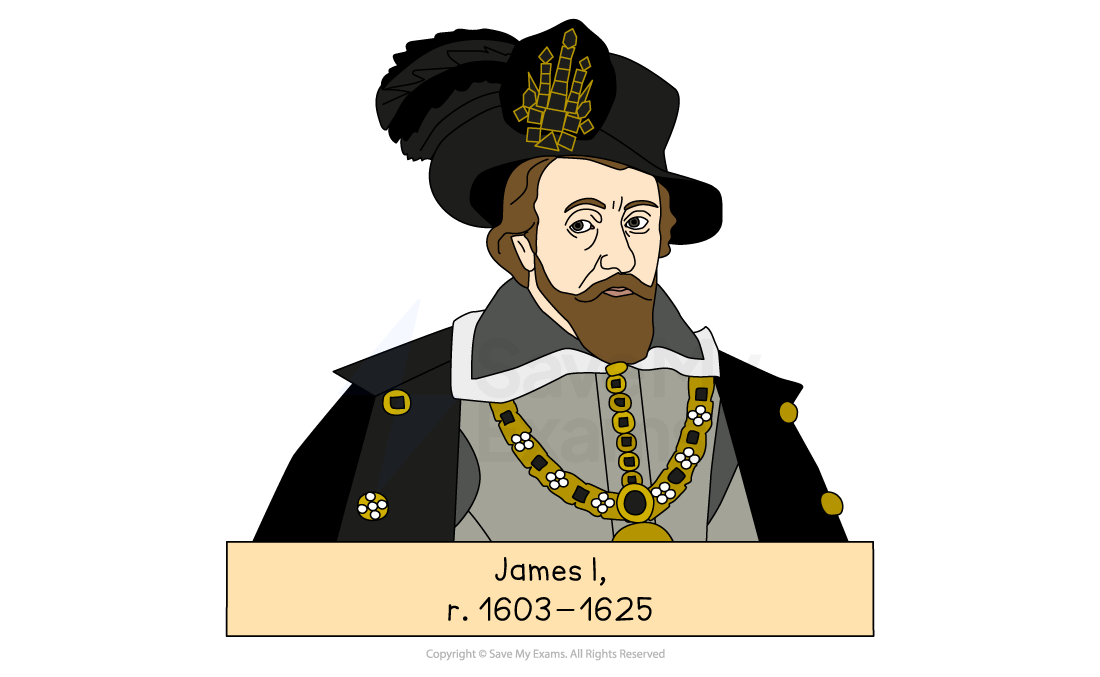
By early 1603, Elizabeth was visibly declining
She was 69, had lost most of her closest friends and councillors, and and appeared increasingly withdrawn and low in spirits
She reportedly refused to go to bed, sitting propped up on cushions for days
She died at Richmond Palace on 24th March 1603, in the early hours of the morning
According to later accounts, she indicated assent when asked if James VI should succeed
Robert Cecil had been quietly preparing James VI's succession for years
Cecil had opened secret correspondence with James from 1601
He reassured James that his accession would be smooth, and he would manage the transition
When Elizabeth died, James was proclaimed king within hours
The transition was remarkably smooth given the problems that surrounded it
England had been at war with Spain since 1585
The Crown's finances were strained and there were outstanding religious tensions
Yet, there was no rebellion, no rival claimant and no civil war
James VI of Scotland rode south and was welcomed enthusiastically
“The report of her death, like a thunderclap, was able to kill thousands. It took away the heart from millions. For having brought up, under her wing, a nation of people who were almost all born under her, that never saw the face of any prince but herself, never understood what the strange outlandish word ‘change’ signified – how was it possible but that her sickness should throw abroad a universal fear, and her death an astonishment?”
Thomas Dekker, playwright and writer, describing the nation’s reaction to Elizabeth’s death, 1603
Dekker captures how completely Elizabeth had defined the age she governed. By 1603, almost everyone alive in England had known no other monarch. His description of "change" as a "strange outlandish word" shows how extraordinary the continuity of her reign had been, and how shocking any end to it was bound to feel.
Examiner Tips and Tricks
The smooth succession of James I is itself important evidence for the debate about the legacy of the reign. Despite all the problems of the last decade, the political system held together. The transition was peaceful. This was no small feat: plenty of other European monarchies ended in chaos or civil war.
Religious Change & Continuity across the Tudor Period
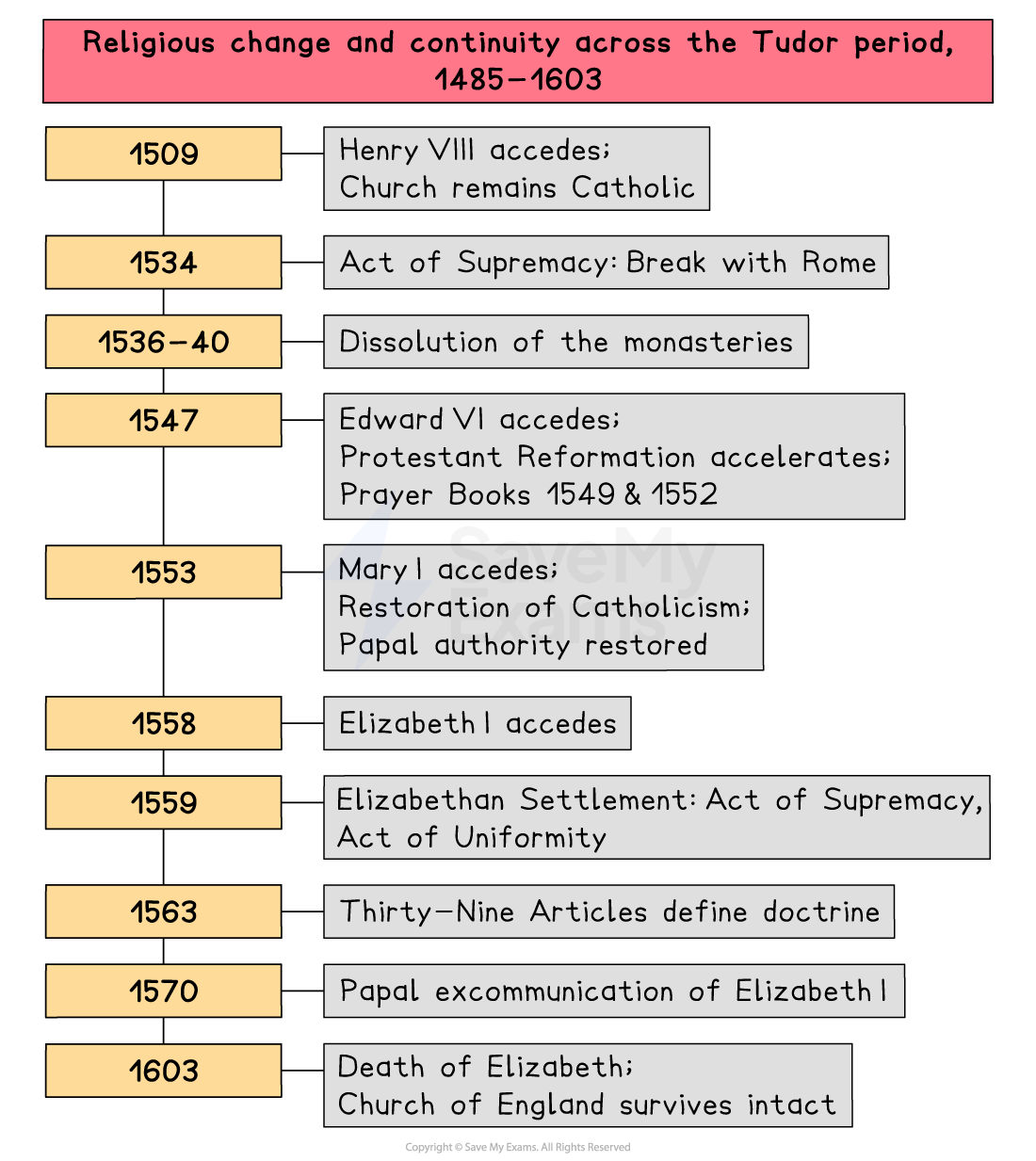
What changed?
The Tudor period saw the most dramatic religious transformation in English history
England began the period as a Catholic country in full obedience to the Pope
By 1603, it was a Protestant country with its own national Church under royal authority
The monasteries had been dissolved, stripping the Church of its land and wealth
The Bible was available in English; services were conducted in English
The doctrine of papal authority and transubstantiation had been officially rejected
The monarch, not the Pope, controlled Church appointments and doctrine
What remained continuous?
Despite the scale of change, significant elements of continuity survived
The Church retained its episcopal structure
Archbishops, bishops and the parish system all continued
Church courts continued to operate
Many church buildings remained the same
The visual appearance of the Church of England remained deliberately familiar and relatively conservative
The rhythm of the Church year, including Christmas and Easter, continued
For many ordinary people, the experience of Church life in 1603 was not as radically different from 1503 as the official changes might suggest
How Protestant was England by 1603?
The extent of Protestant belief varied by region and social group
The south and east of England were genuinely Protestant in conviction by 1603
London was strongly Protestant
The north and west were more conservative, with Catholicism surviving in some areas
The gentry and educated class were more thoroughly Protestant than the labouring poor
The Reformation was real but incomplete by 1603
England was Protestant in law, in its official doctrine and in most of its literate culture
But popular religious practice, especially in the north, showed strong continuity with pre-Reformation patterns
The real Protestantisation of England was a long, slow process that continued well into the 17th century
Examiner Tips and Tricks
Religious change and continuity is one of the biggest themes in Tudor history. A strong answer will avoid treating 1603 as a neat endpoint. The Reformation changed the structures and doctrine of the English Church dramatically. But it took generations to change what ordinary people actually believed and practised. Both things can be true at the same time.
What Was the State of England by 1603? Assessing the Tudor Legacy
Use the specific evidence below to build and support your argument
The case that England was in a strong position by 1603
The political system had survived every challenge it faced
Catholic plots, the Armada, the Northern Rebellion and the Essex Rebellion had all failed
The succession passed smoothly to James I without rebellion or civil war
The Privy Council and the administrative system remained functional to the end
The Church of England was institutionally secure
The 1559 Settlement had survived intact for 44 years
Two generations knew no other Church
The Tudor monarchy had strengthened royal authority significantly
Parliament worked with the Crown, not against it, through most of the reign
The gentry had a growing stake in the stability of the established order
England had developed significant commercial and cultural reach
New trading companies, the beginning of overseas expansion and the cultural achievements of the Golden Age all pointed to a more confident nation
The case that England faced serious problems in 1603
The Crown’s finances were in a poor state
Wars against Spain and in Ireland had been enormously expensive
Land sales and monopolies had stored up long-term financial problems
James I inherited debt and a Parliament that was increasingly resistant to granting subsidies
Religious divisions had not been resolved
Catholics survived at the margins; Puritans were underground but not eliminated
The quality and commitment of the conformist clergy was uneven
James I would face serious religious tension almost immediately after his accession
Social conditions had deteriorated for the poorest
Real wages had been badly eroded by inflation across the reign
The 1590s had been genuinely miserable for ordinary people
The Poor Laws created a framework, but poverty itself remained severe
The personal nature of Tudor monarchy made royal leadership crucial
Elizabeth’s achievements depended partly on her personal skills and longevity
She created no institutional solution to the problem of weak or incompetent monarchy
The Stuart period would expose the fragility of what she had built
Key historian
S. Brigden, New Worlds, Lost Worlds: The Rule of the Tudors, 1485–1603 (2000) |
|
|---|
Examiner Tips and Tricks
The key question is deliberately broad. A strong answer will organise its evidence by theme rather than just listing problems. Political, economic, religious and social conditions each need assessing in turn, and the answer needs to weigh them against each other rather than treating them as equally significant. What was most important depends on how you define the question.

Unlock more, it's free!
Join the 100,000+ Students that ❤️ Save My Exams
the (exam) results speak for themselves:

Was this revision note helpful?
