Elizabeth I: Trade & Commerce (AQA A Level History: Component 1: Breadth study): Revision Note
Exam code: 7042

Summary
In 1558, England's trade was heavily dependent on a single export: woollen cloth sold through Antwerp
By 1603, it had diversified across Europe, Russia and Asia
London grew from around 60,000 people in 1520 to around 200,000 by 1600, becoming one of the largest cities in northern Europe and the hub of English commercial life
New overseas markets were opened through trading companies, each given a royal monopoly over a specific region
The Muscovy Company (chartered in 1555 under Mary I) and the East India Company (founded 1600) were the most significant of these
Joint-stock companies spread financial risk across many investors
This model was a key commercial innovation with lasting consequences
Trade & Commercial Development in Elizabethan England
The state of trade in 1558
England's economy in 1558 was heavily dependent on a single export
Woollen cloth made up the overwhelming bulk of English exports
Most of this cloth was sold through Antwerp in the Spanish Netherlands
This made England dangerously exposed to any disruption in the Netherlands
When Spanish military operations disrupted Antwerp increasingly from the 1560s, culminating in its decline after the 1576 Spanish Fury and 1585 capture by Spain
The old pattern of trade was breaking down at the start of Elizabeth's reign
Antwerp's role as a trading hub declined as the Dutch revolt intensified
By the 1580s, English cloth merchants had largely shifted from Antwerp to Amsterdam
Cecil (Burghley) encouraged the shift away from Spanish-controlled Antwerp towards safer northern markets such as Amsterdam (Protestant)
Government action to stimulate trade
Cecil (Burghley) steered a series of measures through Parliament between 1559 and 1563 to encourage trade
Acts regulated the manufacture and export of cloth, leather, coal, iron, grain and timber
Measures encouraged the use of English ships for carrying goods
Cecil recognised that a thriving economy would benefit the Crown through taxes and duties
The Crown benefited financially through customs duties on trade, particularly tonnage and poundage
The government also used trading company charters as a commercial tool
Royal charters gave specific companies a monopoly over trade with particular regions
This encouraged investment by reducing competition and spreading risk
It also gave the Crown direct influence over overseas commercial activity
The diversification of trade
The key commercial story of Elizabeth's reign is diversification
England moved from dependence on Antwerp and cloth to a much wider network of trade
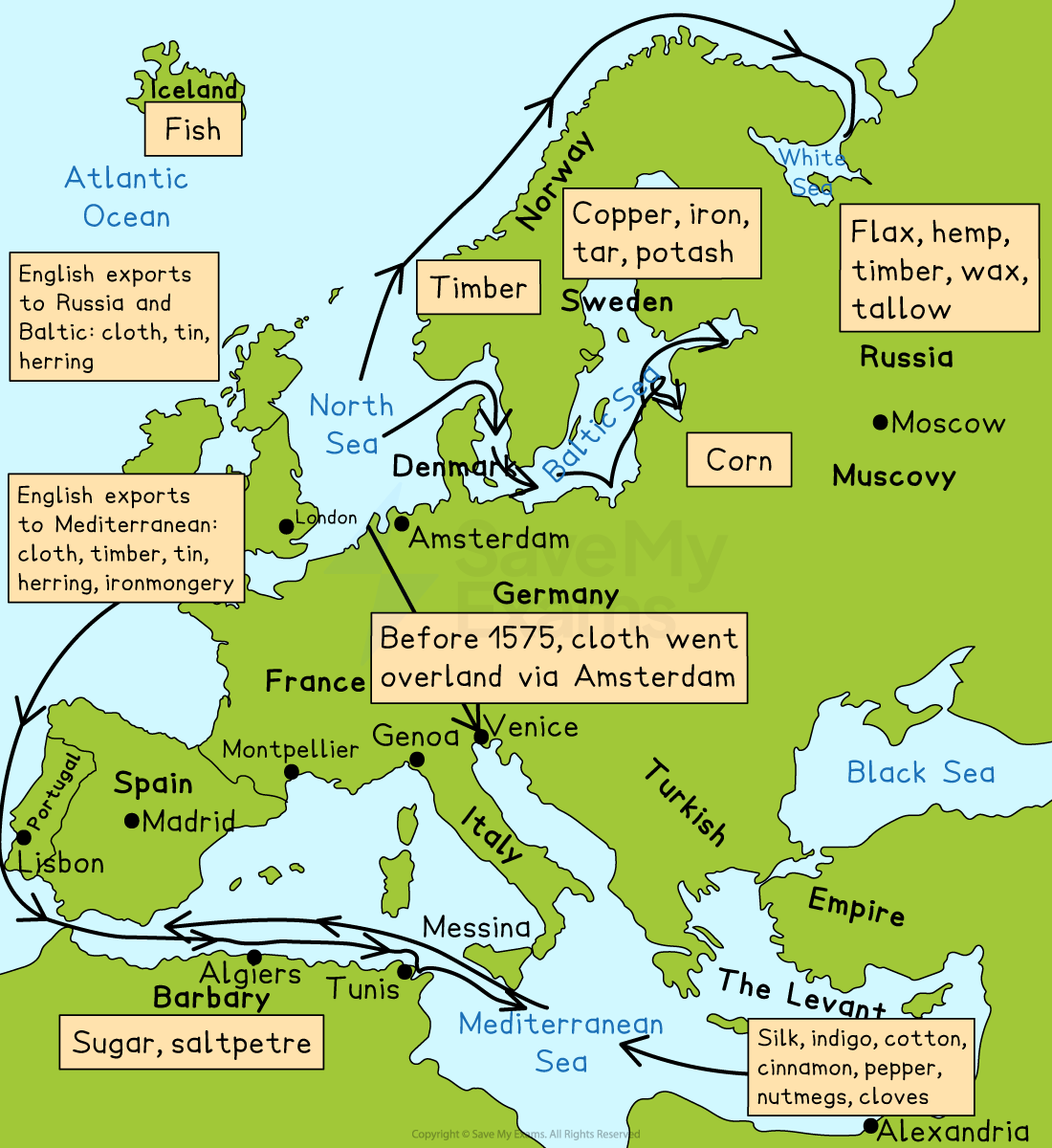
New markets opened in Russia, the Baltic, the Ottoman Empire and eventually Asia
Internal trade also grew:
Key example: coal shipments from Newcastle to London via the North Sea and the Thames
New urban settlements developed, creating a broad range of goods such as coal, leather and iron
Legislation to regulate trade and industry increased
This reflected the government's awareness that taxing manufacturers and traders brought wealth to the Crown
Examiner Tips and Tricks
Students often focus on individual voyages or trading companies, but the key development in this period is diversification. England moved away from dependence on cloth exports through Antwerp towards a wider network of markets across Europe, Russia and beyond. In answers, prioritise this long-term structural shift rather than listing isolated examples.
The Growth of London & the Development of Overseas Markets
The growth of London
London grew dramatically under Elizabeth
Its population rose from around 60,000 in 1520 to around 200,000 by 1600
By the end of the reign, it was one of the largest cities in northern Europe
This growth was driven by London's role as the centre of English trade, law, government and the royal court
London developed as a major commercial and manufacturing centre
It was the main hub for trading companies, merchants and financiers
The city grew as a consumer market
Shipbuilding and associated port industries grew with the expansion of trade
London's growth also created new pressures
Overcrowding and disease were persistent problems
The food riot of 1595 reflected the social strain that rapid growth produced
The development of overseas markets
The Netherlands (Antwerp to Amsterdam) |
|
|---|---|
Russia and northern Europe (The Muscovy Company) |
|
The Baltic (Eastland Company) |
|
The Ottoman Empire (Levant Company) |
|
Asia (East India Company) |
|
English shipping grew to support the expansion of overseas trade
Navigation legislation promoted the use of English ships
The navy expanded, partly driven by war with Spain
English sailors gained experience on increasingly long ocean voyages
Drake's circumnavigation (1577–1580) boosted English confidence at sea
Examiner Tips and Tricks
People often underestimate London's growth. Its rise to 200,000 by 1600 made it a genuinely major European city and commercial hub, not just a trading port. The internal trade it generated became very valuable by the later Tudor period.
Joint-Stock Companies: The East India Company & the Muscovy Company
What is a joint-stock company?
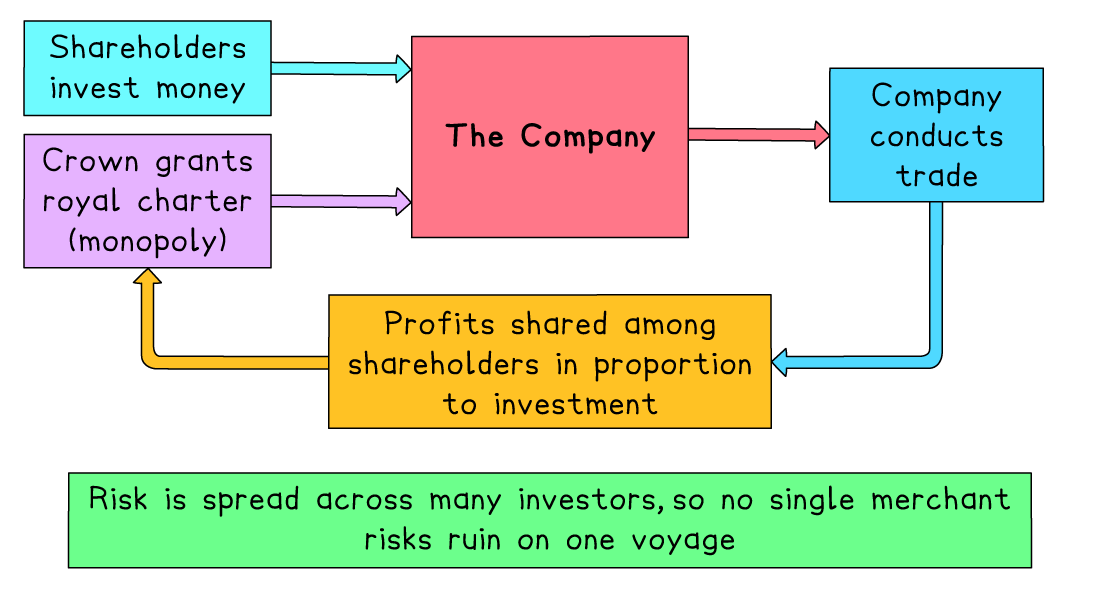
A joint-stock company is owned by its shareholders
Investors bought shares in the company and received a proportion of any profits
Key advantages:
Risk was spread across many investors
No single merchant risked ruin on one failed voyage
The company often received a royal charter granting monopoly trading rights
This model was a significant commercial innovation
It shaped the future of English (and later British) commercial expansion
The Muscovy Company
The Muscovy Company was chartered in 1555 by Mary I
It grew out of an expedition led by Hugh Willoughby and Richard Chancellor to find a north-east passage to Asia
Willoughby and his crew froze to death in the Arctic
Chancellor survived, reached the White Sea and made contact with Tsar Ivan IV of Russia
A profitable trade with Russia was established
English cloth and tin went east; Russian furs, timber, wax and tallow came back
The Muscovy Company had mixed long-term results
It helped challenge the Hanseatic League's monopoly over Baltic trade
Anthony Jenkinson extended southward from Russia to Persia in the 1560s, attempting to open central Asian trade routes
These Persian ventures ultimately failed
The Company eventually struggled to compete with the Dutch in the Baltic
But it established Russia as a long-term trading partner
The East India Company
The East India Company was founded on 31st December 1600 with a royal charter from Elizabeth
A group of London merchants received a monopoly on all English trade in Asia
James Lancaster had already sailed to the East Indies in 1591, capturing two Portuguese ships
His return journey was disastrous; he was eventually picked up by French privateers and returned to England in 1594
Lancaster's second voyage, backed by the newly-founded Company, was far more successful
He returned with fully-laden ships in 1603, just after Elizabeth's death
The East India Company faced serious challenges in its early years
The Dutch East India Company (VOC, founded 1602) used established trading networks and regional contacts in Asia
English competition with the Dutch in Asia would prove difficult and costly for decades
Despite this, the Company grew into one of the most significant commercial enterprises in world history
It late became central to British expansion in India
Examiner Tips and Tricks
When assessing the importance of trade, avoid simply describing growth. Instead, evaluate how far diversification had transformed England by 1603. A strong answer will weigh the expansion of overseas markets and London’s growth against the continued importance of internal trade and the limited scale of early trading companies.
How Important was Trade to Elizabethan England's Development?
Use the specific evidence below to build and support your own argument
The case that trade was central to Elizabethan development
Cecil's active role in shaping commercial policy shows trade was a government priority from the start of the reign
It regulated key industries and promoted English shipping
Royal charters gave trading companies monopolies, encouraging investment and spreading risk
The diversification of trade transformed England's economic position
In 1558, England depended almost entirely on cloth exports through Antwerp
By 1603, English merchants were trading with Russia, the Baltic, the Ottoman Empire and Asia
This reduced England's vulnerability to disruption in any single market
London's growth to 200,000 by 1600 reflected the scale of trade's impact on society
It became one of the largest cities in northern Europe, concentrating financial and commercial activity
Internal trade grew alongside overseas commerce
Customs duties (especially tonnage and poundage) provided an increasingly important source of Crown revenue
The case that trade's importance should not be overstated
England's trading companies were still modest organisations by 1603
The East India Company was only months old at Elizabeth's death
Its significance came under the Stuarts
The Muscovy Company ultimately struggled to compete with the Dutch in the Baltic
The economic depression of the 1590s showed how vulnerable trade still was
Four successive harvest failures between 1594 and 1597 hit the poorest hard despite commercial growth
The war with Spain disrupted trade with Spanish-controlled markets for nearly two decades
Internal trade surpassed foreign trade in value by the later Tudor period
This suggests overseas commerce alone does not explain England's development
Examiner Tips and Tricks
This question asks about trade's importance to England's development, not just whether trade grew. A strong answer will connect commercial change to broader consequences: London's growth, the joint-stock model's long-term significance and the Crown's financial dependence on taxing trade. Always weigh what had genuinely been achieved by 1603 against what only became significant under the Stuarts.

Unlock more, it's free!
Join the 100,000+ Students that ❤️ Save My Exams
the (exam) results speak for themselves:

Was this revision note helpful?
