Elizabeth I: Foreign Policy - Spain, the Netherlands & the Armada (AQA A Level History: Component 1: Breadth study): Revision Note
Exam code: 7042

Summary
Anglo-Spanish relations deteriorated steadily over two decades, driven by religion, trade disputes and the crisis in the Netherlands (a Protestant revolt against Spanish rule)
Elizabeth resisted open war with Spain for 20 years, giving the Dutch rebels unofficial support while avoiding direct military commitment
The Treaty of Nonsuch (1585) finally committed England to open military support for the Dutch rebels, marking the unofficial start of the war
The Spanish Armada (1588) was defeated through a combination of English tactics, Spanish weaknesses (planning, coordination and leadership) and severe weather
The Armada's defeat did not end the war
Fighting dragged on until 1604, at enormous cost to England
Historians debate how far Elizabeth's foreign policy was a success
Wernham argues she "only half achieved her aims" but that this was a fair result against the power of Philip II
Relations With Spain: From Alliance to Hostility
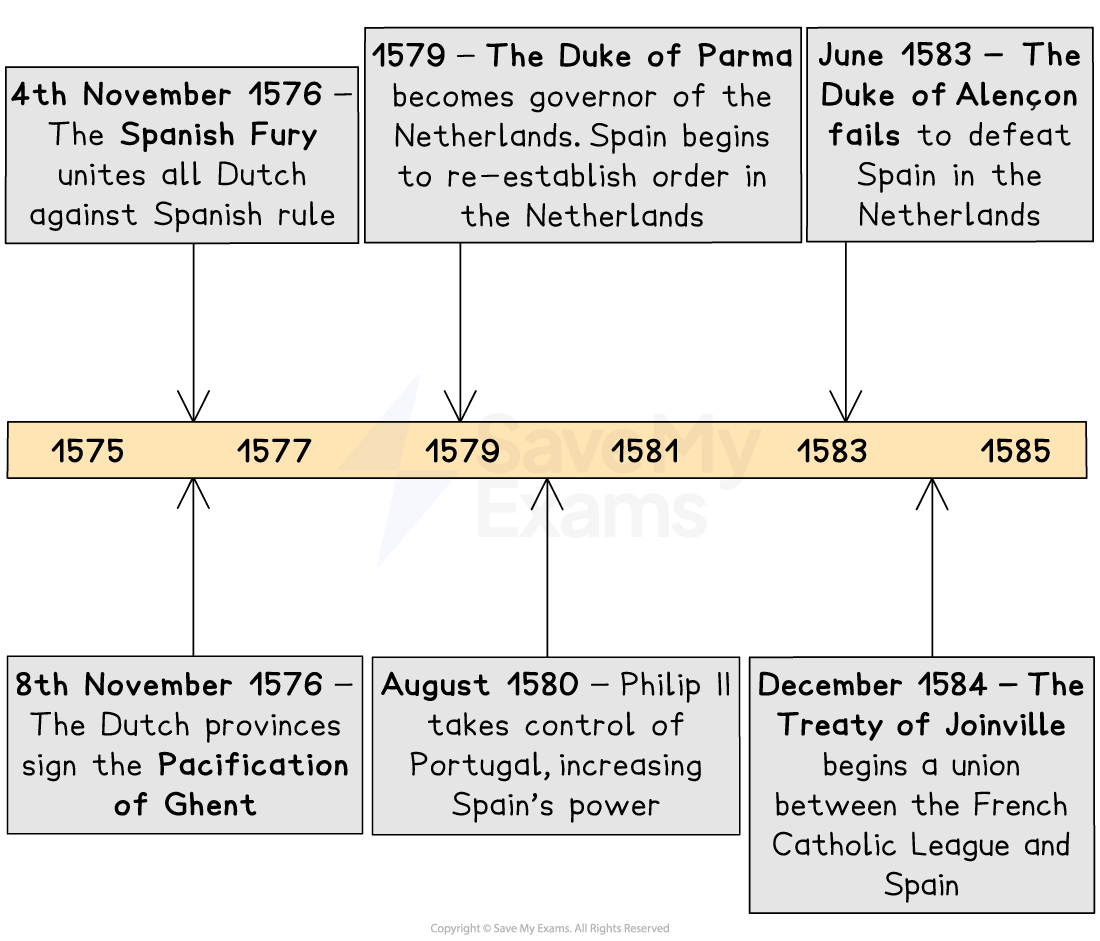
Anglo-Spanish relations began well but deteriorated over two decades
Philip II proposed marriage to Elizabeth in 1559
She declined but relations remained broadly cordial into the 1560s
Three overlapping causes drove the countries apart
Religion
Trade disputes
The situation in the Netherlands
Religious tensions
Religion was a growing source of conflict between the two countries
Philip was a committed Catholic and champion of the Counter-Reformation
Elizabeth's Protestant settlement and her support for Protestant rebels across Europe put the two increasingly at odds
The papal excommunication of Elizabeth in 1570 deepened the divide
Philip had not been consulted and was initially angry, but the effect was to make English Catholics appear increasingly suspect to Elizabeth’s government
Trade and privateering
English privateers were a persistent cause of Spanish grievance
John Hawkins conducted slave-trading and privateering expeditions to the Caribbean in 1562, 1564 and 1567
These directly challenged Spain's influence over the Atlantic trade
In 1568, Spanish ships attacked Hawkins's fleet at San Juan de Ulua
Most English ships were destroyed or captured
English privateers continued to raid Spanish shipping throughout the 1560s and 1570s
Elizabeth turned a blind eye
The bullion seizure of 1568 was a major diplomatic flashpoint
Elizabeth seized Spanish silver being transported through the Channel to pay the Duke of Alba's army in the Netherlands
Alba retaliated by confiscating all English ships docked in the Netherlands
England banned all trade with Spain and the Netherlands
Normal relations were not restored until 1573
The deterioration of relations, 1568–1585
The table below shows the key events that pushed England and Spain towards war
Date | Event and significance |
|---|---|
1568 |
|
1571 |
|
1572 |
|
1583–1584 |
|
1584 |
|
1585 |
|
Examiner Tips and Tricks
Be careful about treating the Armada as the beginning of the Anglo-Spanish conflict. Relations had been deteriorating for more than 20 years before 1588. A strong answer will show how the tension built gradually through religion, trade, the plots involving Mary Queen of Scots and the Netherlands crisis, rather than jumping straight to 1588.
English Involvement in the Netherlands: Supporting the Dutch Revolt
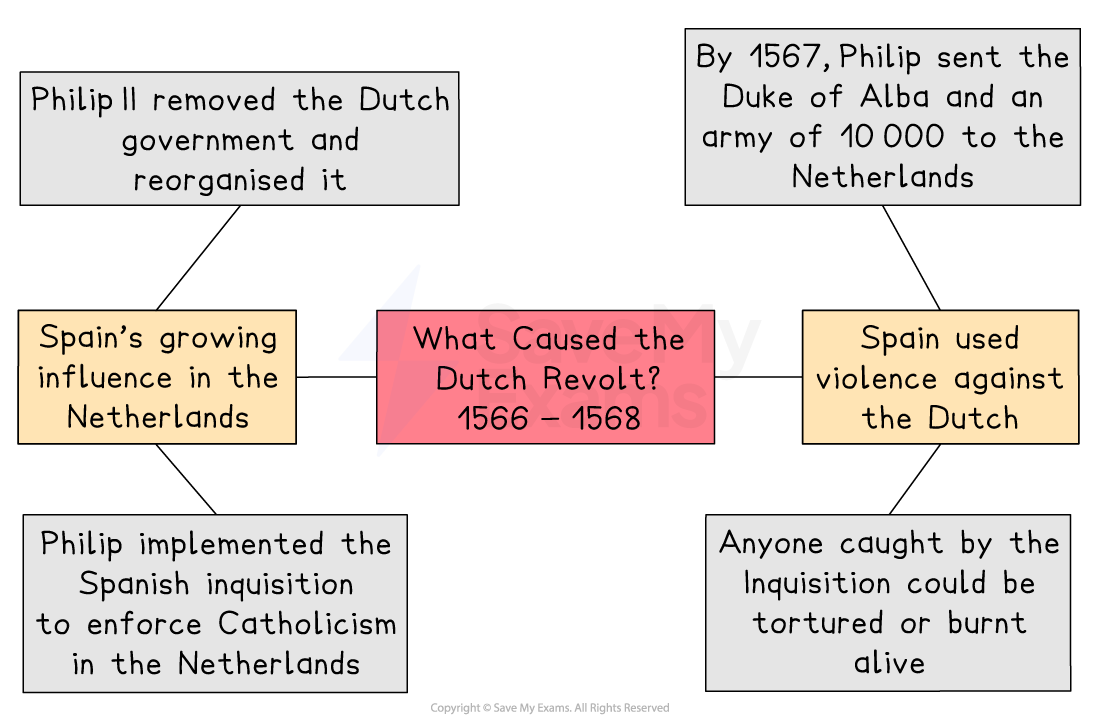
The Netherlands mattered to England for both economic and strategic reasons
The main market for English cloth exports ran through Dutch ports, especially Antwerp
England's security depended on keeping a hostile power off the Channel coastline directly opposite
Spain's control of the Netherlands meant a large, professional Spanish army just across the Channel
From 1566, the revolt against Spanish rule in the Netherlands created a growing crisis
The Duke of Alba was sent with 10,000 troops to crush the revolt in 1567
His brutal methods alarmed England
The Spanish Fury of 1576 saw unpaid Spanish troops sacked Antwerp and other towns
Elizabeth gave unofficial support to the rebels throughout the 1560s and 1570s: money, English volunteers and allowing rebel ships to use English ports
She resisted pressure from Leicester and Walsingham to commit troops directly
The turning point: 1584–1585
A series of events in 1584 forced Elizabeth to act openly
William of Orange, the Dutch rebel leader, was assassinated in July 1584
The Duke of Parma was steadily reconquering the Netherlands for Spain
France allied with Spain at the Treaty of Joinville (1584), removing France as a counterweight
The Duke of Alençon, Elizabeth's last potential ally in the Netherlands, died
The Treaty of Nonsuch (1585) committed England to open military intervention in the Netherlands
Elizabeth agreed to send around 7,000 troops and 1,000 cavalry to the rebel provinces
The Dutch handed over Flushing and Brill as guarantees
Elizabeth refused sovereignty over the Netherlands but agreed to protect the rebel provinces
The Earl of Leicester commanded the English forces
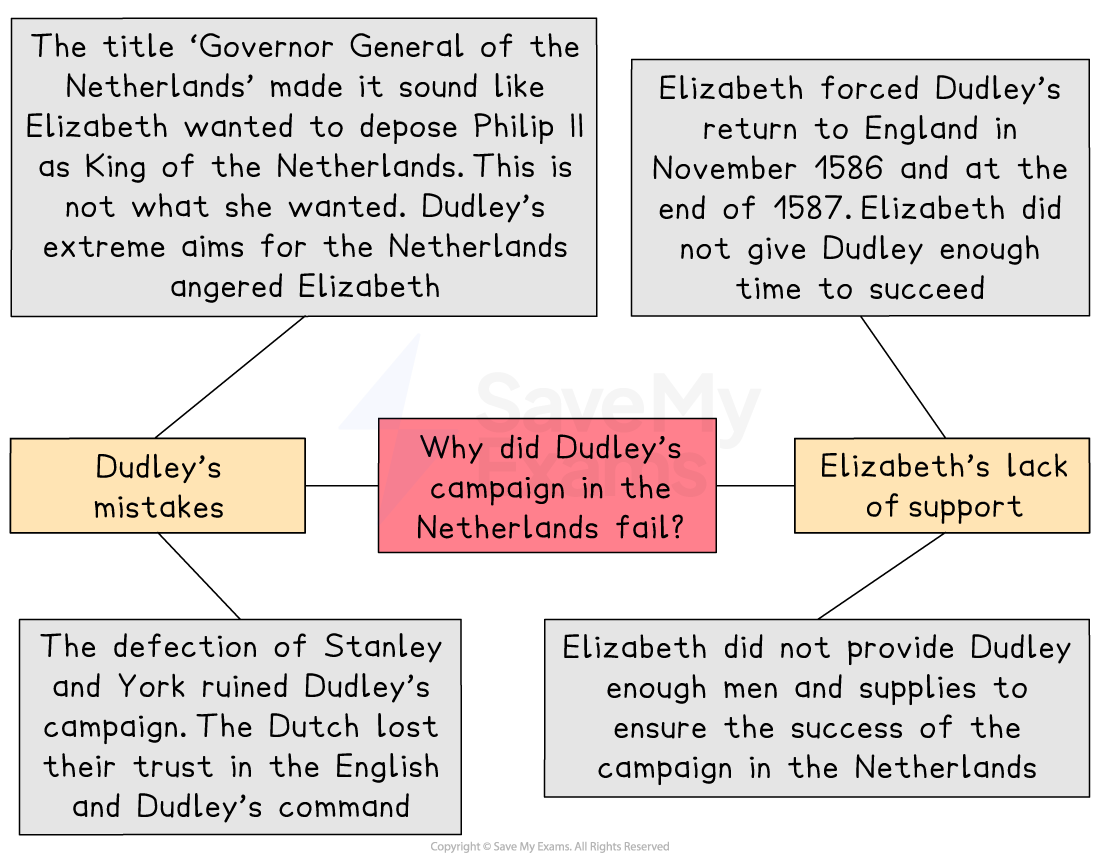
Leicester's campaign was largely a failure
He accepted the title of Governor-General in the Netherlands, directly against Elizabeth's instructions
English commanders quarrelled among themselves
The campaign achieved little militarily, though it kept the revolt alive
Leicester returned to England in 1587
Examiner Tips and Tricks
The Netherlands is often underplayed in essays in favour of the Armada. It was actually the central issue in Anglo-Spanish relations for nearly 20 years. Elizabeth's reluctance to commit troops directly, and her eventual forced involvement, tells you a great deal about how she approached foreign policy: cautious, reactive and driven by necessity rather than ideological commitment.
The Spanish Armada, 1588: Causes, Events & Significance
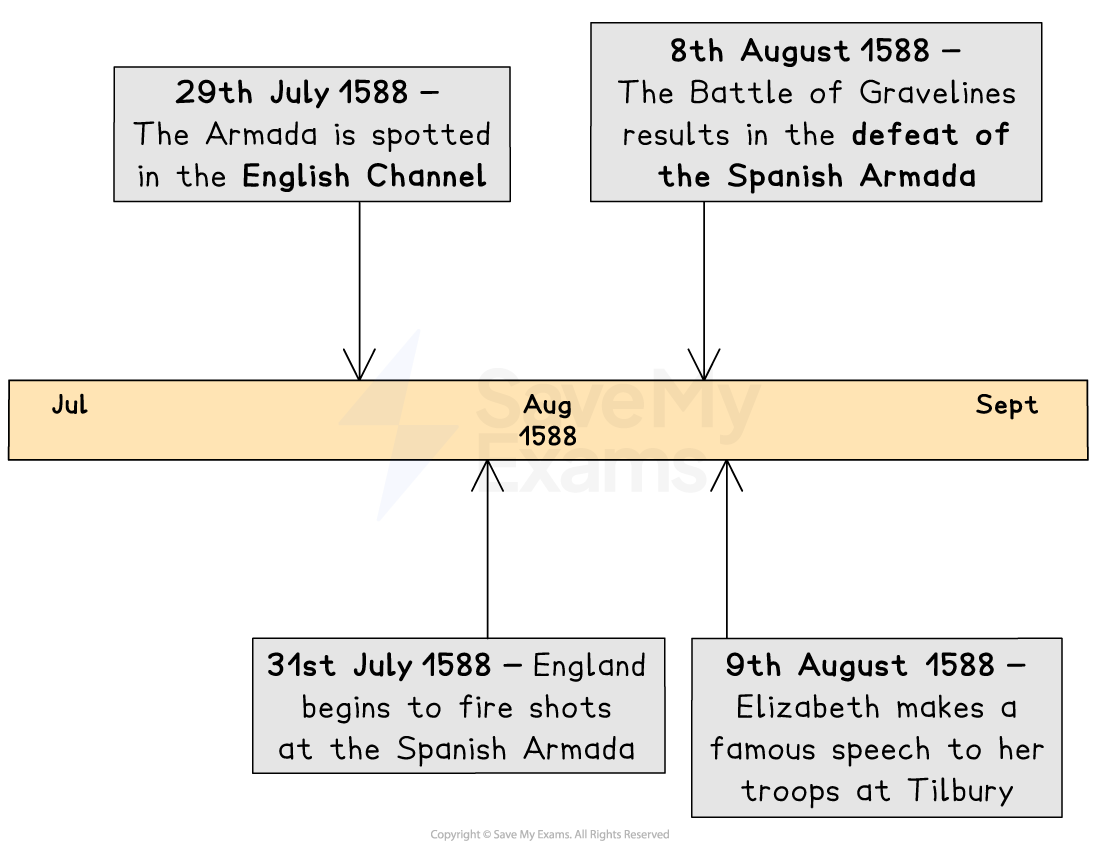
Causes of the Armada
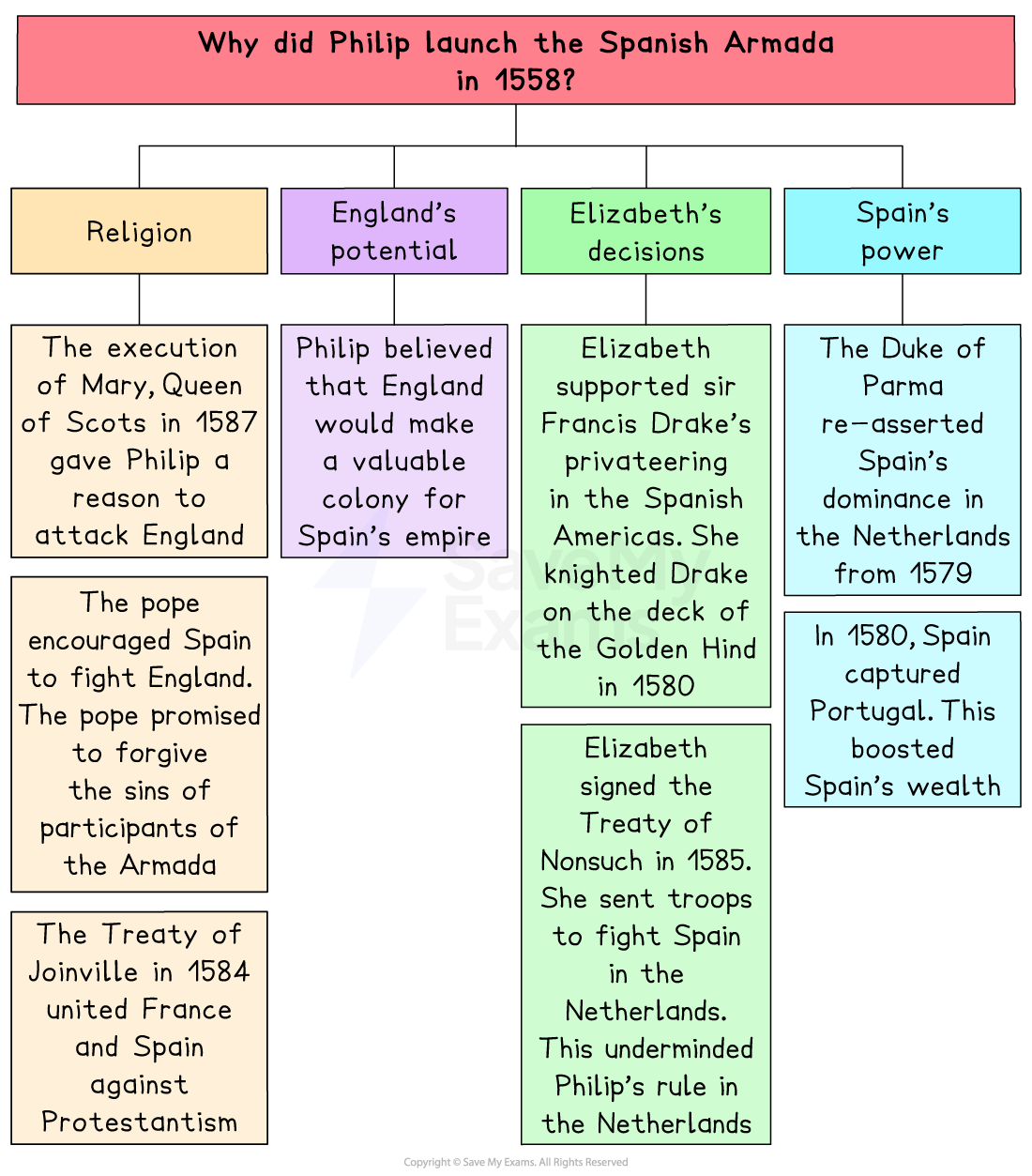
Several causes came together in the mid-1580s to make Philip II decide to invade England
The Treaty of Nonsuch (1585) and Leicester's intervention in the Netherlands directly challenged Spanish power
Sir Francis Drake, a leading English privateer and naval commander, raided Cadiz in 1587 destroyed around 30 Spanish ships
This helped delay the Armada by a year
The execution of Mary Queen of Scots in 1587 removed Philip's hope of a Catholic succession in England
Philip convinced himself that an invasion was the only solution to English interference
The Spanish plan and its weaknesses
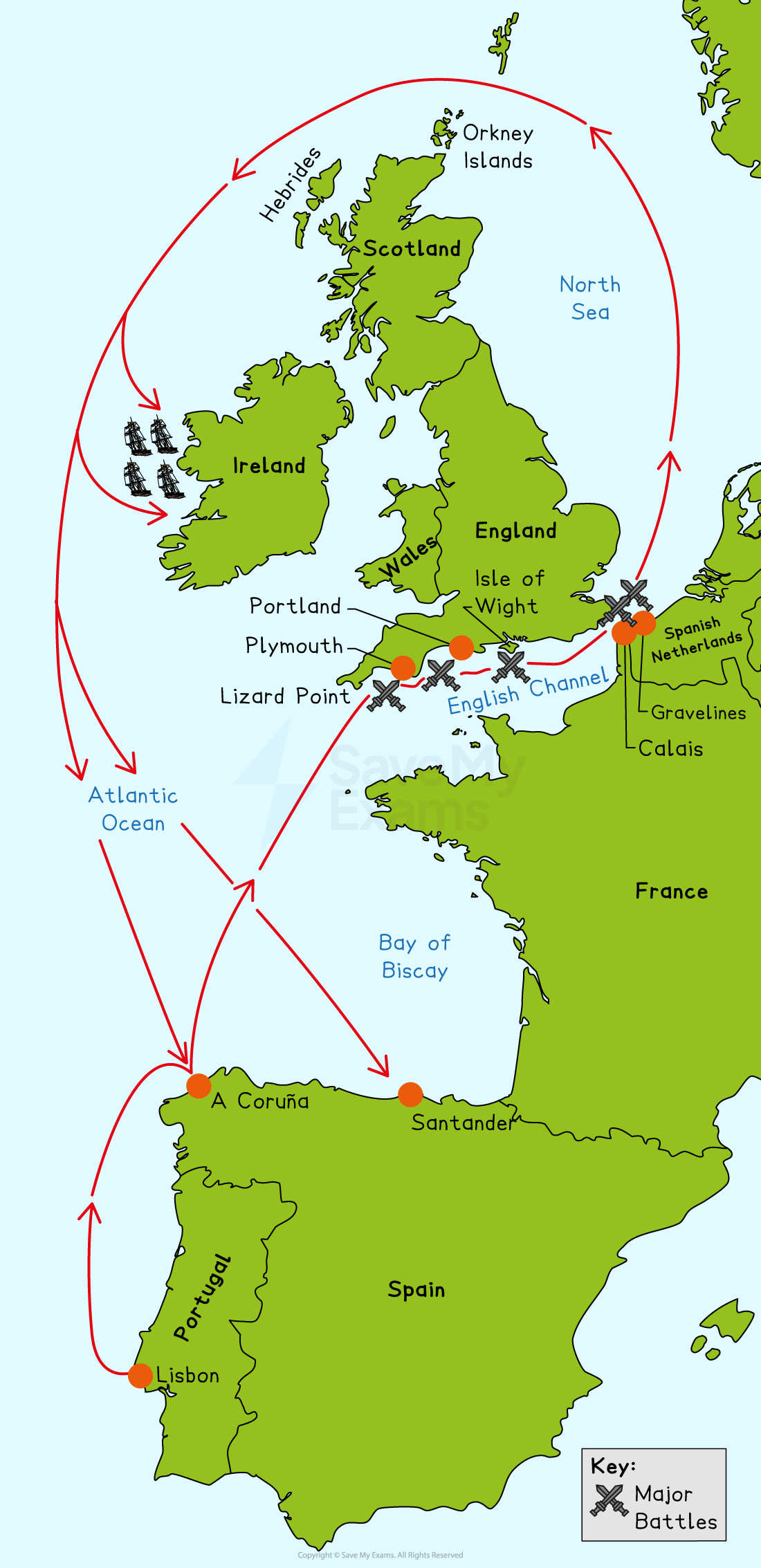
The plan was for the Armada to link up with Parma's army and transport it to England
The Armada of 130 ships and around 30,000 men (estimates vary) sailed from Lisbon under the Duke of Medina Sidonia
Parma's army of around 17,000 men was waiting in the Netherlands to embark
The plan had fundamental weaknesses before the fleet even left port
Communication between the fleet and Parma's army at sea was nearly impossible
Dutch fly-boats blockaded Parma's forces in shallow ports
His troops could not reach the deep-water Armada
The Armada could not anchor safely in deep water off the Flemish coast to wait for Parma
South-westerly winds made sailing back into the Channel extremely difficult once the fleet had passed
Medina Sidonia was an experienced administrator, but not an experienced naval commander
The Armada’s failure was not inevitable, but the weaknesses in Spanish planning made success highly unlikely once the fleet entered the Channel
Supplies were inadequate for a prolonged campaign
Ships were designed for transport rather than naval combat
Events of the Armada Campaign:
Stage | What happened? |
|---|---|
Late July 1588: Channel engagement (English Channel) |
|
6–7 August 1588: Anchoring at Calais |
|
7–8 August 1588: Fireship attack (Calais) |
|
8 August 1588: Battle of Gravelines |
|
August–September 1588: Retreat and return voyage |
|
English advantages in the Armada campaign
Faster, more manoeuvrable ships
Superior naval gunnery (faster rate of fire, not just range)
Experienced commanders (e.g. Drake, Hawkins)
Fighting in home waters with better supply and coordination
“God hath given us so good a day in forcing the enemy so far to leeward as I hope in God that the Prince of Parma and the Duke of Sidonia shall not shake hands these few days; and whensoever they shall meet, I believe neither of them will greatly rejoice of this day's service… From aboard her Majesty's good ship the Revenge, this 29th July 1588.”
Sir Francis Drake, report to Sir Francis Walsingham, 29 July 1588
Written early in the campaign (29 July 1588), before the decisive engagement at Gravelines. The tone is optimistic and reflects expectations of success rather than the final outcome.
The defeat of the Armada was a major propaganda victory for Elizabeth
Elizabeth visited her troops at Tilbury and delivered one of the most famous speeches in English history
The Armada Portrait was commissioned to celebrate the victory and project Elizabeth's power
Medals were struck with the inscription "God blew and they scattered"
The victory was presented as proof of God's favour for Protestant England
However, the defeat of the Armada did not end the war
Fighting continued for another 16 years
Examiner Tips and Tricks
The Drake source was written early in the campaign (29 July 1588), before the decisive engagement at Gravelines (8 August). It reflects optimism and expectation rather than the final outcome. When evaluating it in a Section A question, consider: Drake had every reason to present events positively to Walsingham. It captures the immediate mood of victory but does not reflect a considered judgement on what had been achieved. Always evaluate the purpose and context of a source, not just what it says.
The Anglo-Spanish War After 1588
The defeat of the Armada did not end the war; it dragged on until 1604
Further Spanish Armadas were launched in 1596 and 1597
Both were scattered by storms
The war was fought at sea, in the Netherlands, on the coasts of Spain and Portugal, and in Ireland
It was enormously costly for England
Key events
Event | What happened and why it mattered |
|---|---|
Drake's Portugal expedition, 1589 |
|
Death of Hawkins (Nov 1595) and Drake (Jan 1596) |
|
Raid on Cadiz, 1596 |
|
Second and Third Spanish Armadas, 1596–1597 |
|
Death of Philip II, 1598 |
|
Spanish troops in Ireland, 1601 |
|
Peace of London, 1604 |
|
The war left England in serious financial difficulty
Elizabeth sold Crown lands worth around £800,000 to fund the conflict
She issued monopolies as a substitute for taxation, fuelling the parliamentary crisis of 1601
The loss of Crown lands reduced regular income for her Stuart successors
Examiner Tips and Tricks
Students often treat 1588 as the end of the story. A strong answer will show that the Armada's defeat was the beginning of a long and costly war, not the climax of Elizabeth's foreign policy. The financial consequences of the war are particularly important for understanding the political tensions of the 1590s.
How Successfully Did Elizabeth Handle Foreign Affairs? (Spain and the Netherlands)
Use the specific evidence below to build and support your argument
The case that Elizabeth handled foreign affairs well
Elizabeth kept England out of open war with Spain for 20 years through careful diplomacy
She used marriage negotiations as a diplomatic tool to maintain leverage with France, Spain and the Austrian Habsburgs
She gave unofficial support to the Dutch rebels from the mid-1560s to 1585 without triggering war
The Armada was defeated and England was not invaded
The survival of Protestant England in the face of the most powerful Catholic monarchy in Europe was a significant achievement
By 1609, the Dutch had effectively secured their independence from Spain
English intervention had helped keep the revolt alive
Elizabeth avoided outright bankruptcy even while fighting a major European power
She sold Crown lands and used monopolies to fund the war rather than keep raising taxes or going bankrupt
James I was able to make peace in 1604 from a position of security, not desperation
Key historian
R. B. Wernham, 'Elizabethan War Aims and Strategy', in Elizabethan Government and Society (1961) |
|
|---|
The case that Elizabeth's foreign policy had serious weaknesses
20 years of indecision over the Netherlands allowed Spain to strengthen its position considerably
Parma had reconquered much of the southern Netherlands by the time Elizabeth finally intervened in 1585
Leicester's campaign, when it finally came, was a failure
The war after 1588 produced few decisive results despite large costs
Drake's Portugal expedition (1589) was an expensive failure
Attacks on Spanish bullion ships became far less effective as Spain developed a convoy system
The sale of Crown lands stored up serious financial problems for the Stuart monarchs who followed
Elizabeth's failure to reform Crown finances during the war left James I in a weak position
Examiner Tips and Tricks
The Wernham quote is carefully balanced. He criticises Elizabeth as a war leader while still arguing the overall result was fair. A strong answer will use this nuance rather than simply arguing that Elizabeth was a success or failure. The key is to show that foreign policy was a mixed record, with genuine achievements alongside real costs and limitations.

Unlock more, it's free!
Join the 100,000+ Students that ❤️ Save My Exams
the (exam) results speak for themselves:

Was this revision note helpful?
