Elizabeth I: The Church - Archbishops, Injunctions & Enforcement (AQA A Level History: Component 1: Breadth study): Revision Note
Exam code: 7042

Summary
The Royal Injunctions of 1559 set out the practical rules that turned the Settlement into a working national Church, from how clergy dressed to how they preached
Archbishop Parker (1559–1575) stabilised the Church in its first decade, produced the Bishops' Bible and enforced the Settlement cautiously without making martyrs
Archbishop Grindal (1575–1583) was suspended by Elizabeth for refusing to ban prophesyings, leaving the Church without effective leadership for much of his tenure
Archbishop Whitgift (1583–1604) broke organised Puritanism within the Church through the Three Articles, the Court of High Commission and his campaign against the classis movement
The Settlement survived all challenges intact, but its success depended on enforcement machinery that was uneven in practice and often relied on local co-operation
Historians debate how successfully Elizabeth managed the Church:
Williams argued her management looked like failure in the early years
Others credit her consistency and Whitgift's enforcement with securing the Settlement long-term
The Royal Injunctions & Enforcement of the Settlement
What were the Royal Injunctions?
The 1559 Settlement was established through three interlocking documents
The Act of Supremacy made Elizabeth "Supreme Governor of the Church"
The Act of Uniformity required the use of the Prayer Book and compulsory attendance at church
The Royal Injunctions filled in the practical detail that Parliament could not legislate for
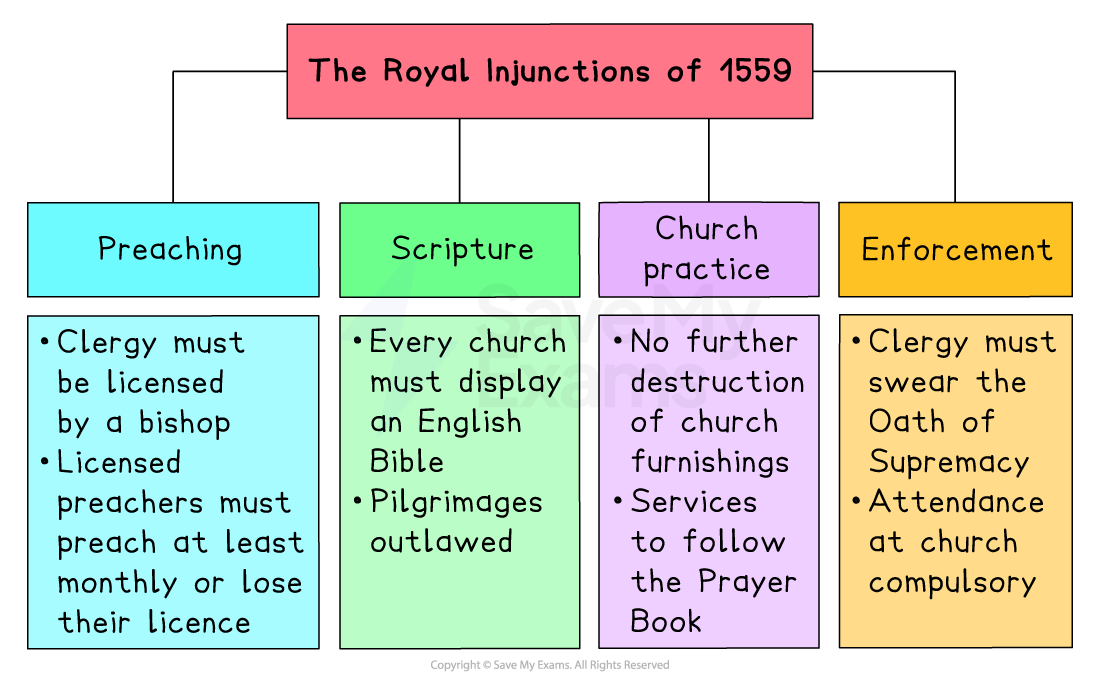
The Royal Injunctions of July 1559 contained 57 separate instructions
Below are some of the key instructions:
Preachers had to be licensed by a bishop before they could preach at all
Licensed preachers were expected to preach regularly or risk losing their licence
Every church had to display a Bible written in English
Pilgrimages were outlawed
Further destruction of church fittings, including altars, was to cease
All clergy had to swear the Oath of Supremacy, accepting Elizabeth as Supreme Governor of the Church
The Injunctions were the practical backbone of the Elizabethan Church
They gave archbishops and bishops the tools to enforce conformity at parish level
The licensing requirement was the key mechanism for controlling who could preach
It also aimed to raise standards:
Unlicensed or inactive preachers could be removed
What did the Settlement look like in practice?
The Settlement was deliberately designed to retain a familiar, Catholic-looking appearance
Elizabeth wanted a Church that the majority could accept, not one that drove people away
English psalms, music and vestments such as the surplice all remained
This was a source of frustration for Puritans and comfort for moderate Catholics
“As for the manner of their service in church and their prayers, except that they say them in the English tongue, one can still recognise a great part of the Mass, which they have limited only in what concerns individual communion. They sing the psalms in English, and at certain hours of the day they use organs and music. The priests wear the hood and surplice. It seems, apart from the absence of images, that there is little difference between their ceremonies and those of the Church of Rome.”
French ambassador de Maisse, report on the Church of England, 1597
De Maisse was a French diplomat writing nearly 40 years into the reign. His observation captures exactly what Elizabeth intended: a Church that looked familiar enough to be acceptable to the majority of English people, while being doctrinally Protestant. The deliberate conservatism of the Settlement was a management choice, not an accident.
Enforcement machinery
The Court of High Commission was the main tool for enforcing Church discipline
It was an ecclesiastical court with the power to prosecute those who refused conformity
It could summon, examine and punish clergy who broke the Settlement's rules
It had the power to use the ex officio oath:
Ministers had to answer questions under oath without being told the charges in advance
This was deeply resented but highly effective
Royal visitations checked that the Settlement was being implemented
Commissioners visited dioceses to inspect church practice in 1559 and at intervals thereafter
They found wide variation: enthusiastically Protestant in some areas, deeply conservative in others
The north of England and parts of Wales remained particularly slow to accept the new Church
Justices of the Peace (JPs) and local gentry were essential to making enforcement work at parish level
Recusancy fines required JPs to report and collect them
In practice, JPs often had Puritan or Catholic sympathies that shaped how vigorously they enforced the law
The Settlement's success depended heavily on the co-operation of local elites
Examiner Tips and Tricks
The Royal Injunctions are sometimes overlooked in favour of the Acts of Supremacy and Uniformity. But it was the Injunctions that turned the Settlement into something parishes actually felt. It is worth knowing two or three specific provisions, such as the licensing of preachers or the English Bible requirement.
The Role of the Archbishop of Canterbury: Parker, Grindal & Whitgift
Archbishop Matthew Parker (1559–1575)
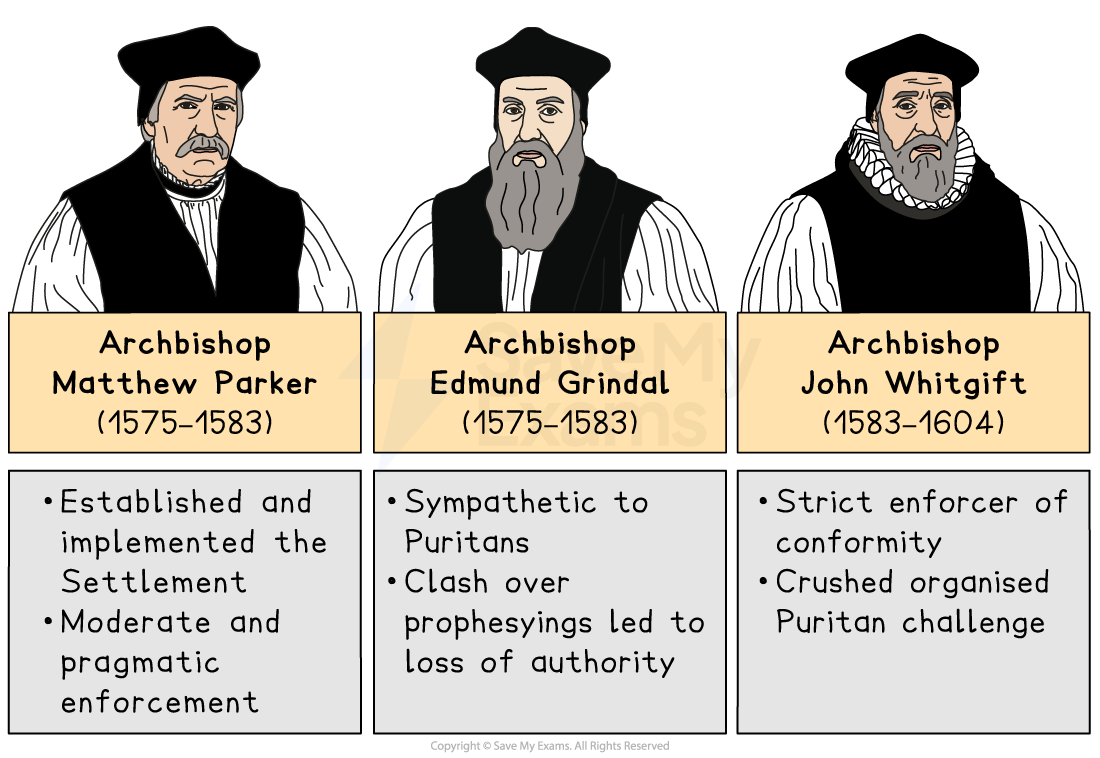
Parker was Elizabeth's first archbishop and the man who shaped the Church in its formative decade
He had previously served as Vice-Chancellor of Cambridge University and was a moderate Protestant
He had spent Mary's reign in hiding in England rather than going into exile
Elizabeth appointed him in 1559; he accepted reluctantly and served until his death in 1575
Parker oversaw the practical establishment of the new Church
He organised the 1559 visitation that checked the Settlement was being put into place
He worked to implement the Royal Injunctions across the country
He organised the production of the Bishops' Bible in 1568, a new translation approved for use in churches
He supervised the approval of the Thirty-Nine Articles through Convocation in 1563
Parker's approach was cautious and broadly effective
He sought to hold together a wide range of opinion within the Church
He enforced the Settlement without needlessly provoking either Catholics or Puritans
When the Vestiarian Controversy broke out in 1566, he watered down his own requirements to try to limit the damage
Parker's limits as archbishop
He lacked the political strength to impose full conformity on resistant clergy
The Vestiarian Controversy rumbled on without resolution through his tenure
He was more scholar than church politician
He worked best on administration, not confrontation
Archbishop Edmund Grindal (1575–1583)
Grindal was appointed Archbishop of Canterbury in 1575, having previously served as Archbishop of York
He was a committed Protestant with genuine Puritan sympathies
He had been in exile during Mary's reign and had direct experience of Reformed churches abroad
His appointment suggested Elizabeth was willing to work with moderate reformers
Grindal's downfall came quickly over the prophesyings crisis of 1576
Prophesyings were organised clerical gatherings for preaching practice and biblical discussion
Elizabeth ordered Grindal to suppress them; she saw them as a vehicle for Puritan ideas
Grindal refused and defended the prophesyings directly to Elizabeth in writing
Elizabeth suspended him from exercising his authority as Archbishop
“In sundry parts of our realm there are no small number of persons which, contrary to our laws established for the public divine service of Almighty God and the administration of the holy sacraments within this Church of England, do daily devise, imagine, propound and put into execution sundry new rites and forms… which manner of invasions they in some places call prophesying and in some other places exercises… we will charge you that the same forthwith cease. But if any shall attempt, or continue, or renew the same, we will you not only to commit them unto prison as maintainers of disorders, but also to advertise us, or our council, of the names and qualities of them, and of their maintainers and abettors.”
Elizabeth I, instructions to the bishops banning prophesyings, 1576
Elizabeth’s language is revealing: she frames prophesyings not as a religious matter but as a breach of established law and an act of disorder. This shows how she consistently treated threats to the Settlement as threats to public order rather than as theological debates. It also shows why she was so angry at Grindal’s refusal to act.
Grindal remained Archbishop in title but was unable to exercise his authority
He was never formally dismissed, but was unable to carry out his duties from 1577 until his death in 1583
Prophesyings were suppressed by Elizabeth's direct orders to other bishops
A prolonged period of reduced leadership at the top of the Church was a serious gap in management
Assessment of Grindal
He is sometimes viewed sympathetically as a man of principle who genuinely believed prophesyings improved the clergy
But his refusal created a dangerous vacuum at a critical moment for the Church
His suspension showed that ultimate authority over the Church rested with the Crown, not the archbishop
Archbishop John Whitgift (1583–1604)
Whitgift was appointed in 1583 after Grindal's death
He was a committed Anglican with no sympathy for Puritanism and shared Elizabeth's instincts
Elizabeth called him "my little black husband" due to his sombre dress and unmarried state
She backed him fully and without reservation throughout his tenure
Whitgift moved immediately to enforce strict conformity
He issued the Three Articles, requiring all clergy to subscribe to royal supremacy, the Prayer Book and the Thirty-Nine Articles
Around 300 ministers were reportedly suspended for refusing
He used the Court of High Commission and the ex officio oath to prosecute non-conformists
See the Puritan Challenge revision notes for further details
Whitgift broke the organised Puritan challenge within the Church
The classis movement, a shadow Presbyterian network growing across several counties in the 1580s, was broken up by the early 1590s
The Marprelate Tracts (1588–1589) backfired on the Puritan cause and gave the government grounds for harsher action
After the Act against Seditious Sectaries (1593), organised separatism in England collapsed
Whitgift gained unusual political authority for an archbishop
In 1586, he was appointed to the Privy Council, one of the few archbishops to sit on it after the Reformation
This gave him both ecclesiastical and political power to pursue uniformity
Assessment of Whitgift
He was the most effective archbishop of the reign in terms of enforcing conformity
His methods were harsh and drew criticism even from Cecil (Burghley)
The Settlement survived intact to 1603, due in large part to his work from 1583 onwards
Puritan sentiment survived underground and re-emerged vigorously under James I, suggesting the underlying tensions were managed rather than resolved
Examiner Tips and Tricks
Questions on the archbishops reward answers that compare all three rather than focusing on just one. The pattern across the three is worth setting out: Parker stabilised but could not fully enforce; Grindal lost control; Whitgift imposed order at the cost of significant resentment. Together they show how difficult it was to manage a Church that contained a wide range of religious opinion.
How Successfully Did Elizabeth Manage the Church of England?
Use the specific evidence to build and support your own argument
The evidence below is not an exhaustive list, consult the other revision notes concerning Elizabeth's approach to the Church for a full picture
The case that Elizabeth managed the Church successfully
The 1559 Settlement survived intact for the entire reign
Neither Catholic recusancy nor Puritan pressure produced a single concession on Church structure
The Settlement Elizabeth established in 1559 remained the Settlement England had at her death in 1603
Three archbishops, however different in approach, each contributed to the Church’s survival
Parker stabilised the Church in its first and most vulnerable decade
Even Grindal’s suspension did not break the Settlement: Elizabeth governed the Church directly in his place
Whitgift broke organised internal opposition within a decade of his appointment
The Royal Injunctions and enforcement machinery worked effectively over time
The licensing system gave bishops long-term control over who could preach and what they said
The Court of High Commission gave the Crown real power over Church discipline
By 1603, the licensing system had shaped what the clergy said for more than 40 years
England avoided the religious civil wars that destroyed France and the Netherlands
By that standard alone, Elizabeth’s management of religious difference was a significant achievement
Two generations of English people had grown up knowing no other Church by 1603
The case that Elizabeth's management of the Church was limited
The Grindal episode showed how badly things could go wrong
Grindal’s suspension created a prolonged period of weak central leadership
Grindal was Elizabeth’s own appointment and his refusal left her with no good options
Enforcement was uneven and depended on local co-operation that was never guaranteed
By the mid-1560s, only around half of JPs could be relied on to support the Settlement
Lancashire and parts of the north remained strongholds of Catholicism throughout the reign
The gap between what the Settlement required and what happened in practice was often wide
The Puritan challenge was managed rather than resolved
Whitgift drove Puritanism underground rather than winning the argument against it
The movement re-emerged with renewed force under James I
Elizabeth’s personal religious conservatism sometimes confused the Church’s direction
Her attachment to crucifixes and candles puzzled both Puritans and committed Protestants
Her personal preferences, including discomfort with some Protestant practices such as clerical marriage, created friction with bishops and ministers
Key historian
N. Williams, Elizabeth I, Queen of England (1971) |
|
|---|
Examiner Tips and Tricks
The key question is partly about what "success" means. If it means keeping the Settlement intact, Elizabeth clearly succeeded. If it means building a genuinely unified national Church that satisfied everyone, she clearly did not. The Williams quote is useful because it reminds you that the Settlement’s survival was not inevitable: things looked very different in 1572 than they did in 1603.

Unlock more, it's free!
Join the 100,000+ Students that ❤️ Save My Exams
the (exam) results speak for themselves:

Was this revision note helpful?