Elizabeth I: Foreign Policy - France & Ireland (AQA A Level History: Component 1: Breadth study): Revision Note
Exam code: 7042

Summary
France was engaged in a civil war between Catholics and Huguenots from 1562
Elizabeth gave occasional support to the Huguenots but avoided full military commitment
The St Bartholomew's Day Massacre (1572) killed thousands of Huguenots and ended any realistic prospect of a Protestant French alliance
Henry IV's conversion to Catholicism in 1593 and the Treaty of Vervins (1598) reduced France’s usefulness as a Protestant ally, although a stable France still limited Spanish power
Ireland posed a persistent challenge to English authority throughout the reign
English control barely extended beyond the Pale around Dublin
The Nine Years' War (1594–1603), led by Hugh O'Neill, Earl of Tyrone, was the most serious rebellion of the reign and cost the Crown around £2 million (an enormous cost for the Crown)
The Battle of Kinsale (1601) ended Spanish involvement in Ireland
O'Neill submitted to English authority in 1603, days after Elizabeth's death
Historians debate how far these problems threatened Elizabeth's security
Ireland was a genuine crisis
France was largely contained through diplomacy
English Involvement in France: The Wars of Religion
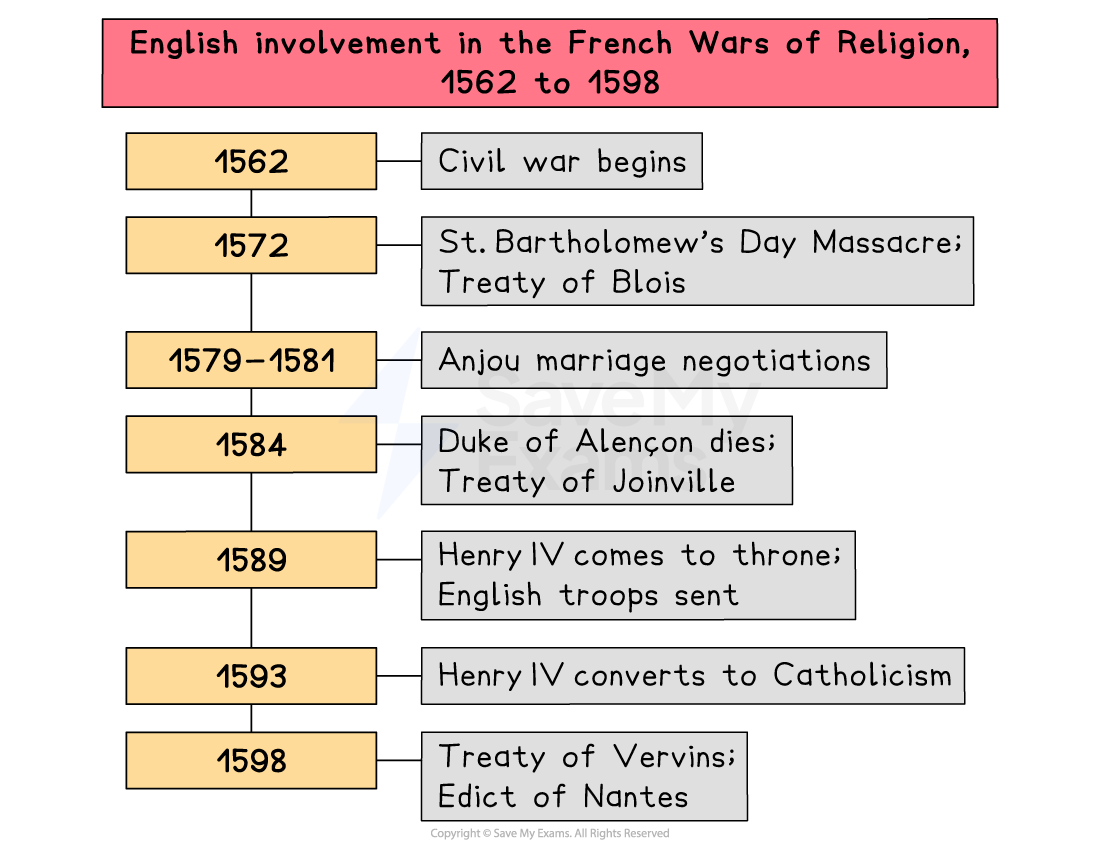
France descended into civil war between Catholics and Huguenots from 1562
The Wars of Religion were fought between powerful Catholic noble families (led by the Guises) and Huguenot (Protestant) families (led by the Prince of Condé)
Elizabeth's early involvement in 1562–1563 ended in failure at Le Havre (England was forced to withdraw without securing Calais)
From 1563 onwards, England gave intermittent financial support to the Huguenots without committing openly
A divided France suited England's interests
Civil war prevented France from acting as a major threat to England
But a France allied with Spain would be dangerous
Elizabeth had to balance these concerns throughout the reign
The St. Bartholomew's Day Massacre, 1572
The massacre was a turning point in the French Wars of Religion
In August 1572, Catholic mobs killed thousands of Huguenots across France
The violence began in Paris on 24th August and spread to other cities
Elizabeth publicly expressed shock, even wearing black at court
The massacre ended any serious prospect of France becoming a Protestant ally for England
It pushed England and France further apart diplomatically, despite the Treaty of Blois earlier that year
The Anjou marriage negotiations, 1579–1581
The closest Elizabeth came to marriage was with Francis, Duke of Anjou (also known as the Duke of Alençon)
Francis was the youngest brother of the French king, Henry III
The negotiations were partly strategic: France was a useful ally against Spain
Elizabeth appeared genuinely attracted to Francis and called him her "frog"
The match was ultimately rejected due to public hostility in England and Elizabeth's reluctance to commit
Henry IV and the later French Wars, 1589–1598
The assassination of Henry III in 1589 brought the Huguenot Henry of Navarre to the throne as Henry IV
Elizabeth saw Henry as a valuable Protestant ally and sent money and troops to support him
An English force was sent to Normandy in 1590–1592, but achieved little
Key events
Event | What happened and why it mattered |
|---|---|
1589: Henry IV becomes King of France |
|
1593: Henry IV converts to Catholicism |
|
1598: Treaty of Vervins |
|
1598: Edict of Nantes |
|
England's involvement in the French Wars of Religion was reactive and limited
Elizabeth gave money and occasional troops but never committed fully
She used the prospect of the Anjou marriage as a diplomatic tool for several years
The stabilisation of France under Henry IV ultimately reduced the Spanish threat to England, but was not the result of English policy
Examiner Tips and Tricks
France is often overshadowed by Ireland in answers regarding foreign policy and security. Make sure you cover both. Elizabeth's handling of France was broadly cautious and reactive but avoided serious damage to English security. Ireland posed a far more costly and dangerous problem. A strong answer will make this distinction clearly.
Ireland Under Elizabeth: Rebellion, Plantation & the Nine Years’ War
Background: the challenge of governing Ireland
England had claimed lordship of Ireland since the medieval period
Henry VIII declared Ireland a kingdom in 1541, but real English control barely extended beyond the Pale around Dublin
Beyond the Pale, Gaelic chieftains exercised real power under their own customs and laws
Ireland was overwhelmingly Catholic and strongly resistant to the Protestant Reformation
It was a persistent strategic weakness for England:
Spain or the papacy could use Ireland as aa potential landing point for foreign invasion of England
The policy of plantation
The main English strategy for controlling Ireland was plantation
Plantation involved settling English (and later Scottish) colonists on land confiscated from Irish lords
It began under Mary I in Laois and Offaly in the 1550s as a policy of control and anglicisation, though it developed more fully under Elizabeth into a Protestant colonial strategy
Under Elizabeth, plantation expanded significantly into Munster after the Desmond rebellions
Grants of Irish land were given to English settlers, including the poet Edmund Spenser and Sir Walter Raleigh
Plantation created lasting resentment among the Gaelic Irish population and failed to produce a stable, English-controlled Ireland
Earlier rebellions
Rebellion | Key details |
|---|---|
Shane O'Neill's rebellion (1559–1567) |
|
First Desmond Rebellion (1569–1573) |
|
Second Desmond Rebellion (1579–1583) |
|
The Nine Years' War, 1594–1603
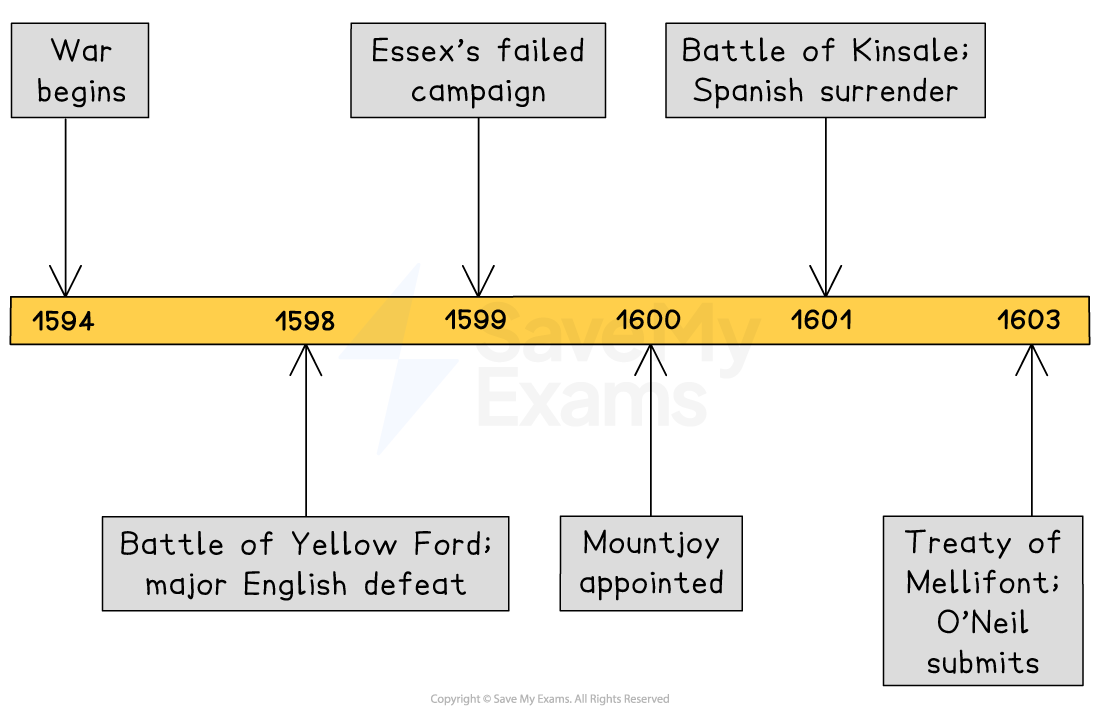
The Nine Years' War was the most serious rebellion of Elizabeth's entire reign
It was led by Hugh O'Neill, Earl of Tyrone, with Red Hugh O'Donnell as his main ally
O'Neill had been educated in England and understood English military tactics
He used this knowledge to fight English forces far more effectively than any previous Irish rebel
He demandedreligious toleration for Catholics and political autonomy for Gaelic lords
O'Neill sought foreign support to strengthen his position
He appealed to Philip II of Spain and to the Pope for military assistance
Spain eventually agreed to send troops, landing at Kinsale in 1601
Key events of the Nine Years' War
Event | What happened and why it mattered |
|---|---|
Battle of Yellow Ford, 1598 |
|
Essex's campaign, 1599 |
|
Mountjoy's campaign, 1600–1603 |
|
Spanish landing at Kinsale, 1601 |
|
Treaty of Mellifont, 1603 |
|
The Nine Years' War left Ireland and England weakened
The war cost England around £2 million, far more than any other military commitment of the reign
It stretched Crown finances to breaking point, and fuelled the political tensions of the 1590s
Ireland remained Catholic and resentful of English rule
The plantation policy had not yet secured a stable Protestant-controlled Ireland
Examiner Tips and Tricks
Yellow Ford was a genuine military crisis. Spain landing troops at Kinsale showed Ireland was still a real strategic vulnerability. Make sure you give the war its full weight rather than treating Ireland as a minor background issue.
How Far Did Foreign Policy Problems in France and Ireland Threaten Elizabeth's Security?
Use the specific evidence below to build and support your own argument
The case that foreign policy problems posed a serious threat
Ireland represented a genuine and sustained threat to English security
The Battle of Yellow Ford (1598) was the worst English military defeat of the reign
It triggered rebellions across the whole of Ireland and came close to collapsing English control entirely
Spain landing around 3,500 troops at Kinsale (1601) showed Ireland could be used as a back door for foreign invasion
The war cost around £2 million and left Crown finances severely damaged
France posed a serious threat in the 1570s and early 1580s
The St Bartholomew's Day Massacre (1572) destroyed the prospect of a Protestant French alliance
The Treaty of Joinville (1584) saw France's Catholic League ally with Spain, raising the prospect of encirclement
The death of the Duke of Anjou (1584) removed Elizabeth’s last useful ally in France
The case that Elizabeth managed threats adequately
France never combined with Spain in a sustained military attack on England
Elizabeth used the Anjou marriage negotiations to keep France diplomatically engaged for several years
Henry IV's accession (1589) and the Edict of Nantes (1598) produced a more stable France that was less threatening to England
The Treaty of Vervins (1598) removed France as an active participant against Spain, reducing Spain’s potential allies
Ireland was eventually brought under control
Mountjoy's campaign was systematic and effective
The Spanish force at Kinsale was defeated and the rebellion ended
O'Neill's submission in 1603 secured English control, even if Elizabeth did not live to see it
The plantation of Ireland continued under James I, building on Elizabethan foundations
Examiner Tips and Tricks
Make sure you also use evidence from Elizabeth's early foreign policy, and her foreign policy with regards to Spain, the Netherlands and the Armada (refer to those revision notes for further evidence). A strong answer will distinguish between the different levels of threat: France was manageable through diplomacy; Spain was the primary military danger; Ireland was the most costly and persistent challenge of all. Make sure your conclusion reflects this range.

Unlock more, it's free!
Join the 100,000+ Students that ❤️ Save My Exams
the (exam) results speak for themselves:

Was this revision note helpful?
