Elizabeth I: Factional Rivalries & the Essex Rebellion (AQA A Level History: Component 1: Breadth study): Revision Note
Exam code: 7042

Summary
For most of her reign, Elizabeth kept factions under control by balancing her rivals against each other; this broke down in the 1590s
The deaths of Leicester (1588), Walsingham (1590) and Burghley (1598) removed the experience ministers who had kept court politics stable
Robert Devereux, Earl of Essex emerged as Elizabeth’s most prominent favourite
He was brave and popular, but politically reckless
Essex and Robert Cecil became bitter rivals, competing for patronage and power throughout the 1590s
Essex's disastrous command in Ireland (1599) and his defiance of Elizabeth destroyed his position at court
In February 1601, Essex marched into London, expecting the citizens to rise with him
No significant support materialised; he was arrested, tried and executed
Historians debate how far factional rivalry represented a crisis of government
Some argue it revealed serious weaknesses; others stress that government continued to function
Factional Rivalries at Court: Essex vs. the Cecils in the 1590s
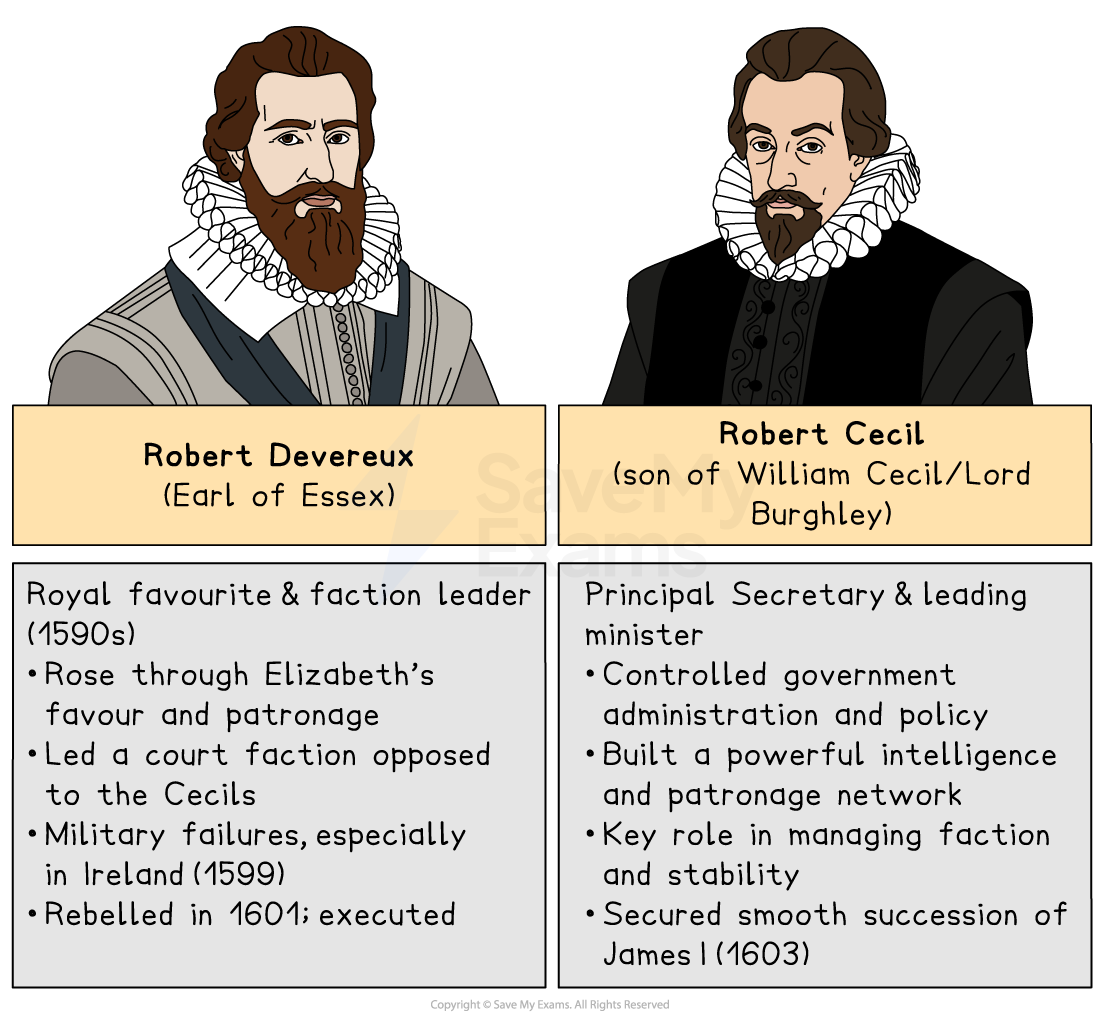
The collapse of the old guard
Court politics were broadly stable for the first 30 years of Elizabeth's reign
Leicester and Cecil (Burghley) were rivals, but they co-operated as much as they competed
Elizabeth deliberately balanced the two, preventing either from dominating
Faction-fighting only became a serious problem in the 1590s
The deaths of key ministers created a vacuum at court
Robert Dudley (Earl of Leicester) died in 1588
Sir Francis Walsingham died in 1590
Sir Christopher Hatton (Lord Chancellor) died in 1591
William Cecil (Lord Burghley) was increasingly incapacitated from 1592 and died in 1598
A new younger generation of courtiers moved into the space they left behind
The two factions
The two dominant figures of the 1590s were:
Robert Devereux, Earl of Essex
Robert Cecil, son of Lord Burghley
The Essex Faction |
|
|---|---|
The Cecil Faction |
|
The rivalry was about patronage as much as policy
High-ranking courtiers attracted networks of clients who depended on them for offices and rewards
Essex tried to monopolise military commands and patronage, squeezing out Cecil's allies
Cecil worked methodically in the background, building administrative control while Essex burned through royal favour
Before the 1590s, the factions co-operated as much as they competed
The serious breakdown only came from the 1590s, when a younger and more aggressive generation took to the political stage
Essex's relationship with Elizabeth was stormy from the start
Quarrels, reconciliations and accusations were a constant feature
Examiner Tips and Tricks
In answers, make it clear that factional problems were only a serious issue in the 1590s. Elizabeth managed court politics well for roughly the first 30 years.
The Rise & Fall of the Earl of Essex
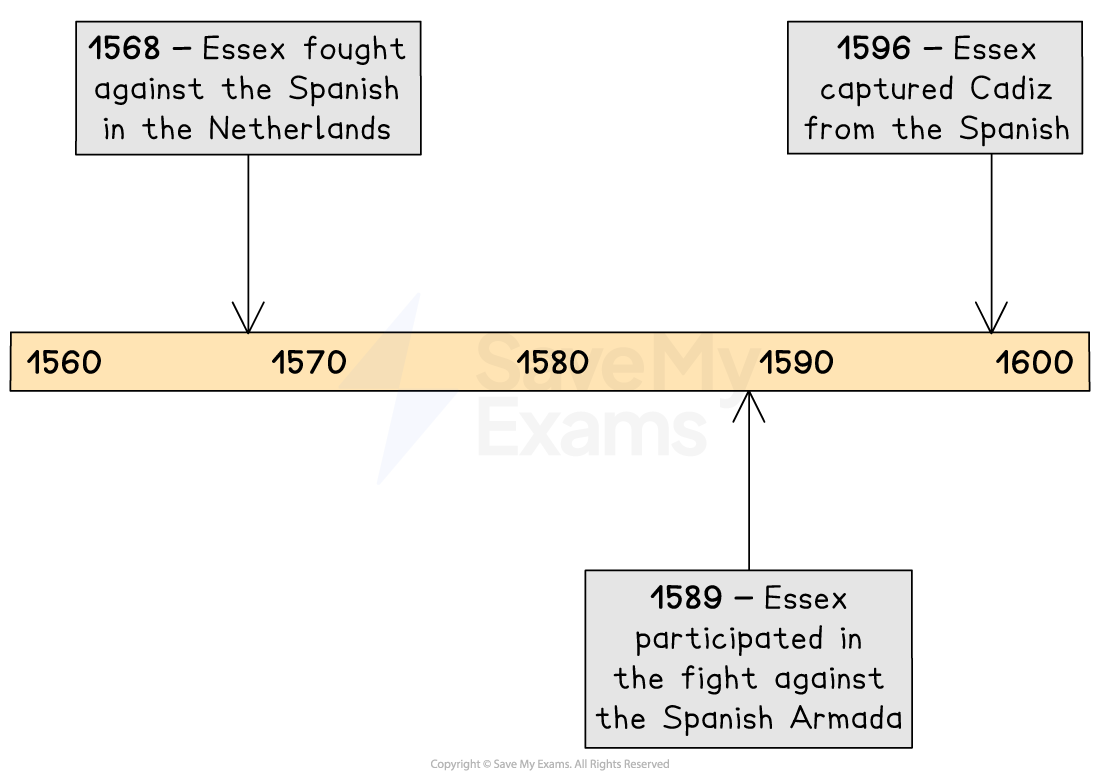
Essex rose to prominence in the mid-1580s as Elizabeth's new favourite
He was young, charming and courageous, and Elizabeth was captivated by him
He served in the Netherlands in 1585–1586, earning a reputation for bravery
Leicester's death in 1588 left a vacancy as Elizabeth's military favourite
Essex filled it immediately
High point: The Cadiz raid, 1596
Essex and Lord Howard of Effingham led a joint expedition to Spain
They captured the city of Cadiz and destroyed a large number of Spanish ships
Essex became a public hero; his popularity in London was enormous
However, he quarrelled with Howard and Raleigh over strategy
He wanted to hold Cadiz permanently but was overruled
Low point: The Islands Voyage of 1597 damaged his reputation
Essex and Raleigh attempted to repeat the success of Cadiz by attacking the Azores
The expedition was a failure, marked by quarrels and bad weather
Essex was made Earl Marshal in 1597, but his relationship with Elizabeth was under increasing strain
The beginning of the fall
A Privy Council confrontation in 1598 marked a turning point
Essex turned his back on Elizabeth during a Council meeting
She struck him (reportedly “boxed his ears”), and he reached for his sword, leading to him being dismissed from court
The incident revealed how far the relationship had deteriorated
Additionally, Cecil (Burghley) died the same year, removing the main stabilising figure at court
Ireland, 1599
Essex was appointed Lord Lieutenant of Ireland in 1599
The task was to defeat the Earl of Tyrone's rebellion in Ulster as part of the wider Nine Years' War (1594–1603)
Elizabeth gave him around 16,000 men, the largest army sent to Ireland
The Ireland campaign was a serious failure
Essex ignored his orders and misused this force on minor campaigns in the south
He made a private truce with Tyrone, directly against Elizabeth's orders
He then abandoned his post and returned to England without permission
He forced entry into Elizabeth’s private chambers at Nonsuch Palace in September 1599, catching her before she had dressed
Elizabeth was furious; she placed him under house arrest and stripped him of his offices
His income from the sweet wines monopoly was not renewed, cutting off his main source of revenue
Examiner Tips and Tricks
The Ireland campaign is crucial for understanding the context behind the Essex Rebellion. Essex's financial ruin after the non-renewal of the sweet wines monopoly pushed him towards desperate action. Without money, he could not maintain his faction or his network of clients. The rebellion was born out of this crisis as much as out of political ambition. Make sure you give the right amount of context in an exam response without narratively describing the events.
The Essex Rebellion, 1601: Causes, Events & Consequences
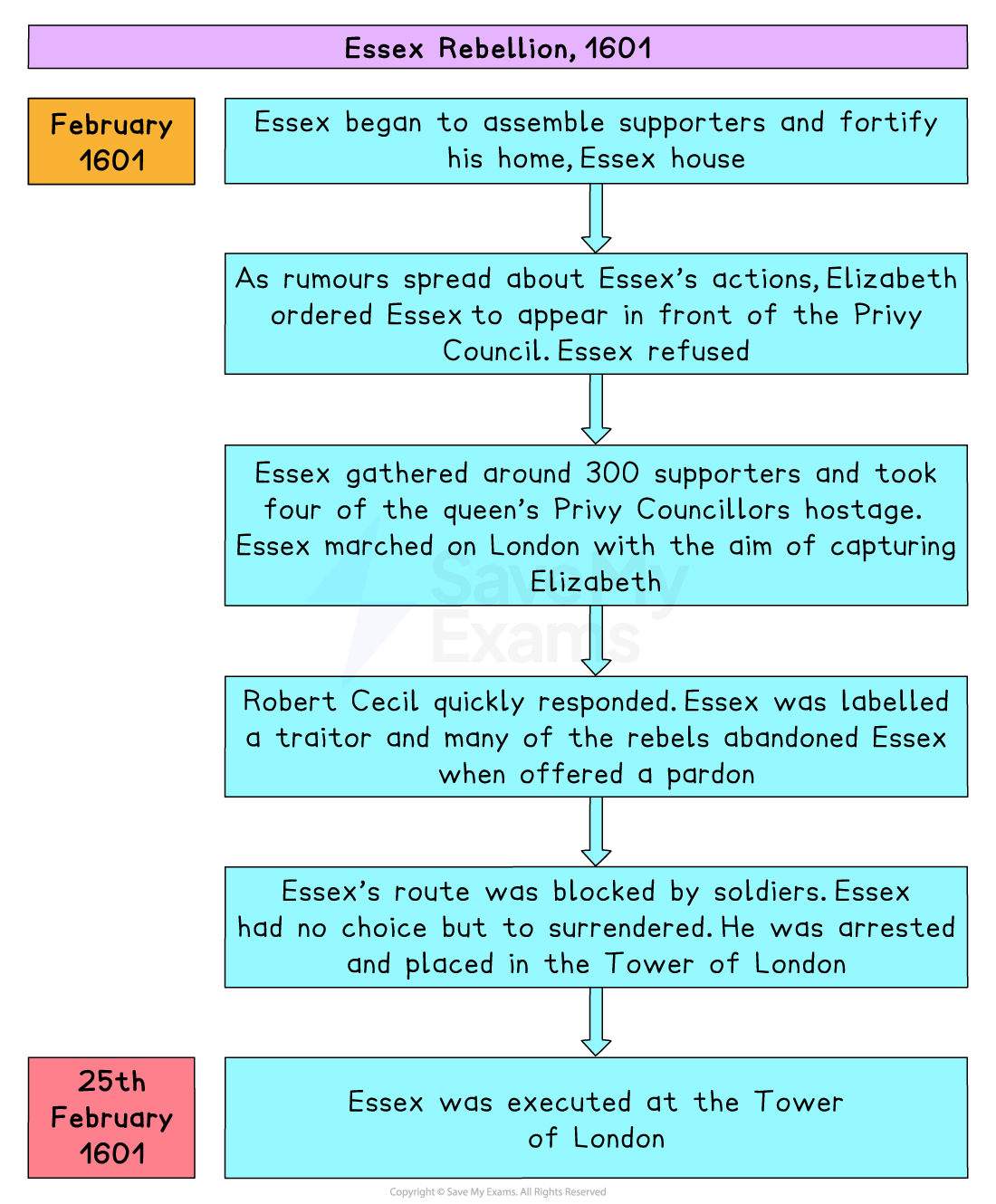
Causes of the rebellion
Essex faced financial ruin after the non-renewal of the sweet wines monopoly
Without this income, he could not pay his debts or maintain his network of followers
He convinced himself that Cecil and Raleigh had poisoned Elizabeth's mind against him
Essex had a circle of discontented followers ready to act
The Earl of Southampton and other young courtiers were also excluded from power and patronage
In February 1601, Essex's supporters paid Shakespeare's theatre company to perform Richard II, a play depicting the deposition of a king, the day before the rebellion
This was intended as political propaganda, but failed to stir any wider feeling
Events of the rebellion
Event | What happened |
|---|---|
The march |
|
Failure to raise support |
|
Return to Essex House |
|
Surrender |
|
Trial and execution |
|
Why did the rebellion fail?
Essex had no realistic plan
He expected the City of London to rise spontaneously; it did not
The political nation remained loyal to Elizabeth
The rebellion had no serious support beyond Essex’s own circle
The government had prior warning and was prepared
Consequences of the rebellion
The rebellion confirmed Robert Cecil's dominance
With Essex gone, Cecil had no comparable rival
Cecil continued his secret correspondence with James VI of Scotland, preparing the ground for a smooth succession
When Elizabeth died in March 1603, the transition to James VI (now James I of England) was peaceful
Elizabeth was visibly shaken by Essex's execution
By all accounts, she had genuinely cared for him
Reports suggested that she spent days in a state of deep depression afterwards
Examiner Tips and Tricks
Essex is sometimes presented simply as a reckless hothead. The stronger argument is that his rebellion reveals something deeper: the patronage system was under serious strain. When Elizabeth could no longer distribute enough rewards to keep ambitious courtiers loyal, the system of personal monarchy was was under increasing strain. That is a structural point worth making in your answers.
How Effectively Did Elizabeth Manage Government & Faction?
Use the specific evidence below to build and support your own argument
The case that Elizabeth managed faction effectively
Elizabeth balanced Leicester and Cecil against each other for over 20 years without either dominating
She chose ministers on merit
Cecil, Walsingham, Hatton and Leicester all served loyally for long periods
Parliament was managed, the Settlement held, the Cadiz raid succeeded, the Armada was defeated
Faction only became dangerous after the deaths of her experienced ministers in the late 1580s and 1590s
This suggests the system itself was sound
The case that factional management broke down
Elizabeth allowed Essex's personal relationship with her to override sound political judgement throughout the 1590s
The rebellion of 1601 showed the patronage system had produced a man who could neither be managed nor safely dismissed
Essex was given the Irish command in 1599 for factional reasons
He wasted 16,000 men, defied his orders and achieved nothing
This is clear evidence that faction had distorted royal decision-making at the highest level
Robert Cecil was secretly corresponding with James VI of Scotland regarding the succession by the late 1590s
This is evidence that the centre of power had already shifted away from her
Examiner Tips and Tricks
The key question demands a judgement across the whole reign (1558–1603), not just the 1590s. A strong answer will acknowledge roughly thirty years of broadly effective management before addressing the breakdown at the end.

Unlock more, it's free!
Join the 100,000+ Students that ❤️ Save My Exams
the (exam) results speak for themselves:

Was this revision note helpful?
