Elizabeth I: The Court, Privy Council & Patronage (AQA A Level History: Component 1: Breadth study): Revision Note
Exam code: 7042

Summary
The royal court was both the centre of government and the queen's personal household
The two functions were inseparable
Elizabeth used patronage to bind the nobility and gentry to the Crown through office, land, titles and monopolies
Royal progresses, image-making and court ceremony reinforced Elizabeth's authority across the whole country
The Privy Council had under 20 members and served four main functions: advisory, administrative, co-ordinating and judicial
Haigh argues the Council's narrow membership made it unrepresentative of the political nation and limited meaningful debate within government
William Cecil (Lord Burghley)served Elizabeth for 40 years, remaining her chief minister until his death in 1598
He was widely regarded as her greatest minister
Sir Francis Walsingham served as Principal Secretary from 1573 to 1590 and built the spy network that uncovered the Catholic plots against Elizabeth
The Elizabethan Court: Structure, Patronage & Political Culture
The royal court was the hub of both government and social life
The social and political functions of the court overlapped
Nobles had to be seen at court to secure titles, land or status
Royal officials had to attend to secure royal permission for their actions
Physical structure
Elizabeth inherited around 14 principal residences, mainly in London and the south of England
Whitehall was her main palace
Greenwich, her birthplace, was her favourite
The royal household employed nearly 1,500 people, from the Lord Chamberlain to the herb women
Domestic staff were organised in departments with strict hierarchies: the Robes, Pantry, Bakehouse, Woodyard and others
Access to the monarch
The court was organised into layers of physical access
Outer rooms
Open to any gentlemen who wished to attend
Privy Chamber
Restricted access, for courtiers and ministers the queen permitted to enter
Bedchamber
The innermost ring, where only the Ladies of the Bedchamber had regular access
Physical proximity to Elizabeth translated directly into political influence and access to patronage
Royal progresses
Elizabeth went on progress through the country at least 25 times during her reign
Progresses served several political functions:
It demonstrated royal authority outside London
It saved the Crown money
The host bore all the costs
It showed Elizabeth as accessible and engaged with her subjects
It reinforced loyalty among the nobility whose houses she visited
"She was received everywhere with great acclamations and signs of joy... She ordered her carriage to be taken where the crowd seemed the thickest and stood up and thanked the people."
Spanish ambassador, writing in 1568
The Spanish ambassador represented a Catholic power hostile to Elizabeth. His surprise at her popular reception makes his testimony more striking; he had every reason to downplay it.
Elizabeth's image-making
Elizabeth constructed a carefully managed public image throughout her reign
Portrait control:
She ordered in 1563 that all paintings of her were to be modelled on portraits supplied by her "Sergeant Painter"
Unauthorised images were prohibited and destroyed
A standard, unchanging image appeared across the decade, even as Elizabeth grew older
The "Virgin Queen"
Her refusal to marry was turned into propaganda; she presented herself as married to England
This drew on the Catholic image of the Virgin Mary and the classical image of Astraea (the Greek goddess whose return mythology said would herald a golden age)
She also gained the title "Gloriana" from Edmund Spenser's poem The Faerie Queene (1590)
Court ceremony
Elaborate rituals, masques and jousting reinforced her authority
The most important jousts were held on the anniversary of her accession
The patronage system
"That you gratify your nobility and the principal persons of your realm to bind them fast to you with such things [i.e. patronage gifts]... whereby you shall have all means of value in your realm to depend upon only yourself."
William Cecil (Lord Burghley) advising Elizabeth in 1579
Cecil wrote this advice to Elizabeth in 1579, over 20 years into the reign. The fact that he still felt the need to remind her of the importance of broad patronage distribution shows that keeping the system balanced was an ongoing challenge, not something that could be established once and left to run itself.
Patronage was the fundamental mechanism of political control
Those who received it had a direct interest in supporting the Crown
Those who were denied it could become dangerous
Form of patronage | How it worked |
|---|---|
Office |
|
Land |
|
Titles |
|
Monopolies |
|
Pensions and land grants |
|
Elizabeth distributed patronage carefully and to a wide circle to bind as many of the politically active as possible
Cecil kept careful watch over the patronage scene to ensure wide distribution
The danger was concentrating patronage in too few hands
This imbalance contributed directly to the Essex Crisis of 1599–1601
Key courtiers and "favourites"
Elizabeth's personal relationships with courtiers shaped the political landscape of her reign
Courtier | Role and significance |
|---|---|
Robert Dudley, Earl of Leicester (1532–1588) |
|
Sir Christopher Hatton (c. 1540–1591) |
|
Sir Walter Raleigh (c. 1554–1618) |
|
"She took me into her bed-chamber, and opened a little cabinet, wherein she kept many little pictures wrapped within paper, and their names written on with her own hand upon the papers. Upon the first that she took up was written, 'My Lord's Picture'. I held the candle and pressed to see which picture was so named."
James Melville, ambassador of Mary Queen of Scots, writing in the 1570s
Recording a private moment with Elizabeth; the picture was of Robert Dudley, Earl of Leicester.
Factional rivalries at court
Courtiers formed factions
Individuals within each faction shared aims, competing for the queen’s favour and patronage
For most of the reign, Elizabeth kept factions balanced against each other and maintained control
The main division:
Burghley (cautious, financially prudent, preferred diplomacy), vs.
Leicester (radical, interventionist, anti-Spanish)
These factions disagreed on policy but were generally competing within the system rather than challenging royal authority
By maintaining the close support of Burghley and Leicester over long periods, Elizabeth avoided the destructive factionalism of Henry VIII's later years
Eventually, the balance was disrupted as experienced ministers died and Essex became dominant in the 1590s
Examiner Tips and Tricks
The court and patronage question often appears as part of a broader question about how effectively Elizabeth managed government. The key point is that patronage was not just a reward system; it was a control mechanism. When Elizabeth managed it well (most of the reign), it produced stability. When it broke down (1590s), it produced the Essex crisis.
The Privy Council Under Elizabeth: Role & Influence
The Privy Council restructuring at Elizabeth's accession has already been covered; this section addresses the Council's functions and significance during the later period of Elizabeth’s reign (1563–1603)
Composition
Elizabeth preferred councillors with proven loyalty to the Tudor dynasty over rank or birth
Few of Mary I's pro-Catholic councillors survived the transition
The number of nobles was significantly reduced
Senior clergy were largely excluded from the Council
In their place were a core of professional men who served long periods, improving effectiveness and unity
Around ten members regularly attended meetings
Christopher Haigh's critique
Christopher Haigh, the leading critic of Elizabeth's achievements, argues the narrow composition was a weakness, not a strength:
By excluding the nobility and the Church, Elizabeth made the Council unrepresentative of the ruling elite
This undermined its value as an advisory body
It provoked resentment among courtiers denied advancement
The narrow membership limited the range of debate and produced a body unlikely to challenge the Queen
Four functions of the Privy Council:
Function | Detail and examples |
|---|---|
Advisory |
|
Administrative |
|
Co-ordinating |
|
Judicial |
|
Growth in workload
The Council's workload grew significantly across the reign
Early reign:
Typically three half-days a week
1590s crisis years (war with Spain, economic problems)
Often six full days a week
Part of the increase came from the growth in private petitions (individuals approaching the Council directly rather than using the courts)
Significance: strengths and limitations
As an advisory body:
Significant but limited
Elizabeth retained ultimate control and could reject advice
As an administrative body:
Essential
It was the engine that kept Elizabethan government running day to day
Over time:
Most effective in the 1560s to 1580s
Less cohesive in the 1590s as factional rivalries intensified due to the deaths of key ministers
Examiner Tips and Tricks
Questions on the Privy Council often ask about its role or effectiveness. Separate the advisory role from the administrative role. The advisory role was dramatic but limited, Elizabeth was not bound by the Council's advice. The administrative role was quieter but more important, it was what kept the country actually governed.
Ministers: William Cecil (Lord Burghley): Elizabeth’s Most Trusted Minister
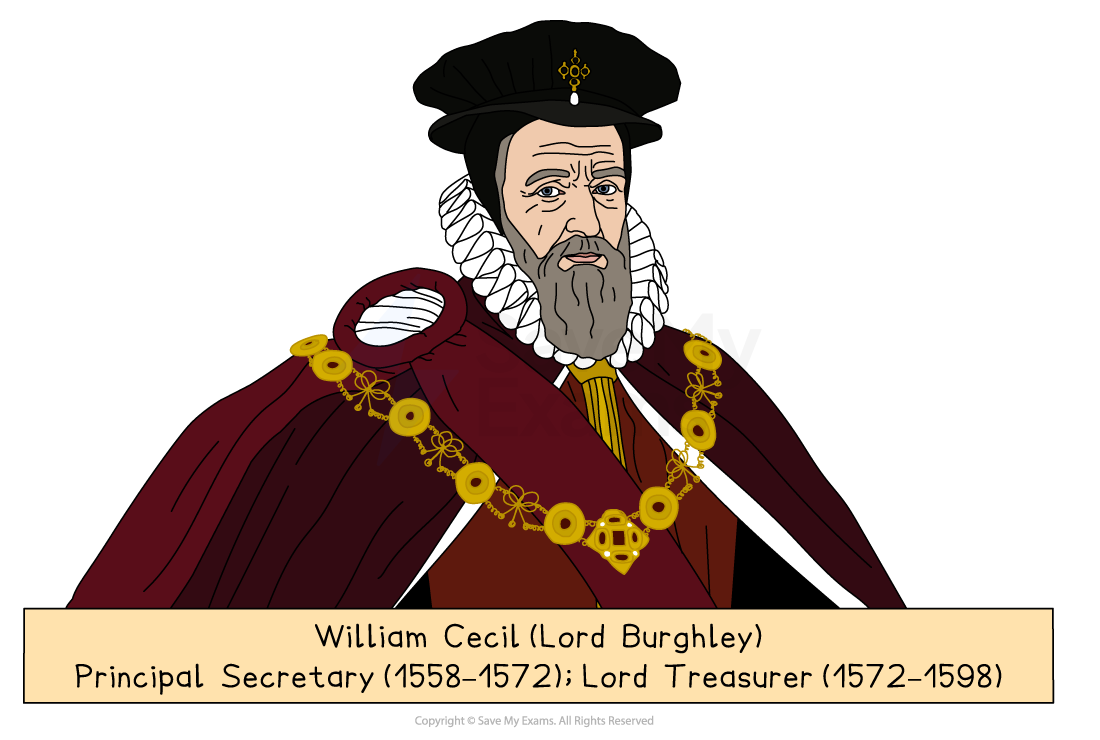
There is general agreement that William Cecil was the greatest of Elizabeth's ministers
He served her for 40 years, first as Principal Secretary, then as Lord Treasurer until his death in 1598
Character and approach
Conservative and a stabiliser (like Elizabeth herself)
His family background was modest, his talent exceptional
He promoted policies that attacked religious extremism from both directions: Puritans and Catholics alike
He sought to preserve England's independence by treading a careful path between France and Spain
This brought him into direct conflict with Leicester, who favoured a more openly anti-Spanish and anti-Catholic policy
He kept careful control of the patronage scene, ensuring a wide distribution to prevent dangerous concentrations of favour
"The principal person in the Council at present is William Cecil, now Lord Burghley. He is a man of mean sort, but very astute, false, lying, and full of all artifice. He is a great heretic and such a clownish Englishman as to believe that all the Christian princes joined together are not able to injure the sovereign of his country."
Spanish ambassador, writing in the 1570s, from a report sent to Philip II of Spain
The Spanish ambassador was an enemy of both Cecil and England. His hostility reveals how feared and effective Cecil was. A diplomat from the most powerful Catholic power in Europe regarded Cecil as the principal obstacle to Spanish influence over England.
The Court of Wards
Cecil was appointed Master of the Court of Wards in 1561
The Court of Wards administered the estates of nobles who were minors
It was extremely lucrative, wardships could be distributed as patronage
It gave Cecil enormous additional power and influence beyond his role as Principal Secretary
Robert Cecil: his father's successor
Cecil's son, Robert Cecil, took over the dominant ministerial role in the 1590s
Appointed as a Principal Secretary in 1596, becoming Elizabeth’s leading minister in the final decade of the reign
His rivalry with Essex is the central story of factional politics in the 1590s
He played a crucial role in ensuring the peaceful succession of James VI of Scotland in 1603
Examiner Tips and Tricks
William Cecil questions often ask about his relationship with Elizabeth or his significance as a minister. Two points matter: first, they were not always in agreement, notably over the marriage question, but disagreements never led to a breakdown; second, his death in 1598 left a void that contributed directly to the instability of the final years.
Ministers: Sir Francis Walsingham: Spymaster & Secretary of State
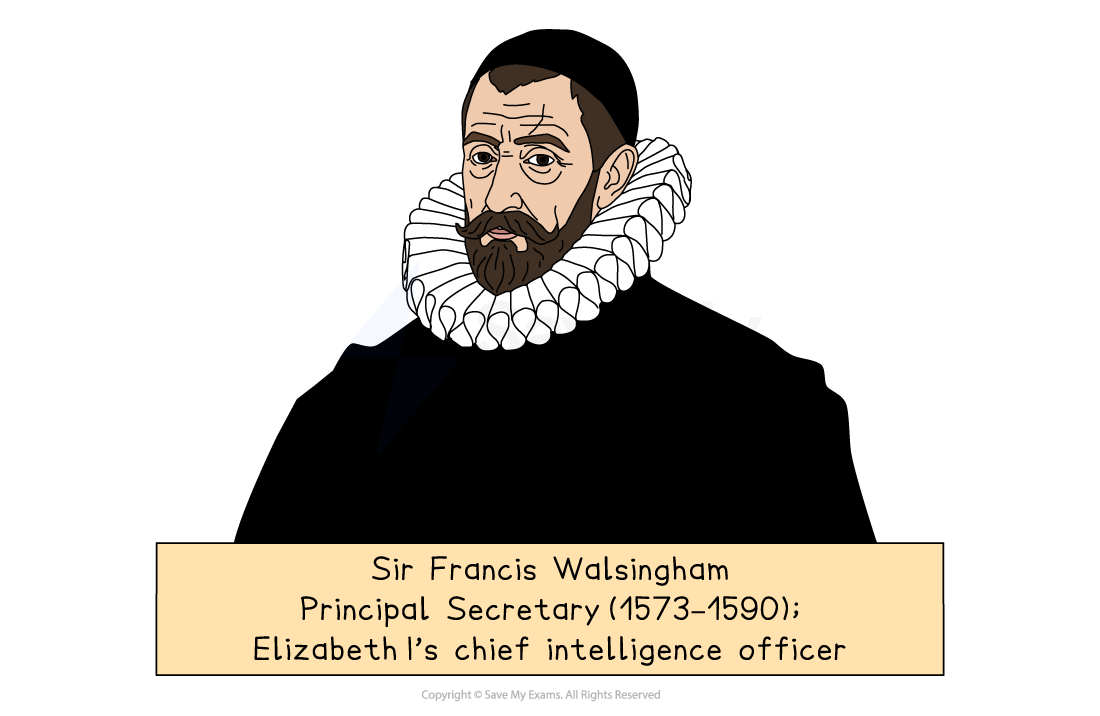
Sir Francis Walsingham served as one of Elizabeth's Principal Secretaries (alongside Cecil initially) from 1573 to 1590
He is best known for building the spy network that uncovered Catholic plots against Elizabeth
Character and beliefs
Walsingham was a committed Protestant who wanted the Church of England to adopt more radical Protestant views
His religious convictions drove his intelligence work; he saw it as a mission, not merely a job
He hated Catholicism and its foreign supporters
This made him an exceptionally motivated intelligence chief
He died in 1590 deeply in debt, having spent much of his personal fortune on the spy network
The spy network
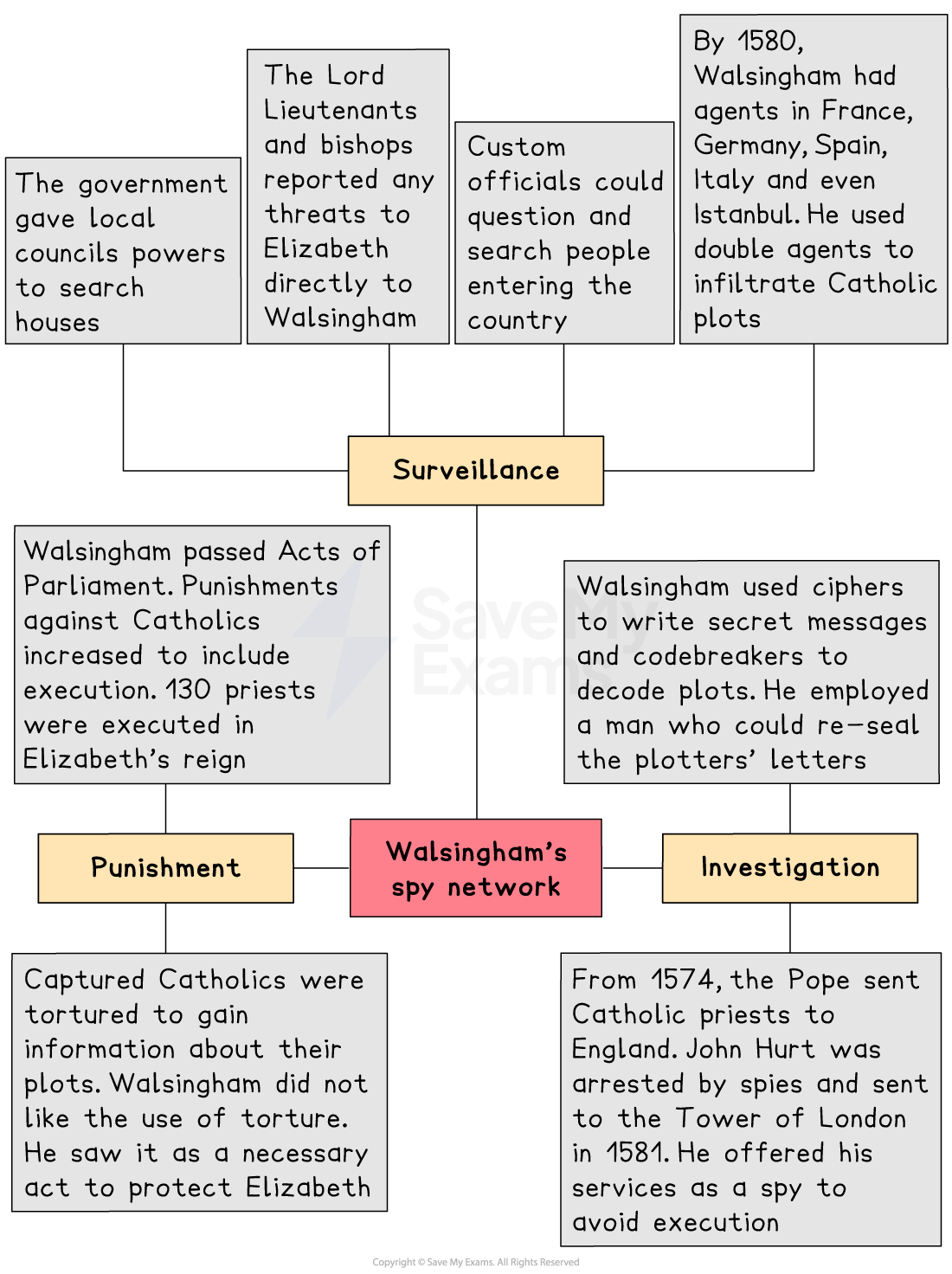
Walsingham developed his extensive spy network in the 1580s
He employed agents across Europe:
At the Spanish court
In the Papal States
At the French court
Within Catholic networks inside England
He used entrapment, torture and the interception of letters to gather intelligence
The network successfully uncovered:
The Throckmorton Plot (1583):
A French-backed Catholic conspiracy
Defeated but confirmed the seriousness of Catholic threats
The Babington Plot (1586)
Letters between Mary Queen of Scots and the plotters were intercepted and decoded
This provided the evidence needed to convict and execute Mary
Note that historians debate whether Walsingham manipulated the Babington correspondence
Significance
Walsingham's intelligence work was central to Elizabeth's survival
Without the Babington Plot interception, Mary Queen of Scots could not have been convicted and executed
His death in 1590 left Elizabeth without her most effective intelligence officer
His death, combined with Leicester's (1588) and Cecil's (1598), marked the end of the generation of ministers that made the reign stable
Cecil and Walsingham compared
Cecil |
|
|---|---|
Walsingham |
|
Examiner Tips and Tricks
Walsingham and Cecil are often compared. The key distinction is their approach: Cecil was the conservative stabiliser who kept England financially solvent and diplomatically balanced; Walsingham was the radical Protestant who took risks to eliminate Catholic threats. Elizabeth needed both. The reign was stronger for having both.

Unlock more, it's free!
Join the 100,000+ Students that ❤️ Save My Exams
the (exam) results speak for themselves:

Was this revision note helpful?
