Elizabeth I: Economy - Prosperity & Depression (AQA A Level History: Component 1: Breadth study): Revision Note
Exam code: 7042

Summary
England's economy was built on the cloth trade, which dominated exports throughout the reign but remained vulnerable to war and diplomatic disruption
The Antwerp Crisis of 1563–1564 forced English merchants to find new markets
Crown income rose by roughly 50% between 1558 and 1603, roughly kept pace with inflation in peacetime but far short of what was needed to fund prolonged war with Spain
The 1590s brought the worst economic conditions of the reign
Four successive harvest failures pushed prices up by over a third, and real wages fell to their lowest point since the Black Death
By the 1590s, Elizabeth was spending close to twice her annual revenue in wartime, resorting to land sales and monopolies that weakened the Crown's long-term finances
Historians debate how much the economy truly developed:
Trade grew and diversified, but inflation outpaced wages throughout and ordinary people were no better off in real terms by 1603 than in 1558
Prosperity in the Elizabethan Era: The Growth of the Cloth Trade
England's economy at the start of the reign
Elizabeth inherited a difficult economic situation in 1558
Mary's reign had left serious financial problems: debased coinage, expensive wars and a trade crisis
England's population was rising rapidly, putting pressure on food supplies, land and wages
Inflation had run throughout the mid-Tudor period and continued to rise under Elizabeth
The cloth trade
The cloth trade was the foundation of England's commercial prosperity
Woollen cloth accounted for around 80–90% of England's exports by value
England produced vast quantities of undyed and unfinished cloth for sale abroad
The Merchant Adventurers held a monopoly over the export of this cloth
Before the 1560s, virtually all English cloth was sold through Antwerp
Antwerp was the commercial hub of northern Europe
English cloth arrived there unfinished and was dyed and sold on across Europe
English merchants brought back luxury goods: spices, silks and other Mediterranean produce
This dependence on a single market made England very vulnerable to disruption in the Netherlands
The Antwerp Crisis and its consequences
The Antwerp Crisis of 1563–1564 was the most serious economic shock of the early reign
Philip II imposed restrictions on English cloth imports to the Netherlands in 1563, triggering a sharp trade crisis
The Merchant Adventurers had to find alternative markets almost overnight
They eventually relocated to Emden, then Hamburg, as their main base of operations
New markets gradually replaced Antwerp over the following decades
English cloth found buyers in Russia, the Baltic, the Mediterranean and Asia
New joint-stock companies managed these new trading routes (see the Trade and Commerce revision note for full details)
Crown finances
Elizabeth faced persistent financial pressure throughout her reign
Inflation meant the costs of government rose steadily while traditional revenues stayed relatively flat
The prices of goods the government consumed, such as iron for shipbuilding and provisions for armies, all rose
Between 1558 and 1603, royal income grew by approximately 50%
This was just enough to keep pace with inflation in peacetime
It was nowhere near enough to fund prolonged war with Spain after 1585
Elizabeth raised revenues through several sources
The Book of Rates, revised in 1558 (at the end of Mary's reign), increased customs duties on cloth exports
First fruits: a revived tax on the first year’s income of clergy (originally taken by the papacy), provided the Crown with revenue from Church appointments
Parliamentary subsidies were voted in wartime
Elizabeth relied on these increasingly from 1585 onwards
The sale of Crown lands raised short-term cash
But deprived later monarchs of regular income
Monopolies were licences granting individuals exclusive rights to produce or sell certain goods
London and growing prosperity
London grew significantly as a commercial centre throughout the reign
By 1600, London had become by far the largest city in England and a major European commercial centre
London generated a large share of the Crown's customs revenue
A growing merchant class built wealth through trade, with some buying land and joining the gentry
For those at the top of society, the reign brought real material gains
The gentry built or extended country houses, reflecting their growing wealth
New goods such as tobacco, sugar and spices began appearing among wealthier households
For ordinary labourers, rising prices eroded any gains from growth in trade
Examiner Tips and Tricks
Do not treat the cloth trade as simply a success story. Its strength was also its vulnerability: the Antwerp Crisis showed how dependent England was on a single market. A strong answer will acknowledge both the prosperity the cloth trade created and the fragility it carried.
Economic Depression in the 1590s: Bad Harvests, Plague & Rising Prices
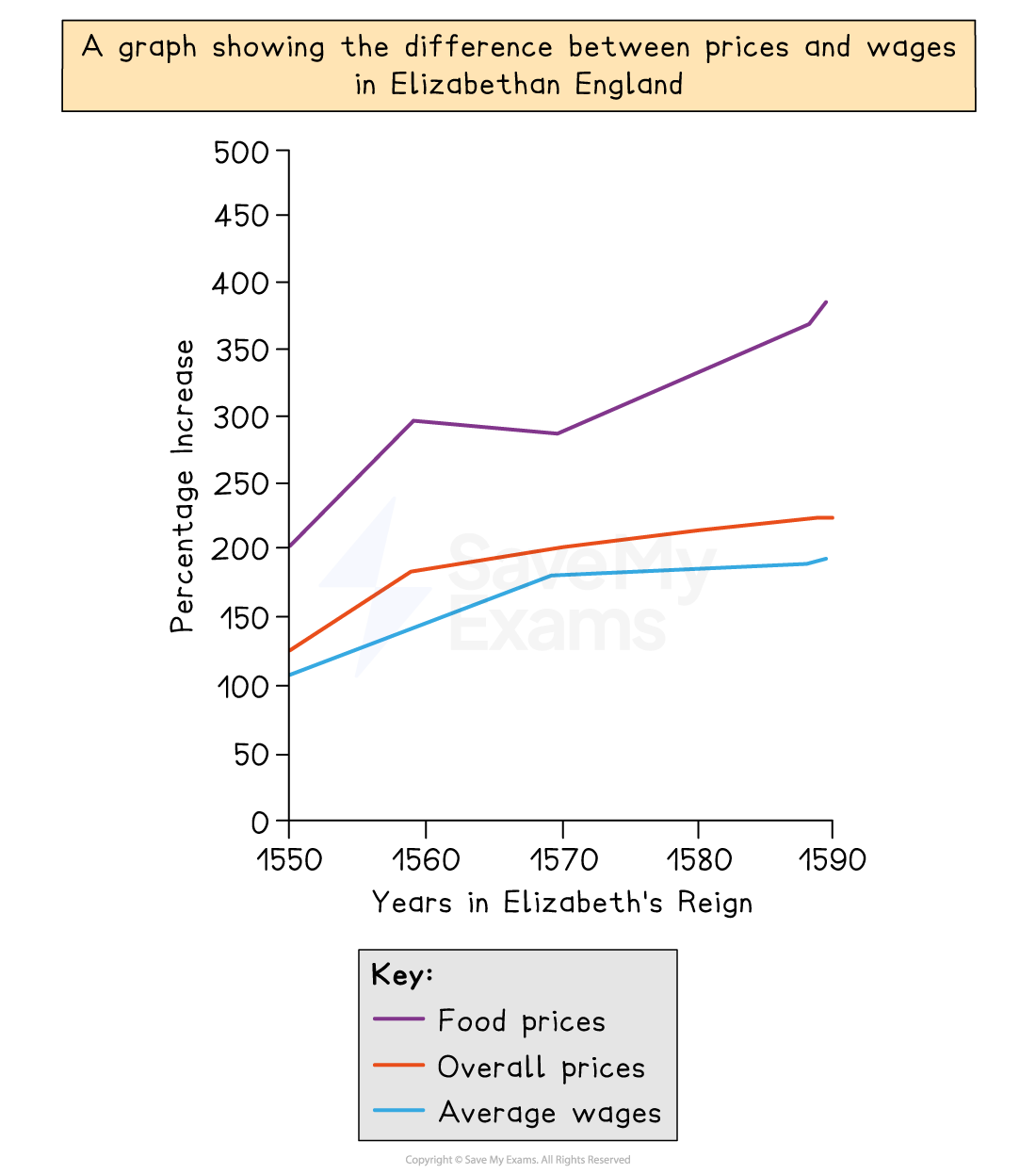
Inflation throughout the reign
Prices rose throughout the whole of Elizabeth's reign, not just in the 1590s
Prices rose by around 400% across the Tudor period as a whole
Wages did not keep pace; real wages fell consistently from the 1520s onwards
The poorest in society were hit hardest at every stage
Several long-term factors drove this inflation
Population growth from around 2.5 million in 1520 to around 4 million by 1600 put pressure on food supplies
Earlier debasement under Henry VIII and Edward VI had contributed to inflation, although recoinage in the 1550s began to stabilise the currency
The price rises from this still lingered into the start of Elizabeth's reign
Silver flooding into European markets from Spanish mines in the Americas kept prices rising
Landowners shifting from arable farming to sheep pasture (enclosure) reduced food production and pushed prices up further
The 1590s depression
The 1590s brought the worst economic conditions of the reign
The decade began with good harvests, but 1594–1597 saw four successive serious crop failures
Agricultural prices rose by over a third over the decade
Real wages fell to their lowest levels since the Black Death
Many parish registers for the 1590s show far more burials than baptisms
While plague temporarily reduced population pressure, its impact was short-term and did not reverse the long-term trend of population growth
A serious epidemic in 1592–1593 killed thousands and continued to hit urban and rural populations
Disease compounded food shortages and reduced the workforce available for harvest and trade
The war with Spain added severe financial pressure from 1585
The loss of legitimate trade with Spain removed a major market for English cloth
By the 1590s, in wartime, Elizabeth was spending close to twice her annual revenue
Parliamentary subsidies were demanded more frequently and resented more strongly
Food riots reflected genuine popular desperation
Riots broke out in London, the south-east and East Anglia in 1595–1597
Merchants hoarding grain were a particular target
Local authorities and the Privy Council responded by regulating food prices and distribution
The severity of the depression varied by region and should not be overstated
The impact of the depression varied across England, with some regions experiencing more severe hardship than others
In comparative terms, the 1590s were not as severe as crises in the 1550s or 1630s
The government's responses, including the regulation of food markets, were better co-ordinated than elsewhere in Europe
But, for the poorest, the suffering was real, severe and sustained
Examiner Tips and Tricks
The 1590s depression is a rich topic for questions about the limits of Elizabethan success. Try not to present it as simply a product of bad weather. The war with Spain, long-running inflation, population growth and the disruption of trade all contributed. The strongest answers show these causes working together, not as a list of separate factors.
How Much Did England’s Economy Develop under Elizabeth?
Use the specific evidence below to build and support your argument
The case that England's economy developed under Elizabeth
The cloth trade expanded and adapted to new markets
New trading routes to Russia, the Baltic and the Mediterranean replaced dependence on a single market
The Merchant Adventurers adapted and continued to drive cloth exports throughout the reign
Crown income grew and Elizabeth developed new revenue sources
Royal income increased by around 50% between 1558 and 1603
The Book of Rates improved customs revenue from cloth exports
Elizabeth managed to avoid bankruptcy despite the enormous costs of war with Spain
London grew into a major European commercial centre
The merchant class expanded and diversified, with wealth enabling some merchants to buy land and enter the gentry
Greater political and religious stability after 1559 created conditions for trade to grow
The avoidance of expensive continental wars in the early reign allowed commerce to develop
The religious settlement reduced the domestic instability that had characterised the 1540s and 1550s
The case that economic development was limited
Inflation outpaced wages throughout the entire reign
Prices rose by around 400 per cent across the Tudor period
Real wages fell consistently; ordinary people were poorer in real terms by 1603 than in 1558
The benefits of growth accumulated with the gentry and merchants, not with the labouring poor
The cloth trade remained vulnerable to disruption
The Antwerp crisis of 1563–1564 was a serious shock that took years to recover from
War with Spain from 1585 cut off another major market and raised the costs of trade
The 1590s depression was severe
Four harvest failures in four years pushed prices up by over a third
Real wages reached their lowest point since the Black Death
The Crown was spending around twice its revenues by the end of the reign
Crown finances were left in a weakened state by the end of the reign
Sales of Crown land provided short-term income but damaged long-term royal finances
Reliance on parliamentary subsidies created political tension, as seen in the 1601 monopolies debate
The structural problems of the economy were never solved
Population growth and inflation were beyond the government’s control or reach
The fundamental problem of wages lagging behind prices persisted into the 17th century
Examiner Tips and Tricks
Avoid framing this as simple success or failure. The cloth trade grew and diversified, but inflation undermined real living standards. Crown finances were stable in peacetime but came under severe strain during war. The 1590s were genuinely terrible for ordinary people. A strong answer will show how the picture changed across the reign, rather than treating it as one uniform period.

Unlock more, it's free!
Join the 100,000+ Students that ❤️ Save My Exams
the (exam) results speak for themselves:

Was this revision note helpful?
