Elizabeth I: Religion - The Catholic Threat (AQA A Level History: Component 1: Breadth study): Revision Note
Exam code: 7042

Summary
Catholicism never disappeared under Elizabeth, but it was kept alive by a small minority of committed recusants and a growing network of missionary priests rather than by any mass popular movement
The most sustained challenge came from the seminary and Jesuit missions, which kept underground Catholicism alive across the reign
William Allen founded the Douai seminary in 1568
Edmund Campion and Robert Parsons led the Jesuit mission from 1580
The government responded with escalating penal legislation, moving from early recusancy fines to the 1585 Act that made harbouring a priest an act of high treason
Around 130–150 Catholic priests were executed
The government always framed these as treason, not persecution for faith
Historians disagree about how serious the threat really was:
Turvey and Heard argue that 1570 was a turning point that hardened the Catholic challenge
Davies argues conventional Catholicism was always declining
Recusancy & Catholic Resistance to the Settlement
The position of Catholics after 1559
Most Catholics were willing to accept the settlement outwardly
Most of Mary's bishops refused to accept Elizabeth's religious changes and lost their positions
But very few parish priests refused to take the Oath of Supremacy
This did not mean they were enthusiastic; many simply went along with what the law required
Catholic practice survived in pockets across the country
Regional surveys show substantial Catholic sympathy in Lancashire, Yorkshire, Durham, Herefordshire and South Wales
In some areas, Mass continued semi-openly or with limited enforcement
Catholic customs, prayers and practices persisted in many communities throughout the 1560s
What was recusancy?
Recusants were those who refused to attend Church of England (Protestant) services
The recusancy laws required all subjects to attend their parish church on Sundays
Initial fines were 1 shilling per absence, rising to £20 per month under the 1581 Act
Which made it impossible for ordinary people to afford
In practice, fines were rarely collected before 1569; the government had no desire to push Catholics into outright defiance
Most Catholics were "church papists" rather than active recusants
Church papists attended Anglican services while outwardly maintaining Catholic beliefs in private
This allowed them to avoid fines and stay loyal to the Crown at the same time
Active recusancy remained a minority position throughout the reign
By 1603, only around 2% of the population were active recusants
The 1570 papal excommunication as a turning point
Pope Pius V's papal bull Regnans in Excelsis (1570) changed the situation significantly
It excommunicated Elizabeth and declared her subjects released from their allegiance to her
This made loyal Catholicism harder to sustain without suspicion of treason
It forced English Catholics to choose between loyalty to Rome and loyalty to their queen
Most chose their queen; the excommunication had the effect of isolating committed Catholics rather than radicalising ordinary ones
The papacy's own actions weakened Catholic resistance
By forbidding attendance at church, the Pope exposed Catholics to heavy fines
Most Catholics could see a difference between Elizabeth as the head of their Church and Elizabeth as their rightful monarch
Social stability mattered: if Elizabeth's right to the throne was questioned, so too could landowners' rights to their property
Examiner Tips and Tricks
The key thing to understand is the distinction between active recusants and church papists. Most English Catholics were the latter. The Catholic threat was serious in some regions and among some families, but it never had mass popular support. Keep that proportion in mind when you assess the threat overall.
Seminary Priests & Jesuit Missions: Campion, Parsons & Allen
William Allen and the Douai Seminary
The seminary mission was designed to keep Catholicism alive in England
In 1568, William Allen, an English Catholic exile, founded a training college for priests at Douai in the Spanish Netherlands
Its purpose was to train Englishmen as priests who could return to England and minister to English Catholic communities
The first four seminary priests arrived in England in 1574
By the 1590s, there were over 100 seminary priests operating secretly across the country
They moved around in secret, living with Catholic gentry families
The seminary priests were primarily pastoral in purpose
Their role was to administer the sacraments, say Mass and keep the faith alive
They were not initially seen as a major political threat by the government
Initially treated with relative leniency compared to later decades
Several were executed for denying the royal supremacy (treason), not simply for being priests
The Jesuit mission from 1580
From 1580, a new and more organised mission began
The Jesuits were members of the Society of Jesus, a religious order dedicated to serving the Pope
They were highly trained, intensely committed and seen by the government as far more dangerous than the seminary priests
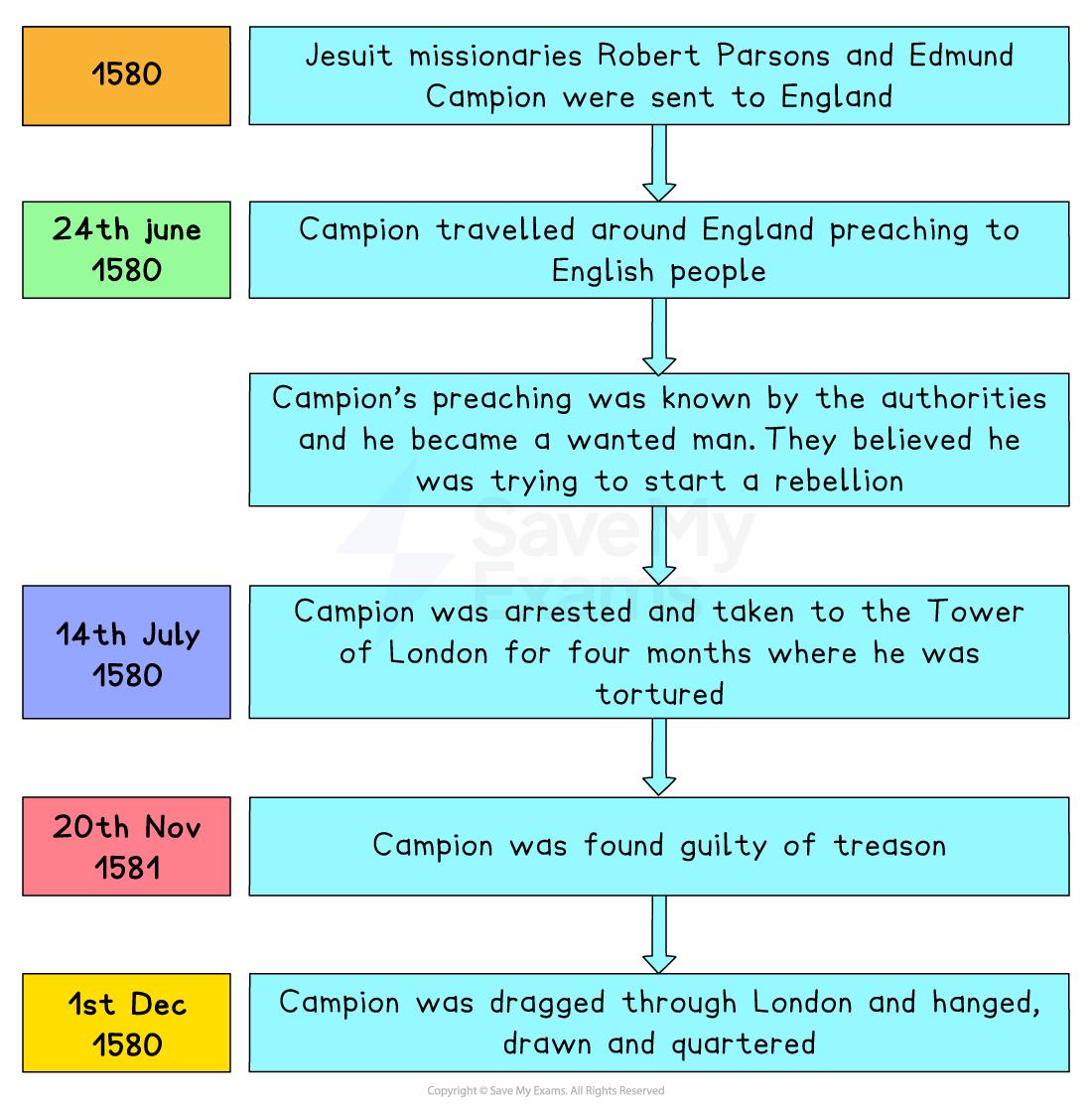
The first two Jesuits to arrive in England were Edmund Campion and Robert Parsons
They arrived in 1580 and immediately began building a network of safe houses
Many of these safe houses had specifically built priest holes (hidden spaces where priests could hide during searches)

Edmund Campion and Robert Parsons
Campion was the most celebrated of the Jesuit missionaries
He travelled to Lancashire, the heartland of English Catholicism, and preached in the homes of Catholic gentry families
He disguised his identity to avoid arrest
He was eventually tracked down by government agents and arrested in 1581
At his trial, he denied any treasonous intent
He claimed he had come only for the saving of souls
He was convicted of high treason and executed in December 1581
His death made him a Catholic martyr, giving the mission greater attention
Robert Parsons escaped to the Continent after Campion's arrest
He continued to organise the mission from Europe throughout the rest of the reign
He was a more politically ambitious figure than Campion, associated with plans for a Catholic succession to the English throne
The scale and impact of the missions
The seminary and Jesuit missions grew significantly across the reign
Over 100 seminary priests were active in England by the 1590s
The missions kept Catholicism alive in the gentry households of the north and west
Some historians argue the missions gained genuine converts; others argue that they ministered to families already committed to Catholicism
Examiner Tips and Tricks
When writing about the seminary priests and Jesuits, try to be precise about what they were actually doing. They were not raising armies or organising plots. Their mission was pastoral. The government treated them as a political threat, but that does not mean they all were one. The distinction between Campion and Parsons with regard to this is worth making.
Government Response: Penal Laws, Fines & Executions
The early approach: caution over confrontation
In the 1560s, the government moved cautiously against Catholics
Public celebration of Mass was forbidden, but private worship was largely ignored
Recusancy fines were imposed in law but rarely enforced by Justices of the Peace (JPs) or collected
Elizabeth had no desire to create martyrs or push loyal Catholics into open resistance
No Catholic priest was executed simply for saying Mass until the 1580s
Penal legislation: the key acts
The table below summarises the main legislation against Catholics across the reign
Act | What was it? |
|---|---|
Treason Act, 1563 |
|
Treason Act, 1571 |
|
Act to Retain the Queen’s Majesty’s Subjects in their Due Obedience, 1581 |
|
Act against Jesuits and Seminary Priests, 1585 |
|
Recusancy Act, 1593 |
|
The scale of executions
Nearly 150 Catholic priests were executed in Elizabeth's reign
Around 60 Catholic laypeople were also executed for sheltering or assisting priests
The government consistently framed all executions as treason, not religion
The official position was that no one was executed for their faith alone
Campion's execution in 1581 was presented as punishment for treason, not for being a Jesuit
Elizabeth remained reluctant to push persecution further than necessary
She consistently resisted pressure from Parliament and hardline councillors for harsher measures
The 1585 Act was driven partly by the deteriorating relationship with Spain
It was also driven by the pressing need to act against Mary,Queen of Scots and the plots around her
The result by the 1590s
By the 1590s, Catholicism had become a largely private and gentry-based practice
Active recusant communities survived mainly in the north and west: Lancashire, Durham, Yorkshire, Herefordshire and South Wales
Catholicism had little widespread popular support by the end of the reign
The missionary priests kept the faith alive in isolated gentry households
But enthusiasm for plots against Elizabeth was low even among committed Catholics
Examiner Tips and Tricks
The government's response changed significantly across the reign. A question asking about the government's handling of the Catholic threat rewards answers that show this change over time, from the cautious early years through to the harsher legislation of the 1580s and 1590s. Elizabeth's reluctance to persecute is itself worth analysing.
How Serious Was the Catholic Threat to Elizabeth?
Use the specific evidence below to build and support your argument
The case that the Catholic threat was serious
The papal excommunication of 1570 made loyal Catholicism more difficult without suspicion of treason
It formally released Catholics from their allegiance to Elizabeth
It gave foreign Catholic powers a religious justification for intervention in England
The seminary and Jesuit missions sustained organised Catholic activity across the country
Over 100 priests were operating in England by the 1590s
The missions kept the faith alive across a generation and prevented Catholicism from simply dying out
Catholic plots repeatedly threatened Elizabeth’s life and throne
The Ridolfi (1571), Throckmorton (1583) and Babington (1586) plots all aimed at replacing Elizabeth with Mary Queen of Scots
The Spanish Armada of 1588 showed the scale of the foreign Catholic threat
Spain’s attempt to invade England was partly driven by the desire to restore Catholicism
Lancashire and parts of Yorkshire and the Welsh Marches remained strongholds of recusancy throughout the reign
Regional Catholicism had deep roots that penal laws could not fully eradicate
Key historians
R. Turvey and N. Heard, Change and Protest 1536–1588 (2012) |
|
|---|
The case that the Catholic threat was manageable and overstated
The vast majority of English Catholics chose loyalty to their queen over obedience to Rome
Most were church papists who attended services and avoided trouble
The papal excommunication isolated committed Catholics rather than mobilising wider support
Active recusancy never had mass popular support
Only around 2% of the population were active recusants by 1603
Plots against Elizabeth found little enthusiasm even among Catholic families
The seminary and Jesuit missions mainly served existing Catholic gentry households
There is debate about whether they made significant new converts or simply maintained existing faith
The missions were strongest in remote areas far from the centres of power
The Catholic cause was not helped by the plots carried out in its name
Attacks by foreigners on Elizabeth were not popular with most English Catholics
Each plot tended to harden Protestant feeling and justify harsher government action
The Spanish Armada (1588) further hardened Protestant attitudes, associating Catholicism with foreign invasion and reinforcing suspicion of English Catholics
The Catholic threat declined as the reign went on
As the Marian generation of priests died out, maintaining Catholic practice became harder
Without new recruitment from a dying English Catholic community, the old faith would eventually fade
Key historian
C. S. L. Davies, Peace, Print and Protestantism (1988) |
|
|---|
Examiner Tips and Tricks
The key question works well if you think about it across the whole reign rather than just focusing on one event or period. The threat shifted in character: early recusancy was passive; the missionary priests intensified it; the plots connected it to foreign invasion. A good answer will show how the nature of the threat changed, and why that matters for assessing how serious it was.

Unlock more, it's free!
Join the 100,000+ Students that ❤️ Save My Exams
the (exam) results speak for themselves:

Was this revision note helpful?
