Elizabeth I: Exploration, Colonisation & Privateering (AQA A Level History: Component 1: Breadth study): Revision Note
Exam code: 7042

Summary
England's explorers and privateers under Elizabeth mounted ambitious voyages across the globe, but the lasting gains of empire came only under James I
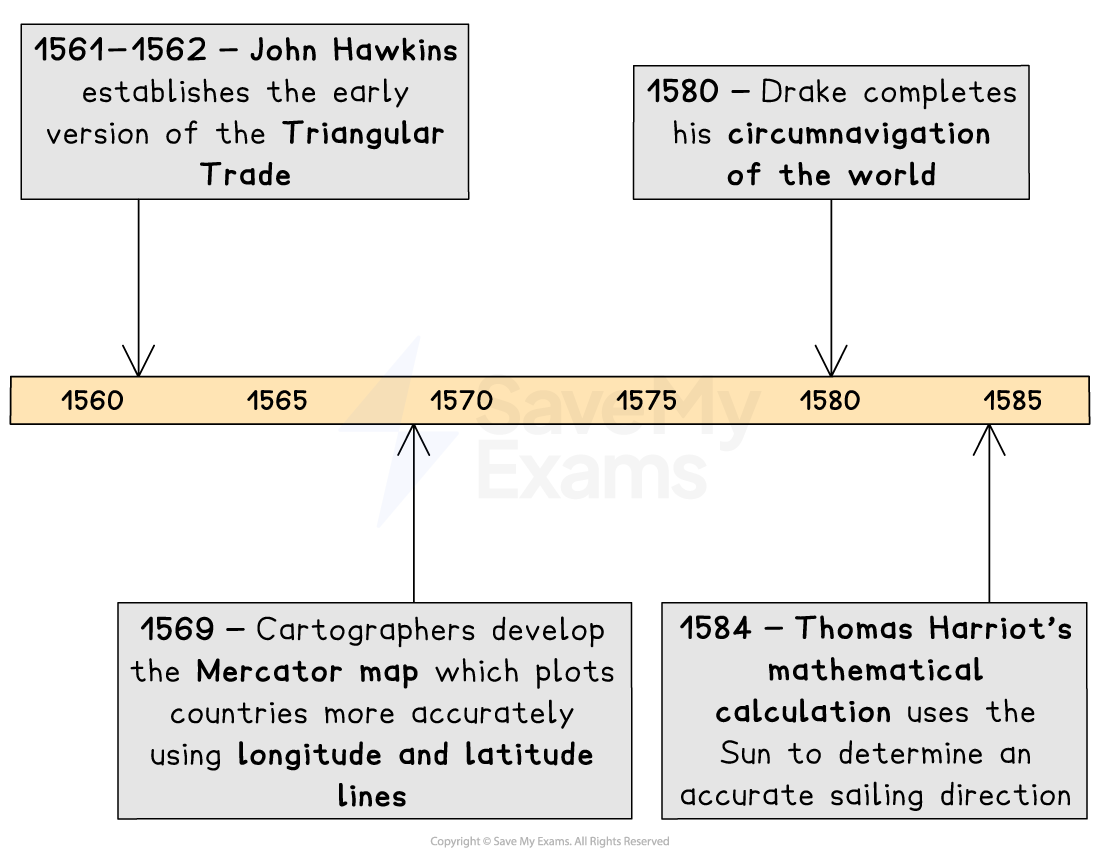
England’s involvement in the transatlantic slave trade was pioneered by John Hawkins in the 1560s
The third voyage ended in disaster at San Juan de Ulúa in 1568
The most celebrated figure of the age was Francis Drake, the first Englishman to circumnavigate the globe (1577–1580)
Elizabeth used privateering as a tool of foreign policy, sharing in profits while avoiding formal responsibility for attacks on Spain
Both attempts to establish a permanent colony in Virginia failed
No English settlement survived Elizabeth's reign
Historians debate how significant Elizabethan exploration really was:
The reign produced no permanent colony and most expeditions failed, but the voyages established the foundations of English maritime power
Exploration & the 'New World': Drake, Raleigh & Hawkins
England and the 'New World'
Spain and Portugal dominated overseas trade and settlement by the mid-16th century
The Treaty of Tordesillas (1494) had divided the 'New World' between them
England had almost no overseas presence beyond the Newfoundland cod fisheries
English merchants had little incentive to look beyond Europe while cloth trade with the Netherlands remained strong
English attitudes towards overseas expansion began to change under Elizabeth
Technical advances in shipbuilding made longer sea voyages more feasible
Growing tensions with Spain over the Netherlands made challenging Spanish trade routes attractive
A small number of ambitious merchants and sailors were eager to break into Spain's and Portugal's Atlantic monopolies
The search for new routes
English sailors hoped to find sea routes to Asia that bypassed Spanish and Portuguese control
No successful route was found during Elizabeth's reign
The attempts did produce new geographical knowledge and new trading contacts
The main routes are summarised below:
Route and explorer | Voyage and outcome |
|---|---|
North-East Passage (1553) |
|
North-West Passage: Frobisher (1576–1578) |
|
North-West Passage: Davis (1585–1587) |
|
John Hawkins and the Slave Trade
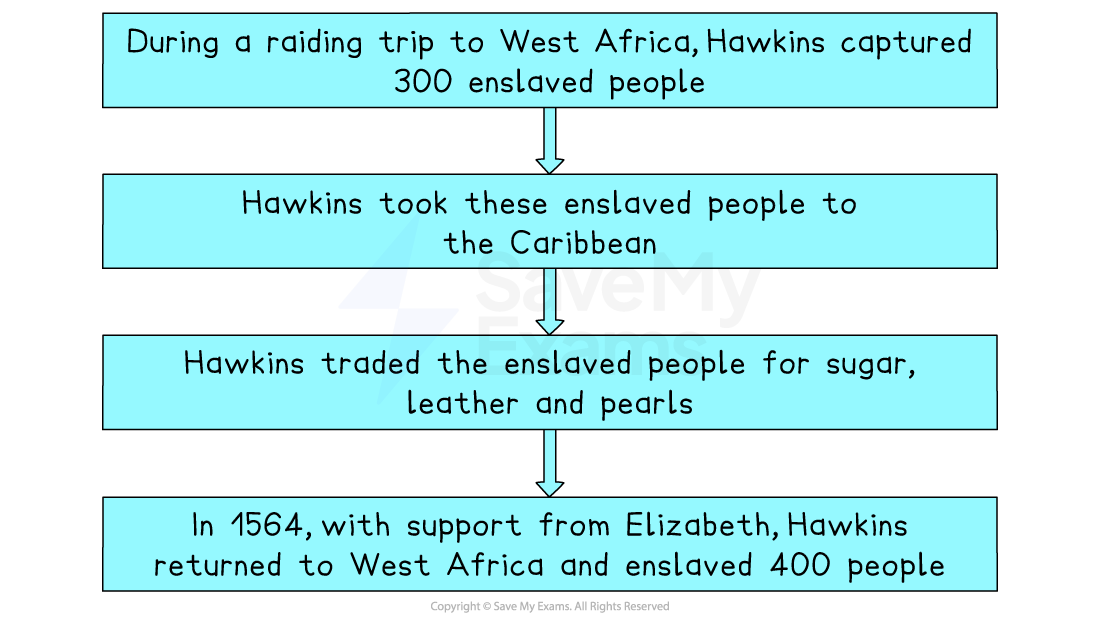
John Hawkins was the first English sailor to profit significantly from the Transatlantic slave trade
His three voyages are summarised below:
Voyage | What happened |
|---|---|
First voyage (1562) |
|
Second voyage (1564) |
|
Third voyage (1567–1568) |
|
Francis Drake
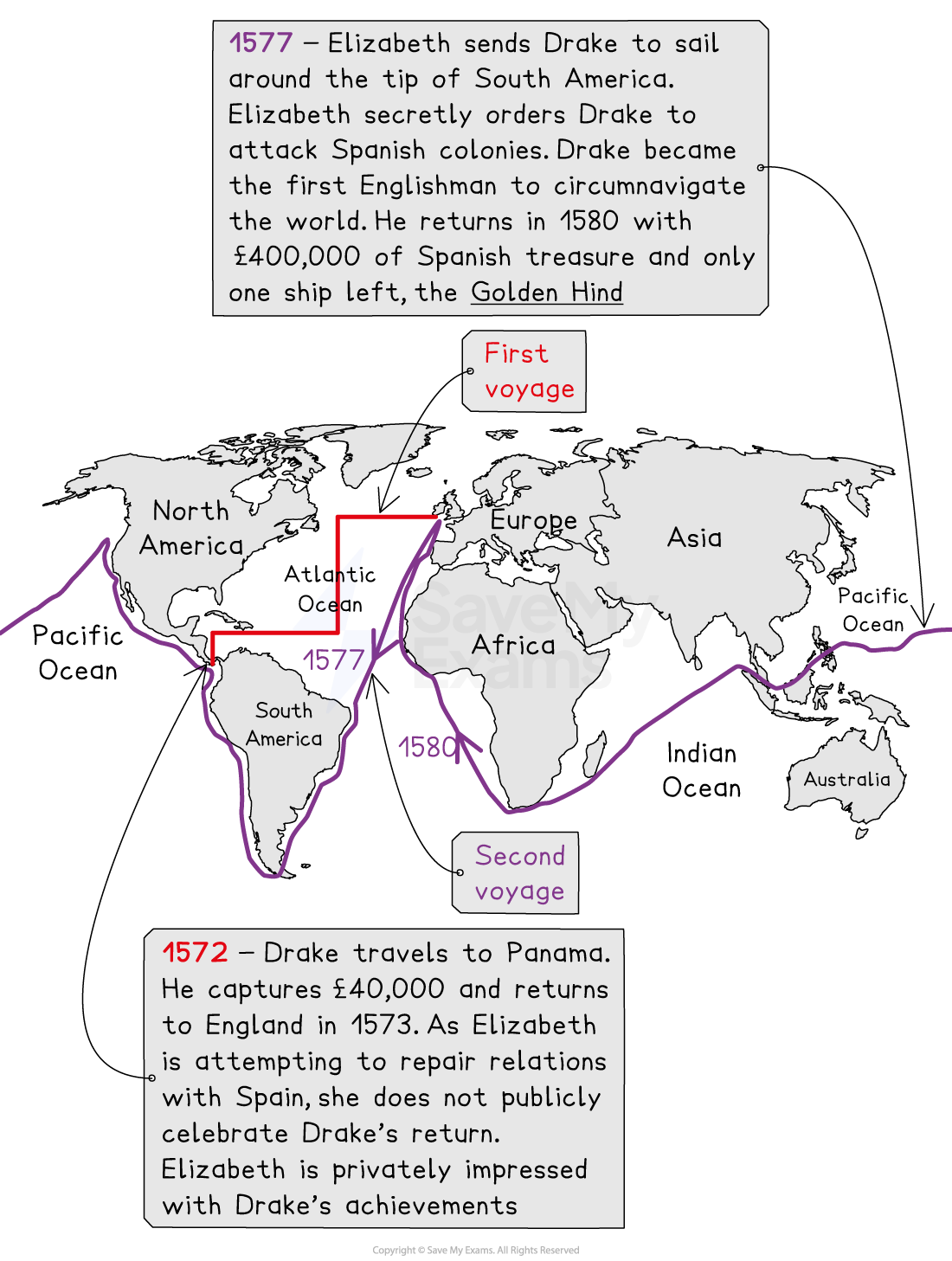
Drake became the defining figure of Elizabethan maritime ambition
His key expeditions and voyages are summarised below
Voyage/Expedition | What happened |
|---|---|
1572–1573: Raids on Panama |
|
1577–1580: Circumnavigation of the globe |
|
1585: Caribbean raid with Hawkins |
|
1587: Cadiz raid |
|
1589: Portuguese expedition |
|
1595–1596: Final Caribbean expedition |
|
Walter Raleigh
Raleigh was a court favourite who received a royal patent for the Virginia colony
His patent gave him rights over any land he claimed along the North American coast
He organised and financed the Roanoke ventures without always leading them in person
In 1595, Raleigh sailed up the Orinoco River in South America
He was searching for El Dorado, a mythical city believed to be filled with gold
The expedition found nothing of value
Raleigh's contribution was more as an organiser and promoter than as a voyager
His patronage kept the Virginia project alive even after the failure of Roanoke
Richard Hakluyt and the case for empire
Richard Hakluyt (c.1552–1616), a clergyman and writer who promoted English exploration made the intellectual case for English overseas expansion
He collected first-hand accounts from sailors returning from voyages
He worked to revise maps and charts as new information came in
He framed exploration as both a patriotic duty and a calling from God
In 1589, Hakluyt published his landmark collection of English voyages
Principal Navigations, Voyages and Discoveries of the English Nation brought together accounts of exploration across the whole reign
It built public enthusiasm for further exploration and colonisation
It inspired the next generation of explorers who went on to succeed under James I
“It cannot be denied they have been men full of activity, stirrers abroad, and searchers of remote parts of the world, so in this most famous and peerless government of her most excellent Majesty, her subjects, through the special assistance and blessing of God, in searching the most opposite corners and quarters of the world and, to speak plainly, in compassing the vast globe of the earth more than once, have excelled all the nations and people of the earth.”
Richard Hakluyt, Principal Navigations, Voyages and Discoveries of the English Nation (1589)
Hakluyt wrote as a strong supporter of English exploration. He argued that English sailors had matched or exceeded other nations. His book was designed to inspire further exploration and build the case for colonisation.
Examiner Tips and Tricks
Be careful about treating Drake, Hawkins and Raleigh as interchangeable figures. Drake was primarily a privateer who also explored; Hawkins began the foundations of the slave trade; Raleigh was more of an organiser and promoter than a voyager. A strong answer gives each individual his own significance rather than grouping them together.
The Beginnings of English Colonisation: Roanoke & Virginia
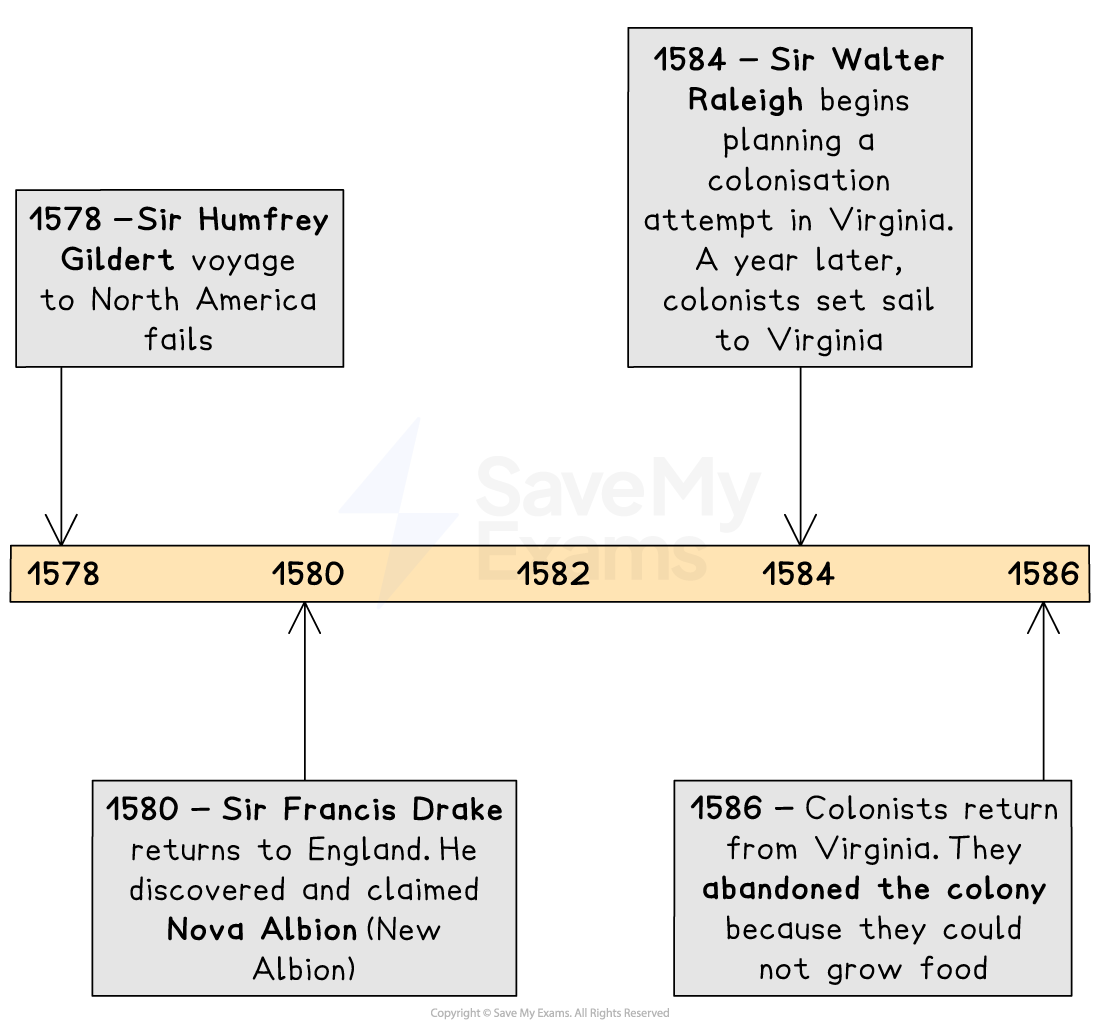
The vision of a permanent English colony in North America attracted several Elizabethan explorers
No colony survived Elizabeth's reign
The lessons learned shaped the more successful attempts made under James I
Humphrey Gilbert
Humphrey Gilbert pioneered the idea of a permanent English colony in North America
He received a royal patent giving him rights over any land he claimed
In 1583, he claimed Newfoundland for England but failed to establish a lasting colony
On the return voyage, his ship The Squirrel went down and Gilbert was lost at sea
The Roanoke colonies
After Gilbert's death, his half-brother Walter Raleigh took on the Virginia venture
Raleigh received a patent for a stretch of North American coastline, which he named Virginia
He organised two attempts to establish a colony on Roanoke Island
The two Roanoke colonies are summarised below:
Colony | What happened |
|---|---|
First Roanoke colony (1585–1586) |
|
Second Roanoke colony (1587–1590) |
|
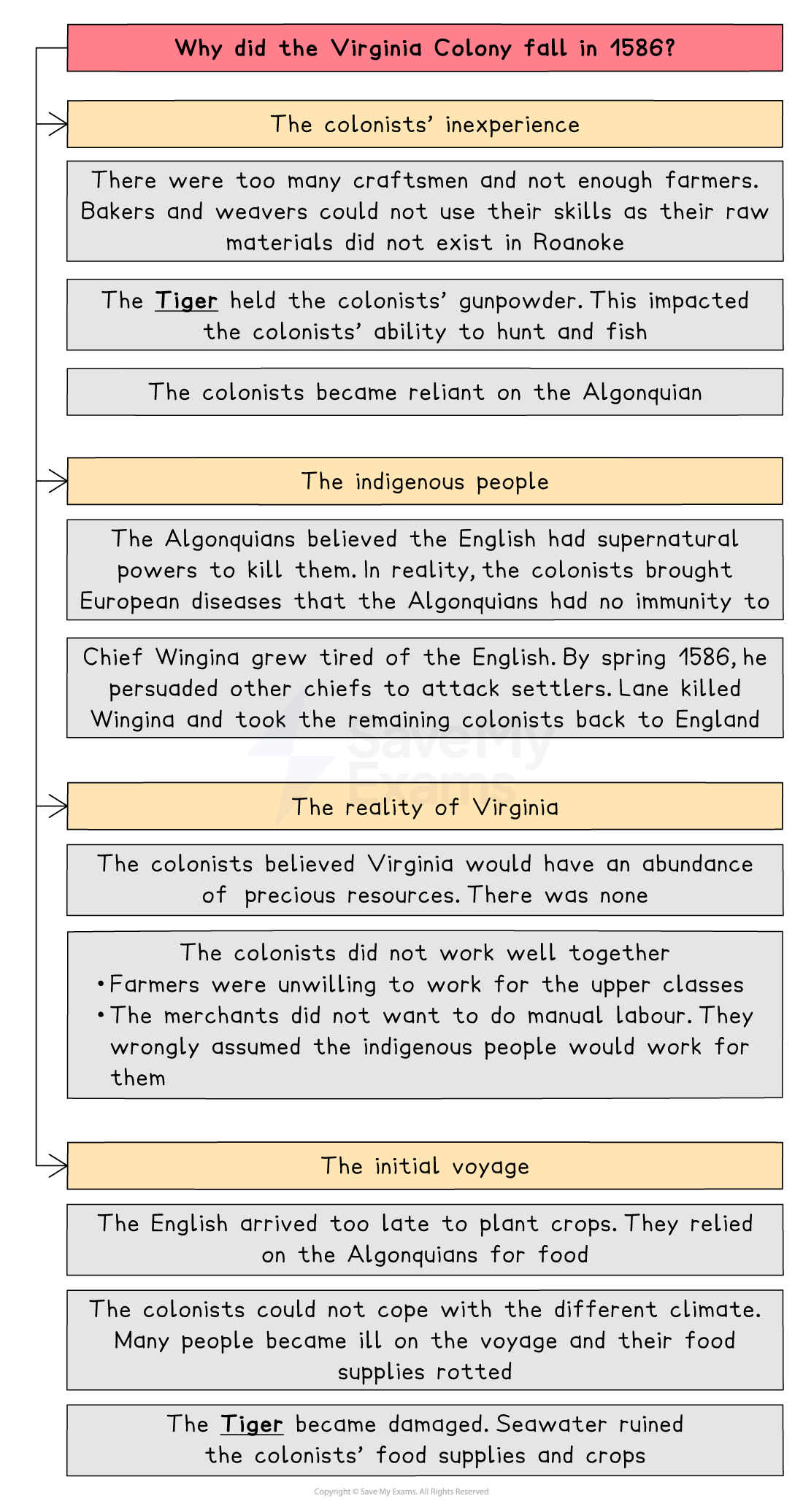
Why colonisation failed
Private financing was insufficient for the scale of the challenge
Supply chains across the Atlantic were fragile and costly to maintain
Spanish hostility made the Atlantic crossing dangerous
Communication delays meant problems became crises before they could be solved
However, the failure of Roanoke did not end the colonial project
Jamestown was successfully founded in 1607, under James I
New England was settled in 1620
Both drew on the experience gained during the Elizabethan failures
Towards trade with the East
A route to India and the East Indies was another major goal of Elizabethan exploration
Date | What happened |
|---|---|
1583 |
|
1591 |
|
1600 |
|
Examiner Tips and Tricks
The failure of Roanoke is not evidence that Elizabeth achieved nothing of lasting value here. The voyages produced geographical knowledge, coastal maps and a model for future ventures. But no permanent colony survived Elizabeth's reign: that distinction matters when a question asks about the significance of Elizabethan colonisation.
Privateering: Profit, Patriotism & Anglo-Spanish Relations
What was privateering?
Privateers were private sailors who attacked enemy ships with royal approval
Unlike pirates, they operated with the backing of the Crown, whether tacit or formal
A letter of marque was an official written permission to attack enemy shipping
Elizabeth often gave informal backing rather than formal letters, giving her plausible deniability
Privateering was attractive to everyone involved
For Elizabeth:
Revenue without the full cost of maintaining a war fleet
For the sailors:
Wealth, glory and patriotic purpose
For England:
A way to challenge Spain's Atlantic dominance without formally declaring war
Early tensions with Spain
The earliest roots of English privateering lay in trade disputes with Spain
Spain controlled the Atlantic trade routes and Caribbean commerce
English sailors in the Caribbean were trespassing on Spanish dominance
1568 was the year tensions became open conflict
Elizabeth seized Spanish silver bullion being transported through the English Channel to pay Alba's army
Spain retaliated by banning English ships from the Netherlands
Trade between the two countries was disrupted until 1573
Both events hardened anti-Spanish feeling and pushed English sailors further towards open raiding
Privateering in practice
Drake was the defining figure of English privateering
His 1572–1573 Panama raids established his reputation for daring against Spain
During the circumnavigation (1577–1580), he raided Spanish ports and seized the Cacafuego's silver
Elizabeth took a share of the profits while publicly denying any involvement in Drake's actions
Spain demanded she punish him
She knighted him instead
Privateering became more openly part of royal foreign policy over time
The 1585 Caribbean raid was semi-official: Elizabeth was clearly pushing confrontation with Spain, coinciding with England’s intervention in the Netherlands (1585) and rising tensions leading to the Armada
The 1587 Cadiz raid was formally authorised by Elizabeth
By the 1590s, privateering had merged into the broader war effort against Spain
Was privateering worth it?
In the short term, privateering generated significant wealth
Drake's circumnavigation produced large returns for its investors
Spanish silver and trade goods flowed into England's hands throughout the 1570s and 1580s
Elizabeth benefited financially without bearing the formal costs of war
By the 1590s, the financial picture had changed
The costs of war with Spain were rising steeply
Spanish convoys were better defended and harder to attack profitably
The 1596–1597 raids on Spain produced diminishing returns
The deaths of both Drake and Hawkins in 1595–1596 ended the golden age of English privateering
Examiner Tips and Tricks
Avoid treating privateering as simply a heroic adventure. It was also a tool of foreign policy, a source of royal revenue, and a cause of international tension with Spain. A strong answer will distinguish between the early period (profitable and politically useful) and the later 1590s (rising costs and falling returns), rather than treating the whole reign as one unified success. As always, make sure you do not narrate, be specific.
How Significant was Exploration and Colonisation under Elizabeth?
Use the specific evidence below to build and support your own argument
The case that exploration and colonisation were significant
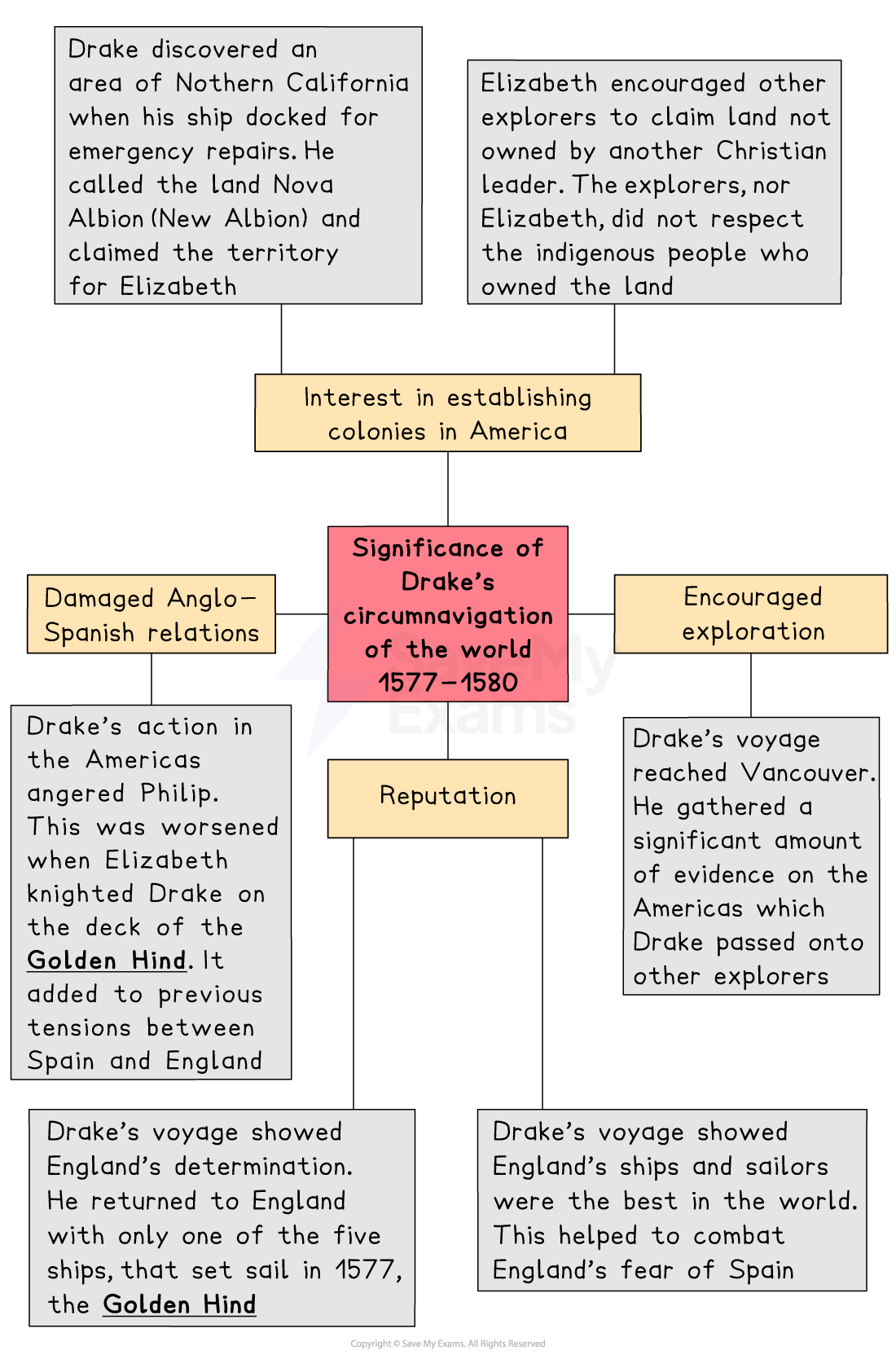
Drake’s circumnavigation (1577–1580) was an achievement no other English sailor had matched
It expanded English knowledge of trade routes across the Pacific
Spain could no longer assume its Pacific trade routes were beyond English reach
It enhanced England’s reputation as a maritime power across Europe
Privateering generated real wealth for the Crown and investors throughout the 1570s and 1580s
Drake’s circumnavigation produced enormous returns for its investors
Elizabeth benefited financially without formally committing to war with Spain
Hakluyt’s Principal Navigations (1589) built the intellectual case for empire
It sustained public enthusiasm for further exploration across the reign
It inspired the next generation of explorers who succeeded under James I
The East India Company (1600) was the most enduring institutional legacy
It could not have existed without the foundation laid by Elizabethan exploration
It eventually became central to the British Empire in Asia
England established itself as a maritime power capable of challenging Spain and Portugal
The Treaty of Tordesillas had seemed to close the world to England in 1494
By 1603, England was recognised as a serious seafaring nation
Experience gained by sailors such as Drake and Hawkins contributed to England’s naval effectiveness against the Spanish Armada
The case that exploration and colonisation were of limited significance
No permanent colony was established under Elizabeth
Roanoke failed twice
Gilbert was lost at sea on his return from Newfoundland
The "Lost Colony" showed the limits of private financing for large colonial ventures
Most voyages failed to achieve their stated objectives
Neither the North-West nor the North-East Passage was ever found
El Dorado was a myth; Raleigh’s 1595 Orinoco expedition found nothing
Hawkins’ slave trade ended in disaster at San Juan de Ulúa in 1568
Privateering became less profitable as the reign went on
By the 1590s, the costs of the war with Spain outweighed the gains from raiding
The deaths of Drake and Hawkins in 1595–1596 marked the end of the era
State investment in exploration was minimal throughout
Elizabeth relied on private finance rather than committing royal funds
This limited the scale and sustainability of what could be achieved
The real gains of empire came after 1603
Jamestown (1607) and New England (1620) were achievements of James I’s reign
Elizabethan exploration laid the foundations for later success, but did not produce lasting results during her reign
Examiner Tips and Tricks
The key analytical distinction is between short-term results and long-term legacy. Most outcomes within Elizabeth’s reign were failures or limited successes; the lasting significance comes mainly from what the voyages set in motion. Make sure your answer is clear about which timeframe it is judging: a conclusion built around Jamestown or the later East India Company is really an argument about James I, not Elizabeth.

Unlock more, it's free!
Join the 100,000+ Students that ❤️ Save My Exams
the (exam) results speak for themselves:

Was this revision note helpful?
