Elizabeth I: Succession, Mary Queen of Scots & Catholic Plots (AQA A Level History: Component 1: Breadth study): Revision Note
Exam code: 7042

Summary
Elizabeth refused to marry or name a successor throughout her reign, insisting the succession was a matter of royal prerogative
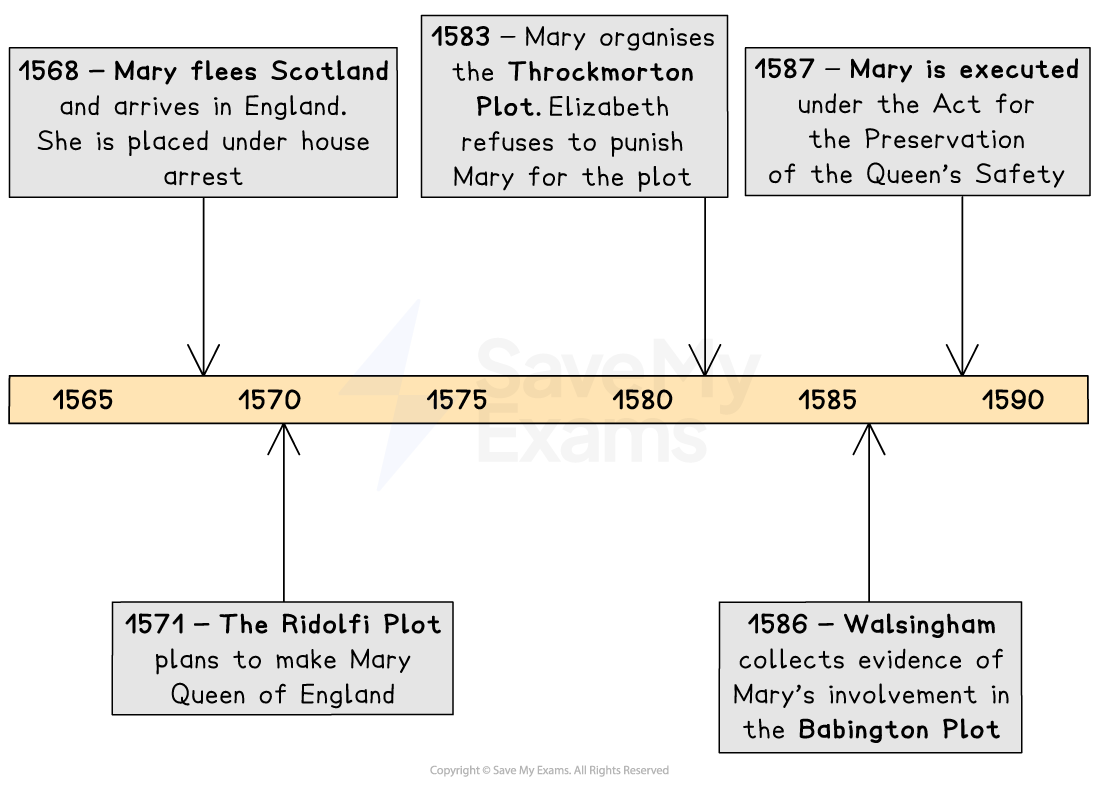
Mary Queen of Scots arrived in England in 1568 after fleeing Scotland
She became a prisoner and a constant focus for Catholic plots against Elizabeth with Mary
Three major plots centred on Mary: the Ridolfi Plot (1571), the Throckmorton Plot (1583) and the Babington Plot (1586)
Elizabeth delayed signing Mary's death warrant, but she was finally executed at Fotheringhay Castle in February 1587
The execution became one of Philip II’s key justifications for the Spanish Armada (1588)
Historians debate how successfully Elizabeth handled the Mary problem
Some argue that 19 years of delay was wise diplomacy; others argue that it allowed three major plots to develop
The Issue of the Succession: Why Did Elizabeth Never Marry?
The succession question dominated the entire reign
Without an heir, a disputed or Catholic succession remained a constant danger
Parliament repeatedly pressed Elizabeth to marry or name a successor; she refused on both counts
Elizabeth insisted that marriage and the succession were matters of royal prerogative
Marriage posed serious risks for Elizabeth
A foreign husband would risk dragging England into European conflicts
An English noble husband would fuel faction and rivalry at court
Any husband would expect a share in governing
Elizabeth was determined to rule alone
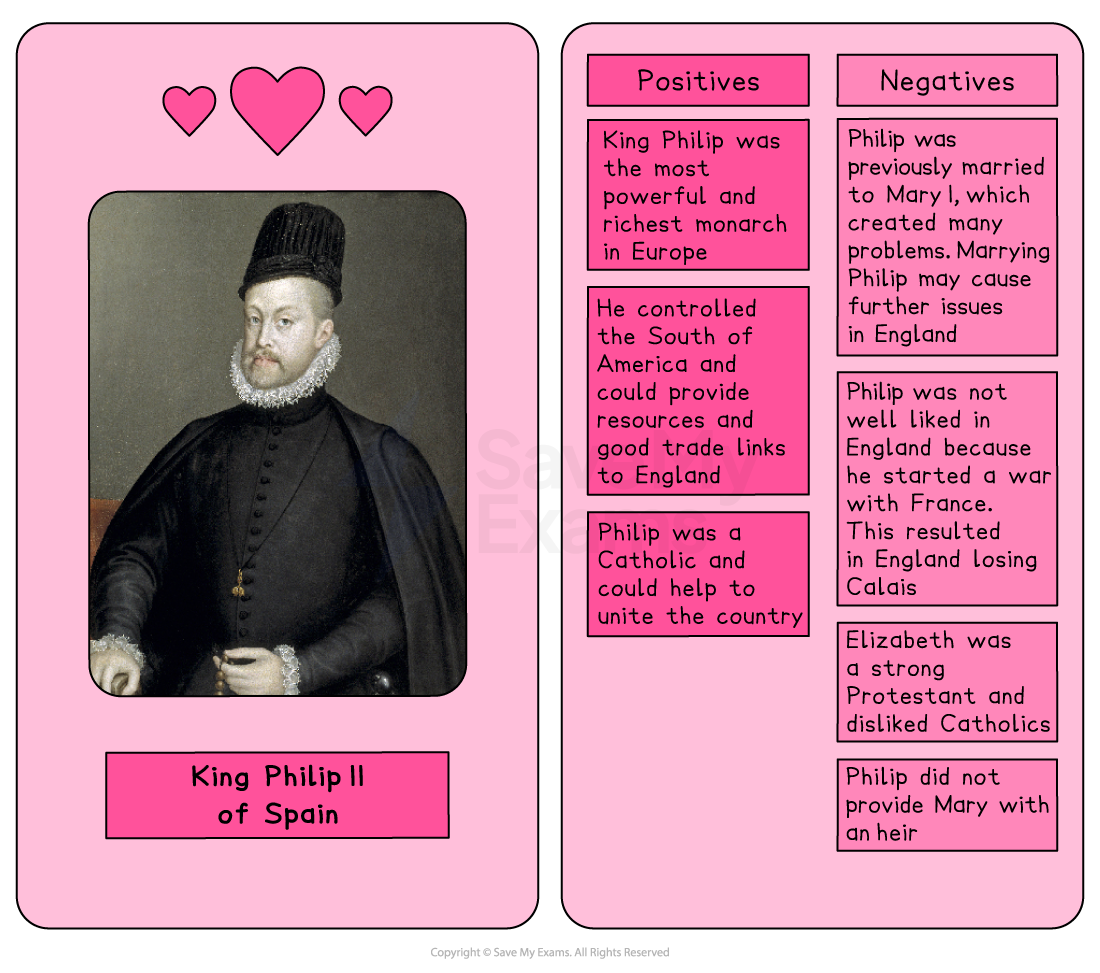
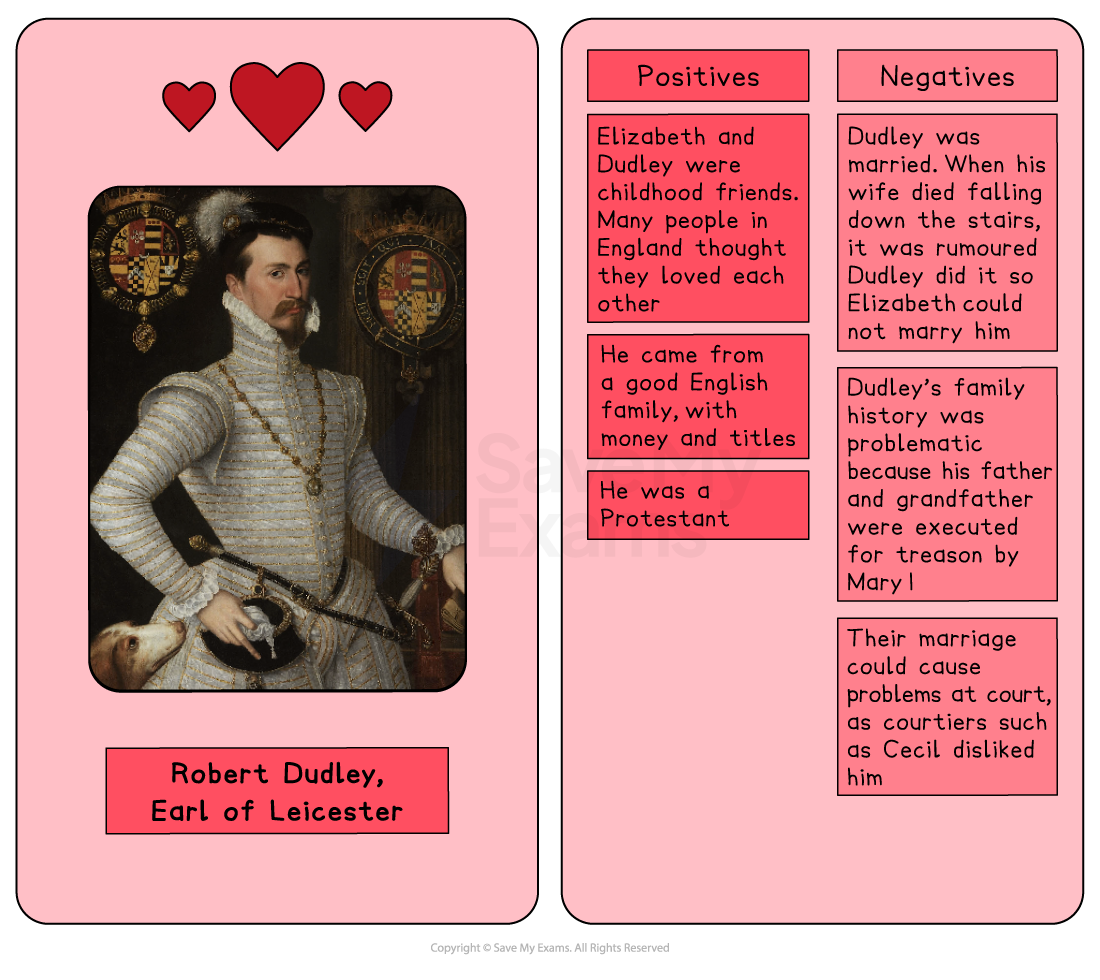
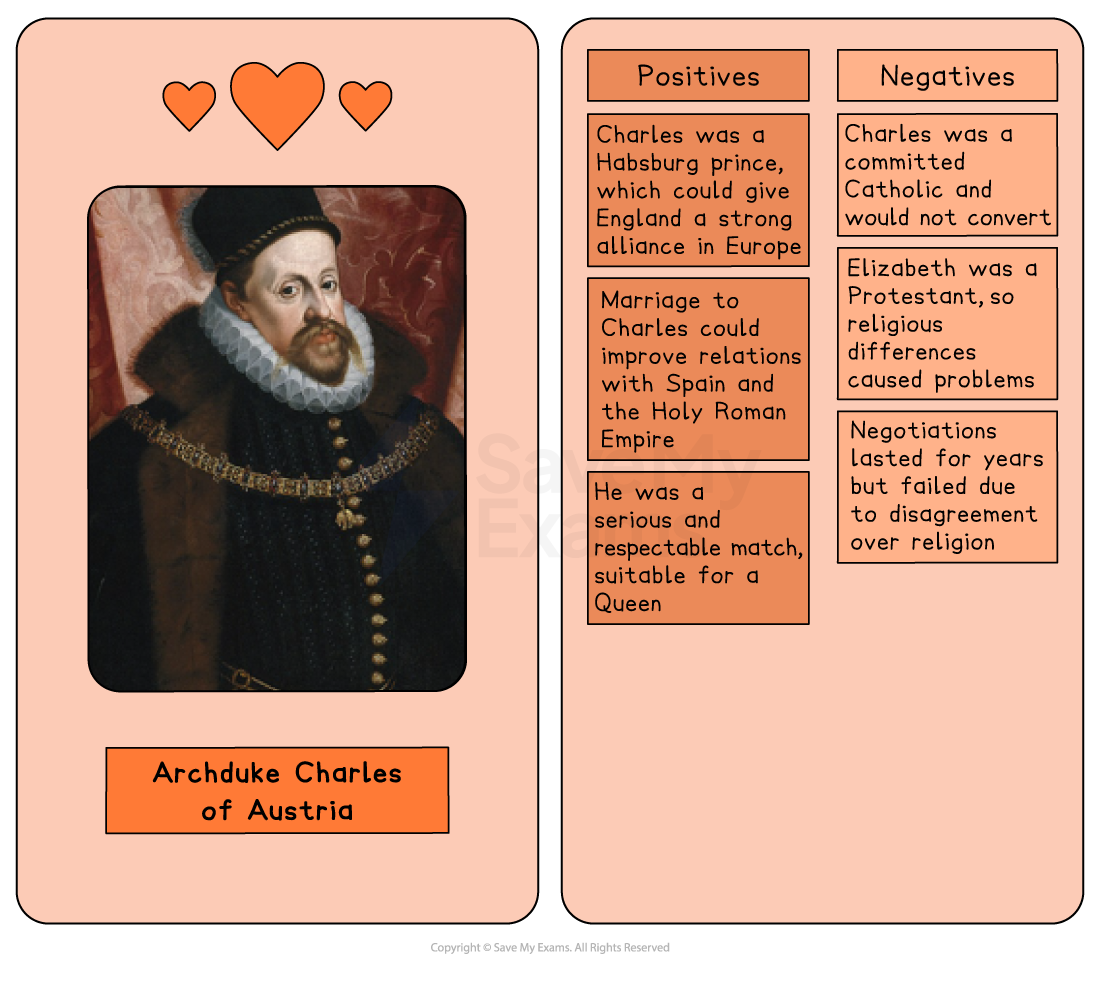
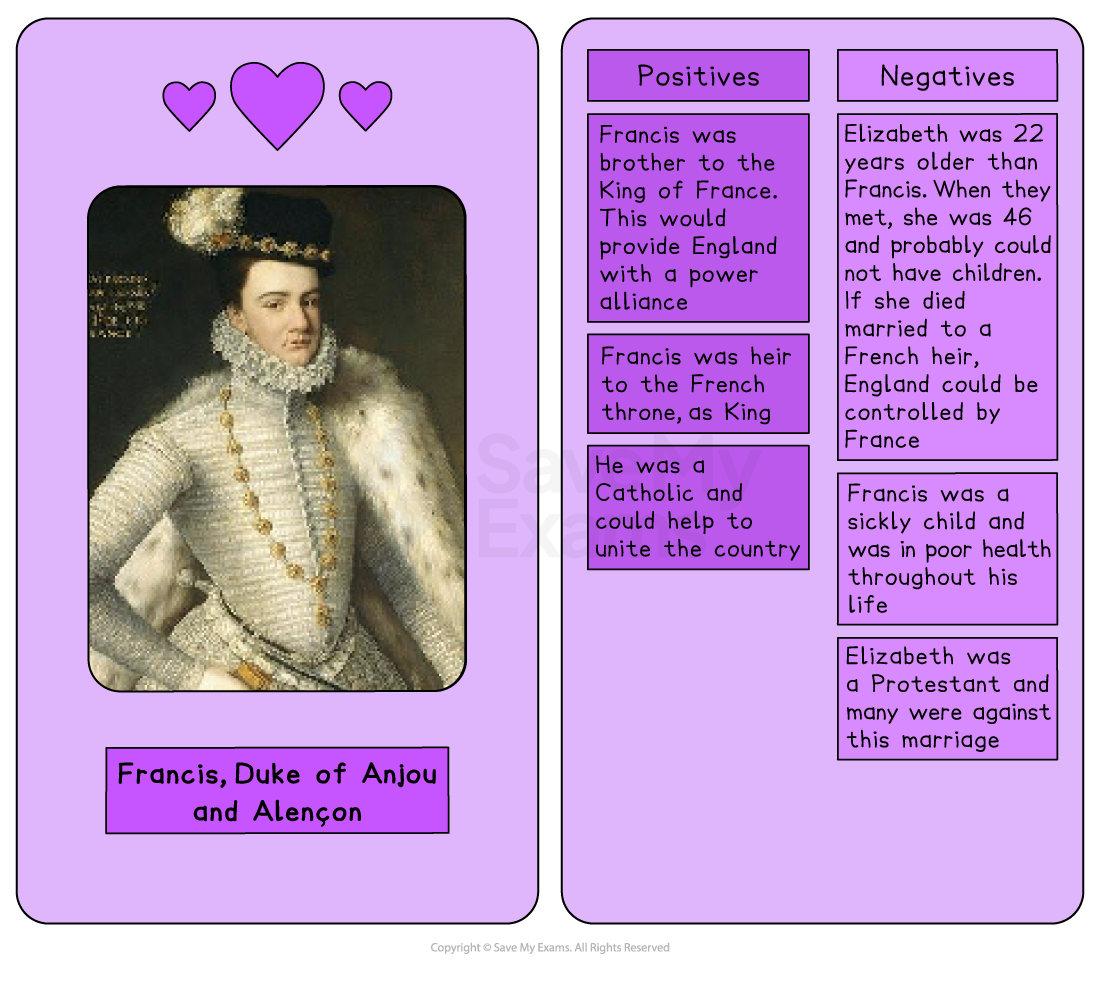
The main suitors
Suitor | Why it came to nothing |
|---|---|
Philip II of Spain |
|
Robert Dudley, Earl of Leicester |
|
Charles, Archduke of Austria |
|
Francis, Duke of Anjou |
|
Elizabeth turned her unmarried status into a political tool
She kept marriage negotiations running with multiple suitors simultaneously
This gave her diplomatic leverage with France, Spain and the Habsburg Empire without ever committing
With France: negotiations with the Duke of Anjou helped maintain an anti-Spanish balance of power
From the 1570s, the cult of the Virgin Queen (Gloriana) grew around her unmarried status
The succession was only settled at Elizabeth’s death in 1603, when James VI of Scotland succeeded smoothly, largely thanks to Robert Cecil’s prior preparations
Examiner Tips and Tricks
Be careful of presenting Elizabeth's refusal to marry as simply irrational or personal. She had strong political reasons. Her use of marriage negotiations as a diplomatic tool was a sign of her intelligence and served her well for decades. The question is whether her failure to settle the succession was ultimately a weakness.
Mary Queen of Scots: Arrival in England, 1568 & Imprisonment
Mary's background and claim
Mary was a serious threat to Elizabeth before she ever arrived in England
She was Queen of Scotland from one week old, born in 1542
She was raised as a Catholic at the French court from 1548
She married the French Dauphin in 1558, briefly making her Queen of France (1559–1560)
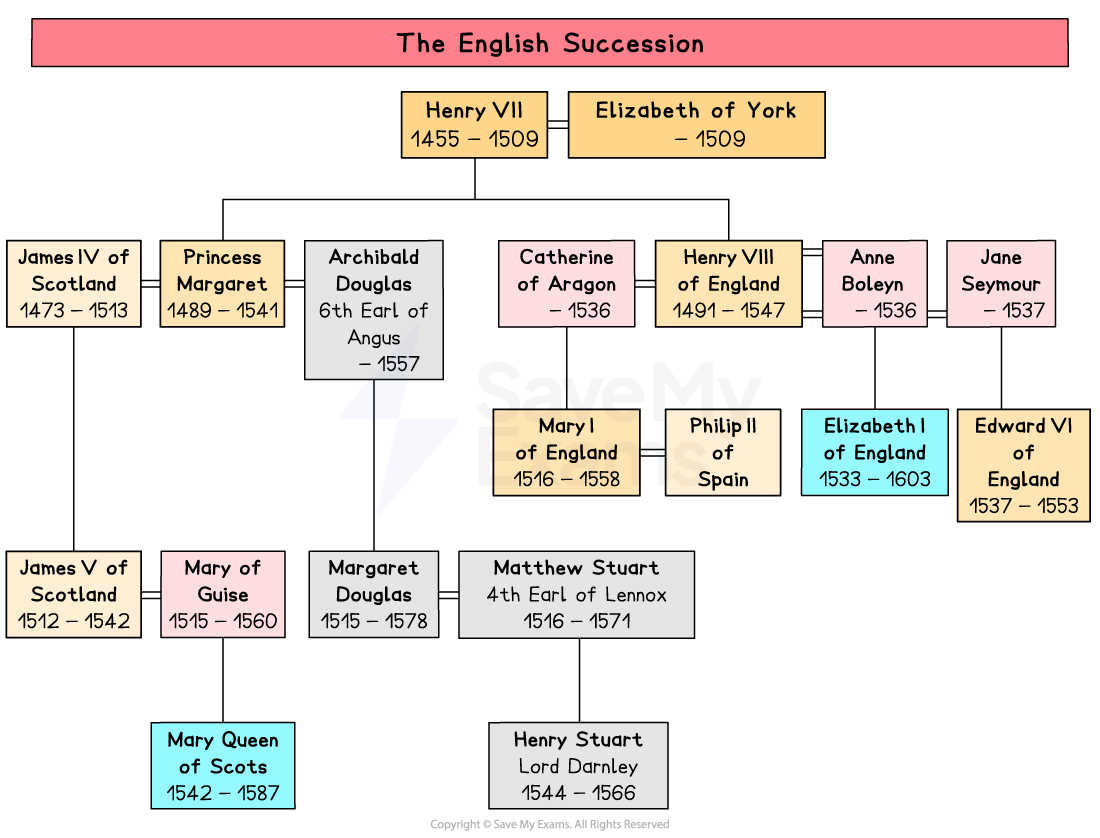
Mary's claim to the English throne came through her grandmother Margaret Tudor, daughter of Henry VII
In Catholic eyes, she had a stronger claim than Elizabeth, whom they regarded as illegitimate
The Pope and many Catholic powers saw her as the legitimate alternative to Elizabeth
Disasters in Scotland
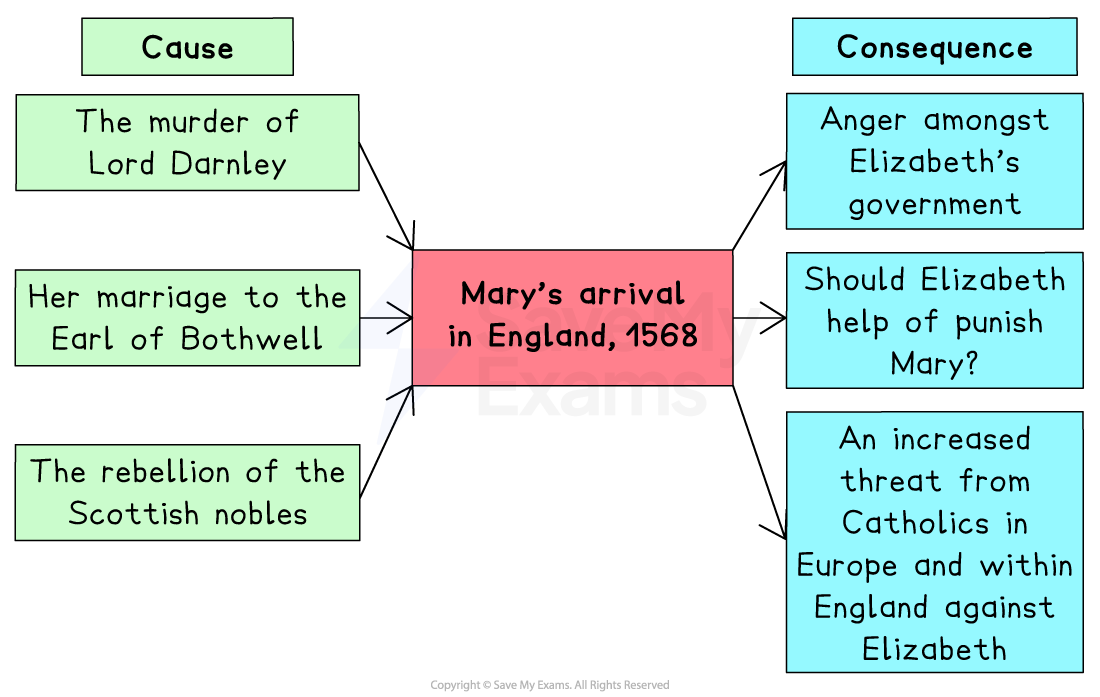
Mary's rule in Scotland collapsed in a series of personal and political crises
She married Lord Darnley in 1565; the marriage quickly became a disaster
Darnley was murdered in February 1567 in suspicious circumstances
Mary then married the Earl of Bothwell, widely suspected of Darnley's murder
Scottish nobles forced her to abdicate in favour of her baby son, James
She fled to England in 1568, expecting Elizabeth's support
Elizabeth's dilemma
Mary's arrival in England put Elizabeth in an impossible position
To support Mary would mean attacking Protestant allies in Scotland
To do nothing would imply that a monarch could be legitimately deposed
Elizabeth could neither free her, return her to Scotland nor execute her without serious consequences
Her solution was to keep Mary under house arrest indefinitely
Mary was held for 19 years, moving between various northern castles (e.g. Sheffield Castle under the Earl of Shrewsbury, and Tutbury Castle under Sir Amyas Paulet)
“Mary’s arrival set Elizabeth a problem which was only to be solved nineteen years later by her execution. There were really two Mary Stuarts to be dealt with. One was the sister sovereign in exile, who merited honourable asylum and perhaps assistance to regain her throne. The other was the Catholic claimant to the English succession, if not to the English throne, the woman who would be under Elizabeth – only much more actively and dangerously – what Elizabeth had been under Mary Tudor, and Mary Tudor under Somerset and Northumberland, the magnet drawing together scattered elements of religious and political discontent.”
S.T. Bindoff, Tudor England (1952)
Bindoff argues that Mary posed a dual problem: as a deposed queen deserving protection, and as a Catholic claimant who was a natural focus for every conspiracy against Elizabeth. He presents the problem as structural rather than personal.
The Casket Letters (1568–1569), allegedly written by Mary, were produced as evidence of her involvement in Darnley’s murder
The inquiry reached no decisive verdict, but the suspicion was enough for Elizabeth to justify keeping Mary in captivity
Examiner Tips and Tricks
The Bindoff quote captures the core tension perfectly. Mary was simultaneously a figure deserving protection and a permanent threat. Elizabeth's 19-year delay in resolving the problem can be presented either as pragmatic diplomacy or as dangerous indecision. Make sure you can argue both.
Catholic Plots: Ridolfi (1571), Throckmorton (1583) & Babington (1586)
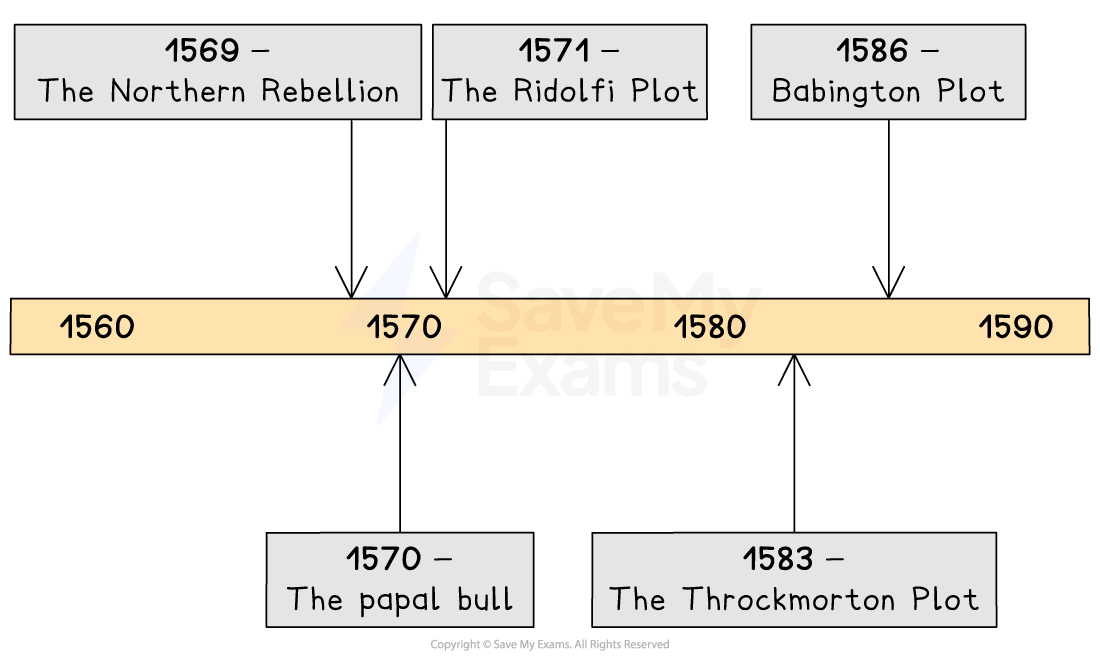
All three plots shared the same basic aim: to remove Elizabeth and replace her with Mary Queen of Scots
Each involved Catholic conspirators at home working with foreign powers abroad
Each was uncovered by Cecil (Lord Burghley's) and, later, Walsingham's intelligence networks
The plots escalated in seriousness, each making Mary's position more precarious
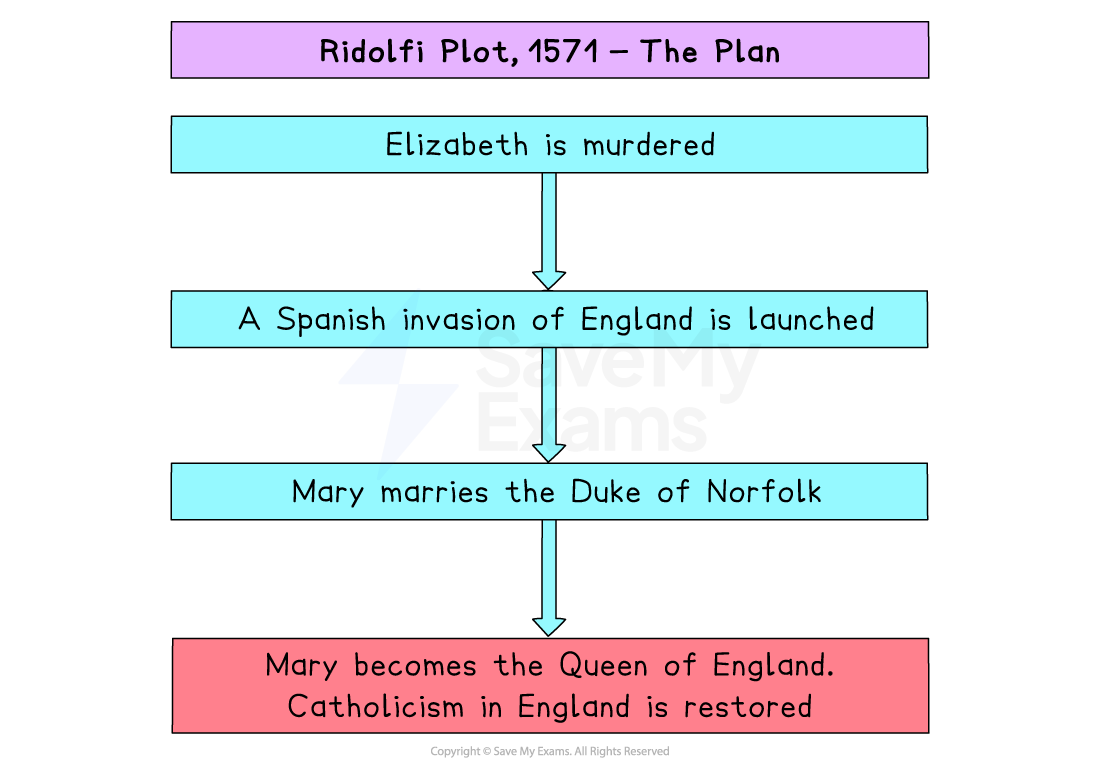
The Ridolfi Plot, 1571
Who |
|
|---|---|
The plan |
|
How it was uncovered |
|
Outcome |
|
The Throckmorton Plot, 1583
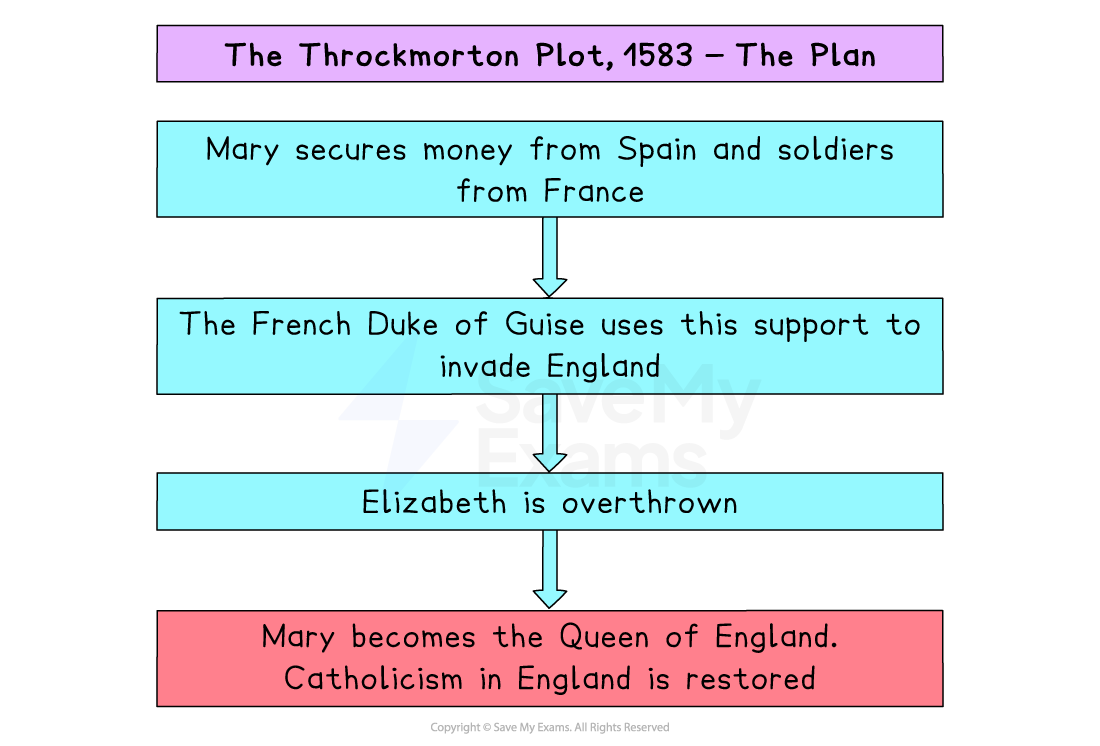
Who |
|
|---|---|
The plan |
|
How it was uncovered |
|
Outcome |
|
The Babington Plot, 1586
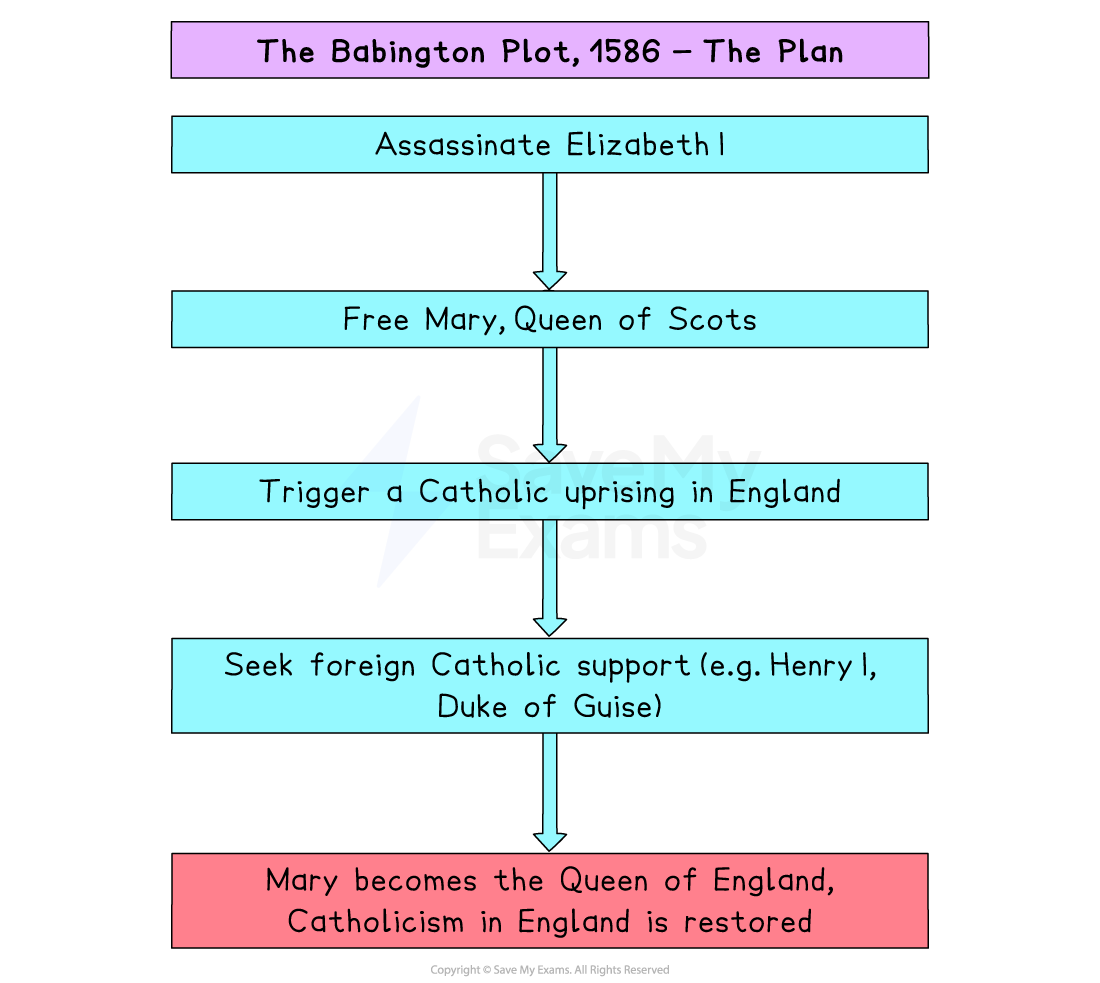
Who |
|
|---|---|
The plan |
|
How it was uncovered |
|
Outcome |
|
"Everything being prepared, and the forces as well within as without … then you must set the six gentlemen to work and give order that, their design accomplished, I may be in some way got away from there and that all your forces shall be simultaneously in the field to receive me while we await foreign assistance…”
Mary Queen of Scots' letter to Anthony Babington, 17 July 1586, intercepted by Walsingham
The Bond of Association (1584) helped prepare the ground for Mary’s execution
Drawn up after the assassination of William of Orange, it stated that anyone benefitting from a plot against Elizabeth could be excluded from the succession
This principle was reinforced by the Act for the Queen’s Safety (1585), which made Mary legally vulnerable even if she had not personally carried out the assassination
Examiner Tips and Tricks
The Babington Plot letter is commonly set in the Extract section of the paper. When evaluating it, consider that many historians have questioned whether Mary's letter was authentic or whether Walsingham had altered it to ensure her guilt. However, make sure you show both sides of the story. Always show you can evaluate the source critically, not just summarise what it says or take it at face value.
The Execution of Mary Queen of Scots, 1587
Elizabeth delayed for months after Mary was found guilty in October 1586
She regarded Mary as a fellow anointed queen
Executing her set a dangerous precedent
Mary had close ties to the French Guise family, which held diplomatic value
England was already heading towards war with Spain
The execution would make things worse
Elizabeth felt personal sympathy for a cousin who had suffered greatly
Elizabeth signed the death warrant in February 1587, but did not authorise its release
Her Secretary of State, William Davison, released the warrant to the Privy Council
The Council acted and Mary was executed at Fotheringhay Castle on 8 February 1587
Elizabeth flew into a rage
She publicly blamed the Council and imprisoned Davison
Most historians regard this as political theatre; Elizabeth wanted to be able to deny responsibility
Davison was eventually released and his fine remitted; the Council was restored to favour
James VI protested formally but took no real action
He had no intention of sacrificing the prospect of the English succession for his mother
He was already regarded as the likely heir to the English throne
“Elizabeth never acted solely out of sentiment, and if she had earlier judged Mary’s death a necessity, she would not have shrunk from its cruelty. When at last she yielded – although even then she left the final responsibility to others – the argument for Mary’s death was overwhelmingly strong… Mary living would be infinitely more dangerous than Mary dead. Justice had long demanded that Mary should die, but it was expediency not justice that sent her to her death in 1587.”
S.T. Bindoff, Tudor England (1950)
Bindoff argues that Elizabeth’s delay was not purely sentimental. He presents the execution as a political necessity driven by self-preservation, not by justice. The phrase "expediency not justice" is the key analytical point: Elizabeth acted when she had no other option, not out of principle.
Examiner Tips and Tricks
The phrase "expediency not justice" is one of the most useful analytical phrases available for this topic. It captures the argument that Elizabeth’s entire handling of Mary was driven by political calculation rather than principle. Use it in essays to show analytical precision.
How Successfully Did Elizabeth Handle the Problem of Mary Queen of Scots?
Use the specific evidence below to build and support your own argument
The case that Elizabeth handled the problem successfully
Elizabeth kept Mary imprisoned for 19 years without triggering a major war
Despite three plots, England remained secure and Mary was never freed
Elizabeth used the threat of Mary to maintain diplomatic leverage with France and Spain throughout the 1560s and 1570s
Walsingham's intelligence network, built partly in response to Mary, was one of the most effective in Europe
The eventual execution was handled with political care
Elizabeth obtained written proof of Mary's guilt before acting
A special commission was ordered to investigate Mary's guilt
Elizabeth maintained plausible deniability by blaming Davison and the Council
James VI accepted the situation, and the Protestant succession was secured
The case that Elizabeth handled the problem poorly
19 years of indecision created a permanent focus for conspiracy
All three plots (Ridolfi, Throckmorton, Babington) centred on Mary
Each plot put Elizabeth's life in danger and sought to destabilise government
Earlier action could have prevented years of threat
The execution of 1587 contributed to the Spanish Armada, though preparations had already begun earlier in response to English intervention in the Netherlands (from 1585)
Philip II cited Mary's execution as a key justification for the invasion of 1588
The execution produced the very diplomatic crisis Elizabeth had long tried to avoid
Examiner Tips and Tricks
This question demands a judgement across the whole problem, not just the execution. A strong answer will weigh the diplomatic skill of the long delay against the dangers it created.

Unlock more, it's free!
Join the 100,000+ Students that ❤️ Save My Exams
the (exam) results speak for themselves:

Was this revision note helpful?
