Elizabeth I: Parliament, Conflict & Cooperation (AQA A Level History: Component 1: Breadth study): Revision Note
Exam code: 7042

Summary
Elizabeth used Parliament sparingly
It met just 13 times across a 44-year reign and was a tool of royal government, not a rival to the Crown
The biggest early clashes were over the marriage and succession question
MPs pressed Elizabeth to marry or name an heir in 1563 and 1566; she refused on both occasions
Puritan MPs tried to push Church reform through Parliament from 1563 onwards but achieved nothing
Peter Wentworth's demand for absolute free speech attracted almost no backing from other MPs
Monopolies became the sharpest flashpoint of the later reign
Members of Parliament (MPs) were openly furious and threatening to delay or withhold subsidies
Elizabeth defused the crisis with the Golden Speech (1601), framing the withdrawal of monopolies as an act of royal care rather than a concession forced by Parliament
Elizabeth & Parliament: How Did She Manage the Commons and Lords?
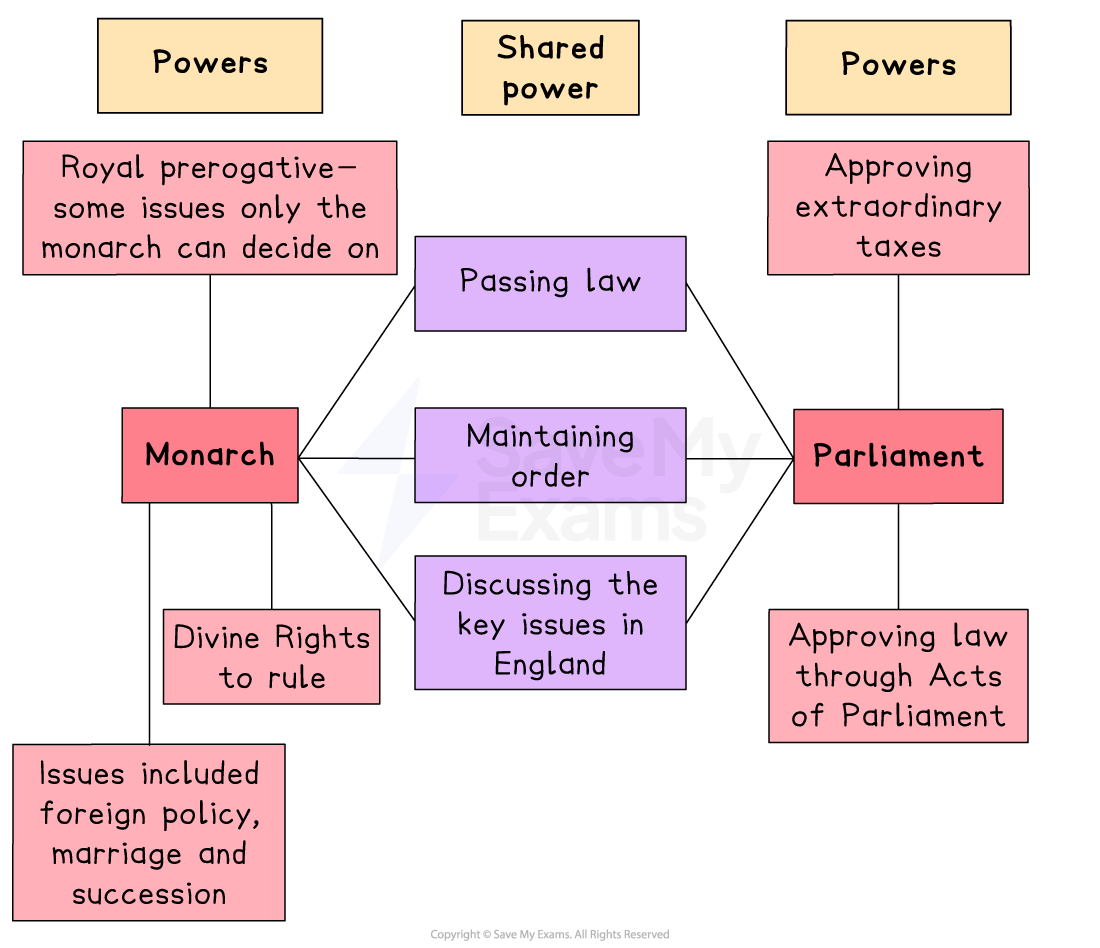
Parliament was summoned rarely and sat for short sessions
Elizabeth called just 13 Parliaments in 44 years
Most sessions were relatively short, often lasting a few weeks to a few months
For most of the reign, government ran through the Privy Council without Parliament
Functions of Parliament:
Parliament's function | How Elizabeth kept control |
|---|---|
Granting taxation |
|
Enacting legislation |
|
Advising the monarch |
|
The House of Lords generally carried more political weight than the House of Commons
Senior ministers such as William Cecil (Lord Burghley) sat in the Lords, not the Commons
Many MPs were influenced by noble patronage, particularly in smaller boroughs
Many government bills were introduced in the Lords first
Elizabeth managed the Commons through parliamentary managers
"Men of business" such as Sir Christopher Hatton and Sir Francis Knollys steered debates and legislation on the Crown's behalf
Elizabeth was often reluctant to call Parliament and had to be persuaded by her ministers, particularly when taxation was required
Parliamentary confidence grew over time, though opposition remained intermittent
By the end of the reign, over half of MPs had a university education or legal training
A more confident Commons was harder to manage
War costs after 1585 forced reliance on parliamentary subsidies, giving Parliament financial leverage
Even so, Elizabeth almost always obtained the taxation she needed
Historian J. E. Neale argues that a rising Commons was asserting itself against the Crown
Geoffrey Elton and later revisionist historians have challenged this, arguing that cooperation was the norm and opposition was never sustained
Examiner Tips and Tricks
Be careful of stating that Parliament was "powerful" without qualification. Elizabeth controlled when it met, what it discussed and whether bills became law. Always show you understand the limits of parliamentary influence alongside any examples of conflict.
Parliamentary Clashes Over the Marriage Question & the Succession
The marriage and succession question dominated early Parliaments
MPs feared Elizabeth's death without an heir would trigger civil war or a Catholic succession
Parliament pressed Elizabeth repeatedly to marry or name a successor; she refused
Elizabeth drew a firm line between matters of commonwealth and matters of state
Matters of commonwealth (trade, local law, finance) were Parliament's legitimate business
Matters of state (marriage, succession, foreign policy, religion) were the royal prerogative
MPs could raise them only at Elizabeth's invitation
This distinction was the foundation of every clash over the marriage and succession question
The Parliaments of 1563 and 1566–1567
Parliament | What happened and how did Elizabeth respond? |
|---|---|
1563 |
|
1566–1567 |
|
These clashes showed Elizabeth's management style
She punished insolence but avoided a permanent breakdown in relations
She obtained the money she needed while conceding nothing on the succession
Pressure regarding Mary Queen of Scots
Parliament repeatedly demanded action against Mary Queen of Scots from 1572 onwards
After the Ridolfi Plot (1571), Parliament called for Mary's exclusion or execution
Elizabeth blocked these measures, refusing to execute a fellow anointed monarch
In 1586, following the Babington Plot, Parliament formally demanded Mary's execution
Elizabeth eventually signed the death warrant in February 1587 under sustained pressure
The Norfolk election case (1586) showed the Commons asserting a further privilege
The Commons claimed the right to settle a disputed election
Traditionally it was the Lord Chancellor's responsibility
The Commons eventually backed down and conceded the Lord Chancellor's authority
This illustrated the limits of parliamentary assertiveness
Demands were made but rarely sustained
Examiner Tips and Tricks
Elizabeth's handling of the marriage and succession question is strong evidence of her political skill. She refused to yield on matters of royal prerogative at every point. In answers, show how she used delay and charm to defuse pressure without making permanent concessions. Obtaining the subsidy while rejecting the succession petition in 1566 is a precise example here.
Parliamentary Clashes Over Religion: Puritans in the Commons
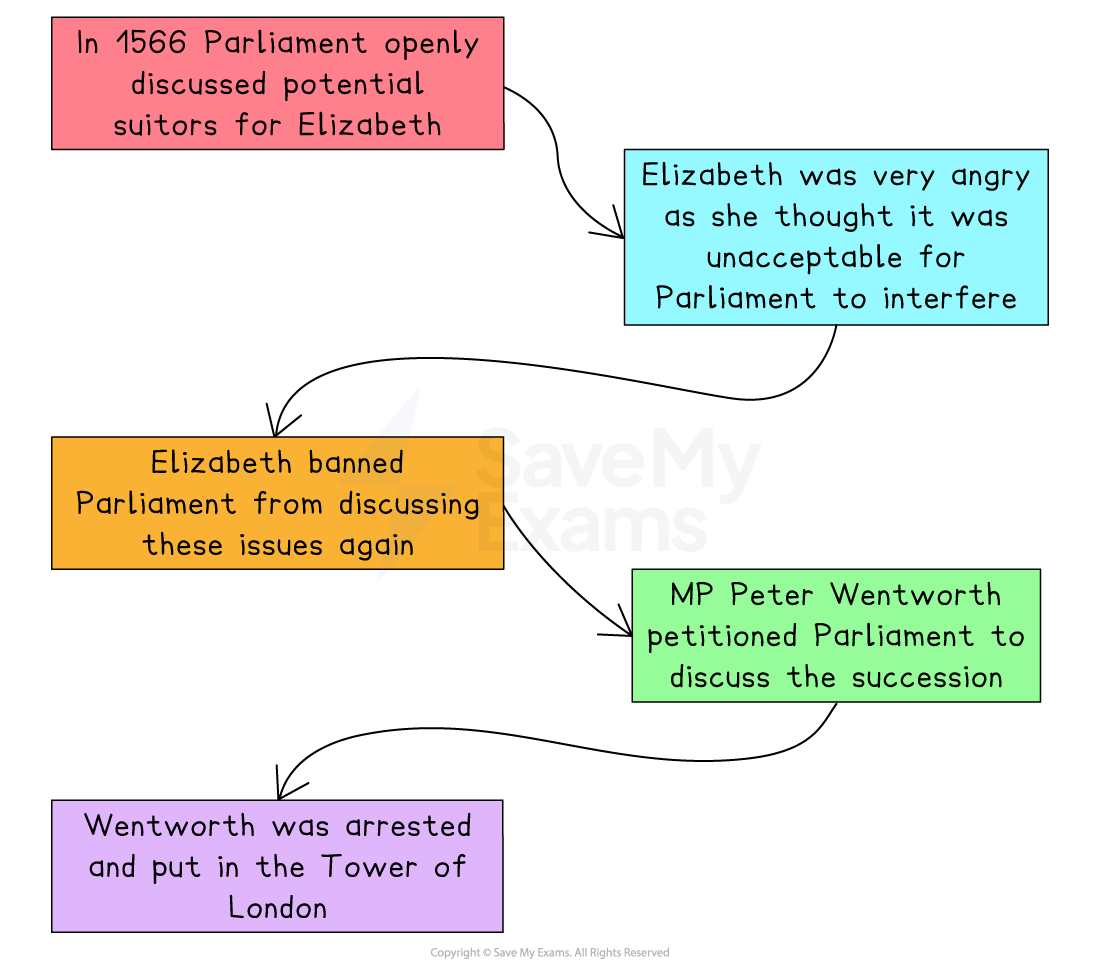
The Puritan challenge in Parliament
Puritan MPs wanted to push the Church Settlement further away from Catholicism
They objected to Catholic-style vestments, ceremonies and church courts retained in the Settlement of 1559
From 1563, they introduced reform bills and tried to extend free speech to cover religious matters
None succeeded
Elizabeth blocked every bill, insisting Church doctrine was a matter of royal prerogative, not Parliament's business
Historian J. E. Neale argues that a "Puritan Choir" of at least 40 co-ordinated MPs pressed for reform from 1563
Later historians, including John Guy, challenged this view
Guy argues this group was far less organised than Neale claimed, and that it achieved no lasting legislative change
Peter Wentworth and free speech
Wentworth was the most persistent supporter of parliamentary free speech
In 1576, he argued that MPs should be free to speak on any matter without royal interference
The Commons committed him to the Tower without direct royal intervention
He was imprisoned again in 1587 and 1593 for raising the succession question
He died in the Tower in 1597
Even at his most persistent, Wentworth attracted almost no backing from other MPs
Date | Event and outcome |
|---|---|
1571 |
|
1576 |
|
1584 |
|
1587 |
|
1593 |
|
Puritan opposition in Parliament achieved nothing
No real changes were made to the Settlement through parliamentary pressure
Examiner Tips and Tricks
The "Puritan Choir" is a favourite subject for Section A extract questions. It's a good idea to be familiar with Neale's argument (a co-ordinated Puritan opposition driving constitutional change) and the revisionist challenge (the group was disorganised and ineffective).
Monopolies & Parliamentary Protest in the 1590s
Monopolies were Crown licences granting exclusive trading rights over a product
The Crown sold monopoly rights as a way to raise revenue without relying solely on parliamentary subsidies
Common monopolies included salt, starch, playing cards, iron and glass
Monopoly holders could charge inflated prices, harming merchants and consumers
The number of monopolies grew sharply in the 1590s
War costs after 1588 pushed Elizabeth to raise money by any means available
Courtiers and royal favourites received monopolies as rewards, fuelling resentment among MPs, merchants and consumers
By 1601, the large number of licences made trade very difficult
The 1597 Parliament
MPs raised monopolies in Parliament formally in 1597 for the first time
A bill was put forward to fight their growth
Elizabeth promised reform and the bill was withdrawn
No real change occurred; by 1601, the problem had worsened considerably
The 1601 Parliament: the monopolies crisis
The 1601 Parliament produced the most serious confrontation of the reign
When MPs read out a list of monopolies in the House, the mood was openly angry
One MP asked what was not yet monopolised
Another replied "bread"
Members resisted voting subsidies for the war in Ireland until the monopolies issue was resolved
The Golden Speech, 30th November 1601
Elizabeth defused the crisis by summoning a deputation of MPs to receive her in person
In the speech:
She declared she had never valued wealth above the welfare of her subjects
She promised to abolish all monopolies that harmed her people
In practice, many monopolies were reviewed or withdrawn, though the system itself was not completely abolished
MPs responded with warm loyalty and voted the subsidies she needed
The speech was circulated in print immediately and became one of the most celebrated statements of Elizabethan monarchy
"Her touch was as sure as ever. Before Christmas her words to the deputation in the Council Chamber were in print and later generations were to call it her 'golden speech', for she had here put into words, without attempting a definition, the essence of that remarkable relationship between sovereign and people in the golden age of monarchy that passed with her death."
N. Williams, Elizabeth I: Queen of England (1967)
Williams argues that even at the very end of her reign, Elizabeth retained the political skill to turn a confrontation into a performance of royal love. He presents the Golden Speech as the defining expression of the bond between Elizabeth and her subjects.
The monopolies crisis also reflected the wider strains of Elizabeth's last years
The patronage system was under strain
Too many courtiers competed for too few rewards
War costs made structural financial reform unavoidable
Elizabeth still avoided structural financial reform
Examiner Tips and Tricks
The Golden Speech is one of the most commonly set source extracts for this topic. Do not treat it simply as proof of Elizabeth’s popularity. Contextualise it as a deliberate political performance designed to manage a specific crisis. Ask how far it represents genuine concession versus expert management of conflict.

Unlock more, it's free!
Join the 100,000+ Students that ❤️ Save My Exams
the (exam) results speak for themselves:

Was this revision note helpful?
