Social Environment (AQA A Level Business): Exam Questions

Exam code: 7132

Syllabus Edition

First teaching 2026

First exams 2028

3 hours18 questions
1
6 marks

Source A: Trainline

Trainline plc, which is listed on the London Stock Exchange, sells rail and coach tickets through its app and website in the UK and across Europe. It also provides ticketing technology to train operators and to travel management companies, which book travel for businesses. Its app is the most downloaded rail app in Europe.

Trainline earns its revenue mainly as commission on the tickets it sells. In April 2025 its commission on UK online ticket sales fell from 5.0% to 4.5%, under a rail industry agreement announced in 2022.

In the year to 28 February 2026:

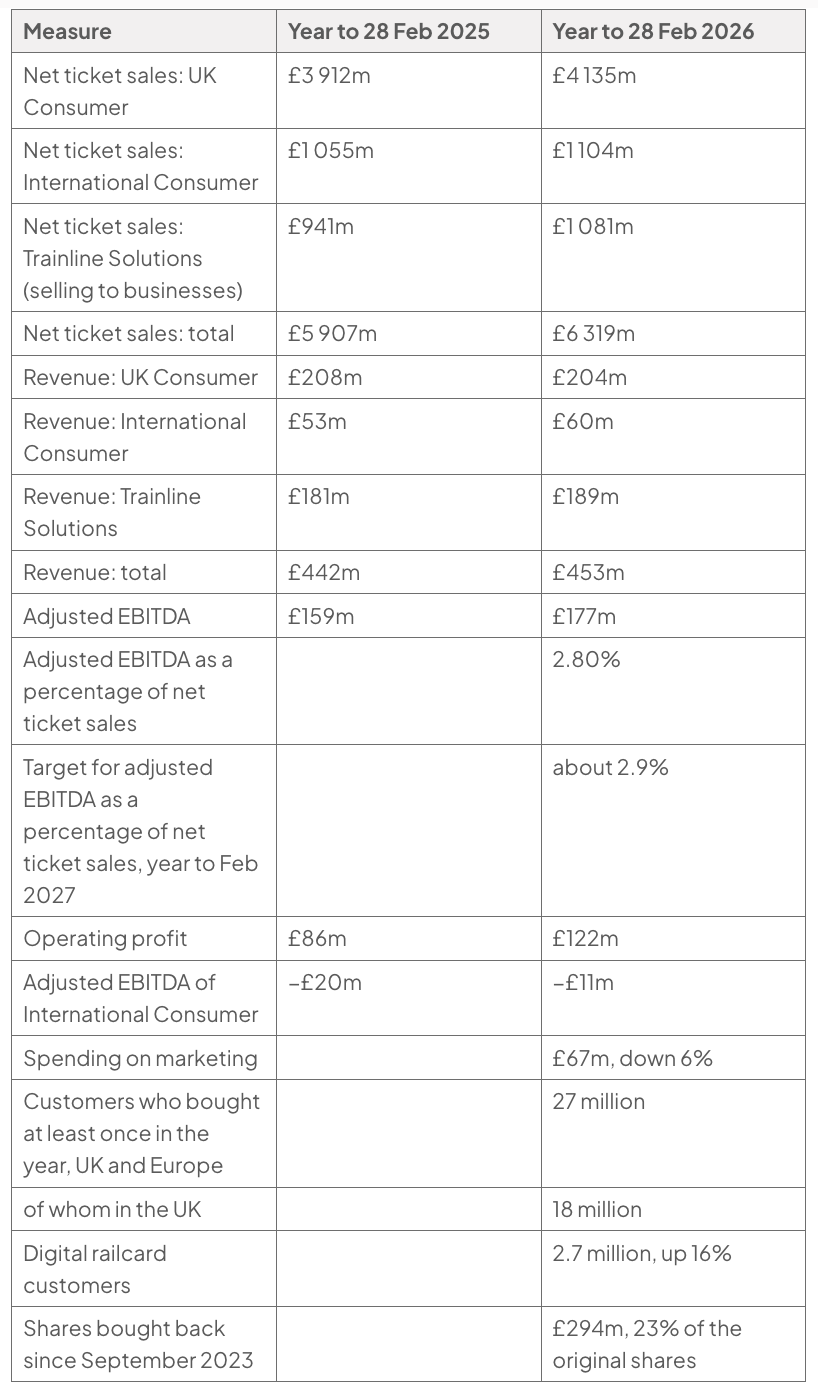
  • it sold tickets worth £6 319 million, up 7%, to 27 million customers, 18 million of them in the UK

  • revenue rose by 2% to £453 million, while UK revenue fell by 2%

  • adjusted EBITDA was 2.80% of the value of tickets sold; the target for the year to February 2027 is about 2.9%

Growth in the UK slowed in the second half of the year. Trainline identified three causes:

  • Contactless payment. Transport for London is expanding contactless payment, which lets passengers travel by tapping a bank card without buying a ticket.

  • Operators' websites. Train operators have encouraged customers to use their own websites, including by offering automatic delay compensation, which independent retailers such as Trainline were not allowed to offer.

  • Fares. The government has frozen regulated rail fares until March 2027.

The government is creating Great British Railways to run most of the railway; its online retailer is expected eventually to replace the operators' websites. In March 2026 the government announced that passengers will then be able to claim delay compensation wherever they bought their ticket, including through Trainline.

In the first half of the year, sales to foreign travellers fell after Google changed its search results page. Trainline has made its app available within ChatGPT and introduced artificial intelligence features which help customers when trains are disrupted. Young people are among its most important customers: 45% of railcard holders aged 16 to 30 use a Trainline digital railcard, held on their phone.

Source: Trainline plc, Results for the twelve months ended 28 February 2026

45% of railcard holders aged 16 to 30 use a Trainline digital railcard, which is held on their phone rather than as a card.

Analyse one way in which young people's use of digital railcards might affect Trainline's sales.

2
6 marks

Source B: Tarnside Travel

Tarnside Travel Limited organises escorted coach holidays from its base in Kendal, Cumbria. It was founded in 1972 and is owned by the Fell family; its Managing Director is Joanne Fell. It employs 42 people, runs 8 coaches and has two booking offices, in Kendal and Penrith. In the year to 30 September 2026 it carried 10 300 passengers on holidays in the UK and Europe, at an average price of £815.

Most of Tarnside Travel's customers are retired: 76% are aged over 65. Its holidays are priced in a brochure published a year in advance, and include coach travel, hotels and entrance to attractions. A growing share of its customers travel alone; they pay a single supplement of £180 for a room of their own.

Customers can book by telephone, in a branch or, since 2024, online. A booking taken by telephone costs the company about £24 to process, compared with about £6 online.

Changes in government policy affect the company's holidays. Edinburgh introduced a visitor levy of 5% of the cost of accommodation from 24 July 2026, and councils in Wales may charge a levy of £1.30 a person a night from April 2027. In April 2026 the full new state pension rose by 4.8%, from £230.25 to £241.30 a week.

The coaches run on diesel. Tarnside Travel buys its fuel at the price on the day, while the price of each holiday is fixed when the brochure is published.

Source: Tarnside Travel

A growing share of Tarnside Travel's customers travel alone. They pay a single supplement of £180 for a room of their own.

Analyse one way in which the growing number of people who travel alone might affect Tarnside Travel's revenue.

3
6 marks

Source A: Red Funnel

Red Funnel Limited provides ferry services across the Solent between Southampton and Cowes on the Isle of Wight, trading as Red Funnel. It has served the island since 1861. It runs vehicle ferries between Southampton and East Cowes, a freight ferry, and the Red Jet Hi-Speed passenger service between Southampton and West Cowes. Its passengers include island residents, visitors, commuters and patients travelling to mainland hospitals, and for many of them the service is a lifeline. Competitors, such as Wightlink, operate other routes across the Solent.

Red Funnel's mission is "to be the preferred ferry service to and from the Isle of Wight". Its strategy includes:

  • operating a safe, reliable and year-round lifeline service

  • offering customer service that exceeds expectations

  • gaining market share through a superior value proposition based on safety, reliability, service, price and value for money

  • improving its environmental footprint on the pathway to Net Zero

  • managing the business efficiently, with robust financial stewardship and investment discipline.

In 2025 Red Funnel carried 2.71 million passengers, including about 922 000 on the Red Jet, and 163 000 freight vehicles. Turnover rose by 0.7% to £60.4 million. Costs rose faster, including the effects of increases in the National Living Wage and employers' National Insurance contributions.

On 28 November 2025 the company was bought by a business controlled by Njord Partners, an investment firm, after government approval. As part of the deal, banks wrote off loans, the debt was restructured, and the owners provided new capital. The company says this provides a "materially strengthened financial platform from which to invest in operations, infrastructure and customer experience".

Source: Red Funnel Limited, Annual Report and Financial Statements for the year ended 31 December 2025

Red Jet passengers include commuters who travel between the Isle of Wight and the mainland. In 2025 the number of Red Jet passengers was 78% of its 2019 level, although it rose by 3.8% compared with 2024.

Analyse one way in which a change in working patterns, such as more people working from home, might affect Red Funnel's revenue from the Red Jet service.

4
6 marks

Source B: Linbury Preserves

Linbury Preserves Limited makes jam and marmalade near Leominster, Herefordshire. It was founded in 1952 by Joan Ashby in her farmhouse kitchen and is still owned by the Ashby family; its Managing Director is Tom Ashby, her grandson. It employs 58 people and in the year to 31 March 2026 sold 3.02 million jars, mainly to farm shops, delicatessens and independent food shops, and through its own website.

The company's mission is to make "proper preserves, the slow way": every batch is boiled in open copper pans, and the fruit comes from farms within 30 miles. It buys its fruit from 14 Herefordshire growers on five-year contracts, at prices above the market price, so that the growers can plan and invest. In 2025 the family set an objective of doubling the company's revenue by 2030.

To be sold as "jam", a product must meet the legal standards for fruit and sugar content. In 2024 Linbury Preserves launched a range with less sugar; because its sugar content is below the legal standard, it must be sold as a "fruit spread" rather than as jam.

Many of its customers say they are trying to eat less sugar. At the same time, the company's costs have risen. The National Living Wage rose by 4.1% to £12.71 an hour from April 2026, employers have paid more National Insurance since April 2025, and since 2025 the company has paid fees on the glass jars and lids it uses, under new rules which make businesses pay towards the cost of recycling packaging.

Source: Linbury Preserves

Many of Linbury Preserves' customers say they are trying to eat less sugar.

Analyse one way in which this change in customers' attitudes might affect Linbury Preserves' revenue.

5
6 marks

Source A: Mulberry

Mulberry Group plc was founded in Somerset in 1971 and is known for leather handbags such as the Bayswater. Its two largest shareholders are Challice, controlled by Singapore's Ong family, and Frasers Group, which owns retailers such as Sports Direct and Flannels. In 2024 Mulberry's board rejected a takeover approach from Frasers.

Mulberry designs, makes and sells bags, small leather goods and clothing. About half of its iconic bags are made by craftspeople at its two factories in Somerset. It sells through:

  • its own stores and website

  • franchise partners abroad

  • wholesale to other retailers

In the year to March 2025 Mulberry's revenue fell by 21% and it made a loss before tax of £32.2 million. Andrea Baldo, who became Chief Executive in 2024, launched a strategy called "Back to the Mulberry Spirit" in January 2025. Its aims are to:

  • simplify the business

  • restore profitability

  • rebuild the gross margin by selling more at full price

  • "put creativity back at the centre of what we do"

In July 2025 Challice and Frasers provided £20 million of funding. As part of the strategy, Mulberry:

  • made redundancies in both the year to March 2025 and the year to March 2026

  • closed one UK store and eight international stores in the year to March 2026

  • introduced a new incentive scheme for store staff "supporting a stronger performance culture"

In the 52 weeks to 28 March 2026 revenue rose by 4% to £125.5 million, and the loss before tax fell to £8.9 million. More than half of Mulberry's UK sales through its stores and website came from returning customers. Its pre-loved service, Mulberry Exchange, which buys back and resells used Mulberry bags, increased its sales by 46%.

Mulberry's medium-term goal is revenue of more than £200 million with an adjusted operating profit margin of 15%.

Source: Mulberry Group plc, audited results for the 52 weeks ended 28 March 2026

Sales through Mulberry Exchange, which buys back and resells used Mulberry bags, increased by 46%.

Analyse one way in which growing consumer interest in second-hand luxury goods might affect Mulberry's sales of new bags.

6
6 marks

Source A: AG Barr

A.G. BARR p.l.c. is a UK drinks company listed on the London Stock Exchange. It employs about 1 000 people and has factories at Cumbernauld, near Glasgow, and Milton Keynes. Its brands include:

  • IRN-BRU, the UK's third-biggest flavoured fizzy drink brand, 125 years old in 2026, with about 40% of sales outside Scotland

  • Boost energy and sports drinks, whose revenue rose 12% in 2025/26

  • Rubicon, Barr and MOMA oat drinks

In the 53 weeks to 31 January 2026, revenue rose 4.0% to £437.3 million. In early 2025 it raised some prices by between 1% and 11%, an approach it called "value over volume", and overall volume was "relatively flat". The chief executive, Euan Sutherland, aims to "double the size of the business".

In 2018 the sugar in regular IRN-BRU was cut from 10.3g to 4.7g per 100ml, and 96% of AG Barr's soft drinks by volume contain under 5g of sugar per 100ml.

Soft drinks are closely regulated:

  • Sugar. The Soft Drinks Industry Levy applies to drinks with 5g or more of sugar per 100ml.

  • Advertising. Paid online advertising of less healthy food and drink has been banned since January 2026. AG Barr says it never advertises caffeinated or energy products to under-16s.

  • Energy drinks. The government plans to ban selling drinks with more than 150mg of caffeine per litre to under-16s in England from April 2027.

  • Packaging. A deposit return scheme for plastic bottles and cans is due in October 2027.

The company says: "We view regulation as a catalyst for innovation."

Source: A.G. BARR p.l.c., annual report and final results for the 53 weeks ended 31 January 2026, and interim results for the 26 weeks ended 1 August 2026

Half of UK fizzy drink sales are now low-calorie drinks, and AG Barr sells IRN-BRU ZERO alongside regular IRN-BRU.

Analyse one way in which consumers' wish to reduce their sugar intake might affect AG Barr.

7
6 marks

Source B: Quarrenden Drinks

Quarrenden Drinks Limited is a family-owned private limited company, founded in 1996 on a family farm near Tiverton, Devon. It employs 46 people and makes two types of drink, both with no added sugar:

  • pressed apple juice

  • lightly sparkling fruit drinks

The drinks are sold in glass bottles at premium prices to farm shops, delicatessens, cafés, independent grocers and two regional supermarket chains, and through the company's own website, which also offers a monthly subscription box. Some of the bottles delivered to cafés are returned, washed and refilled.

Quarrenden buys all its apples from 34 orchards in Devon and Somerset, under three-year contracts at a fixed price above the market price. Drinks with no added sugar are not charged the Soft Drinks Industry Levy.

The company faces three main pressures:

  • Costs. Quarrenden's costs rose sharply in 2025, including the cost of glass bottles, energy and wages. The National Living Wage and employers' National Insurance both rose in April 2025.

  • Health advice. NHS advice is to drink no more than 150ml of fruit juice and smoothies a day.

  • Customers. Both regional supermarket chains have asked suppliers for evidence of their social and environmental standards.

Its directors are considering how to respond, including raising all prices or moving the sparkling range from glass bottles to cans.

Source: Quarrenden Drinks

The NHS's latest advice is to drink no more than 150ml of fruit juice and smoothies a day.

Analyse one way in which this advice might affect Quarrenden Drinks.

8
6 marks

Source B: Brackenfold Outdoor

Brackenfold Outdoor Limited is a private limited company, founded in 1987 in Kendal, Cumbria. It designs and makes waterproof jackets and trousers for walkers and for people who work outdoors, and employs 132 people. Its waterproof fabric is bought from an overseas supplier and priced in US dollars.

Brackenfold sells its products in three markets:

  • United Kingdom. It sells to outdoor shops and through its own website.

  • European Union. It sells to shops in the European Union.

  • United States. It sells to shops through a distributor.

In 2025 its sales to the European Union rose, while its sales to the United States fell.

Brackenfold also offers a repair service for its products. The number of jackets it repaired rose by more than half in 2025. In a survey of its website customers, more than half said they would rather repair a jacket than replace it.

The company faces two main pressures:

  • Trade. Since April 2025 most UK goods sold into the United States have faced an extra US tariff of 10%.

  • Costs. Its wage costs rose in 2025, after increases in the National Living Wage and in employers' National Insurance. The price of its waterproof fabric also rose.

Brackenfold's directors are considering investing in automated cutting machinery.

Source: Brackenfold Outdoor

More consumers say they would rather repair clothing than replace it.

Analyse one way in which this change in consumer values might affect Brackenfold Outdoor.

1
9 marks

Source A: Burberry

Burberry Group plc is a British luxury fashion brand, headquartered in London and listed on the London Stock Exchange, where it is a member of the FTSE 100. It was founded in 1856 by Thomas Burberry, whose gabardine fabric and trench coat became the basis of the brand. It sells mainly through its own stores, of which there were 410 at 28 March 2026, and online. It also sells to other retailers and earns income from licences.

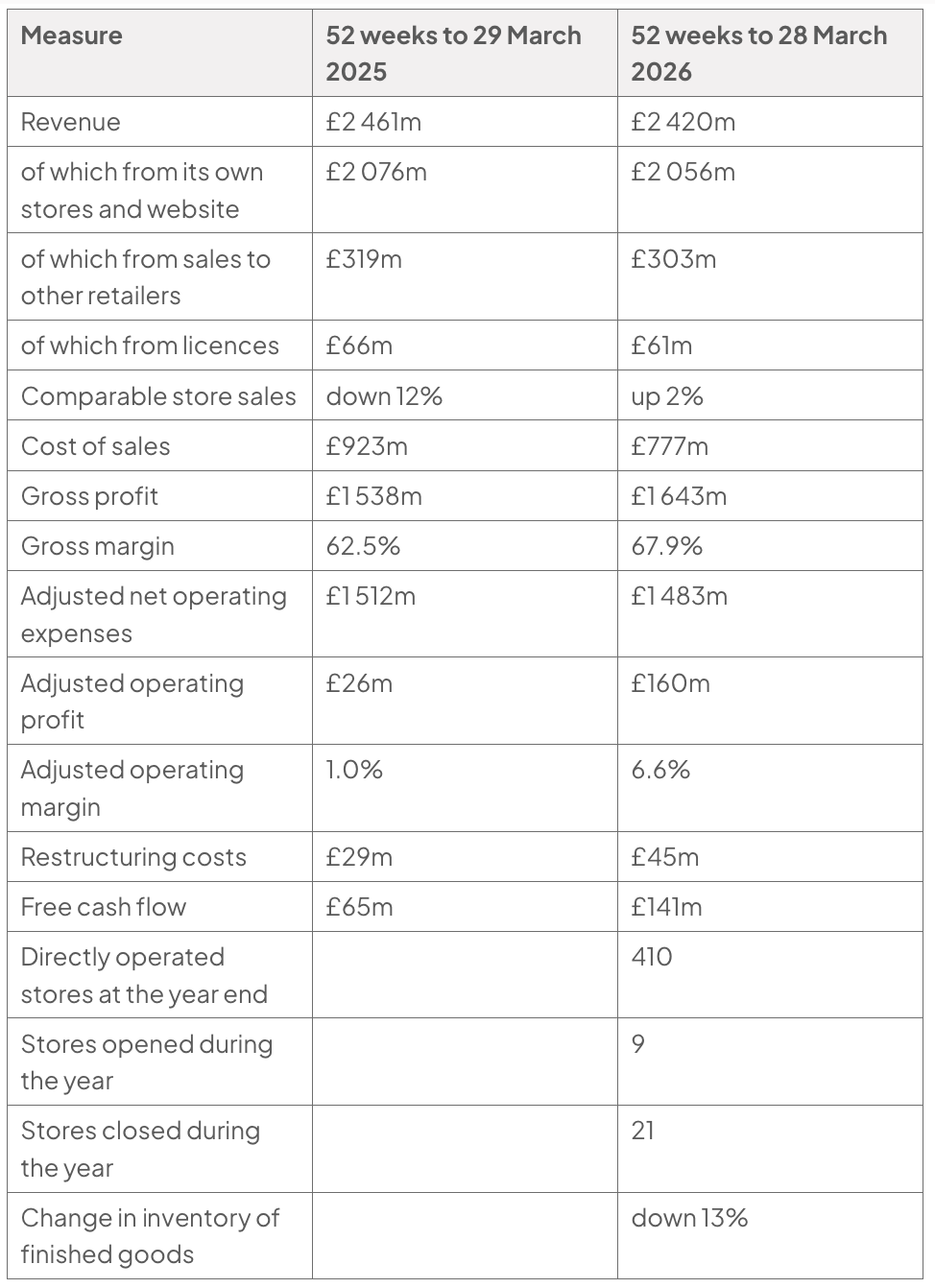
In the 52 weeks to 29 March 2025 Burberry's comparable store sales fell by 12% and its adjusted operating profit fell to £26 million. Joshua Schulman, who became Chief Executive in July 2024, launched a strategy called Burberry Forward in November 2024. Its aims include restoring the brand's cultural relevance and asserting its authority in outerwear and scarves before extending that success to other categories.

In the 52 weeks to 28 March 2026 Burberry's revenue was £2 420 million, compared with £2 461 million the year before, while comparable store sales rose by 2% and adjusted operating profit rose to £160 million. The Chief Executive described the year as "a meaningful inflection point". During the year the company:

  • achieved savings in operating costs of £80 million, while continuing to invest in marketing;

  • spent £45 million on restructuring, mainly on redundancies and consultancy;

  • opened 200 scarf bars in its stores;

  • increased e-commerce sales by a percentage in the high teens;

  • opened 9 stores and closed 21.

Outerwear sold better than other categories in every region, scarves grew throughout the year, and sales of leather goods improved in the second half.

Sales growth differed between regions. In Europe, the Middle East, India and Africa, sales were held back by a fall in tourist numbers. In Japan, sales fell by 6% in the final quarter as fewer visitors arrived, while South Korea grew by 13%, helped by visitors from China. In Greater China and the Americas, sales in the final quarter grew by 10%, driven by local customers.

For the year to March 2027 Burberry expects to increase both its revenue and its profit margin, but says it is mindful of the uncertain economic and political environment.

Source: Burberry Group plc, Preliminary Results, 14 May 2026

Appendix A: Burberry selected data

Table comparing Burberry’s revenue sources in 2025 and 2026: own stores and website £2 076m and £2 056m; other retailers £319m and £303m; licences £66m and £61m. Gross margin rose from 62.5% to 67.9%.

The gross margin in the year to March 2026 was helped by better sales at full price and by recovery from the clearance of excess inventory in the previous year.

Source: Burberry Group plc

Appendix B: Comparable store sales by region, year to 28 March 2026

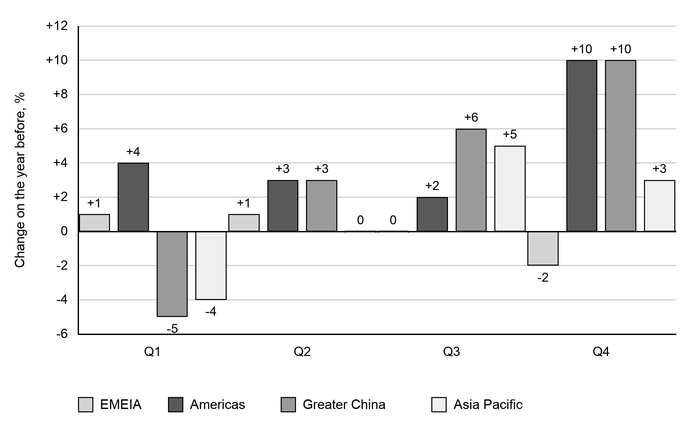
Grouped bar chart of Burberry comparable store sales by region, Q1 to Q4, measured as percentage change from the previous year. Q4 shows Americas and Greater China at +10%, EMEIA at −2% and Asia Pacific at +3%.

Change in comparable store sales on the same quarter a year earlier

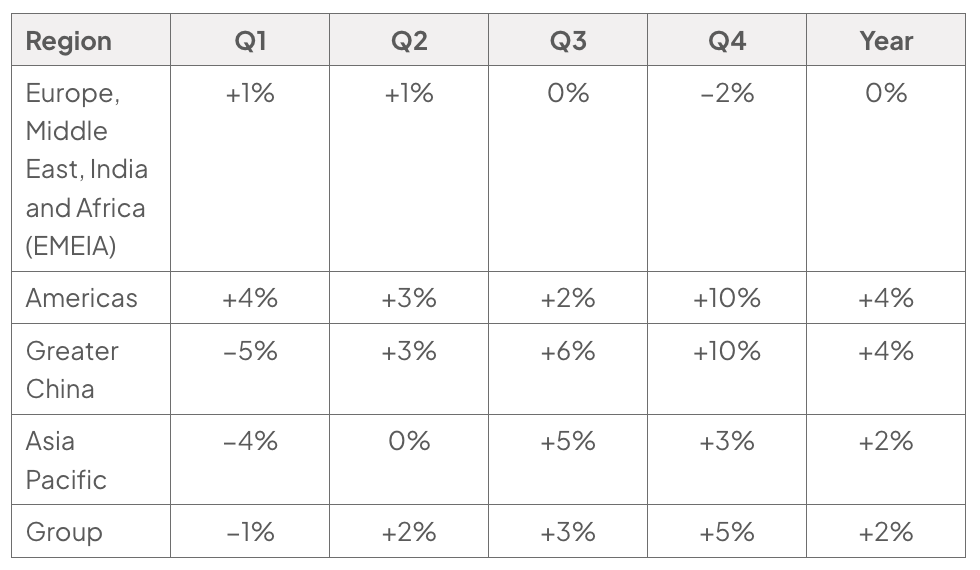
Table of comparable store sales changes for Q1, Q2, Q3, Q4 and the year: EMEIA +1%, +1%, 0%, −2%, 0%; Americas +4%, +3%, +2%, +10%, +4%; Greater China −5%, +3%, +6%, +10%, +4%; Asia Pacific −4%, 0%, +5%, +3%, +2%; Group −1%, +2%, +3%, +5%, +2%.
  • EMEIA: the fall in Q4 reflected fewer tourists in the region and conflict in the Middle East towards the end of the quarter.

  • Americas and Greater China: growth in Q4 was driven by spending by local customers.

  • Asia Pacific: South Korea grew 13% in Q4, helped by visitors from China; Japan fell 6% as fewer visitors arrived.

Source: Burberry Group plc

Assess whether luxury shoppers choosing to buy in their home countries rather than while travelling is likely to reduce Burberry's revenue.

2
9 marks

Source B: Draycote Soap Co

Draycote Soap Co Limited makes solid shampoo bars, conditioner bars and soaps by hand in a workshop near Rugby, Warwickshire. It was founded in 2016 by Hannah Okafor, who began making soap at her kitchen table; she remains its Managing Director and sole owner. The company employs 14 people. Its products contain no palm oil, are sold without any plastic packaging, and have an average customer rating of 4.8 out of 5 from more than 6 000 reviews.

The company sells through five channels:

  • Its own website, where a shampoo bar costs £8.50.

  • Amazon.

  • About 240 independent shops, many of which specialise in reducing waste.

  • Markets and fairs.

  • TikTok Shop, since 2024/25, where people who post videos of its products earn a commission on each sale they generate.

All of its staff are paid at least the Real Living Wage, a voluntary rate set by the Living Wage Foundation which is higher than the legal minimum wage. Several large distribution warehouses close to the workshop also recruit local staff. Every product is packed in a card box which costs 11p, compared with about 4p for a plastic wrapper.

Supermarkets have begun to sell their own-label shampoo bars, priced from about £3. Lush, a much larger business with its own shops, has sold solid shampoo bars for many years. In 2026 a national supermarket chain offered Draycote Soap Co a three-year contract to make shampoo bars to be sold under the supermarket's own label.

Source: Draycote Soap Co

Appendix E: Draycote Soap Co selected data

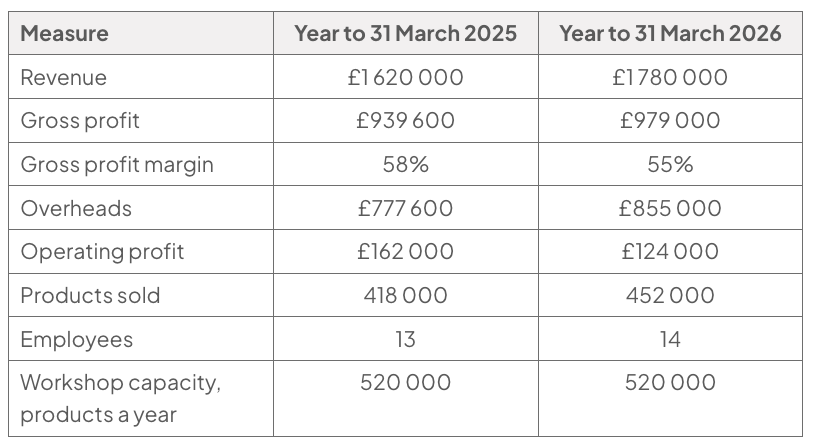
Table of selected Draycote Soap Co data for the years to 31 March 2025 and 2026: revenue £1 620 000 and £1 780 000; gross profit £939 600 and £979 000; gross profit margin 58% and 55%; overheads £777 600 and £855 000; operating profit £162 000 and £124 000; products sold 418 000 and 452 000; employees 13 and 14; workshop capacity 520 000 products a year in both years.

Source: Draycote Soap Co

Appendix F: Where Draycote Soap Co's sales come from

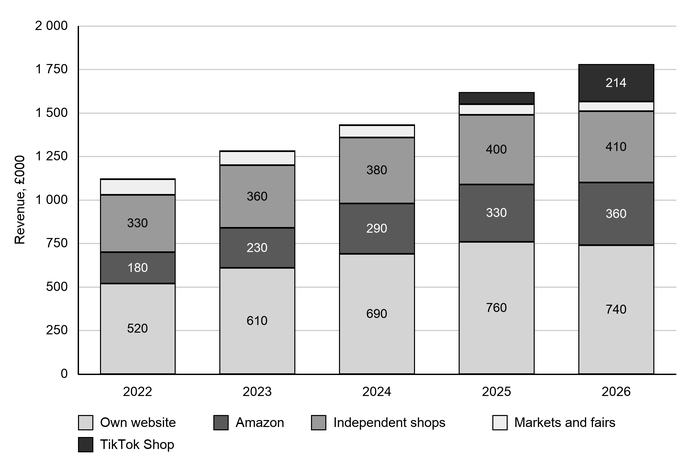
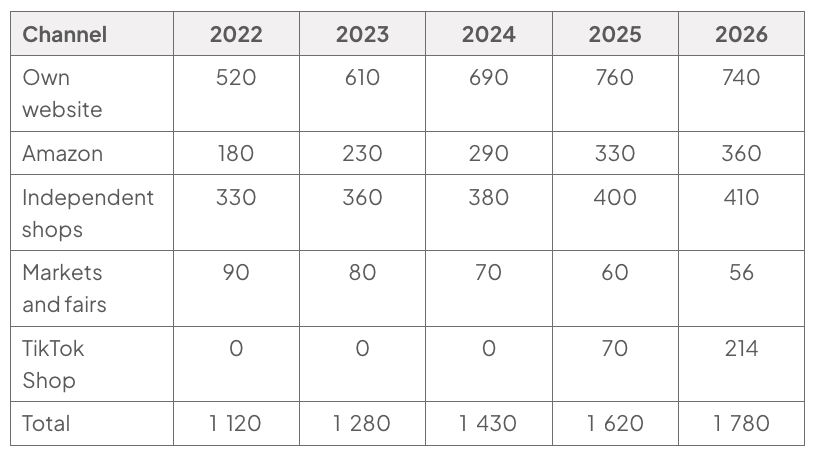
Stacked bar chart of revenue by sales channel, in £000, for years to 31 March 2022 to 2026. Total revenue rises from 1 120 to 1 780; TikTok Shop grows from 70 in 2025 to 214 in 2026.

Revenue by channel, £000, years to 31 March

Table of revenue by sales channel (£000) for the years to 31 March 2022 to 2026: own website 520, 610, 690, 760 and 740; Amazon 180, 230, 290, 330 and 360; independent shops 330, 360, 380, 400 and 410; markets and fairs 90, 80, 70, 60 and 56; TikTok Shop 0, 0, 0, 70 and 214; total 1 120, 1 280, 1 430, 1 620 and 1 780.

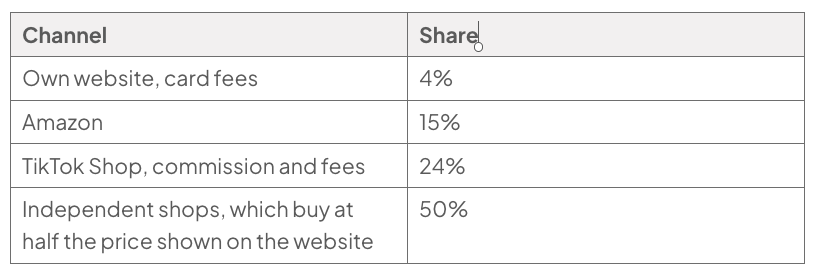
Share of the selling price taken by fees and commission, 2026

Table of the share of selling price taken in 2026: own website, card fees 4%; Amazon 15%; TikTok Shop, commission and fees 24%; independent shops, buying at half website price, 50%.

Source: Draycote Soap Co

Assess whether the growth of shopping through social media is likely to increase Draycote Soap Co's profit.

Calculate Draycote Soap Co's operating profit margin in the year to 31 March 2026 to support your answer. Give your answer to one decimal place.

3
9 marks

Source B: Swanmoor Knitwear

Swanmoor Knitwear Limited makes knitted jumpers, cardigans and scarves at a factory in Hinckley, Leicestershire, a town with a long history of knitwear manufacturing. The company was founded in 1958 and has been owned and run since 2015 by Priya Desai. It employs 92 people.

For most of its history Swanmoor Knitwear made knitwear for other brands, including luxury fashion houses, to their designs and under their labels. Since 2015 it has also sold its own brand, Swanmoor, online. Own-brand jumpers sell for an average of £165. They are designed to last for at least twenty years, and the company repairs them free of charge.

Customers can choose the colour of an own-brand jumper on Swanmoor's website and have it knitted to order, for delivery within ten days.

Swanmoor's managers use data on the workforce to judge the success of their decisions. After a new training scheme was introduced in 2025, the share of employees leaving each year fell from 18% to 9%.

The company is considering buying four seamless knitting machines, which knit a whole garment in a single piece. At present, the separate pieces of each garment are knitted and then joined by hand, a skilled process called linking.

Second-hand clothing is increasingly bought and sold through apps such as Vinted, where Swanmoor jumpers resell for around £70.

Source: Swanmoor Knitwear

Appendix D: Swanmoor Knitwear selected data

Selected data for years to 31 March 2025 and 2026: total revenue £8 400 000 and £8 100 000; gross margin 22% on work for other brands and 58% on its own brand; gross profit £2 997 120 and £3 094 200; overheads £2 687 120 and £2 699 420; operating profit £310 000 and £394 780; employees 96 and 92; employees leaving 18% and 9%.

Source: Swanmoor Knitwear

Appendix E: Where Swanmoor Knitwear's revenue comes from

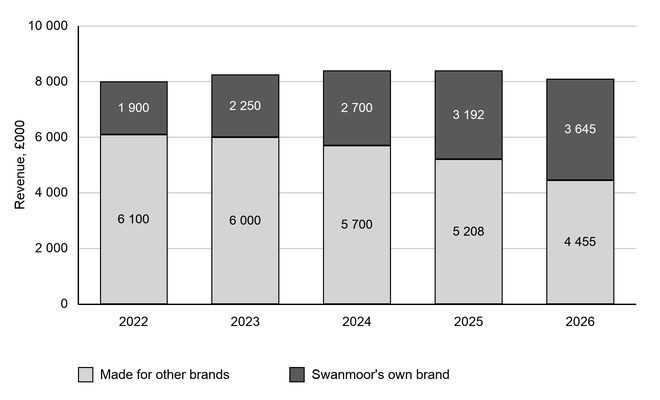
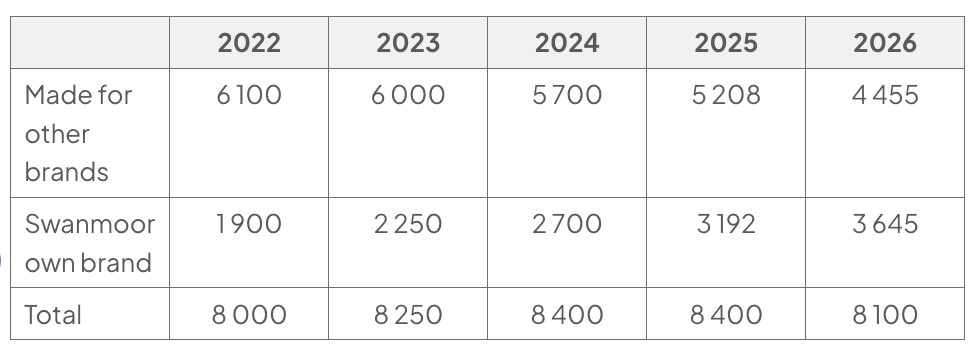
Stacked bar chart of revenue in £000 from 2022 to 2026: own-brand revenue rises from 3 192 in 2025 to 3 645 in 2026, while other-brand revenue falls from 5 208 to 4 455.

Revenue, £000, years to 31 March

Revenue table (£000) for years to 31 March 2022 to 2026: other brands 6 100, 6 000, 5 700, 5 208, 4 455; own brand 1 900, 2 250, 2 700, 3 192, 3 645; totals 8 000, 8 250, 8 400, 8 400, 8 100.

Source: Swanmoor Knitwear

Assess whether customers' growing interest in where and how their clothes are made is likely to increase Swanmoor Knitwear's profit.

Calculate Swanmoor Knitwear's operating profit margin for the years to 31 March 2025 and 31 March 2026 to support your answer. Give your answers to one decimal place.

4
9 marks

Source A: Rightmove

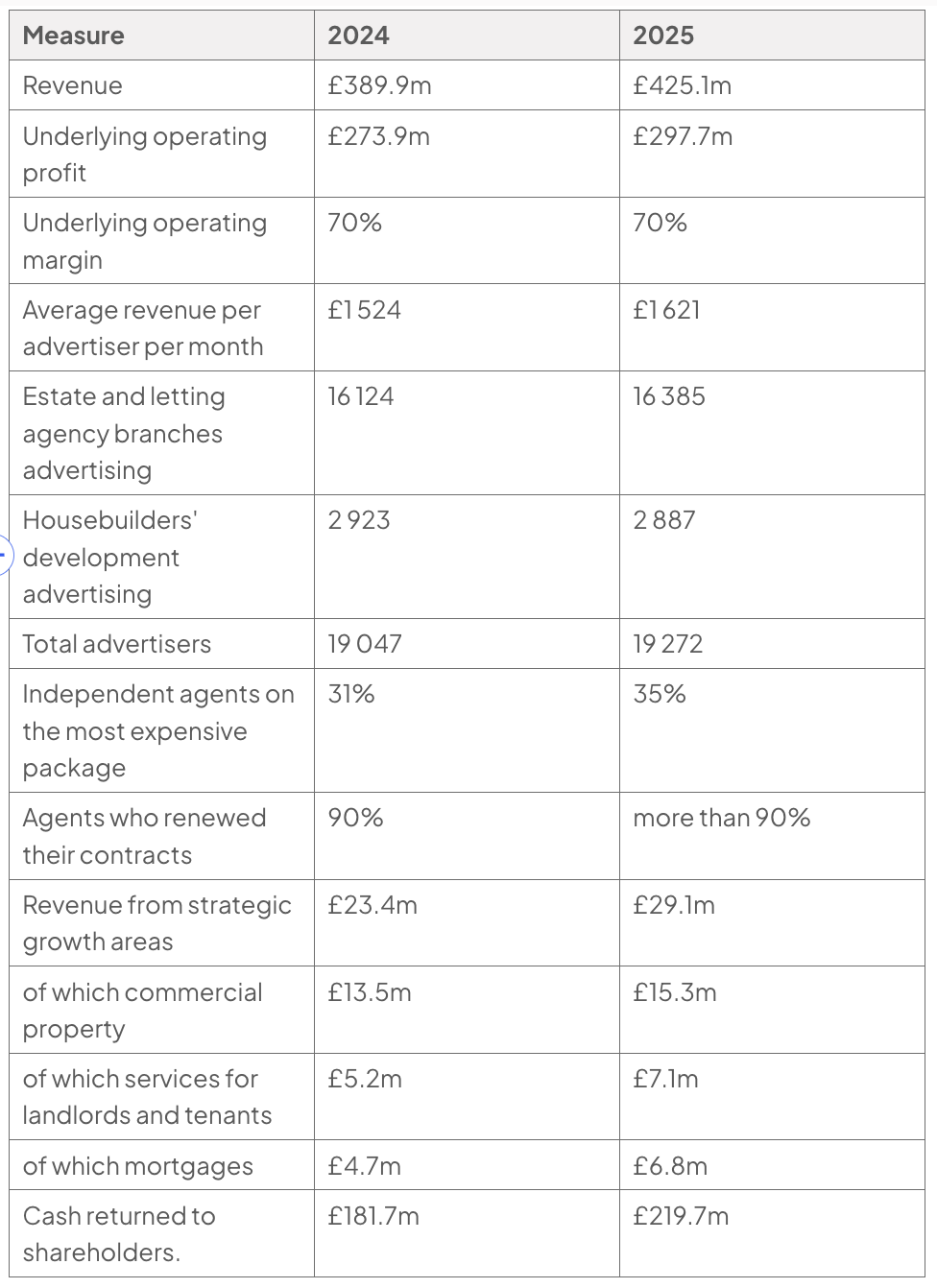
Rightmove plc runs the UK's largest property portal, where estate agents, letting agents and housebuilders advertise homes for sale and to rent. It is listed on the London Stock Exchange. Its customers are the agents and developers, who pay a monthly subscription; people looking for a home use the website and app free of charge. In 2025 users spent 16.8 billion minutes on Rightmove, which had 89% of all the time spent on UK property portals in December 2025, and more than 85% of visits came to the site directly rather than through a search engine or advertisement.

In the year to 31 December 2025 Rightmove's revenue rose 9% to £425.1 million and its underlying operating profit rose 9% to £297.7 million, a margin of 70%. Average revenue per advertiser rose by 6%, while the number of advertisers rose by 1%. Most agents choose a package of products, and a growing share choose the most expensive one.

Rightmove has three newer areas of business, which it calls its strategic growth areas: commercial property, mortgages and services for landlords and tenants. Together their revenue grew by 25% in 2025.

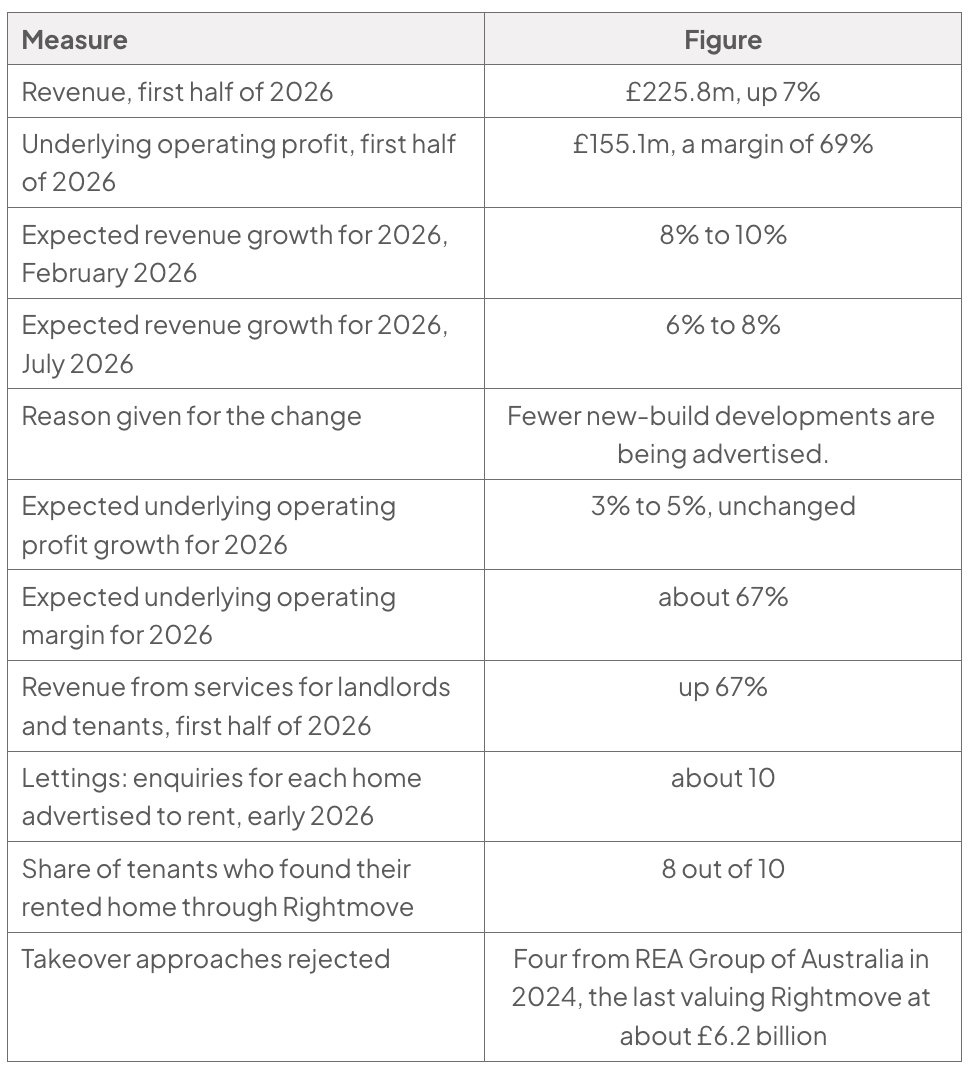
The company is using artificial intelligence across its business. It had 46 strategic AI initiatives in progress by June 2026. It has also launched a conversational search tool developed with Google Cloud and has submitted an app for use within ChatGPT. In November 2025 it announced that it would increase its investment in technology and AI, and that its underlying operating profit would therefore grow by only 3% to 5% in 2026. Its share price fell by more than 25% that day.

Source: Rightmove plc, Results for the year ended 31 December 2025, and Half Year Results 2026

Appendix A: Rightmove selected data

Table comparing Rightmove’s 2024 and 2025 measures: revenue £389.9m to £425.1m; profit £273.9m to £297.7m; strategic growth revenue £23.4m to £29.1m, including landlord and tenant services £5.2m to £7.1m.

The three strategic growth areas do not add exactly to the published total because of rounding.

Source: Rightmove plc

Appendix C: Rightmove in 2026

Rightmove 2026 table: H1 revenue £225.8m (+7%) and profit £155.1m (69% margin); rental enquiries average 10 per home, and 8 in 10 tenants found homes through Rightmove.

Source: Analyst, using Rightmove plc and press reports

Assess whether more people renting their homes is likely to increase Rightmove's revenue.

5
9 marks

Source B: Kelsmere Community Trust

Kelsmere Community Trust is a registered charity founded in 2003 on the Kelsmere estate in Middlesbrough. It employs 15 staff and is supported by 96 volunteers. Its founder and chief executive, who has led the charity for 23 years, will retire in December 2026. It runs:

  • a food bank

  • a youth club

  • a café that trains young people for work; in 2026, 15 of its 22 trainees found work

Most of Kelsmere's income comes from a five-year National Lottery grant, which is its largest single source of income, and a contract with the local council to run youth services. Eleven local businesses now support the charity with money, food or staff time, up from seven. In the year to March 2026, income from local business partners and income from café and room hire both rose.

The charity faces four main pressures:

  • Demand. Use of the food bank is rising.

  • Council funding. The council cut the youth services contract by £30 000 in 2025/26, and the youth club has closed on Fridays since September 2025 because of the cut. The council proposes a further 20% cut from April 2027.

  • Lottery funding. The National Lottery grant ends in March 2027. A new application must show evidence of the charity's impact.

  • Volunteers. Volunteers agreeing "I feel listened to" fell from 81% to 63%.

The trustees are considering whether to merge with Northgate Family Centre, a charity 1.5 miles away that provides family support and debt advice.

Source: Kelsmere Community Trust

Appendix D: Kelsmere Community Trust financial data

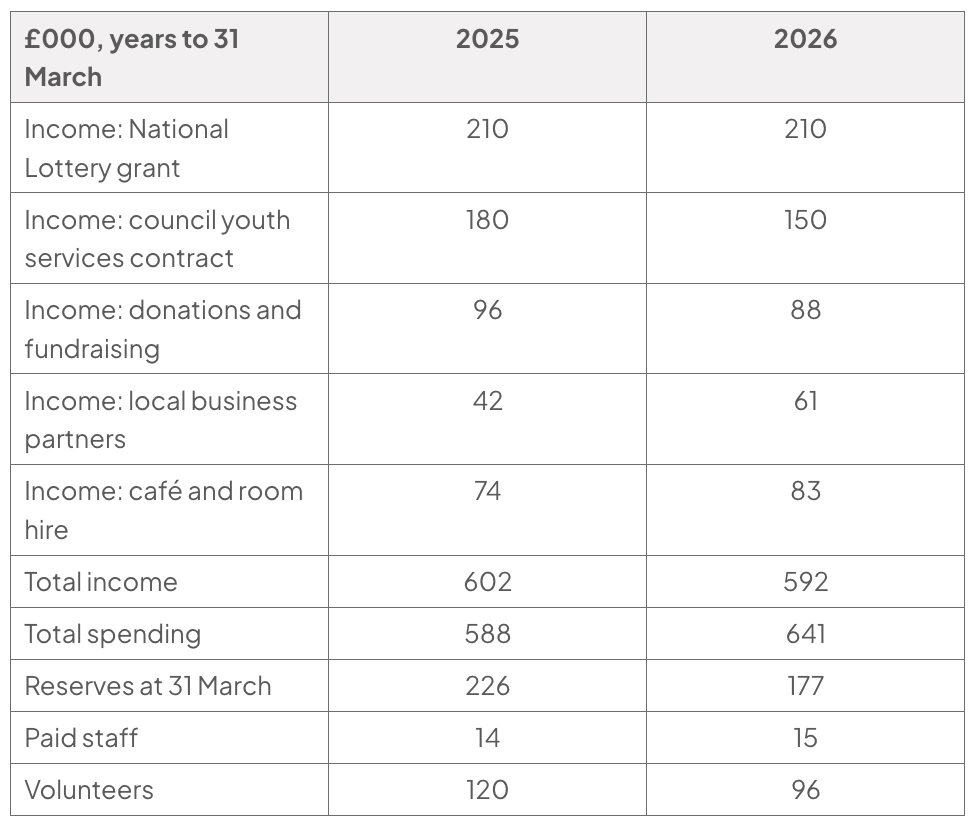
Table of Kelsmere's financial data (£000, years to 31 March) for 2025 and 2026: income from the National Lottery grant 210 and 210, council youth services contract 180 and 150, donations and fundraising 96 and 88, local business partners 42 and 61, café and room hire 74 and 83; total income 602 and 592; total spending 588 and 641; reserves at 31 March 226 and 177; paid staff 14 and 15; volunteers 120 and 96.
  • Reserves policy. The trustees aim to hold reserves equal to at least three months' spending.

Source: Kelsmere Community Trust

Appendix E: Demand for Kelsmere's services

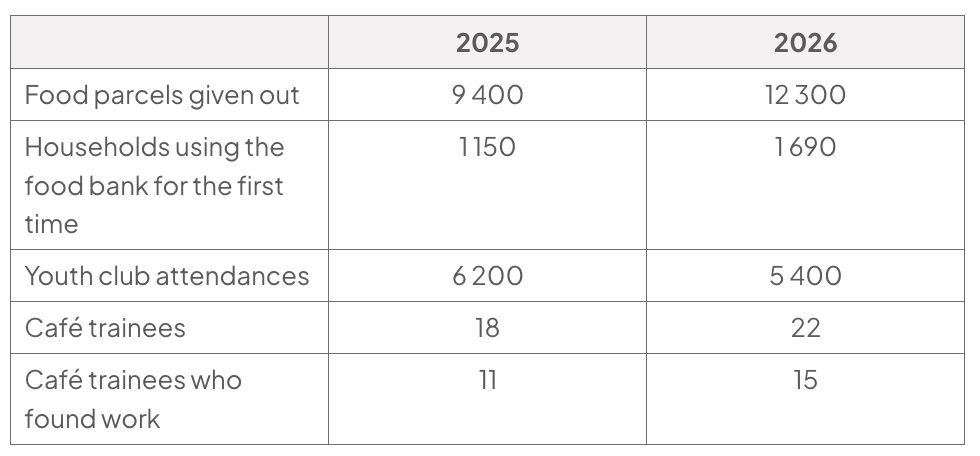
Table comparing Kelsmere’s 2025 and 2026 service data: food parcels 9 400 and 12 300; first-time households 1 150 and 1 690; youth attendances 6 200 and 5 400; café trainees 18 and 22, with 11 and 15 finding work.
  • Two in five households using the food bank for the first time in 2026 included someone in work.

  • The youth club closed on Fridays from September 2025 because the council contract was cut.

Source: Kelsmere Community Trust

Assess whether rising demand for its food bank is the biggest challenge facing Kelsmere Community Trust.

Calculate Kelsmere Community Trust's employee productivity, measured as food parcels given out per paid employee, in 2025 and in 2026 to support your answer. Give your answers to the nearest whole number.

6
9 marks

Source A: Just Eat Takeaway

Just Eat Takeaway.com (JET) runs online food delivery platforms in Europe, including Just Eat in the UK and Ireland, Lieferando in Germany and Thuisbezorgd in the Netherlands. Its headquarters are in Amsterdam. JET was formed in 2020 when Just Eat merged with Takeaway.com. In October 2025 JET was bought by Prosus, a Dutch-listed technology investor, for about €4.1 billion, and its shares were removed from the stock market. Roberto Gandolfo replaced the founder, Jitse Groen, as chief executive in January 2026.

Customers order from restaurants and shops through JET's apps and websites. Some orders are delivered by the restaurant itself and some by couriers working through JET.

JET has changed in three main ways:

  • Acquisitions. In 2021 it bought Grubhub, a US delivery business, for $7.3 billion; it sold Grubhub in January 2025.

  • Countries. Since 2022 it has left Norway, Portugal, New Zealand, France, Australia, Denmark and Bulgaria, and it now operates in 14 countries. When it left Denmark in April 2026, its customers there were directed to Uber Eats.

  • Technology. About 450 jobs were cut in September 2025, partly by automating customer service. An AI voice assistant was launched across Europe in August 2026; early UK users found what they wanted about 40% faster than with the text assistant.

In the UK, JET competes with Uber Eats and with Deliveroo, which DoorDash, a US delivery business, bought in October 2025.

Prosus wants JET to become "a true European tech champion" and says it is "trading short-term profitability" for growth.

Source: Just Eat Takeaway.com, results for 2024 and the half year to June 2025; Prosus; and press reports

Appendix A: Just Eat Takeaway financial data

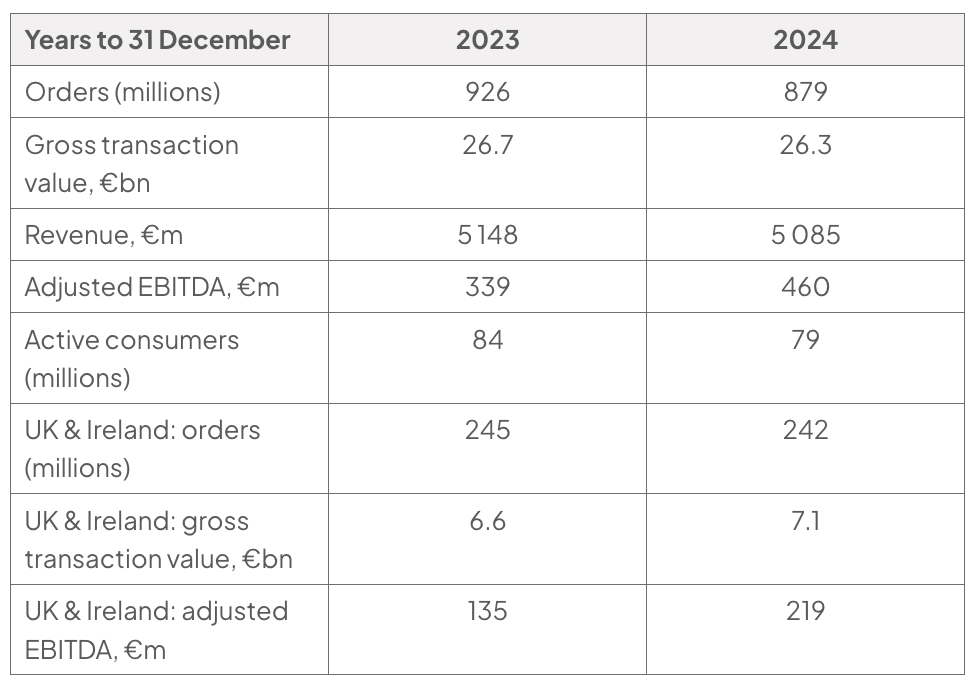
Table of Just Eat Takeaway data for 2023 and 2024: orders 926 million and 879 million; gross transaction value €26.7bn and €26.3bn; revenue €5 148m and €5 085m; adjusted EBITDA €339m and €460m; active consumers 84 million and 79 million; UK & Ireland orders 245 million and 242 million; UK & Ireland gross transaction value €6.6bn and €7.1bn; UK & Ireland adjusted EBITDA €135m and €219m.
  • Gross transaction value is the total value of orders placed through JET's platforms. Adjusted EBITDA is profit before interest, tax, depreciation and amortisation, excluding one-off items.

  • 2023 and 2024 include Grubhub. In 2024 JET reduced the value of Grubhub in its accounts by €1 002m.

  • Half year to June 2025. Orders 308 million, down from 330 million. UK & Ireland orders 114 million, down from 120 million, while UK & Ireland gross transaction value rose from €3.4bn to €3.6bn.

  • After the takeover. JET's orders fell for 55 months in a row before rising 0.1% in September 2026.

Source: Just Eat Takeaway.com and Prosus

Appendix B: Couriers and the law

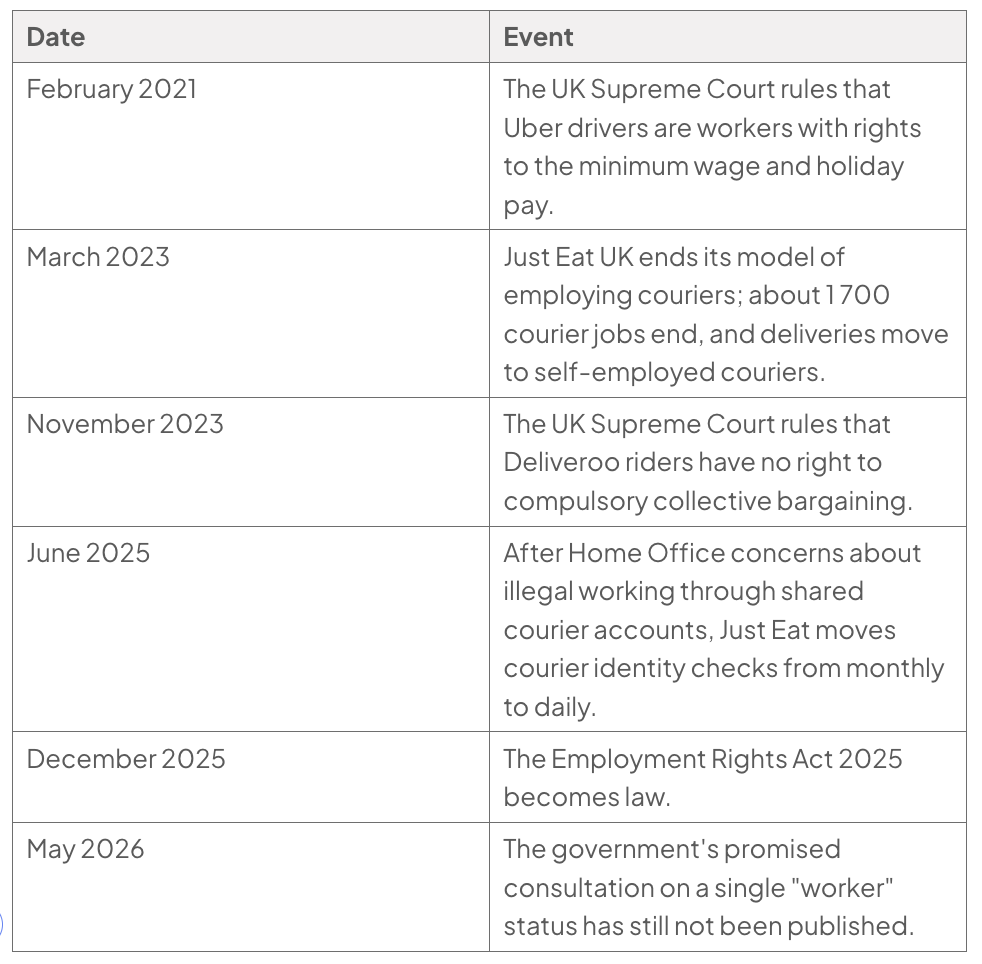
Timeline of UK gig-work courier rules, February 2021 to May 2026: February 2021, UK Supreme Court rules Uber drivers are workers with rights to minimum wage and holiday pay; March 2023, Just Eat ends employed courier model.
  • Rising living costs reduced how often UK customers ordered.

Source: Analyst, using UK court judgments, UK government announcements and press reports

Assess whether changing attitudes and rules on gig work are a threat to Just Eat Takeaway.com in the UK.

1
15 marks

Source A: Trainline

Trainline plc, which is listed on the London Stock Exchange, sells rail and coach tickets through its app and website in the UK and across Europe. It also provides ticketing technology to train operators and to travel management companies, which book travel for businesses. Its app is the most downloaded rail app in Europe.

Trainline earns its revenue mainly as commission on the tickets it sells. In April 2025 its commission on UK online ticket sales fell from 5.0% to 4.5%, under a rail industry agreement announced in 2022.

In the year to 28 February 2026:

  • it sold tickets worth £6 319 million, up 7%, to 27 million customers, 18 million of them in the UK

  • revenue rose by 2% to £453 million, while UK revenue fell by 2%

  • adjusted EBITDA was 2.80% of the value of tickets sold; the target for the year to February 2027 is about 2.9%

Growth in the UK slowed in the second half of the year. Trainline identified three causes:

  • Contactless payment. Transport for London is expanding contactless payment, which lets passengers travel by tapping a bank card without buying a ticket.

  • Operators' websites. Train operators have encouraged customers to use their own websites, including by offering automatic delay compensation, which independent retailers such as Trainline were not allowed to offer.

  • Fares. The government has frozen regulated rail fares until March 2027.

The government is creating Great British Railways to run most of the railway; its online retailer is expected eventually to replace the operators' websites. In March 2026 the government announced that passengers will then be able to claim delay compensation wherever they bought their ticket, including through Trainline.

In the first half of the year, sales to foreign travellers fell after Google changed its search results page. Trainline has made its app available within ChatGPT and introduced artificial intelligence features which help customers when trains are disrupted. Young people are among its most important customers: 45% of railcard holders aged 16 to 30 use a Trainline digital railcard, held on their phone.

Source: Trainline plc, Results for the twelve months ended 28 February 2026

Appendix A: Trainline selected data

Table comparing Trainline’s 2025 and 2026 results: total ticket sales rose from £5,907m to £6,319m, revenue from £442m to £453m, and adjusted EBITDA from £159m to £177m; 2026 EBITDA margin was 2.80%.

Net ticket sales are the total value of tickets sold. The three segments do not add exactly to the total because of rounding.

Source: Trainline plc

Appendix B: Changes in the UK rail market

  • Commission. The commission on online ticket sales in the UK fell from 5.0% to 4.5% in April 2025, under an agreement announced in 2022.

  • Contactless payment. Transport for London is extending pay-as-you-go contactless payment to more stations outside London.

  • Train operators' own websites. Operators have offered their customers automatic compensation for delays, which independent retailers were not allowed to offer.

  • Great British Railways. The government is creating Great British Railways. Its online retailer is expected eventually to replace the operators' own websites. In March 2026 the government said that once it is established, passengers will be able to claim delay compensation wherever they bought their ticket. Trainline's legal and public affairs costs rose as it engaged with the process.

  • Fares and refunds. Regulated fares are frozen until March 2027. Rules on refunds were tightened from April 2026, which Trainline expects to reduce its income from refund fees.

  • Contracts. Trainline lost its contract to run CrossCountry's ticket website during the year and expects to lose its contract with ScotRail.

Source: Analyst, using Trainline plc

Appendix C: Technology and Europe

  • AI features. Travel Forecast warns customers of likely disruption to their journey; an AI Travel Assistant answers questions and helps with refunds; customers are prompted to claim delay compensation.

  • Search. Trainline has the largest share of mentions in answers from generative AI tools among rail retailers, and its app can be used within ChatGPT. Sales to foreign travellers fell in the first half of the year after Google changed its search results page, and recovered in the second half as more customers arrived through generative AI.

  • Competition in Europe. In markets where new train operators compete with the national operator, Trainline sells tickets for all of them. Sales on the South-East France network grew 26% after Trenitalia expanded services there. The routes Trainline expects to sell in France and Italy are expected to be worth €10 billion by 2030.

  • Profitability. International Consumer is expected to break even in the year to February 2027 for the first time.

Source: Analyst, using Trainline plc

Trainline has 18 million customers in the UK, but the ways in which people find, buy and use train tickets are changing.

Evaluate two ways Trainline could respond to changes in how people buy and use train tickets and recommend which one it should do first.

2
15 marks

Source B: Swanmoor Knitwear

Swanmoor Knitwear Limited makes knitted jumpers, cardigans and scarves at a factory in Hinckley, Leicestershire, a town with a long history of knitwear manufacturing. The company was founded in 1958 and has been owned and run since 2015 by Priya Desai. It employs 92 people.

For most of its history Swanmoor Knitwear made knitwear for other brands, including luxury fashion houses, to their designs and under their labels. Since 2015 it has also sold its own brand, Swanmoor, online. Own-brand jumpers sell for an average of £165. They are designed to last for at least twenty years, and the company repairs them free of charge.

Customers can choose the colour of an own-brand jumper on Swanmoor's website and have it knitted to order, for delivery within ten days.

Swanmoor's managers use data on the workforce to judge the success of their decisions. After a new training scheme was introduced in 2025, the share of employees leaving each year fell from 18% to 9%.

The company is considering buying four seamless knitting machines, which knit a whole garment in a single piece. At present, the separate pieces of each garment are knitted and then joined by hand, a skilled process called linking.

Second-hand clothing is increasingly bought and sold through apps such as Vinted, where Swanmoor jumpers resell for around £70.

Source: Swanmoor Knitwear

Appendix D: Swanmoor Knitwear selected data

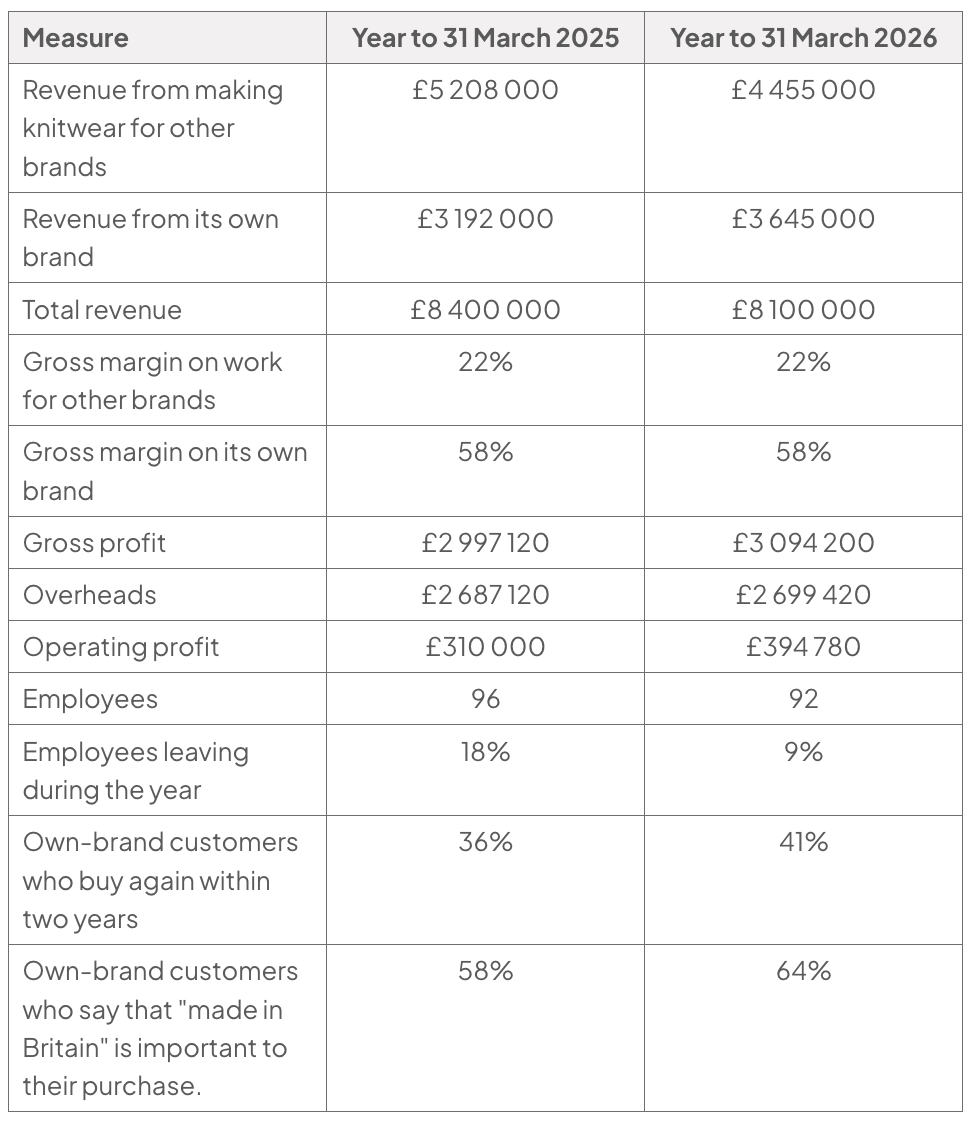
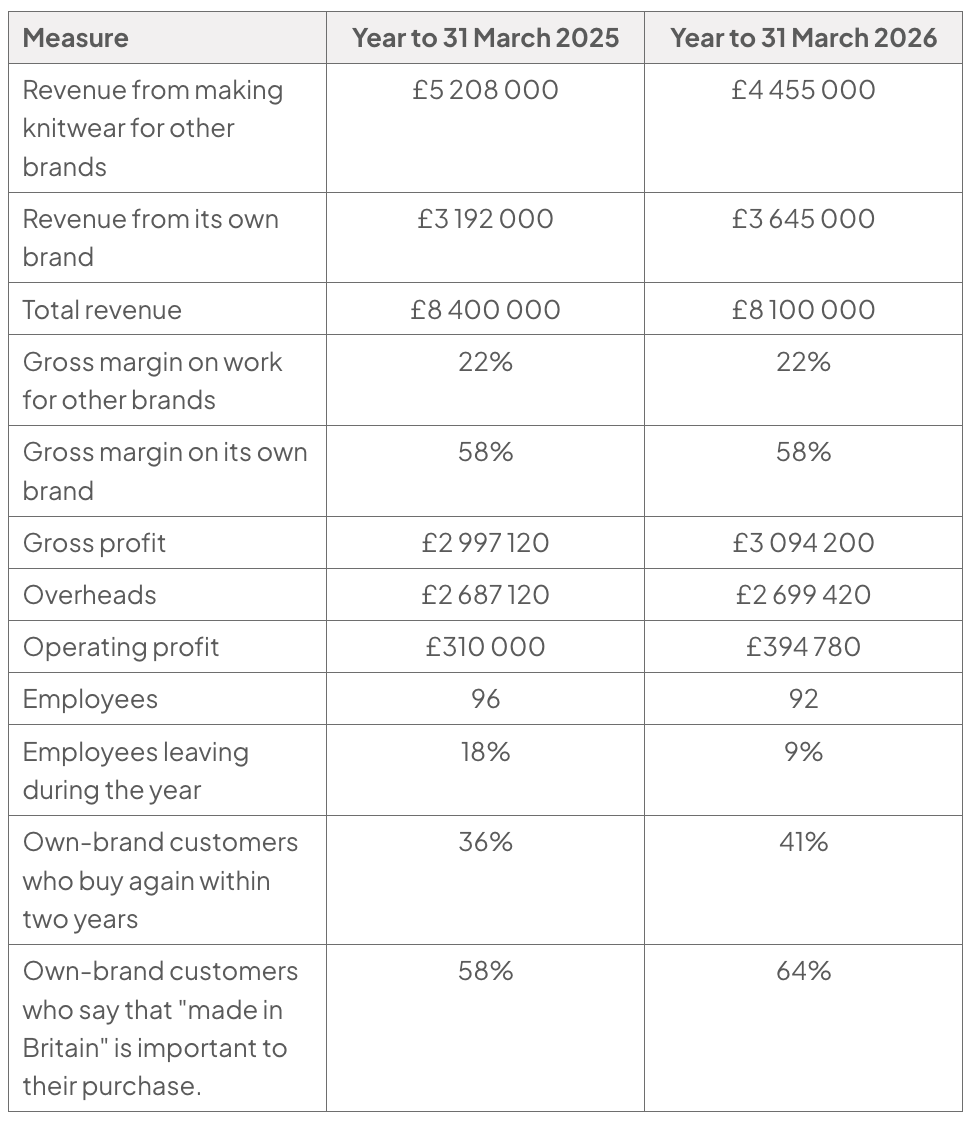
Table comparing Swanmoor Knitwear’s 2025 and 2026 revenue, margins, profit, overheads, employee numbers, staff turnover, repeat purchases and the importance of “made in Britain”.

Source: Swanmoor Knitwear

Appendix E: Where Swanmoor Knitwear's revenue comes from

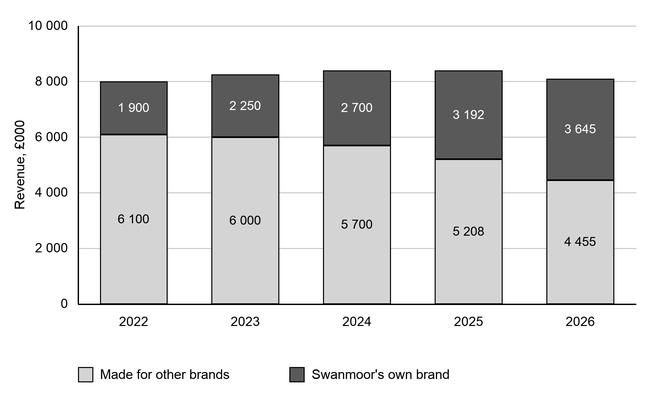
Stacked bar chart of Swanmoor Knitwear revenue, £000, for 2022–2026: own-brand revenue rises from 1,900 to 3,645, while sales for other brands fall from 6,100 to 4,455.

Revenue, £000, years to 31 March

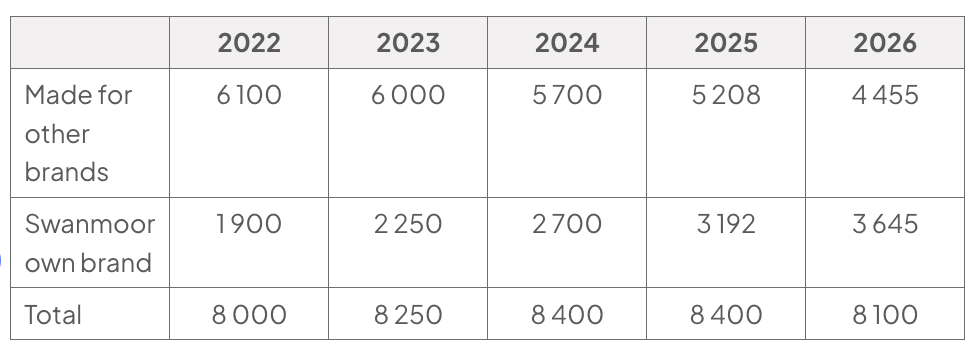
Table of Swanmoor Knitwear revenue (£000) by source, 2022–2026: other brands 6,100, 6,000, 5,700, 5,208, 4,455; own brand 1,900, 2,250, 2,700, 3,192, 3,645; totals 8,000, 8,250, 8,400, 8,400, 8,100.

Source: Swanmoor Knitwear

Appendix F: Seamless knitting machines

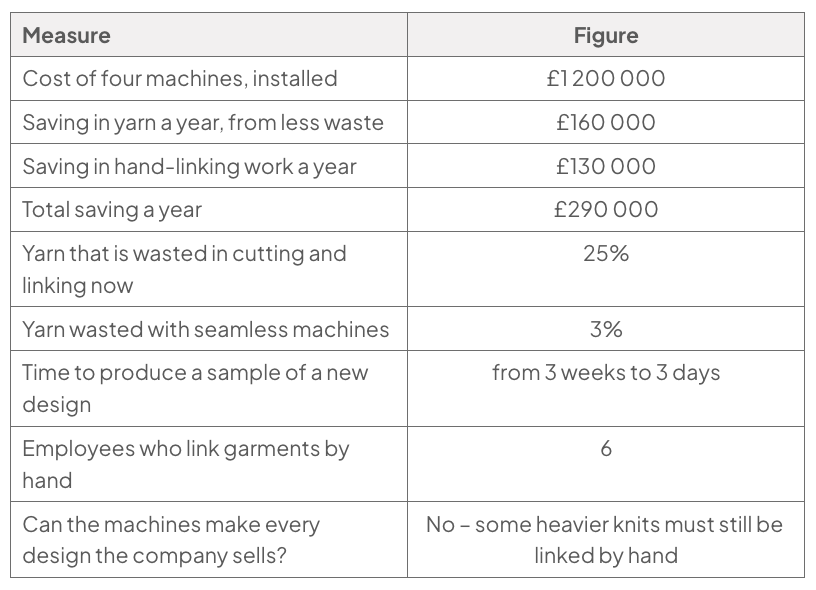
Table of seamless knitting machine data: cost £1.2m; annual yarn saving £160k plus hand-linking saving £130k = £290k; waste 25% to 3%; sample time 3 weeks to 3 days; six hand-linkers; heavy knits still hand-linked.

Source: Swanmoor Knitwear

Appendix G: Responding to second-hand clothing

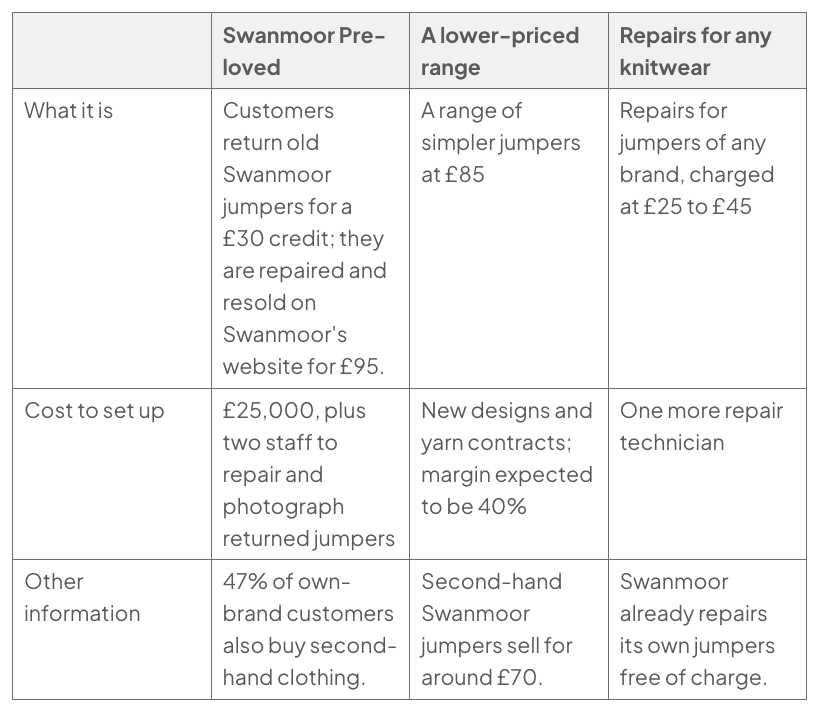
Table comparing responses to second-hand clothing: Swanmoor Pre-loved returns jumpers for £30 credit and resells them at £95; a lower-priced range costs £85; repairs for any brand cost £25–£45.

Source: Swanmoor Knitwear

More people are buying second-hand clothes through apps such as Vinted, where Swanmoor jumpers resell for around £70.

Evaluate two ways Swanmoor Knitwear could respond to the growth of second-hand clothing and recommend which one it should do first.

Use information from Appendices D to G to support your answer.

3
15 marks

Source B: Royal Shakespeare Company

The Royal Shakespeare Company (RSC) is a registered charity based in Stratford-upon-Avon, the town where Shakespeare was born. Its Co-Artistic Directors are Daniel Evans and Tamara Harvey. Its mission is to "redefine how Shakespeare and great story-telling connects us, creates opportunities and brings joy".

The RSC performs in three theatres in Stratford, transfers productions to London, tours the UK and abroad, and works with schools nationwide. It also earns income from licensing its productions, including the musical Matilda, which has had more than 5 000 performances in London since 2011 and began a UK tour in October 2025.

Its income comes from ticket sales, an annual grant from Arts Council England, Theatre Tax Relief, donations, catering and retail.

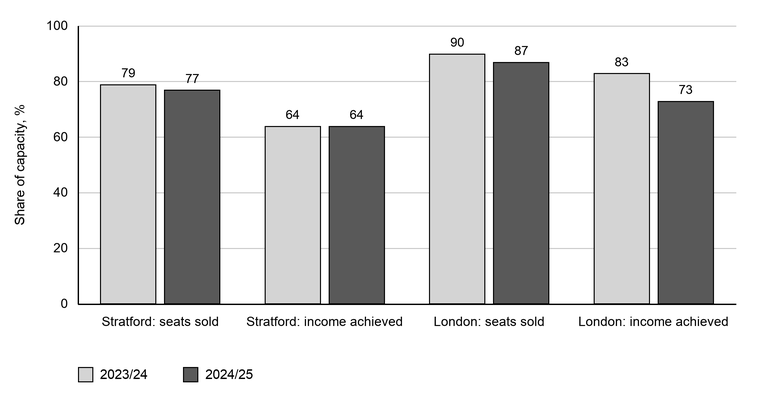
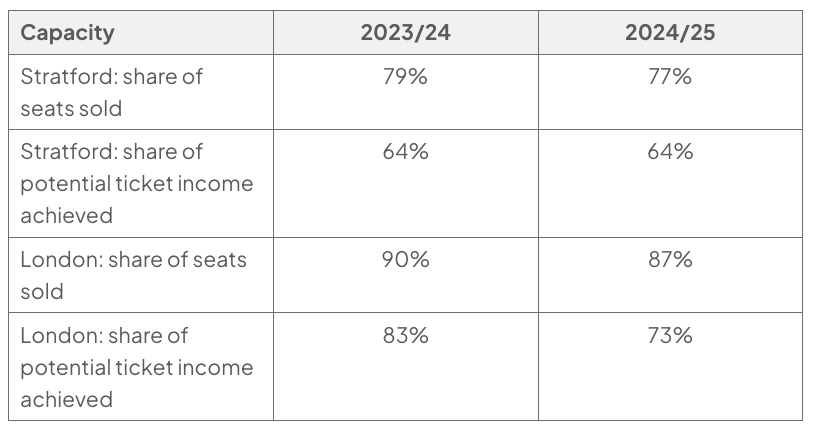
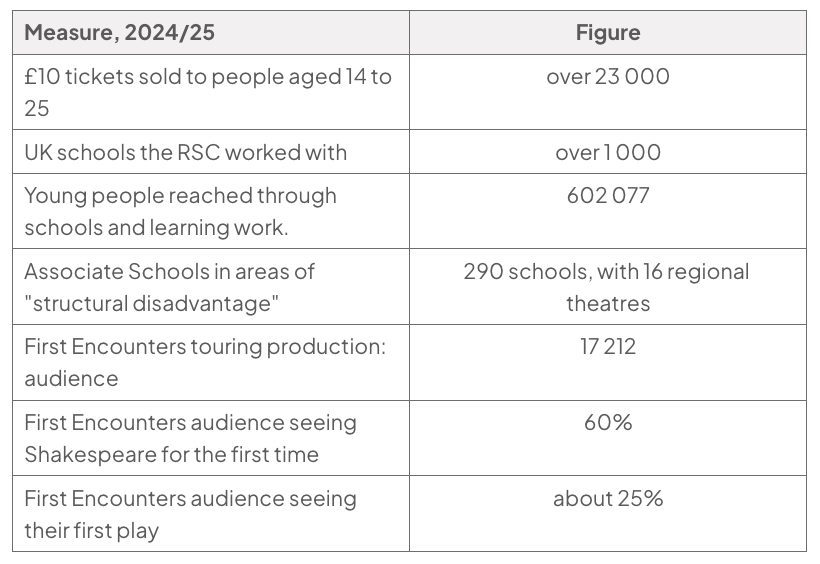
In 2024/25 the RSC sold more than 25 000 tickets at £25 or less, and in Stratford it sold 77% of its seats but achieved 64% of its potential ticket income. It sold more than 23 000 tickets at £10 to young people aged 14 to 25, in a partnership with the social media company TikTok. Linear television viewing is declining, particularly among younger audiences.

The RSC faces two pressures:

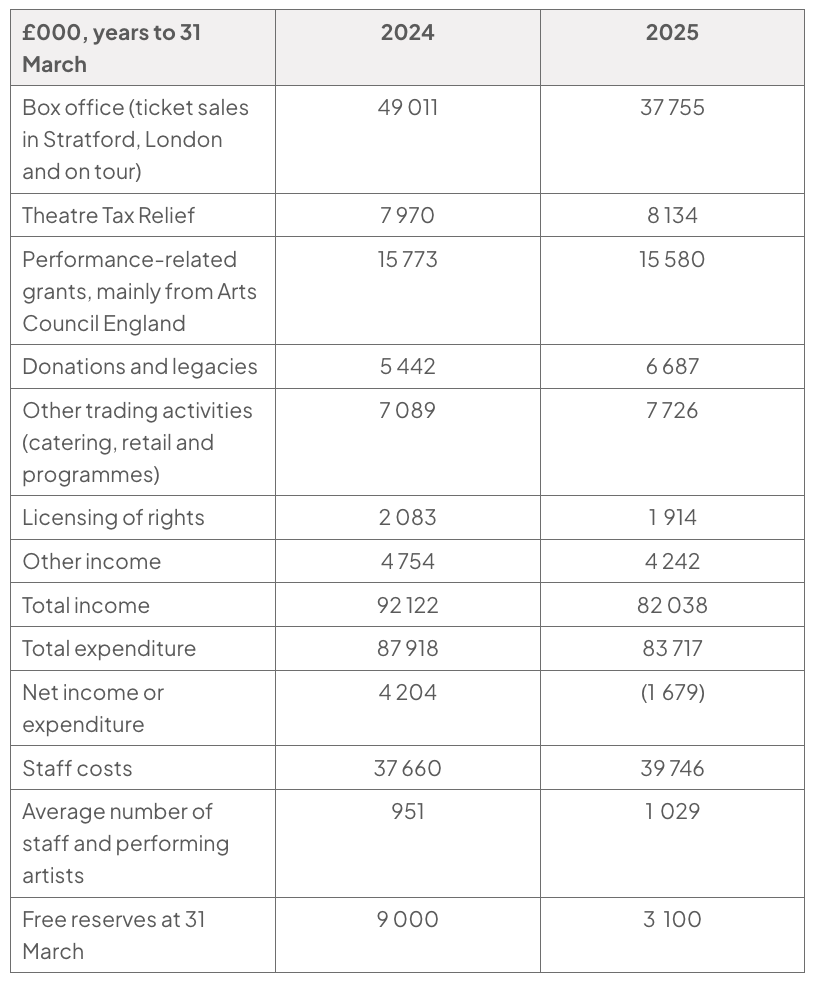
  • Income. In the year to 31 March 2025 income fell from £92.1 million to £82.0 million, partly because the previous year's income from Matilda and other productions was not repeated, and spending exceeded income.

  • Audiences. The RSC sees cost-of-living pressures as a risk to audience levels.

In 2025 it announced plans to reduce its workforce by 11%, first through voluntary redundancy, to close a shortfall of about £5 million.

Source: Royal Shakespeare Company, Report and Financial Statements for the year ended 31 March 2025, and press reports

Appendix D: RSC financial data

Table of RSC finances (£000, years to 31 March): income fell from 92 122 in 2024 to 82 038 in 2025; expenditure was 87 918 and 83 717; surplus became a 1 679 loss, and reserves fell from 9 000 to 3 100.
  • Free reserves are money not tied up in buildings or given for a particular purpose.

  • In 2021 the RSC borrowed £19.4m from the government's Culture Recovery Fund for 20 years at 2%; repayments of about £1.5m a year began in February 2025 and run to 2041.

Source: Royal Shakespeare Company

Appendix E: Audiences and productions

Bar chart of RSC capacity shares in 2023/24 and 2024/25: Stratford seats sold fell 79% to 77%, income stayed at 64%; London seats sold fell 90% to 87% and income 83% to 73%. Y-axis 0 to 100%.
Table comparing RSC capacity in 2023/24 and 2024/25: Stratford seats sold 79% to 77%, income 64% to 64%; London seats sold 90% to 87%, income 83% to 73%.
  • 2024/25 season. 17 plays on four stages in Stratford; 68% of actors made their RSC debut; more than 25 000 tickets sold at £25 or less. Productions transferred to London theatres, and one toured to Chicago.

  • Matilda. More than 5 000 performances in London since 2011; a UK tour began in October 2025.

  • Theatre Tax Relief. Worth £8.1m in 2024/25; the rates fell by 5 percentage points from 1 April 2025.

  • Estate. Spending on buildings and equipment was £4.2m (2023/24: £1.6m); the RSC describes its estate as "a major drain on our resources".

Source: Royal Shakespeare Company

Appendix F: Funding, people and strategy

  • Arts Council England. National Portfolio funding of £15.3m a year, unchanged since 2022 apart from a 1.61% increase in 2025/26, and extended to 2026/27. It was 18.6% of income in 2024/25.

  • Donations. More than 38 000 individual donations in 2024/25, and a legacy of £2m, of which up to £1m is designated to support a Shakespeare curriculum for schools.

  • Board response. The 2025/26 budget "shows a further reduction in unrestricted reserves". The Board began a strategic review of ways to increase income from a range of sources and make "its cost base more flexible".

  • Workforce changes, 2025/26. Staff were invited to apply for voluntary redundancy from September 2025. The in-house music department has effectively closed, and long-term contracts for actors and musicians are being replaced by freelance contracts.

  • Pay. The 2024/25 pay award was 3.75%.

Source: Analyst, using the Royal Shakespeare Company and press reports

Appendix G: Young people, schools and communities

RSC 2024/25: over 23 000 £10 tickets sold to 14 to 25-year-olds; over 1 000 schools; 602 077 young people reached; 290 Associate Schools in areas of structural disadvantage, with 16 regional theatres; First Encounters audience 17 212 (60% first-time Shakespeare, 25% first play).
  • Risks. The RSC identifies a "risk of audience levels being impacted by cost-of-living pressures affecting consumer spending patterns".

  • Region. The Musicians' Union describes the West Midlands as the "worst-funded region in England for the arts".

  • Viewing habits. Across the UK, linear television viewing is declining, particularly among younger audiences, while viewing on streaming services and YouTube grows.

Source: Analyst, using the Royal Shakespeare Company, ITV plc and press reports

The RSC works with more than 1 000 schools and sells £10 tickets to young people, but identifies the cost of living as a risk to its audiences.

Evaluate whether the RSC should respond to changes in the social environment by focusing on building young and first-time audiences or by protecting income from its existing audiences.

Use information from Appendices D to G to support your answer.

4
15 marks

Source B: Elvaston Food Hub

Elvaston Food Hub Limited is a private limited company, founded in Derby in 2017. It sells fresh food online from 60 farms and producers in Derbyshire and Nottinghamshire, all within 40 miles of Derby, and employs 38 people. Its range includes:

  • fruit and vegetables

  • meat and dairy products

  • bread

Customers order through the company's website and app, which records each customer's order history. They choose a delivery slot at least one day ahead, and food is delivered within 15 miles of Derby. Elvaston buys from its producers only what customers have ordered.

All deliveries are made by electric van; the last of the company's diesel vans was replaced in 2025. Electric vans cost more to buy than diesel vans, but less to run. Food is delivered in reusable crates, which customers return.

In a customer survey, most customers said they buy from Elvaston mainly because its food is local.

The company faces two main pressures:

  • Speed. Supermarkets and delivery apps in Derby offer grocery deliveries within one hour.

  • Price. Elvaston's prices are higher than supermarket prices for most products.

Its directors are considering whether to launch a lower-priced range.

Source: Elvaston Food Hub

Appendix D: Elvaston Food Hub selected data

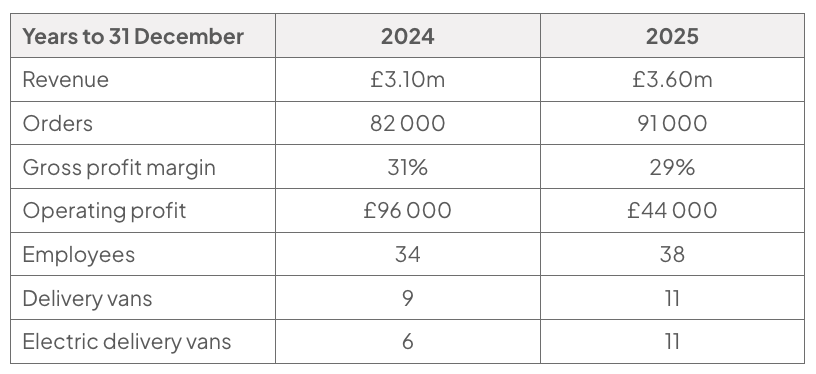
Table: Elvaston Food Hub selected data for 2024/2025 (years to 31 December): revenue £3.10m/£3.60m; orders 82 000/91 000; gross margin 31%/29%; operating profit £96 000/£44 000; employees 34/38; delivery vans 9/11; electric vans 6/11.

Source: Elvaston Food Hub

Appendix E: Customers and competition

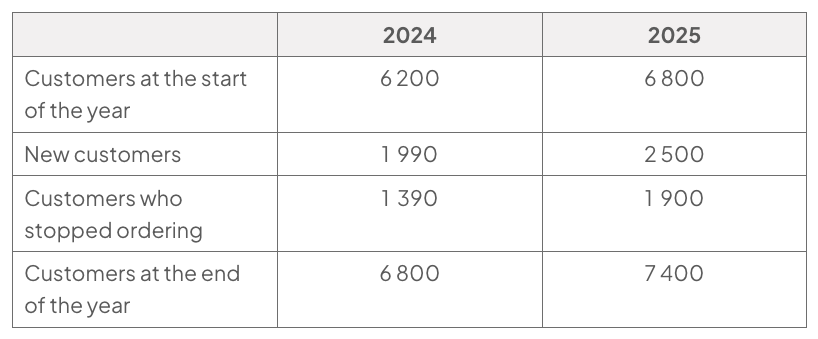
Customer table for 2024 and 2025: customers at the start of the year 6 200 and 6 800; new customers 1 990 and 2 500; customers who stopped ordering 1 390 and 1 900; customers at the end of the year 6 800 and 7 400.
  • Why customers stopped, 2025 survey: price 41%; wanted faster delivery 23%; moved away 14%; other reasons 22%.

  • Price. A basket of 30 products cost 18% more from Elvaston than from the nearest large supermarket.

  • Speed. Supermarkets and delivery apps in Derby offer deliveries within one hour.

Source: Elvaston Food Hub

Appendix G: Customers and the proposed Essentials range

  • Who buys. 38% of Elvaston's customers are aged over 60. In a survey, 64% of customers said they buy from Elvaston mainly because its food is local.

  • Proposal. An Essentials range of 40 everyday products, bought from a wholesaler rather than local producers, priced to match supermarkets, with a gross profit margin of 12%.

  • Producers. Some of Elvaston's farm producers worry that cheaper products would take sales from theirs.

Source: Elvaston Food Hub

Elvaston Food Hub's directors are considering launching an Essentials range of 40 everyday products priced to match supermarkets.

Evaluate whether Elvaston Food Hub should launch the Essentials range or keep selling only food from local producers, and recommend which it should do.

Use information from Appendices D, E and G to support your answer.