Stakeholders (AQA A Level Business): Exam Questions

Exam code: 7132

Syllabus Edition

First teaching 2026

First exams 2028

3 hours17 questions
1
6 marks

Source A: Yeo Valley

Yeo Valley Farms (Production) Limited makes yogurts, desserts, ice cream, fruit products and soups, which it sells to UK retailers under the Yeo Valley Organic brand and other brands, including Tideford. The business traces its origins to 1961, when Roger and Mary Mead bought a farm in the Yeo Valley in Somerset. Yeo Valley is the third largest yogurt brand in the UK, and all Yeo Valley branded products are organic. Most of its products are chilled foods with a short shelf life. The company states its purpose as "To Nurture and Nourish People and Planet".

In the 53 weeks to 1 June 2025 turnover rose 17.6% to £424.6 million, mainly because of higher sales volumes rather than higher prices. Profit before tax fell from £6.4 million to £4.7 million. The company has a long-stated aim of a 5% profit before tax margin, and is in the second year of a five-year plan which runs to May 2028.

Demand grew faster than the company's factories could meet. Large investments in production capacity and automation came into use from spring 2025; until then, the additional volume was made using less efficient methods. During the year the company also:

  • raised the price it pays its organic dairy farmers by 16.5%, to give them the confidence to grow with the business and to attract new farmers into organic dairy;

  • completed its first acquisition, The Collective, a more premium yogurt brand with ranges for children and indulgent desserts;

  • launched products in new categories, including kefir, granola and an organic beef burger.

Five years ago employees became co-owners, when the company established an employee benefit trust which holds 20% of its shares on their behalf. The majority shareholder sits on the board as a non-executive director. Co-owners have a voice in decisions through Co-Ownership Forums, and the company measures their engagement through an annual survey, Yeo Voice.

The company identifies three principal risks:

  • Resilience of supply. The number of dairy farmers in the UK is falling, and few are converting to organic.

  • Availability of labour and skills, particularly in specialist technical roles.

  • Cyber security. A breach could make the company's business systems unavailable. It has detailed business continuity plans, which are kept under regular review.

Yeo Valley buys all its electricity from verifiable renewable sources and holds ISO 14001 environmental accreditation. During the year it began a programme to reuse waste heat from its cooling processes in its heating processes, and improved pipework across its sites to reduce the energy lost. Much of the emissions from farm to fork fall outside the emissions it is required to report, and it is registering for science-based targets in order to set a date for reaching net zero. The company has given surplus food to the charity FareShare since 2015, providing 121.5 tonnes in the year.

Source: Yeo Valley Farms (Production) Limited, Annual Report and Financial Statements 2025

Yeo Valley raised the price it pays its organic dairy farmers by 16.5% during the year, while its profit before tax fell from £6.4 million to £4.7 million.

Analyse one way in which the interests of Yeo Valley's organic dairy farmers might conflict with those of its shareholders.

2
6 marks

Source B: Harbourne Joinery

Harbourne Joinery Limited makes timber windows, doors and staircases in a workshop near Totnes, Devon. The company was founded in 1994 by Martin Pryce and employs 48 people, including four apprentices. In the year to 31 March 2026 its sales came from three groups of customer:

  • Owners of listed buildings and of homes in conservation areas, 46% of sales.

  • Architects and building contractors, 34%.

  • Small housebuilders, 20%.

All of the company's timber is certified as coming from responsibly managed forests, and 80% of it is bought from a single importer in Bristol. In 2021, when timber was scarce, the importer supplied Harbourne Joinery ahead of smaller customers.

In April 2025 Martin Pryce sold the whole company to an employee ownership trust for £4.2 million. The trust holds the shares on behalf of all employees; no employee owns shares individually. £600 000 was paid on completion from the company's cash. The remaining £3.6 million is to be paid from the company's profits after tax, in six annual instalments of £600 000 beginning in 2026/27. Under the rules for employee-owned companies, each employee may receive bonuses of up to £3 600 a year free of income tax, and each received a bonus of £1 000 in December 2025. Martin Pryce remains chair until 2027. The former production manager, Sian Kerr, has become Managing Director.

In 2019 the company installed a biomass boiler which burns the offcuts and sawdust from the workshop to heat the building and to dry timber. Before then, it paid to have this waste collected and heated the workshop with oil. The boiler must be loaded and cleaned by staff each day.

Harbourne Joinery's windows cost more than windows made of uPVC, a plastic. Timber frames can be repaired rather than replaced. Owners of listed buildings usually need consent to replace their windows, and are normally expected to replace them like for like.

The company is considering how it can demonstrate its commitment to its employees, its community and the environment. It is assessing three possibilities: certification as a B Corporation, taking on more apprentices, and a service which repairs old timber windows rather than replacing them.

Source: Harbourne Joinery

From 2026/27 Harbourne Joinery must pay its former owner £600 000 a year from its profits after tax. Its employees may receive bonuses of up to £3 600 a year each free of income tax.

Analyse one way in which the payments to the former owner might affect the bonuses Harbourne Joinery's employees receive.

3
6 marks

Source A: Barratt Redrow

Barratt Redrow plc, listed on the London Stock Exchange, is the UK's largest housebuilder by number of homes. Formed when Barratt Developments bought Redrow in October 2024, it builds under three brands: Barratt Homes, David Wilson Homes and Redrow.

In the 52 weeks to 28 June 2026:

  • homes completed rose by 5.0% to 17 667

  • revenue rose by 6.6% to £6 055.0 million

  • adjusted profit before tax fell by 7.1% to £572.8 million

To keep sales moving while mortgages were expensive, the company increased incentives for buyers, such as help with a deposit and part-exchange, and sold more homes to housing associations and to investors building up homes to rent.

The company faces three main pressures:

  • Planning. It describes planning as a constraint on output. Delays in gaining planning permission meant it expected to open fewer new sales sites, and in September 2026 it reduced its forecast of completions for the following year. The Planning and Infrastructure Act, intended to speed up decisions, became law in December 2025.

  • Past building work. Under the Building Safety Act it must pay to put right fire-safety defects in buildings it developed, and continues to find and repair problems at older developments.

  • Competition law. A claim filed in June 2026 against seven housebuilders, including Barratt Redrow, alleges that their sharing of information raised prices for buyers.

The company says the government must do more to support demand from first-time buyers, and that regulatory and tax burdens make many sites uneconomic. It plans to return £400 million to shareholders in the year to June 2027.

Source: Barratt Redrow plc, Results for the 52 weeks ended 28 June 2026

Under the Building Safety Act, Barratt Redrow must pay to put right fire-safety defects in buildings it developed in the past. It also plans to return £400m to its shareholders in the year to June 2027.

Analyse one way in which the interests of residents of buildings with fire-safety defects might conflict with those of Barratt Redrow's shareholders.

4
6 marks

Source B: Eden Project

The Eden Project opened in 2001 in a former china clay pit near St Austell, Cornwall. Its giant biomes hold plants from the rainforest and the Mediterranean, and in February 2026 it welcomed its 25 millionth visitor. Eden Project Limited runs the site, its shops, cafés and events, including the Eden Sessions summer concerts. It is wholly owned by The Eden Trust, a registered charity whose mission is "to demonstrate and inspire positive action for the planet".

The company "exists only to deliver the charitable objectives of the Trust", and every activity, "including that which might ordinarily be termed commercial", is designed to educate people about the environment or inspire them to change. Visitors are described as "the primary source of earned income". Other income includes grants from funders and Gift Aid, a tax relief on donations which the charity reclaims and passes to the company.

Visitor numbers fell by more than 10% in the year to March 2025. In January 2025 Eden Project announced plans to cut its payroll by about 20%, affecting about 80 jobs. Its accounts describe "a programme of organisational change to simplify structures, reduce costs and strengthen operational control", including "workforce reduction and changes to leadership structures". The board endorsed "a stabilisation strategy, prioritising control, clarity and resilience", to lay the foundations for "scaffolded growth".

In the year to 31 March 2026 visitor numbers rose by about 0.4%, and the company said it had "halted the pattern of decline seen in prior years". It is also developing two new Eden projects, in Morecambe and Dundee.

Source: Eden Project Limited, Annual Report and Consolidated Financial Statements for the year ended 31 March 2026

Eden Project runs community programmes, such as The Big Lunch, which are paid for by grants from funders. Grants from one funder for The Big Lunch ended, but a different funder provided new grants.

Analyse one way in which the decisions of grant funders might affect Eden Project's ability to run its community programmes.

5
6 marks

Source A: ITV

ITV plc is a UK broadcaster and programme maker listed on the London Stock Exchange. It has two divisions:

  • Media & Entertainment (M&E) runs ITV1, ITV2 and other channels and the streaming service ITVX, and earns most of its income from advertising.

  • ITV Studios makes and sells programmes, such as Coronation Street, Emmerdale and Love Island, to ITV and to other broadcasters and streaming services around the world.

ITV follows its "More Than TV" strategy, which has three parts: expanding ITV Studios, "supercharging" streaming and optimising broadcast television. In 2025 ITV made £63 million of permanent cost savings through technology, organisational redesign and growing use of AI.

In 2025 total revenue was £4 121 million, almost unchanged on 2024. The company faces two main pressures:

  • Viewing. ITV says that "linear viewing continues to decline, particularly among younger audiences".

  • Advertising. Total advertising revenue fell 5% in 2025. Digital revenue, mainly from ITVX, rose 10% to £614 million, but most advertising revenue still comes from the broadcast channels.

On 6 July 2026 ITV agreed to sell M&E, including its channels, ITVX and the Channel 3 licences, to Sky for up to £1.6 billion. ITV Studios would remain a separate company listed in London. The sale must be approved by regulators, including the Competition and Markets Authority. ITV and Sky argue that, including online advertising, they would have about 20% of UK advertising spending; on a television-only measure the share would be much higher. The sale is expected to complete in the second half of 2027.

Source: ITV plc, results for 2025 and the first half of 2026, and announcement of 6 July 2026

ITV has agreed to sell its channels and ITVX to Sky for up to £1.6 billion. The sale must be approved by regulators, including the Competition and Markets Authority.

Analyse one way in which the Competition and Markets Authority, as a stakeholder, might affect the sale.

6
6 marks

Source A: Co-op Group

The Co-operative Group, known as Co-op, began in Rochdale in 1844. It is a co-operative owned by its members, who can vote at its annual general meeting (AGM). Co-op says that because it is owned by its members, it "can make decisions that other businesses can't, from our Net Zero goals to our community support".

It runs more than 2 300 food stores and supplies others through Co-op Wholesale, partners and franchises, close to 8 000 stores in all. It also provides funerals, insurance and legal services.

Changes in 2025 included:

  • Prices. It price-matched over 100 everyday items to Aldi for members; these items reached 40% of members' baskets.

  • Online. Its online quick-commerce business, selling through its own website and delivery apps Uber Eats, Just Eat and Deliveroo, grew by 15%. Online services were added to 279 more stores, and 90% of the UK population can shop online with Co-op.

In April 2025 Co-op suffered a criminal cyber attack. To contain it, Co-op restricted its own computer systems, which caused shortages of goods in stores. Group revenue fell 2.3% to £11 025 million, and Co-op made an underlying operating loss of £35 million. In 2026 Co-op says its market share has returned to or passed pre-attack levels in every business area.

Its Chief Executive, Shirine Khoury-Haq, stepped down on 29 March 2026, almost seven years after joining Co-op, and Kate Allum was appointed interim Group Chief Executive.

Co-op plans to remove £200 million of annual operating costs in 2026, and has set a target of 10 million active members by 2030.

Source: Co-operative Group, Members' Annual Report 2025 and 2025 trading update

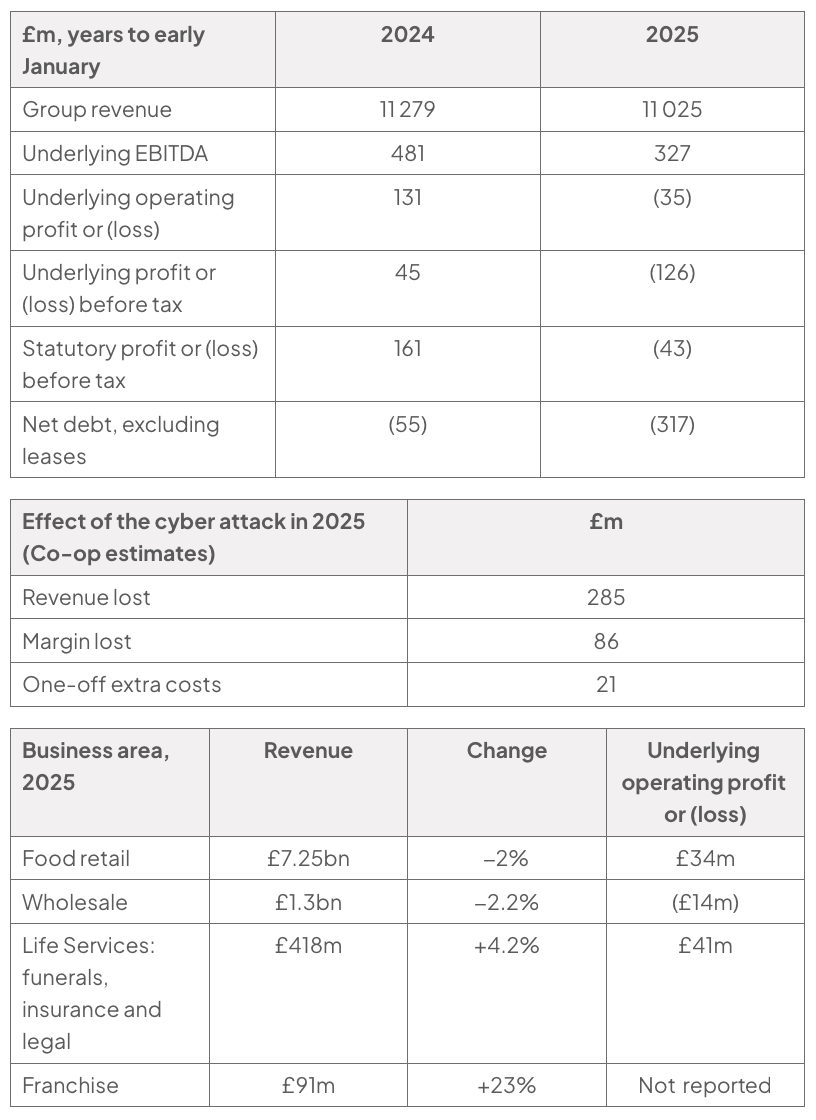
In April 2025 Co-op restricted its own computer systems to contain a criminal cyber attack, which caused shortages of goods in stores.

Analyse one way in which the cyber attack might have affected Co-op's relationship with its customers.

7
6 marks

Source B: Bretforton Facilities

Bretforton Facilities Limited was founded in 1989 by Anne Fielding in Bretforton, near Evesham, and is still owned by her family. Her son, Mark Fielding, is Managing Director. It cleans and maintains about 180 schools, 64 GP surgeries and health centres, and a number of offices across Worcestershire and the West Midlands, and employs 640 people, most of them part-time cleaners and caretakers.

Its mission is "clean, safe buildings, looked after by local people who are paid fairly". Since 2016 it has been an accredited Real Living Wage employer, which means it pays all its staff at least the Real Living Wage, a voluntary rate set by the Living Wage Foundation that is higher than the legal National Living Wage. Its objective is to reach £30 million of revenue by 2030 while remaining a Real Living Wage employer.

Bretforton Facilities competes for contracts against national facilities management companies, which can often offer lower prices. Its largest customer, a county council, wants to cut the price of its contract when it is renewed next year.

Anne Fielding is 71 and wants to sell the business. A national competitor, Corvane Group, has made an offer, and the family is also considering selling to an employee ownership trust.

Source: Bretforton Facilities

Bretforton Facilities' largest customer, a county council, wants to cut the price of its contract when it is renewed next year.

Analyse one way in which this customer's power might affect Bretforton Facilities' profit.

8
6 marks

Source B: Macknade

Macknade is a family-owned food hall on the edge of Faversham, Kent, on the site of a farm the Neame family began farming in 1847. The company, Macknade Fine Foods Ltd, employed an average of 82 people in the year to 31 March 2025.

In 1979 Patricia Neame and her husband Renato Cuomo, who was born on the Italian island of Ischia, opened a pick-your-own business on the farm. In 2001 the family stopped farming to concentrate on retail. Their son, Stefano Cuomo, the sixth generation to run the business, became managing director in 2013 and later Chief Executive.

The seven-acre site is dominated by a 10 000 square foot food hall, which sells:

  • local and Mediterranean produce

  • more than 100 cheeses

  • meat from its own butchery, which opened in 2016 and buys whole carcasses from farms using regenerative "Pasture for Life" methods

The site also has a café and an outdoor food village of street-food traders. Other businesses rent space on the site, including a vet, a fitness studio and a sauna.

In 2021 Macknade's managing director said that "community is at our core". Its Chief Executive has described a shopper with a "dual shopping list", who buys some items in supermarkets and others from independent shops.

In 2020 Macknade opened a second shop, in Ashford. Its website now lists only the Faversham site.

Source: Macknade, Macknade Fine Foods Ltd accounts and press interviews

Other businesses rent space on Macknade's site, including a vet, a fitness studio and a sauna.

Analyse one way in which these tenants might affect Macknade's own sales.

1
9 marks

Source B: Linbury Preserves

Linbury Preserves Limited makes jam and marmalade near Leominster, Herefordshire. It was founded in 1952 by Joan Ashby in her farmhouse kitchen and is still owned by the Ashby family; its Managing Director is Tom Ashby, her grandson. It employs 58 people and in the year to 31 March 2026 sold 3.02 million jars, mainly to farm shops, delicatessens and independent food shops, and through its own website.

The company's mission is to make "proper preserves, the slow way": every batch is boiled in open copper pans, and the fruit comes from farms within 30 miles. It buys its fruit from 14 Herefordshire growers on five-year contracts, at prices above the market price, so that the growers can plan and invest. In 2025 the family set an objective of doubling the company's revenue by 2030.

To be sold as "jam", a product must meet the legal standards for fruit and sugar content. In 2024 Linbury Preserves launched a range with less sugar; because its sugar content is below the legal standard, it must be sold as a "fruit spread" rather than as jam.

Many of its customers say they are trying to eat less sugar. At the same time, the company's costs have risen. The National Living Wage rose by 4.1% to £12.71 an hour from April 2026, employers have paid more National Insurance since April 2025, and since 2025 the company has paid fees on the glass jars and lids it uses, under new rules which make businesses pay towards the cost of recycling packaging.

Source: Linbury Preserves

Appendix D: Linbury Preserves selected data

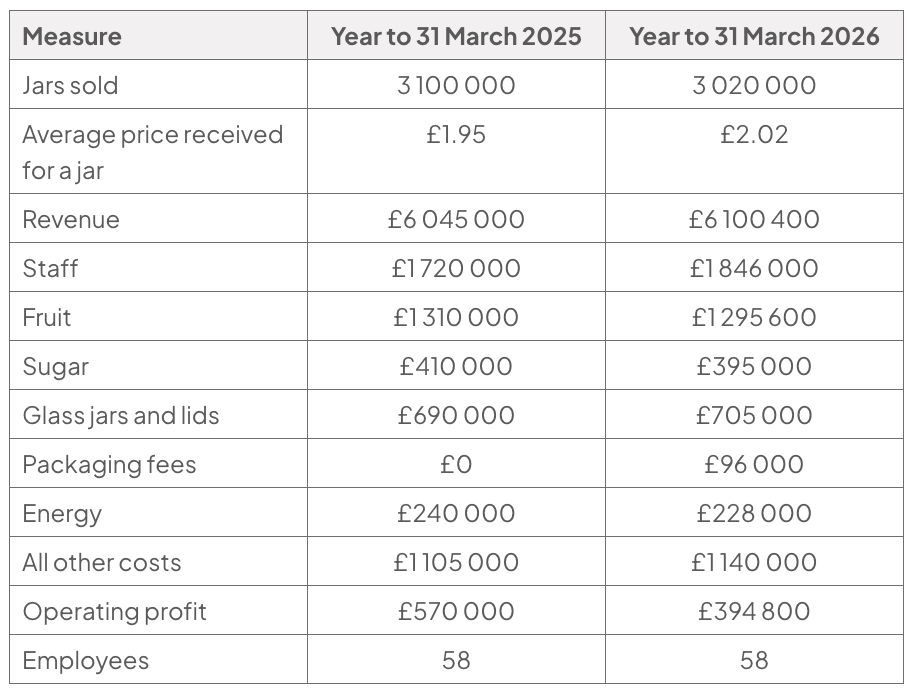
Table comparing Linbury Preserves’ sales, revenue, costs and operating profit for the years to 31 March 2025 and 2026. Operating profit falls from £570 000 to £394 800, while employees remain at 58.

Source: Linbury Preserves

Appendix F: Fruit, growers and costs

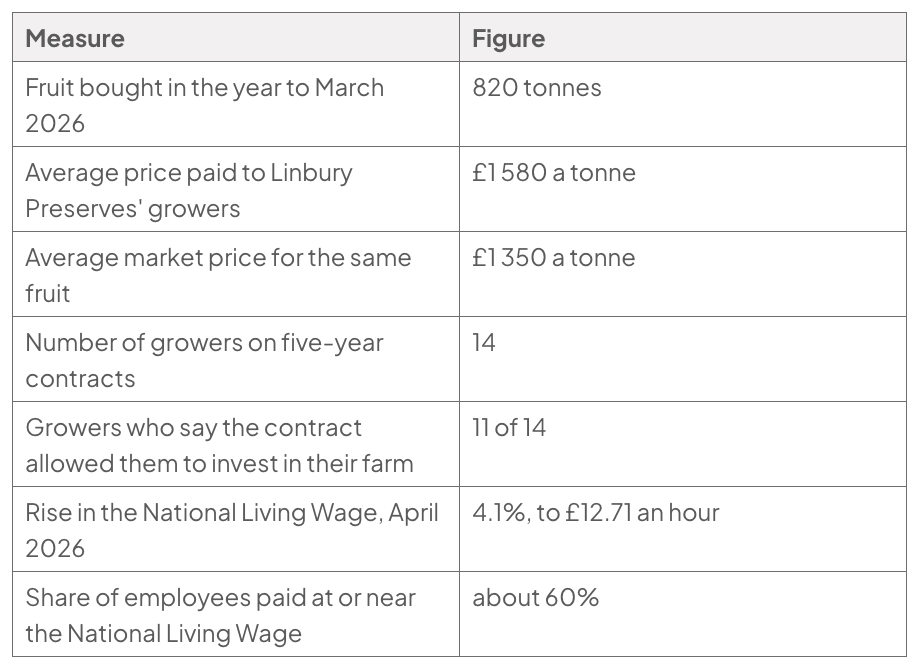
Table: fruit bought, 820 tonnes; average price paid, £1 580 a tonne; market price, £1 350 a tonne; 14 growers, 11 reporting investment; wage rise 4.1% to £12.71 an hour; 60% of employees affected.

Source: Linbury Preserves

Assess whether paying its growers more than the market price is in the interests of Linbury Preserves' owners.

Calculate Linbury Preserves' operating profit margin for the year to 31 March 2026 to support your answer. Give your answer to one decimal place.

2
9 marks

Source B: Stowe Valley Mutual

Stowe Valley Mutual is a building society founded in 1867 in Buckingham. It takes savings from its members and lends to members who are buying a home. It has nine branches in Buckinghamshire and Oxfordshire and 155 employees. As a building society it has no shareholders: it is owned by its 97 100 members, its savers and borrowers, who each have a vote at its annual general meeting. Its profits are not paid out as dividends but kept as reserves, which the law requires it to hold to protect its savers.

Its mission is "helping members save and own their homes, with a branch in every town we serve". By law, at least half of a building society's funds must come from its members' savings, and at least three-quarters of its lending must be secured on homes.

Stowe Valley Mutual's income comes mainly from the gap between the interest it earns on mortgages and the interest it pays to savers. Bank Rate, the Bank of England's interest rate, has fallen from 5.25% in July 2024 to 3.75% in September 2026.

Its board measures performance with key performance indicators including its cost to income ratio (operating costs as a percentage of income), its profit before tax, and the satisfaction of its members.

Source: Stowe Valley Mutual

Appendix D: Stowe Valley Mutual selected data

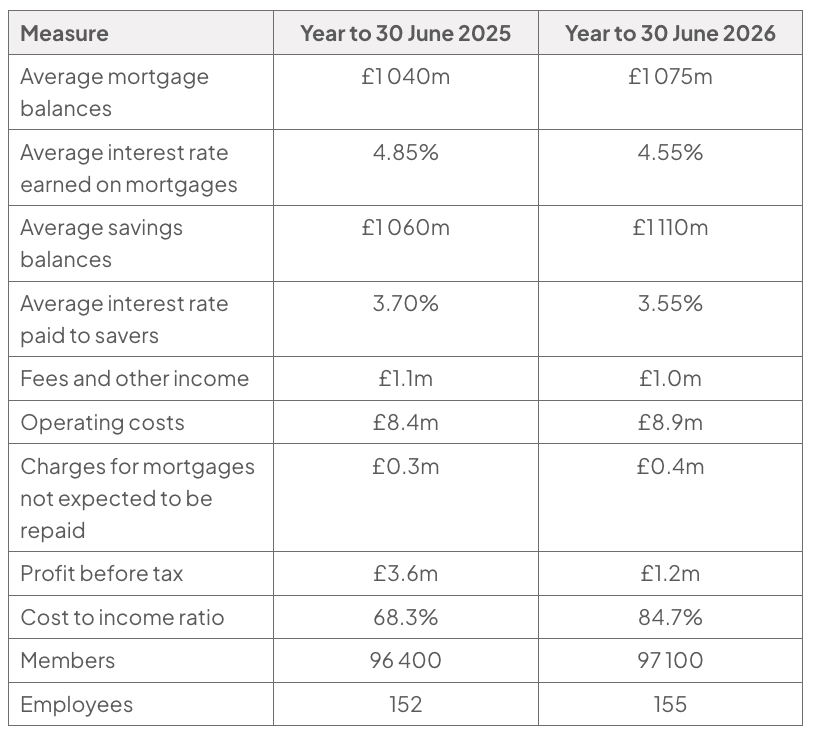
Table comparing the years to 30 June 2025 and 2026: average mortgage balances £1 040m and £1 075m, earning 4.85% and 4.55%; average savings balances £1 060m and £1 110m, paying 3.70% and 3.55%; also fees and other income, operating costs, charges for mortgages not expected to be repaid, profit before tax, cost to income ratio, members and employees.

Interest earned on the society's cash and other liquid assets is included in fees and other income.

Source: Stowe Valley Mutual

Appendix F: Members and savers

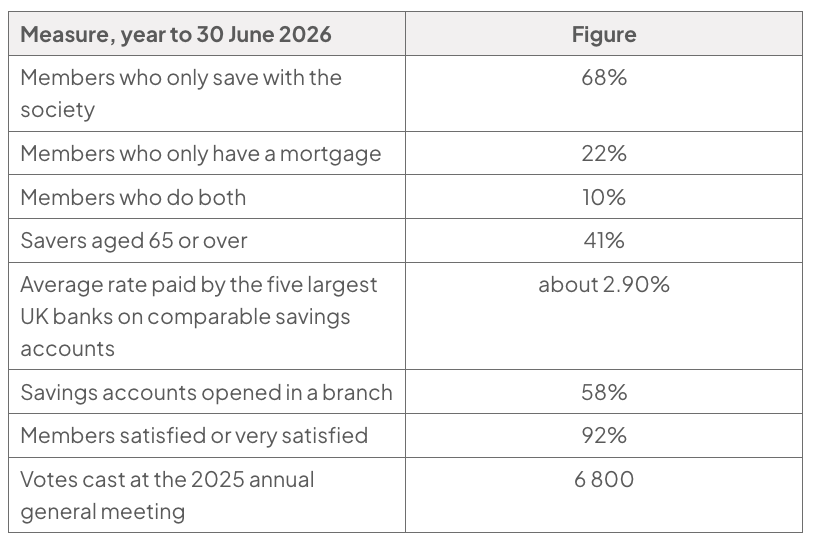
Stowe Valley Mutual member and saver measures, year to 30 June 2026: savers only 68%, mortgage only 22%, both 10%, savers aged 65+ 41%, largest banks’ comparable savings rate about 2.90%, branch accounts 58%, satisfied 92%, 2025 AGM votes 6 800.

The board says paying savers a better rate than the large banks is "the clearest benefit of being a member". It also says that profit is needed to build the reserves that the regulator requires before the society can lend more.

Source: Stowe Valley Mutual

Assess whether paying its savers more than the largest banks is in the interests of Stowe Valley Mutual's members.

3
9 marks

Source A: Mitie

Mitie Group plc was founded in 1987 and is listed on the London Stock Exchange. It is the UK's leading facilities management company, employing 84 000 colleagues who clean, guard, maintain and upgrade buildings for customers such as the Home Office, Transport for London, Asda and GSK.

Mitie's strategic plan for the three years to March 2027 aims to move it from facilities management, where UK market growth is about 2-3% a year, into higher-margin work: Facilities Transformation projects, such as building upgrades, data centres and decarbonisation; and Facilities Compliance, such as fire and security systems that buildings must have by law. In August 2025 it bought Marlowe, a compliance business, for about £350 million in cash and shares.

In the year to 31 March 2026 revenue rose by 10.5% to £5 619 million, including 5.3% organic growth. Costs were increased by higher employers' National Insurance contributions and the loss of two public sector contracts.

Mitie describes itself as "technology-led" and has launched a programme to "re-imagine and optimise" its internal workflows and customer services through agentic AI: AI systems that can carry out tasks with little human input. Its Chief Executive, Phil Bentley, intends to retire at the end of the strategic plan, once a successor is in place.

Source: Mitie Group plc, results for the 12 months to 31 March 2026

Appendix A: Mitie financial data

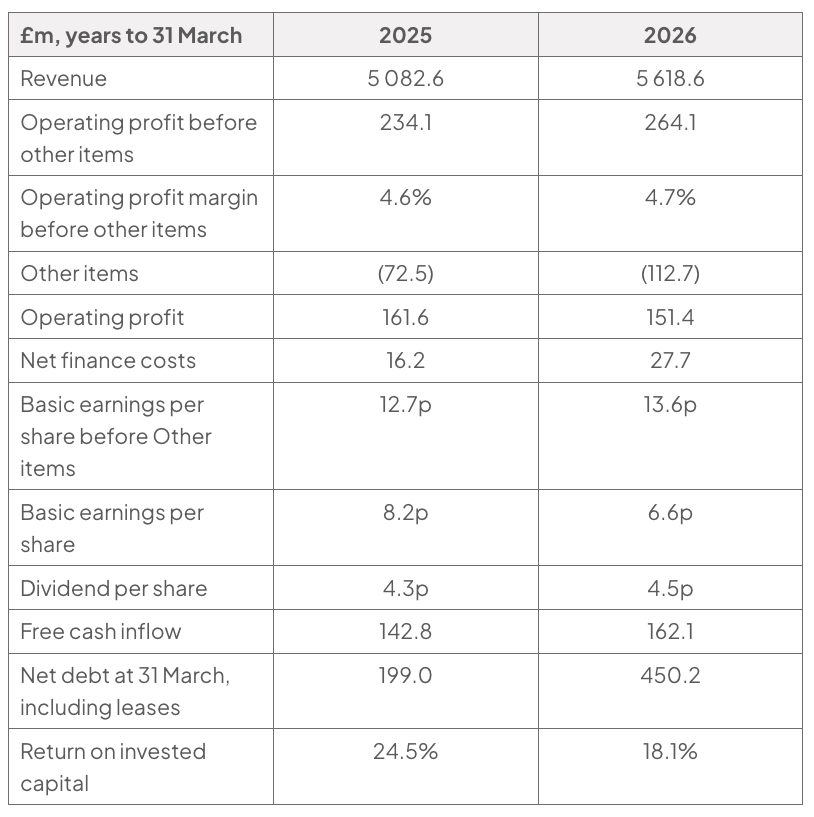
Table of Mitie financial data (£m, years to 31 March) comparing 2025 and 2026: revenue 5 082.6 and 5 618.6; operating profit before other items 234.1 and 264.1; operating profit margin before other items 4.6% and 4.7%; other items (72.5) and (112.7); operating profit 161.6 and 151.4; net finance costs 16.2 and 27.7; basic earnings per share before Other items 12.7p and 13.6p; basic earnings per share 8.2p and 6.6p; dividend per share 4.3p and 4.5p; free cash inflow 142.8 and 162.1; net debt at 31 March, including leases, 199.0 and 450.2; return on invested capital 24.5% and 18.1%.
  • Other items in 2026 included £42m of amortisation, £29m of costs to deliver margin enhancement initiatives, including redundancy costs, and £22m of Marlowe transaction and integration costs.

  • Shareholder returns. About £60m of shares were bought back in 2026, and £100m of buybacks are planned for the year to March 2027. Shares were also issued to help pay for Marlowe.

Source: Mitie Group plc

Appendix B: Strategy and the three pillars

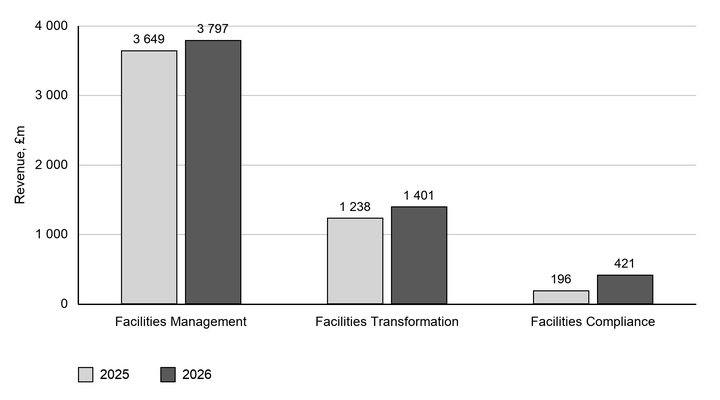
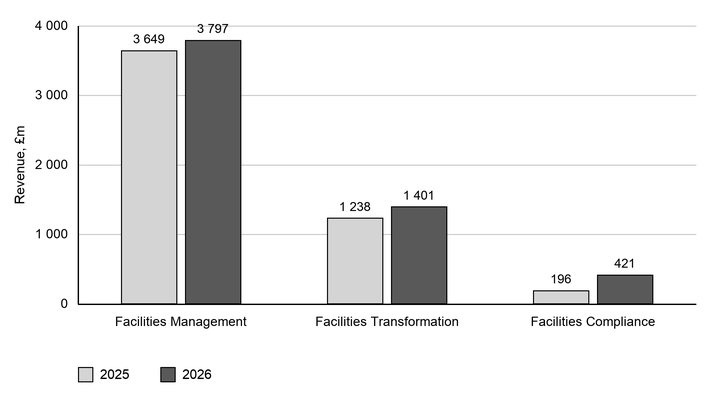
Grouped bar chart of Mitie revenue by segment (£m) in 2025 and 2026: Facilities Management 3 649 to 3 797; Facilities Transformation 1 238 to 1 401; Facilities Compliance 196 to 421.
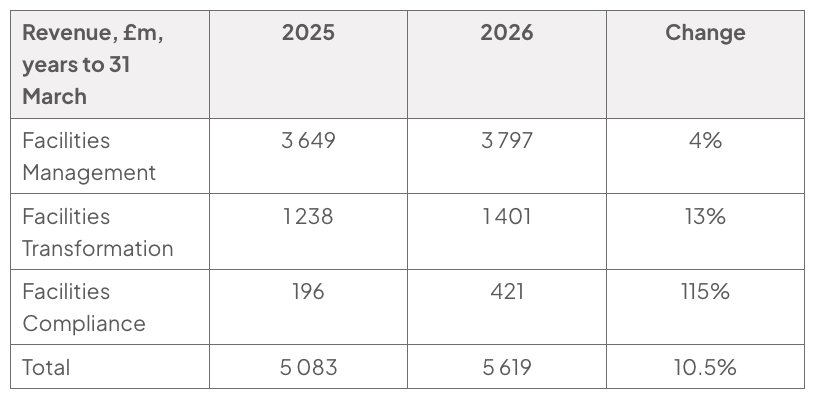
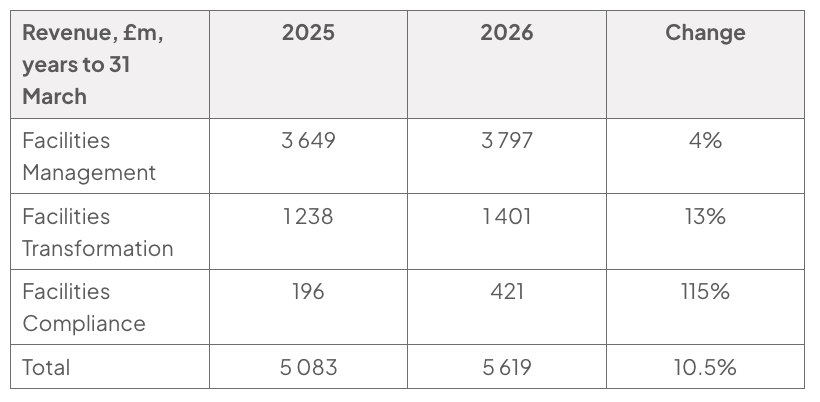
Revenue table for years to 31 March: Facilities Management £3 649m to £3 797m, up 4%; Transformation £1 238m to £1 401m, up 13%; Compliance £196m to £421m, up 115%; total £5 083m to £5 619m, up 10.5%.
  • Targets for the year to March 2027. High single-digit annual revenue growth; operating margin of at least 5%; free cash flow of £150m; return on invested capital above 20%. The operating margin was 5.3% in the second half of the year to March 2026.

  • Marlowe. Added £208m of revenue in its first eight months; Mitie and Marlowe's combined compliance businesses have about £0.5bn of annual revenue. Cost savings of £7m in the first year, from merging alarm-monitoring centres, leaving 15 Marlowe properties and moving payroll and purchasing onto Mitie's systems; at least £30m expected by March 2028. Some revenue was lost in the first months after the deal, as competitors that had used Marlowe moved their work away.

  • Growth with existing customers. Mitie provides integrated facilities management to only about 40% of its largest contracts, and about 80% of Transformation projects are for existing customers.

  • Contracts. Renewal rate 84% (2025: 59%; long-term average about 90%). Order book £16.3bn (2025: £15.4bn).

Source: Analyst, using Mitie Group plc

Assess whether Mitie's shareholders benefited from its performance in the year to 31 March 2026.

Calculate Mitie's operating profit margin in the year to 31 March 2026 to support your answer. Give your answer to one decimal place.

4
9 marks

Source B: Bretforton Facilities

Bretforton Facilities Limited was founded in 1989 by Anne Fielding in Bretforton, near Evesham, and is still owned by her family. Her son, Mark Fielding, is Managing Director. It cleans and maintains about 180 schools, 64 GP surgeries and health centres, and a number of offices across Worcestershire and the West Midlands, and employs 640 people, most of them part-time cleaners and caretakers.

Its mission is "clean, safe buildings, looked after by local people who are paid fairly". Since 2016 it has been an accredited Real Living Wage employer, which means it pays all its staff at least the Real Living Wage, a voluntary rate set by the Living Wage Foundation that is higher than the legal National Living Wage. Its objective is to reach £30 million of revenue by 2030 while remaining a Real Living Wage employer.

Bretforton Facilities competes for contracts against national facilities management companies, which can often offer lower prices. Its largest customer, a county council, wants to cut the price of its contract when it is renewed next year.

Anne Fielding is 71 and wants to sell the business. A national competitor, Corvane Group, has made an offer, and the family is also considering selling to an employee ownership trust.

Source: Bretforton Facilities

Appendix D: Bretforton Facilities selected data

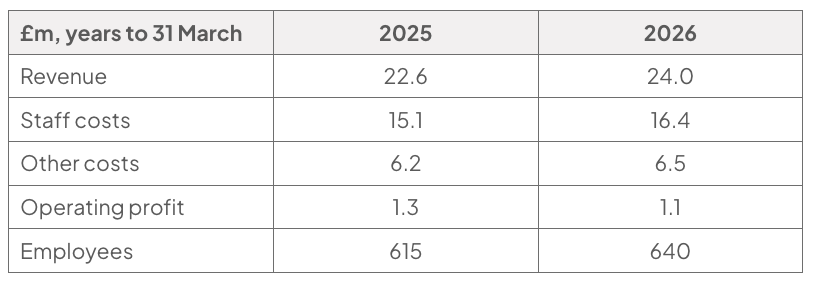
Table of Bretforton Facilities’ selected data for years to 31 March 2025 and 2026, showing revenue, staff costs, other costs, operating profit and employee numbers in millions of pounds or people.

Source: Bretforton Facilities

Appendix F: Customers and competitors

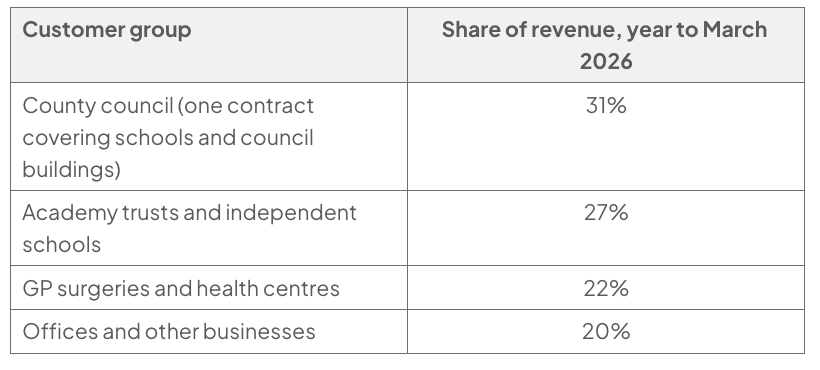
Table showing Bretforton Facilities’ customer groups and their shares of revenue for the year to March 2026, divided into four categories: council, schools, healthcare, and offices or other businesses.
  • The county council contract is worth £7.44m a year. The council wants a price 6% lower when the contract is renewed in April 2027, and has said it will also invite bids from national companies.

  • Bretforton Facilities has never lost a school contract on quality, but lost four in 2025 to national competitors bidding about 8% lower.

Source: Bretforton Facilities

Assess whether Bretforton Facilities should accept the county council's demand for a lower price.

Calculate the fall in Bretforton Facilities' profit a year if it accepts the 6% price cut to support your answer.

5
9 marks

Source B: Kelsmere Community Trust

Kelsmere Community Trust is a registered charity founded in 2003 on the Kelsmere estate in Middlesbrough. It employs 15 staff and is supported by 96 volunteers. Its founder and chief executive, who has led the charity for 23 years, will retire in December 2026. It runs:

  • a food bank

  • a youth club

  • a café that trains young people for work; in 2026, 15 of its 22 trainees found work

Most of Kelsmere's income comes from a five-year National Lottery grant, which is its largest single source of income, and a contract with the local council to run youth services. Eleven local businesses now support the charity with money, food or staff time, up from seven. In the year to March 2026, income from local business partners and income from café and room hire both rose.

The charity faces four main pressures:

  • Demand. Use of the food bank is rising.

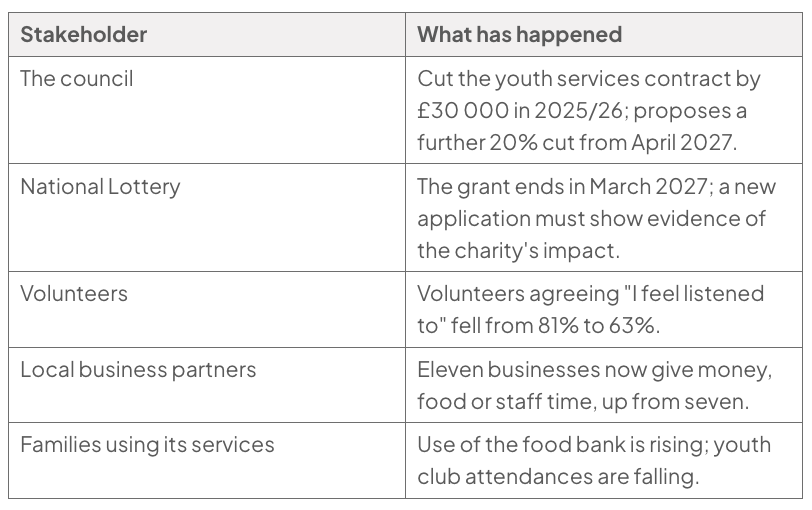
  • Council funding. The council cut the youth services contract by £30 000 in 2025/26, and the youth club has closed on Fridays since September 2025 because of the cut. The council proposes a further 20% cut from April 2027.

  • Lottery funding. The National Lottery grant ends in March 2027. A new application must show evidence of the charity's impact.

  • Volunteers. Volunteers agreeing "I feel listened to" fell from 81% to 63%.

The trustees are considering whether to merge with Northgate Family Centre, a charity 1.5 miles away that provides family support and debt advice.

Source: Kelsmere Community Trust

Appendix D: Kelsmere Community Trust financial data

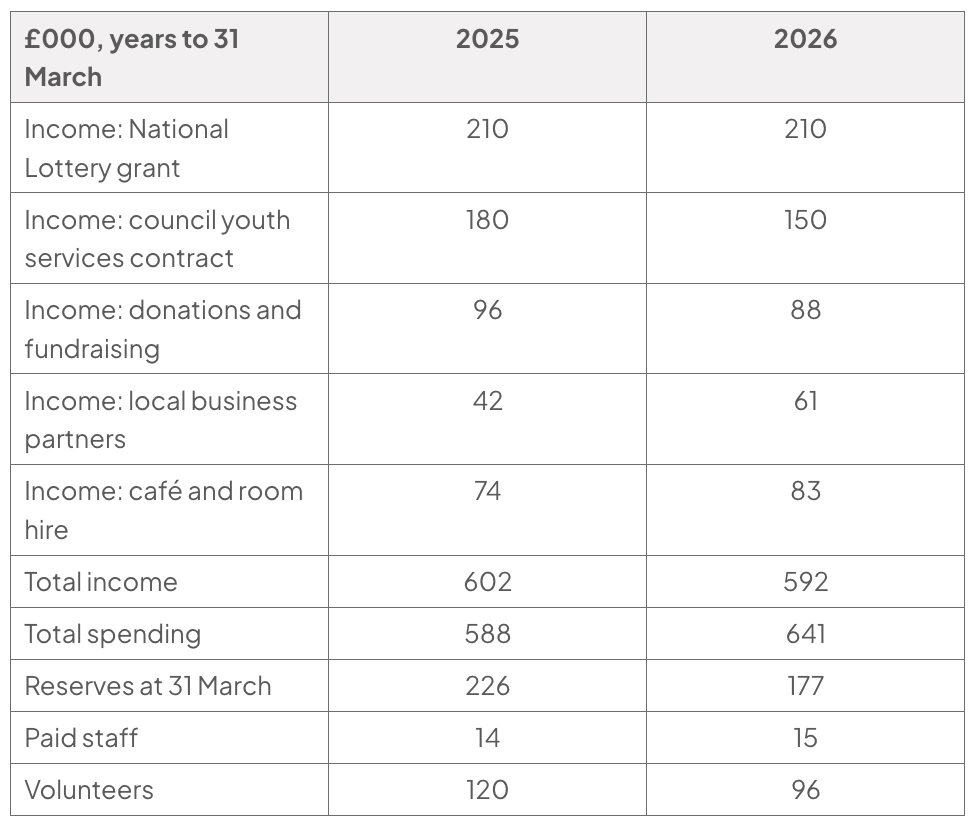
Table of Kelsmere's financial data (£000, years to 31 March) for 2025 and 2026: income from the National Lottery grant 210 and 210, council youth services contract 180 and 150, donations and fundraising 96 and 88, local business partners 42 and 61, café and room hire 74 and 83; total income 602 and 592; total spending 588 and 641; reserves at 31 March 226 and 177; paid staff 14 and 15; volunteers 120 and 96.
  • Reserves policy. The trustees aim to hold reserves equal to at least three months' spending.

Source: Kelsmere Community Trust

Appendix F: Kelsmere's stakeholders

Stakeholder table covering the council, National Lottery, volunteers, local business partners and families using services; it notes that youth club attendances are falling.

Source: Kelsmere Community Trust

Assess whether the council is Kelsmere Community Trust's most important stakeholder.

Calculate Kelsmere Community Trust's profit (surplus or deficit) for the years to 31 March 2025 and 31 March 2026 to support your answer.

1
15 marks

Source A: Lancashire Cricket

Lancashire County Cricket Club Limited, known as Lancashire Cricket, was founded in 1864 and plays at Emirates Old Trafford in Manchester. It has men's and women's teams, hosts international matches, and runs a hotel and a conference and events business at the ground. It is not owned by shareholders: it is a registered society, owned by its members, who vote at its general meetings and elect some members of its Board.

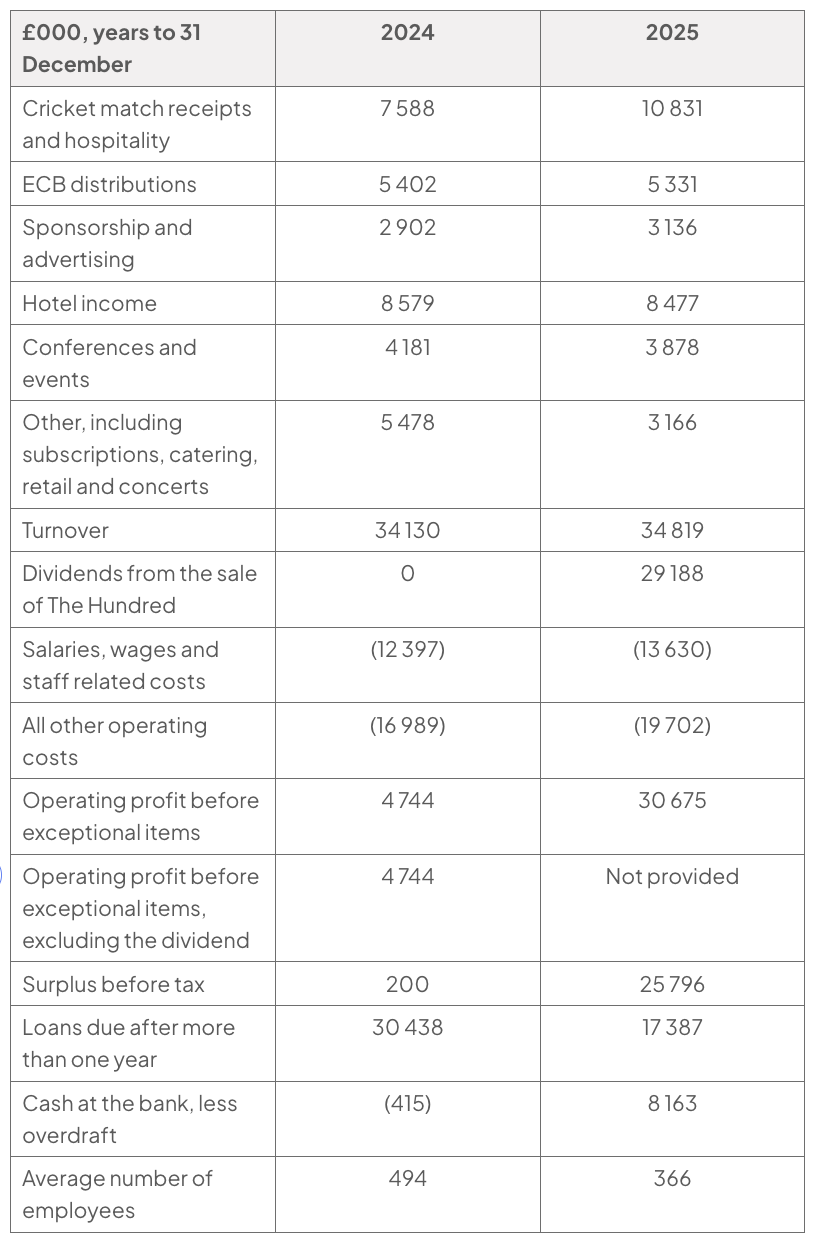
In 2025 Lancashire Women won their first two professional trophies, and Emirates Old Trafford hosted a five-day men's Test match against India. Turnover rose slightly, to £34.8 million. The Chief Executive said that "the primary challenge for the business now is not revenue generation" but operating costs, which have increased significantly since the pandemic. During the year the club outsourced its catering and retail operations.

In 2025 the England and Wales Cricket Board (ECB) sold stakes in the eight teams in The Hundred, a short-format competition. RPSG Group, an Indian business which also owns teams in the Indian Premier League and South Africa, bought 70% of Manchester Originals; Lancashire Cricket kept 30%, and the team was renamed Manchester Super Giants. The club received dividends of £29.2 million from the sale, repaid £13.3 million of loans, and expects further dividends over the next few years. Lancashire Cricket's surplus before tax was £25.8 million.

The club's £20 million second ground at Farington, near Preston, built in partnership with Lancashire County Council, was handed over to the club in early 2026.

Source: Lancashire County Cricket Club Limited, Annual Report and Financial Statements 2025

Appendix A: Lancashire Cricket financial data

Table comparing Lancashire Cricket’s 2024 and 2025 finances in £000: turnover rose slightly, dividends reached 29,188, surplus before tax rose to 25,796, loans fell and cash became positive.

Source: Lancashire County Cricket Club Limited

Appendix B: Cricket, venue, costs and digital

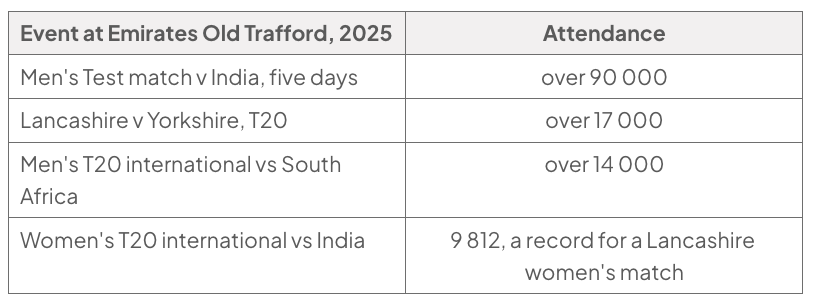
Table of 2025 event attendances at Emirates Old Trafford: over 90,000 for the men’s Test against India, over 17,000 for Lancashire v Yorkshire T20, over 14,000 for men’s T20 v South Africa, and 9,812 for the women’s T20 v India, a record.
  • 2026 fixtures. Two men's T20 internationals and four matchdays of the ICC Women's T20 World Cup. The club expects international cricket "will be challenging financially compared to previous years". No concerts are planned; there were three sold-out concerts in 2024 and none in 2025.

  • Hotel. Revenue just below £8.5m, down just over 1%, with high occupancy but a slightly lower average room rate.

  • Conferences and events. "A very competitive market, with many companies slowing down spend"; revenue fell by just over £0.3m.

  • Costs. Since 2019 payroll has risen by £2.4m (22%) and utilities by £0.4m (56%). Business rates will rise by £0.2m in 2026 and a further £0.2m in 2027. The National Living Wage and employers' National Insurance contributions both rose in April 2025. The club gave staff a standard pay rise of 2% and says "the UK economy is not thriving".

  • The economy, September 2026. Bank Rate 3.75%; inflation 3.1%; unemployment 4.9%.

  • Digital. In July 2025 the club launched LancsTV, a streaming service built with StreamAMG, a Manchester company, showing all non-televised home men's and women's matches, interviews and archive footage. It is free, but viewers must register; members and ticket holders use the same login as for tickets and membership. A members-only area, LancsTV+, is planned. The Chief Executive said: "we have no plans to charge supporters to watch LancsTV". The club also updated its website in 2025.

  • Partnerships. Commercial partnership revenue is about £3m a year.

Source: Analyst, using Lancashire County Cricket Club Limited, the Bank of England, the Office for National Statistics and press reports

Appendix C: Owners, partners and The Hundred

  • Members. 6 470 members hold a 5p share that gives them a vote (2024: 6 609). The club had over 8 000 members of all kinds ahead of the 2026 season and wants to grow membership. A Members' Representative Group meets club officials to pass on members' views.

  • Governance in 2025. Two Special General Meetings of members were held, costing £68 000. The Chair resigned in August 2025 and an Interim Chair was appointed.

  • The ECB. Money from The Hundred "must be applied for and subsequently approved by the ECB Board", and may be used for debt repayment, cash reserves and activity that generates revenue. The club has agreed with the ECB to hold £5m as a cash reserve.

  • RPSG. Owns 70% of Manchester Super Giants; Lancashire Cricket owns 30%. In July 2026 RPSG and Lancashire Cricket bought the land behind Emirates Old Trafford to build a high-performance cricket centre, which will be used by Lancashire's teams and as a training base for RPSG's teams.

  • Lancashire County Council. Partner in the Farington ground, with a joint commitment to increase cricket and physical activity in schools and communities across the county.

  • Staff. The club lists "the mental health and wellbeing of all our staff after a very challenging 2025" as a key priority for 2026.

Source: Analyst, using Lancashire County Cricket Club Limited and press reports

Lancashire Cricket is owned by its members, but its new partner RPSG owns 70% of Manchester Super Giants and is helping to pay for a high-performance cricket centre.

Evaluate whether Lancashire Cricket should give priority to the interests of its members or to the interests of RPSG when planning its future.

2
15 marks

Source B: Stowe Valley Mutual

Stowe Valley Mutual is a building society founded in 1867 in Buckingham. It takes savings from its members and lends to members who are buying a home. It has nine branches in Buckinghamshire and Oxfordshire and 155 employees. As a building society it has no shareholders: it is owned by its 97 100 members, its savers and borrowers, who each have a vote at its annual general meeting. Its profits are not paid out as dividends but kept as reserves, which the law requires it to hold to protect its savers.

Its mission is "helping members save and own their homes, with a branch in every town we serve". By law, at least half of a building society's funds must come from its members' savings, and at least three-quarters of its lending must be secured on homes.

Stowe Valley Mutual's income comes mainly from the gap between the interest it earns on mortgages and the interest it pays to savers. Bank Rate, the Bank of England's interest rate, has fallen from 5.25% in July 2024 to 3.75% in September 2026.

Its board measures performance with key performance indicators including its cost to income ratio (operating costs as a percentage of income), its profit before tax, and the satisfaction of its members.

Source: Stowe Valley Mutual

Appendix D: Stowe Valley Mutual selected data

Table comparing the years to 30 June 2025 and 2026: average mortgage balances £1 040m and £1 075m, earning 4.85% and 4.55%; average savings balances £1 060m and £1 110m, paying 3.70% and 3.55%; also fees and other income, operating costs, charges for mortgages not expected to be repaid, profit before tax, cost to income ratio, members and employees.

Interest earned on the society's cash and other liquid assets is included in fees and other income.

Source: Stowe Valley Mutual

Appendix E: Interest rates and the economy

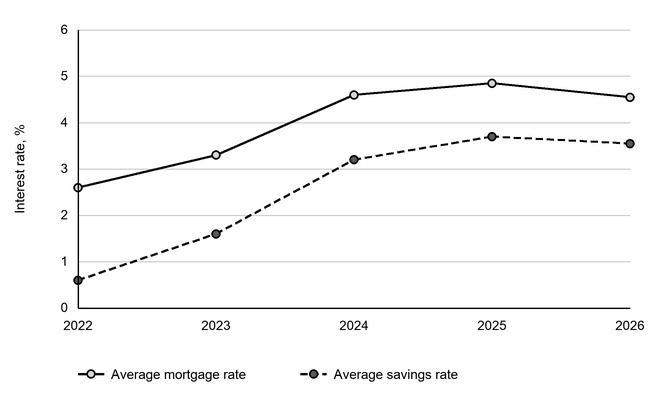
Line chart of average mortgage and savings rates from 2022 to 2026, with mortgage rates rising from 2.6% to 4.85% then 4.55%, and savings rates from 0.6% to 3.7% then 3.55%.
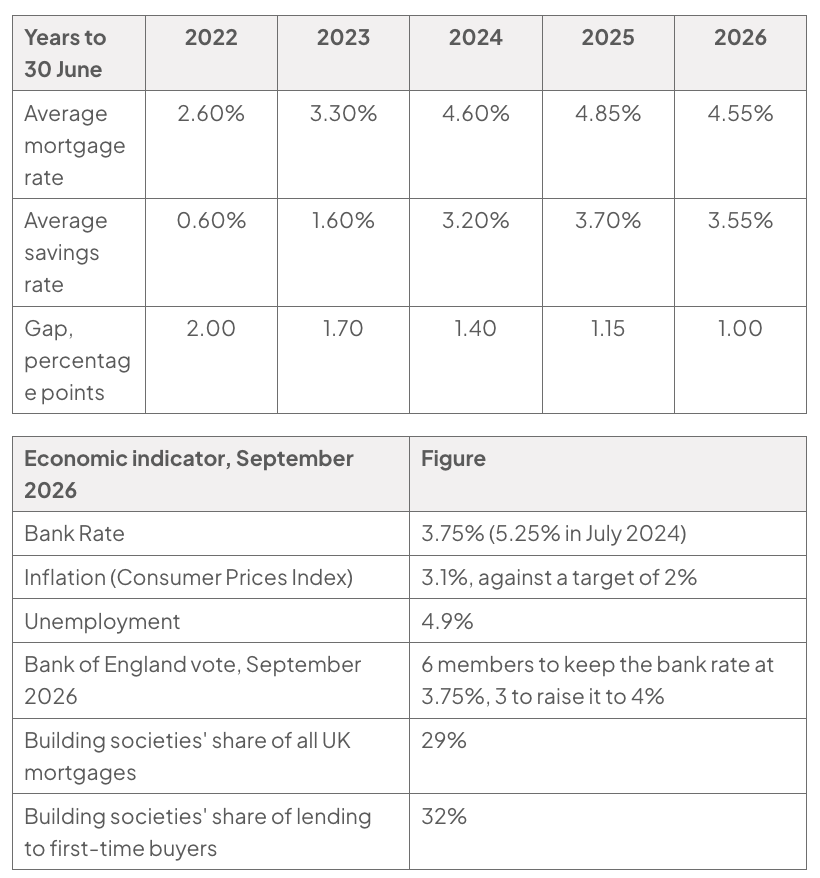
Two tables show mortgage and savings rates from 2022 to 2026, with the gap narrowing from 2.00 to 1.00 percentage points, plus September 2026 economic indicators including Bank Rate, inflation, unemployment and mortgage shares.

Many of Stowe Valley Mutual's mortgages are fixed for two or five years, so their rates change only when they end. Savers can move their money more quickly.

Source: Analyst, using Stowe Valley Mutual, the Bank of England, the Office for National Statistics and the Building Societies Association

Appendix F: Members and savers

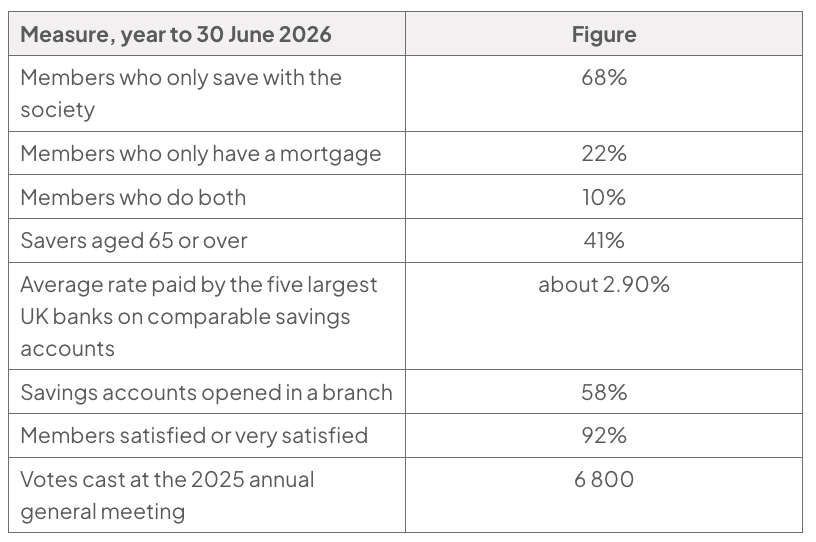
Two-column table headed “Measure, year to 30 June 2026” and “Figure”, listing Stowe Valley Mutual member and saver statistics; the same data is provided in the surrounding text.

The board says paying savers a better rate than the large banks is "the clearest benefit of being a member". It also says that profit is needed to build the reserves that the regulator requires before the society can lend more.

Source: Stowe Valley Mutual

Appendix G: Three ways to restore profit

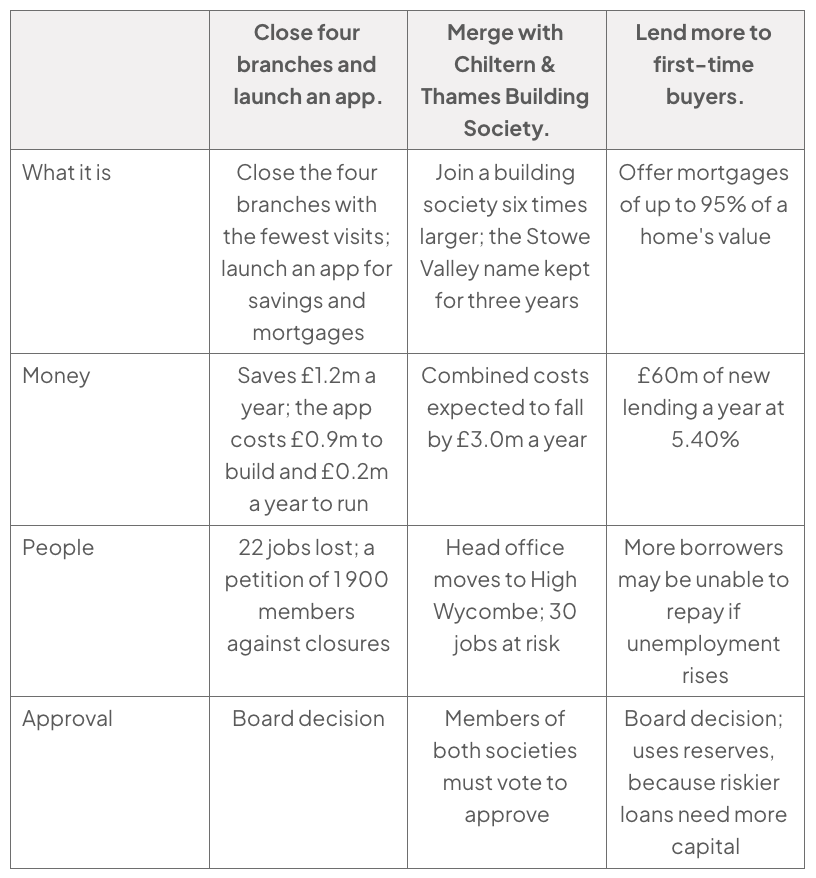
Table of three profit-restoration options: close four branches and launch an app (£1.2m saved, £0.9m build cost, £0.2m annual running cost, 22 jobs lost); merge with Chiltern & Thames (costs fall £3m, 30 jobs at risk); lend £60m more to first-time buyers at 5.4%.

Source: Stowe Valley Mutual

Stowe Valley Mutual's profit before tax has fallen from £3.6m to £1.2m. Its board is considering three ways to restore it.

Evaluate two ways Stowe Valley Mutual could restore its profit and recommend which one it should choose.

Use information from Appendices D to G to support your answer.

3
15 marks

Source A: Co-op Group

The Co-operative Group, known as Co-op, began in Rochdale in 1844. It is a co-operative owned by its members, who can vote at its annual general meeting (AGM). Co-op says that because it is owned by its members, it "can make decisions that other businesses can't, from our Net Zero goals to our community support".

It runs more than 2 300 food stores and supplies others through Co-op Wholesale, partners and franchises, close to 8 000 stores in all. It also provides funerals, insurance and legal services.

Changes in 2025 included:

  • Prices. It price-matched over 100 everyday items to Aldi for members; these items reached 40% of members' baskets.

  • Online. Its online quick-commerce business, selling through its own website and delivery apps Uber Eats, Just Eat and Deliveroo, grew by 15%. Online services were added to 279 more stores, and 90% of the UK population can shop online with Co-op.

In April 2025 Co-op suffered a criminal cyber attack. To contain it, Co-op restricted its own computer systems, which caused shortages of goods in stores. Group revenue fell 2.3% to £11 025 million, and Co-op made an underlying operating loss of £35 million. In 2026 Co-op says its market share has returned to or passed pre-attack levels in every business area.

Its Chief Executive, Shirine Khoury-Haq, stepped down on 29 March 2026, almost seven years after joining Co-op, and Kate Allum was appointed interim Group Chief Executive.

Co-op plans to remove £200 million of annual operating costs in 2026, and has set a target of 10 million active members by 2030.

Source: Co-operative Group, Members' Annual Report 2025 and 2025 trading update

Appendix A: Co-op financial data

Three tables of Co-op data. Table 1, £m, years to early January 2024 and 2025: group revenue 11 279 and 11 025; underlying EBITDA 481 and 327; underlying operating profit or (loss) 131 and (35); underlying profit or (loss) before tax 45 and (126); statutory profit or (loss) before tax 161 and (43); net debt, excluding leases, (55) and (317). Table 2, effect of the cyber attack in 2025 (Co-op estimates), £m: revenue lost 285; margin lost 86; one-off extra costs 21. Table 3, business area in 2025, showing revenue, change and underlying operating profit or (loss): food retail £7.25bn, −2%, £34m; wholesale £1.3bn, −2.2%, (£14m); Life Services (funerals, insurance and legal) £418m, +4.2%, £41m; franchise £91m, +23%, operating profit not reported.
  • Costs. About £150m of cost increases in 2025, including £47m of regulatory costs from higher employers' National Insurance and new packaging charges, and investment in colleague pay.

  • Investment. £318m in stores and technology in 2025.

  • Distributions. Members were not asked to approve any distribution of profits for 2025.

Source: Co-operative Group

Appendix B: Markets and competition

  • Convenience. Co-op describes "a contracting convenience market" and "a competitive grocery convenience market", with "health-led consumer behaviour shifts" and cautious consumers.

  • Price. Matching over 100 items to Aldi prices reached 40% of members' baskets.

  • Online. 90% of the UK population can shop online with Co-op; member prices are available through Uber Eats, Just Eat and Deliveroo. Online services were added to 279 more stores in 2025.

  • Range. A partnership with Holland & Barrett brought its vitamins and supplements into Co-op stores; 447 new product lines were launched.

  • Buying. A new Commercial and Logistics business centralises buying for close to 8 000 stores to improve prices by "buying at scale".

  • Recovery. In 2026 Co-op says its market share has returned to or passed pre-attack levels in every business area.

Source: Analyst, using Co-operative Group

Appendix C: Members, colleagues and communities

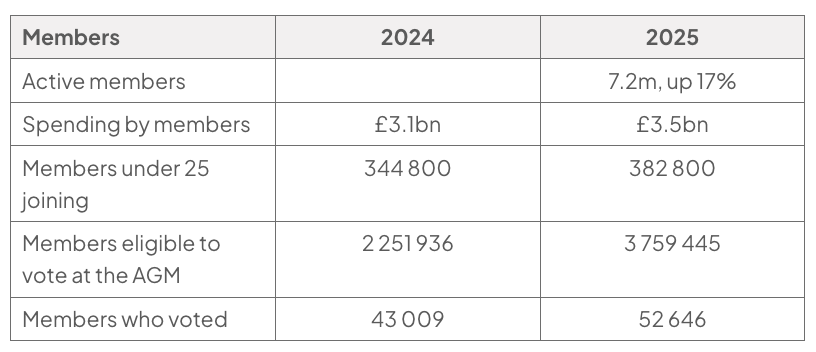
Table of Co-op members for 2024 and 2025: active members 7.2m in 2025, up 17%; spending by members £3.1bn and £3.5bn; members under 25 joining 344 800 and 382 800; members eligible to vote at the AGM 2 251 936 and 3 759 445; members who voted 43 009 and 52 646.
  • Communities. £15m shared with causes and communities in 2025; the Local Community Fund has shared £120m since 2016. Co-op supports 38 Co-op Academies.

  • Suppliers. Over £700m spent with UK farmers and agriculture suppliers; 100% of fresh and frozen own-brand meat is British. Members' priorities led to a pledge to stop sourcing from countries where the international community has identified serious risks of human rights violations.

  • Colleagues. A 30% colleague discount; physical assaults on colleagues in stores fell from 1 217 to 839 after new security measures.

  • Target. 10 million active members by 2030, raised from 8 million.

Source: Analyst, using Co-operative Group

Co-op plans to remove £200 million of annual operating costs in 2026. It is owned by its members and employs colleagues across its food stores, wholesale and funeral businesses.

Evaluate whether Co-op should give priority to the interests of its members or of its colleagues as it reduces its costs.

4
15 marks

Source A: Mitie

Mitie Group plc was founded in 1987 and is listed on the London Stock Exchange. It is the UK's leading facilities management company, employing 84 000 colleagues who clean, guard, maintain and upgrade buildings for customers such as the Home Office, Transport for London, Asda and GSK.

Mitie's strategic plan for the three years to March 2027 aims to move it from facilities management, where UK market growth is about 2-3% a year, into higher-margin work: Facilities Transformation projects, such as building upgrades, data centres and decarbonisation; and Facilities Compliance, such as fire and security systems that buildings must have by law. In August 2025 it bought Marlowe, a compliance business, for about £350 million in cash and shares.

In the year to 31 March 2026 revenue rose by 10.5% to £5 619 million, including 5.3% organic growth. Costs were increased by higher employers' National Insurance contributions and the loss of two public sector contracts.

Mitie describes itself as "technology-led" and has launched a programme to "re-imagine and optimise" its internal workflows and customer services through agentic AI: AI systems that can carry out tasks with little human input. Its Chief Executive, Phil Bentley, intends to retire at the end of the strategic plan, once a successor is in place.

Source: Mitie Group plc, results for the 12 months to 31 March 2026

Appendix A: Mitie financial data

Table of Mitie financial data (£m, years to 31 March) comparing 2025 and 2026: revenue 5 082.6 and 5 618.6; operating profit before other items 234.1 and 264.1; operating profit margin before other items 4.6% and 4.7%; other items (72.5) and (112.7); operating profit 161.6 and 151.4; net finance costs 16.2 and 27.7; basic earnings per share before Other items 12.7p and 13.6p; basic earnings per share 8.2p and 6.6p; dividend per share 4.3p and 4.5p; free cash inflow 142.8 and 162.1; net debt at 31 March, including leases, 199.0 and 450.2; return on invested capital 24.5% and 18.1%.
  • Other items in 2026 included £42m of amortisation, £29m of costs to deliver margin enhancement initiatives, including redundancy costs, and £22m of Marlowe transaction and integration costs.

  • Shareholder returns. About £60m of shares were bought back in 2026, and £100m of buybacks are planned for the year to March 2027. Shares were also issued to help pay for Marlowe.

Source: Mitie Group plc

Appendix B: Strategy and the three pillars

Bar chart of Mitie revenue by segment in 2025 and 2026 (£m; vertical scale 0 to 4 000): Facilities Management 3 649 to 3 797; Transformation 1 238 to 1 401; Compliance 196 to 421.
Table of Mitie revenue in £m for years to 31 March: Facilities Management 3 649 to 3 797, up 4%; Transformation 1 238 to 1 401, up 13%; Compliance 196 to 421, up 115%; total 5 083 to 5 619, up 10.5%.
  • Targets for the year to March 2027. High single-digit annual revenue growth; operating margin of at least 5%; free cash flow of £150m; return on invested capital above 20%. The operating margin was 5.3% in the second half of the year to March 2026.

  • Marlowe. Added £208m of revenue in its first eight months; Mitie and Marlowe's combined compliance businesses have about £0.5bn of annual revenue. Cost savings of £7m in the first year, from merging alarm-monitoring centres, leaving 15 Marlowe properties and moving payroll and purchasing onto Mitie's systems; at least £30m expected by March 2028. Some revenue was lost in the first months after the deal, as competitors that had used Marlowe moved their work away.

  • Growth with existing customers. Mitie provides integrated facilities management to only about 40% of its largest contracts, and about 80% of Transformation projects are for existing customers.

  • Contracts. Renewal rate 84% (2025: 59%; long-term average about 90%). Order book £16.3bn (2025: £15.4bn).

Source: Analyst, using Mitie Group plc

Appendix C: People, technology and customers

  • Colleagues. 84 000. Mitie has been named a UK Top Employer for eight years in a row, is 16th in the Top 100 Apprenticeship Employers, and about 1 800 colleagues took part in more than 120 training programmes in the year.

  • Costs. Higher employers' National Insurance contributions from April 2025 increased costs. Revenue growth and £25m of savings from margin enhancement initiatives more than offset these and other cost increases.

  • Technology. Aria, Mitie's customer app, automates about 40% of service requests with its AI assistant. AI agents and software robots are being deployed across operational and back-office processes. Thousands of colleagues use Microsoft Copilot, and 172 AI apprenticeships have been created.

  • Customers. Two public sector contracts were lost in the year, one of them large and higher-margin. Public sector Facilities Management contracts typically last up to 5-10 years; private sector contracts 3-5 years.

  • Leadership. The Chief Executive has led Mitie for almost ten years; a search for his successor is "well underway".

Source: Analyst, using Mitie Group plc

Mitie is using agentic AI to "re-imagine and optimise" its workflows and customer services, and aims to raise its operating margin to at least 5%.

Evaluate whether Mitie should give priority to the interests of its employees or the interests of its shareholders as it increases its use of artificial intelligence.