Selecting a Strategy (AQA A Level Business): Exam Questions

Exam code: 7132

Syllabus Edition

First teaching 2026

First exams 2028

3 hours18 questions
1
6 marks

Source A: Lancashire Cricket

Lancashire County Cricket Club Limited, known as Lancashire Cricket, was founded in 1864 and plays at Emirates Old Trafford in Manchester. It has men's and women's teams, hosts international matches, and runs a hotel and a conference and events business at the ground. It is not owned by shareholders: it is a registered society, owned by its members, who vote at its general meetings and elect some members of its Board.

In 2025 Lancashire Women won their first two professional trophies, and Emirates Old Trafford hosted a five-day men's Test match against India. Turnover rose slightly, to £34.8 million. The Chief Executive said that "the primary challenge for the business now is not revenue generation" but operating costs, which have increased significantly since the pandemic. During the year the club outsourced its catering and retail operations.

In 2025 the England and Wales Cricket Board (ECB) sold stakes in the eight teams in The Hundred, a short-format competition. RPSG Group, an Indian business which also owns teams in the Indian Premier League and South Africa, bought 70% of Manchester Originals; Lancashire Cricket kept 30%, and the team was renamed Manchester Super Giants. The club received dividends of £29.2 million from the sale, repaid £13.3 million of loans, and expects further dividends over the next few years. Lancashire Cricket's surplus before tax was £25.8 million.

The club's £20 million second ground at Farington, near Preston, built in partnership with Lancashire County Council, was handed over to the club in early 2026.

Source: Lancashire County Cricket Club Limited, Annual Report and Financial Statements 2025

Lancashire Cricket has diversified from cricket into running a hotel and a conference and events business at its ground. It uses surpluses from these businesses to help pay for its cricket.

Analyse one way in which this diversification might affect the risks faced by Lancashire Cricket.

2
6 marks

Source A: Wise

Wise Group plc is a public limited company, founded in London in 2011, as TransferWise, by Kristo Käärmann and Taavet Hinrikus. It describes its mission as "building the best way to move and manage the world's money". Its services allow people and businesses to:

  • send money between countries

  • hold more than 40 currencies in one account

  • spend abroad with a Wise card

Banks and other companies also use Wise's technology through Wise Platform to offer international payments to their own customers. Wise Platform partners include UniCredit, Raiffeisen Bank, MBSB Bank and, from April 2026, Capitec.

Wise keeps its prices low. In the year to 31 March 2026 the average fee it charged on a cross-border transfer fell to 0.52% of the amount sent. Its 19 million active customers moved $243 billion across borders, 31% more than in the previous year, and its net revenue rose by 19% to $2.5 billion. In the fourth quarter of the year, 75% of payments arrived in under 20 seconds.

Wise must hold a licence from regulators in each country where it offers its services. In 2025-26 it won licences in South Africa, the UAE and Thailand and connected directly to the domestic payment systems of Brazil and Japan, which Wise says reduces its costs and increases speed.

On 11 May 2026 Wise moved its primary share listing to the Nasdaq stock exchange in New York, keeping a secondary listing in London.

Source: Wise Group plc, Full Year 2026 results

Wise keeps its prices low: the average fee it charges on a cross-border transfer fell to 0.52% of the amount sent.

Analyse one way in which this low-price strategy might affect Wise's competitive advantage.

3
6 marks

Source A: Co-op Group

The Co-operative Group, known as Co-op, began in Rochdale in 1844. It is a co-operative owned by its members, who can vote at its annual general meeting (AGM). Co-op says that because it is owned by its members, it "can make decisions that other businesses can't, from our Net Zero goals to our community support".

It runs more than 2 300 food stores and supplies others through Co-op Wholesale, partners and franchises, close to 8 000 stores in all. It also provides funerals, insurance and legal services.

Changes in 2025 included:

  • Prices. It price-matched over 100 everyday items to Aldi for members; these items reached 40% of members' baskets.

  • Online. Its online quick-commerce business, selling through its own website and delivery apps Uber Eats, Just Eat and Deliveroo, grew by 15%. Online services were added to 279 more stores, and 90% of the UK population can shop online with Co-op.

In April 2025 Co-op suffered a criminal cyber attack. To contain it, Co-op restricted its own computer systems, which caused shortages of goods in stores. Group revenue fell 2.3% to £11 025 million, and Co-op made an underlying operating loss of £35 million. In 2026 Co-op says its market share has returned to or passed pre-attack levels in every business area.

Its Chief Executive, Shirine Khoury-Haq, stepped down on 29 March 2026, almost seven years after joining Co-op, and Kate Allum was appointed interim Group Chief Executive.

Co-op plans to remove £200 million of annual operating costs in 2026, and has set a target of 10 million active members by 2030.

Source: Co-operative Group, Members' Annual Report 2025 and 2025 trading update

Co-op's online quick-commerce business, selling through its own website and delivery apps, grew by 15% in 2025.

Analyse one way in which selling through delivery apps might affect Co-op's competitive position.

4
6 marks

Source A: Mitie

Mitie Group plc was founded in 1987 and is listed on the London Stock Exchange. It is the UK's leading facilities management company, employing 84 000 colleagues who clean, guard, maintain and upgrade buildings for customers such as the Home Office, Transport for London, Asda and GSK.

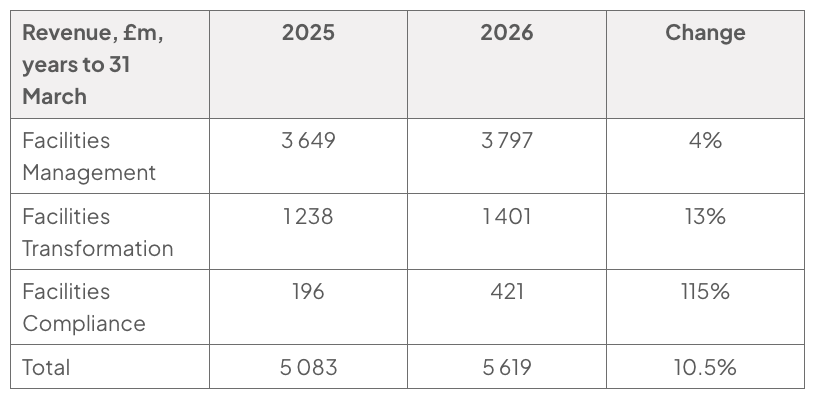
Mitie's strategic plan for the three years to March 2027 aims to move it from facilities management, where UK market growth is about 2-3% a year, into higher-margin work: Facilities Transformation projects, such as building upgrades, data centres and decarbonisation; and Facilities Compliance, such as fire and security systems that buildings must have by law. In August 2025 it bought Marlowe, a compliance business, for about £350 million in cash and shares.

In the year to 31 March 2026 revenue rose by 10.5% to £5 619 million, including 5.3% organic growth. Costs were increased by higher employers' National Insurance contributions and the loss of two public sector contracts.

Mitie describes itself as "technology-led" and has launched a programme to "re-imagine and optimise" its internal workflows and customer services through agentic AI: AI systems that can carry out tasks with little human input. Its Chief Executive, Phil Bentley, intends to retire at the end of the strategic plan, once a successor is in place.

Source: Mitie Group plc, results for the 12 months to 31 March 2026

Mitie aims to move from facilities management, where UK market growth is about 2-3% a year, into higher-margin Facilities Transformation projects and Facilities Compliance work.

Analyse one way in which this strategic direction might affect the risks faced by Mitie.

5
6 marks

Source A: Bretforton Facilities

Bretforton Facilities Limited was founded in 1989 by Anne Fielding in Bretforton, near Evesham, and is still owned by her family. Her son, Mark Fielding, is Managing Director. It cleans and maintains about 180 schools, 64 GP surgeries and health centres, and a number of offices across Worcestershire and the West Midlands, and employs 640 people, most of them part-time cleaners and caretakers.

Its mission is "clean, safe buildings, looked after by local people who are paid fairly". Since 2016 it has been an accredited Real Living Wage employer, which means it pays all its staff at least the Real Living Wage, a voluntary rate set by the Living Wage Foundation that is higher than the legal National Living Wage. Its objective is to reach £30 million of revenue by 2030 while remaining a Real Living Wage employer.

Bretforton Facilities competes for contracts against national facilities management companies, which can often offer lower prices. Its largest customer, a county council, wants to cut the price of its contract when it is renewed next year.

Anne Fielding is 71 and wants to sell the business. A national competitor, Corvane Group, has made an offer, and the family is also considering selling to an employee ownership trust.

Source: Bretforton Facilities

Bretforton Facilities competes for contracts against national facilities management companies, which can often offer lower prices.

Analyse one way in which focusing on schools and GP surgeries in one region might help Bretforton Facilities to compete.

6
6 marks

Source B: Macknade

Macknade is a family-owned food hall on the edge of Faversham, Kent, on the site of a farm the Neame family began farming in 1847. The company, Macknade Fine Foods Ltd, employed an average of 82 people in the year to 31 March 2025.

In 1979 Patricia Neame and her husband Renato Cuomo, who was born on the Italian island of Ischia, opened a pick-your-own business on the farm. In 2001 the family stopped farming to concentrate on retail. Their son, Stefano Cuomo, the sixth generation to run the business, became managing director in 2013 and later Chief Executive.

The seven-acre site is dominated by a 10 000 square foot food hall, which sells:

  • local and Mediterranean produce

  • more than 100 cheeses

  • meat from its own butchery, which opened in 2016 and buys whole carcasses from farms using regenerative "Pasture for Life" methods

The site also has a café and an outdoor food village of street-food traders. Other businesses rent space on the site, including a vet, a fitness studio and a sauna.

In 2021 Macknade's managing director said that "community is at our core". Its Chief Executive has described a shopper with a "dual shopping list", who buys some items in supermarkets and others from independent shops.

In 2020 Macknade opened a second shop, in Ashford. Its website now lists only the Faversham site.

Source: Macknade, Macknade Fine Foods Ltd accounts and press interviews

Macknade sells local and Mediterranean produce, more than 100 cheeses and meat from its own butchery. Its Chief Executive describes shoppers who buy some items in supermarkets and others from independent shops.

Analyse one way in which a differentiation strategy might help Macknade to keep its customers.

7
6 marks

Source B: Gadderby Sportswear

Gadderby Sportswear Limited is a private limited company, founded in 2008 by Martin Ashworth, a former rugby league player, and based in Huddersfield, West Yorkshire. It is owned by the Ashworth family, and Martin's daughter, Jo Ashworth, is Managing Director.

The company makes custom kit, including shirts, shorts, socks and training wear in each team's colours with names, numbers and sponsors' logos, for about 2 300 amateur rugby, football and netball clubs and 410 schools. Its mission is "kit made in Yorkshire for every grassroots team".

Every garment is cut, printed and sewn in its own factory, which allows it to deliver an order in 10 working days. The company repairs damaged kit free of charge for the first season and keeps each club's designs on file for quick reorders.

Revenue rose from £12.6 million to £14.2 million in 2025, and the factory made 610 000 garments. In 2025 the company began supplying clubs in Ireland and the Netherlands, which are in the European Union. Three rules apply to sales to EU customers:

  • Tariffs. UK-made goods are free of tariffs if they meet the "rules of origin" in the UK-EU trade agreement.

  • Customs. Every shipment needs a customs declaration.

  • VAT. EU customers pay VAT when their goods arrive.

Many competitors sell online and import kit from factories in Asia, at lower prices but with deliveries that take four to six weeks.

The company's objective is to reach revenue of £20 million by 2030 with an operating profit margin of at least 10%.

Source: Gadderby Sportswear

Many of Gadderby Sportswear's competitors import kit from factories in Asia, which they sell at lower prices but with deliveries that take four to six weeks.

Analyse one way in which a differentiation strategy might help Gadderby Sportswear to compete.

8
6 marks

Source B: Quarrenden Drinks

Quarrenden Drinks Limited is a family-owned private limited company, founded in 1996 on a family farm near Tiverton, Devon. It employs 46 people and makes two types of drink, both with no added sugar:

  • pressed apple juice

  • lightly sparkling fruit drinks

The drinks are sold in glass bottles at premium prices to farm shops, delicatessens, cafés, independent grocers and two regional supermarket chains, and through the company's own website, which also offers a monthly subscription box. Some of the bottles delivered to cafés are returned, washed and refilled.

Quarrenden buys all its apples from 34 orchards in Devon and Somerset, under three-year contracts at a fixed price above the market price. Drinks with no added sugar are not charged the Soft Drinks Industry Levy.

The company faces three main pressures:

  • Costs. Quarrenden's costs rose sharply in 2025, including the cost of glass bottles, energy and wages. The National Living Wage and employers' National Insurance both rose in April 2025.

  • Health advice. NHS advice is to drink no more than 150ml of fruit juice and smoothies a day.

  • Customers. Both regional supermarket chains have asked suppliers for evidence of their social and environmental standards.

Its directors are considering how to respond, including raising all prices or moving the sparkling range from glass bottles to cans.

Source: Quarrenden Drinks

Quarrenden Drinks sells pressed apple juice in glass bottles at premium prices to farm shops, cafés and independent grocers.

Analyse one reason why a differentiation strategy might suit Quarrenden Drinks.

1
9 marks

Source B: Draycote Soap Co

Draycote Soap Co Limited makes solid shampoo bars, conditioner bars and soaps by hand in a workshop near Rugby, Warwickshire. It was founded in 2016 by Hannah Okafor, who began making soap at her kitchen table; she remains its Managing Director and sole owner. The company employs 14 people. Its products contain no palm oil, are sold without any plastic packaging, and have an average customer rating of 4.8 out of 5 from more than 6 000 reviews.

The company sells through five channels:

  • Its own website, where a shampoo bar costs £8.50.

  • Amazon.

  • About 240 independent shops, many of which specialise in reducing waste.

  • Markets and fairs.

  • TikTok Shop, since 2024/25, where people who post videos of its products earn a commission on each sale they generate.

All of its staff are paid at least the Real Living Wage, a voluntary rate set by the Living Wage Foundation which is higher than the legal minimum wage. Several large distribution warehouses close to the workshop also recruit local staff. Every product is packed in a card box which costs 11p, compared with about 4p for a plastic wrapper.

Supermarkets have begun to sell their own-label shampoo bars, priced from about £3. Lush, a much larger business with its own shops, has sold solid shampoo bars for many years. In 2026 a national supermarket chain offered Draycote Soap Co a three-year contract to make shampoo bars to be sold under the supermarket's own label.

Source: Draycote Soap Co

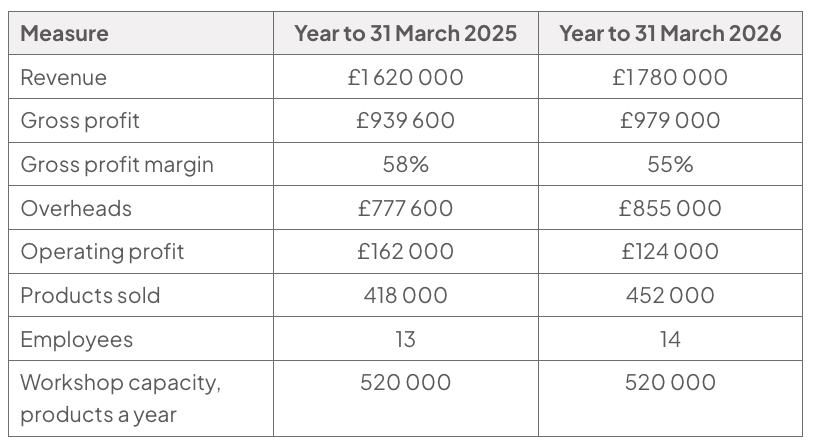
Appendix E: Draycote Soap Co selected data

Table comparing Draycote Soap Co’s revenue, profit, margins, overheads, products sold, employees and workshop capacity for the years ending March 2025 and 2026.

Source: Draycote Soap Co

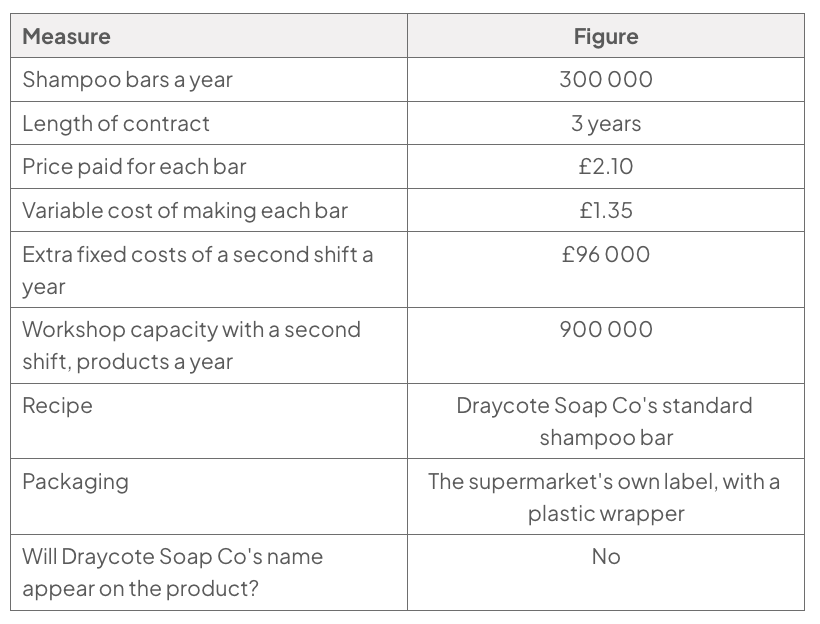
Appendix G: The supermarket's offer

Table of the supermarket offer: 300 000 bars a year for three years at £2.10 each, with a £1.35 variable cost per bar and £96 000 annual second-shift costs. Capacity is 900 000 products; plastic own-label packaging, no Draycote name.

Source: Draycote Soap Co

Assess whether accepting the supermarket's offer is likely to improve Draycote Soap Co's long-term profit.

Calculate the contribution Draycote Soap Co would earn each year from the contract to support your answer.

2
9 marks

Source A: Mitie

Mitie Group plc was founded in 1987 and is listed on the London Stock Exchange. It is the UK's leading facilities management company, employing 84 000 colleagues who clean, guard, maintain and upgrade buildings for customers such as the Home Office, Transport for London, Asda and GSK.

Mitie's strategic plan for the three years to March 2027 aims to move it from facilities management, where UK market growth is about 2-3% a year, into higher-margin work: Facilities Transformation projects, such as building upgrades, data centres and decarbonisation; and Facilities Compliance, such as fire and security systems that buildings must have by law. In August 2025 it bought Marlowe, a compliance business, for about £350 million in cash and shares.

In the year to 31 March 2026 revenue rose by 10.5% to £5 619 million, including 5.3% organic growth. Costs were increased by higher employers' National Insurance contributions and the loss of two public sector contracts.

Mitie describes itself as "technology-led" and has launched a programme to "re-imagine and optimise" its internal workflows and customer services through agentic AI: AI systems that can carry out tasks with little human input. Its Chief Executive, Phil Bentley, intends to retire at the end of the strategic plan, once a successor is in place.

Source: Mitie Group plc, results for the 12 months to 31 March 2026

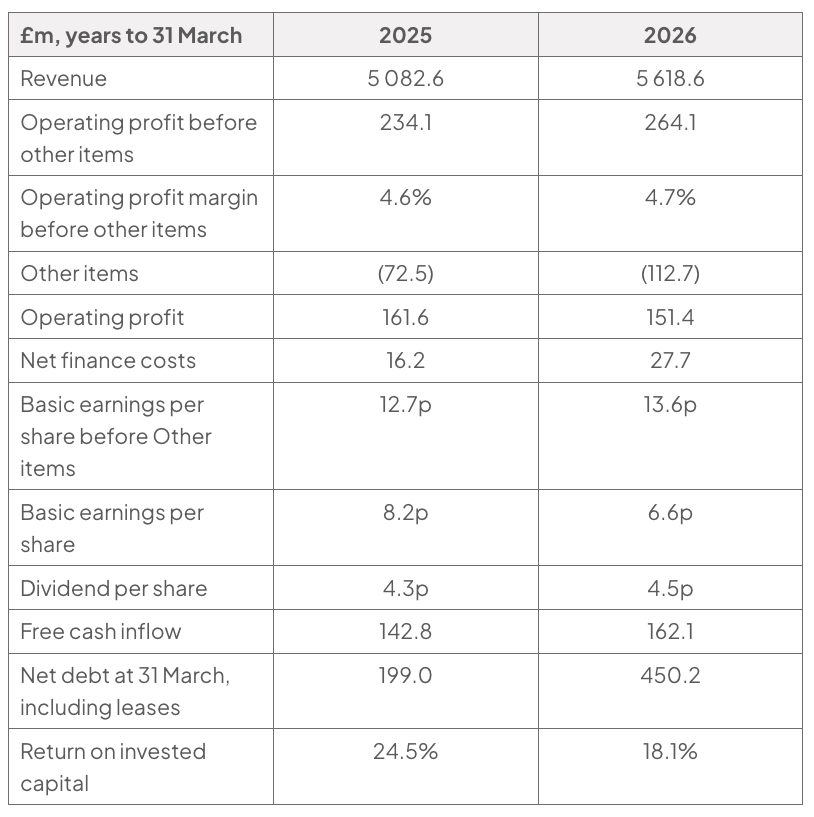
Appendix A: Mitie financial data

Table of Mitie financial data (£m, years to 31 March) comparing 2025 and 2026: revenue 5 082.6 and 5 618.6; operating profit before other items 234.1 and 264.1; operating profit margin before other items 4.6% and 4.7%; other items (72.5) and (112.7); operating profit 161.6 and 151.4; net finance costs 16.2 and 27.7; basic earnings per share before Other items 12.7p and 13.6p; basic earnings per share 8.2p and 6.6p; dividend per share 4.3p and 4.5p; free cash inflow 142.8 and 162.1; net debt at 31 March, including leases, 199.0 and 450.2; return on invested capital 24.5% and 18.1%.
  • Other items in 2026 included £42m of amortisation, £29m of costs to deliver margin enhancement initiatives, including redundancy costs, and £22m of Marlowe transaction and integration costs.

  • Shareholder returns. About £60m of shares were bought back in 2026, and £100m of buybacks are planned for the year to March 2027. Shares were also issued to help pay for Marlowe.

Source: Mitie Group plc

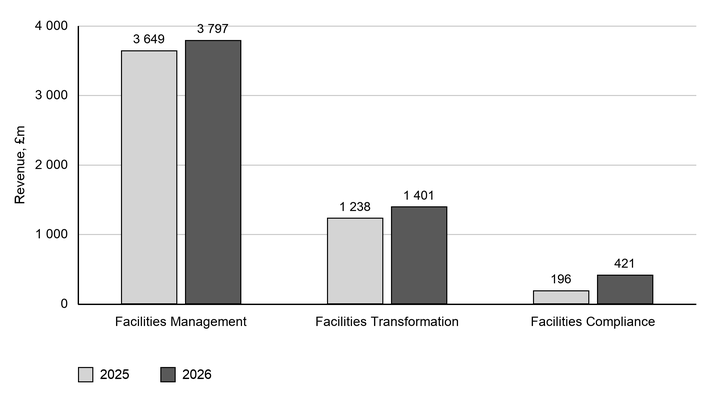
Appendix B: Strategy and the three pillars

Grouped bar chart of Mitie revenue by business area, £m, in 2025 and 2026: Management 3 649/3 797, Transformation 1 238/1 401, Compliance 196/421. All areas increased, especially Compliance.
Table of Mitie revenue in £m for years to 31 March: 2026 Facilities Transformation £1 401, Facilities Compliance £421 and total revenue £5 619; 2025 figures and percentage changes are also shown.
  • Targets for the year to March 2027. High single-digit annual revenue growth; operating margin of at least 5%; free cash flow of £150m; return on invested capital above 20%. The operating margin was 5.3% in the second half of the year to March 2026.

  • Marlowe. Added £208m of revenue in its first eight months; Mitie and Marlowe's combined compliance businesses have about £0.5bn of annual revenue. Cost savings of £7m in the first year, from merging alarm-monitoring centres, leaving 15 Marlowe properties and moving payroll and purchasing onto Mitie's systems; at least £30m expected by March 2028. Some revenue was lost in the first months after the deal, as competitors that had used Marlowe moved their work away.

  • Growth with existing customers. Mitie provides integrated facilities management to only about 40% of its largest contracts, and about 80% of Transformation projects are for existing customers.

  • Contracts. Renewal rate 84% (2025: 59%; long-term average about 90%). Order book £16.3bn (2025: £15.4bn).

Source: Analyst, using Mitie Group plc

Assess whether moving into Facilities Transformation and Facilities Compliance is the right strategic direction for Mitie.

Calculate Mitie's operating profit margin in the year to 31 March 2025 to support your answer. Give your answer to one decimal place.

3
9 marks

Source A: JD Sports

JD Sports Fashion plc, founded in 1981 in Bury, Greater Manchester, is listed on the London Stock Exchange. It sells trainers, clothing and accessories from brands such as Nike and Adidas, and some own-brand products, through 4 811 stores in 36 countries and online. Its shop names include JD, Size?, Hibbett, Finish Line, Shoe Palace, Courir and Go Outdoors.

Online made up 20% of sales in the half year to August 2026. Its JD STATUS loyalty programme has more than 10 million active members. In 2026 JD became one of the first US retailers to let customers buy its products and pay directly within an AI platform.

In July 2024 JD bought Hibbett, a US chain of about 1 000 stores, funded mainly by a $1 billion loan, and in November 2024 the French chain Courir. It is converting many of its US stores that trade as Finish Line to the JD name. It follows a "fewer, bigger, better" approach to its UK stores, and in 2026 JD Germany was reduced from 91 to 62 stores.

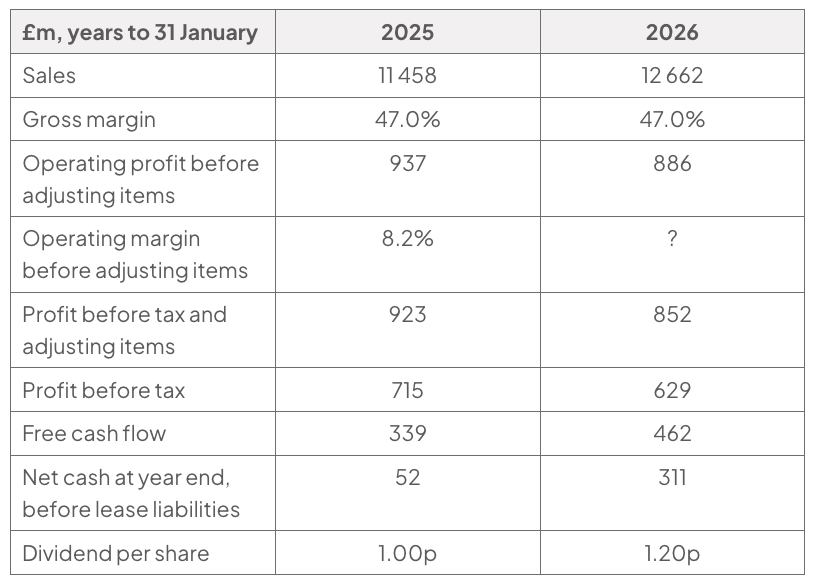
In the year to 31 January 2026 sales rose 10.5% to £12 662 million. Organic sales, which exclude acquisitions, rose 2.1%, and like-for-like sales, from stores and websites open in both years, fell 2.1%. Free cash flow rose. JD describes its market as "highly promotional".

Its medium-term priorities are sales growth ahead of its markets, a rising operating margin and strong free cash flow. It aims to generate more than £1.4 billion of free cash flow over the three years to January 2028.

Source: JD Sports Fashion plc, results for the year to 31 January 2026 and the half year to 1 August 2026

Appendix A: JD Sports financial data

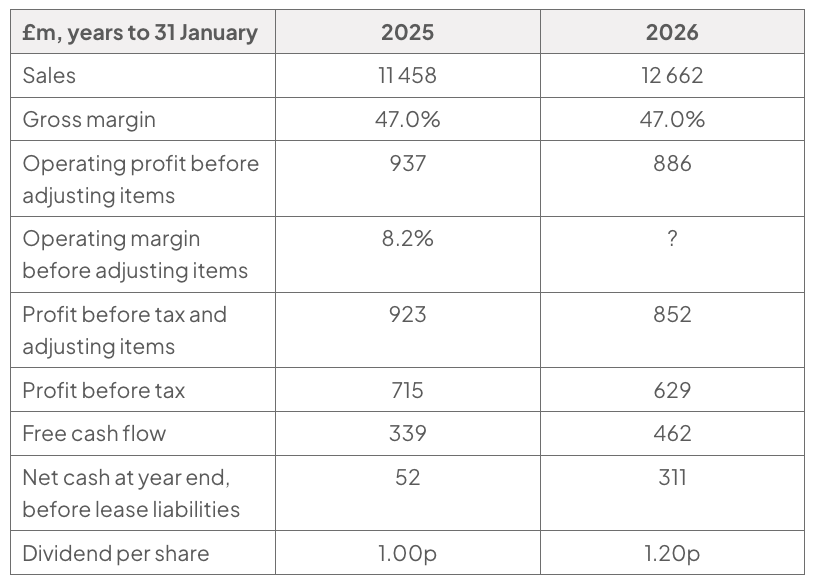
Table of JD Sports financial data (£m, years to 31 January): sales were 11,458 in 2025 and 12,662 in 2026; operating profit before adjusting items was 937 and 886; operating margin was 8.2% and ?.
  • Prices. JD made "controlled price investments", or price cuts, particularly online; their cost to gross margin was offset by higher marketing contributions from brands.

  • Shareholders. A £200m share buyback each year, alongside the 20% higher dividend.

  • Half year to 1 August 2026. Sales £5 899m (2025: £5 940m); profit before tax and adjusting items £282m (2025: £351m); like-for-like sales down 2.8%. Guidance for profit before tax and adjusting items for the year to January 2027 was cut from £750m-£850m to £700m-£800m.

Source: JD Sports Fashion plc

Appendix C: Strategy, technology and customers

  • Five priorities for 2026/27. A broader product range, including own brands; store productivity and optimisation; completing new e-commerce platforms worldwide; "accelerating AI adoption"; and using data to personalise marketing.

  • Online. 20% of sales in the half year to August 2026 (2025: 19%). Organic online sales grew 12.2% in North America and 3.8% in Europe in the year to January 2026. New e-commerce platforms went live in North America, South-East Asia, Italy, and the UK and Ireland.

  • JD STATUS. In the US, 5.7m active members made about 40% of JD and Finish Line's sales across stores and online, spending 21% more than non-members. In the UK and Europe, 3.7m members made about a third of sales, spending 25% more.

  • Products. Apparel and accessories reached 36% of sales; footwear sales were weaker because of the brands' product cycles, and JD describes the market as "highly promotional".

  • Operations. Automation was introduced at JD's distribution centre in Heerlen, the Netherlands.

  • Market. JD expects "muted market growth" and cites consumer cost-of-living pressures.

Source: Analyst, using JD Sports Fashion plc

Assess whether cutting prices to protect sales is the right strategy for JD Sports.

Calculate JD Sports' operating margin before adjusting items in the year to 31 January 2026 to support your answer. Give your answer to one decimal place.

4
9 marks

Source A: ITV

ITV plc is a UK broadcaster and programme maker listed on the London Stock Exchange. It has two divisions:

  • Media & Entertainment (M&E) runs ITV1, ITV2 and other channels and the streaming service ITVX, and earns most of its income from advertising.

  • ITV Studios makes and sells programmes, such as Coronation Street, Emmerdale and Love Island, to ITV and to other broadcasters and streaming services around the world.

ITV follows its "More Than TV" strategy, which has three parts: expanding ITV Studios, "supercharging" streaming and optimising broadcast television. In 2025 ITV made £63 million of permanent cost savings through technology, organisational redesign and growing use of AI.

In 2025 total revenue was £4 121 million, almost unchanged on 2024. The company faces two main pressures:

  • Viewing. ITV says that "linear viewing continues to decline, particularly among younger audiences".

  • Advertising. Total advertising revenue fell 5% in 2025. Digital revenue, mainly from ITVX, rose 10% to £614 million, but most advertising revenue still comes from the broadcast channels.

On 6 July 2026 ITV agreed to sell M&E, including its channels, ITVX and the Channel 3 licences, to Sky for up to £1.6 billion. ITV Studios would remain a separate company listed in London. The sale must be approved by regulators, including the Competition and Markets Authority. ITV and Sky argue that, including online advertising, they would have about 20% of UK advertising spending; on a television-only measure the share would be much higher. The sale is expected to complete in the second half of 2027.

Source: ITV plc, results for 2025 and the first half of 2026, and announcement of 6 July 2026

Appendix A: ITV financial data

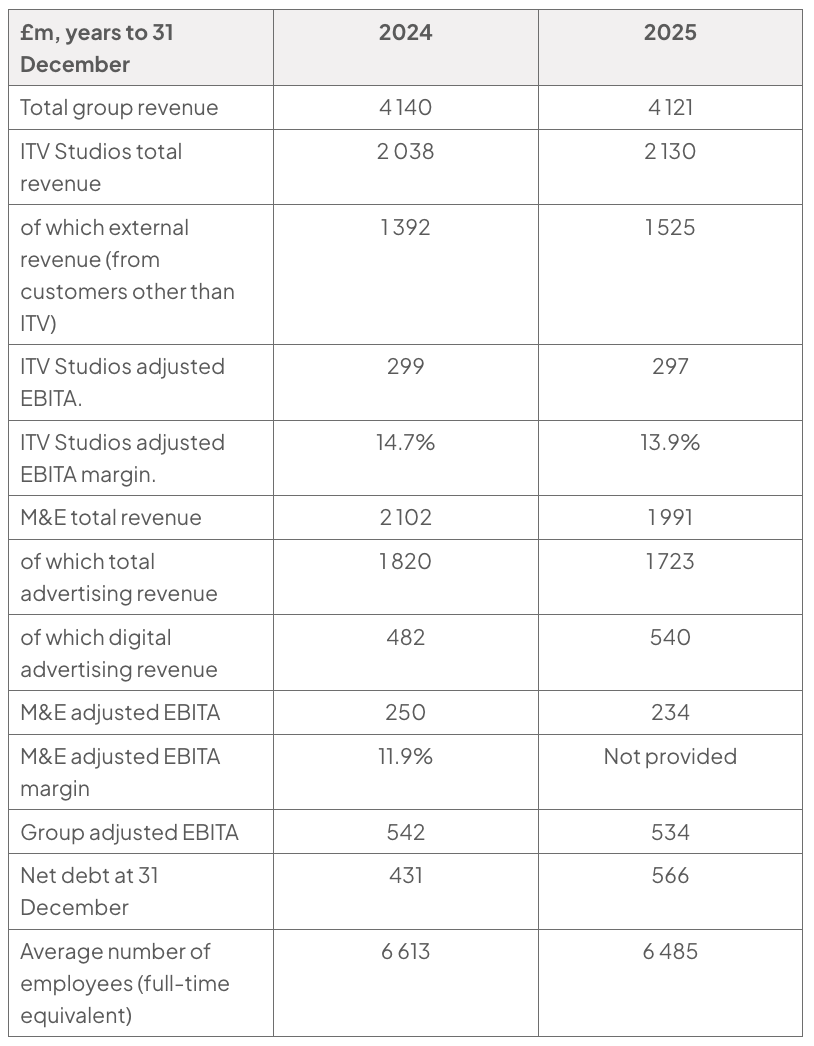
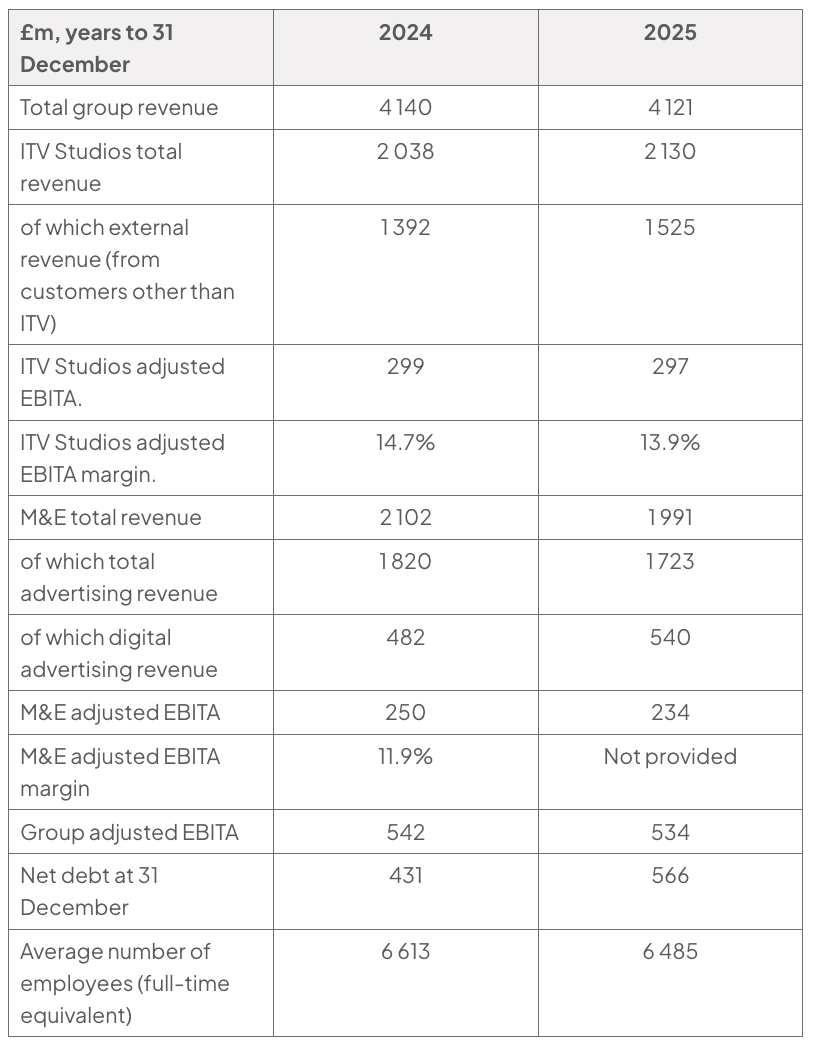
Table of ITV financial data in £m for years ending 31 December 2024 and 2025, including revenue, adjusted EBITA, margins, debt and employees; the 2025 M&E adjusted EBITA margin is marked “Not provided”.

Adjusted EBITA is profit before interest, tax, amortisation and one-off items.

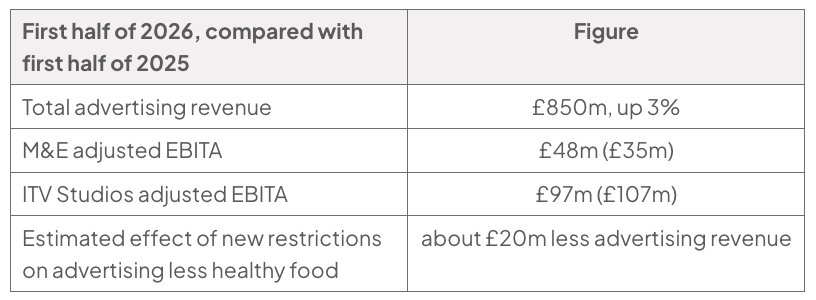
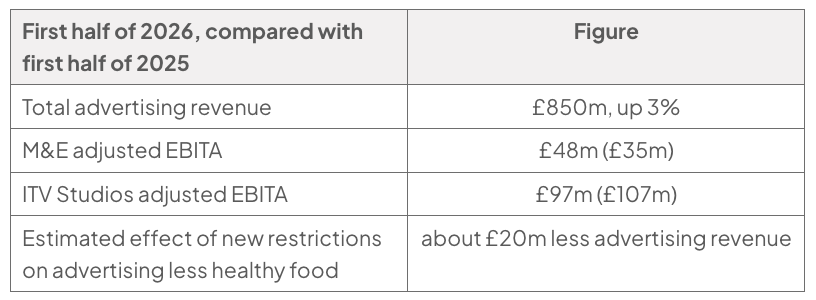
Table comparing ITV’s first-half 2026 with 2025: total advertising revenue £850m, up 3%; M&E adjusted EBITA £48m (£35m); ITV Studios adjusted EBITA £97m (£107m); food-advertising restrictions may reduce revenue by about £20m.

Source: ITV plc

Appendix B: Viewers, streaming and technology

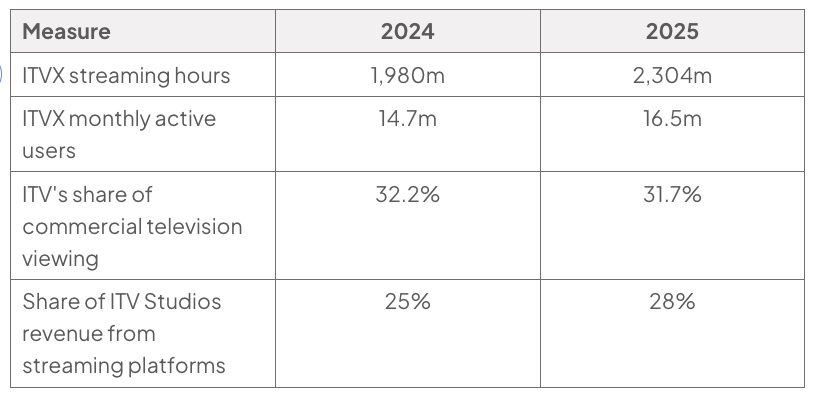
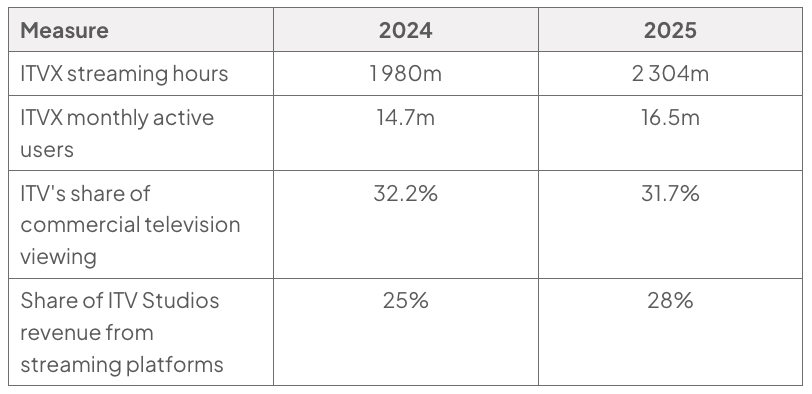
Table comparing ITV data in 2024 and 2025: ITVX streaming hours rose from 1,980m to 2,304m; monthly active users from 14.7m to 16.5m; commercial viewing share fell from 32.2% to 31.7%; ITV Studios streaming revenue share rose from 25% to 28%.
  • Digital target. In 2022 ITV set a target of £750m of digital revenue. After deciding to give less priority to paid subscriptions, it says reaching it "will take slightly longer".

  • YouTube. ITV shows its programmes on YouTube; over 40% of the viewing of ITV content on YouTube is by people under 35.

  • ITV Studios. 59% of its revenue comes from outside the UK.

  • Costs. £63m of permanent cost savings in 2025, and £253m since 2019, through technology, organisational redesign and growing use of AI; a further £20m is planned for 2026.

Source: Analyst, using ITV plc

Assess whether ITV Studios is in a stronger strategic position than ITV's Media & Entertainment business.

Calculate the adjusted EBITA margin of ITV's Media & Entertainment business in 2025 to support your answer. Give your answer to one decimal place.

5
9 marks

Source B: Macknade

Macknade is a family-owned food hall on the edge of Faversham, Kent, on the site of a farm the Neame family began farming in 1847. The company, Macknade Fine Foods Ltd, employed an average of 82 people in the year to 31 March 2025.

In 1979 Patricia Neame and her husband Renato Cuomo, who was born on the Italian island of Ischia, opened a pick-your-own business on the farm. In 2001 the family stopped farming to concentrate on retail. Their son, Stefano Cuomo, the sixth generation to run the business, became managing director in 2013 and later Chief Executive.

The seven-acre site is dominated by a 10 000 square foot food hall, which sells:

  • local and Mediterranean produce

  • more than 100 cheeses

  • meat from its own butchery, which opened in 2016 and buys whole carcasses from farms using regenerative "Pasture for Life" methods

The site also has a café and an outdoor food village of street-food traders. Other businesses rent space on the site, including a vet, a fitness studio and a sauna.

In 2021 Macknade's managing director said that "community is at our core". Its Chief Executive has described a shopper with a "dual shopping list", who buys some items in supermarkets and others from independent shops.

In 2020 Macknade opened a second shop, in Ashford. Its website now lists only the Faversham site.

Source: Macknade, Macknade Fine Foods Ltd accounts and press interviews

Appendix D: Macknade Fine Foods Ltd balance sheet data

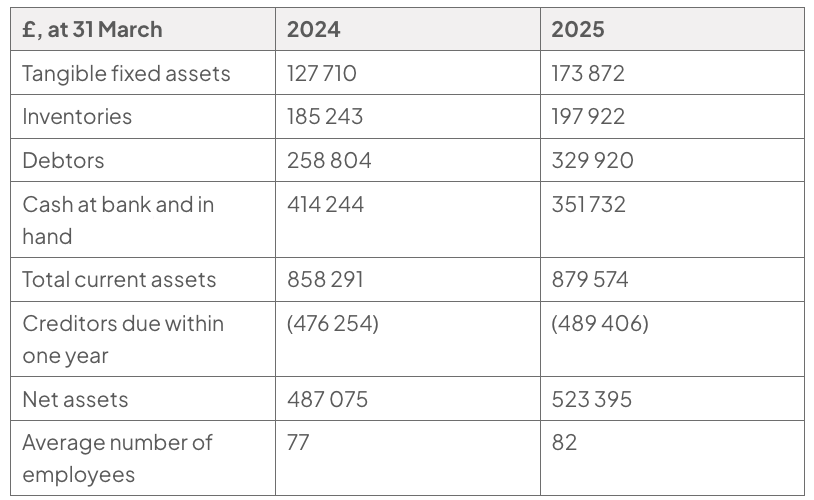
Balance-sheet table in pounds at 31 March, showing tangible fixed assets rising from £127 710 in 2024 to £173 872 in 2025, with inventories, debtors, cash, total current assets, creditors, net assets and employees for both years.
  • In the year to 31 March 2025 Macknade spent £107 559 on new fixed assets, including property improvements, equipment and fixtures, and charged £59 714 of depreciation.

  • As a small company, Macknade is not required to publish its profit and loss account, and does not.

Source: Macknade Fine Foods Ltd

Appendix E: The Faversham site

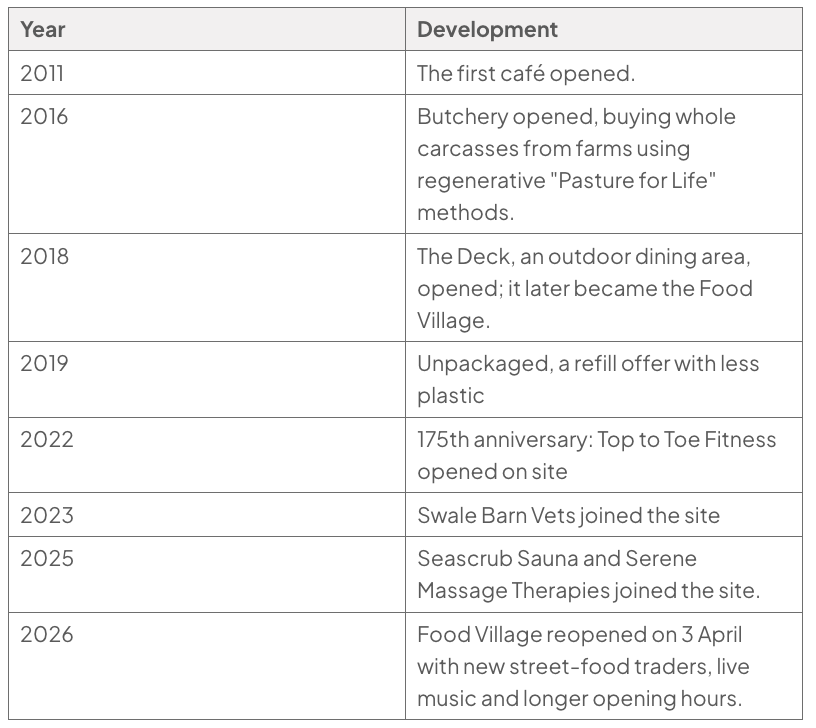
Timeline of Macknade’s Faversham site development, 2011 to 2026: 2011 “The first café opened”; 2016 butchery opened; 2018 The Deck opened; 2019 Unpackaged launched; 2022 175th anniversary and Top to Toe Fitness opened; 2023 Swale Barn Vets joined; 2025 Seascrub Sauna and Serene Massage Therapies joined; 2026 Food Village reopened.
  • The site also offers an online shop for hampers and gift boxes, events, venue hire and catering.

  • Macknade won a Farm Shop & Deli Retailer Award in 2023.

Source: Macknade and press reports

Assess whether developing its Faversham site as a destination is the right strategy for Macknade.

Calculate Macknade's acid test ratio at 31 March 2025 to support your answer. Give your answer to two decimal places.

6
9 marks

Source B: Royal Shakespeare Company

The Royal Shakespeare Company (RSC) is a registered charity based in Stratford-upon-Avon, the town where Shakespeare was born. Its Co-Artistic Directors are Daniel Evans and Tamara Harvey. Its mission is to "redefine how Shakespeare and great story-telling connects us, creates opportunities and brings joy".

The RSC performs in three theatres in Stratford, transfers productions to London, tours the UK and abroad, and works with schools nationwide. It also earns income from licensing its productions, including the musical Matilda, which has had more than 5 000 performances in London since 2011 and began a UK tour in October 2025.

Its income comes from ticket sales, an annual grant from Arts Council England, Theatre Tax Relief, donations, catering and retail.

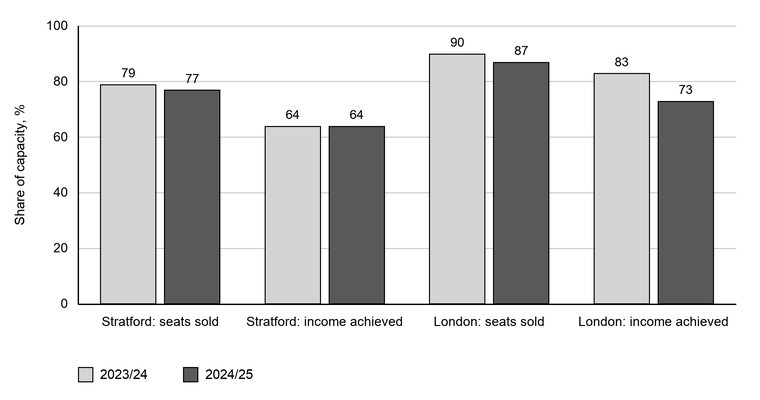
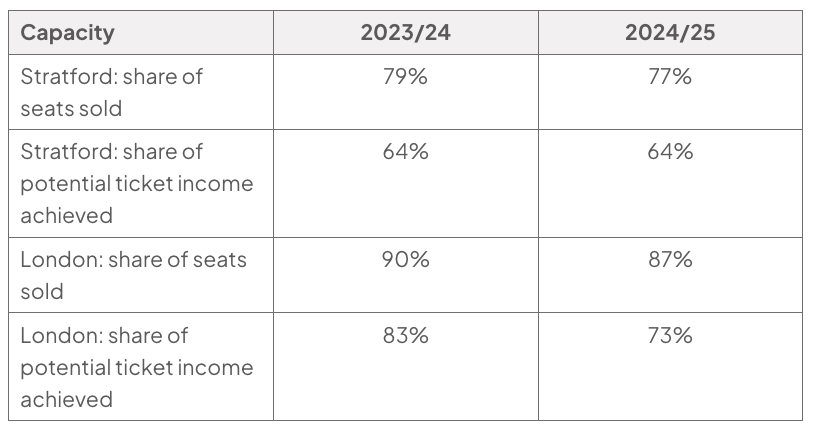
In 2024/25 the RSC sold more than 25 000 tickets at £25 or less, and in Stratford it sold 77% of its seats but achieved 64% of its potential ticket income. It sold more than 23 000 tickets at £10 to young people aged 14 to 25, in a partnership with the social media company TikTok. Linear television viewing is declining, particularly among younger audiences.

The RSC faces two pressures:

  • Income. In the year to 31 March 2025 income fell from £92.1 million to £82.0 million, partly because the previous year's income from Matilda and other productions was not repeated, and spending exceeded income.

  • Audiences. The RSC sees cost-of-living pressures as a risk to audience levels.

In 2025 it announced plans to reduce its workforce by 11%, first through voluntary redundancy, to close a shortfall of about £5 million.

Source: Royal Shakespeare Company, Report and Financial Statements for the year ended 31 March 2025, and press reports

Appendix D: RSC financial data

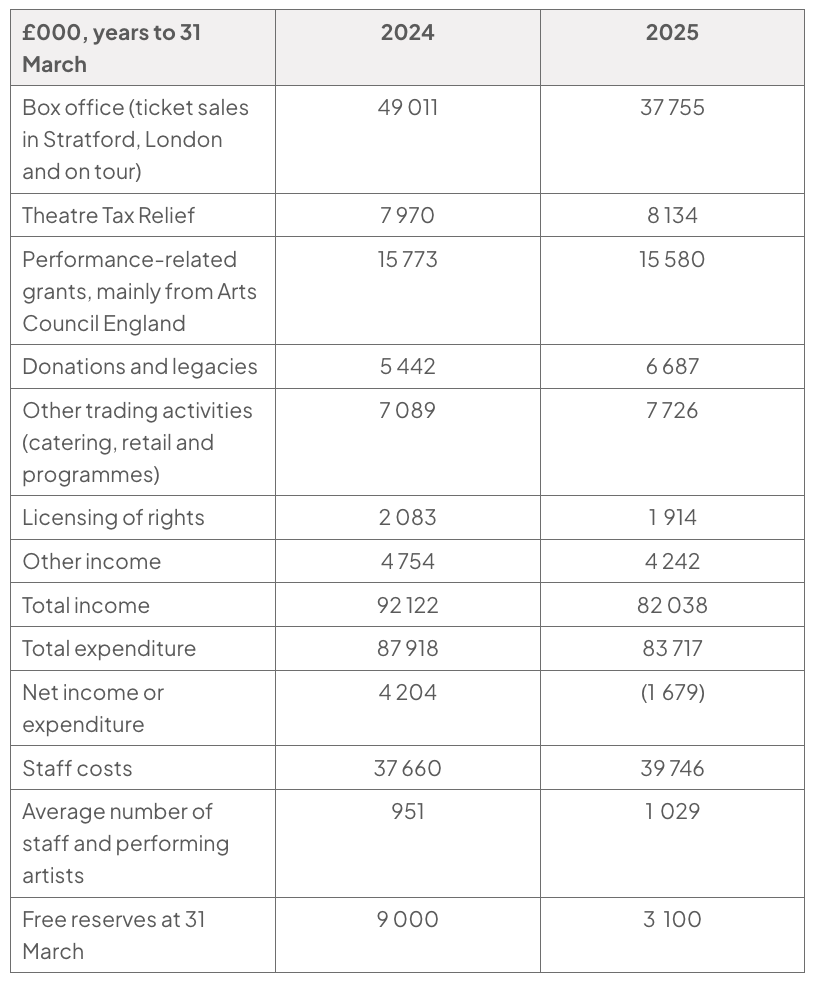
Table of RSC financial data in £000 for years ending 31 March 2024 and 2025, including income sources, total income (92 122 and 82 038) and expenditure, net income or expenditure, staff costs, the average number of staff and performing artists (951 and 1 029) and free reserves.
  • Free reserves are money not tied up in buildings or given for a particular purpose.

  • In 2021 the RSC borrowed £19.4m from the government's Culture Recovery Fund for 20 years at 2%; repayments of about £1.5m a year began in February 2025 and run to 2041.

Source: Royal Shakespeare Company

Appendix E: Audiences and productions

Bar chart of share of capacity, 0 to 100%; 2023/24 and 2024/25: Stratford seats sold 79% and 77%, income 64% and 64%; London seats sold 90% and 87%, income 83% and 73%.
Table comparing RSC capacity in 2023/24 and 2024/25: Stratford seats sold 79% and 77%, income 64% in both years; London seats sold 90% and 87%, income 83% and 73%.
  • 2024/25 season. 17 plays on four stages in Stratford; 68% of actors made their RSC debut; more than 25 000 tickets sold at £25 or less. Productions transferred to London theatres, and one toured to Chicago.

  • Matilda. More than 5 000 performances in London since 2011; a UK tour began in October 2025.

  • Theatre Tax Relief. Worth £8.1m in 2024/25; the rates fell by 5 percentage points from 1 April 2025.

  • Estate. Spending on buildings and equipment was £4.2m (2023/24: £1.6m); the RSC describes its estate as "a major drain on our resources".

Source: Royal Shakespeare Company

Assess whether the RSC should rely more on commercial activities, such as catering, retail and licensing, to fund its work.

1
15 marks

Source A: Burberry

Burberry Group plc is a British luxury fashion brand, headquartered in London and listed on the London Stock Exchange, where it is a member of the FTSE 100. It was founded in 1856 by Thomas Burberry, whose gabardine fabric and trench coat became the basis of the brand. It sells mainly through its own stores, of which there were 410 at 28 March 2026, and online. It also sells to other retailers and earns income from licences.

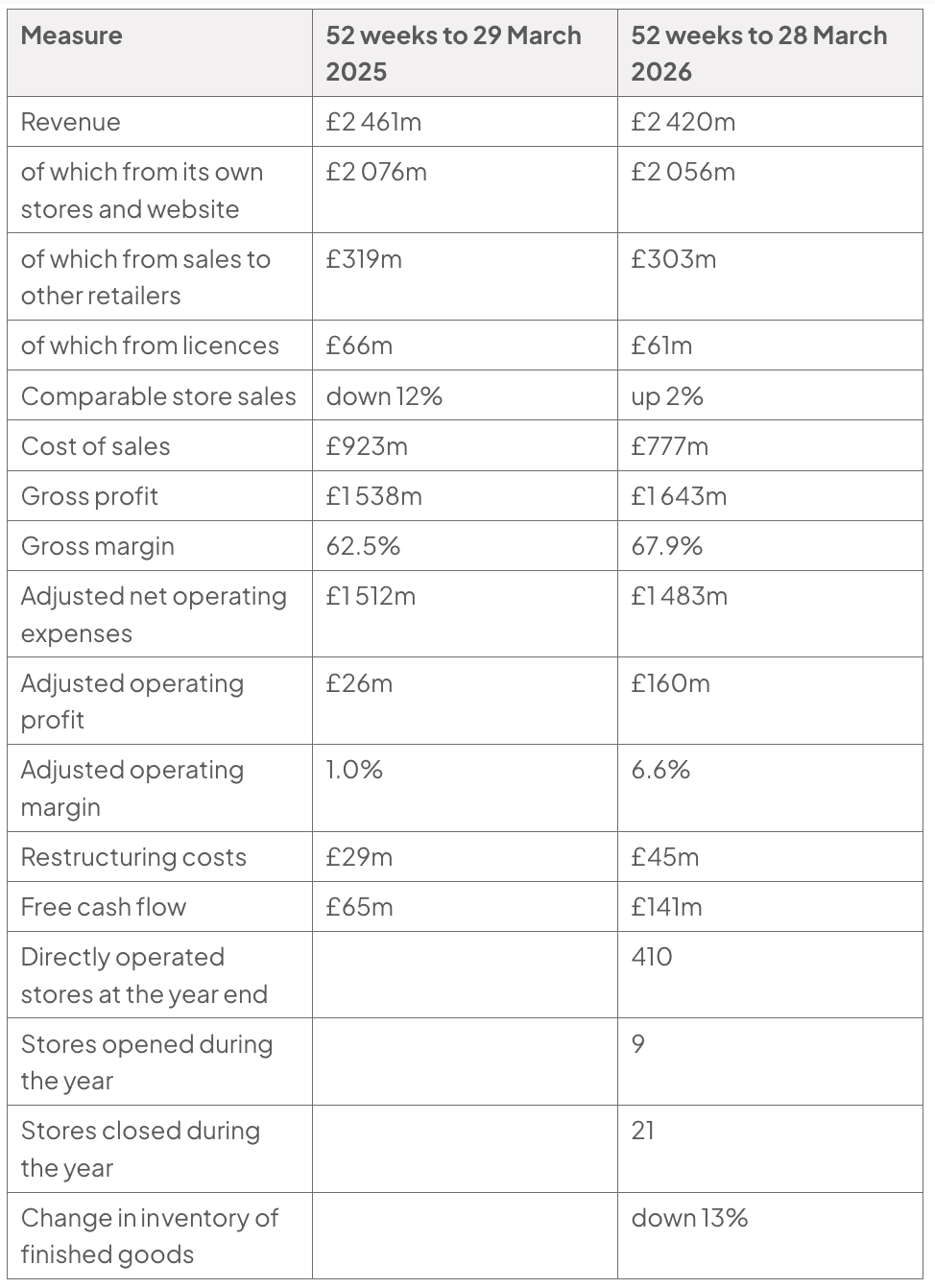
In the 52 weeks to 29 March 2025 Burberry's comparable store sales fell by 12% and its adjusted operating profit fell to £26 million. Joshua Schulman, who became Chief Executive in July 2024, launched a strategy called Burberry Forward in November 2024. Its aims include restoring the brand's cultural relevance and asserting its authority in outerwear and scarves before extending that success to other categories.

In the 52 weeks to 28 March 2026 Burberry's revenue was £2 420 million, compared with £2 461 million the year before, while comparable store sales rose by 2% and adjusted operating profit rose to £160 million. The Chief Executive described the year as "a meaningful inflection point". During the year the company:

  • achieved savings in operating costs of £80 million, while continuing to invest in marketing;

  • spent £45 million on restructuring, mainly on redundancies and consultancy;

  • opened 200 scarf bars in its stores;

  • increased e-commerce sales by a percentage in the high teens;

  • opened 9 stores and closed 21.

Outerwear sold better than other categories in every region, scarves grew throughout the year, and sales of leather goods improved in the second half.

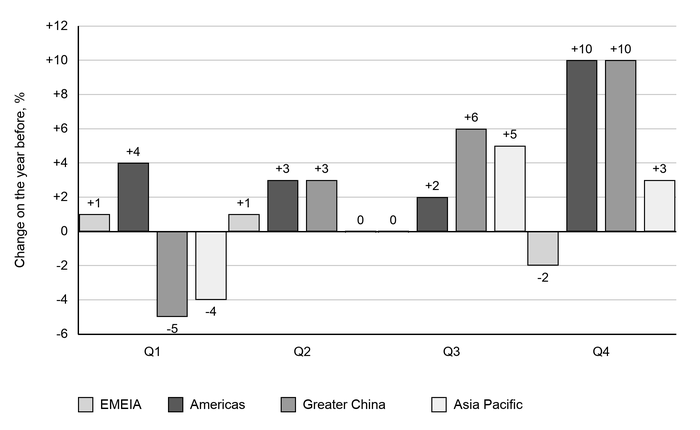
Sales growth differed between regions. In Europe, the Middle East, India and Africa, sales were held back by a fall in tourist numbers. In Japan, sales fell by 6% in the final quarter as fewer visitors arrived, while South Korea grew by 13%, helped by visitors from China. In Greater China and the Americas, sales in the final quarter grew by 10%, driven by local customers.

For the year to March 2027 Burberry expects to increase both its revenue and its profit margin, but says it is mindful of the uncertain economic and political environment.

Source: Burberry Group plc, Preliminary Results, 14 May 2026

Appendix A: Burberry selected data

Table of Burberry’s selected data comparing the 52 weeks to 29 March 2025 with the 52 weeks to 28 March 2026; measures include revenue, profitability, costs, cash flow, stores and inventory.

The gross margin in the year to March 2026 was helped by better sales at full price and by recovery from the clearance of excess inventory in the previous year.

Source: Burberry Group plc

Appendix B: Comparable store sales by region, year to 28 March 2026

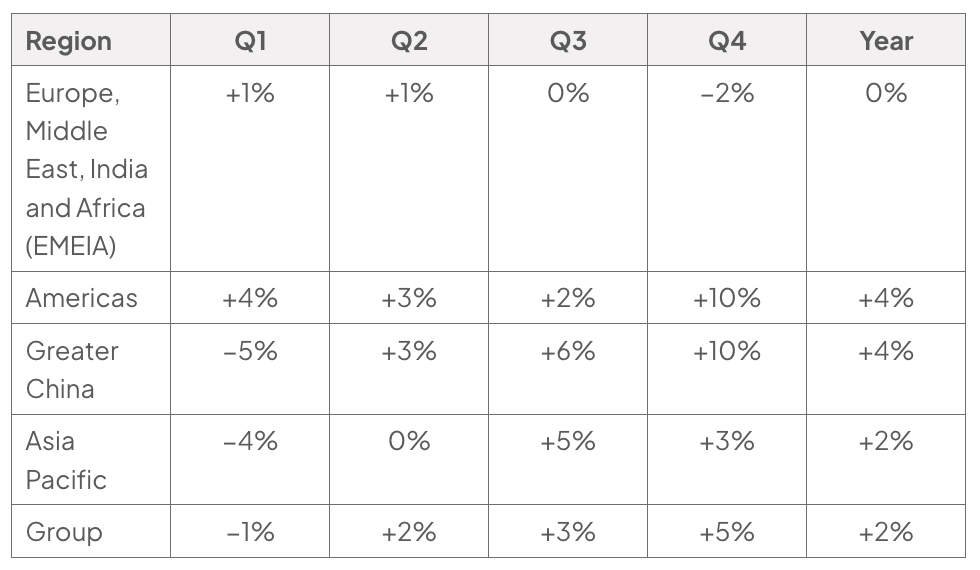
Grouped bar chart of quarterly comparable store sales change by region, year to 28 March 2026; vertical axis ranges from −6% to +12%. Q1 to Q4: EMEIA +1,+1,0,−2; Americas +4,+3,+2,+10; Greater China −5,+3,+6,+10; Asia Pacific −4,0,+5,+3.

Change in comparable store sales on the same quarter a year earlier

Table of quarterly and annual comparable store sales changes by region for the year to 28 March 2026. The Group rose from −1% in Q1 to +5% in Q4, with annual growth of 2%.
  • EMEIA: the fall in Q4 reflected fewer tourists in the region and conflict in the Middle East towards the end of the quarter.

  • Americas and Greater China: growth in Q4 was driven by spending by local customers.

  • Asia Pacific: South Korea grew 13% in Q4, helped by visitors from China; Japan fell 6% as fewer visitors arrived.

Source: Burberry Group plc

Appendix C: Burberry Forward and the year ahead

  • In stores. 200 scarf bars opened in FY26. "Polo galleries" and "trench destinations" are being introduced in FY27 to encourage customers to buy across categories.

  • Online. E-commerce sales grew by a percentage in the high teens, helped by an improved website.

  • Costs. Savings of £80 million were achieved in FY26; annual savings are expected to reach £100 million in FY27. The company continued to invest in marketing.

  • Expectations for FY27. Growth in revenue and in profit margin; store space broadly unchanged; sales to other retailers expected to grow by a mid-single-digit percentage in the first half; capital spending of about £120 million.

  • Risks. The company is mindful of the uncertain geopolitical and economic environment and its possible effect on consumer confidence.

  • Board. The Chair will retire in November 2026 and be succeeded by a new Chair who joins the Board in July 2026.

Source: Analyst, using Burberry Group plc

Burberry has asserted its authority in outerwear and scarves, and says it is extending this success to other categories.

Evaluate whether Burberry should focus on selling more outerwear and scarves or on growing other categories, such as leather goods.

2
15 marks

Source A: ITV

ITV plc is a UK broadcaster and programme maker listed on the London Stock Exchange. It has two divisions:

  • Media & Entertainment (M&E) runs ITV1, ITV2 and other channels and the streaming service ITVX, and earns most of its income from advertising.

  • ITV Studios makes and sells programmes, such as Coronation Street, Emmerdale and Love Island, to ITV and to other broadcasters and streaming services around the world.

ITV follows its "More Than TV" strategy, which has three parts: expanding ITV Studios, "supercharging" streaming and optimising broadcast television. In 2025 ITV made £63 million of permanent cost savings through technology, organisational redesign and growing use of AI.

In 2025 total revenue was £4 121 million, almost unchanged on 2024. The company faces two main pressures:

  • Viewing. ITV says that "linear viewing continues to decline, particularly among younger audiences".

  • Advertising. Total advertising revenue fell 5% in 2025. Digital revenue, mainly from ITVX, rose 10% to £614 million, but most advertising revenue still comes from the broadcast channels.

On 6 July 2026 ITV agreed to sell M&E, including its channels, ITVX and the Channel 3 licences, to Sky for up to £1.6 billion. ITV Studios would remain a separate company listed in London. The sale must be approved by regulators, including the Competition and Markets Authority. ITV and Sky argue that, including online advertising, they would have about 20% of UK advertising spending; on a television-only measure the share would be much higher. The sale is expected to complete in the second half of 2027.

Source: ITV plc, results for 2025 and the first half of 2026, and announcement of 6 July 2026

Appendix A: ITV financial data

Table comparing ITV’s 2024 and 2025 financial data in £ millions, including revenue, adjusted EBITA and margins, net debt, and average full-time-equivalent employees.

Adjusted EBITA is profit before interest, tax, amortisation and one-off items.

Table comparing ITV’s first-half 2026 results with 2025: total advertising revenue £850m, up 3%; M&E adjusted EBITA £48m (£35m); ITV Studios adjusted EBITA £97m (£107m); restrictions on advertising less healthy food may reduce revenue by about £20m.

Source: ITV plc

Appendix B: Viewers, streaming and technology

Table comparing ITV’s 2024 and 2025: streaming hours rose from 1,980m to 2,304m, monthly active users from 14.7m to 16.5m, Studios streaming revenue from 25% to 28%, while viewing share fell from 32.2% to 31.7%.
  • Digital target. In 2022 ITV set a target of £750m of digital revenue. After deciding to give less priority to paid subscriptions, it says reaching it "will take slightly longer".

  • YouTube. ITV shows its programmes on YouTube; over 40% of the viewing of ITV content on YouTube is by people under 35.

  • ITV Studios. 59% of its revenue comes from outside the UK.

  • Costs. £63m of permanent cost savings in 2025, and £253m since 2019, through technology, organisational redesign and growing use of AI; a further £20m is planned for 2026.

Source: Analyst, using ITV plc

Appendix C: The sale to Sky

  • Price. Up to £1.6bn: £1.2bn in cash, Sky's Love Productions (maker of The Great British Bake Off) valued at £200m, and up to £200m more depending on advertising revenue in 2027.

  • What Sky would buy. ITV's channels, ITVX, the Channel 3 licences to 2034, ITV Sport and a 20% stake in ITN, which makes ITV News.

  • Shareholders. About £950m, or 25p a share, would be returned to shareholders, after transaction and separation costs of about £185m.

  • ITV Studios. Would become "a distinctive pure-play global content business", with a minimum of £2.1bn of programme spending committed by ITV M&E and Sky over 2028-2032.

  • Public service broadcasting. ITV's duties as a public service broadcaster, "including nations, regional and national news", continue under the Channel 3 licences, which Sky would take over.

  • Regulators. The Competition and Markets Authority invited comments in July and August 2026. ITV and Sky argue that, including online advertising, they would have about 20% of UK advertising spending; on a television-only measure the share would be much higher.

  • Views. Chief Executive Carolyn McCall: Sky "will be a strong and responsible custodian" of ITV M&E. Chair Andrew Cosslett: the deal creates "a UK champion with the scale and resources to better compete with global streaming platforms".

Source: Analyst, using ITV plc, the Competition and Markets Authority and press reports

ITV has agreed to sell its Media & Entertainment business to Sky. The sale is not expected to complete until the second half of 2027.

Evaluate whether ITV should complete the sale or keep its Media & Entertainment business and ITV Studios together.

3
15 marks

Source A: JD Sports

JD Sports Fashion plc, founded in 1981 in Bury, Greater Manchester, is listed on the London Stock Exchange. It sells trainers, clothing and accessories from brands such as Nike and Adidas, and some own-brand products, through 4 811 stores in 36 countries and online. Its shop names include JD, Size?, Hibbett, Finish Line, Shoe Palace, Courir and Go Outdoors.

Online made up 20% of sales in the half year to August 2026. Its JD STATUS loyalty programme has more than 10 million active members. In 2026 JD became one of the first US retailers to let customers buy its products and pay directly within an AI platform.

In July 2024 JD bought Hibbett, a US chain of about 1 000 stores, funded mainly by a $1 billion loan, and in November 2024 the French chain Courir. It is converting many of its US stores that trade as Finish Line to the JD name. It follows a "fewer, bigger, better" approach to its UK stores, and in 2026 JD Germany was reduced from 91 to 62 stores.

In the year to 31 January 2026 sales rose 10.5% to £12 662 million. Organic sales, which exclude acquisitions, rose 2.1%, and like-for-like sales, from stores and websites open in both years, fell 2.1%. Free cash flow rose. JD describes its market as "highly promotional".

Its medium-term priorities are sales growth ahead of its markets, a rising operating margin and strong free cash flow. It aims to generate more than £1.4 billion of free cash flow over the three years to January 2028.

Source: JD Sports Fashion plc, results for the year to 31 January 2026 and the half year to 1 August 2026

Appendix A: JD Sports financial data

Table of JD Sports financial data in £ millions for years to 31 January 2025 and 2026, including sales, margins, profits, cash flow, net cash and dividends; 2026 operating margin is shown as “?”.
  • Prices. JD made "controlled price investments", or price cuts, particularly online; their cost to gross margin was offset by higher marketing contributions from brands.

  • Shareholders. A £200m share buyback each year, alongside the 20% higher dividend.

  • Half year to 1 August 2026. Sales £5 899m (2025: £5 940m); profit before tax and adjusting items £282m (2025: £351m); like-for-like sales down 2.8%. Guidance for profit before tax and adjusting items for the year to January 2027 was cut from £750m-£850m to £700m-£800m.

Source: JD Sports Fashion plc

Appendix B: Regions and stores

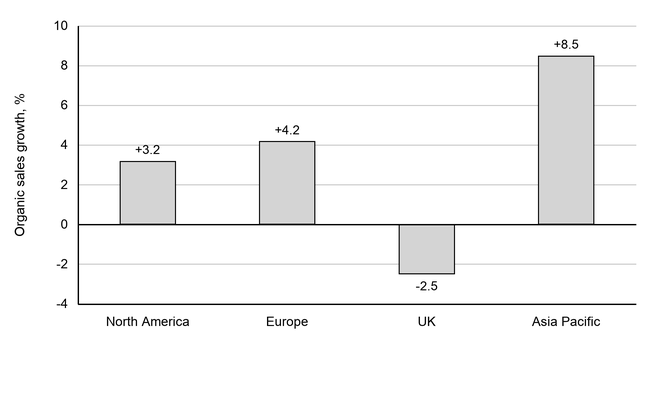
Bar chart of JD Sports’ organic sales growth by region, with a vertical scale from minus 4% to 10%: North America +3.2%, Europe +4.2%, UK −2.5% and Asia Pacific +8.5%.
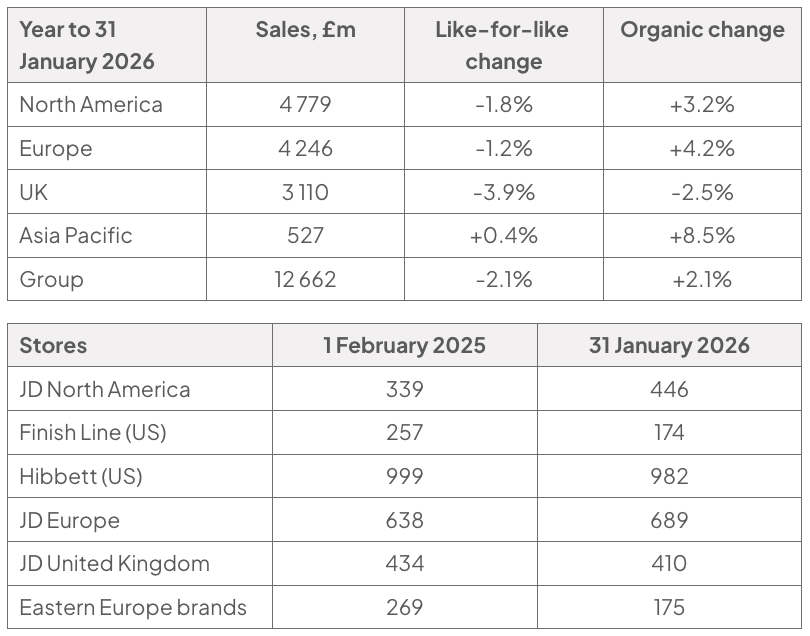
Tables show 2026 regional sales (£m), like-for-like and organic change: North America 4,779, −1.8%, +3.2%; Europe 4,246, −1.2%, +4.2%; UK 3,110, −3.9%, −2.5%; Asia Pacific 527, +0.4%, +8.5%. Store counts for 2025 and 2026 are also listed.
  • US. All remaining standalone Finish Line stores are to be converted or closed by January 2028.

  • UK. A "fewer, bigger, better" approach, with new flagship stores in Cardiff and Sheffield in 2026.

  • Germany. JD Germany was reduced from 91 to 62 stores in 2026.

Source: Analyst, using JD Sports Fashion plc

Appendix C: Strategy, technology and customers

  • Five priorities for 2026/27. A broader product range, including own brands; store productivity and optimisation; completing new e-commerce platforms worldwide; "accelerating AI adoption"; and using data to personalise marketing.

  • Online. 20% of sales in the half year to August 2026 (2025: 19%). Organic online sales grew 12.2% in North America and 3.8% in Europe in the year to January 2026. New e-commerce platforms went live in North America, South-East Asia, Italy, and the UK and Ireland.

  • JD STATUS. In the US, 5.7m active members made about 40% of JD and Finish Line's sales across stores and online, spending 21% more than non-members. In the UK and Europe, 3.7m members made about a third of sales, spending 25% more.

  • Products. Apparel and accessories reached 36% of sales; footwear sales were weaker because of the brands' product cycles, and JD describes the market as "highly promotional".

  • Operations. Automation was introduced at JD's distribution centre in Heerlen, the Netherlands.

  • Market. JD expects "muted market growth" and cites consumer cost-of-living pressures.

Source: Analyst, using JD Sports Fashion plc

North America is JD Sports' largest region after the purchase of Hibbett, but JD also has stores across Europe.

Evaluate whether JD Sports should focus its growth on North America or on Europe.

4
15 marks

Source B: Gadderby Sportswear

Gadderby Sportswear Limited is a private limited company, founded in 2008 by Martin Ashworth, a former rugby league player, and based in Huddersfield, West Yorkshire. It is owned by the Ashworth family, and Martin's daughter, Jo Ashworth, is Managing Director.

The company makes custom kit, including shirts, shorts, socks and training wear in each team's colours with names, numbers and sponsors' logos, for about 2 300 amateur rugby, football and netball clubs and 410 schools. Its mission is "kit made in Yorkshire for every grassroots team".

Every garment is cut, printed and sewn in its own factory, which allows it to deliver an order in 10 working days. The company repairs damaged kit free of charge for the first season and keeps each club's designs on file for quick reorders.

Revenue rose from £12.6 million to £14.2 million in 2025, and the factory made 610 000 garments. In 2025 the company began supplying clubs in Ireland and the Netherlands, which are in the European Union. Three rules apply to sales to EU customers:

  • Tariffs. UK-made goods are free of tariffs if they meet the "rules of origin" in the UK-EU trade agreement.

  • Customs. Every shipment needs a customs declaration.

  • VAT. EU customers pay VAT when their goods arrive.

Many competitors sell online and import kit from factories in Asia, at lower prices but with deliveries that take four to six weeks.

The company's objective is to reach revenue of £20 million by 2030 with an operating profit margin of at least 10%.

Source: Gadderby Sportswear

Appendix D: Gadderby Sportswear selected data

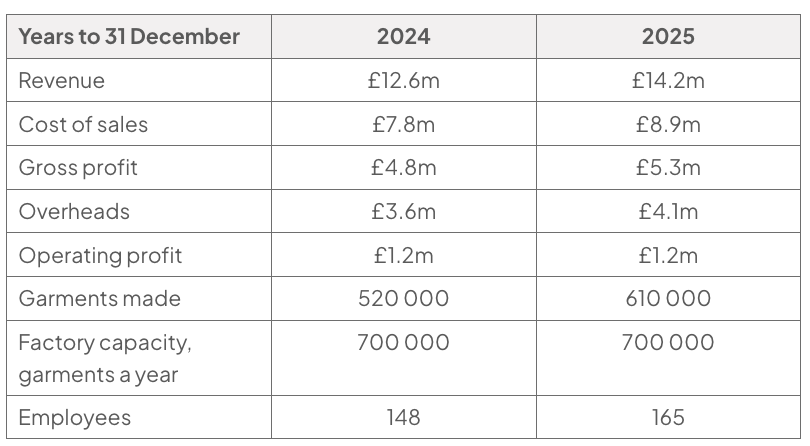
Table of Gadderby Sportswear data for the years to 31 December 2024 and 2025: revenue £12.6m and £14.2m; cost of sales £7.8m and £8.9m; gross profit £4.8m and £5.3m; overheads £3.6m and £4.1m; operating profit £1.2m in both years; garments made 520 000 and 610 000; factory capacity 700 000 garments a year in both years; employees 148 and 165.

Source: Gadderby Sportswear

Appendix E: Customers, competitors and trade

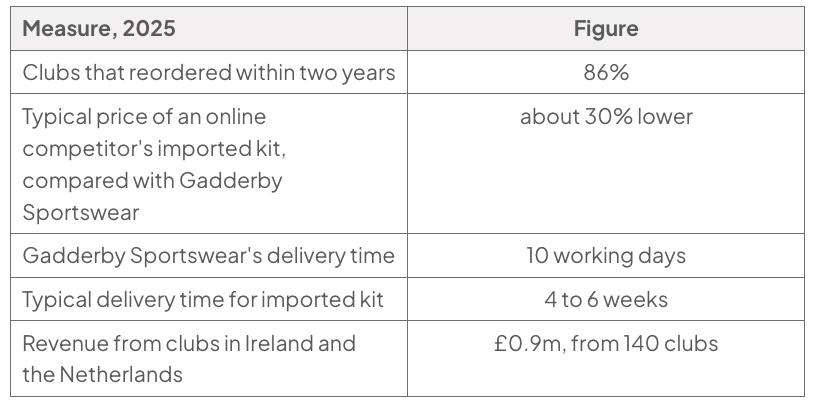
Table of 2025 customer and competitor data: 86% reordered within two years; imported online kit is about 30% cheaper; delivery is 10 working days versus 4 to 6 weeks; Ireland and Netherlands revenue is £0.9m from 140 clubs.
  • Trade with the EU. Goods made in the UK can be sold to EU customers without tariffs if they meet the "rules of origin" in the UK-EU trade agreement, but every shipment needs a customs declaration, and EU customers pay VAT when their goods arrive.

  • Service. Gadderby Sportswear repairs damaged kit free of charge for the first season and keeps each club's designs on file for quick reorders.

Source: Gadderby Sportswear and UK government guidance

Appendix F: Making in Yorkshire

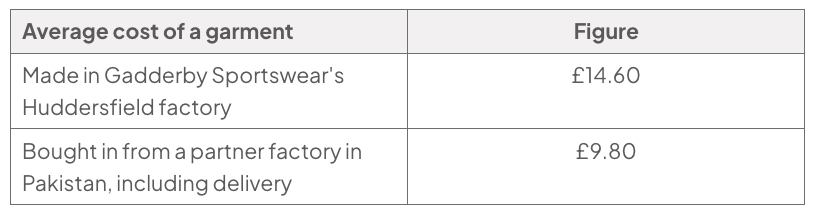
Table of average garment costs: made in Gadderby Sportswear’s Huddersfield factory, £14.60; bought from a partner factory in Pakistan including delivery, £9.80.
  • 41 of the 165 employees have worked for the company for more than ten years; 12 apprentices joined in 2025.

  • Club survey, 2025: 64% of club secretaries said "made in the UK" was important to their choice of supplier; 71% said delivery time was important.

  • A partner factory would need about six weeks to deliver, and minimum order sizes of 500 garments.

Source: Gadderby Sportswear

Appendix G: Three ways to grow

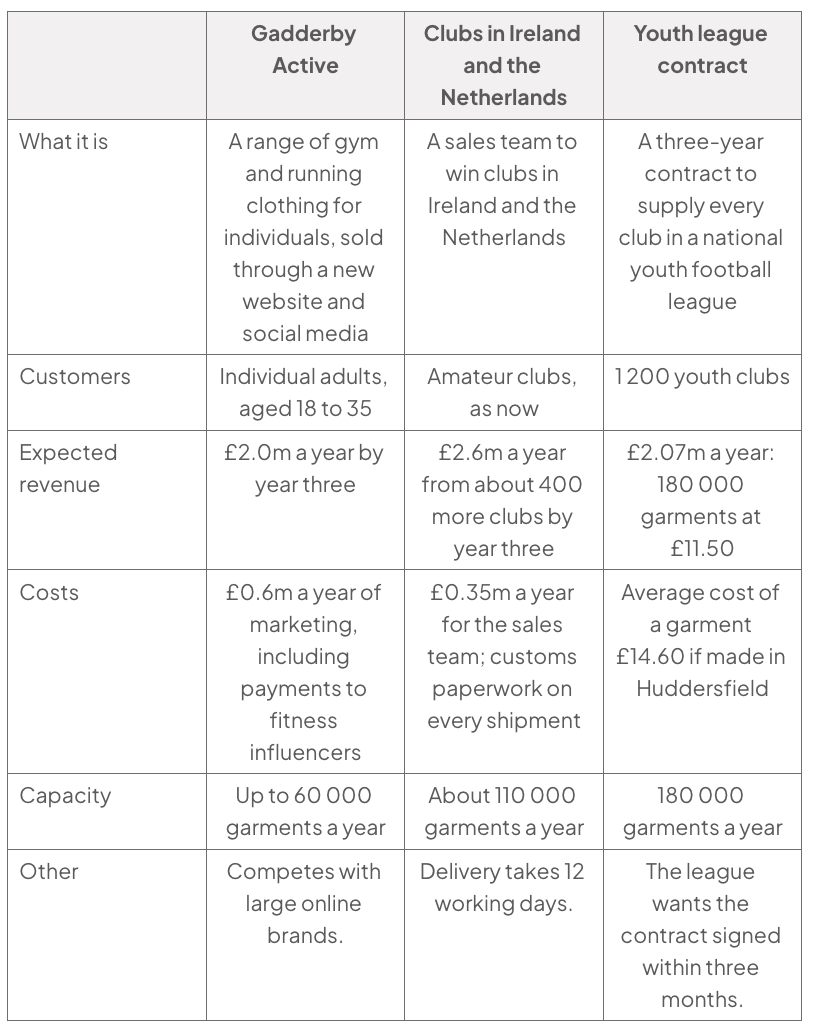
Comparison table of three growth options (Gadderby Active, EU clubs and a youth-league contract), showing annual revenue of £2.0m, £2.6m and £2.07m, and capacities of 60 000, 110 000 and 180 000 garments.

Source: Gadderby Sportswear

Gadderby Sportswear's objective is to reach revenue of £20 million by 2030 with an operating profit margin of at least 10%.

Evaluate two ways Gadderby Sportswear could grow and recommend which one it should choose.

Use information from Appendices D to G to support your answer.