Corporate Social Responsibility (CSR) (AQA A Level Business): Exam Questions

Exam code: 7132

Syllabus Edition

First teaching 2026

First exams 2028

2 hours16 questions
1
6 marks

Source A: Severn Trent

Severn Trent Plc provides water and wastewater services to more than 9 million people across the Midlands and mid-Wales through its regulated business, Severn Trent Water. It is a public limited company listed on the London Stock Exchange and employs more than 11 000 people. In the year to 31 March 2026 its revenue rose 16.6% to £2 831 million and its profit before interest and tax rose 46% to £861 million. It invested £1 954 million in its water and wastewater networks, the largest investment programme in its history. The full-year dividend rose 3.5% to 126.02 pence a share, in line with the company's policy of increasing the dividend by at least the rate of inflation each year.

Water companies in England and Wales are the only suppliers of water and wastewater services in their regions. The prices they may charge, and the investment they must deliver, are set by the economic regulator, Ofwat, for five years at a time; the current period runs from 2025 to 2030. Companies receive financial rewards from Ofwat when they beat performance targets and pay penalties when they miss them. From April 2026 the average Severn Trent household bill for water and wastewater rose by £52, or 10%, to £587.

The discharge of sewage into rivers has become a major political issue. Severn Trent reports that:

  • average spills from its storm overflows fell by 41% in 2025, to 15 for each overflow, beating its regulatory target and earning a reward of £10 million;

  • pollution incidents fell by 35% to 178, two of which were confirmed as serious;

  • it has committed to invest £450 million by 2030 to reduce spills to an average of fewer than 14 for each overflow.

The company supports customers who struggle to pay. During the year it provided £127 million of bill support to around 330 000 households, an average reduction of 64% on their bills, and it aims to help around 1 in 6 households in its region by 2030. Its employability programmes reached more than 15 000 people.

The company also works to improve the natural environment. During the year it planted almost 100 000 trees and 45 kilometres of hedgerow and restored 207 acres of habitat, and its performance on biodiversity reached the maximum financial reward available from the regulator. It generates renewable energy at its own sites.

Among its principal risks, Severn Trent lists uncertainty over regulatory, legislative and government reforms which could fundamentally change its operating environment.

Source: Severn Trent Plc, Preliminary Announcement of Annual Results, 20 May 2026

During the year Severn Trent provided £127 million of bill support to around 330,000 households, an average reduction of 64% on their bills. From April 2026 its average household bill rose by 10%.

Analyse one way in which this support might affect the amount Severn Trent loses through customers not paying their bills.

2
6 marks

Source A: Octopus Energy Group

Octopus Energy Group Limited is a privately owned company which supplies gas and electricity to households and businesses, installs low-carbon technology in homes, and owns Kraken, a software platform which manages energy customers' accounts. The group was founded in the UK in 2016. In the year to 30 April 2025 its revenue rose 10% to £13 683 million, and it supplied 9.94 million customers across eight countries, compared with 7.95 million a year earlier.

In January 2025 Octopus Energy became the largest household energy supplier in the UK, with 24% of the market measured by number of meters. Its UK customers reached 7.6 million, and it accounted for 42% of all switches between household energy suppliers during the year. It has been named a Which? Recommended Energy Supplier for eight consecutive years and holds a Trustpilot rating of 4.8 out of 5.

Every customer account in the group runs on Kraken. The platform combines data from customers' smart meters with weather data to forecast how much energy customers will use, and the group adjusts its purchases of gas and electricity each day as the forecast changes. Kraken is also licensed to other energy suppliers, including EDF Energy, and to water and broadband companies. In September 2025 the group announced its intention to demerge Kraken as a separate company.

The group buys energy in two ways:

  • Fixed price contracts. For each customer on a fixed price, it buys the gas and electricity it expects that customer to use, in advance, for the whole length of the contract.

  • The standard variable tariff. The maximum price is set by Ofgem, the energy regulator, every three months. The group buys energy for these customers on a rolling basis which follows the method Ofgem uses to set the price cap.

The group tests its finances against a range of shocks, including a period of cold weather combined with a rise in wholesale prices. The spring of 2025 was the warmest in the UK on record, and in April 2025 its UK customers used 25% less gas than normal for the time of year.

Octopus Energy supports customers who are struggling to pay. It employs social workers in every one of its UK locations, gave energy credit to more than 90 000 customers in financial hardship through its Octo Assist Fund, and made home visits to fit thermostats, timers and draught-proofing. Throughout the year it kept its standard variable tariff below the price cap by reducing standing charges, at a cost of £57 million.

The group's stated aim is to make energy greener, cheaper and fairer. It installs heat pumps, including its own Cosy range, together with solar panels, batteries and electric vehicle chargers, and offers smart tariffs which reward customers for using electricity when it is cheapest. Of the group's total emissions, 95% come from the gas its customers use. It has committed to reach net zero emissions across its whole value chain by 2040.

In the year to 30 April 2025 the group made a net loss of £255 million, compared with a profit of £83 million in the previous year.

Source: Octopus Energy Group Limited, Annual Report and Financial Statements 2025

Octopus Energy Group employs social workers in every one of its UK locations, and gave energy credit to more than 90 000 customers in financial hardship through its Octo Assist Fund.

Analyse one way in which this support might affect Octopus Energy Group's costs.

3
6 marks

Source B: Elmsworth Recycling

Elmsworth Recycling Limited recycles plastic packaging at a plant in Telford, Shropshire. The company was founded in 2009 by Dev Sharma, its Managing Director, and is owned by him and an investment firm. It employs 160 people. One in eight of them joined through a resettlement programme for people leaving prison, and each is given a mentor for their first six months.

The company buys bales of plastic pots, tubs and trays which households have put out for recycling, from the facilities that sort councils' collections. It shreds, washes and sorts the plastic, then melts it into pellets of recycled polypropylene, which it sells to manufacturers of plastic packaging. In the year to 30 June 2026 it bought 34 000 tonnes of bales and sold 26 500 tonnes of pellets. The plant can handle 40 000 tonnes of bales a year.

The material that cannot be made into pellets, such as labels, food residue and mixed plastics, is dealt with in two ways:

  • 4 000 tonnes a year is sold to a broker, which ships it to Turkey.

  • The remainder is sent to energy-from-waste plants in the UK, which charge a fee to burn it.

In 2024 the company installed a closed-loop system which cleans and reuses the water used to wash the plastic, cutting its use of mains water by three quarters. The system uses electricity to pump and filter the water. The remaining waste water is discharged to the public sewer, for which the company pays its water company a charge.

Packaging manufacturers can buy virgin polypropylene, made from oil, instead of Elmsworth Recycling's pellets. Since April 2022 the government has charged Plastic Packaging Tax on plastic packaging which contains less than 30% recycled plastic.

Source: Elmsworth Recycling

One in eight of Elmsworth Recycling's 160 employees joined through a resettlement programme for people leaving prison. Each is given a mentor for their first six months.

Analyse one way in which recruiting through this programme might affect Elmsworth Recycling's labour costs.

4
6 marks

Source B: Draycote Soap Co

Draycote Soap Co Limited makes solid shampoo bars, conditioner bars and soaps by hand in a workshop near Rugby, Warwickshire. It was founded in 2016 by Hannah Okafor, who began making soap at her kitchen table; she remains its Managing Director and sole owner. The company employs 14 people. Its products contain no palm oil, are sold without any plastic packaging, and have an average customer rating of 4.8 out of 5 from more than 6 000 reviews.

The company sells through five channels:

  • Its own website, where a shampoo bar costs £8.50.

  • Amazon.

  • About 240 independent shops, many of which specialise in reducing waste.

  • Markets and fairs.

  • TikTok Shop, since 2024/25, where people who post videos of its products earn a commission on each sale they generate.

All of its staff are paid at least the Real Living Wage, a voluntary rate set by the Living Wage Foundation which is higher than the legal minimum wage. Several large distribution warehouses close to the workshop also recruit local staff. Every product is packed in a card box which costs 11p, compared with about 4p for a plastic wrapper.

Supermarkets have begun to sell their own-label shampoo bars, priced from about £3. Lush, a much larger business with its own shops, has sold solid shampoo bars for many years. In 2026 a national supermarket chain offered Draycote Soap Co a three-year contract to make shampoo bars to be sold under the supermarket's own label.

Source: Draycote Soap Co

Draycote Soap Co pays all of its staff at least the Real Living Wage. Several large distribution warehouses close to its workshop also recruit local staff.

Analyse one way in which paying the Real Living Wage might affect Draycote Soap Co's ability to recruit staff.

5
6 marks

Source B: Thistleden Kitchens

Thistleden Kitchens Limited is a private limited company, founded in Penrith, Cumbria, in 2003. It designs, makes and fits hand-built painted timber kitchens, each designed for the individual customer, and employs 64 people. In 2025 its kitchens sold for an average of £26 300.

It sells through four showrooms:

  • Penrith, Kendal and Carlisle, in Cumbria

  • Newcastle upon Tyne, opened in February 2025, its first outside Cumbria

Kitchens are made in its workshop in Penrith and fitted either by its own team of fitters or by subcontractors. Customers pay a 40% deposit when they order, and the balance when the kitchen is fitted.

Thistleden uses timber certified as coming from responsibly managed forests, trains four apprentices a year, and passes customers' old kitchens that can be reused to a local charity.

The company faces three main pressures:

  • Competition. National kitchen retailers offer free design visits and online booking.

  • Demand. Its order book fell in both 2024 and 2025, and its revenue and operating profit fell in 2025.

  • Fitting. In 2025 a higher share of kitchens was finished later than promised than in 2024, and about a third of kitchens were fitted by subcontractors.

In 2026 Thistleden introduced new software to schedule its fitters. A regional housebuilder has offered it a three-year contract to supply kitchens for new homes.

Source: Thistleden Kitchens

Thistleden Kitchens uses certified timber, trains four apprentices a year and passes customers' old kitchens that can be reused to a local charity.

Analyse one way in which this approach to corporate social responsibility might benefit Thistleden Kitchens.

6
6 marks

Source B: Kelsmere Community Trust

Kelsmere Community Trust is a registered charity founded in 2003 on the Kelsmere estate in Middlesbrough. It employs 15 staff and is supported by 96 volunteers. Its founder and chief executive, who has led the charity for 23 years, will retire in December 2026. It runs:

  • a food bank

  • a youth club

  • a café that trains young people for work; in 2026, 15 of its 22 trainees found work

Most of Kelsmere's income comes from a five-year National Lottery grant, which is its largest single source of income, and a contract with the local council to run youth services. Eleven local businesses now support the charity with money, food or staff time, up from seven. In the year to March 2026, income from local business partners and income from café and room hire both rose.

The charity faces four main pressures:

  • Demand. Use of the food bank is rising.

  • Council funding. The council cut the youth services contract by £30 000 in 2025/26, and the youth club has closed on Fridays since September 2025 because of the cut. The council proposes a further 20% cut from April 2027.

  • Lottery funding. The National Lottery grant ends in March 2027. A new application must show evidence of the charity's impact.

  • Volunteers. Volunteers agreeing "I feel listened to" fell from 81% to 63%.

The trustees are considering whether to merge with Northgate Family Centre, a charity 1.5 miles away that provides family support and debt advice.

Source: Kelsmere Community Trust

Eleven local businesses support Kelsmere Community Trust with money, food or staff time.

Analyse one reason why a local business might choose to support Kelsmere Community Trust as part of its corporate social responsibility.

7
6 marks

Source B: Quarrenden Drinks

Quarrenden Drinks Limited is a family-owned private limited company, founded in 1996 on a family farm near Tiverton, Devon. It employs 46 people and makes two types of drink, both with no added sugar:

  • pressed apple juice

  • lightly sparkling fruit drinks

The drinks are sold in glass bottles at premium prices to farm shops, delicatessens, cafés, independent grocers and two regional supermarket chains, and through the company's own website, which also offers a monthly subscription box. Some of the bottles delivered to cafés are returned, washed and refilled.

Quarrenden buys all its apples from 34 orchards in Devon and Somerset, under three-year contracts at a fixed price above the market price. Drinks with no added sugar are not charged the Soft Drinks Industry Levy.

The company faces three main pressures:

  • Costs. Quarrenden's costs rose sharply in 2025, including the cost of glass bottles, energy and wages. The National Living Wage and employers' National Insurance both rose in April 2025.

  • Health advice. NHS advice is to drink no more than 150ml of fruit juice and smoothies a day.

  • Customers. Both regional supermarket chains have asked suppliers for evidence of their social and environmental standards.

Its directors are considering how to respond, including raising all prices or moving the sparkling range from glass bottles to cans.

Source: Quarrenden Drinks

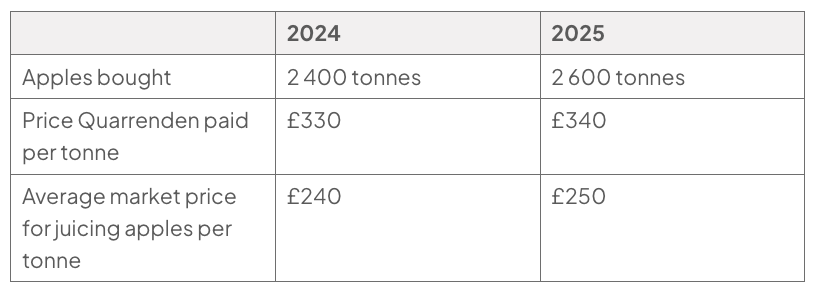
Quarrenden Drinks buys all its apples from 34 local orchards under three-year contracts at a fixed price above the market price.

Analyse one way in which this policy might benefit Quarrenden Drinks.

1
9 marks

Source A: Finlay's Farm Ltd

Finlay's Farm Ltd is a small family-owned farm in Scotland. It has a herd of 130 cows, and their milk is used to make:

  • Cheese. This is sold both online and through various retail stores.

  • Ice cream. This is sold through retailers.

The company's founders are David and Wilma Finlay. They have built strong long-term relationships with its customers. There are two other employees. The dairy industry has been restructuring in recent years with bigger farms buying up smaller ones.

The company:

  • has high gearing but has also used crowdfunding to raise finance

  • receives government agricultural grants and subsidies

  • exports some of its products; although since the UK left the European Union exporting regulations have been complex.

The farm is organic. Organic farming aims to ensure that it uses processes that do not harm the environment, plant health or animal welfare. This is important to David and Wilma and its other employees. For example, the cows are fed an organic and natural diet as opposed to animal feed which has been genetically modified. The company aims to reduce energy use and greenhouse emissions and reduce the use of chemicals in farming as much as it can, even if this impacts on productivity. David and Wilma have been asked to speak at a number of environmental events and have been awarded an Outstanding Achievement award for their environmentally friendly practices.

The company has a good brand image and charges a premium price for its products. Its customers value its niche position in the market. It is said to be operating close to capacity. To increase scale, it would need to buy more cows and invest in new production facilities.

The farm has a small visitor centre which:

  • sells its products

  • offers food workshops such as ice cream making

  • organises visits for people who want to know more about organic farming and look around the farm.

Analysts say the key risks facing the company are:

  • changes in market conditions if customers become more price sensitive

  • the retirement of the founders

  • IT issues with its online sales business such as data theft.

One possible growth option for the business is to open a glamping campsite.

Source: Information sourced from Finlay's Farm Ltd

Assess the value to Finlay's Farm Ltd of introducing Environmental, Social, and Governance (ESG) reporting.

2
9 marks

Source A: Octopus Energy Group

Octopus Energy Group Limited is a privately owned company which supplies gas and electricity to households and businesses, installs low-carbon technology in homes, and owns Kraken, a software platform which manages energy customers' accounts. The group was founded in the UK in 2016. In the year to 30 April 2025 its revenue rose 10% to £13 683 million, and it supplied 9.94 million customers across eight countries, compared with 7.95 million a year earlier.

In January 2025 Octopus Energy became the largest household energy supplier in the UK, with 24% of the market measured by number of meters. Its UK customers reached 7.6 million, and it accounted for 42% of all switches between household energy suppliers during the year. It has been named a Which? Recommended Energy Supplier for eight consecutive years and holds a Trustpilot rating of 4.8 out of 5.

Every customer account in the group runs on Kraken. The platform combines data from customers' smart meters with weather data to forecast how much energy customers will use, and the group adjusts its purchases of gas and electricity each day as the forecast changes. Kraken is also licensed to other energy suppliers, including EDF Energy, and to water and broadband companies. In September 2025 the group announced its intention to demerge Kraken as a separate company.

The group buys energy in two ways:

  • Fixed price contracts. For each customer on a fixed price, it buys the gas and electricity it expects that customer to use, in advance, for the whole length of the contract.

  • The standard variable tariff. The maximum price is set by Ofgem, the energy regulator, every three months. The group buys energy for these customers on a rolling basis which follows the method Ofgem uses to set the price cap.

The group tests its finances against a range of shocks, including a period of cold weather combined with a rise in wholesale prices. The spring of 2025 was the warmest in the UK on record, and in April 2025 its UK customers used 25% less gas than normal for the time of year.

Octopus Energy supports customers who are struggling to pay. It employs social workers in every one of its UK locations, gave energy credit to more than 90 000 customers in financial hardship through its Octo Assist Fund, and made home visits to fit thermostats, timers and draught-proofing. Throughout the year it kept its standard variable tariff below the price cap by reducing standing charges, at a cost of £57 million.

The group's stated aim is to make energy greener, cheaper and fairer. It installs heat pumps, including its own Cosy range, together with solar panels, batteries and electric vehicle chargers, and offers smart tariffs which reward customers for using electricity when it is cheapest. Of the group's total emissions, 95% come from the gas its customers use. It has committed to reach net zero emissions across its whole value chain by 2040.

In the year to 30 April 2025 the group made a net loss of £255 million, compared with a profit of £83 million in the previous year.

Source: Octopus Energy Group Limited, Annual Report and Financial Statements 2025

Appendix A: Octopus Energy Group selected data

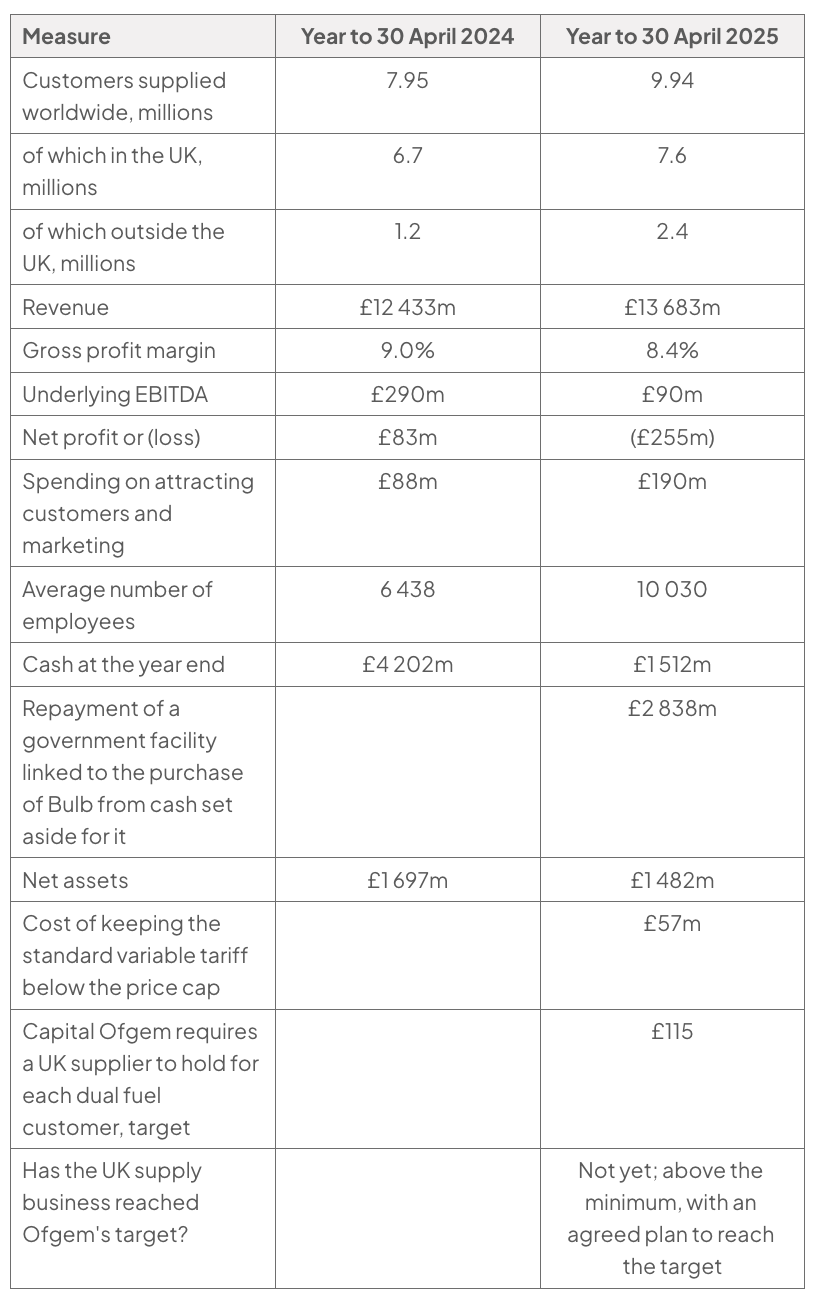
Table comparing Octopus Energy Group data for years to 30 April 2024 and 2025, covering customers, revenue, margins, profit, marketing, employees, cash, assets, Ofgem capital and tariff costs.

Underlying EBITDA is profit before interest, tax, depreciation and amortisation, excluding one-off items.

Source: Octopus Energy Group Limited

Assess whether keeping its standard variable tariff below the price cap is likely to increase Octopus Energy Group's long-term profit.

Calculate Octopus Energy Group's sales per employee for the year to 30 April 2025 to support your answer. Give your answer in £ million to two decimal places.

3
9 marks

Source A: AG Barr

A.G. BARR p.l.c. is a UK drinks company listed on the London Stock Exchange. It employs about 1 000 people and has factories at Cumbernauld, near Glasgow, and Milton Keynes. Its brands include:

  • IRN-BRU, the UK's third-biggest flavoured fizzy drink brand, 125 years old in 2026, with about 40% of sales outside Scotland

  • Boost energy and sports drinks, whose revenue rose 12% in 2025/26

  • Rubicon, Barr and MOMA oat drinks

In the 53 weeks to 31 January 2026, revenue rose 4.0% to £437.3 million. In early 2025 it raised some prices by between 1% and 11%, an approach it called "value over volume", and overall volume was "relatively flat". The chief executive, Euan Sutherland, aims to "double the size of the business".

In 2018 the sugar in regular IRN-BRU was cut from 10.3g to 4.7g per 100ml, and 96% of AG Barr's soft drinks by volume contain under 5g of sugar per 100ml.

Soft drinks are closely regulated:

  • Sugar. The Soft Drinks Industry Levy applies to drinks with 5g or more of sugar per 100ml.

  • Advertising. Paid online advertising of less healthy food and drink has been banned since January 2026. AG Barr says it never advertises caffeinated or energy products to under-16s.

  • Energy drinks. The government plans to ban selling drinks with more than 150mg of caffeine per litre to under-16s in England from April 2027.

  • Packaging. A deposit return scheme for plastic bottles and cans is due in October 2027.

The company says: "We view regulation as a catalyst for innovation."

Source: A.G. BARR p.l.c., annual report and final results for the 53 weeks ended 31 January 2026, and interim results for the 26 weeks ended 1 August 2026

Appendix A: AG Barr financial data

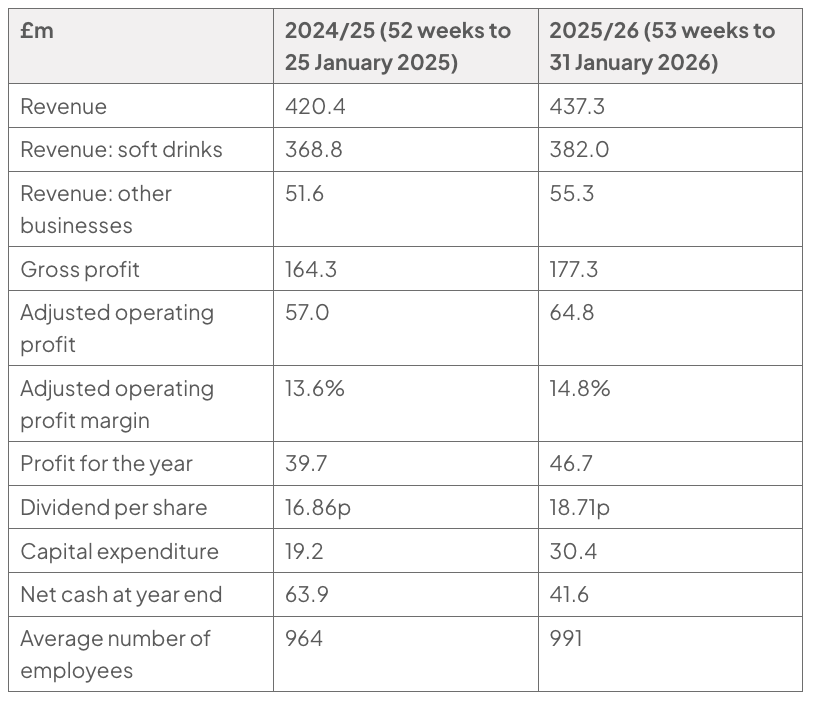
Table comparing AG Barr’s financial data for 2024/25 and 2025/26, including revenue, profits, margins, dividend per share, capital expenditure, net cash and average employees; revenue was £420.4m in 2024/25 and £437.3m in 2025/26, and profit for the year was £39.7m in 2024/25 and £46.7m in 2025/26.
  • Brands. IRN-BRU was 32% of revenue in 2025/26, down from 43% five years earlier. Boost revenue rose 12%. In July 2025 AG Barr bought 50.1% of Innate-Essence, a maker of health drinks, for £14.7 million.

  • Targets. Revenue growth of at least 4% a year and an operating margin of 14% to 16%.

  • Half year to 1 August 2026. Revenue rose 8.5% to £247.4 million. Supply problems cost an estimated £10 million of lost revenue. After acquisitions and capital spending, net cash of £41.6 million had become net debt of £47.0 million.

Source: A.G. BARR p.l.c.

Appendix B: Health, regulation and the community

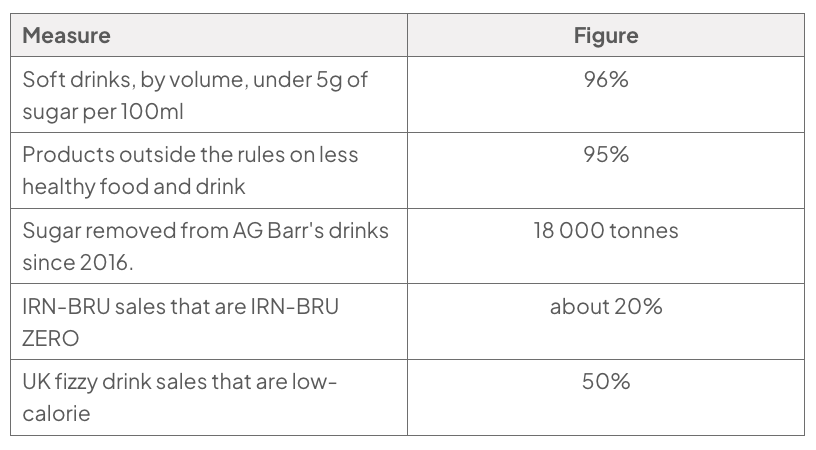
Table of AG Barr health measures: soft drinks under 5g sugar per 100ml, 96%; products outside less-healthy food rules, 95%; sugar removed since 2016, 18 000 tonnes; IRN-BRU ZERO sales, about 20%; UK low-calorie fizzy drinks, 50%.
  • IRN-BRU. In January 2018, before the sugar levy began, the sugar in regular IRN-BRU was cut from 10.3g to 4.7g per 100ml.

  • Sugar levy from January 2028. The threshold falls from 5g to 4.5g of sugar per 100ml, and oat and other milk-substitute drinks with added sugar will no longer be exempt. AG Barr says it is "considering the extent of any further reformulation".

  • Energy drinks. In July 2026 the government announced that selling drinks with more than 150mg of caffeine per litre to under-16s in England would be banned from April 2027, subject to Parliament.

  • Marketing. "We never advertise HFSS, caffeinated or energy products to under 16s."

  • Charity. AG Barr is moving from one national charity partner, given £50 000 a year, to one local charity at each of its four main sites, given £25 000 each a year. It also supports FareShare and local food banks.

Source: Analyst, using A.G. BARR p.l.c. and UK government announcements

Assess whether AG Barr is a socially responsible business.

Calculate AG Barr's profit for the year margin for 2025/26 to support your answer. Give your answer to one decimal place.

4
9 marks

Source B: Quarrenden Drinks

Quarrenden Drinks Limited is a family-owned private limited company, founded in 1996 on a family farm near Tiverton, Devon. It employs 46 people and makes two types of drink, both with no added sugar:

  • pressed apple juice

  • lightly sparkling fruit drinks

The drinks are sold in glass bottles at premium prices to farm shops, delicatessens, cafés, independent grocers and two regional supermarket chains, and through the company's own website, which also offers a monthly subscription box. Some of the bottles delivered to cafés are returned, washed and refilled.

Quarrenden buys all its apples from 34 orchards in Devon and Somerset, under three-year contracts at a fixed price above the market price. Drinks with no added sugar are not charged the Soft Drinks Industry Levy.

The company faces three main pressures:

  • Costs. Quarrenden's costs rose sharply in 2025, including the cost of glass bottles, energy and wages. The National Living Wage and employers' National Insurance both rose in April 2025.

  • Health advice. NHS advice is to drink no more than 150ml of fruit juice and smoothies a day.

  • Customers. Both regional supermarket chains have asked suppliers for evidence of their social and environmental standards.

Its directors are considering how to respond, including raising all prices or moving the sparkling range from glass bottles to cans.

Source: Quarrenden Drinks

Appendix D: Quarrenden Drinks selected data

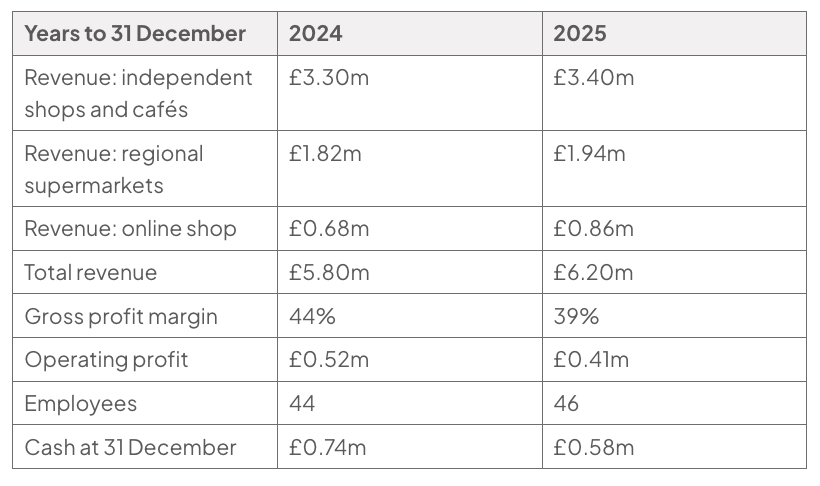
Table of Quarrenden Drinks’ selected data for years to 31 December 2024 and 2025, comparing revenue by channel, total revenue, gross profit margin, operating profit, employees and cash.

Source: Quarrenden Drinks

Appendix E: Growers, packaging and certification

Table comparing growers’ apple data for 2024 and 2025: tonnes bought, price Quarrenden paid per tonne and average market price per tonne.
  • Bottles. 38% of the bottles delivered to cafés are returned, washed and refilled.

  • B Corporation. Quarrenden is considering applying for B Corporation certification, which shows that a business meets standards of social and environmental performance. It estimates the cost at about £15 000 a year, including fees and staff time; the process would take about 18 months, and Quarrenden would have to publish an annual report on its social and environmental performance.

  • Customers. Both regional supermarket chains have asked suppliers for evidence of their social and environmental standards.

Source: Quarrenden Drinks

Assess whether Quarrenden Drinks should apply for B Corporation certification.

5
9 marks

Source A: Card Factory

Card Factory plc is a UK retailer of greeting cards, gifts and party products, listed on the London Stock Exchange. It employs about 10 000 people and has its own printing business, Printcraft. It sells through three channels:

  • Stores. 1 117 stores in the UK and the Republic of Ireland.

  • Online. Its own website, cardfactory.co.uk, and Funky Pigeon.

  • Wholesale partnerships. Supplying other retailers, including Aldi.

In August 2025 Card Factory bought Funky Pigeon, an online card business, from WH Smith for £25.7 million, making it "the second largest online UK card and attached gift retailer". Moonpig Group is a larger online rival. Card Factory plans to run both websites on one shared platform, saving at least £5 million a year from 2027/28.

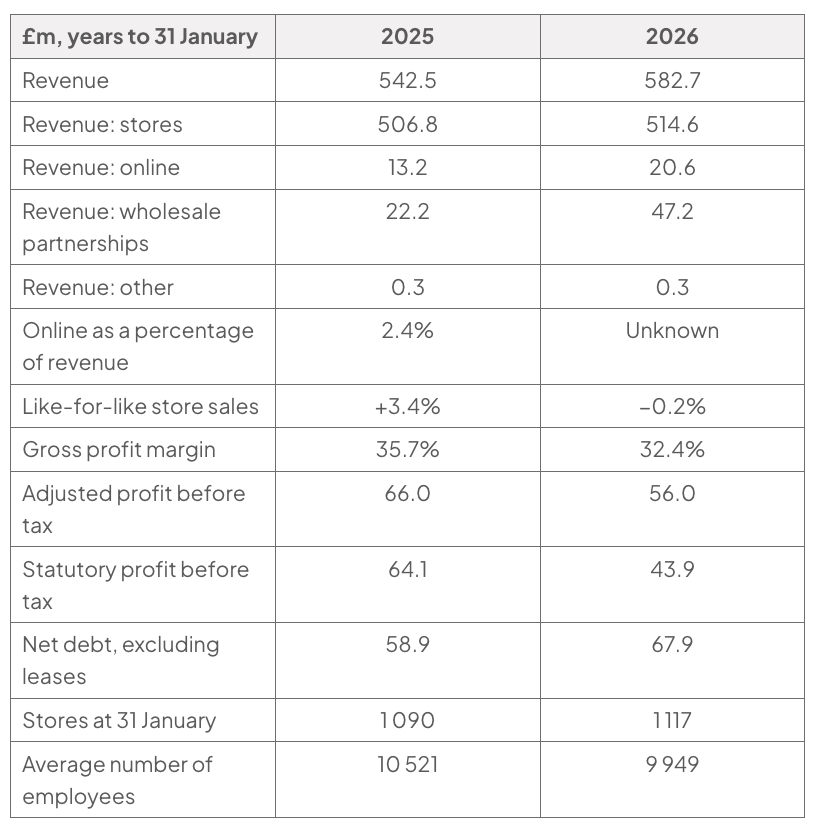
In the year to 31 January 2026 revenue rose by 7.4% to £582.7 million, but profit and the gross profit margin both fell. Like-for-like sales on cardfactory.co.uk also fell. In December 2025 the company warned that profit would be lower than expected.

The company faces two main pressures:

  • Wage costs. Changes to the National Living Wage and employers' National Insurance from April 2025 added an estimated £15 million to its wage costs. In response, it cut store hours by 9% and used fewer temporary and seasonal staff.

  • Consumer confidence. The company reported weak consumer confidence, "particularly among lower-income demographics".

Card Factory has trialled an artificial intelligence system that manages energy use in about 200 stores, with a rollout to 800 planned. It is also replacing its diesel vans with plug-in hybrids.

Source: Card Factory plc, results for the year ended 31 January 2026 and half-year results to 31 July 2026

Appendix A: Card Factory financial data

Appendix A table comparing Card Factory’s financial and operating data for years to 31 January 2025 and 2026, including revenue of £542.5m and £582.7m and average employees of 10 521 and 9 949.
  • Like-for-like store sales compare stores open in both years. In 2025/26 the number of customer transactions fell 3.7%, while the average basket rose 3.5%.

  • Online. 2025/26 online revenue includes £13.5m from Funky Pigeon. Like-for-like sales on cardfactory.co.uk fell 19.9%.

  • Half year to 31 July 2026. Revenue £260.8m, up from £247.6m; online revenue £16.0m, up from £3.2m. Like-for-like store sales fell 2.0%. Stores were 87% of revenue.

Source: Card Factory plc

Appendix C: Costs, technology and responsibility

Table of Card Factory store and warehouse wages, in millions of pounds, for years to 31 January: £134.4 million in 2025 and £143.3 million in 2026.
  • Wage costs. The £15m rise from April 2025 was partly offset by a 9% cut in store hours and fewer temporary and seasonal staff. Card Factory says it has absorbed "£60m+" of cost increases in three years; its efficiency programme saved £21m in 2025/26.

  • Currency. About half its inventory is bought in US dollars from suppliers in the Far East. Its US dollar needs for 2026/27 are fully hedged, fixing the exchange rate in advance.

  • Technology. An artificial intelligence system that manages energy use was trialled in about 200 stores, with a rollout to 800 planned. New tills were installed in 2025/26.

  • Environment. Cellophane wrap has been removed from all own-label gift wrap rolls, and bubble wrap from Printcraft. Diesel vans are being replaced by plug-in hybrids.

  • Charity. The Card Factory Foundation received £1.4m from carrier bag sales in 2024/25.

Source: Card Factory plc

Assess whether Card Factory is acting in a socially responsible way.

Calculate Card Factory's store and warehouse wages as a percentage of revenue for the year to 31 January 2026 to support your answer. Give your answer to one decimal place.

1
15 marks

Source A: The Body Shop

The Body Shop was founded by Anita Roddick, who opened its first shop in Brighton on 27 March 1976 with 25 products. From the start it sold products in refillable bottles. It became known for its campaigns: in 1987 it launched Community Trade, through which it buys ingredients directly from producer communities, and in 1989 it began campaigning against the testing of cosmetics on animals. In 2019 it was certified as a B Corporation. Much of its growth outside the UK came through franchising; by 1994, 89% of its shops were run by franchisees.

The business has had four owners since 2006:

  • L'Oréal bought it for £652.3 million in 2006.

  • Natura & Co bought it for £880 million in 2017, when it had about 3 200 stores in 66 countries.

  • Aurelius, an investment firm, bought it for £207 million in November 2023.

  • Auréa, a group led by Mike Jatania, bought the UK business and the brand from the administrators in September 2024 for at least £44.3 million.

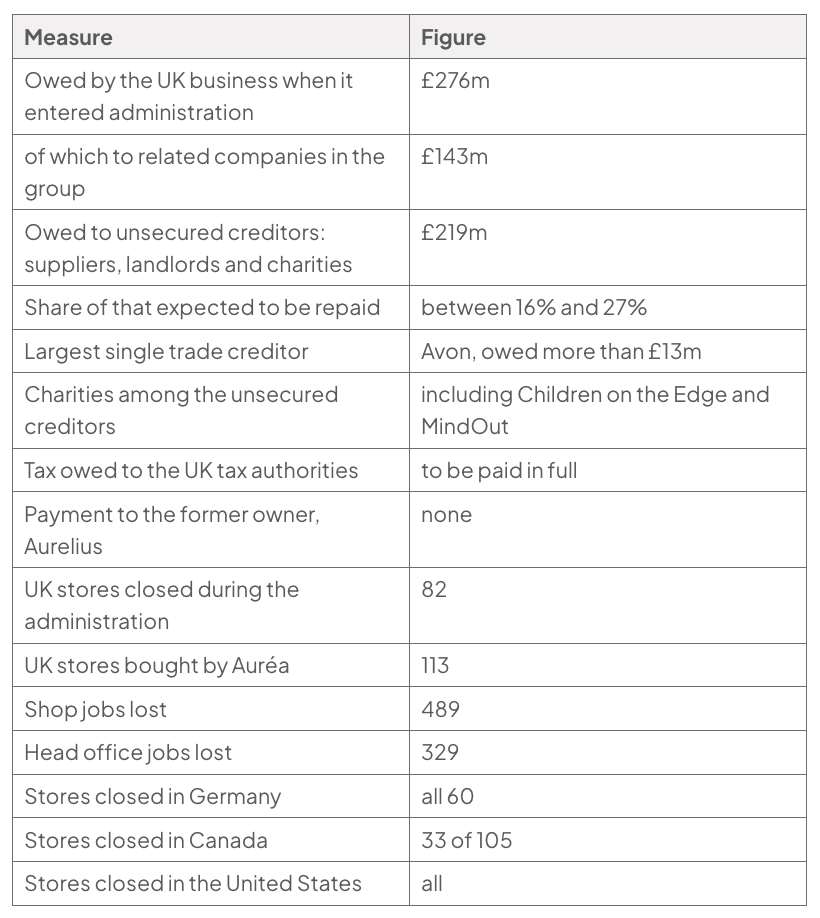
In February 2024 the UK business entered administration owing £276 million. More than 80 UK stores closed and more than 800 jobs were lost. The company-run businesses in Germany and the United States closed all their stores, while shops run by franchisees in many other countries continued to trade.

Auréa has said that the business returned to profit after it "fundamentally changed the operating model" and cut costs quickly, including reducing the range from more than 800 products. It has said that The Body Shop is unlikely to open many more UK stores, and that it is considering selling its products through other retailers, such as Boots, and supplying miniature products to hotels. In January 2024 the company completed a move to make its entire range vegan; in August 2025 it reintroduced some products which are not vegan.

Source: The Body Shop, Auréa and press reports

Appendix B: The UK administration, 2024

Table of The Body Shop’s 2024 UK administration: £276m owed, including £219m to unsecured creditors; 16% to 27% repayment expected; 82 UK stores closed, 113 bought by Auréa, 818 jobs lost, and all US and German stores closed.

Source: Analyst, using the administrators' reports and press reports

Appendix C: Since the rescue

  • The first 100 days. In December 2024 the new management told staff that the business had made a profit of £2 million on sales of £28 million in its first 100 days under Auréa. A source close to the business warned that it was now a smaller operation and that sales may have been helped by discounting and clearing old inventory.

  • Profit. In June 2026 Auréa said that the accounts it was about to file would show earnings before interest, tax, depreciation and amortisation of more than £24 million for the latest year, compared with a loss of £27 million the year before: the first profit since 2021.

  • What changed. The loss-making UK stores had already been closed during the administration. The new owners reduced the range from more than 800 products and cut costs.

  • Where it plans to sell. Auréa has focused on online sales and on wholesale deals with other businesses. It is considering selling through rival retailers such as Boots, and supplying miniature products to hotels. It has said it is unlikely to open many more UK stores.

  • Franchise markets. The franchise partner in India, with around 200 stores, aims to have more than 400 within five years. The Body Shop returned to New Zealand through a franchise partner in November 2025, after the company-run business there closed. The company-run business in Austria became insolvent in January 2026, affecting 12 shops.

  • Values. The range became entirely vegan in January 2024. In August 2025 some products that are not vegan were reintroduced.

Source: Analyst, using press reports

When The Body Shop's UK business entered administration, suppliers, landlords and charities were owed £219 million and expected to be repaid between 16% and 27% of it.

Evaluate two ways The Body Shop could rebuild its reputation for social responsibility and recommend which one it should do first.

2
15 marks

Source A: Severn Trent

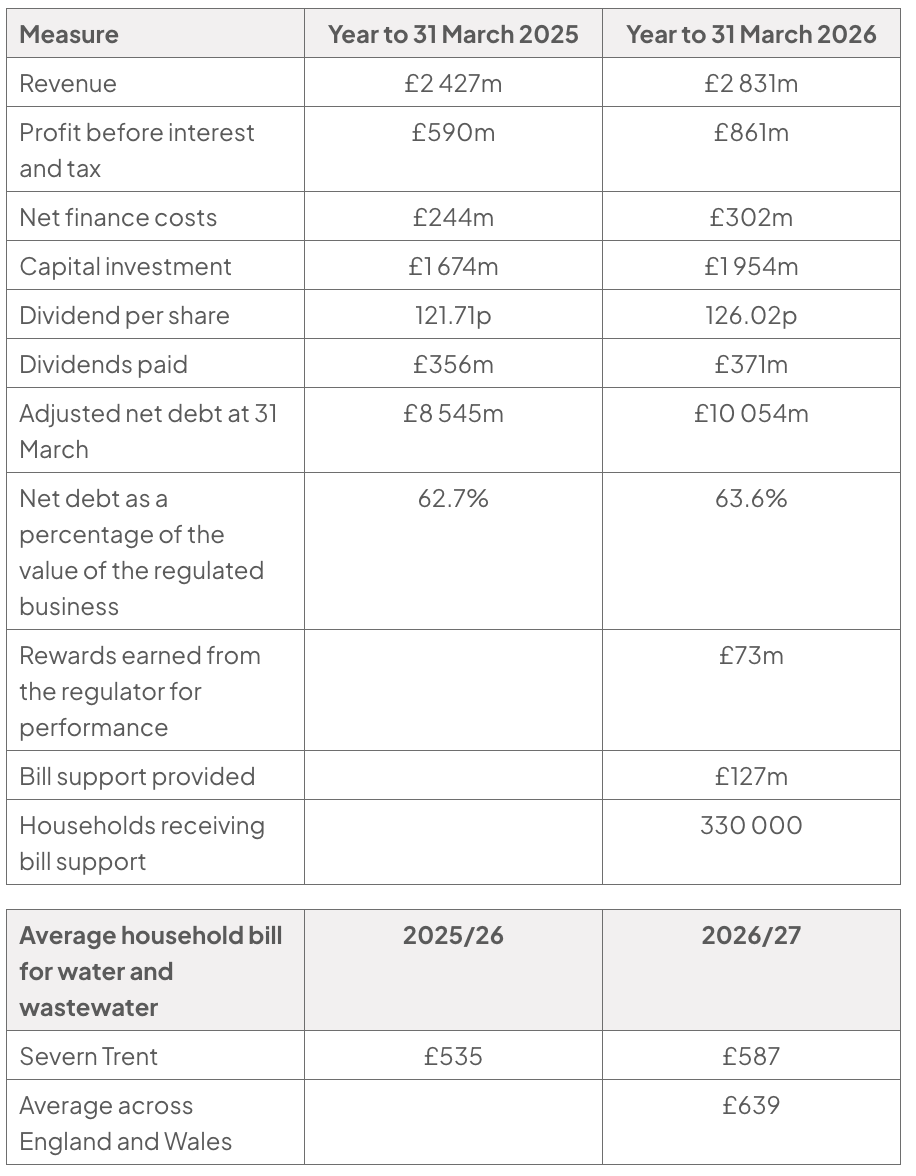
Severn Trent Plc provides water and wastewater services to more than 9 million people across the Midlands and mid-Wales through its regulated business, Severn Trent Water. It is a public limited company listed on the London Stock Exchange and employs more than 11 000 people. In the year to 31 March 2026 its revenue rose 16.6% to £2 831 million and its profit before interest and tax rose 46% to £861 million. It invested £1 954 million in its water and wastewater networks, the largest investment programme in its history. The full-year dividend rose 3.5% to 126.02 pence a share, in line with the company's policy of increasing the dividend by at least the rate of inflation each year.

Water companies in England and Wales are the only suppliers of water and wastewater services in their regions. The prices they may charge, and the investment they must deliver, are set by the economic regulator, Ofwat, for five years at a time; the current period runs from 2025 to 2030. Companies receive financial rewards from Ofwat when they beat performance targets and pay penalties when they miss them. From April 2026 the average Severn Trent household bill for water and wastewater rose by £52, or 10%, to £587.

The discharge of sewage into rivers has become a major political issue. Severn Trent reports that:

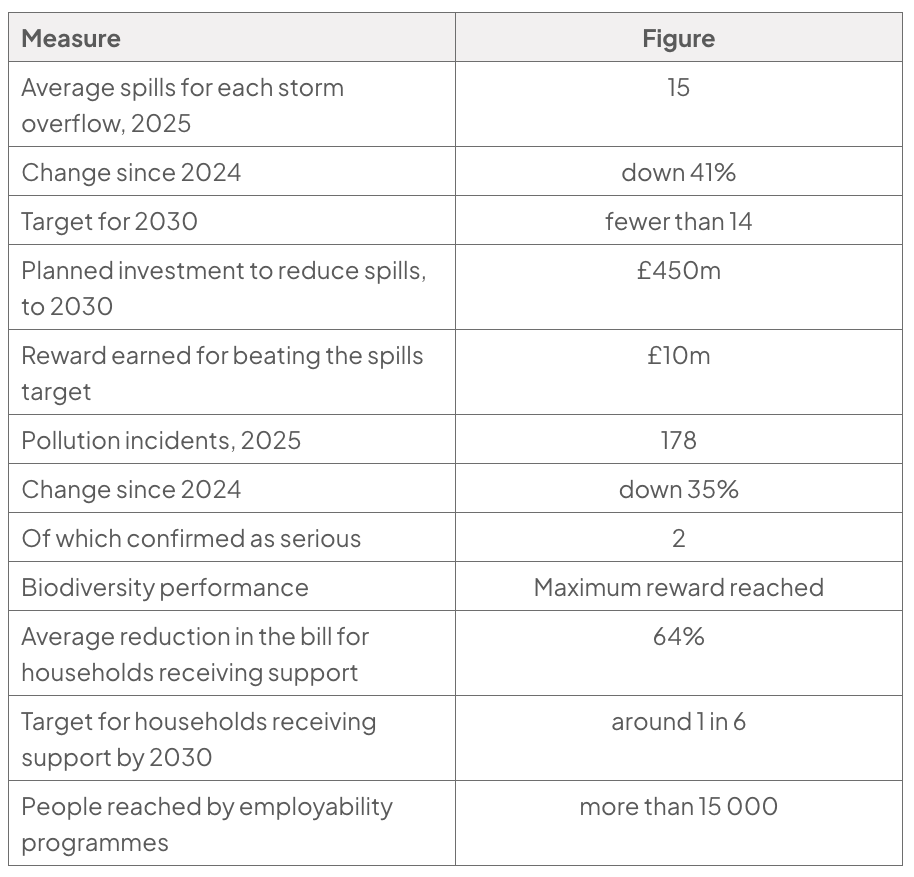
  • average spills from its storm overflows fell by 41% in 2025, to 15 for each overflow, beating its regulatory target and earning a reward of £10 million;

  • pollution incidents fell by 35% to 178, two of which were confirmed as serious;

  • it has committed to invest £450 million by 2030 to reduce spills to an average of fewer than 14 for each overflow.

The company supports customers who struggle to pay. During the year it provided £127 million of bill support to around 330 000 households, an average reduction of 64% on their bills, and it aims to help around 1 in 6 households in its region by 2030. Its employability programmes reached more than 15 000 people.

The company also works to improve the natural environment. During the year it planted almost 100 000 trees and 45 kilometres of hedgerow and restored 207 acres of habitat, and its performance on biodiversity reached the maximum financial reward available from the regulator. It generates renewable energy at its own sites.

Among its principal risks, Severn Trent lists uncertainty over regulatory, legislative and government reforms which could fundamentally change its operating environment.

Source: Severn Trent Plc, Preliminary Announcement of Annual Results, 20 May 2026

Appendix A: Severn Trent selected data

Two tables: Severn Trent’s selected financial and customer-support data for 2025 and 2026, followed by a comparison of average household water and wastewater bills for 2025/26 and 2026/27.

Source: Severn Trent Plc and Water UK

Appendix B: Reform of the water industry

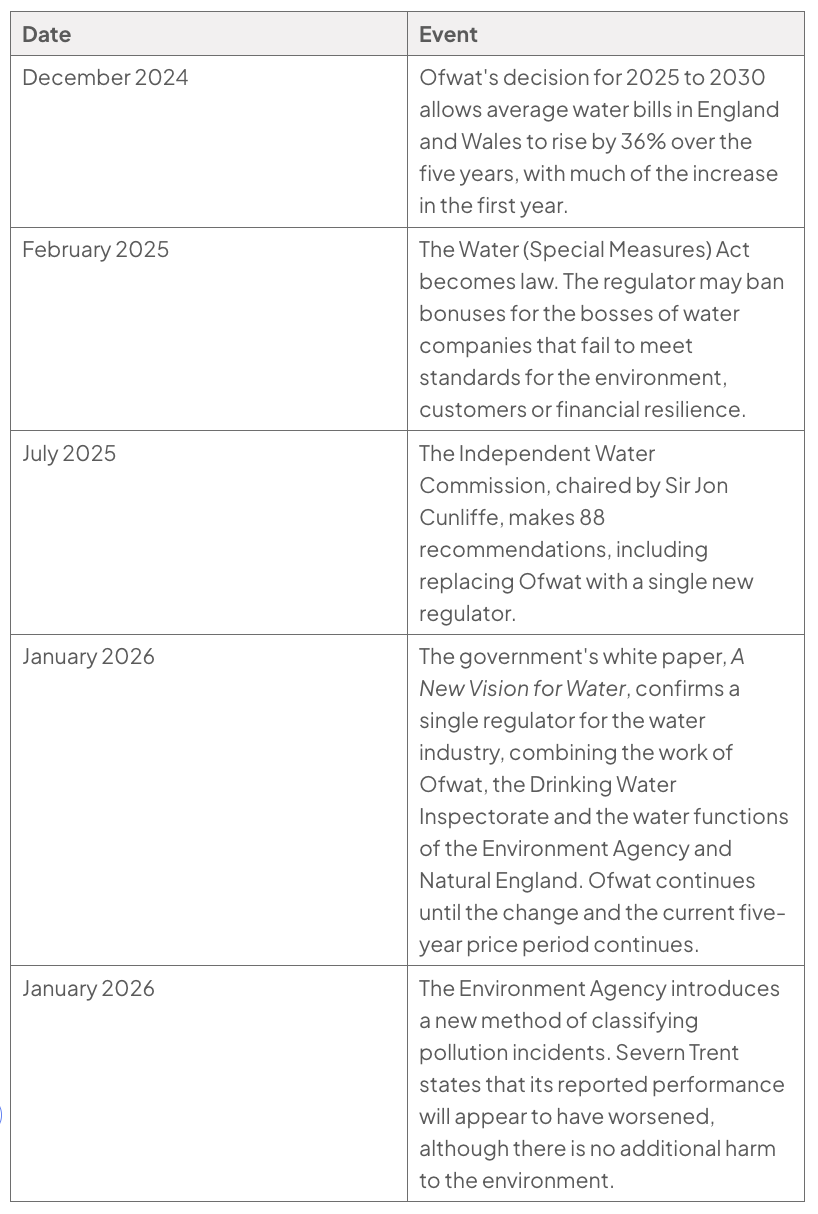
Two-column chronological table of reforms to England and Wales’s water industry, dated December 2024 to January 2026, covering legislation, Ofwat’s replacement and changes to pollution reporting.

Source: Analyst

Appendix C: Severn Trent's environmental and customer performance

Table of Severn Trent performance: 15 spills in 2025, down 41%, target fewer than 14 by 2030; £450m investment and £10m reward. Pollution incidents 178, two serious; biodiversity maximum reward; bill reduction 64%.

Source: Severn Trent Plc

In the year to 31 March 2026 Severn Trent's profit before interest and tax rose by 46%. From April 2026 its average household bill rose by 10%.

Evaluate two ways Severn Trent could demonstrate its social responsibility to its customers and recommend which one it should focus on first.

3
15 marks

Source B: Elmsworth Recycling

Elmsworth Recycling Limited recycles plastic packaging at a plant in Telford, Shropshire. The company was founded in 2009 by Dev Sharma, its Managing Director, and is owned by him and an investment firm. It employs 160 people. One in eight of them joined through a resettlement programme for people leaving prison, and each is given a mentor for their first six months.

The company buys bales of plastic pots, tubs and trays which households have put out for recycling, from the facilities that sort councils' collections. It shreds, washes and sorts the plastic, then melts it into pellets of recycled polypropylene, which it sells to manufacturers of plastic packaging. In the year to 30 June 2026 it bought 34 000 tonnes of bales and sold 26 500 tonnes of pellets. The plant can handle 40 000 tonnes of bales a year.

The material that cannot be made into pellets, such as labels, food residue and mixed plastics, is dealt with in two ways:

  • 4 000 tonnes a year is sold to a broker, which ships it to Turkey.

  • The remainder is sent to energy-from-waste plants in the UK, which charge a fee to burn it.

In 2024 the company installed a closed-loop system which cleans and reuses the water used to wash the plastic, cutting its use of mains water by three quarters. The system uses electricity to pump and filter the water. The remaining waste water is discharged to the public sewer, for which the company pays its water company a charge.

Packaging manufacturers can buy virgin polypropylene, made from oil, instead of Elmsworth Recycling's pellets. Since April 2022 the government has charged Plastic Packaging Tax on plastic packaging which contains less than 30% recycled plastic.

Source: Elmsworth Recycling

Appendix D: The UK market for recycled plastic

  • Plastic Packaging Tax. Charged on plastic packaging made in or imported into the UK which contains less than 30% recycled plastic. The rate from 1 April 2025 is £217.85 a tonne of packaging. Packaging with 30% or more recycled plastic pays no tax.

  • Extended Producer Responsibility. Since 2025, businesses that supply packaging pay fees towards the cost of collecting and recycling it.

  • Closures. Several UK plastic recycling plants closed in 2024 and 2025. Their owners blamed low prices for virgin plastic and imports of cheaper recycled plastic.

  • Imports. UK recyclers say that some imported plastic sold as recycled is difficult to verify.

  • Food packaging. Recycled plastic used in contact with food must be produced by a process approved by the food safety regulator.

  • Exports. In 2021 an investigation by Greenpeace found plastic waste from the UK dumped and burned at sites in Turkey.

Source: Analyst

Appendix E: Elmsworth Recycling selected data

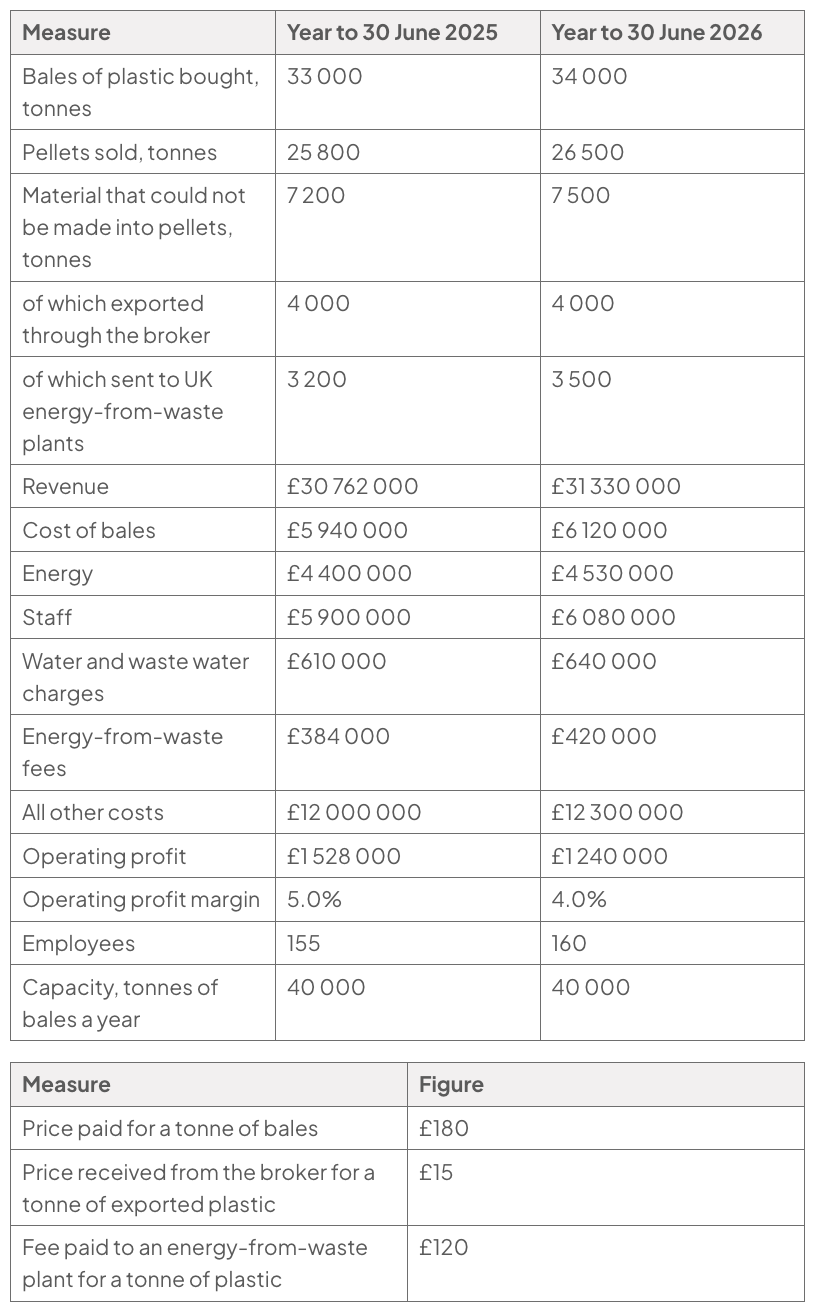
Two data tables for Elmsworth Recycling: the first compares 2025 and 2026 operating measures, costs and outputs; the second lists prices for bales, exported plastic and energy-from-waste disposal.

Source: Elmsworth Recycling

Appendix G: Elmsworth Recycling and the environment

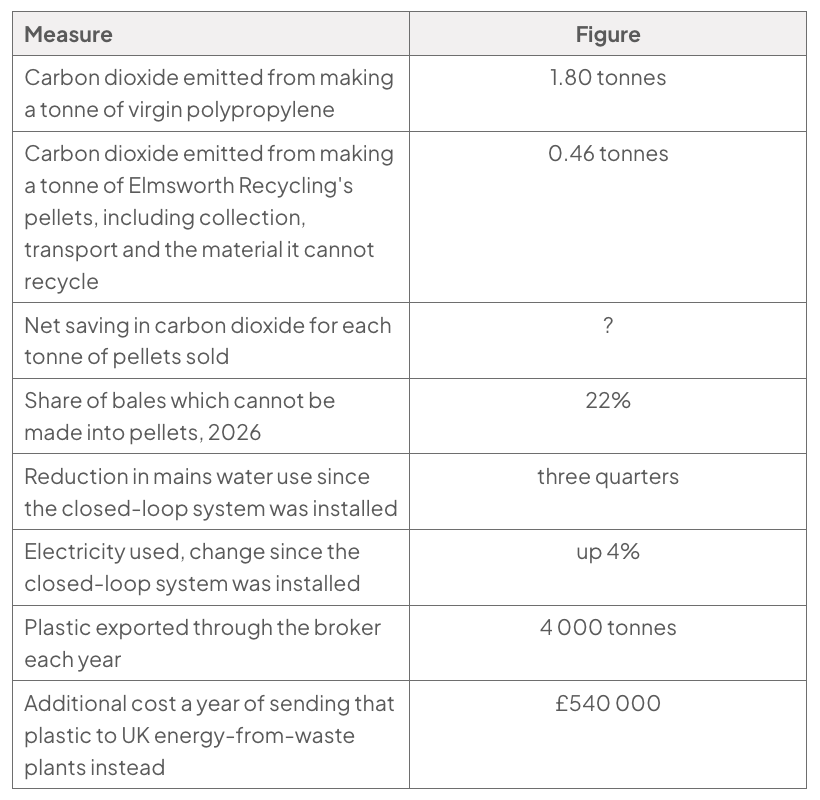
Environmental data table for Elmsworth Recycling: carbon dioxide emissions are 1.80 and 0.46 tonnes per tonne; net saving is shown as a question mark; other figures are 22%, three quarters, up 4%, 4,000 tonnes and £540,000.

Source: Analyst

Elmsworth Recycling sells 4 000 tonnes a year of plastic it cannot recycle to a broker, which ships it to Turkey.

Evaluate whether Elmsworth Recycling should stop exporting this plastic or continue to export it.

4
15 marks

Source A: Harbourne Joinery

Harbourne Joinery Limited makes timber windows, doors and staircases in a workshop near Totnes, Devon. The company was founded in 1994 by Martin Pryce and employs 48 people, including four apprentices. In the year to 31 March 2026 its sales came from three groups of customer:

  • Owners of listed buildings and of homes in conservation areas, 46% of sales.

  • Architects and building contractors, 34%.

  • Small housebuilders, 20%.

All of the company's timber is certified as coming from responsibly managed forests, and 80% of it is bought from a single importer in Bristol. In 2021, when timber was scarce, the importer supplied Harbourne Joinery ahead of smaller customers.

In April 2025 Martin Pryce sold the whole company to an employee ownership trust for £4.2 million. The trust holds the shares on behalf of all employees; no employee owns shares individually. £600 000 was paid on completion from the company's cash. The remaining £3.6 million is to be paid from the company's profits after tax, in six annual instalments of £600 000 beginning in 2026/27. Under the rules for employee-owned companies, each employee may receive bonuses of up to £3 600 a year free of income tax, and each received a bonus of £1 000 in December 2025. Martin Pryce remains chair until 2027. The former production manager, Sian Kerr, has become Managing Director.

In 2019 the company installed a biomass boiler which burns the offcuts and sawdust from the workshop to heat the building and to dry timber. Before then, it paid to have this waste collected and heated the workshop with oil. The boiler must be loaded and cleaned by staff each day.

Harbourne Joinery's windows cost more than windows made of uPVC, a plastic. Timber frames can be repaired rather than replaced. Owners of listed buildings usually need consent to replace their windows, and are normally expected to replace them like for like.

The company is considering how it can demonstrate its commitment to its employees, its community and the environment. It is assessing three possibilities: certification as a B Corporation, taking on more apprentices, and a service which repairs old timber windows rather than replacing them.

Source: Harbourne Joinery

Appendix A: Harbourne Joinery selected data

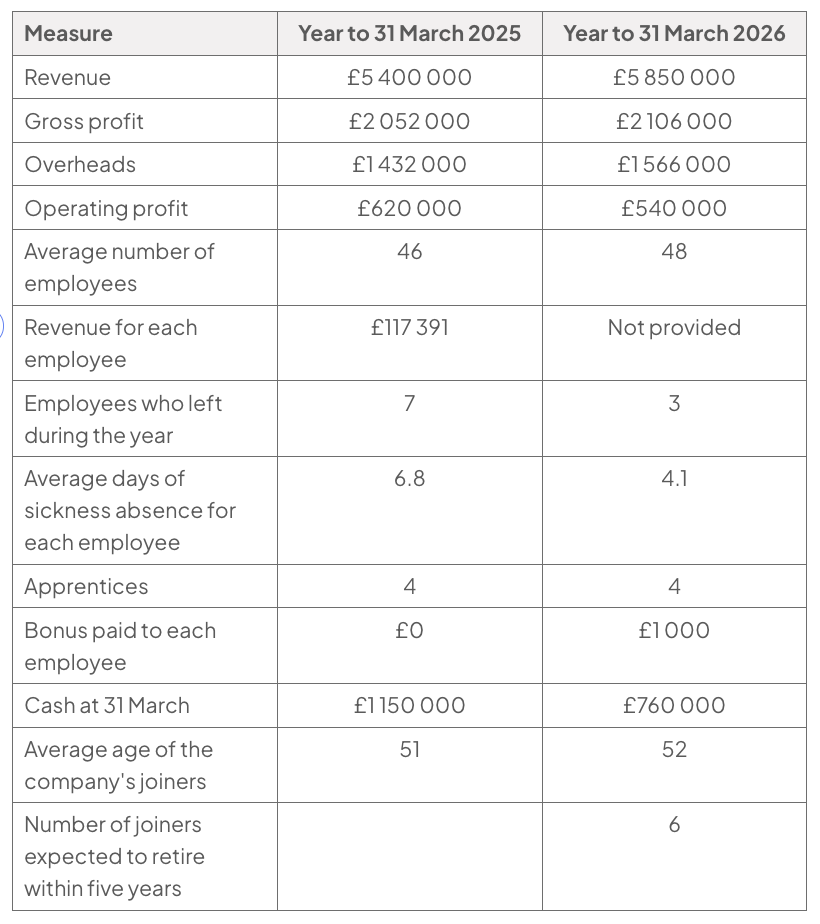
Table comparing Harbourne Joinery’s selected measures for years ending 31 March 2025 and 2026, including financial performance, staffing, absence, apprentices, bonuses, cash and expected retirements.

Source: Harbourne Joinery

Appendix B: Paying for employee ownership

  • The sale. Martin Pryce sold 100% of the shares to an employee ownership trust in April 2025 for £4.2 million.

  • How it is paid. £600 000 was paid on completion from the company's cash. The remaining £3.6 million is paid in six annual instalments of £600 000 from 2026/27, out of the company's profit after corporation tax of 25%.

  • The trust. The trust board has four members: an independent chair, two trustees elected by employees, and Martin Pryce until 2027.

  • Employees' voice. An employee council, elected by all staff, meets the Managing Director every month.

  • Bonuses. Each employee may receive up to £3 600 a year free of income tax.

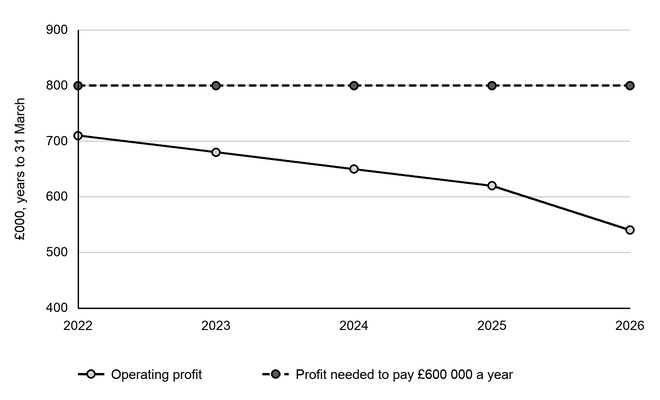
Line chart of Harbourne Joinery’s operating profit and required profit, 2022 to 2026: operating profit falls from £710 000 to £540 000, while £800 000 is needed annually to pay £600 000 after tax.
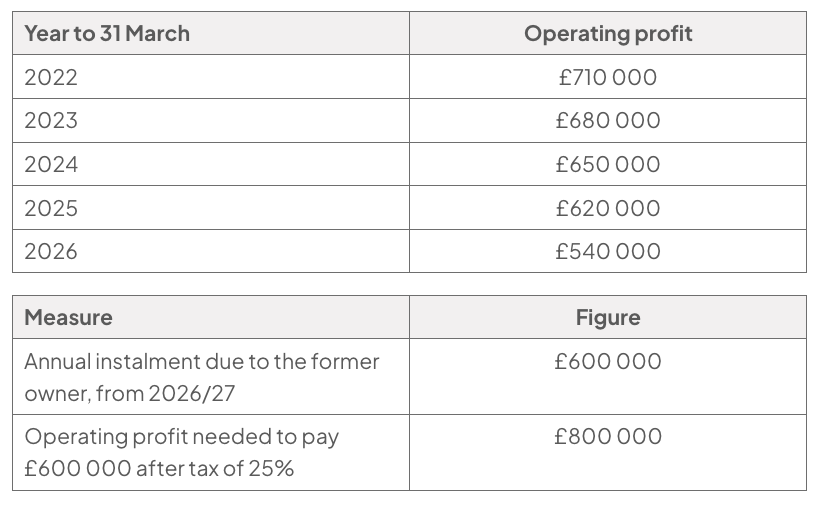
Table showing operating profit falling from £710 000 in 2022 to £540 000 in 2026: £680 000 in 2023, £650 000 in 2024 and £620 000 in 2025. The annual instalment is £600 000; £800 000 operating profit is needed after 25% tax.

Source: Harbourne Joinery

Appendix C: Timber and uPVC windows compared

A typical sash window, supplied and fitted

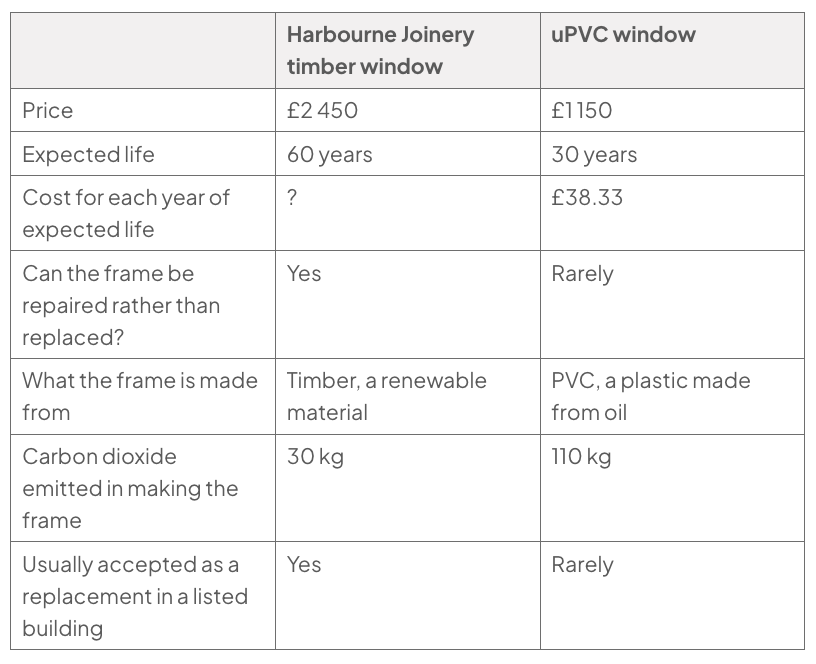
Comparison table of timber and uPVC windows: timber costs £2 450, lasts 60 years, is repairable, renewable, emits 30 kg carbon dioxide and is usually accepted in listed buildings; uPVC costs £1 150 and lasts 30 years.

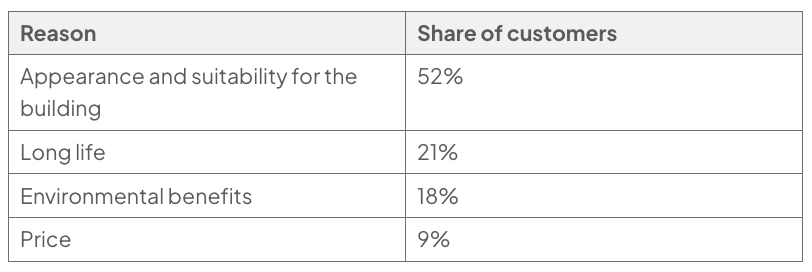
Main reason customers gave for choosing Harbourne Joinery, customer survey 2026

Table of customers’ main reasons for choosing Harbourne Joinery: appearance and suitability for the building, 52%; long life, 21%; environmental benefits, 18%; price, 9%.

Source: Analyst

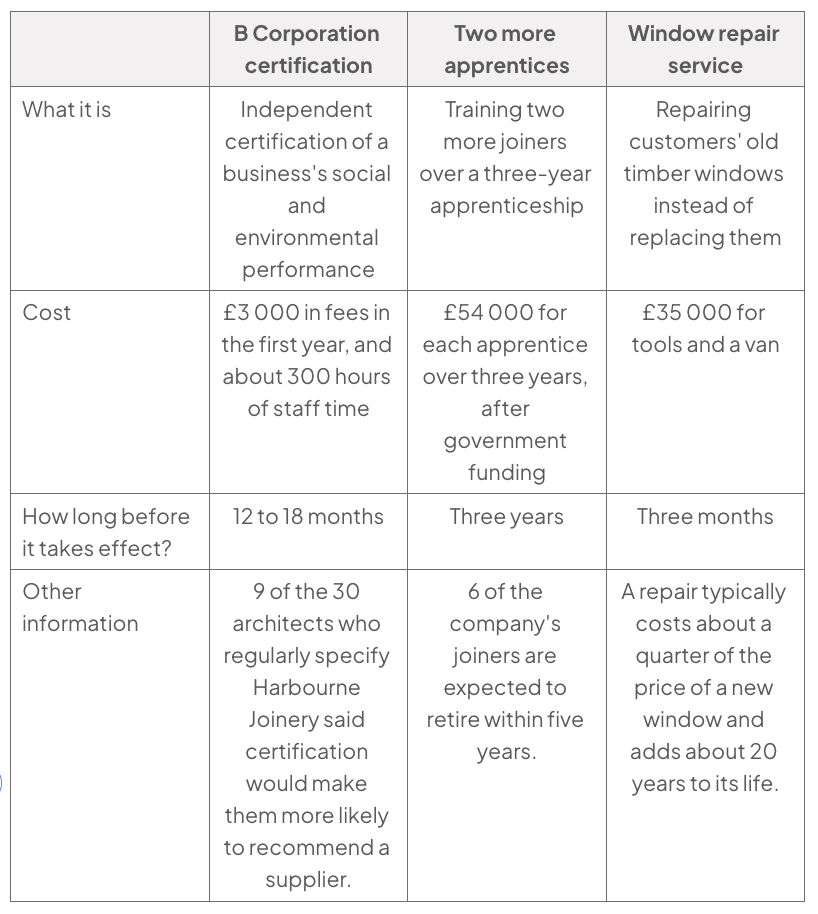
Appendix D: Three ways to demonstrate social responsibility

Comparison table of B Corporation certification, two more apprentices and a window repair service, comparing their purpose, cost, time to take effect and relevant benefits or considerations.

Source: Harbourne Joinery

Harbourne Joinery wants to demonstrate its commitment to its employees, its community and the environment. From 2026/27 it must also pay its former owner £600 000 a year.

Evaluate two ways Harbourne Joinery could demonstrate its social responsibility and recommend which one it should do first.

Use information from Appendices A to D to support your answer.