Economic Environment (AQA A Level Business): Exam Questions

Exam code: 7132

Syllabus Edition

First teaching 2026

First exams 2028

2 hours16 questions
1
6 marks

Source A: JCB

J.C. Bamford Excavators Limited, known as JCB, makes construction and agricultural machinery, including backhoe loaders, excavators and telescopic handlers. It was founded in 1945 by Joseph Cyril Bamford and is still owned by the Bamford family. Its headquarters are at Rocester, Staffordshire, and it employs more than 20 000 people in 23 factories around the world. It sells its machines through independent dealers. Its competitors include Caterpillar and Komatsu, both of which are larger.

In 2025 JCB's turnover was £5.7 billion, compared with £5.8 billion in 2024, and its profit before tax fell from £687 million to £642 million. It sold 113 498 machines, about 5% fewer than in 2024, although it increased its share of the global market. Demand for machinery was flat in North America and fell by 12% in India. The company has no net borrowing, and it expects moderate growth in 2026.

Demand for construction machinery depends on the amount of building taking place, which tends to fall when interest rates are high. Many machines in the UK are bought by plant hire companies, which buy in large numbers and rent the machines to builders.

JCB is investing £100 million at its Staffordshire headquarters, including £60 million in a fully automated paint plant, which it says will help to secure more than 8 000 UK jobs.

In April 2025 the United States introduced tariffs on imports, including a tariff of 10% on most goods from the UK. JCB responded by doubling the size of the factory it was building in San Antonio, Texas, which will be its largest in the world. It said that in the short term the tariffs would have a significant impact on its business, but that in the medium term the Texas factory would help to reduce that impact.

Over three years JCB spent £100 million, and employed more than 150 engineers, developing an engine which burns hydrogen instead of diesel. In January 2025 the engine was approved for use in Great Britain, Northern Ireland and nine other European countries. JCB also makes machines powered by batteries.

Source: JCB and press reports

Demand for construction machinery depends on the amount of building taking place, which tends to fall when interest rates are high.

Analyse one way in which a fall in UK interest rates might affect JCB's sales.

2
6 marks

Source B: Tarnside Travel

Tarnside Travel Limited organises escorted coach holidays from its base in Kendal, Cumbria. It was founded in 1972 and is owned by the Fell family; its Managing Director is Joanne Fell. It employs 42 people, runs 8 coaches and has two booking offices, in Kendal and Penrith. In the year to 30 September 2026 it carried 10 300 passengers on holidays in the UK and Europe, at an average price of £815.

Most of Tarnside Travel's customers are retired: 76% are aged over 65. Its holidays are priced in a brochure published a year in advance, and include coach travel, hotels and entrance to attractions. A growing share of its customers travel alone; they pay a single supplement of £180 for a room of their own.

Customers can book by telephone, in a branch or, since 2024, online. A booking taken by telephone costs the company about £24 to process, compared with about £6 online.

Changes in government policy affect the company's holidays. Edinburgh introduced a visitor levy of 5% of the cost of accommodation from 24 July 2026, and councils in Wales may charge a levy of £1.30 a person a night from April 2027. In April 2026 the full new state pension rose by 4.8%, from £230.25 to £241.30 a week.

The coaches run on diesel. Tarnside Travel buys its fuel at the price on the day, while the price of each holiday is fixed when the brochure is published.

Source: Tarnside Travel

Tarnside Travel buys diesel for its coaches at the price on the day, while the price of each holiday is fixed a year in advance.

Analyse one way in which a rise in the price of diesel might affect Tarnside Travel's profit.

3
6 marks

Source B: Oakhanger Lettings

Oakhanger Lettings Limited is a letting agent with branches in Alton and Farnham, Hampshire and Surrey. It was founded in 2004 by Rachel Dunn, who owns it and is its Managing Director, and it employs 28 people. At 30 June 2026 it managed 1 120 rented homes for 640 landlords. It advertises every home on Rightmove.

The company offers landlords two main services:

  • Full management. Oakhanger Lettings finds a tenant, collects the rent, arranges repairs and inspections and makes sure the landlord meets the law. It charges 12% of the rent.

  • Let-only. Oakhanger Lettings finds a tenant and the landlord manages the home. It charges a fee equal to one month's rent.

It also charges landlords for arranging the safety checks and certificates the law requires. By law, letting agents in England may not charge tenants fees.

Most of its landlords own one or two homes, and many have buy-to-let mortgages. Bank Rate was 3.75% at the start of 2026, and financial markets expected further cuts during the year. Rents in its area rose by 1.5% in the year to 30 June 2026.

The law on renting has changed. From 1 May 2026 the Renters' Rights Act ended "no-fault" evictions, under which a landlord could end a tenancy without giving a reason. A landlord must now prove one of the grounds set out in law. All tenancies became periodic, with no fixed end date, and rents may be raised only once a year. In the November 2025 Budget the government announced that, from April 2027, the income tax rates on rental income will be 2 percentage points higher than on other income.

Source: Oakhanger Lettings

Many of Oakhanger Lettings' landlords have buy-to-let mortgages. Bank Rate was 3.75% at the start of 2026, and financial markets expected further cuts during the year.

Analyse one way in which a fall in interest rates might affect the number of homes Oakhanger Lettings manages.

4
6 marks

Source B: Fenwick Vale Homes

Fenwick Vale Homes Limited builds houses on small sites, usually of 10 to 60 homes, across Northumberland. It was founded in 1988 by Peter Robson and is owned by the Robson family; his daughter, Kate Robson, is Managing Director. It employs 64 people and uses local subcontractors for most building work. In the year to 31 March 2026 it completed 115 homes at an average price of £315 000.

Fenwick Vale Homes buys land with planning potential and applies for permission to build. It borrows to buy the land and build the homes, from a bank which charges interest at 4 percentage points above Bank Rate; Bank Rate was 3.75% at the start of 2026. The loan is repaid as homes are sold.

Since 2024 the law has required most new developments in England to deliver biodiversity net gain: the habitat for wildlife after development must be at least 10% better than before. A builder that cannot achieve this on the site itself must buy units of habitat elsewhere. The local council also requires 15% of the homes on larger sites to be affordable homes, sold to a housing association at about 55% of their open-market value.

The government has set a target of 1.5 million new homes in England during this Parliament, and the Planning and Infrastructure Act became law in December 2025. Fenwick Vale Homes says that the time it waits for a planning decision has continued to grow.

Source: Fenwick Vale Homes

Fenwick Vale Homes borrows to buy land and build homes, at an interest rate 4 percentage points above the base rate. The base rate was 3.75% at the start of 2026.

Analyse one way in which a fall in the base ratemight affect Fenwick Vale Homes' costs.

5
6 marks

Source A: Lancashire Cricket

Lancashire County Cricket Club Limited, known as Lancashire Cricket, was founded in 1864 and plays at Emirates Old Trafford in Manchester. It has men's and women's teams, hosts international matches, and runs a hotel and a conference and events business at the ground. It is not owned by shareholders: it is a registered society, owned by its members, who vote at its general meetings and elect some members of its Board.

In 2025 Lancashire Women won their first two professional trophies, and Emirates Old Trafford hosted a five-day men's Test match against India. Turnover rose slightly, to £34.8 million. The Chief Executive said that "the primary challenge for the business now is not revenue generation" but operating costs, which have increased significantly since the pandemic. During the year the club outsourced its catering and retail operations.

In 2025 the England and Wales Cricket Board (ECB) sold stakes in the eight teams in The Hundred, a short-format competition. RPSG Group, an Indian business which also owns teams in the Indian Premier League and South Africa, bought 70% of Manchester Originals; Lancashire Cricket kept 30%, and the team was renamed Manchester Super Giants. The club received dividends of £29.2 million from the sale, repaid £13.3 million of loans, and expects further dividends over the next few years. Lancashire Cricket's surplus before tax was £25.8 million.

The club's £20 million second ground at Farington, near Preston, built in partnership with Lancashire County Council, was handed over to the club in early 2026.

Source: Lancashire County Cricket Club Limited, Annual Report and Financial Statements 2025

Lancashire Cricket runs a hotel and a conference and events business at Emirates Old Trafford. Its Chief Executive says that operating costs, not revenue, are now its main challenge.

Analyse one way in which slower growth in the UK economy might affect the revenue of Lancashire Cricket's hotel, conference and events business.

6
6 marks

Source B: Stowe Valley Mutual

Stowe Valley Mutual is a building society founded in 1867 in Buckingham. It takes savings from its members and lends to members who are buying a home. It has nine branches in Buckinghamshire and Oxfordshire and 155 employees. As a building society it has no shareholders: it is owned by its 97 100 members, its savers and borrowers, who each have a vote at its annual general meeting. Its profits are not paid out as dividends but kept as reserves, which the law requires it to hold to protect its savers.

Its mission is "helping members save and own their homes, with a branch in every town we serve". By law, at least half of a building society's funds must come from its members' savings, and at least three-quarters of its lending must be secured on homes.

Stowe Valley Mutual's income comes mainly from the gap between the interest it earns on mortgages and the interest it pays to savers. Bank Rate, the Bank of England's interest rate, has fallen from 5.25% in July 2024 to 3.75% in September 2026.

Its board measures performance with key performance indicators including its cost to income ratio (operating costs as a percentage of income), its profit before tax, and the satisfaction of its members.

Source: Stowe Valley Mutual

Bank Rate has fallen from 5.25% in July 2024 to 3.75% in September 2026. Stowe Valley Mutual lends to members who are buying a home.

Analyse one way in which lower interest rates might affect the number of mortgages Stowe Valley Mutual provides.

7
6 marks

Source A: Card Factory

Card Factory plc is a UK retailer of greeting cards, gifts and party products, listed on the London Stock Exchange. It employs about 10 000 people and has its own printing business, Printcraft. It sells through three channels:

  • Stores. 1 117 stores in the UK and the Republic of Ireland.

  • Online. Its own website, cardfactory.co.uk, and Funky Pigeon.

  • Wholesale partnerships. Supplying other retailers, including Aldi.

In August 2025 Card Factory bought Funky Pigeon, an online card business, from WH Smith for £25.7 million, making it "the second largest online UK card and attached gift retailer". Moonpig Group is a larger online rival. Card Factory plans to run both websites on one shared platform, saving at least £5 million a year from 2027/28.

In the year to 31 January 2026 revenue rose by 7.4% to £582.7 million, but profit and the gross profit margin both fell. Like-for-like sales on cardfactory.co.uk also fell. In December 2025 the company warned that profit would be lower than expected.

The company faces two main pressures:

  • Wage costs. Changes to the National Living Wage and employers' National Insurance from April 2025 added an estimated £15 million to its wage costs. In response, it cut store hours by 9% and used fewer temporary and seasonal staff.

  • Consumer confidence. The company reported weak consumer confidence, "particularly among lower-income demographics".

Card Factory has trialled an artificial intelligence system that manages energy use in about 200 stores, with a rollout to 800 planned. It is also replacing its diesel vans with plug-in hybrids.

Source: Card Factory plc, results for the year ended 31 January 2026 and half-year results to 31 July 2026

Changes to the National Living Wage and employers' National Insurance from April 2025 added an estimated £15 million to Card Factory's wage costs.

Analyse one way in which Card Factory could respond to rising wage costs.

1
9 marks

Source B: Tarnside Travel

Tarnside Travel Limited organises escorted coach holidays from its base in Kendal, Cumbria. It was founded in 1972 and is owned by the Fell family; its Managing Director is Joanne Fell. It employs 42 people, runs 8 coaches and has two booking offices, in Kendal and Penrith. In the year to 30 September 2026 it carried 10 300 passengers on holidays in the UK and Europe, at an average price of £815.

Most of Tarnside Travel's customers are retired: 76% are aged over 65. Its holidays are priced in a brochure published a year in advance, and include coach travel, hotels and entrance to attractions. A growing share of its customers travel alone; they pay a single supplement of £180 for a room of their own.

Customers can book by telephone, in a branch or, since 2024, online. A booking taken by telephone costs the company about £24 to process, compared with about £6 online.

Changes in government policy affect the company's holidays. Edinburgh introduced a visitor levy of 5% of the cost of accommodation from 24 July 2026, and councils in Wales may charge a levy of £1.30 a person a night from April 2027. In April 2026 the full new state pension rose by 4.8%, from £230.25 to £241.30 a week.

The coaches run on diesel. Tarnside Travel buys its fuel at the price on the day, while the price of each holiday is fixed when the brochure is published.

Source: Tarnside Travel

Appendix D: Tarnside Travel selected data

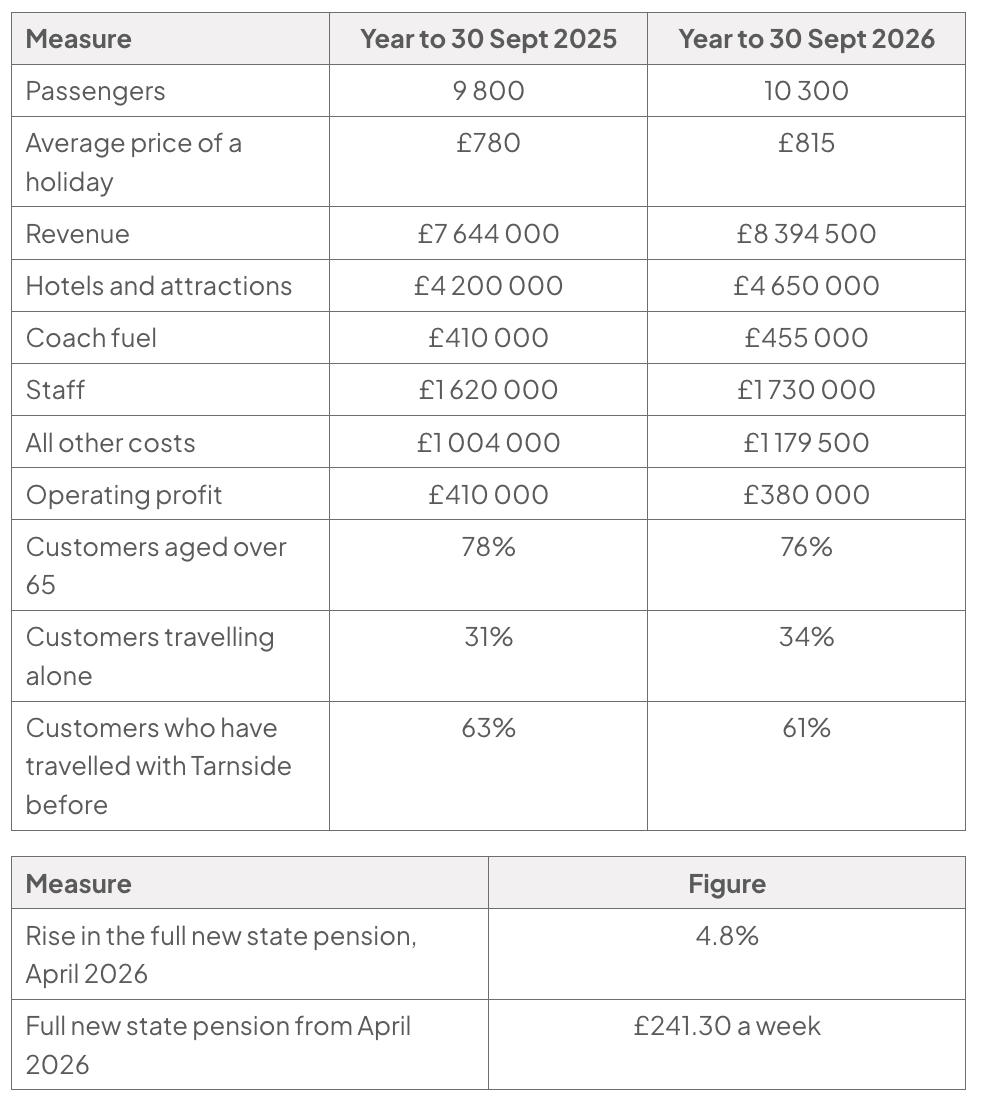
Appendix D: two tables of Tarnside Travel data, comparing the years to 30 September 2025 and 2026, followed by the April 2026 state pension rise and weekly amount.

Source: Tarnside Travel

Appendix E: How customers book

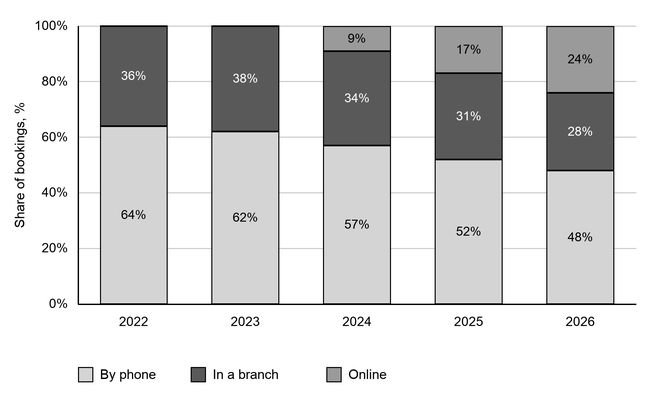
Stacked bar chart of booking shares by channel, 2022 to 2026: phone falls from 64% to 48%, branch bookings from 36% to 28%, while online rises from 0% to 24%.

Share of bookings, years to 30 September

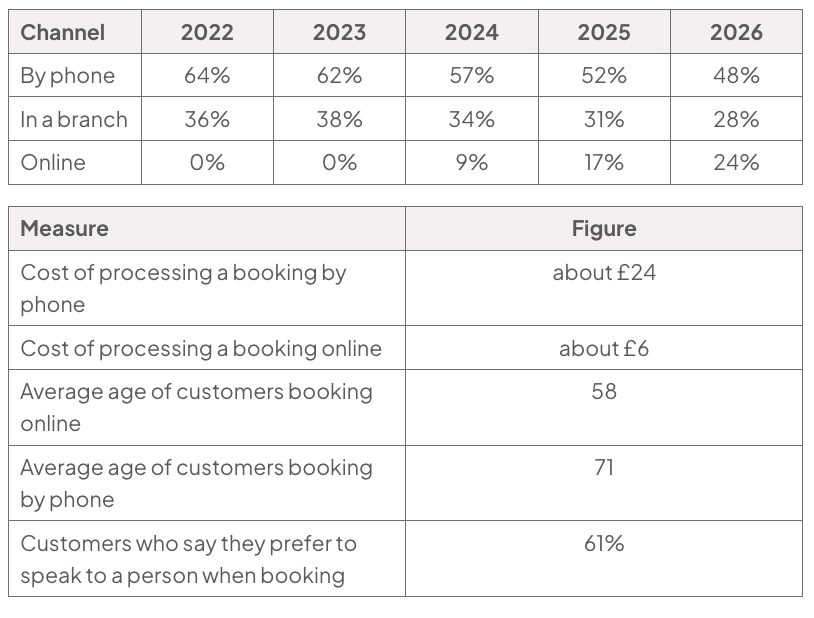
Two tables: booking shares, 2022 to 2026: phone 64%, 62%, 57%, 52%, 48%; branch 36%, 38%, 34%, 31%, 28%; online 0%, 0%, 9%, 17%, 24%. Phone processing £24, online £6; ages 71 and 58; 61% prefer a person.

Source: Tarnside Travel

Assess whether the 4.8% rise in the state pension in April 2026 is likely to increase demand for Tarnside Travel's holidays.

2
9 marks

Source A: Barratt Redrow

Barratt Redrow plc, listed on the London Stock Exchange, is the UK's largest housebuilder by number of homes. Formed when Barratt Developments bought Redrow in October 2024, it builds under three brands: Barratt Homes, David Wilson Homes and Redrow.

In the 52 weeks to 28 June 2026:

  • homes completed rose by 5.0% to 17 667

  • revenue rose by 6.6% to £6 055.0 million

  • adjusted profit before tax fell by 7.1% to £572.8 million

To keep sales moving while mortgages were expensive, the company increased incentives for buyers, such as help with a deposit and part-exchange, and sold more homes to housing associations and to investors building up homes to rent.

The company faces three main pressures:

  • Planning. It describes planning as a constraint on output. Delays in gaining planning permission meant it expected to open fewer new sales sites, and in September 2026 it reduced its forecast of completions for the following year. The Planning and Infrastructure Act, intended to speed up decisions, became law in December 2025.

  • Past building work. Under the Building Safety Act it must pay to put right fire-safety defects in buildings it developed, and continues to find and repair problems at older developments.

  • Competition law. A claim filed in June 2026 against seven housebuilders, including Barratt Redrow, alleges that their sharing of information raised prices for buyers.

The company says the government must do more to support demand from first-time buyers, and that regulatory and tax burdens make many sites uneconomic. It plans to return £400 million to shareholders in the year to June 2027.

Source: Barratt Redrow plc, Results for the 52 weeks ended 28 June 2026

Appendix A: Barratt Redrow selected data

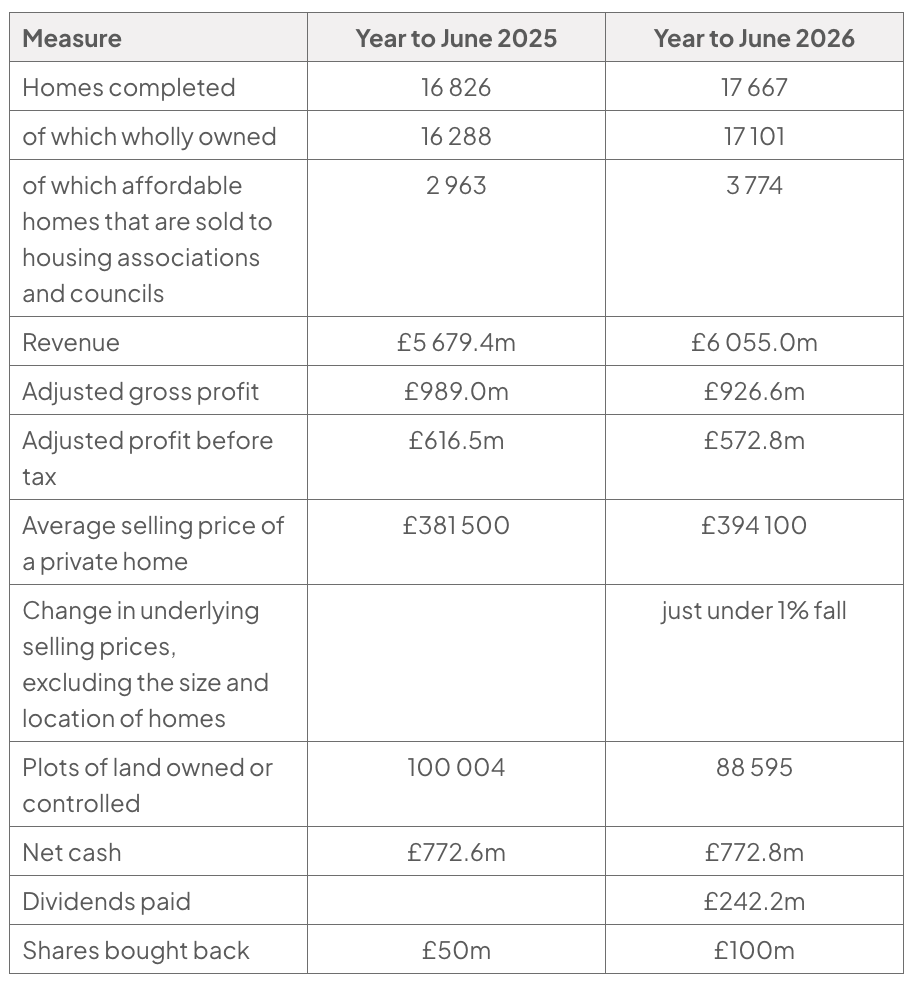
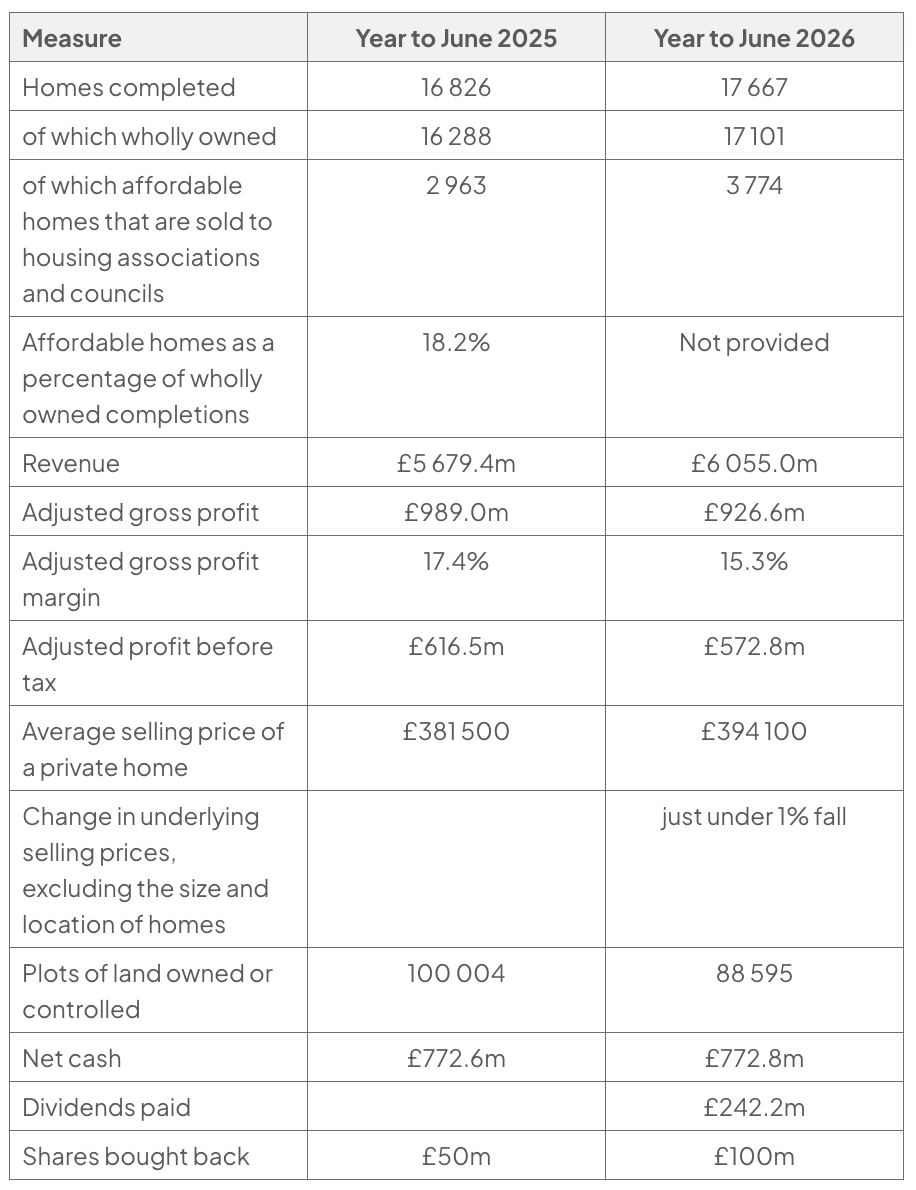
Table of Barratt Redrow data for years to June 2025 and 2026, including completions, affordable homes, revenue, adjusted gross profit, adjusted profit before tax, selling prices, land, net cash, dividends and share buy-backs.

Figures for the year to June 2025 combine Barratt and Redrow for the whole year.

Source: Barratt Redrow plc

Appendix C: The market and the government

  • Buyers. The company reports that higher mortgage rates and pressure on what buyers can afford continue to affect confidence, but that demand from committed buyers remains resilient. It offers schemes including part-exchange, a deposit contribution for key workers and Deposit Unlock, aimed at first-time buyers.

  • Planning. The Planning and Infrastructure Act became law in December 2025, and a revised National Planning Policy Framework was published in August 2026. The company says these should boost housing delivery "in time". It reduced its forecast for completions in the year to June 2027 to 17 500-17 900, from 17 700-18 200, because of planning delays.

  • Land. The company approved the purchase of fewer plots than planned because of uncertainty about build cost inflation. The estimated gross margin on the land it owns fell from 19.2% to 17.3%.

  • New homes standards. The Future Homes Standard will require new homes to produce far lower carbon emissions when in use.

  • Shareholders. The company plans to return £400m to shareholders in the year to June 2027.

Source: Analyst, using Barratt Redrow plc

Assess whether high mortgage rates are likely to reduce Barratt Redrow's profit.

Calculate Barratt Redrow's adjusted gross profit margin for the year to June 2026 to support your answer. Give your answer to one decimal place.

3
9 marks

Source B: Oakhanger Lettings

Oakhanger Lettings Limited is a letting agent with branches in Alton and Farnham, Hampshire and Surrey. It was founded in 2004 by Rachel Dunn, who owns it and is its Managing Director, and it employs 28 people. At 30 June 2026 it managed 1 120 rented homes for 640 landlords. It advertises every home on Rightmove.

The company offers landlords two main services:

  • Full management. Oakhanger Lettings finds a tenant, collects the rent, arranges repairs and inspections and makes sure the landlord meets the law. It charges 12% of the rent.

  • Let-only. Oakhanger Lettings finds a tenant and the landlord manages the home. It charges a fee equal to one month's rent.

It also charges landlords for arranging the safety checks and certificates the law requires. By law, letting agents in England may not charge tenants fees.

Most of its landlords own one or two homes, and many have buy-to-let mortgages. Bank Rate was 3.75% at the start of 2026, and financial markets expected further cuts during the year. Rents in its area rose by 1.5% in the year to 30 June 2026.

The law on renting has changed. From 1 May 2026 the Renters' Rights Act ended "no-fault" evictions, under which a landlord could end a tenancy without giving a reason. A landlord must now prove one of the grounds set out in law. All tenancies became periodic, with no fixed end date, and rents may be raised only once a year. In the November 2025 Budget the government announced that, from April 2027, the income tax rates on rental income will be 2 percentage points higher than on other income.

Source: Oakhanger Lettings

Appendix D: Oakhanger Lettings selected data

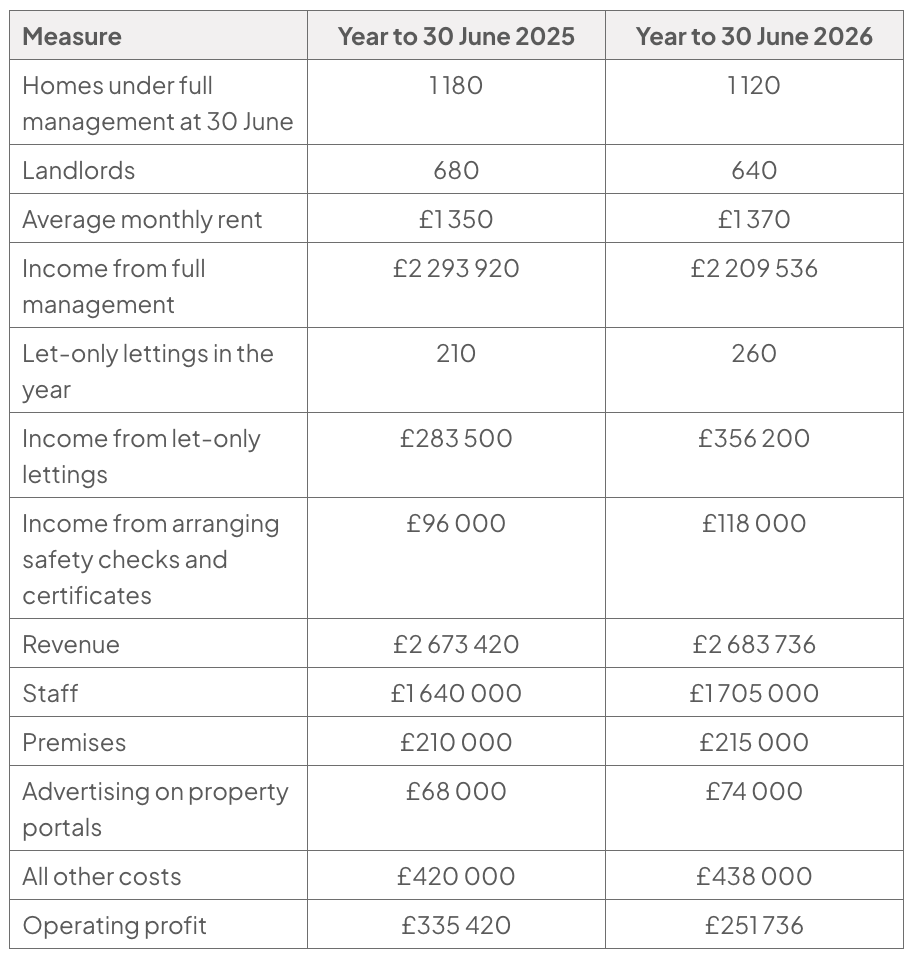
Table comparing Oakhanger Lettings’ measures for years to 30 June 2025 and 2026. Income from full management falls from £2 293 920 to £2 209 536; average monthly rent rises from £1 350 to £1 370.

Source: Oakhanger Lettings

Appendix E: Full management and let-only

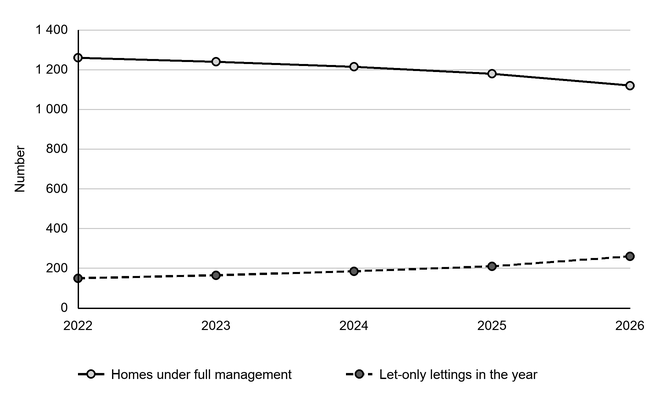
Line chart of Oakhanger Lettings’ numbers from 2022 to 2026: homes under full management fall from 1 260 to 1 120, while let-only lettings rise from 150 to 260. Y-axis: number, 0 to 1 400.
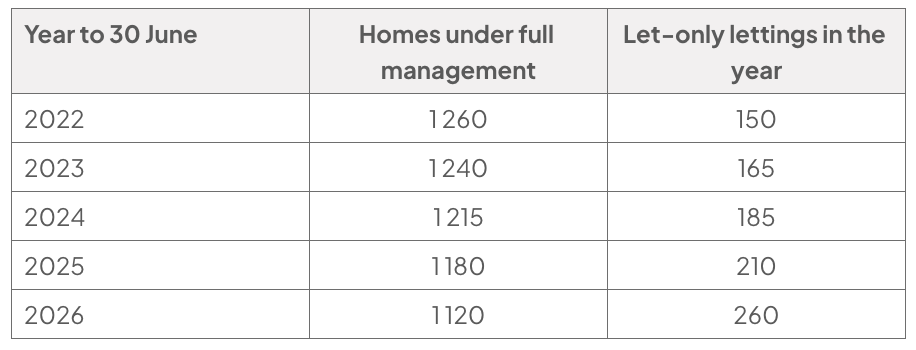
Table of Oakhanger Lettings data for years to 30 June 2022 to 2026, showing homes under full management and let-only lettings in the year; full management falls while let-only lettings rise.

Survey of Oakhanger Lettings' landlords, June 2026

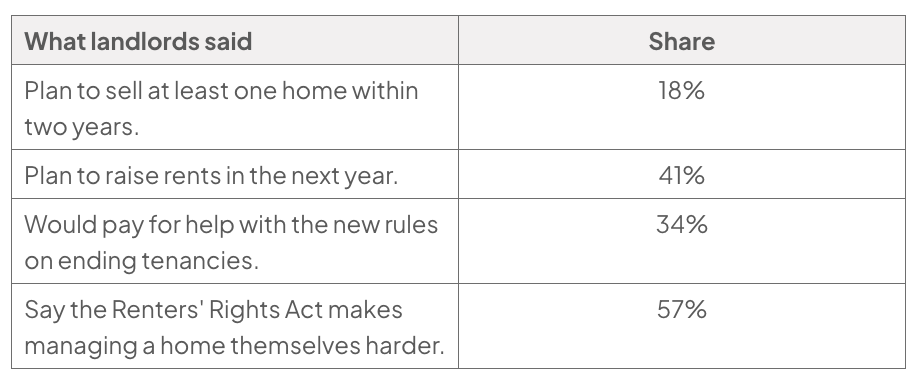
Survey of landlords: 18% plan to sell at least one home within two years; 41% plan to raise rents next year; 34% would pay for help with new tenancy-ending rules; 57% say the Renters’ Rights Act makes self-management harder.

Source: Oakhanger Lettings

Assess whether slower growth in rents is likely to reduce Oakhanger Lettings' profit.

Calculate Oakhanger Lettings' employee costs as a percentage of revenue for the year to 30 June 2026 to support your answer. Give your answer to one decimal place.

4
9 marks

Source B: Fenwick Vale Homes

Fenwick Vale Homes Limited builds houses on small sites, usually of 10 to 60 homes, across Northumberland. It was founded in 1988 by Peter Robson and is owned by the Robson family; his daughter, Kate Robson, is Managing Director. It employs 64 people and uses local subcontractors for most building work. In the year to 31 March 2026 it completed 115 homes at an average price of £315 000.

Fenwick Vale Homes buys land with planning potential and applies for permission to build. It borrows to buy the land and build the homes, from a bank which charges interest at 4 percentage points above Bank Rate; Bank Rate was 3.75% at the start of 2026. The loan is repaid as homes are sold.

Since 2024 the law has required most new developments in England to deliver biodiversity net gain: the habitat for wildlife after development must be at least 10% better than before. A builder that cannot achieve this on the site itself must buy units of habitat elsewhere. The local council also requires 15% of the homes on larger sites to be affordable homes, sold to a housing association at about 55% of their open-market value.

The government has set a target of 1.5 million new homes in England during this Parliament, and the Planning and Infrastructure Act became law in December 2025. Fenwick Vale Homes says that the time it waits for a planning decision has continued to grow.

Source: Fenwick Vale Homes

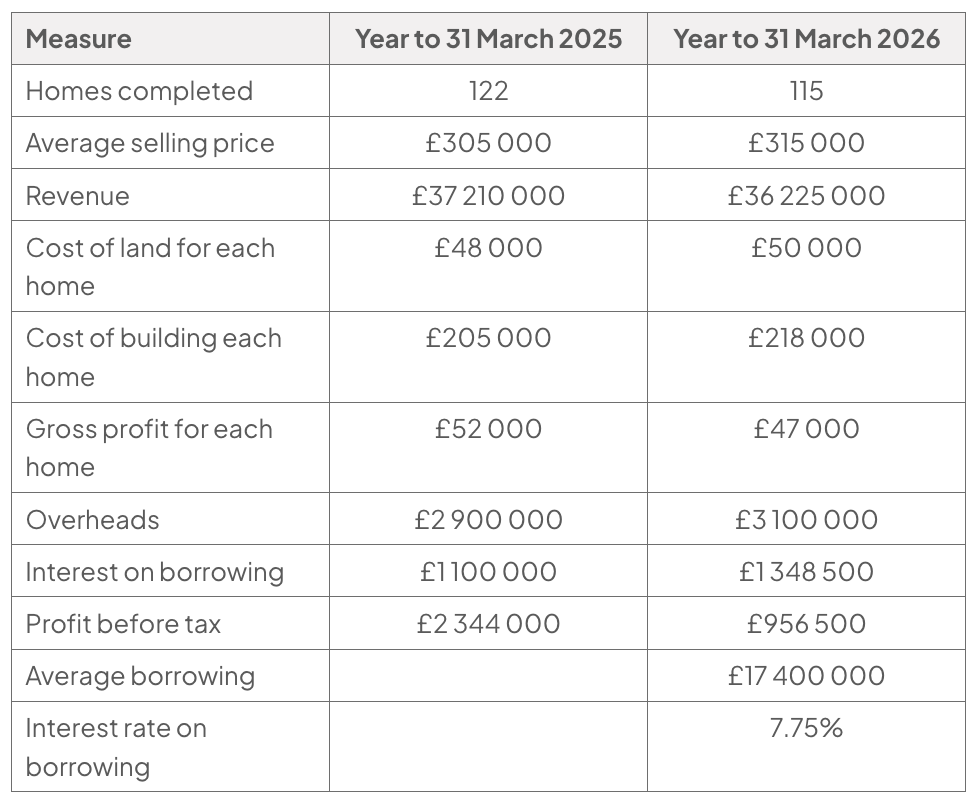
Appendix D: Fenwick Vale Homes selected data

Table of Fenwick Vale Homes’ selected data for the years to 31 March 2025 and 2026, covering homes completed, prices, revenue, costs, profits, overheads, interest, borrowing and interest rate.

Source: Fenwick Vale Homes

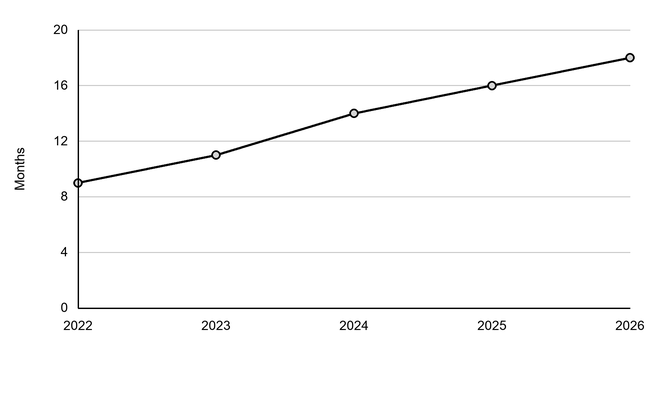
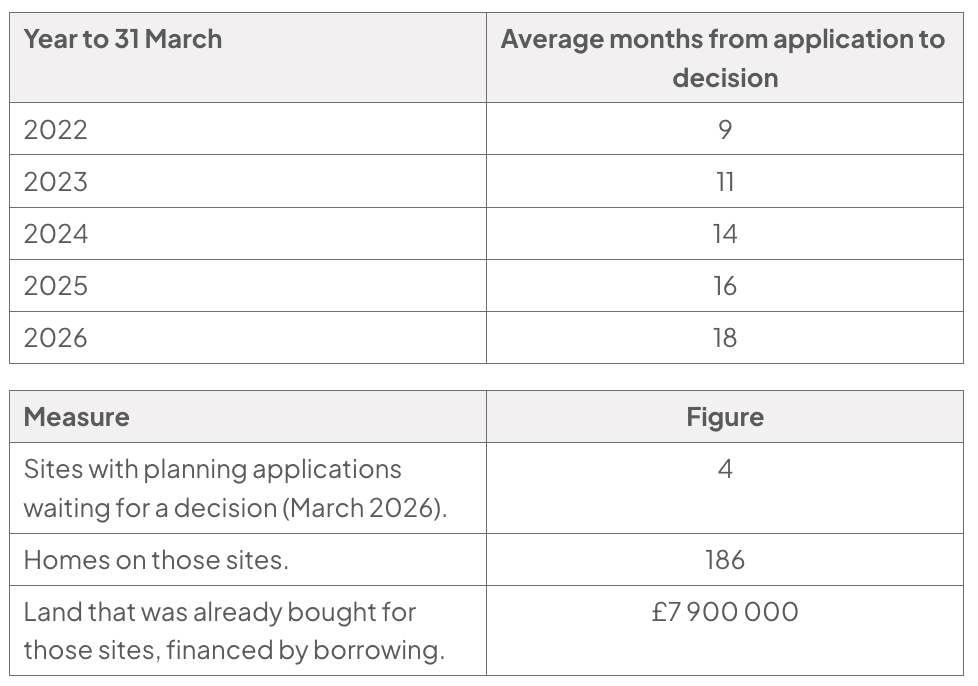
Appendix E: Waiting for planning permission

Line graph of average planning-decision waiting time from 2022 to 2026: 9, 11, 14, 16 and 18 months respectively, with a continuous rise.
Two tables: average planning-decision waiting time rose from 9 months in 2022 to 18 in 2026. In March 2026, 4 sites covering 186 homes were awaiting decisions; borrowed land cost £7 900 000.

Source: Fenwick Vale Homes

Assess whether rising building costs are the main reason for the fall in Fenwick Vale Homes' profit.

Calculate Fenwick Vale Homes' gross profit margin for the year to 31 March 2026 to support your answer. Give your answer to one decimal place.

5
9 marks

Source A: Lancashire Cricket

Lancashire County Cricket Club Limited, known as Lancashire Cricket, was founded in 1864 and plays at Emirates Old Trafford in Manchester. It has men's and women's teams, hosts international matches, and runs a hotel and a conference and events business at the ground. It is not owned by shareholders: it is a registered society, owned by its members, who vote at its general meetings and elect some members of its Board.

In 2025 Lancashire Women won their first two professional trophies, and Emirates Old Trafford hosted a five-day men's Test match against India. Turnover rose slightly, to £34.8 million. The Chief Executive said that "the primary challenge for the business now is not revenue generation" but operating costs, which have increased significantly since the pandemic. During the year the club outsourced its catering and retail operations.

In 2025 the England and Wales Cricket Board (ECB) sold stakes in the eight teams in The Hundred, a short-format competition. RPSG Group, an Indian business which also owns teams in the Indian Premier League and South Africa, bought 70% of Manchester Originals; Lancashire Cricket kept 30%, and the team was renamed Manchester Super Giants. The club received dividends of £29.2 million from the sale, repaid £13.3 million of loans, and expects further dividends over the next few years. Lancashire Cricket's surplus before tax was £25.8 million.

The club's £20 million second ground at Farington, near Preston, built in partnership with Lancashire County Council, was handed over to the club in early 2026.

Source: Lancashire County Cricket Club Limited, Annual Report and Financial Statements 2025

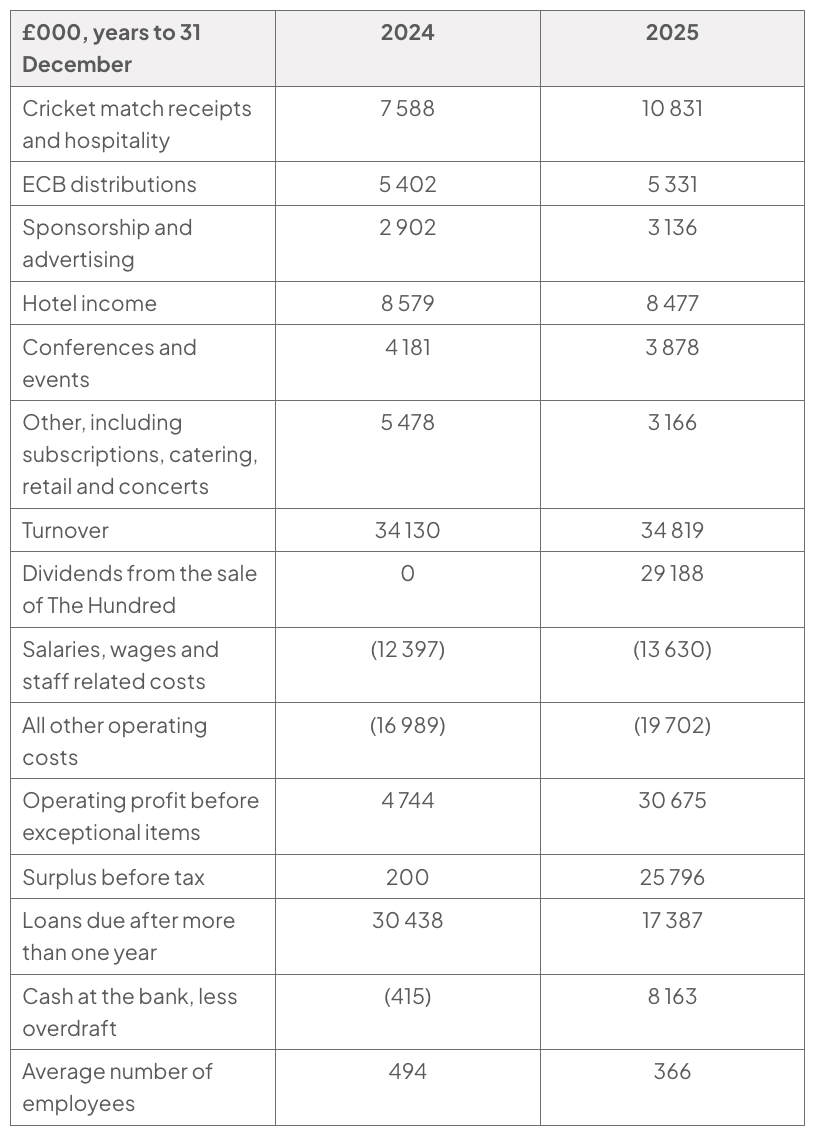
Appendix A: Lancashire Cricket financial data

Financial table in £000 for years to 31 December 2024 and 2025: turnover 34 130 and 34 819; dividends from the sale of The Hundred 0 and 29 188; salaries, wages and staff related costs (12 397) and (13 630); all other operating costs (16 989) and (19 702); operating profit before exceptional items 4 744 and 30 675; average number of employees 494 and 366.

Source: Lancashire County Cricket Club Limited

Appendix B: Cricket, venue, costs and digital

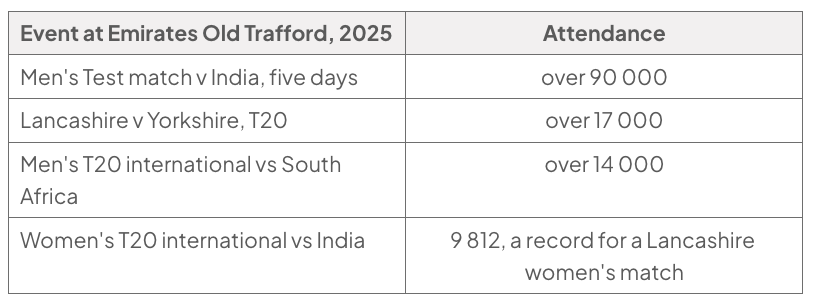
Table of events at Emirates Old Trafford in 2025 and attendance: men’s Test match v India, over 90 000; Lancashire v Yorkshire T20, over 17 000; men’s T20 v South Africa, over 14 000; women’s T20 v India, 9 812, a record.
  • 2026 fixtures. Two men's T20 internationals and four matchdays of the ICC Women's T20 World Cup. The club expects international cricket "will be challenging financially compared to previous years". No concerts are planned; there were three sold-out concerts in 2024 and none in 2025.

  • Hotel. Revenue just below £8.5m, down just over 1%, with high occupancy but a slightly lower average room rate.

  • Conferences and events. "A very competitive market, with many companies slowing down spend"; revenue fell by just over £0.3m.

  • Costs. Since 2019 payroll has risen by £2.4m (22%) and utilities by £0.4m (56%). Business rates will rise by £0.2m in 2026 and a further £0.2m in 2027. The National Living Wage and employers' National Insurance contributions both rose in April 2025. The club gave staff a standard pay rise of 2% and says "the UK economy is not thriving".

  • The economy, September 2026. Bank Rate 3.75%; inflation 3.1%; unemployment 4.9%.

  • Digital. In July 2025 the club launched LancsTV, a streaming service built with StreamAMG, a Manchester company, showing all non-televised home men's and women's matches, interviews and archive footage. It is free, but viewers must register; members and ticket holders use the same login as for tickets and membership. A members-only area, LancsTV+, is planned. The Chief Executive said: "we have no plans to charge supporters to watch LancsTV". The club also updated its website in 2025.

  • Partnerships. Commercial partnership revenue is about £3m a year.

Source: Analyst, using Lancashire County Cricket Club Limited, the Bank of England, the Office for National Statistics and press reports

Assess whether changes in the economic environment are the main threat to Lancashire Cricket's profit.

Calculate Lancashire Cricket's employee costs as a percentage of revenue in 2025, using its salaries, wages and staff related costs and its turnover, to support your answer. Give your answer to one decimal place.

6
9 marks

Source B: Stowe Valley Mutual

Stowe Valley Mutual is a building society founded in 1867 in Buckingham. It takes savings from its members and lends to members who are buying a home. It has nine branches in Buckinghamshire and Oxfordshire and 155 employees. As a building society it has no shareholders: it is owned by its 97 100 members, its savers and borrowers, who each have a vote at its annual general meeting. Its profits are not paid out as dividends but kept as reserves, which the law requires it to hold to protect its savers.

Its mission is "helping members save and own their homes, with a branch in every town we serve". By law, at least half of a building society's funds must come from its members' savings, and at least three-quarters of its lending must be secured on homes.

Stowe Valley Mutual's income comes mainly from the gap between the interest it earns on mortgages and the interest it pays to savers. Bank Rate, the Bank of England's interest rate, has fallen from 5.25% in July 2024 to 3.75% in September 2026.

Its board measures performance with key performance indicators including its cost to income ratio (operating costs as a percentage of income), its profit before tax, and the satisfaction of its members.

Source: Stowe Valley Mutual

Appendix D: Stowe Valley Mutual selected data

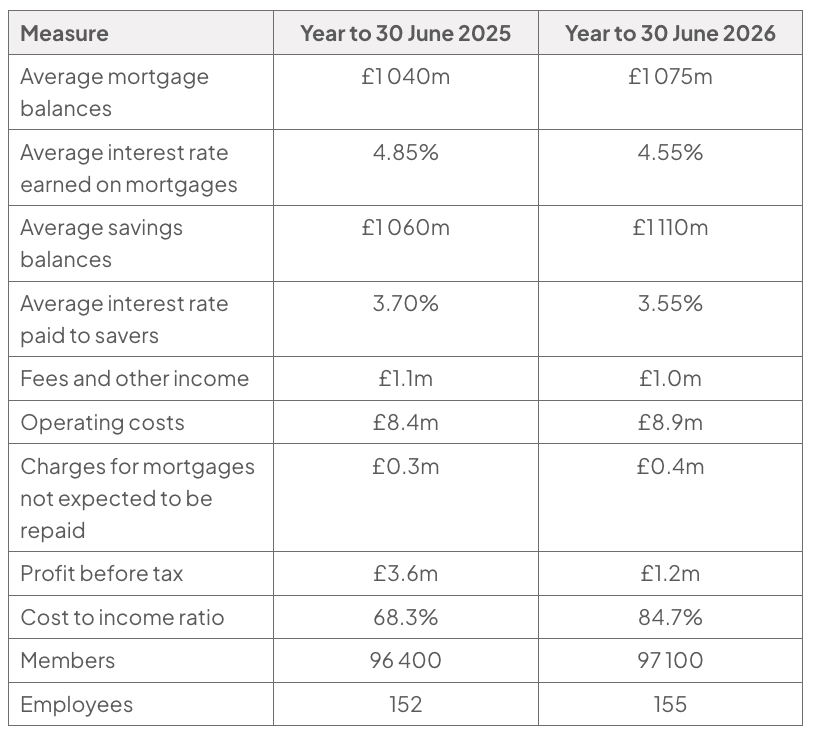
Table comparing the years to 30 June 2025 and 2026: average mortgage balances £1 040m and £1 075m, earning 4.85% and 4.55%; average savings balances £1 060m and £1 110m, paying 3.70% and 3.55%; also fees and other income, operating costs, charges for mortgages not expected to be repaid, profit before tax, cost to income ratio, members and employees.

Interest earned on the society's cash and other liquid assets is included in fees and other income.

Source: Stowe Valley Mutual

Appendix E: Interest rates and the economy

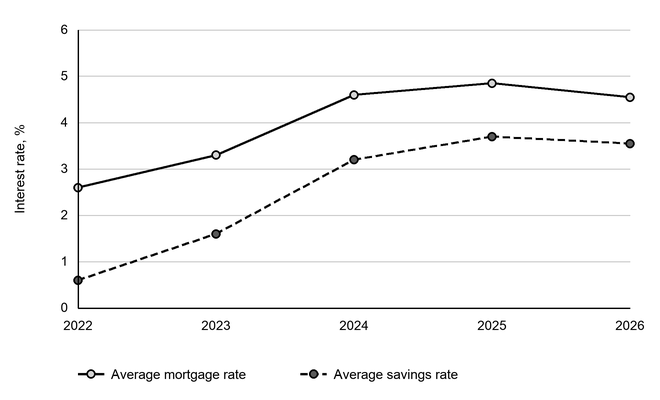
Line chart of average mortgage and savings rates from 2022 to 2026, with rates rising to 4.85% and 3.70% in 2025 before falling to 4.55% and 3.55% in 2026; y-axis 0 to 6%.
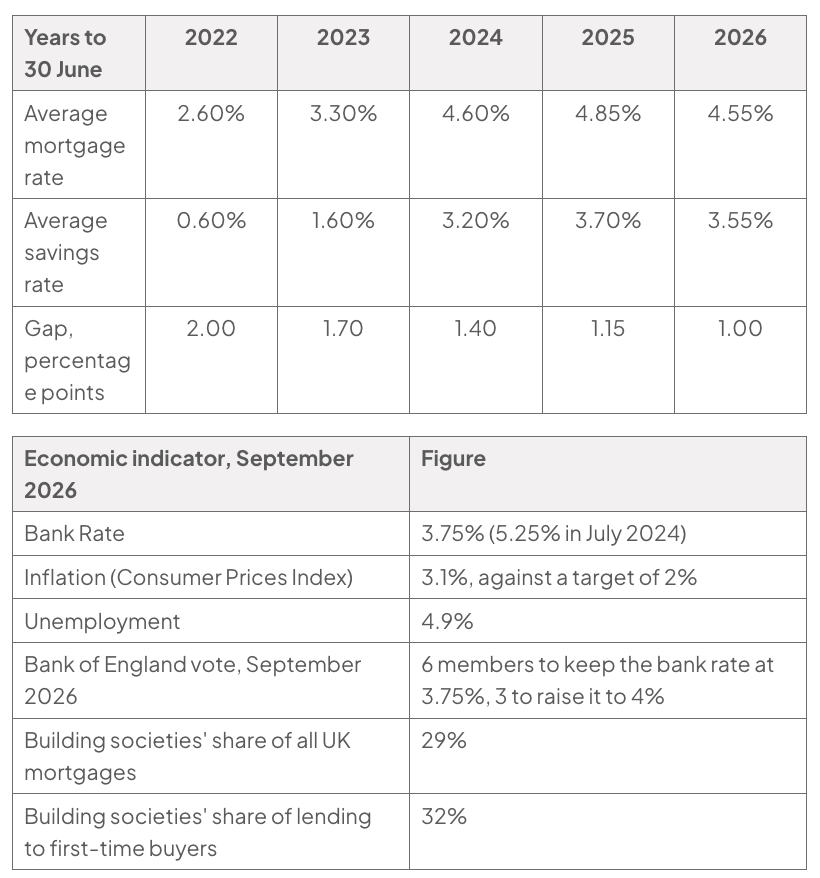
Table of mortgage rates 2.60%, 3.30%, 4.60%, 4.85%, 4.55%; savings rates 0.60%, 1.60%, 3.20%, 3.70%, 3.55%; and gaps 2.00 to 1.00 percentage points, 2022 to 2026. Includes 2026 economic indicators.

Many of Stowe Valley Mutual's mortgages are fixed for two or five years, so their rates change only when they end. Savers can move their money more quickly.

Source: Analyst, using Stowe Valley Mutual, the Bank of England, the Office for National Statistics and the Building Societies Association

Assess whether a further fall in Bank Rate is likely to increase Stowe Valley Mutual's profit.

1
15 marks

Source A: Barratt Redrow

Barratt Redrow plc, listed on the London Stock Exchange, is the UK's largest housebuilder by number of homes. Formed when Barratt Developments bought Redrow in October 2024, it builds under three brands: Barratt Homes, David Wilson Homes and Redrow.

In the 52 weeks to 28 June 2026:

  • homes completed rose by 5.0% to 17 667

  • revenue rose by 6.6% to £6 055.0 million

  • adjusted profit before tax fell by 7.1% to £572.8 million

To keep sales moving while mortgages were expensive, the company increased incentives for buyers, such as help with a deposit and part-exchange, and sold more homes to housing associations and to investors building up homes to rent.

The company faces three main pressures:

  • Planning. It describes planning as a constraint on output. Delays in gaining planning permission meant it expected to open fewer new sales sites, and in September 2026 it reduced its forecast of completions for the following year. The Planning and Infrastructure Act, intended to speed up decisions, became law in December 2025.

  • Past building work. Under the Building Safety Act it must pay to put right fire-safety defects in buildings it developed, and continues to find and repair problems at older developments.

  • Competition law. A claim filed in June 2026 against seven housebuilders, including Barratt Redrow, alleges that their sharing of information raised prices for buyers.

The company says the government must do more to support demand from first-time buyers, and that regulatory and tax burdens make many sites uneconomic. It plans to return £400 million to shareholders in the year to June 2027.

Source: Barratt Redrow plc, Results for the 52 weeks ended 28 June 2026

Appendix A: Barratt Redrow selected data

Table of Barratt Redrow selected data for the years to June 2025 and June 2026: homes completed 16 826 and 17 667; of which wholly owned 16 288 and 17 101; of which affordable homes sold to housing associations and councils 2 963 and 3 774; affordable homes as a percentage of wholly owned completions 18.2% in 2025 and not provided for 2026; revenue £5 679.4m and £6 055.0m; adjusted gross profit £989.0m and £926.6m; adjusted gross profit margin 17.4% and 15.3%; adjusted profit before tax £616.5m and £572.8m; average selling price of a private home £381 500 and £394 100; change in underlying selling prices, excluding the size and location of homes, just under 1% fall in 2026; plots of land owned or controlled 100 004 and 88 595; net cash £772.6m and £772.8m; dividends paid £242.2m in 2026; shares bought back £50m and £100m. No 2025 figure is given for the change in underlying selling prices or for dividends paid.

Figures for the year to June 2025 combine Barratt and Redrow for the whole year.

Source: Barratt Redrow plc

Appendix B: The market and the government

  • Buyers. The company reports that higher mortgage rates and pressure on what buyers can afford continue to affect confidence, but that demand from committed buyers remains resilient. It offers schemes including part-exchange, a deposit contribution for key workers and Deposit Unlock, aimed at first-time buyers.

  • Planning. The Planning and Infrastructure Act became law in December 2025, and a revised National Planning Policy Framework was published in August 2026. The company says these should boost housing delivery "in time". It reduced its forecast for completions in the year to June 2027 to 17 500 to 17 900, from 17 700 to 18 200, because of planning delays.

  • Land. The company approved the purchase of fewer plots than planned because of uncertainty about build cost inflation. The estimated gross margin on the land it owns fell from 19.2% to 17.3%.

  • New homes standards. The Future Homes Standard will require new homes to produce far lower carbon emissions when in use.

  • Shareholders. The company plans to return £400m to shareholders in the year to June 2027.

Source: Analyst, using Barratt Redrow plc

Higher mortgage rates and pressure on what buyers can afford continue to affect confidence in the housing market.

Evaluate two ways Barratt Redrow could respond to these economic conditions and recommend which one it should focus on first.

2
15 marks

Source B: Quarrenden Drinks

Quarrenden Drinks Limited is a family-owned private limited company, founded in 1996 on a family farm near Tiverton, Devon. It employs 46 people and makes two types of drink, both with no added sugar:

  • pressed apple juice

  • lightly sparkling fruit drinks

The drinks are sold in glass bottles at premium prices to farm shops, delicatessens, cafés, independent grocers and two regional supermarket chains, and through the company's own website, which also offers a monthly subscription box. Some of the bottles delivered to cafés are returned, washed and refilled.

Quarrenden buys all its apples from 34 orchards in Devon and Somerset, under three-year contracts at a fixed price above the market price. Drinks with no added sugar are not charged the Soft Drinks Industry Levy.

The company faces three main pressures:

  • Costs. Quarrenden's costs rose sharply in 2025, including the cost of glass bottles, energy and wages. The National Living Wage and employers' National Insurance both rose in April 2025.

  • Health advice. NHS advice is to drink no more than 150ml of fruit juice and smoothies a day.

  • Customers. Both regional supermarket chains have asked suppliers for evidence of their social and environmental standards.

Its directors are considering how to respond, including raising all prices or moving the sparkling range from glass bottles to cans.

Source: Quarrenden Drinks

Appendix D: Quarrenden Drinks selected data

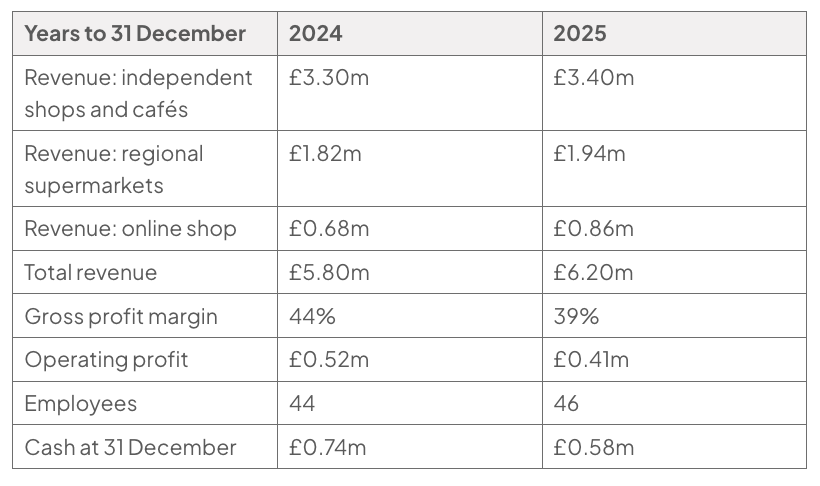
Table of Quarrenden Drinks’ selected data for years ending 31 December 2024 and 2025: revenue by channel and total, gross profit margin, operating profit, employees and year-end cash.

Source: Quarrenden Drinks

Appendix G: Rising costs and two responses

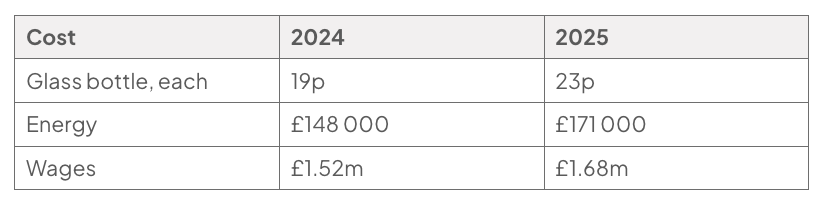
Table of Quarrenden Drinks’ costs in 2024 and 2025: glass bottles rose from 19p to 23p each, energy from £148 000 to £171 000, and wages from £1.52 million to £1.68 million.
  • Wages and tax. The National Living Wage rose to £12.21 an hour in April 2025 and £12.71 in April 2026. In April 2025 employers' National Insurance rose from 13.8% to 15%, and the earnings level at which it starts fell from £9 100 to £5 000 a year.

  • Price. When Quarrenden raised its prices by 5% in 2024, the number of bottles it sold fell by about 2%.

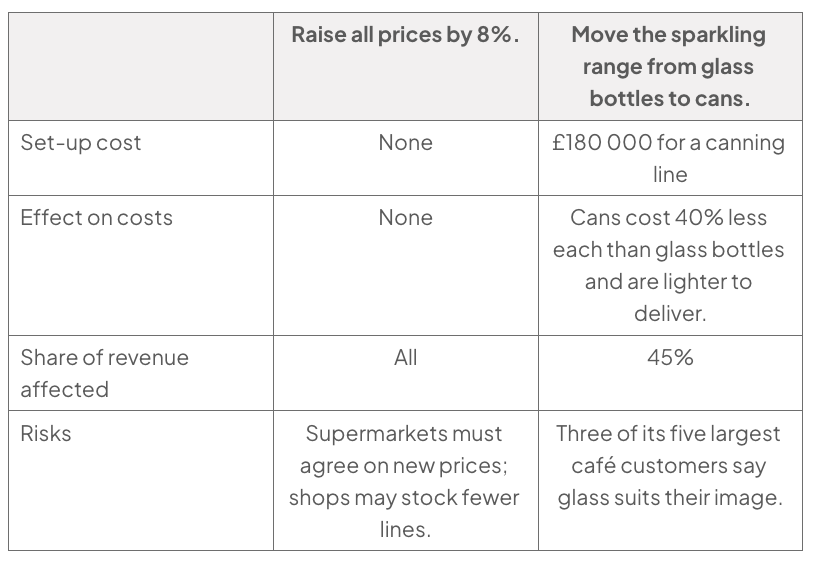
Comparison table: raising all prices by 8% has no set-up cost, affects all revenue and risks fewer product lines; moving to cans costs £180 000, affects 45% of revenue, cuts container costs by 40%, but risks café customers.

Source: Quarrenden Drinks

Quarrenden Drinks' costs rose sharply in 2025. Its directors are considering raising all prices by 8% or moving the sparkling range from glass bottles to cans.

Evaluate which option Quarrenden Drinks should choose.

Use information from Appendices D and G to support your answer.

3
15 marks

Source B: Brackenfold Outdoor

Brackenfold Outdoor Limited is a private limited company, founded in 1987 in Kendal, Cumbria. It designs and makes waterproof jackets and trousers for walkers and for people who work outdoors, and employs 132 people. Its waterproof fabric is bought from an overseas supplier and priced in US dollars.

Brackenfold sells its products in three markets:

  • United Kingdom. It sells to outdoor shops and through its own website.

  • European Union. It sells to shops in the European Union.

  • United States. It sells to shops through a distributor.

In 2025 its sales to the European Union rose, while its sales to the United States fell.

Brackenfold also offers a repair service for its products. The number of jackets it repaired rose by more than half in 2025. In a survey of its website customers, more than half said they would rather repair a jacket than replace it.

The company faces two main pressures:

  • Trade. Since April 2025 most UK goods sold into the United States have faced an extra US tariff of 10%.

  • Costs. Its wage costs rose in 2025, after increases in the National Living Wage and in employers' National Insurance. The price of its waterproof fabric also rose.

Brackenfold's directors are considering investing in automated cutting machinery.

Source: Brackenfold Outdoor

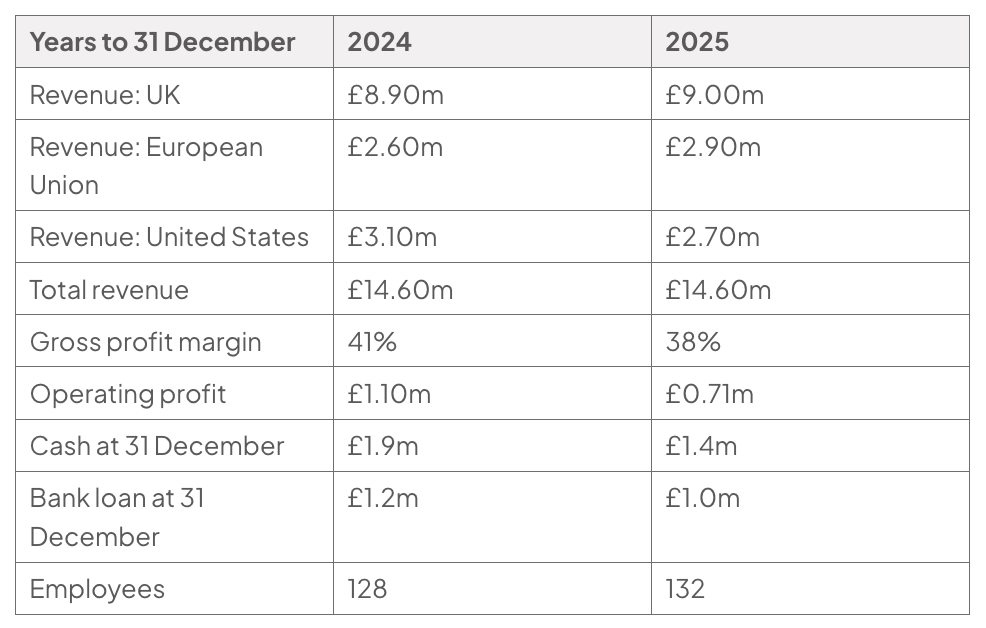
Appendix D: Brackenfold Outdoor selected data

Table of Brackenfold Outdoor’s 2024 and 2025 figures: revenue by market, total revenue, gross profit margin, operating profit, cash, bank loan and employees.

Source: Brackenfold Outdoor

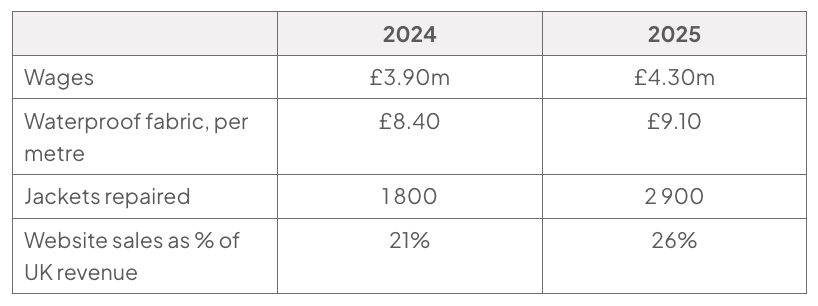
Appendix E: Costs and customers

Table comparing Brackenfold Outdoor’s 2024 and 2025 figures: wages £3.90m to £4.30m; fabric per metre £8.40 to £9.10; jackets repaired 1 800 to 2 900; website sales as a percentage of UK revenue 21% to 26%.
  • Wages. The National Living Wage rose to £12.21 an hour in April 2025 and £12.71 in April 2026. In April 2025 employers' National Insurance rose from 13.8% to 15%.

  • Customers. In a survey of website customers, 58% said they would rather repair a jacket than replace it, and 44% said price was the most important factor when choosing outdoor clothing.

  • Loan. The interest rate on Brackenfold's bank loan changes with the Bank of England's Bank Rate.

Source: Brackenfold Outdoor

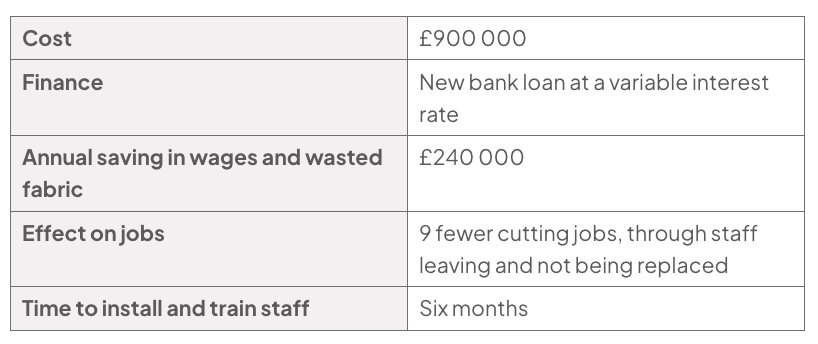
Appendix G: Automated cutting machinery

Table of automated cutting machinery: cost £900 000; finance via a new bank loan at a variable interest rate; annual savings £240 000; nine fewer cutting jobs; installation and staff training take six months.
  • The machinery could cut 30% more fabric a year than Brackenfold uses now.

Source: Brackenfold Outdoor

Brackenfold Outdoor's directors are considering borrowing £900 000 to invest in automated cutting machinery.

Evaluate whether Brackenfold Outdoor should invest in automated cutting machinery now or delay the investment until interest rates and demand are clearer.

Use information from Appendices D, E and G to support your answer.