Implementing Strategic Decisions (AQA A Level Business): Exam Questions

Exam code: 7132

Syllabus Edition

First teaching 2026

First exams 2028

2 hours17 questions
1
6 marks

Source A: Rightmove

Rightmove plc runs the UK's largest property portal, where estate agents, letting agents and housebuilders advertise homes for sale and to rent. It is listed on the London Stock Exchange. Its customers are the agents and developers, who pay a monthly subscription; people looking for a home use the website and app free of charge. In 2025 users spent 16.8 billion minutes on Rightmove, which had 89% of all the time spent on UK property portals in December 2025, and more than 85% of visits came to the site directly rather than through a search engine or advertisement.

In the year to 31 December 2025 Rightmove's revenue rose 9% to £425.1 million and its underlying operating profit rose 9% to £297.7 million, a margin of 70%. Average revenue per advertiser rose by 6%, while the number of advertisers rose by 1%. Most agents choose a package of products, and a growing share choose the most expensive one.

Rightmove has three newer areas of business, which it calls its strategic growth areas: commercial property, mortgages and services for landlords and tenants. Together their revenue grew by 25% in 2025.

The company is using artificial intelligence across its business. It had 46 strategic AI initiatives in progress by June 2026. It has also launched a conversational search tool developed with Google Cloud and has submitted an app for use within ChatGPT. In November 2025 it announced that it would increase its investment in technology and AI, and that its underlying operating profit would therefore grow by only 3% to 5% in 2026. Its share price fell by more than 25% that day.

Source: Rightmove plc, Results for the year ended 31 December 2025, and Half Year Results 2026

In December 2025 Rightmove had 89% of all the time people spent on UK property portals, and more than 85% of its visits came to the site directly.

Analyse one way in which this share of users' time might help Rightmove to maintain its competitiveness.

2
6 marks

Source A: Mitie

Mitie Group plc was founded in 1987 and is listed on the London Stock Exchange. It is the UK's leading facilities management company, employing 84 000 colleagues who clean, guard, maintain and upgrade buildings for customers such as the Home Office, Transport for London, Asda and GSK.

Mitie's strategic plan for the three years to March 2027 aims to move it from facilities management, where UK market growth is about 2-3% a year, into higher-margin work: Facilities Transformation projects, such as building upgrades, data centres and decarbonisation; and Facilities Compliance, such as fire and security systems that buildings must have by law. In August 2025 it bought Marlowe, a compliance business, for about £350 million in cash and shares.

In the year to 31 March 2026 revenue rose by 10.5% to £5 619 million, including 5.3% organic growth. Costs were increased by higher employers' National Insurance contributions and the loss of two public sector contracts.

Mitie describes itself as "technology-led" and has launched a programme to "re-imagine and optimise" its internal workflows and customer services through agentic AI: AI systems that can carry out tasks with little human input. Its Chief Executive, Phil Bentley, intends to retire at the end of the strategic plan, once a successor is in place.

Source: Mitie Group plc, results for the 12 months to 31 March 2026

Mitie's Chief Executive, Phil Bentley, intends to retire at the end of Mitie's three-year strategic plan, once a successor is in place.

Analyse one way in which a change of Chief Executive might affect the implementation of Mitie's strategy.

3
6 marks

Source B: Bretforton Facilities

Bretforton Facilities Limited was founded in 1989 by Anne Fielding in Bretforton, near Evesham, and is still owned by her family. Her son, Mark Fielding, is Managing Director. It cleans and maintains about 180 schools, 64 GP surgeries and health centres, and a number of offices across Worcestershire and the West Midlands, and employs 640 people, most of them part-time cleaners and caretakers.

Its mission is "clean, safe buildings, looked after by local people who are paid fairly". Since 2016 it has been an accredited Real Living Wage employer, which means it pays all its staff at least the Real Living Wage, a voluntary rate set by the Living Wage Foundation that is higher than the legal National Living Wage. Its objective is to reach £30 million of revenue by 2030 while remaining a Real Living Wage employer.

Bretforton Facilities competes for contracts against national facilities management companies, which can often offer lower prices. Its largest customer, a county council, wants to cut the price of its contract when it is renewed next year.

Anne Fielding is 71 and wants to sell the business. A national competitor, Corvane Group, has made an offer, and the family is also considering selling to an employee ownership trust.

Source: Bretforton Facilities

In 2026 Bretforton Facilities introduced an app that gives cleaners their schedules and lets them report problems. Most of its employees are part-time cleaners and caretakers.

Analyse one way in which Bretforton Facilities' employees might affect how successfully the app is introduced.

4
6 marks

Source A: Alexander Dennis

Alexander Dennis Limited (ADL) is a private limited company, owned since 2019 by NFI Group, a Canadian bus and coach maker. It designs and builds single-deck and double-deck buses, including electric buses, and provides spare parts and servicing. It has factories in Scarborough and at Falkirk and Larbert in Scotland, and businesses in Hong Kong, New Zealand, Singapore, Malaysia, Germany and Mexico.

In 2025 ADL's turnover fell by 18.1% to £426.9 million, which it blamed on "increasing Chinese competition for zero-emission vehicles". By market:

  • UK: fell from £482.5 million to £370.7 million

  • Americas: rose from £8.1 million to £31.3 million; firm orders in North America run to 2028

Government grants help bus operators in England and Scotland buy zero-emission buses from any maker. ADL argues that UK rules for buying buses do not reward "local content, job retention and creation". In March 2026 it called the results of Scotland's latest grant scheme "extremely disappointing with the majority of the available funding going overseas".

ADL's Scottish factories have faced two proposals:

  • June 2025: close both, putting 400 jobs at risk, and move all bus-body building to Scarborough. In September 2025, after talks with the UK and Scottish governments and trade unions, ADL kept both.

  • March 2026: close Falkirk and turn Larbert into a site for building chassis, the frame and running gear under a bus body, with up to 115 jobs at risk, about 200 safeguarded and about 350 kept in Scotland. ADL keeps the option of bringing bus-body building back to Larbert if UK volume rises.

Source: Alexander Dennis Limited, annual report and financial statements for the year ended 28 December 2025, and press reports

In March 2026 Alexander Dennis proposed closing its Falkirk factory and turning its Larbert factory into a site for building chassis.

Analyse one factor that might affect how successfully Alexander Dennis implements this plan.

5
6 marks

Source B: Hartlake Department Store

Hartlake Department Store Limited has traded from the same building on the high street of a Cheshire market town since 1886. The Hartlake family owns it, and all four directors are family members; the Managing Director is Rachel Hartlake. The board meets four times a year.

The store has four floors selling clothing, beauty, homeware and toys, a café, and 6 500 square metres of selling space. Most in-store sales are to customers aged 55 or over.

Hartlake employs 196 people, down from 210 a year earlier. Many have worked there for more than ten years; 38% are over 50. Most sales staff have strong relationships with regular customers.

In 2023 a new till system took nine months to install instead of the planned three, and cost 40% more than budgeted. In 2025 Hartlake:

  • relaunched its website, offering delivery and click-and-collect; most online sales are to customers under 45

  • introduced self-service tills on the ground floor

In the year to 31 January 2026:

  • revenue fell to £17.1 million and the store made its first operating loss for eleven years

  • visitors to the store fell from 1.42 million to 1.31 million

  • the share of online orders collected in store rose from 31% to 46%; customers who collect spend an average of £18 more in the store on the same visit

  • in a staff survey, 34% of employees felt prepared for the changes ahead

The board must choose between two plans to change the business in 2026. The Managing Director says: "We have never had to change this much, this quickly."

Source: Hartlake Department Store

All four of Hartlake Department Store's directors are members of the Hartlake family, which has owned the store since 1886.

Analyse one way in which Hartlake's leadership might affect how successfully it implements a new strategy.

6
6 marks

Source A: Wickes

Wickes Group plc is a UK home improvement retailer listed on the London Stock Exchange. It became an independent company in 2021, when it separated from Travis Perkins. It has 230 stores and about 7 800 employees, and serves three groups of customers:

  • Tradespeople, through its TradePro membership scheme. Sales to TradePro members rose in 2025.

  • Do-it-yourself customers.

  • Design & Installation customers, whose kitchens and bathrooms it designs and fits.

It reports a "market-leading price position" against its wider peer group.

Wickes describes itself as "a digitally-led, service-enabled home improvement retailer". Two-thirds of its sales are digitally enabled, but 96% are fulfilled from its stores. Wickes has cut the time to prepare a Click & Collect order from 30 minutes to 15 minutes, and Wickes Rapid delivers orders of up to 800kg to a home or building site within three hours. Its strategy rests on seven "growth levers", including winning trade customers, digital capability and store investment.

Several rivals, including Homebase, have left the market since 2023. Homebase went into administration at the end of 2024, and Carpetright, CTD Tiles and Wilko have also left. Four of Wickes's five new stores in 2025 were former Homebase stores, and it employed 54 former Homebase staff.

In March 2026 the chief executive, David Wood, announced an ambition to reach 300 stores, creating more than 2 000 new jobs. Wickes plans 4 to 5 new stores in 2026, 7 to 9 in 2027 and at least 10 a year from 2028. It reports "ever-increasing demand for prime retail locations".

Source: Wickes Group plc, results for the year ended December 2025, annual report 2025 and half-year results 2026

Wickes has announced an ambition to grow from 230 to 300 stores.

Analyse one factor that might affect how successfully Wickes implements this plan.

7
6 marks

Source B: Thistleden Kitchens

Thistleden Kitchens Limited is a private limited company, founded in Penrith, Cumbria, in 2003. It designs, makes and fits hand-built painted timber kitchens, each designed for the individual customer, and employs 64 people. In 2025 its kitchens sold for an average of £26 300.

It sells through four showrooms:

  • Penrith, Kendal and Carlisle, in Cumbria

  • Newcastle upon Tyne, opened in February 2025, its first outside Cumbria

Kitchens are made in its workshop in Penrith and fitted either by its own team of fitters or by subcontractors. Customers pay a 40% deposit when they order, and the balance when the kitchen is fitted.

Thistleden uses timber certified as coming from responsibly managed forests, trains four apprentices a year, and passes customers' old kitchens that can be reused to a local charity.

The company faces three main pressures:

  • Competition. National kitchen retailers offer free design visits and online booking.

  • Demand. Its order book fell in both 2024 and 2025, and its revenue and operating profit fell in 2025.

  • Fitting. In 2025 a higher share of kitchens was finished later than promised than in 2024, and about a third of kitchens were fitted by subcontractors.

In 2026 Thistleden introduced new software to schedule its fitters. A regional housebuilder has offered it a three-year contract to supply kitchens for new homes.

Source: Thistleden Kitchens

In 2026 Thistleden Kitchens introduced new software to schedule its fitters.

Analyse one factor that might affect how successfully Thistleden Kitchens implements this new software.

8
6 marks

Source B: Brackenfold Outdoor

Brackenfold Outdoor Limited is a private limited company, founded in 1987 in Kendal, Cumbria. It designs and makes waterproof jackets and trousers for walkers and for people who work outdoors, and employs 132 people. Its waterproof fabric is bought from an overseas supplier and priced in US dollars.

Brackenfold sells its products in three markets:

  • United Kingdom. It sells to outdoor shops and through its own website.

  • European Union. It sells to shops in the European Union.

  • United States. It sells to shops through a distributor.

In 2025 its sales to the European Union rose, while its sales to the United States fell.

Brackenfold also offers a repair service for its products. The number of jackets it repaired rose by more than half in 2025. In a survey of its website customers, more than half said they would rather repair a jacket than replace it.

The company faces two main pressures:

  • Trade. Since April 2025 most UK goods sold into the United States have faced an extra US tariff of 10%.

  • Costs. Its wage costs rose in 2025, after increases in the National Living Wage and in employers' National Insurance. The price of its waterproof fabric also rose.

Brackenfold's directors are considering investing in automated cutting machinery.

Source: Brackenfold Outdoor

Brackenfold Outdoor offers a repair service for its jackets and trousers.

Analyse one factor that might affect how successfully Brackenfold Outdoor expands its repair service.

1
9 marks

Source A: Burberry

Burberry Group plc is a British luxury fashion brand, headquartered in London and listed on the London Stock Exchange, where it is a member of the FTSE 100. It was founded in 1856 by Thomas Burberry, whose gabardine fabric and trench coat became the basis of the brand. It sells mainly through its own stores, of which there were 410 at 28 March 2026, and online. It also sells to other retailers and earns income from licences.

In the 52 weeks to 29 March 2025 Burberry's comparable store sales fell by 12% and its adjusted operating profit fell to £26 million. Joshua Schulman, who became Chief Executive in July 2024, launched a strategy called Burberry Forward in November 2024. Its aims include restoring the brand's cultural relevance and asserting its authority in outerwear and scarves before extending that success to other categories.

In the 52 weeks to 28 March 2026 Burberry's revenue was £2 420 million, compared with £2 461 million the year before, while comparable store sales rose by 2% and adjusted operating profit rose to £160 million. The Chief Executive described the year as "a meaningful inflection point". During the year the company:

  • achieved savings in operating costs of £80 million, while continuing to invest in marketing;

  • spent £45 million on restructuring, mainly on redundancies and consultancy;

  • opened 200 scarf bars in its stores;

  • increased e-commerce sales by a percentage in the high teens;

  • opened 9 stores and closed 21.

Outerwear sold better than other categories in every region, scarves grew throughout the year, and sales of leather goods improved in the second half.

Sales growth differed between regions. In Europe, the Middle East, India and Africa, sales were held back by a fall in tourist numbers. In Japan, sales fell by 6% in the final quarter as fewer visitors arrived, while South Korea grew by 13%, helped by visitors from China. In Greater China and the Americas, sales in the final quarter grew by 10%, driven by local customers.

For the year to March 2027 Burberry expects to increase both its revenue and its profit margin, but says it is mindful of the uncertain economic and political environment.

Source: Burberry Group plc, Preliminary Results, 14 May 2026

Appendix A: Burberry selected data

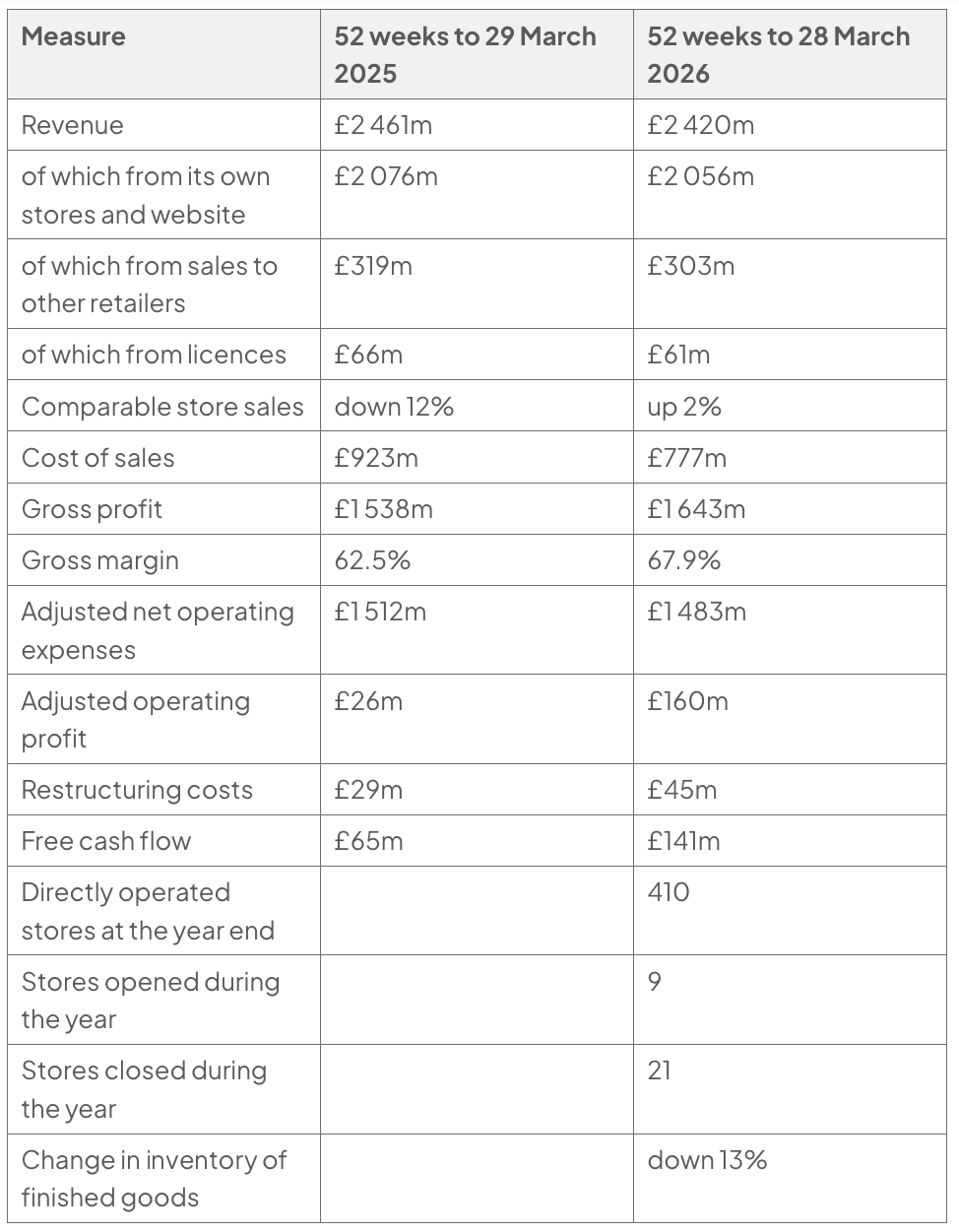
Table comparing Burberry’s selected data for the 52 weeks to 29 March 2025 and 28 March 2026. For 2026, revenue is £2 420m and adjusted net operating expenses £1 483m, with revenue, costs, margins and cash flow for both years and store data for 2026.

The gross margin in the year to March 2026 was helped by better sales at full price and by recovery from the clearance of excess inventory in the previous year.

Source: Burberry Group plc

Appendix B: Burberry Forward and the year ahead

  • In stores. 200 scarf bars opened in FY26. "Polo galleries" and "trench destinations" are being introduced in FY27 to encourage customers to buy across categories.

  • Online. E-commerce sales grew by a percentage in the high teens, helped by an improved website.

  • Costs. Savings of £80 million were achieved in FY26; annual savings are expected to reach £100 million in FY27. The company continued to invest in marketing.

  • Expectations for FY27. Growth in revenue and in profit margin; store space broadly unchanged; sales to other retailers expected to grow by a mid-single-digit percentage in the first half; capital spending of about £120 million.

  • Risks. The company is mindful of the uncertain geopolitical and economic environment and its possible effect on consumer confidence.

  • Board. The Chair will retire in November 2026 and be succeeded by a new Chair who joins the Board in July 2026.

Source: Analyst, using Burberry Group plc

Assess whether cutting operating costs while continuing to invest in marketing is likely to help Burberry implement its Burberry Forward strategy successfully.

Calculate Burberry's adjusted operating profit margin in the 52 weeks to 28 March 2026 to support your answer. Give your answer to one decimal place.

2
9 marks

Source A: AstraZeneca

AstraZeneca plc is a global pharmaceutical company with its headquarters in Cambridge, UK. Its medicines treat cancer, heart, kidney and metabolic disease, respiratory disease and rare diseases. It had 16 "blockbuster" medicines, each with annual sales of more than $1 billion, in 2025. It is one of the largest companies in the FTSE 100, and since 2 February 2026 its shares have also traded on the New York Stock Exchange. It remains listed and headquartered in the UK.

In 2025 total revenue rose by 9% to $58.7 billion, with growth in every major region. AstraZeneca has set itself the ambition of reaching $80 billion of total revenue in 2030.

In July 2025 AstraZeneca announced plans to invest $50 billion in the United States by 2030, including a manufacturing plant in Virginia. In October 2025 it agreed with the US government to offer US patients lower prices, in return for three years' exemption from US tariffs on pharmaceuticals. In the UK, it dropped a planned £450 million vaccine plant at Speke, Merseyside, in 2025, and in September 2025 paused a £200 million expansion of its research centre in Cambridge.

Developing a new medicine takes many years, and most candidates fail in clinical trials. AstraZeneca also buys and licenses medicines discovered by other companies.

Source: AstraZeneca plc, results for the full year 2025 and the first half of 2026

Appendix A: AstraZeneca financial data

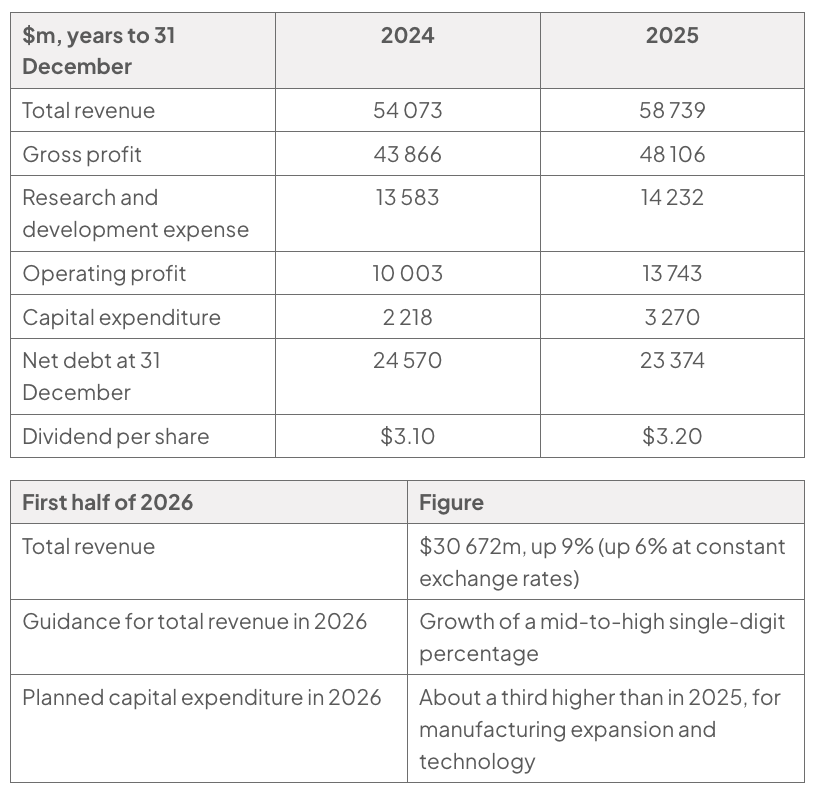
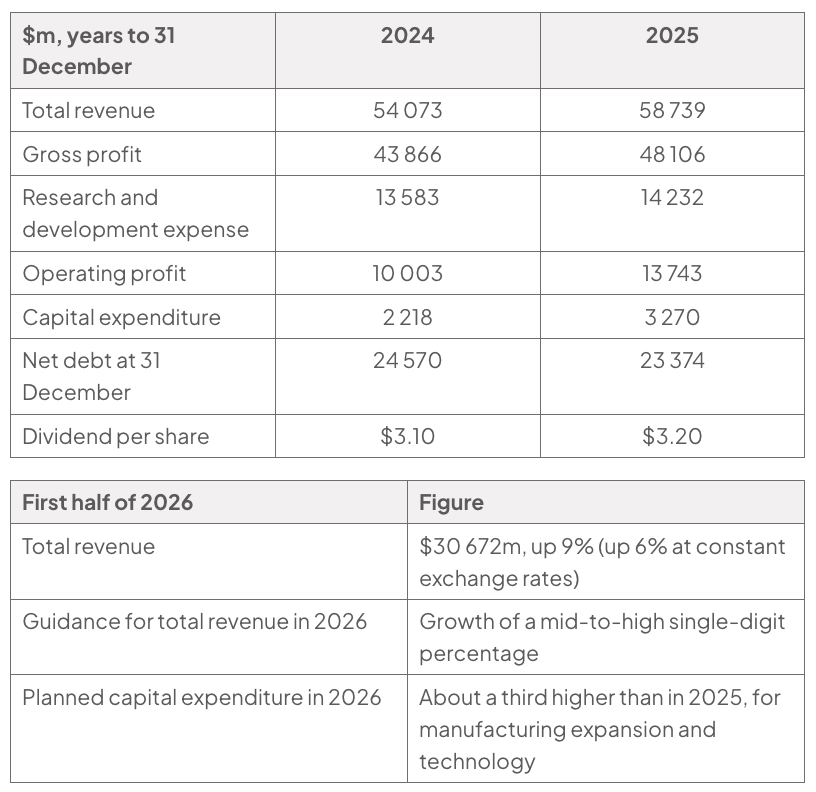
Two tables reproduce AstraZeneca’s financial data: annual figures for 2024 and 2025, including total revenue of $54 073m and $58 739m, operating profit of $10 003m and $13 743m, and capital expenditure of $2 218m and $3 270m; and first-half 2026 figures.

Source: AstraZeneca plc

Appendix B: Investment, governments and listing

  • United States. $50bn by 2030 for manufacturing and research, including a plant in Virginia that is AstraZeneca's largest single manufacturing investment. It will use artificial intelligence, automation and data analytics, and make ingredients for weight-management and metabolic medicines. It is due to open in 2030.

  • US pricing agreement, October 2025. AstraZeneca will offer state Medicaid programmes prices no higher than in other developed countries, launch new medicines at those prices, and sell to patients directly with discounts of up to 80%. In return it is exempt from US tariffs on pharmaceuticals for three years.

  • China. $15bn of investment in manufacturing and research in China through 2030.

  • United Kingdom. The Speke vaccine plant was dropped after AstraZeneca said government support had been reduced; the Chief Executive said it "couldn't be made economically viable". The £200m Cambridge expansion, expected to create about 1 000 jobs, was paused in September 2025, while pharmaceutical companies were in dispute with the UK government over the prices the NHS pays for medicines.

  • Listing. Shares began trading on the New York Stock Exchange on 2 February 2026, alongside London and Stockholm, "enabling more shareholders to participate". AstraZeneca remains UK-listed, headquartered and tax resident.

Source: Analyst, using AstraZeneca plc and press reports

Assess whether AstraZeneca has the financial resources to implement its strategy.

Calculate AstraZeneca's operating profit margin in 2025 to support your answer. Give your answer to one decimal place.

3
9 marks

Source A: Alexander Dennis

Alexander Dennis Limited (ADL) is a private limited company, owned since 2019 by NFI Group, a Canadian bus and coach maker. It designs and builds single-deck and double-deck buses, including electric buses, and provides spare parts and servicing. It has factories in Scarborough and at Falkirk and Larbert in Scotland, and businesses in Hong Kong, New Zealand, Singapore, Malaysia, Germany and Mexico.

In 2025 ADL's turnover fell by 18.1% to £426.9 million, which it blamed on "increasing Chinese competition for zero-emission vehicles". By market:

  • UK: fell from £482.5 million to £370.7 million

  • Americas: rose from £8.1 million to £31.3 million; firm orders in North America run to 2028

Government grants help bus operators in England and Scotland buy zero-emission buses from any maker. ADL argues that UK rules for buying buses do not reward "local content, job retention and creation". In March 2026 it called the results of Scotland's latest grant scheme "extremely disappointing with the majority of the available funding going overseas".

ADL's Scottish factories have faced two proposals:

  • June 2025: close both, putting 400 jobs at risk, and move all bus-body building to Scarborough. In September 2025, after talks with the UK and Scottish governments and trade unions, ADL kept both.

  • March 2026: close Falkirk and turn Larbert into a site for building chassis, the frame and running gear under a bus body, with up to 115 jobs at risk, about 200 safeguarded and about 350 kept in Scotland. ADL keeps the option of bringing bus-body building back to Larbert if UK volume rises.

Source: Alexander Dennis Limited, annual report and financial statements for the year ended 28 December 2025, and press reports

Appendix A: Alexander Dennis financial data

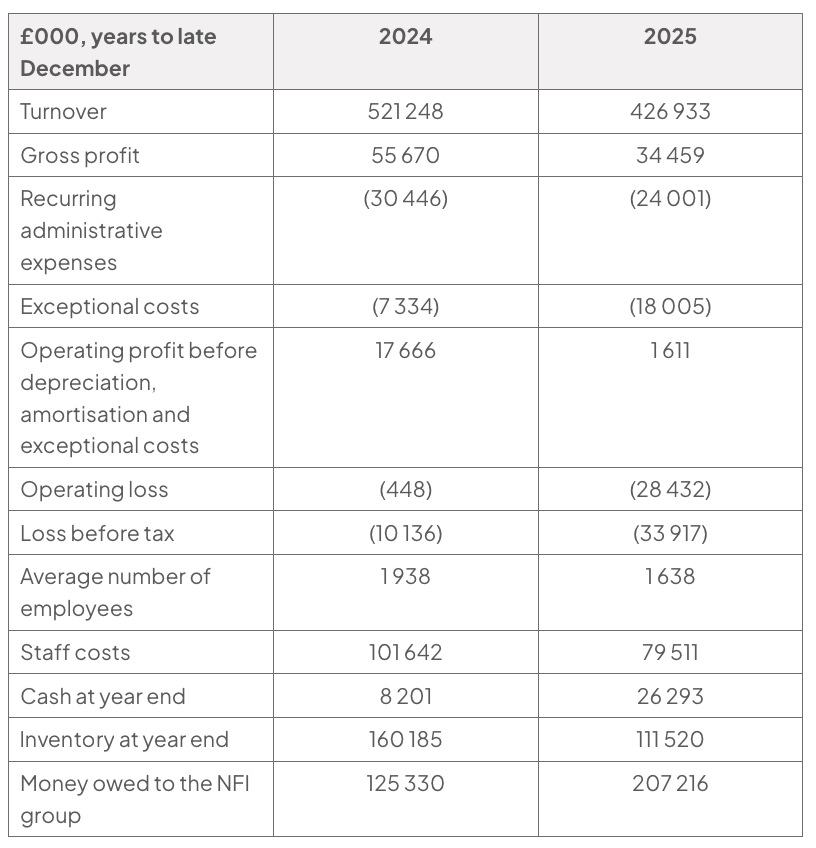
Table of ADL financial data (£000, years to late December) comparing 2024 and 2025: turnover 521 248 and 426 933; gross profit 55 670 and 34 459; recurring administrative expenses (30 446) and (24 001); exceptional costs (7 334) and (18 005); operating profit before depreciation, amortisation and exceptional costs 17 666 and 1 611; operating loss (448) and (28 432); loss before tax (10 136) and (33 917); average number of employees 1 938 and 1 638; staff costs 101 642 and 79 511; cash at year end 8 201 and 26 293; inventory at year end 160 185 and 111 520; money owed to the NFI group 125 330 and 207 216.
  • Exceptional costs in 2025: restructuring of UK manufacturing £9.0m; writing down the value of new products developed £7.4m; redundancy £1.6m; closing the Guildford site £0.1m.

  • New product development: £4.5m of development spending in 2025 was recorded as an asset.

Source: Alexander Dennis Limited

Appendix B: Restructuring and the parent company

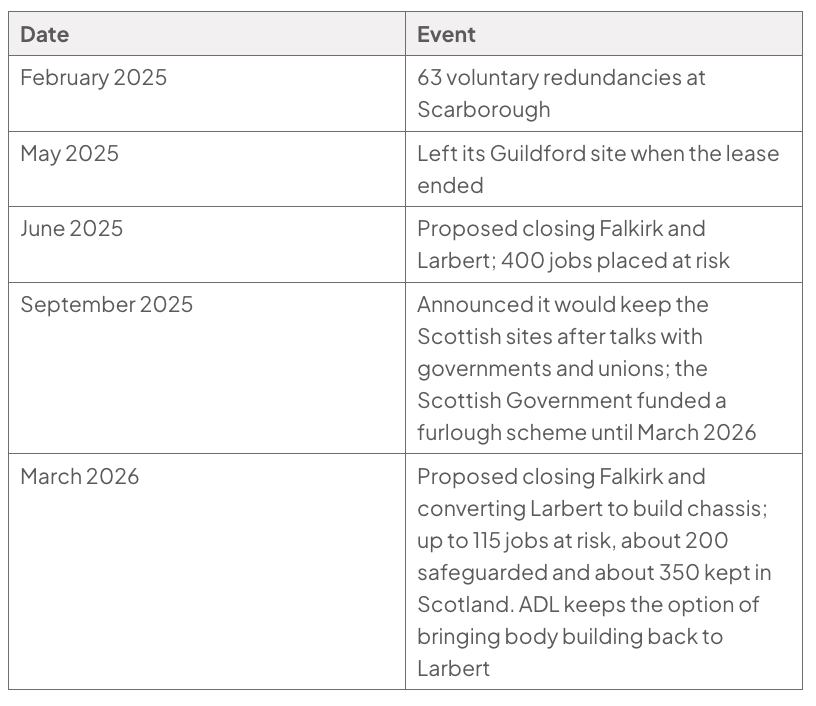
Timeline of ADL restructuring: February 2025, 63 voluntary redundancies at Scarborough; May, Guildford site lease ended; June, Falkirk and Larbert closure proposed; September, Scottish sites retained; March 2026, Falkirk closure and Larbert chassis conversion proposed.
  • Parent support. "NFI Group Inc continues to provide full support to the company allowing us to make these investments and operate without external financing." Of the £207.2m owed to the NFI group at the end of 2025, £91.6m bore interest at 5.4% to 5.55% a year.

  • Future. ADL has kept "the flexibility to reintroduce bus body manufacturing to its Larbert facility at a later date" and "the ability to scale back up in response to any significant increase in UK volume". It aims to enter 2027 "in a stronger position to return to profitability".

Source: Analyst, using Alexander Dennis Limited and press reports

Assess whether Alexander Dennis's restructuring in 2025 was successful.

Calculate Alexander Dennis's employee costs as a percentage of revenue in 2025 to support your answer. Give your answer to one decimal place.

4
9 marks

Source A: Mulberry

Mulberry Group plc was founded in Somerset in 1971 and is known for leather handbags such as the Bayswater. Its two largest shareholders are Challice, controlled by Singapore's Ong family, and Frasers Group, which owns retailers such as Sports Direct and Flannels. In 2024 Mulberry's board rejected a takeover approach from Frasers.

Mulberry designs, makes and sells bags, small leather goods and clothing. About half of its iconic bags are made by craftspeople at its two factories in Somerset. It sells through:

  • its own stores and website

  • franchise partners abroad

  • wholesale to other retailers

In the year to March 2025 Mulberry's revenue fell by 21% and it made a loss before tax of £32.2 million. Andrea Baldo, who became Chief Executive in 2024, launched a strategy called "Back to the Mulberry Spirit" in January 2025. Its aims are to:

  • simplify the business

  • restore profitability

  • rebuild the gross margin by selling more at full price

  • "put creativity back at the centre of what we do"

In July 2025 Challice and Frasers provided £20 million of funding. As part of the strategy, Mulberry:

  • made redundancies in both the year to March 2025 and the year to March 2026

  • closed one UK store and eight international stores in the year to March 2026

  • introduced a new incentive scheme for store staff "supporting a stronger performance culture"

In the 52 weeks to 28 March 2026 revenue rose by 4% to £125.5 million, and the loss before tax fell to £8.9 million. More than half of Mulberry's UK sales through its stores and website came from returning customers. Its pre-loved service, Mulberry Exchange, which buys back and resells used Mulberry bags, increased its sales by 46%.

Mulberry's medium-term goal is revenue of more than £200 million with an adjusted operating profit margin of 15%.

Source: Mulberry Group plc, audited results for the 52 weeks ended 28 March 2026

Appendix A: Mulberry financial data

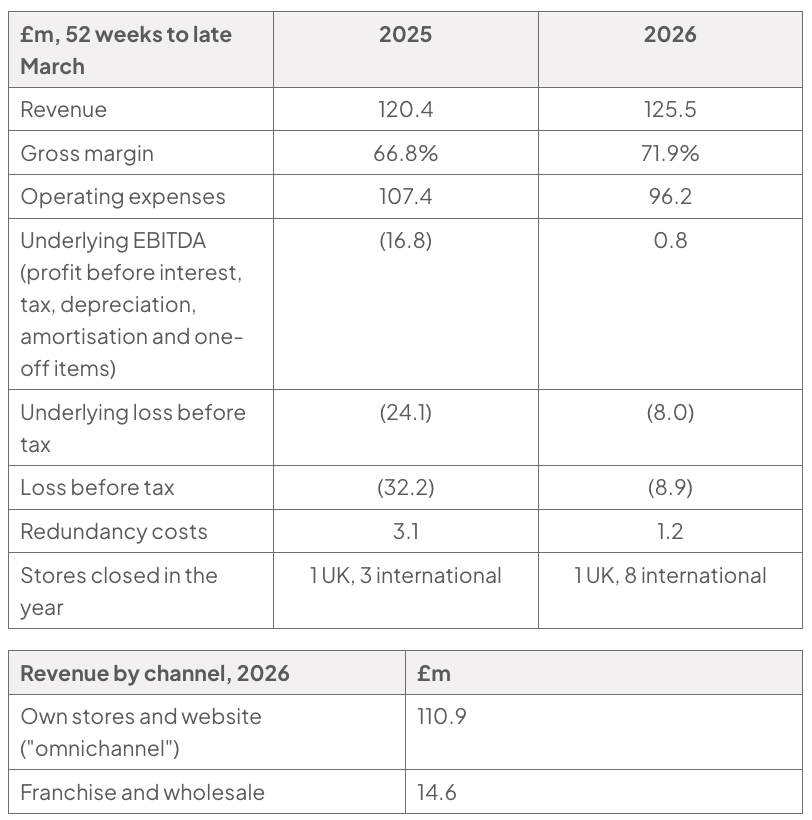
Table of Mulberry financial data (£m, 52 weeks to late March), comparing 2025 and 2026: revenue 120.4/125.5; gross margin 66.8%/71.9%; operating expenses 107.4/96.2. 2026 channel revenue: £110.9m own stores and website, £14.6m franchise and wholesale.
  • Revenue grew 11% in the second half of the year. Like-for-like sales through Mulberry's own stores and website rose 9%.

  • Mulberry's bank facilities are committed until July 2028. Staff costs were £41.2m.

Source: Mulberry Group plc

Appendix B: Carrying out the change

  • Product. New creative team; the return of the Roxanne bag; a limited edition Bayswater "sold out within minutes". The designer Christopher Kane was appointed creative director for clothing.

  • Pricing. Less discounting and "greater full-price discipline".

  • Wholesale. New UK partnerships with John Lewis, Liberty, Flannels and Harvey Nichols.

  • People. Redundancies in both years; a new incentive scheme for store staff "supporting a stronger performance culture". In September 2026 Kenny Wilson, former Chief Executive of Dr. Martens, joined the board.

  • Technology. Investment in a new e-commerce platform and customer relationship management.

  • Brand. Campaigns with the actor Cynthia Erivo and "Rooted in Craft"; the Chair says the board chose "to prioritise brand equity over short-term volume".

  • Outlook. The Chief Executive says "there is still more to do" and that the business remains "mindful of the wider macroeconomic environment".

Source: Analyst, using Mulberry Group plc

Assess whether Mulberry has implemented its turnaround strategy successfully.

Calculate Mulberry's operating profit margin in 2026 to support your answer. Give your answer to one decimal place.

5
9 marks

Source A: Wickes

Wickes Group plc is a UK home improvement retailer listed on the London Stock Exchange. It became an independent company in 2021, when it separated from Travis Perkins. It has 230 stores and about 7 800 employees, and serves three groups of customers:

  • Tradespeople, through its TradePro membership scheme. Sales to TradePro members rose in 2025.

  • Do-it-yourself customers.

  • Design & Installation customers, whose kitchens and bathrooms it designs and fits.

It reports a "market-leading price position" against its wider peer group.

Wickes describes itself as "a digitally-led, service-enabled home improvement retailer". Two-thirds of its sales are digitally enabled, but 96% are fulfilled from its stores. Wickes has cut the time to prepare a Click & Collect order from 30 minutes to 15 minutes, and Wickes Rapid delivers orders of up to 800kg to a home or building site within three hours. Its strategy rests on seven "growth levers", including winning trade customers, digital capability and store investment.

Several rivals, including Homebase, have left the market since 2023. Homebase went into administration at the end of 2024, and Carpetright, CTD Tiles and Wilko have also left. Four of Wickes's five new stores in 2025 were former Homebase stores, and it employed 54 former Homebase staff.

In March 2026 the chief executive, David Wood, announced an ambition to reach 300 stores, creating more than 2 000 new jobs. Wickes plans 4 to 5 new stores in 2026, 7 to 9 in 2027 and at least 10 a year from 2028. It reports "ever-increasing demand for prime retail locations".

Source: Wickes Group plc, results for the year ended December 2025, annual report 2025 and half-year results 2026

Appendix A: Wickes financial data

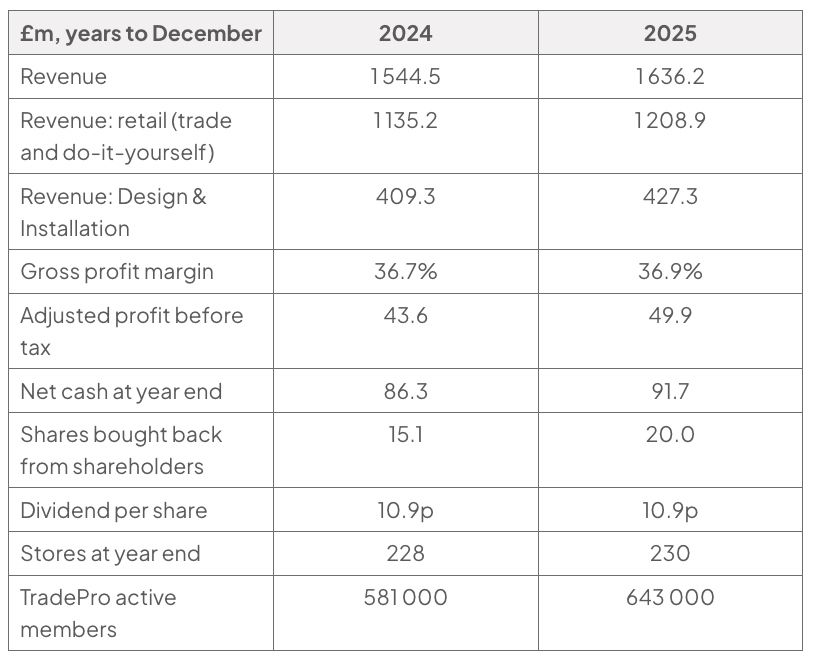
Financial table in £m for years to December, 2024 and 2025: revenue 1 544.5 and 1 636.2; retail (trade and do-it-yourself) revenue 1 135.2 and 1 208.9; Design & Installation revenue 409.3 and 427.3; gross profit margin 36.7% and 36.9%; adjusted profit before tax 43.6 and 49.9; net cash at year end 86.3 and 91.7; shares bought back from shareholders 15.1 and 20.0; dividend per share 10.9p and 10.9p; stores at year end 228 and 230; TradePro active members 581 000 and 643 000.
  • 2024 figures are restated on the 2025 basis.

  • TradePro. Sales to TradePro members rose 9% in 2025; growth in members "was partially offset by a slight decline in average basket size".

  • Half year to June 2026. Revenue rose 2.1% to £865.3m. Like-for-like sales, from stores open in both periods, fell 0.3% in retail and rose 3.6% in Design & Installation. Retail prices were cut by 2.4%. Very heavy rain hit outdoor sales early in the year.

Source: Wickes Group plc

Appendix C: Digital and Design & Installation

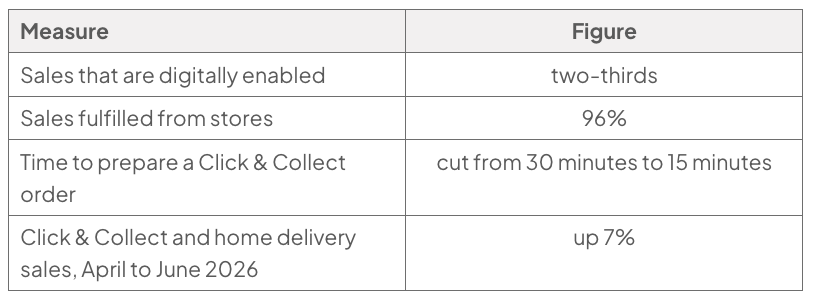
Table of digital and operational measures: two-thirds of sales digitally enabled; 96% of sales fulfilled from stores; time to prepare a Click & Collect order cut from 30 minutes to 15 minutes; Click & Collect and home delivery sales up 7% in April to June 2026.
  • Wickes Rapid delivers orders of up to 800kg to a home or building site within three hours, from a range of more than 10 000 products.

  • Design & Installation. In 2024 revenue fell as customers cut back on large purchases. Wickes added about 160 Design Consultants, replaced two separate kitchen services with one, and replaced "a more cumbersome telephone booking system" with instant online booking.

  • 2026. "Orders for Wickes Bespoke Kitchens have been in slight decline, as customers are being more considered for larger purchases."

  • Plans changed in 2026. The plan to refit or refresh 15 to 20 stores in 2026 was cut to 12. A new order management system, planned in two phases in 2026 and 2027, will now be introduced "from 2027".

Source: Wickes Group plc

Assess whether Wickes has successfully implemented the changes to its Design & Installation business.

6
9 marks

Source B: Thistleden Kitchens

Thistleden Kitchens Limited is a private limited company, founded in Penrith, Cumbria, in 2003. It designs, makes and fits hand-built painted timber kitchens, each designed for the individual customer, and employs 64 people. In 2025 its kitchens sold for an average of £26 300.

It sells through four showrooms:

  • Penrith, Kendal and Carlisle, in Cumbria

  • Newcastle upon Tyne, opened in February 2025, its first outside Cumbria

Kitchens are made in its workshop in Penrith and fitted either by its own team of fitters or by subcontractors. Customers pay a 40% deposit when they order, and the balance when the kitchen is fitted.

Thistleden uses timber certified as coming from responsibly managed forests, trains four apprentices a year, and passes customers' old kitchens that can be reused to a local charity.

The company faces three main pressures:

  • Competition. National kitchen retailers offer free design visits and online booking.

  • Demand. Its order book fell in both 2024 and 2025, and its revenue and operating profit fell in 2025.

  • Fitting. In 2025 a higher share of kitchens was finished later than promised than in 2024, and about a third of kitchens were fitted by subcontractors.

In 2026 Thistleden introduced new software to schedule its fitters. A regional housebuilder has offered it a three-year contract to supply kitchens for new homes.

Source: Thistleden Kitchens

Appendix D: Thistleden Kitchens selected data

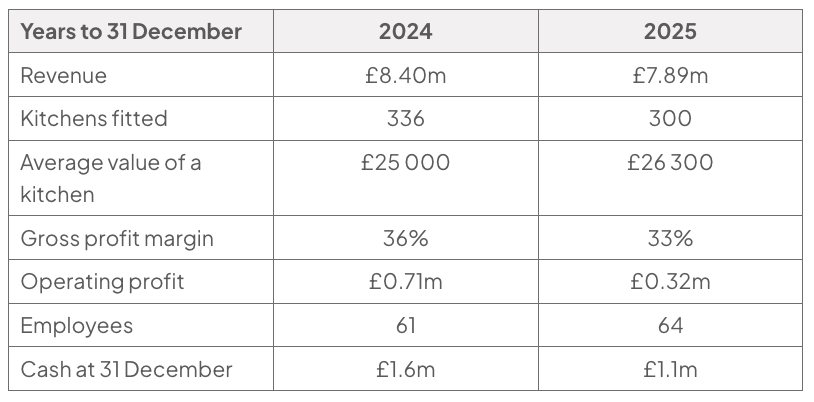
Selected data table for years to 31 December, 2024/2025: revenue £8.40m/£7.89m; kitchens fitted 336/300; average kitchen value £25 000/£26 300; gross margin 36%/33%; operating profit £0.71m/£0.32m; employees 61/64; cash £1.6m/£1.1m.

Source: Thistleden Kitchens

Appendix E: The Newcastle showroom and fitting

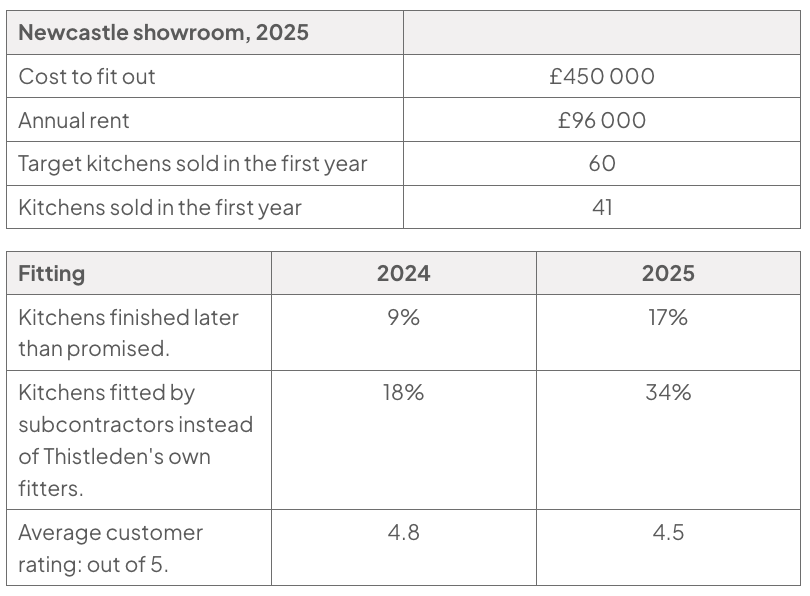
Tables of Newcastle showroom data: fit-out cost £450 000, annual rent £96 000, first-year target 60 kitchens and sales 41; fitting comparisons for 2024 and 2025 show late finishes 9% and 17%, subcontractors 18% and 34%, ratings 4.8 and 4.5 out of 5.
  • Newcastle is 60 miles from the workshop; fitters travel from Penrith each day.

  • The Newcastle showroom manager joined from a national kitchen retailer.

Source: Thistleden Kitchens

Assess whether Thistleden Kitchens implemented the opening of its Newcastle showroom successfully.

Calculate Thistleden Kitchens' employee productivity in 2025, in kitchens fitted per employee, to support your answer. Give your answer to two decimal places.

1
15 marks

Source A: AstraZeneca

AstraZeneca plc is a global pharmaceutical company with its headquarters in Cambridge, UK. Its medicines treat cancer, heart, kidney and metabolic disease, respiratory disease and rare diseases. It had 16 "blockbuster" medicines, each with annual sales of more than $1 billion, in 2025. It is one of the largest companies in the FTSE 100, and since 2 February 2026 its shares have also traded on the New York Stock Exchange. It remains listed and headquartered in the UK.

In 2025 total revenue rose by 9% to $58.7 billion, with growth in every major region. AstraZeneca has set itself the ambition of reaching $80 billion of total revenue in 2030.

In July 2025 AstraZeneca announced plans to invest $50 billion in the United States by 2030, including a manufacturing plant in Virginia. In October 2025 it agreed with the US government to offer US patients lower prices, in return for three years' exemption from US tariffs on pharmaceuticals. In the UK, it dropped a planned £450 million vaccine plant at Speke, Merseyside, in 2025, and in September 2025 paused a £200 million expansion of its research centre in Cambridge.

Developing a new medicine takes many years, and most candidates fail in clinical trials. AstraZeneca also buys and licenses medicines discovered by other companies.

Source: AstraZeneca plc, results for the full year 2025 and the first half of 2026

Appendix A: AstraZeneca financial data

Two tables of AstraZeneca financial data: 2024 and 2025 figures in millions of dollars for revenue, profit, research, spending, debt and dividends, followed by first-half 2026 figures and guidance.

Source: AstraZeneca plc

Appendix B: Markets, medicines and risks

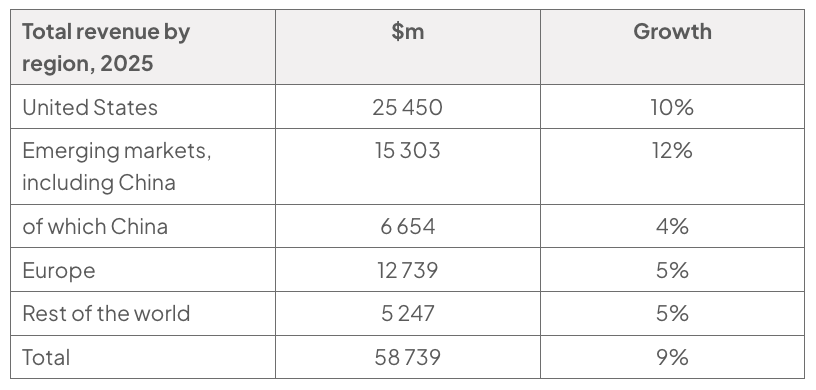
Table of AstraZeneca’s 2025 total revenue by region, in millions of dollars, and growth: United States 25,450, 10%; emerging markets 15,303, 12%, including China 6,654, 4%; Europe 12,739, 5%; rest of world 5,247, 5%; total 58,739, 9%.
  • Pipeline. More than 100 Phase III studies under way; more than 20 high-value trial results due in the 18 months from July 2026. Research and development is 24% of total revenue.

  • Setbacks, 2026. Several Phase III trials did not meet their main goal, including trials of Wainua in a heart condition and Imfinzi in liver cancer.

  • Loss of exclusivity. Farxiga, a diabetes and heart medicine, lost its US patent protection and now faces cheaper copies. Its sales fell 11% at constant exchange rates in the first half of 2026, when it was still 13% of product revenue.

  • China. Volume-based procurement, in which the government buys large volumes of medicines from the lowest bidders, continues to put pressure on prices.

  • Buying in. In 2025 AstraZeneca bought EsoBiotec for $403m, with up to $575m more if regulatory milestones are met. In July 2026 it licensed two medicines from Chinese companies: $600m upfront for Zegfrovy, with up to $900m more, and $200m upfront for TQC3721, with up to $1.9bn more.

Source: Analyst, using AstraZeneca plc

Appendix C: Investment, governments and listing

  • United States. $50bn by 2030 for manufacturing and research, including a plant in Virginia that is AstraZeneca's largest single manufacturing investment. It will use artificial intelligence, automation and data analytics, and make ingredients for weight-management and metabolic medicines. It is due to open in 2030.

  • US pricing agreement, October 2025. AstraZeneca will offer state Medicaid programmes prices no higher than in other developed countries, launch new medicines at those prices, and sell to patients directly with discounts of up to 80%. In return it is exempt from US tariffs on pharmaceuticals for three years.

  • China. $15bn of investment in manufacturing and research in China through 2030.

  • United Kingdom. The Speke vaccine plant was dropped after AstraZeneca said government support had been reduced; the Chief Executive said it "couldn't be made economically viable". The £200m Cambridge expansion, expected to create about 1 000 jobs, was paused in September 2025, while pharmaceutical companies were in dispute with the UK government over the prices the NHS pays for medicines.

  • Listing. Shares began trading on the New York Stock Exchange on 2 February 2026, alongside London and Stockholm, "enabling more shareholders to participate". AstraZeneca remains UK-listed, headquartered and tax resident.

Source: Analyst, using AstraZeneca plc and press reports

AstraZeneca has set itself the ambition of reaching $80 billion of total revenue in 2030.

Evaluate whether the success of its new medicines or pressure on the prices of medicines will have the greater influence on whether AstraZeneca achieves this ambition.

2
15 marks

Source B: Hartlake Department Store

Hartlake Department Store Limited has traded from the same building on the high street of a Cheshire market town since 1886. The Hartlake family owns it, and all four directors are family members; the Managing Director is Rachel Hartlake. The board meets four times a year.

The store has four floors selling clothing, beauty, homeware and toys, a café, and 6 500 square metres of selling space. Most in-store sales are to customers aged 55 or over.

Hartlake employs 196 people, down from 210 a year earlier. Many have worked there for more than ten years; 38% are over 50. Most sales staff have strong relationships with regular customers.

In 2023 a new till system took nine months to install instead of the planned three, and cost 40% more than budgeted. In 2025 Hartlake:

  • relaunched its website, offering delivery and click-and-collect; most online sales are to customers under 45

  • introduced self-service tills on the ground floor

In the year to 31 January 2026:

  • revenue fell to £17.1 million and the store made its first operating loss for eleven years

  • visitors to the store fell from 1.42 million to 1.31 million

  • the share of online orders collected in store rose from 31% to 46%; customers who collect spend an average of £18 more in the store on the same visit

  • in a staff survey, 34% of employees felt prepared for the changes ahead

The board must choose between two plans to change the business in 2026. The Managing Director says: "We have never had to change this much, this quickly."

Source: Hartlake Department Store

Appendix D: Hartlake Department Store selected data

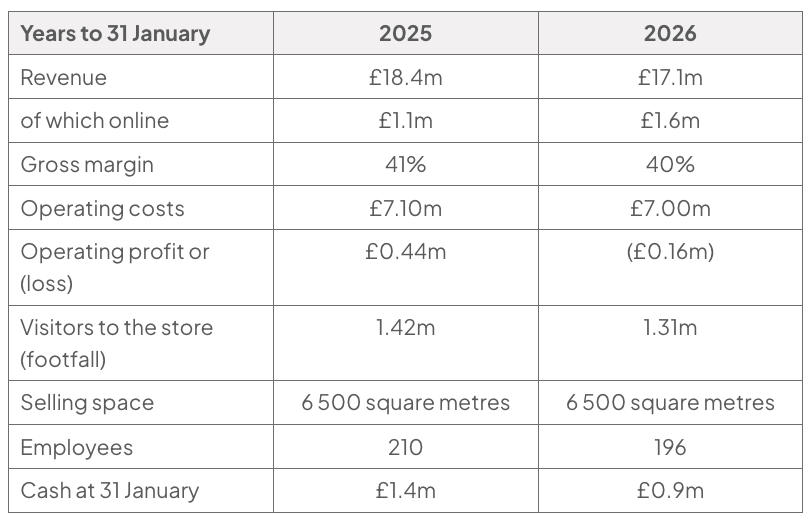
Selected data table for the years to 31 January 2025 and 2026, including revenue, online revenue, margins, costs, footfall, selling space, employees and cash.

Source: Hartlake Department Store

Appendix E: Digital performance

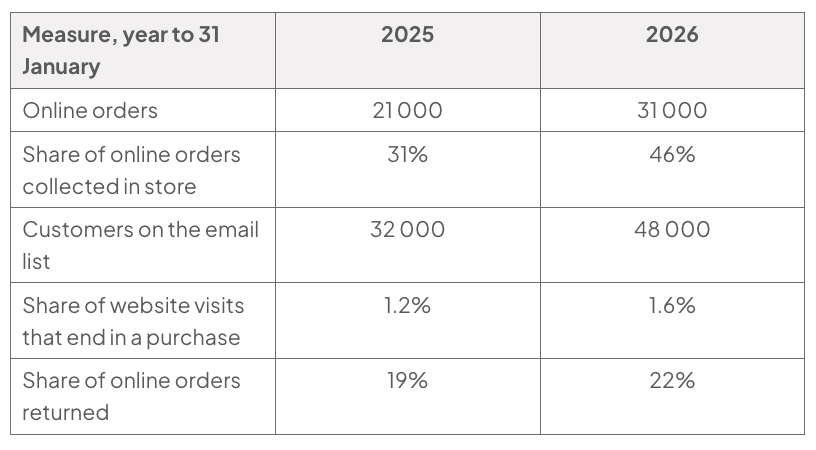
Table comparing 2025 and 2026 online performance: online orders 21 000 to 31 000; in-store collection 31% to 46%; email list 32 000 to 48 000; purchase conversion 1.2% to 1.6%; returns 19% to 22%.
  • The website relaunch in 2025 cost £320 000.

  • Customers who collect online orders in store spend an average of £18 more in the store on the same visit.

  • 58% of in-store sales are to customers aged 55 or over; 71% of online sales are to customers under 45.

Source: Hartlake Department Store

Appendix F: People and culture

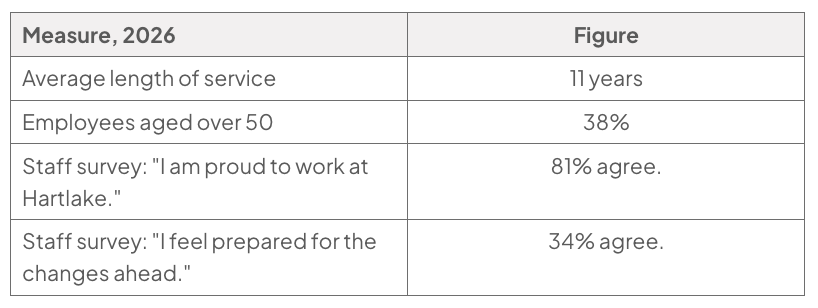
Table of Hartlake’s 2026 staff measures: average service 11 years; 38% of employees over 50; 81% agree they are proud to work there; 34% feel prepared for changes ahead.
  • A new till system introduced in 2023 took nine months to install, instead of the planned three, and cost 40% more than budgeted.

  • The board meets four times a year; the Managing Director says: "We have never had to change this much, this quickly."

  • Most sales staff have worked in one department for many years and have strong relationships with regular customers.

Source: Hartlake Department Store

Appendix G: Two plans

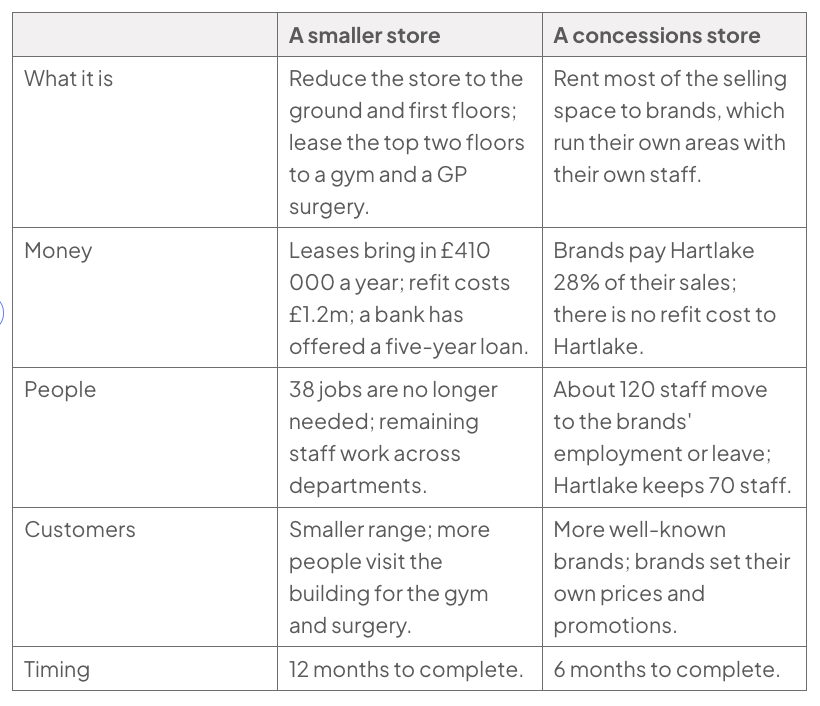
Comparison table of Hartlake’s smaller-store and concessions plans: smaller store leases top floors, earns £410 000 annually, loses 38 jobs and takes 12 months; concessions rent space to brands, retain 70 staff and take six months.

Source: Hartlake Department Store

Hartlake Department Store's board must choose between two plans to change the business in 2026.

Evaluate whether Hartlake Department Store should implement the smaller-store plan or the concessions plan.

Use information from Appendices D to G to support your answer.

3
15 marks

Source A: Oxfam GB

Oxfam GB works to end poverty. It is a registered charity and a company limited by guarantee, and one of 21 affiliates of the Oxfam confederation, which worked in 79 countries in 2024/25. In 2024/25 Oxfam GB's work reached 9.21 million people, 8.05 million of them through humanitarian responses to emergencies.

Oxfam GB raises money from four main sources:

  • donations and legacies

  • grants from governments and international organisations

  • funding from other Oxfam affiliates

  • its shops

In 2024/25 Oxfam GB's income fell by £28.6 million, and it spent more than it received for the second year running. Funding from other Oxfam affiliates fell from £104.1 million to £82.0 million. The largest affiliate funder, Oxfam Germany, gave £17.8 million, down from £27.2 million.

Oxfam GB has gone through several changes:

  • Pay. In December 2023 its staff held the first strike in Oxfam's history. It was settled with a 6% pay rise for most staff and a £2 300 payment.

  • Restructure. In April 2025 it began a restructure to save £10.2 million of forecast pay costs, putting 265 jobs at risk.

  • Leadership. Its chief executive since April 2024 left in December 2025, and an interim chief executive, Richard Hawkes, took over from 31 March 2026.

Its goals for 2025/26 are Income, Influence, People and Decolonisation. Decolonisation means shifting money and decision-making to partners in the Global South.

Source: Oxfam GB, annual report and accounts for the year ended 31 March 2025, and press reports

Appendix A: Oxfam GB financial data

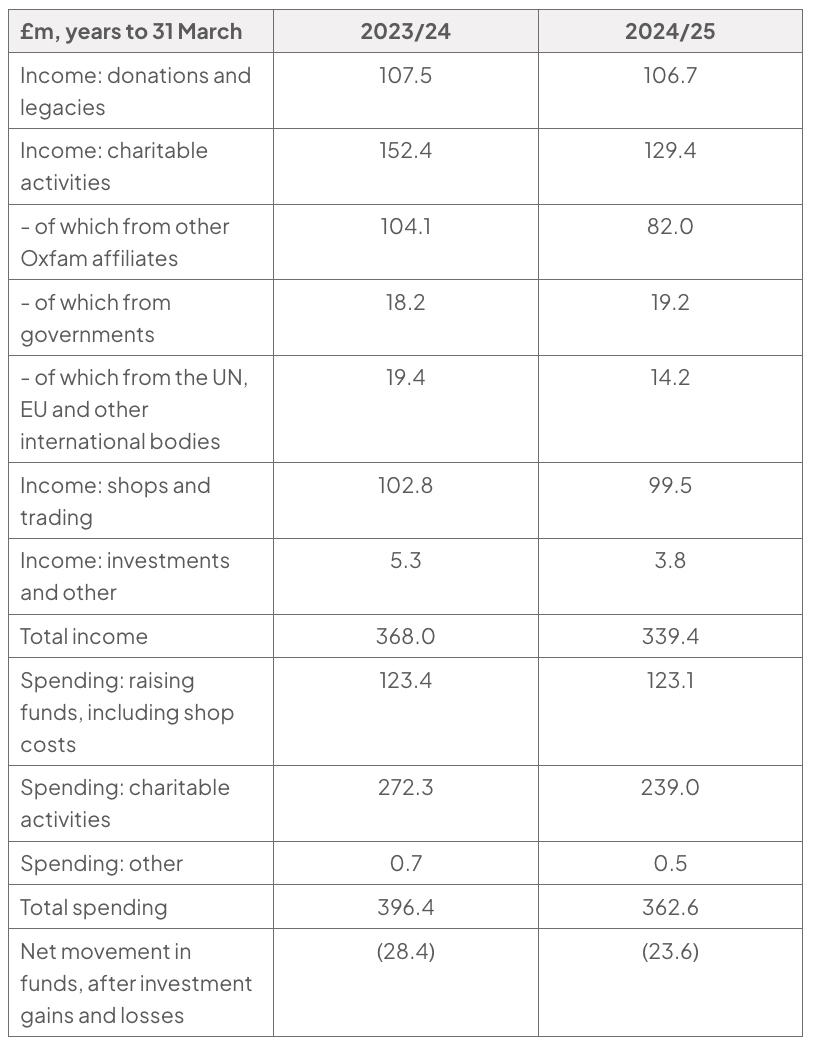
Financial table (£m, years to 31 March) comparing Oxfam GB in 2023/24 and 2024/25: total income 368.0 and 339.4, including 104.1 and 82.0 from other Oxfam affiliates; charitable spending 272.3 and 239.0; total spending 396.4 and 362.6; net movement in funds after investment gains and losses (28.4) and (23.6).
  • Why income fell. "Largely due to lower emergency appeal income", together with lower income from other Oxfam affiliates and international bodies.

  • Charitable spending, 2024/25. Humanitarian 52%, development 46%, campaigning 2%.

  • Reserves. General reserves rose from £32.9m to £35.5m, against a target range of £35m to £45m.

  • Shops. 534 shops in 2024 and 515 in 2025. Shop profit fell from £8.3m to £6.3m. Online sales were £11.2m in 2024/25.

  • People. Average staff fell from 4 180 to 4 084: 2 119 employed in Great Britain and 1 965 overseas. About 28 000 volunteers, more than 20 000 of them in shops.

Source: Oxfam GB

Appendix B: Funding and the outside world

  • UK aid. On 25 February 2025 the UK government announced that aid spending would fall from 0.5% to 0.3% of national income by 2027, to pay for higher defence spending.

  • United States. In January 2025 the US government froze aid funding. In February 2025 USAID ended its humanitarian contracts with Oxfam GB.

  • Government funders, 2024/25. Sweden £10.8m, the United States £2.8m, Switzerland £2.5m.

  • Oxfam affiliates. The largest affiliate funder, Oxfam Germany, gave £17.8m, down from £27.2m.

  • History. In 2018 it was reported that Oxfam staff had committed misconduct in Haiti in 2011. Oxfam GB stopped bidding for UK government funding, and in June 2019 a Charity Commission inquiry found that its culture and safeguarding had repeatedly fallen short and issued it with an Official Warning. New UK government funding was suspended again in April 2021 and restored in November 2022.

Source: Analyst, using Oxfam GB, UK government announcements and press reports

Appendix C: Change at Oxfam GB

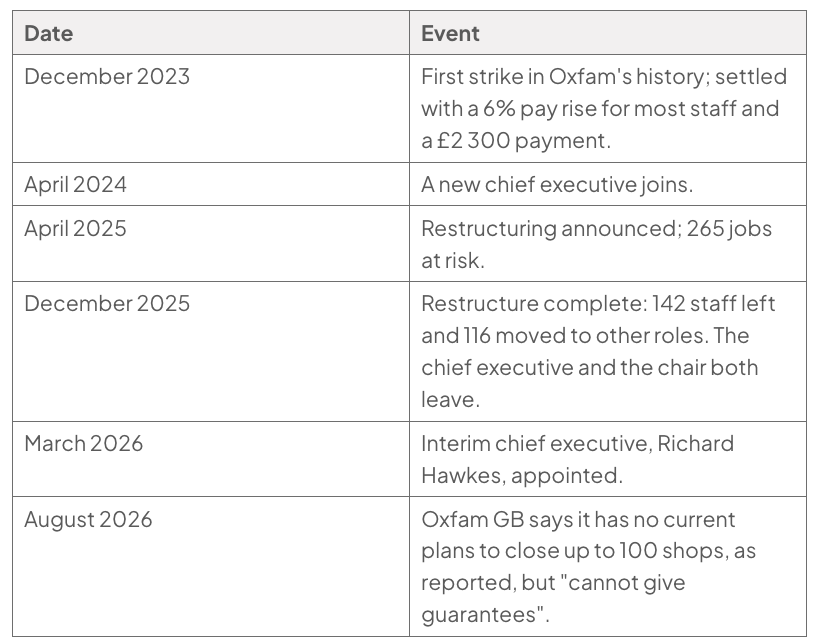
Timeline of change at Oxfam GB, December 2023 to August 2026: December 2023, “First strike in Oxfam's history; settled with a 6% pay rise for most staff and a £2 300 payment.” April 2024, “A new chief executive joins.” April 2025, “Restructuring announced; 265 jobs at risk.” December 2025, “Restructure complete: 142 staff left and 116 moved to other roles. The chief executive and the chair both leave.” March 2026, “Interim chief executive, Richard Hawkes, appointed.” August 2026, “Oxfam GB says it has no current plans to close up to 100 shops, as reported, but ‘cannot give guarantees’.”
  • Goals for 2025/26. Income, Influence, People and Decolonisation.

  • Shops. In 2024/25 Oxfam GB closed low-profit shops and opened a large shop in Manchester; overall, its number of shops fell from 534 to 515.

Source: Analyst, using Oxfam GB and press reports

Oxfam GB's goals for 2025/26 are Income, Influence, People and Decolonisation.

Evaluate whether leadership or funding is the more important factor in determining whether Oxfam GB successfully implements these goals.