Introduction to Aquaculture (College Board AP® Environmental Science): Study Guide

Advantages & disadvantages of aquaculture
What is aquaculture?
Aquaculture is the farming of fish, shellfish, and aquatic plants in controlled environments such as ponds, tanks, and coastal enclosures
Aquaculture has the potential to:
Provide a sustainable way to produce seafood
Meet global food demands
Reduce pressure on wild fish populations
Aquaculture is practiced in freshwater, brackish, and marine environments, depending on the species being farmed
Advantages of aquaculture
High efficiency and productivity
Produces large amounts of seafood in small water areas, making it a highly efficient food production system
More predictable yields compared to wild fishing
This helps to ensure stable food supplies and prices
Allows for year-round production, unlike seasonal wild fishing, which depends on natural fish migration patterns
Can be used to farm high-value species, such as shrimp, salmon, and tuna
Lower fuel requirements
Uses less fuel than commercial fishing, reducing carbon emissions and reliance on fossil fuels
Farming fish close to consumer markets lowers transportation costs and emissions
Some modern aquaculture systems, like recirculating aquaculture systems (RAS), further reduce land and water use
Economic benefits
Supports local economies, especially in coastal regions with fishing industries
Provides jobs in farming, processing, and distribution
Potential to create opportunities for small-scale farmers and developing nations to participate in the global seafood trade
Some aquaculture practices, such as integrated multi-trophic aquaculture (IMTA), allow farmers to cultivate multiple species together
This maximizes efficiency and profits
Disadvantages of aquaculture
Wastewater contamination
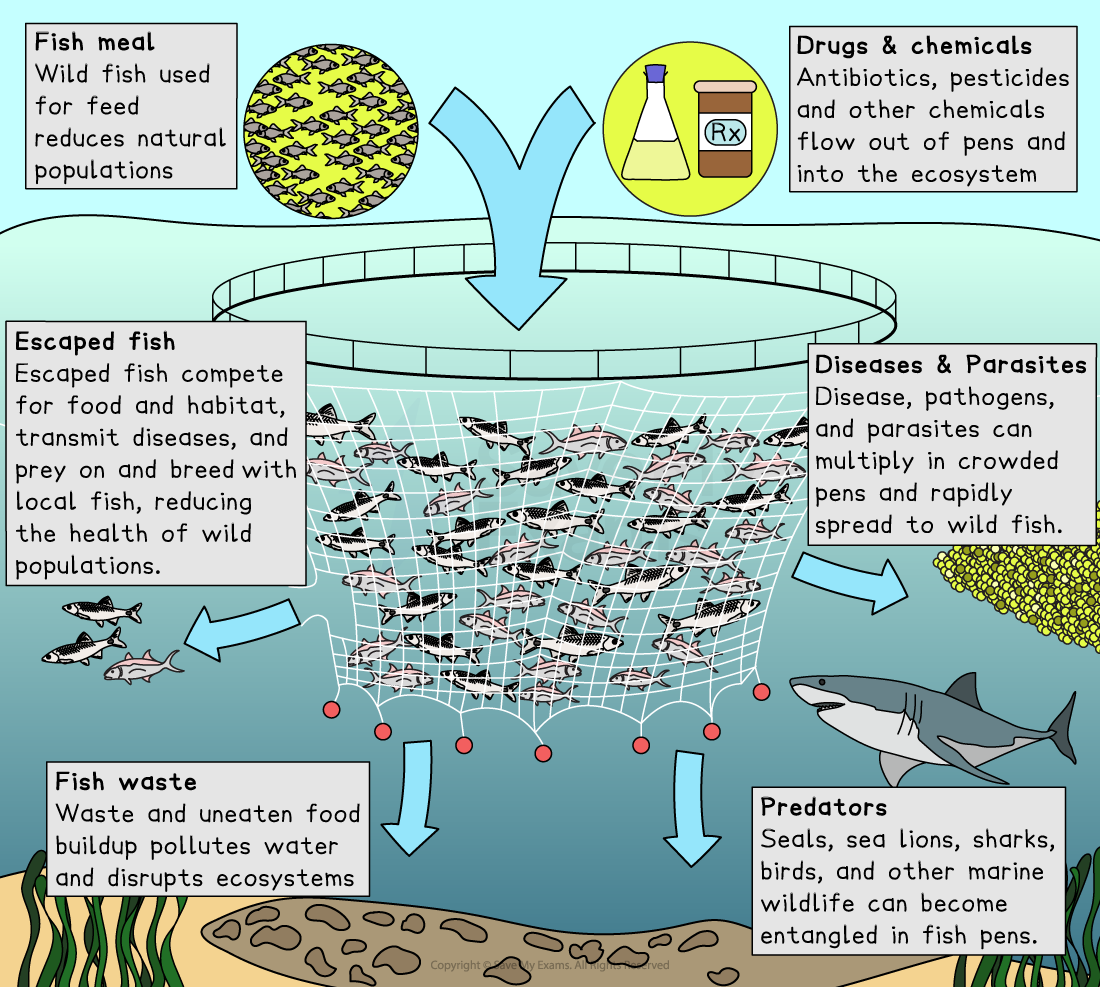
Uneaten feed and fish waste can accumulate, polluting surrounding waters and leading to environmental degradation
Excess nutrients from fish farming can lead to algal blooms
These deplete oxygen and harm marine ecosystems
Some aquaculture farms discharge antibiotics and chemicals into nearby waters
If not managed properly, pollution from aquaculture can affect drinking water sources and recreational waters
Impact on wild fish populations
Escaped farmed fish may compete with or interbreed with wild fish
This can alter natural populations and reduce genetic diversity
Some aquaculture operations rely on wild-caught fish for feed
This increases fishing pressure on already stressed fish stocks
Hybrid or genetically modified fish escaping from farms can potentially spread diseases or outcompete native species
Overcrowded fish farms can attract predators
Disease and parasite spread
High fish density in aquaculture farms increases the risk of disease outbreaks, which can spread rapidly among confined fish
Diseases can spread to wild fish populations
This can threaten local biodiversity and damage local fisheries
The use of antibiotics and chemicals to control diseases can lead to antibiotic-resistant bacteria in marine environments
Parasites such as sea lice can infest farmed fish and spread to wild fish, impacting their health and survival rates
Sustainable aquaculture solutions
Many of the disadvantages above can be reduced through more sustainable aquaculture practices
Small-scale aquaculture and food security
Small-scale aquaculture, such as backyard ponds and small village fish farms, is a major source of affordable protein in much of the developing world
In many parts of South Asia, sub-Saharan Africa, and Southeast Asia, household- and community-level fish farming makes up a significant share of dietary protein
This style of aquaculture:
Uses local labor, ponds, and feed inputs, keeping costs low
Improves household nutrition where animal protein is otherwise scarce
Supports rural livelihoods and local food markets
Recirculating aquaculture systems (RAS) — above-ground tanks
Recirculating aquaculture systems (RAS) are closed, above-ground tanks used to farm fish on land
The same water is reused continuously
Waste is removed by mechanical and biological filters before the water is returned to the tanks
Only a small volume of fresh water is added to make up for losses
Advantages over open-water aquaculture:
Very little wastewater is discharged, drastically reducing pollution of surrounding waters
Tanks can be built far from coasts and rivers, lowering the risk of escapes and disease transfer to wild fish
Operate year-round, independent of season or weather
Use far less land than ponds for a given yield
Disadvantages:
High upfront construction and energy costs — pumps, aeration, and filtration run continuously
Technical complexity: failure of a pump or filter can rapidly kill an entire stock
Currently most economical for high-value species such as salmon and certain shrimp

Unlock more, it's free!
Join the 100,000+ Students that ❤️ Save My Exams
the (exam) results speak for themselves:

Was this revision note helpful?
Build on this topic