Human Resource Planning (AQA A Level Business): Exam Questions

Exam code: 7132

Syllabus Edition

First teaching 2026

First exams 2028

2 hours15 questions
1
6 marks

Source A: Timpson Group

Timpson Group is one of the largest service retailers in the United Kingdom and Ireland. It repairs shoes, cuts keys, mends watches, cleans clothes and prints photographs, trading as Timpson, Max Spielmann, Snappy Snaps, Johnsons, The Watch Lab, Jeeves, Timpson Security and Barbershop. It has been a family business since 1865 and is now run by the sixth generation of Timpsons.

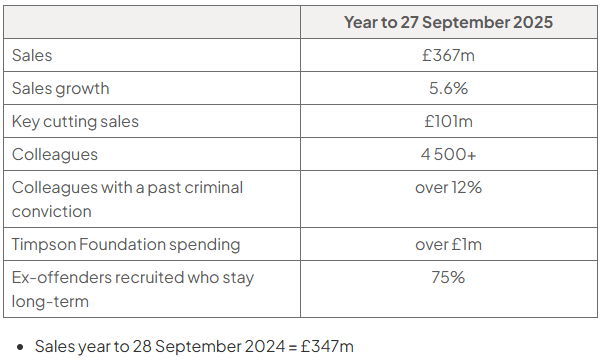
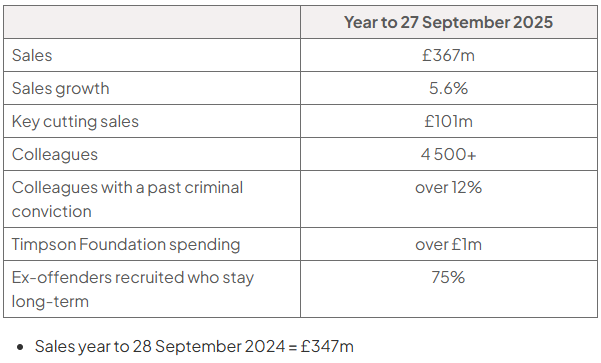
In the 52 weeks to 27 September 2025 sales rose 5.6% to £367 million, from £347 million, the fourth year in a row of record sales. Key cutting alone took £101 million. Watch repair now brings in more than twice as much as shoe repair, the service the company was built on.

The way Timpson Group is run is unusual, and it is deliberate. The company picks colleagues for their personality and then trusts them to do the job their way. It calls this Upside Down Management. John Timpson puts it like this: "The best way to run a business is to trust your colleagues with the freedom to do their job in the way they know best." Colleagues in the shops make decisions that in most retailers would be taken at head office.

Where those colleagues come from is unusual too. After visiting a prison in 2002 and hiring a young man named Matt, Timpson Group has become one of the largest employers of ex-offenders in the United Kingdom. Over 12% of its 4 500+ colleagues have a past criminal conviction. The Timpson Foundation spends over £1 million a year supporting the employment of people from prison, and runs training academies inside prisons so that prisoners learn the shop services before they are released. Some colleagues work on day release while still serving a sentence. The Foundation also recruits care leavers and people leaving the armed forces.

The company says the approach works on its own terms: 75% of the ex-offenders it recruits stay with the business long term, and it describes them as loyal, hardworking colleagues.

Source: Timpson Group, 2026; The Times, 23 September 2026

Appendix A: Timpson Group selected data

Table of Timpson Group data for year to 27 September 2025: sales £367m; growth 5.6%; key cutting £101m; colleagues 4,500+; ex-offenders over 12%; Foundation spending over £1m; 75% stay long-term. 2024 sales: £347m.

Source: Timpson Group and The Times

Analyse one way in which recruiting colleagues through the Timpson Foundation might reduce Timpson Group's recruitment and training costs.

2
6 marks

Source A: Beckworth Care Group

Beckworth Care Group runs six residential care homes in the north of England. It has 312 beds, 284 residents and 240 employees, and in the year to March 2025 it had revenue of £14.8 million and made an operating profit of £0.9 million.

Caring for residents is work that cannot be put off or stored up. Every shift has to be covered, and the law sets a minimum number of qualified staff for the number of residents in a home. Beckworth needs 8 400 hours of care each week across the six homes.

For three years it has struggled to fill those hours with its own staff. Pay in the sector is low, the work is demanding, and supermarkets and warehouses nearby recruit from the same towns. In the year to March 2025, 84 employees left. When Beckworth cannot fill a shift it books an agency worker instead, at roughly twice the hourly cost of its own staff. Agency workers also do not know the residents, and families have begun to comment on the number of unfamiliar faces.

Beckworth's structure has grown up without much thought. Each of the six homes has a registered manager, two deputy managers, four senior carers and then the care staff, and above the home managers sit a regional manager, an operations director and the chief executive. The chief executive, Dana Okoye, believes there are too many layers between her and the people who actually care for residents, and that decisions which should take a day take three weeks.

She has asked for a plan that would remove the deputy manager layer and widen the span of control of each home manager, moving the money saved into higher pay for care staff.

Source: Beckworth Care Group

Appendix B: How Beckworth Care Group fills its care hours

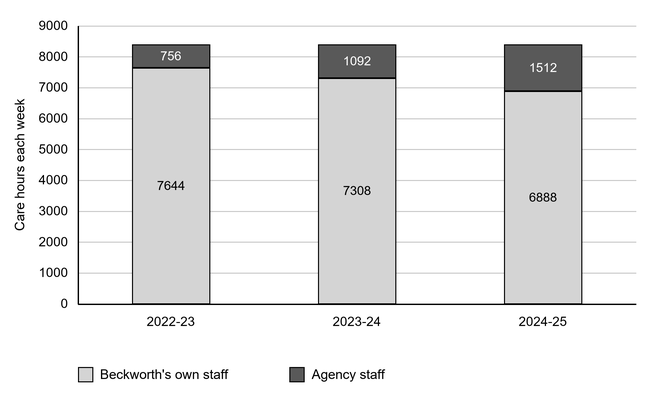
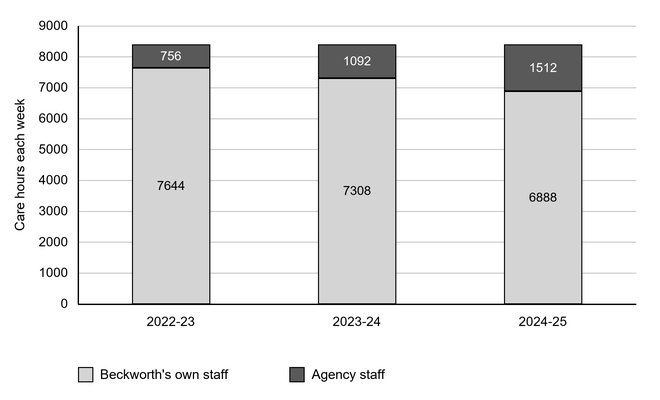
Stacked bar chart of weekly care hours by staff type, 2022–23 to 2024–25. Own-staff hours fall from 7,644 to 6,888, while agency hours rise from 756 to 1,512; axis 0–9,000 hours.
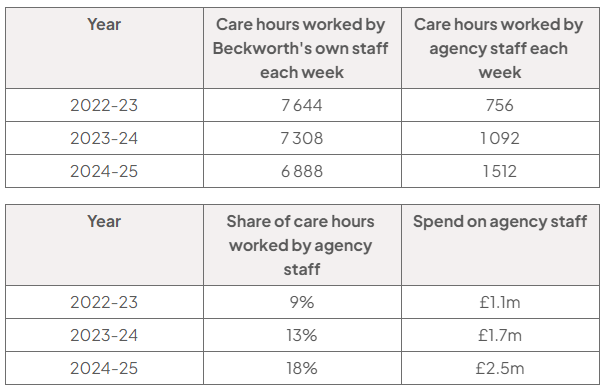
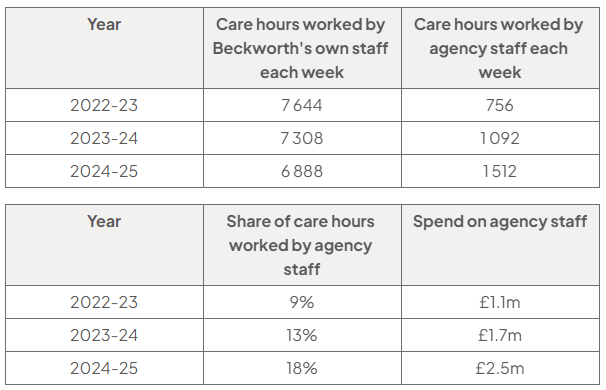
Two tables show Beckworth’s weekly care hours and agency staffing costs: 2022–23, own 7,644, agency 756, 9%, £1.1m; 2023–24, 7,308, 1,092, 13%, £1.7m; 2024–25, 6,888, 1,512, 18%, £2.5m.

Source: Beckworth Care Group

Analyse one way in which better human resource planning might reduce Beckworth Care Group's spending on agency staff.

3
6 marks

Source A: BT Group

BT Group is the United Kingdom's largest telecommunications company. It builds and runs the networks that carry broadband and mobile calls, and it sells services to households, businesses and government.

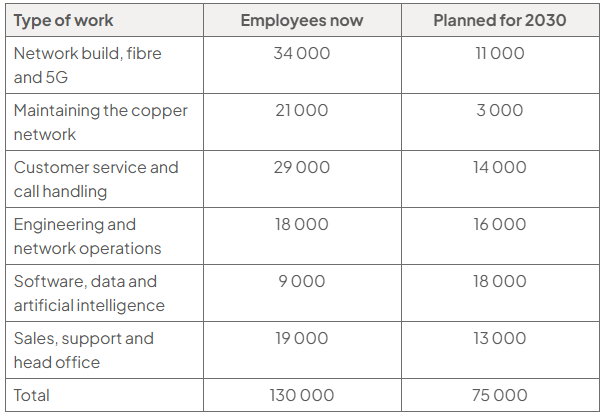
In May 2023 it announced one of the largest planned workforce reductions in British corporate history. By the end of the 2030 financial year it intends to remove between 40 000 and 55 000 roles, taking its global headcount from about 130 000, a figure that includes third-party contractors, down to between 75 000 and 90 000. That is a reduction of between 31% and 42%. The company set itself a target of £3 billion of annual cost savings.

The reasoning is that the work itself is changing. BT Group has spent years digging up roads to lay fibre broadband and building its 5G mobile network. Once that build is finished the business needs far fewer people to do it. At the same time the old copper telephone network and the 3G mobile network are being switched off, so the engineers who maintain them are no longer needed. Artificial intelligence is taking over more of the call handling and network fault diagnosis that used to be done by people, and the chief executive, Allison Kirkby, has said that advances in artificial intelligence will probably deepen the cuts rather than soften them.

The plan is not simply about having fewer people. BT Group needs many more people who can write software, work with data and build artificial intelligence systems, and far fewer who can splice a copper cable. Those are not the same people, and the company cannot buy all the new skills it needs on the open market.

Its structure is also under review. Decisions that affect customers currently pass through several layers of management, and the company has said it wants to be simpler and faster.

Source: BT Group announcements, 2023 to 2026

Appendix B: BT Group employees by type of work

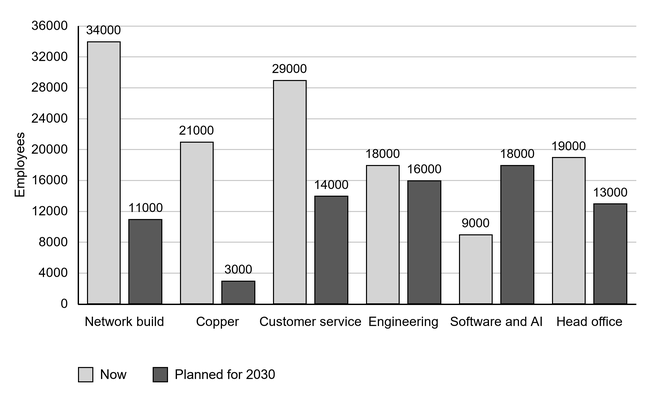
Grouped bar chart of BT Group employees by work type, now versus planned for 2030: network build 34,000 to 11,000; copper 21,000 to 3,000; customer service 29,000 to 14,000; engineering 18,000 to 16,000; software and AI 9,000 to 18,000; head office 19,000 to 13,000. Y-axis: employees.
Table of BT Group employees by work type, comparing now with planned 2030: software, data and artificial intelligence rises from 9,000 to 18,000, while total employment falls from 130,000 to 75,000.

Source: Analyst

Analyse one way in which the planned rise in the number of people working in software, data and artificial intelligence might affect BT Group's employee costs.

4
6 marks

Source A: Castlebrook Veterinary Group

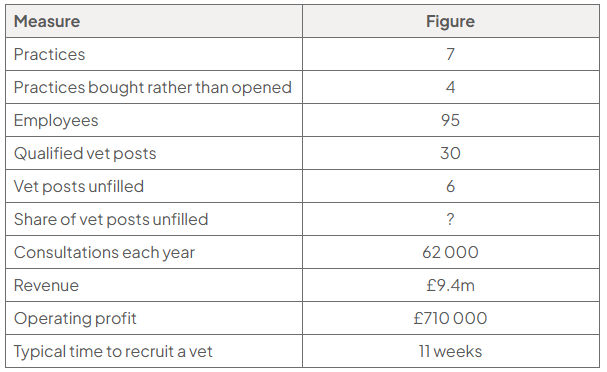
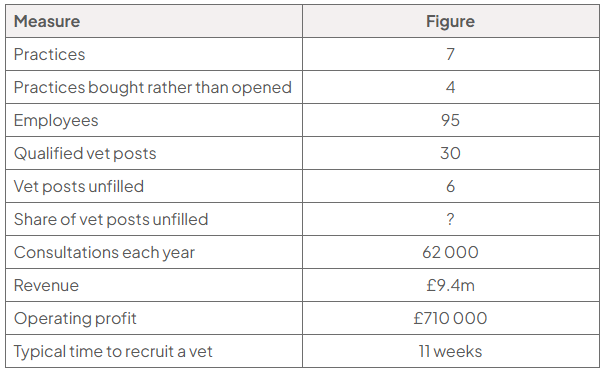
Castlebrook Veterinary Group runs seven veterinary practices across the Midlands. It employs 95 people, of whom 30 are qualified vets, and in the year to September 2025 it had revenue of £9.4 million and an operating profit of £710 000.

It did not grow by opening practices. It grew by buying them. Four of the seven were independent practices bought in the last five years, each with its own name over the door, its own way of booking appointments and its own long-standing clients. Castlebrook kept the names.

The problem is vets. There are not enough of them in the United Kingdom, and small animal practices compete for the same small pool. Six of Castlebrook's thirty vet posts are unfilled. When a practice cannot cover a day it books a locum, a self-employed vet who works for a day rate, and that day rate has risen every year. A locum does not know the animals, cannot be booked for follow-up appointments, and will not take part in the out-of-hours rota.

How much each practice decides for itself is now under review. At present each practice manager sets their own prices, chooses their own suppliers and recruits their own staff. The group's clinical director, Marcus Oyelaran, argues that this is why the group pays four different prices for the same vaccine and why recruitment takes eleven weeks. The practice managers argue that their clients came to them, not to Castlebrook, and that a practice in a market town cannot charge what one in a city suburb charges.

Source: Castlebrook Veterinary Group

Appendix A: Castlebrook Veterinary Group selected data, year to September 2025

Table of selected 2025 data: 7 practices, 4 bought, 95 employees, 30 qualified vet posts, 6 unfilled, share unfilled ?, 62,000 consultations, £9.4m revenue, £710,000 operating profit and 11-week recruitment time.

Source: Castlebrook Veterinary Group

Analyse one way in which having six of its thirty vet posts unfilled might affect Castlebrook Veterinary Group's revenue.

5
6 marks

Source A: Pret A Manger

Pret A Manger sells sandwiches, salads and coffee, made fresh in the shop each morning and thrown away or given to charity at the end of the day. It has grown past 750 shops in 21 countries, of which more than 500 are in the United Kingdom, and employs about 12 500 team members.

In 2025 system sales rose 2.7% to £1.2 billion and the business made an operating profit of £37 million. In the first four months of 2026 sales rose 7% worldwide and 8% in the United Kingdom, helped by opening shops in railway stations, airports and, for the first time, a drive-through in Warrington.

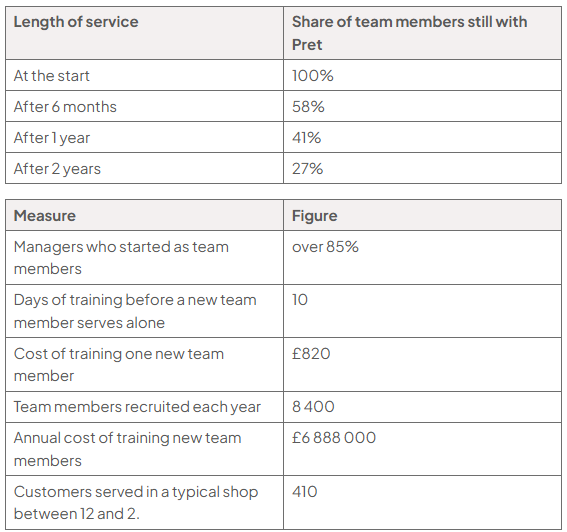
The company says its growth comes from investing in training its teams so that service is faster. It runs what it calls the Pret Academy, and more than 85% of its managers started as team members on the shop floor.

That matters more at Pret than at most retailers, because the job is unusually demanding. Everything is made on site before the shop opens, the lunchtime rush is ferocious and brief, and a queue that moves slowly loses customers who have forty minutes and somewhere else to go. A new team member who has not been trained properly slows the queue down.

Shops are run by a shop manager who reports to an area manager. How much a shop manager may decide for themselves, and how many shops an area manager can realistically look after as the estate grows past 750, is now under discussion.

Source: Pret A Manger announcements, 2025 and 2026

Appendix B: Where Pret's managers come from, and how long people stay

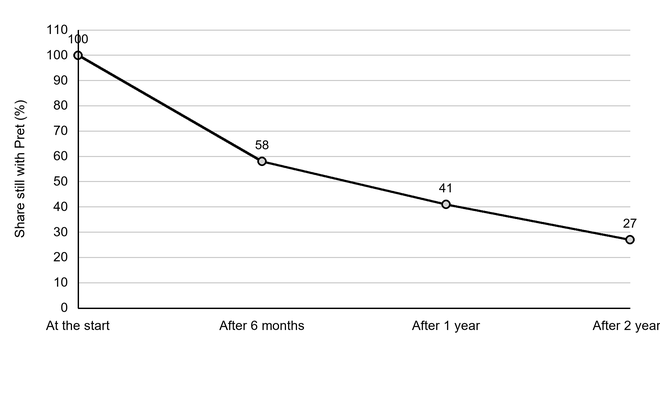
Line graph of team-member retention at Pret, with length of service on the horizontal axis and share still with Pret (%) on the vertical axis: 100% initially, 58% after 6 months, 41% after 1 year and 27% after 2 years.
Two tables: team members still with Pret are 100% initially, 58% after 6 months, 41% after 1 year and 27% after 2 years; other figures include 85%+, 10 days, £820, 8,400, £6,888,000 and 410 customers.

Source: Analyst

Analyse one way in which only 41% of team members still being with Pret after a year might affect its costs.

6
6 marks

Source A: Northvale Logistics Ltd

Northvale Logistics Ltd moves chilled and ambient food between farms, packhouses and supermarket depots across the north of England. It runs 92 lorries from two yards near Wakefield, employs 175 people and had revenue of £18.4 million in the year to March 2025, with an operating profit of £742 000.

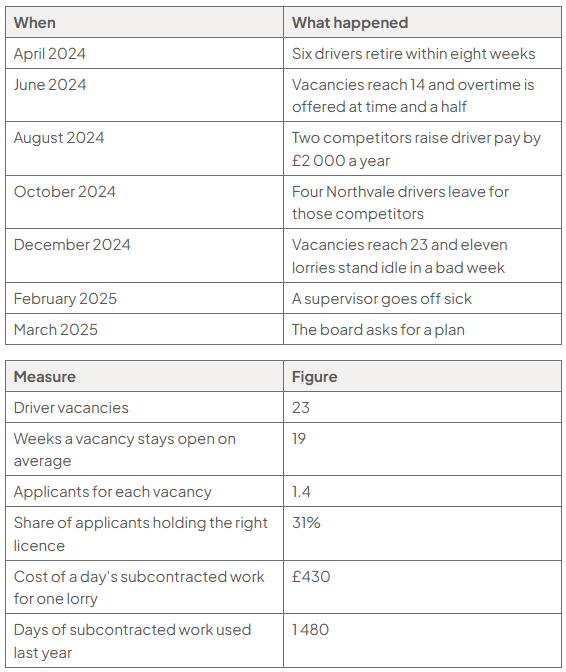
Its problem is people, not vehicles. Northvale has 23 driver vacancies it cannot fill. In a bad week eleven lorries stand in the yard because nobody is licensed to drive them, and the work is passed to a subcontractor at a rate that leaves Northvale with nothing. The average driver is 51 years old and well over a third are past 55, so the gap widens every year even when nobody resigns.

The structure has not kept up either. There are only three levels between the managing director and the cab: one operations director, six supervisors, and the drivers. Each supervisor therefore looks after a large team spread across a region, most of whom they see for a few minutes a day at a weighbridge. Two supervisors have asked for help and one has gone off sick.

Olu Adeyemi, the operations director, has told the board that Northvale must decide whether to train its own drivers or outbid everyone else for the ones who are already qualified. Either way, she has said, the company cannot go on running a fleet it has nobody to drive.

Source: Northvale Logistics Ltd

Appendix C: Northvale's driver shortage, month by month

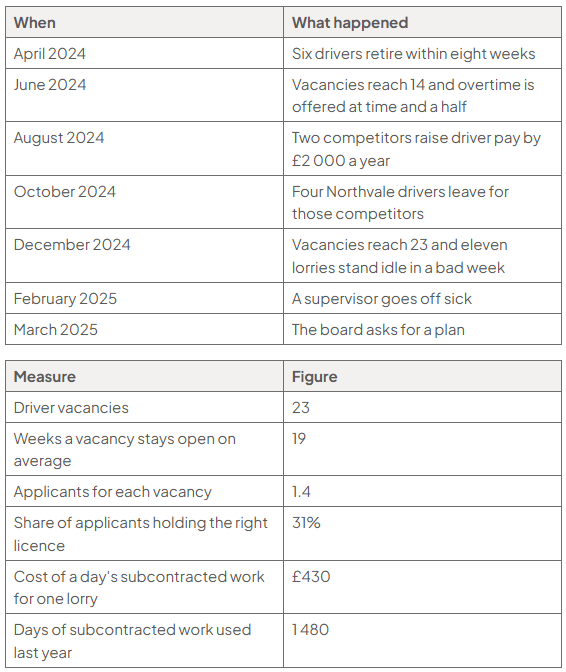
Two tables record the driver-shortage timeline and measures. Key figures are 23 vacancies, 19 weeks’ average vacancy duration, 1.4 applicants per vacancy, 31% licensed, £430 per subcontracted lorry-day and 1,480 subcontracted days last year.

Source: Northvale Logistics Ltd

Analyse one way in which only 31% of applicants holding the right licence might affect Northvale Logistics Ltd's ability to take on new work.

7
6 marks

Source A: Monzo

Monzo is a digital bank with no branches. In the year to 31 March 2025 revenue passed £1 billion for the first time, rising 48% to £1.2 billion, and adjusted profit before tax went from £13.9 million to £113.9 million. It now has more than 12 million customers, including about 625 000 business customers. Of the 2.4 million customers who joined during the year, more than two thirds came by word of mouth.

It grew up on an unusually open way of working. Most internal channels could be read by anybody in the company, decisions were argued out where everyone could see them, and employees were expected to say when they thought something was wrong. That was straightforward when there were a few hundred people.

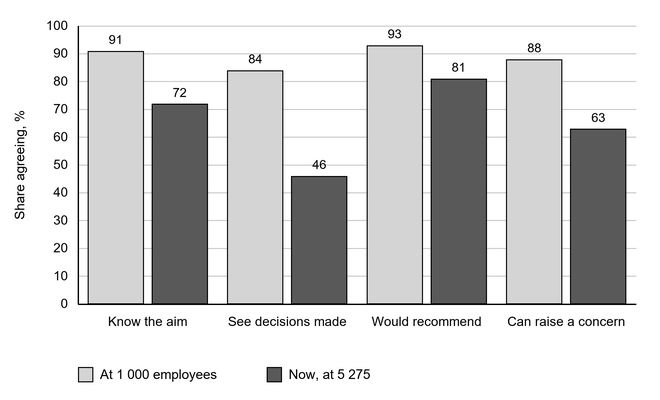
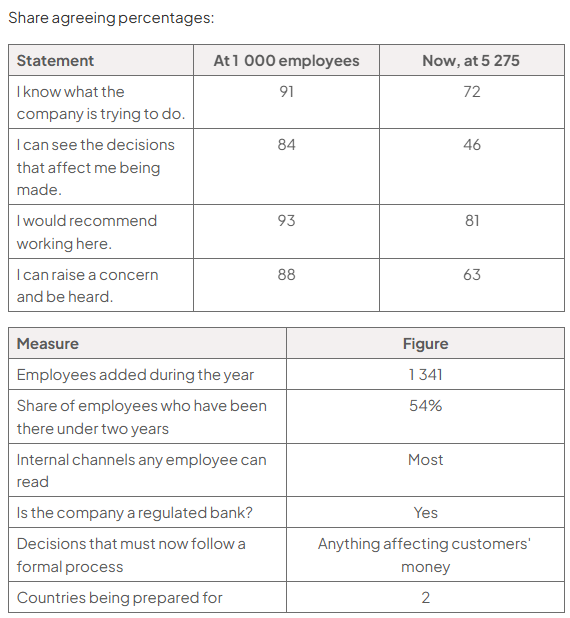
There are now 5 275, a rise of 34% in a year, and more than half of them have been there under two years. The culture survey has moved with the size. The share who say they can see the decisions that affect them being made has fallen from 84% to 46%, and the share who say they can raise a concern and be heard from 88% to 63%.

Two other things have changed. Monzo is a regulated bank, so anything affecting customers' money now has to follow a formal process rather than a conversation in a channel, and some information cannot be visible to 5 275 people at all. And 61% of employees work mainly from home, across three offices, with 72% on London contracts.

The board is preparing to launch in two more countries and wants to know what it is prepared to change.

Source: Monzo Bank Limited Annual Report for the year ended 31 March 2025

Appendix B: What Monzo's people said at 1 000 employees, and what they say now

Grouped bar chart of employee survey responses: agreement falls as Monzo grows from 1 000 to 5 275 employees: know the aim 91% to 72%, see decisions made 84% to 46%, would recommend 93% to 81%, and raise a concern 88% to 63%.
Two tables. Share agreeing, at 1 000 employees and now at 5 275: I know what the company is trying to do, 91 and 72; I can see the decisions that affect me being made, 84 and 46; I would recommend working here, 93 and 81; I can raise a concern and be heard, 88 and 63. A table of measures: 1 341 employees added during the year; 54% of employees have been there under two years; most internal channels can be read by any employee; the company is a regulated bank; anything affecting customers' money must now follow a formal process; 2 countries being prepared for.

Source: Analyst

Analyse one way in which 54% of its employees having been there under two years might affect how Monzo plans its workforce.

1
9 marks

Source A: Timpson Group

Timpson Group is one of the largest service retailers in the United Kingdom and Ireland. It repairs shoes, cuts keys, mends watches, cleans clothes and prints photographs, trading as Timpson, Max Spielmann, Snappy Snaps, Johnsons, The Watch Lab, Jeeves, Timpson Security and Barbershop. It has been a family business since 1865 and is now run by the sixth generation of Timpsons.

In the 52 weeks to 27 September 2025 sales rose 5.6% to £367 million, from £347 million, the fourth year in a row of record sales. Key cutting alone took £101 million. Watch repair now brings in more than twice as much as shoe repair, the service the company was built on.

The way Timpson Group is run is unusual, and it is deliberate. The company picks colleagues for their personality and then trusts them to do the job their way. It calls this Upside Down Management. John Timpson puts it like this: "The best way to run a business is to trust your colleagues with the freedom to do their job in the way they know best." Colleagues in the shops make decisions that in most retailers would be taken at head office.

Where those colleagues come from is unusual too. After visiting a prison in 2002 and hiring a young man named Matt, Timpson Group has become one of the largest employers of ex-offenders in the United Kingdom. Over 12% of its 4 500+ colleagues have a past criminal conviction. The Timpson Foundation spends over £1 million a year supporting the employment of people from prison, and runs training academies inside prisons so that prisoners learn the shop services before they are released. Some colleagues work on day release while still serving a sentence. The Foundation also recruits care leavers and people leaving the armed forces.

The company says the approach works on its own terms: 75% of the ex-offenders it recruits stay with the business long term, and it describes them as loyal, hardworking colleagues.

Source: Timpson Group, 2026; The Times, 23 September 2026

Appendix A: Timpson Group selected data

Selected Timpson Group data for 2025: sales £367m, growth 5.6%, key-cutting sales £101m, 4,500+ colleagues, over 12% with convictions, Foundation spending over £1m and 75% long-term retention. Previous sales were £347m.

Source: Timpson Group and The Times

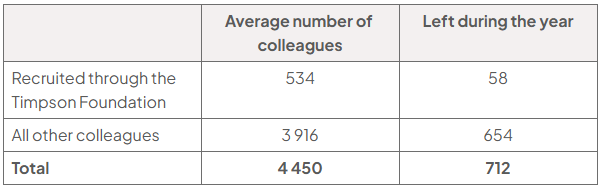
Appendix D: Timpson Group colleague movements, year to 27 September 2025

Table of Timpson Group colleague movements in 2025: Foundation recruits averaged 534, with 58 leaving; all other colleagues averaged 3,916, with 654 leaving; total average 4,450 and 712 departures.

Source: Analyst

Assess whether Timpson Group's human resource planning is working well.

Calculate Timpson Group's employee turnover rate for the year to 27 September 2025 to support your answer.

2
9 marks

Source A: Compass Group

Compass Group is the largest contract catering business in the world. It does not own restaurants. Instead it is hired by other organisations (offices, hospitals, schools, universities, factories, prisons, sports grounds and oil platforms) to run their canteens and cafés for them. If it loses a contract, the client usually keeps the kitchen and hires someone else to work in it.

It is enormous. In the year to September 2025 it had revenue of $46.1 billion, up 9.7%, and it employed over 590 000 people. Organic revenue grew 8.7%, made up of 4.5% from winning new business, about 3% from higher prices and about 1% from selling more. Underlying operating profit grew 11.7% and underlying free cash flow reached $1 975 million, up 13.5%. Net new business growth stayed inside its 4% to 5% target range for the fourth year running.

Almost all of those 590 000 people are frontline: chefs, kitchen porters, counter staff and cleaners, working in someone else's building for a wage close to the legal minimum. Many are on contracts with variable hours, because a university canteen needs very different numbers in October and in July, and because a contract can end at three months' notice.

That flexibility has a price. People leave often, and every leaver has to be recruited, checked, trained in food safety and brought up to speed on a client's site. Clients notice when the faces change: the people serving lunch are the only part of Compass Group that most of its clients' employees ever see.

The business is also unusual in how it is run. A unit manager in a single hospital canteen makes decisions that in most companies of this size would go to head office, because nobody at head office knows that hospital.

Source: Compass Group annual results for the year to September 2025

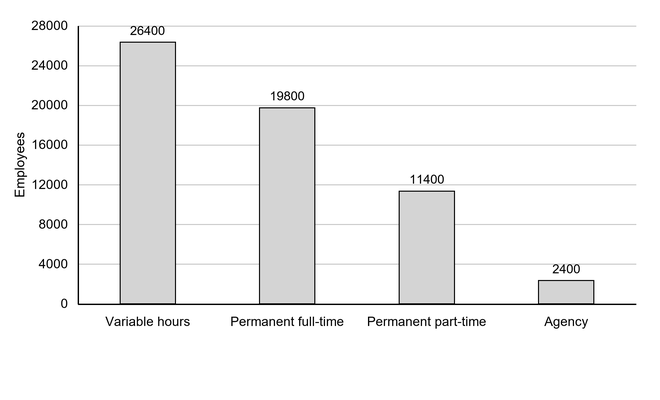
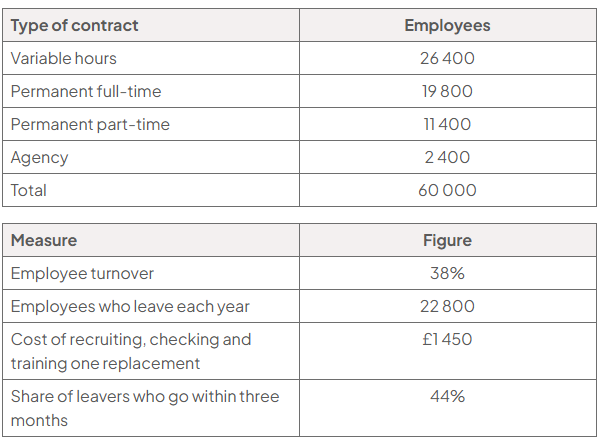
Appendix B: Compass Group's workforce in the UK and Ireland

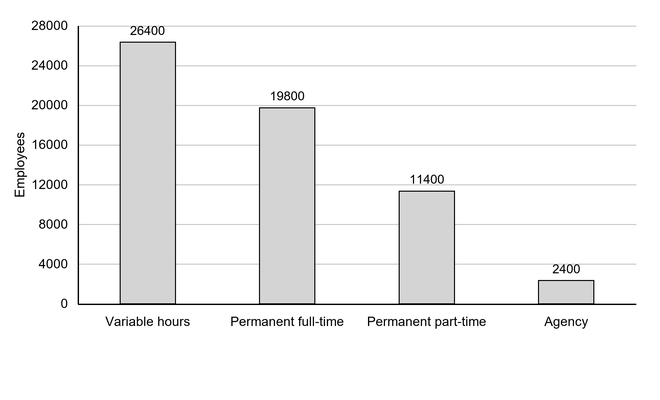
Bar chart of UK and Ireland employees by contract type, with employees on the vertical axis from 0 to 28,000 in 4,000 intervals: variable hours 26,400; permanent full-time 19,800; permanent part-time 11,400; agency 2,400.
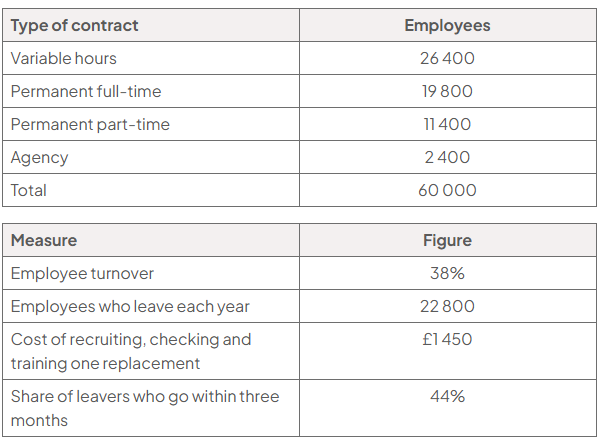
Two tables summarise workforce data: contract types and employee numbers, with variable-hours staff the largest group and 60,000 employees in total; turnover is 38%, with 22,800 leavers, £1,450 replacement cost and 44% leaving within three months.

Source: Analyst

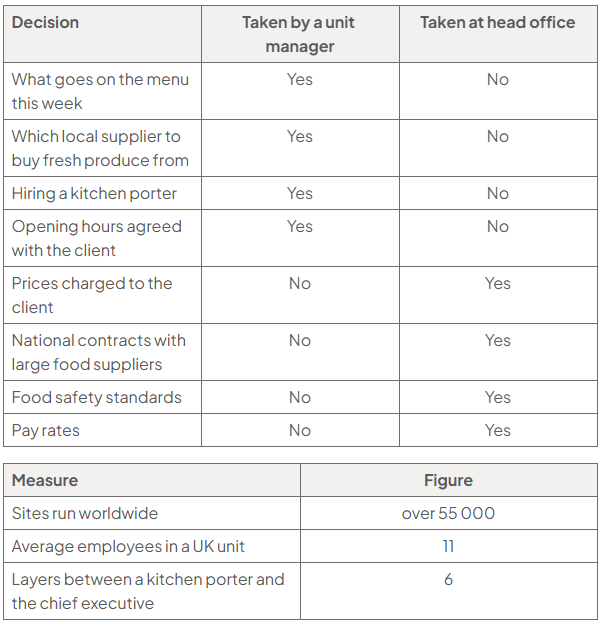
Appendix C: Where decisions are taken at Compass Group

Tables compare decisions and scale: unit managers decide menus, local suppliers, hiring and opening hours; head office sets prices, national contracts, food safety and pay. Compass has over 55,000 sites; UK units average 11 employees, with six layers to the chief executive.

Source: Analyst

Assess the impact of Compass Group's high employee turnover on its ability to win and keep contracts.

3
9 marks

Source A: Castlebrook Veterinary Group

Castlebrook Veterinary Group runs seven veterinary practices across the Midlands. It employs 95 people, of whom 30 are qualified vets, and in the year to September 2025 it had revenue of £9.4 million and an operating profit of £710 000.

It did not grow by opening practices. It grew by buying them. Four of the seven were independent practices bought in the last five years, each with its own name over the door, its own way of booking appointments and its own long-standing clients. Castlebrook kept the names.

The problem is vets. There are not enough of them in the United Kingdom, and small animal practices compete for the same small pool. Six of Castlebrook's thirty vet posts are unfilled. When a practice cannot cover a day it books a locum, a self-employed vet who works for a day rate, and that day rate has risen every year. A locum does not know the animals, cannot be booked for follow-up appointments, and will not take part in the out-of-hours rota.

How much each practice decides for itself is now under review. At present each practice manager sets their own prices, chooses their own suppliers and recruits their own staff. The group's clinical director, Marcus Oyelaran, argues that this is why the group pays four different prices for the same vaccine and why recruitment takes eleven weeks. The practice managers argue that their clients came to them, not to Castlebrook, and that a practice in a market town cannot charge what one in a city suburb charges.

Source: Castlebrook Veterinary Group

Appendix A: Castlebrook Veterinary Group selected data, year to September 2025

Appendix A table: 30 qualified vet posts, 6 unfilled, and the share unfilled shown as “?”. It also lists 62 000 annual consultations, £9.4m revenue, £710 000 operating profit and an 11-week recruitment time.

Source: Castlebrook Veterinary Group

Appendix B: How Castlebrook covers its vet rota

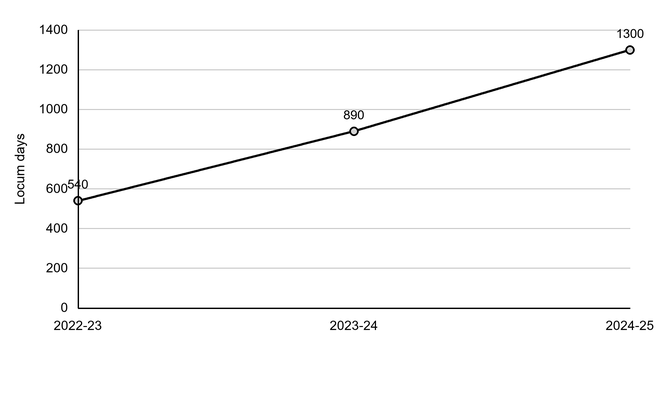
Line graph of locum days booked, rising from 540 in 2022–23 to 890 in 2023–24 and 1,300 in 2024–25; the vertical axis ranges from 0 to 1,400 days.
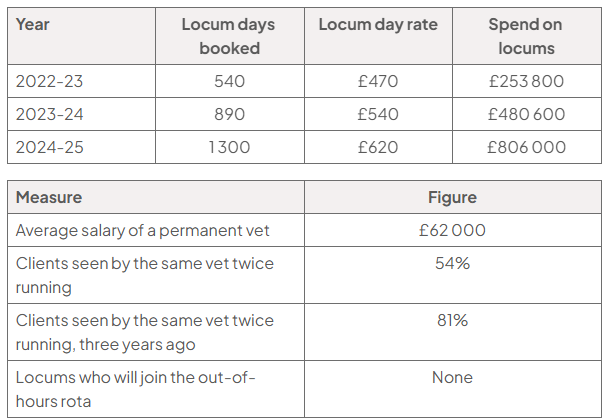
Tables show locum days, day rate and spend rising: 540, £470 and £253,800 in 2022–23; 890, £540 and £480,600 in 2023–24; 1,300, £620 and £806,000 in 2024–25. Permanent-vet salary is £62,000; repeat clients fell from 81% to 54%; no locums join the out-of-hours rota.

Source: Castlebrook Veterinary Group

Assess the impact of the shortage of vets on Castlebrook Veterinary Group's profit.

Calculate the share of Castlebrook Veterinary Group's vet posts that are unfilled to support your answer.

4
9 marks

Source A: Northvale Logistics Ltd

Northvale Logistics Ltd moves chilled and ambient food between farms, packhouses and supermarket depots across the north of England. It runs 92 lorries from two yards near Wakefield, employs 175 people and had revenue of £18.4 million in the year to March 2025, with an operating profit of £742 000.

Its problem is people, not vehicles. Northvale has 23 driver vacancies it cannot fill. In a bad week eleven lorries stand in the yard because nobody is licensed to drive them, and the work is passed to a subcontractor at a rate that leaves Northvale with nothing. The average driver is 51 years old and well over a third are past 55, so the gap widens every year even when nobody resigns.

The structure has not kept up either. There are only three levels between the managing director and the cab: one operations director, six supervisors, and the drivers. Each supervisor therefore looks after a large team spread across a region, most of whom they see for a few minutes a day at a weighbridge. Two supervisors have asked for help and one has gone off sick.

Olu Adeyemi, the operations director, has told the board that Northvale must decide whether to train its own drivers or outbid everyone else for the ones who are already qualified. Either way, she has said, the company cannot go on running a fleet it has nobody to drive.

Source: Northvale Logistics Ltd

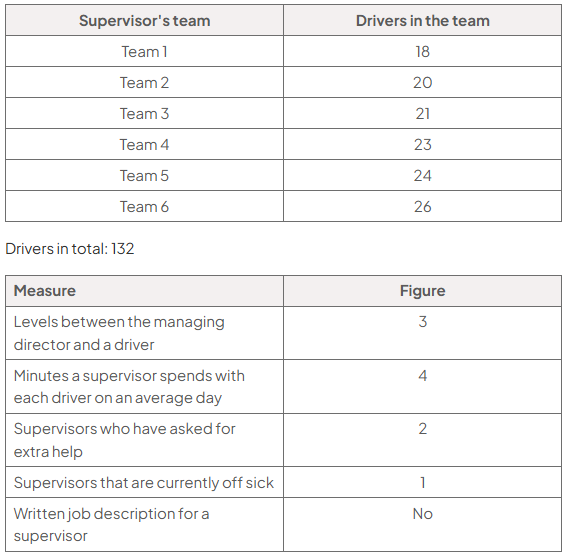
Appendix B: How Northvale's 132 drivers are spread across the six supervisors

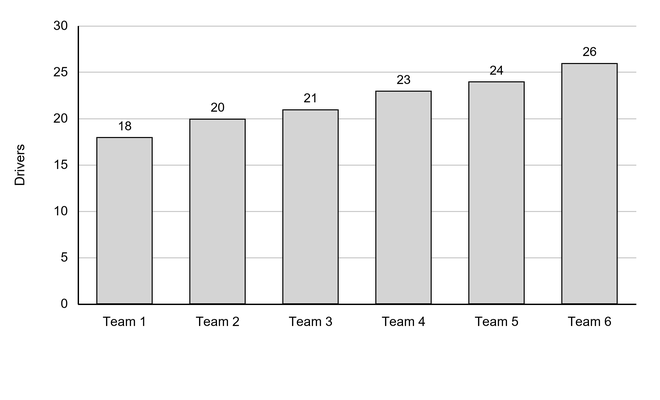
Bar chart of drivers per supervisor team, with the number rising from 18 in Team 1 to 26 in Team 6; vertical axis shows drivers from 0 to 30 in increments of 5.
Two tables: drivers per supervisor team are Team 1 to 6: 18, 20, 21, 23, 24 and 26, totalling 132. Other figures: three management levels, four minutes per driver, two supervisors seeking help, one off sick, and no written job description.

Source: Northvale Logistics Ltd

Appendix C: Northvale's driver shortage, month by month

Two tables. Timeline of Northvale's driver shortage: April 2024, six drivers retire within eight weeks; June 2024, vacancies reach 14 and overtime is offered at time and a half; August 2024, two competitors raise driver pay by £2 000 a year; October 2024, four Northvale drivers leave for those competitors; December 2024, vacancies reach 23 and eleven lorries stand idle in a bad week; February 2025, a supervisor goes off sick; March 2025, the board asks for a plan. A table of measures: 23 driver vacancies; a vacancy stays open for 19 weeks on average; 1.4 applicants for each vacancy; 31% of applicants hold the right licence; cost of a day's subcontracted work for one lorry £430; 1 480 days of subcontracted work used last year.

Source: Northvale Logistics Ltd

Assess how well Northvale Logistics Ltd has planned its workforce over the past year.

5
9 marks

Source A: Ravensworth Security Ltd

Ravensworth Security Ltd supplies security officers to shopping centres, hospitals, building sites and events across the north east of England. It has 27 contracts running at any one time, employs 320 people and had revenue of £11.8 million in the year to March 2025, with an operating profit of £386 000.

Only 112 of those 320 people have a contract that guarantees them work. The other 208 are on zero-hours contracts, and the reason is written into the way the business wins and loses work. A contract can arrive needing 22 guards at four weeks' notice, or end needing none at six weeks' notice, and Ravensworth cannot carry people it has nothing to put them on.

This winter the two happened together. In January the shopping centre that is Ravensworth's largest customer gave notice, taking 46 guards' work away. In February the company won a hospital contract needing 38 guards, but it does not start for fourteen weeks and those guards need training Ravensworth's shopping-centre team does not have.

The staff notice all of this. One guard worked 168 hours in the busiest month last year and 42 in the quietest. Ninety-four people on zero-hours contracts left during the year, most of them to jobs that told them in advance how much they would earn.

Priya Raithatha, the managing director, has told the board that the flexibility that keeps Ravensworth solvent is also what makes it difficult to keep anybody, and that the board has to decide which of the two matters more.

Source: Ravensworth Security Ltd

Appendix B: How Ravensworth's 320 staff are employed

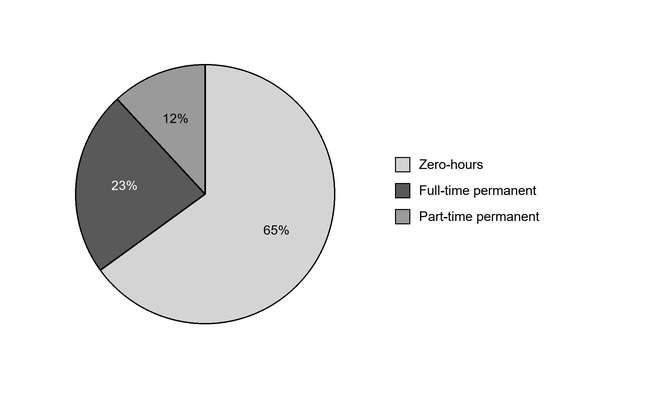
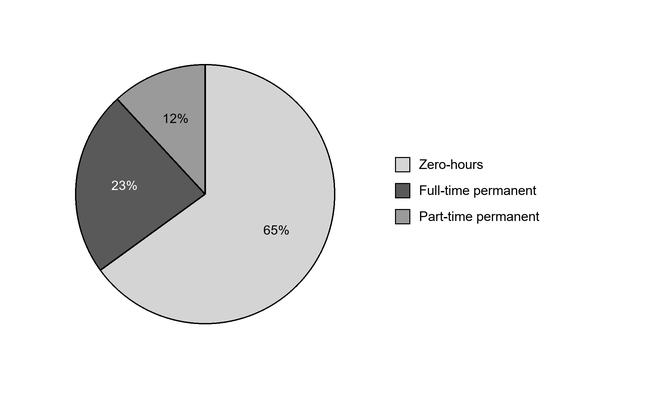
Pie chart of Ravensworth’s staff by contract type: zero-hours 65%, full-time permanent 23%, and part-time permanent 12%; zero-hours staff form the largest group.
  • Staff in total: 320

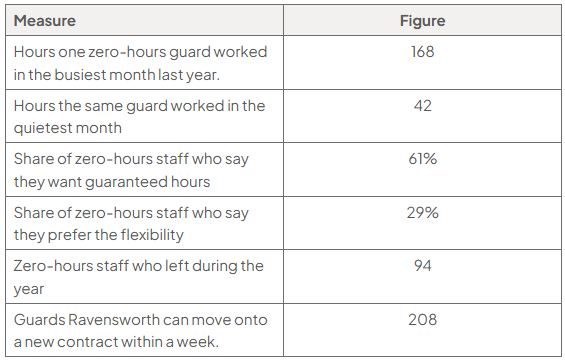
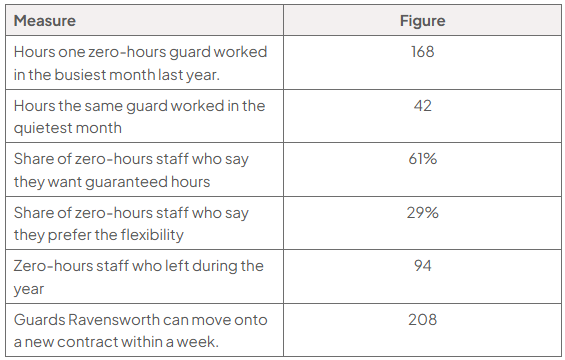
Table of Ravensworth’s zero-hours staffing measures: one guard worked 168 hours in the busiest month and 42 in the quietest; 61% wanted guaranteed hours, 29% preferred flexibility, 94 left, and 208 could move within a week.

Source: Ravensworth Security Ltd

Appendix C: Ravensworth's contracts, and how it is organised

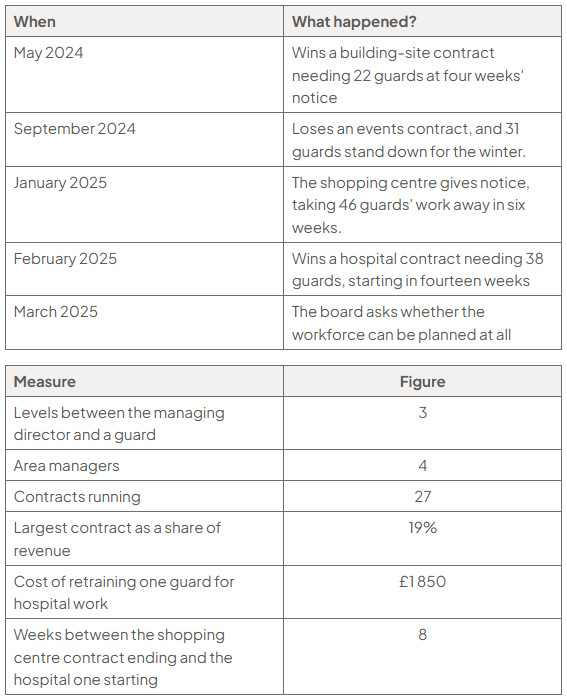
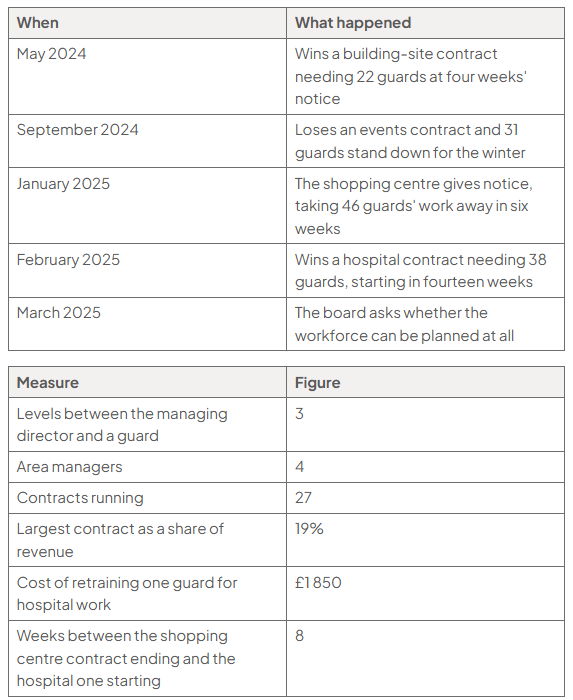
Timeline and staffing table: May 2024, wins 22-guard building-site contract; September, loses events contract and stands down 31 guards; January 2025, loses 46 shopping-centre posts; February, wins 38-guard hospital contract; March, board questions workforce planning. Measures: three management levels, four area managers, 27 contracts, largest contract 19% of revenue, £1,850 retraining cost per guard, and eight weeks between contracts.

Source: Ravensworth Security Ltd

Assess how well Ravensworth Security Ltd has planned for the loss of its largest contract.

1
15 marks

Source A: Beckworth Care Group

Beckworth Care Group runs six residential care homes in the north of England. It has 312 beds, 284 residents and 240 employees, and in the year to March 2025 it had revenue of £14.8 million and made an operating profit of £0.9 million.

Caring for residents is work that cannot be put off or stored up. Every shift has to be covered, and the law sets a minimum number of qualified staff for the number of residents in a home. Beckworth needs 8 400 hours of care each week across the six homes.

For three years it has struggled to fill those hours with its own staff. Pay in the sector is low, the work is demanding, and supermarkets and warehouses nearby recruit from the same towns. In the year to March 2025, 84 employees left. When Beckworth cannot fill a shift, it books an agency worker instead, at roughly twice the hourly cost of its own staff. Agency workers also do not know the residents, and families have begun to comment on the number of unfamiliar faces.

Beckworth's structure has grown up without much thought. Each of the six homes has a registered manager, two deputy managers, four senior carers and then the care staff, and above the home managers sit a regional manager, an operations director and the chief executive. The chief executive, Dana Okoye, believes there are too many layers between her and the people who actually care for residents, and that decisions which should take a day take three weeks.

She has asked for a plan that would remove the deputy manager layer and widen the span of control of each home manager, moving the money saved into higher pay for care staff.

Source: Beckworth Care Group

Appendix A: Beckworth Care Group selected data, year to March 2025

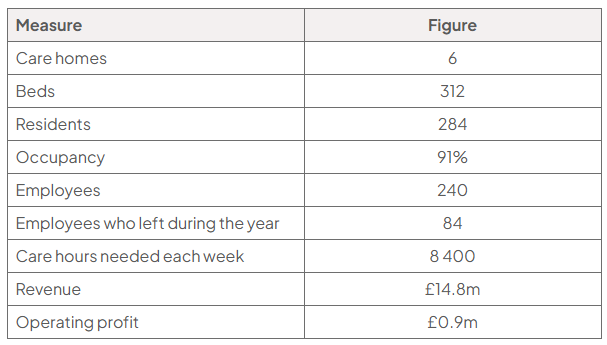
Table of Beckworth Care Group data: 6 care homes, 312 beds, 284 residents, 91% occupancy, 240 employees, 84 employees leaving, 8 400 care hours needed weekly, £14.8m revenue and £0.9m operating profit.

Source: Beckworth Care Group

Appendix B: How Beckworth Care Group fills its care hours

Stacked bar chart of Beckworth’s weekly care hours, showing own staff falling from 7 644 in 2022/23 to 6 888 in 2024/25, while agency hours rise from 756 to 1 512; y-axis 0 to 9 000 hours.
Two tables. Weekly care hours worked by Beckworth's own staff and by agency staff: 2022/23, 7 644 and 756; 2023/24, 7 308 and 1 092; 2024/25, 6 888 and 1 512. Share of care hours worked by agency staff and spend on agency staff: 2022/23, 9% and £1.1m; 2023/24, 13% and £1.7m; 2024/25, 18% and £2.5m.

Source: Beckworth Care Group

Appendix D: Two ways of filling Beckworth Care Group's care hours

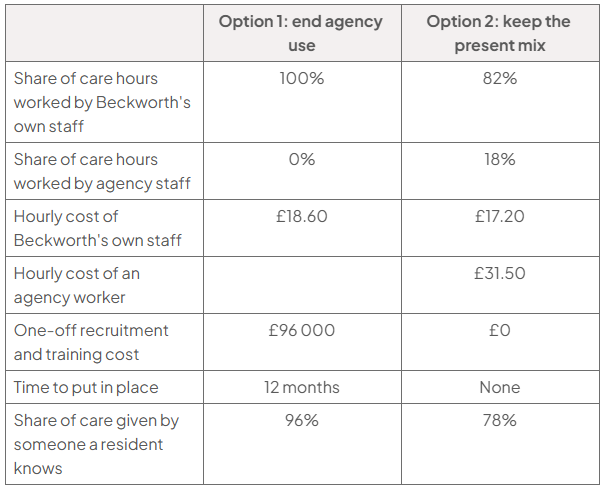
Care hours needed each year = 436 800

Table comparing care-hour options: Option 1 ends agency use: 100% own staff at £18.60/hour, £96 000 recruitment and training, 12 months, 96% known residents; Option 2 keeps the mix: 82% own, 18% agency, £17.20 and £31.50/hour, no cost or delay, 78% known.

Source: Analyst

Beckworth Care Group is considering two ways of covering its care hours:

Option 1: raise pay to £18.60 an hour and recruit enough permanent staff to end the use of agency workers

Option 2: keep the present mix of permanent and agency staff

Evaluate both options and recommend which one Beckworth Care Group should choose.

Calculate the cost of each care hour under Option 2 to support your answer.

2
15 marks

Source A: Compass Group

Compass Group is the largest contract catering business in the world. It does not own restaurants. Instead it is hired by other organisations (offices, hospitals, schools, universities, factories, prisons, sports grounds and oil platforms) to run their canteens and cafés for them. If it loses a contract, the client usually keeps the kitchen and hires someone else to work in it.

It is enormous. In the year to September 2025 it had revenue of $46.1 billion, up 9.7%, and it employed over 590 000 people. Organic revenue grew 8.7%, made up of 4.5% from winning new business, about 3% from higher prices and about 1% from selling more. Underlying operating profit grew 11.7% and underlying free cash flow reached $1 975 million, up 13.5%. Net new business growth stayed inside its 4% to 5% target range for the fourth year running.

Almost all of those 590 000 people are frontline: chefs, kitchen porters, counter staff and cleaners, working in someone else's building for a wage close to the legal minimum. Many are on contracts with variable hours, because a university canteen needs very different numbers in October and in July, and because a contract can end at three months' notice.

That flexibility has a price. People leave often, and every leaver has to be recruited, checked, trained in food safety and brought up to speed on a client's site. Clients notice when the faces change: the people serving lunch are the only part of Compass Group that most of its clients' employees ever see.

The business is also unusual in how it is run. A unit manager in a single hospital canteen makes decisions that in most companies of this size would go to head office, because nobody at head office knows that hospital.

Source: Compass Group annual results for the year to September 2025

Appendix B: Compass Group's workforce in the UK and Ireland

Bar chart of Compass Group employees by contract type: variable hours 26,400; permanent full-time 19,800; permanent part-time 11,400; agency 2,400. Y-axis: employees, 0 to 28,000.
Tables show contract workforce: variable hours 26,400; full-time 19,800; part-time 11,400; agency 2,400; total 60,000. Turnover figures: 38%, 22,800 leavers, £1,450 replacement cost per employee and 44% leaving within three months.

Source: Analyst

Appendix D: Two ways of reducing employee turnover in the UK and Ireland

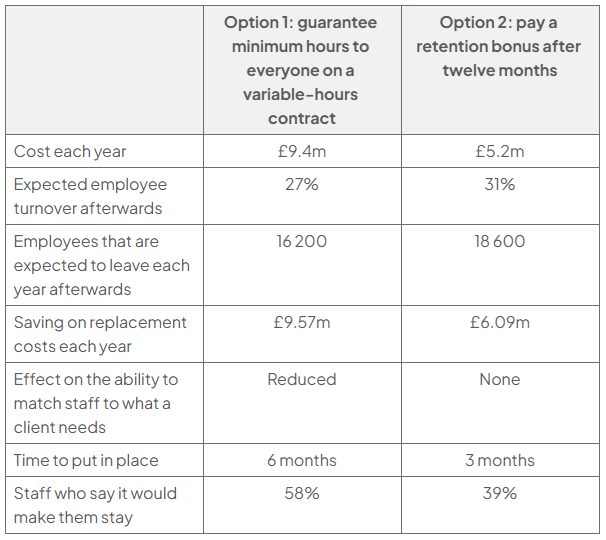
Comparison table: guaranteed minimum hours costs £9.4m, turnover 27% (16,200 leavers), saves £9.57m, reduces flexibility, takes six months and 58% of staff say it would make them stay; a retention bonus costs £5.2m, turnover 31% (18,600), saves £6.09m, has no effect, takes three months and 39% say it would make them stay.

Source: Analyst

Compass Group is considering two ways of reducing employee turnover in the UK and Ireland:

Option 1: guarantee minimum hours to everyone on a variable-hours contract

Option 2: pay a retention bonus after twelve months

Evaluate both options and recommend which one Compass Group should choose.

Calculate the annual cost of replacing the employees who leave to support your answer.

3
15 marks

Source A: Ravensworth Security Ltd

Ravensworth Security Ltd supplies security officers to shopping centres, hospitals, building sites and events across the north east of England. It has 27 contracts running at any one time, employs 320 people and had revenue of £11.8 million in the year to March 2025, with an operating profit of £386 000.

Only 112 of those 320 people have a contract that guarantees them work. The other 208 are on zero-hours contracts, and the reason is written into the way the business wins and loses work. A contract can arrive needing 22 guards at four weeks' notice, or end needing none at six weeks' notice, and Ravensworth cannot carry people it has nothing to put them on.

This winter the two happened together. In January the shopping centre that is Ravensworth's largest customer gave notice, taking 46 guards' work away. In February the company won a hospital contract needing 38 guards, but it does not start for fourteen weeks and those guards need training Ravensworth's shopping-centre team does not have.

The staff notice all of this. One guard worked 168 hours in the busiest month last year and 42 in the quietest. Ninety-four people on zero-hours contracts left during the year, most of them to jobs that told them in advance how much they would earn.

Priya Raithatha, the managing director, has told the board that the flexibility that keeps Ravensworth solvent is also what makes it difficult to keep anybody, and that the board has to decide which of the two matters more.

Source: Ravensworth Security Ltd

Appendix B: How Ravensworth's 320 staff are employed

Pie chart of Ravensworth Security Ltd staff by contract type: zero-hours contracts make up 65%, full-time permanent contracts 23%, and part-time permanent contracts 12%.
  • Staff in total: 320

Table of Ravensworth workforce measures: one zero-hours guard worked 168 hours in the busiest month and 42 in the quietest; 61% wanted guaranteed hours, 29% preferred flexibility, 94 left, and 208 could move within a week.

Source: Ravensworth Security Ltd

Appendix C: Ravensworth's contracts, and how it is organised

Two tables show Ravensworth’s timeline: May 2024, wins 22-guard building-site contract; September, loses events contract and stands down 31 guards; January 2025, loses 46 shopping-centre posts; February, wins 38-guard hospital contract; March, questions workforce planning. Measures: 3 management levels, 4 area managers, 27 contracts, largest contract 19% of revenue, £1,850 retraining cost per guard and an 8-week gap.

Source: Ravensworth Security Ltd

Appendix D: Two ways of holding on to the people Ravensworth needs

208 staff on zero-hours contracts, operating profit £386 000

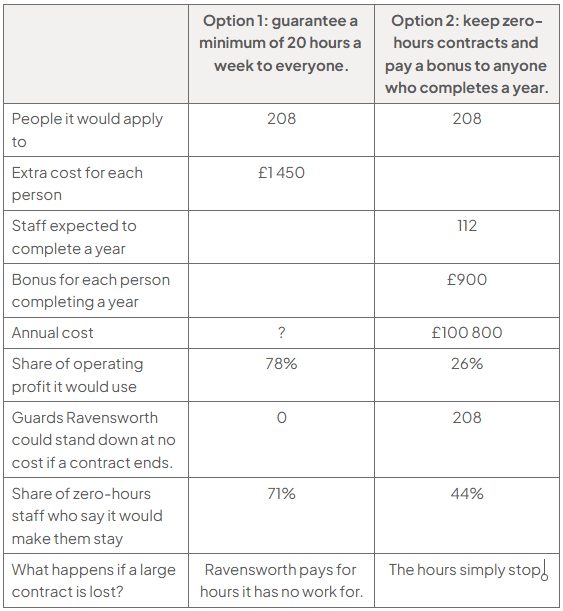
Comparison table: Option 1 guarantees 20 hours weekly; Option 2 keeps zero-hours contracts with a £900 bonus. Both cover 208 staff; costs are £1,450 each versus £100,800 annually, using 78% versus 26% of profit.

Source: Analyst

Ravensworth Security Ltd is considering two ways of holding on to the people it needs:

Option 1: guarantee a minimum of 20 hours a week to everyone

Option 2: keep zero-hours contracts and pay a bonus to anyone who completes a year

Evaluate both options and recommend which one Ravensworth Security Ltd should choose.

Calculate the annual cost of Option 1 to support your answer.