Digital Strategy (AQA A Level Business): Exam Questions

Exam code: 7132

Syllabus Edition

First teaching 2026

First exams 2028

3 hours19 questions
1
6 marks

Source A: Octopus Energy Group

Octopus Energy Group Limited is a privately owned company which supplies gas and electricity to households and businesses, installs low-carbon technology in homes, and owns Kraken, a software platform which manages energy customers' accounts. The group was founded in the UK in 2016. In the year to 30 April 2025 its revenue rose 10% to £13 683 million, and it supplied 9.94 million customers across eight countries, compared with 7.95 million a year earlier.

In January 2025 Octopus Energy became the largest household energy supplier in the UK, with 24% of the market measured by number of meters. Its UK customers reached 7.6 million, and it accounted for 42% of all switches between household energy suppliers during the year. It has been named a Which? Recommended Energy Supplier for eight consecutive years and holds a Trustpilot rating of 4.8 out of 5.

Every customer account in the group runs on Kraken. The platform combines data from customers' smart meters with weather data to forecast how much energy customers will use, and the group adjusts its purchases of gas and electricity each day as the forecast changes. Kraken is also licensed to other energy suppliers, including EDF Energy, and to water and broadband companies. In September 2025 the group announced its intention to demerge Kraken as a separate company.

The group buys energy in two ways:

  • Fixed price contracts. For each customer on a fixed price, it buys the gas and electricity it expects that customer to use, in advance, for the whole length of the contract.

  • The standard variable tariff. The maximum price is set by Ofgem, the energy regulator, every three months. The group buys energy for these customers on a rolling basis which follows the method Ofgem uses to set the price cap.

The group tests its finances against a range of shocks, including a period of cold weather combined with a rise in wholesale prices. The spring of 2025 was the warmest in the UK on record, and in April 2025 its UK customers used 25% less gas than normal for the time of year.

Octopus Energy supports customers who are struggling to pay. It employs social workers in every one of its UK locations, gave energy credit to more than 90 000 customers in financial hardship through its Octo Assist Fund, and made home visits to fit thermostats, timers and draught-proofing. Throughout the year it kept its standard variable tariff below the price cap by reducing standing charges, at a cost of £57 million.

The group's stated aim is to make energy greener, cheaper and fairer. It installs heat pumps, including its own Cosy range, together with solar panels, batteries and electric vehicle chargers, and offers smart tariffs which reward customers for using electricity when it is cheapest. Of the group's total emissions, 95% come from the gas its customers use. It has committed to reach net zero emissions across its whole value chain by 2040.

In the year to 30 April 2025 the group made a net loss of £255 million, compared with a profit of £83 million in the previous year.

Source: Octopus Energy Group Limited, Annual Report and Financial Statements 2025

Octopus Energy Group's Kraken platform combines smart meter data with weather data to forecast how much energy its customers will use, and the group adjusts its purchases each day. In April 2025 its UK customers still used 25% less gas than normal for the time of year.

Analyse one way in which using this data might affect Octopus Energy Group's costs.

2
6 marks

Source B: Tarnside Travel

Tarnside Travel Limited organises escorted coach holidays from its base in Kendal, Cumbria. It was founded in 1972 and is owned by the Fell family; its Managing Director is Joanne Fell. It employs 42 people, runs 8 coaches and has two booking offices, in Kendal and Penrith. In the year to 30 September 2026 it carried 10 300 passengers on holidays in the UK and Europe, at an average price of £815.

Most of Tarnside Travel's customers are retired: 76% are aged over 65. Its holidays are priced in a brochure published a year in advance, and include coach travel, hotels and entrance to attractions. A growing share of its customers travel alone; they pay a single supplement of £180 for a room of their own.

Customers can book by telephone, in a branch or, since 2024, online. A booking taken by telephone costs the company about £24 to process, compared with about £6 online.

Changes in government policy affect the company's holidays. Edinburgh introduced a visitor levy of 5% of the cost of accommodation from 24 July 2026, and councils in Wales may charge a levy of £1.30 a person a night from April 2027. In April 2026 the full new state pension rose by 4.8%, from £230.25 to £241.30 a week.

The coaches run on diesel. Tarnside Travel buys its fuel at the price on the day, while the price of each holiday is fixed when the brochure is published.

Source: Tarnside Travel

Since 2024 customers have been able to book Tarnside Travel's holidays online. A booking taken online costs about £6 to process, compared with about £24 by telephone.

Analyse one way in which taking more bookings online might affect Tarnside Travel's costs.

3
6 marks

Source B: Royal Shakespeare Company

The Royal Shakespeare Company (RSC) is a registered charity based in Stratford-upon-Avon, the town where Shakespeare was born. Its Co-Artistic Directors are Daniel Evans and Tamara Harvey. Its mission is to "redefine how Shakespeare and great story-telling connects us, creates opportunities and brings joy".

The RSC performs in three theatres in Stratford, transfers productions to London, tours the UK and abroad, and works with schools nationwide. It also earns income from licensing its productions, including the musical Matilda, which has had more than 5 000 performances in London since 2011 and began a UK tour in October 2025.

Its income comes from ticket sales, an annual grant from Arts Council England, Theatre Tax Relief, donations, catering and retail.

In 2024/25 the RSC sold more than 25 000 tickets at £25 or less, and in Stratford it sold 77% of its seats but achieved 64% of its potential ticket income. It sold more than 23 000 tickets at £10 to young people aged 14 to 25, in a partnership with the social media company TikTok. Linear television viewing is declining, particularly among younger audiences.

The RSC faces two pressures:

  • Income. In the year to 31 March 2025 income fell from £92.1 million to £82.0 million, partly because the previous year's income from Matilda and other productions was not repeated, and spending exceeded income.

  • Audiences. The RSC sees cost-of-living pressures as a risk to audience levels.

In 2025 it announced plans to reduce its workforce by 11%, first through voluntary redundancy, to close a shortfall of about £5 million.

Source: Royal Shakespeare Company, Report and Financial Statements for the year ended 31 March 2025, and press reports

The RSC sold more than 23 000 tickets at £10 to young people aged 14 to 25, in a partnership with the social media company TikTok.

Analyse one way in which using a social media platform might help the RSC to reach younger audiences.

4
6 marks

Source B: Hartlake Department Store

Hartlake Department Store Limited has traded from the same building on the high street of a Cheshire market town since 1886. The Hartlake family owns it, and all four directors are family members; the Managing Director is Rachel Hartlake. The board meets four times a year.

The store has four floors selling clothing, beauty, homeware and toys, a café, and 6 500 square metres of selling space. Most in-store sales are to customers aged 55 or over.

Hartlake employs 196 people, down from 210 a year earlier. Many have worked there for more than ten years; 38% are over 50. Most sales staff have strong relationships with regular customers.

In 2023 a new till system took nine months to install instead of the planned three, and cost 40% more than budgeted. In 2025 Hartlake:

  • relaunched its website, offering delivery and click-and-collect; most online sales are to customers under 45

  • introduced self-service tills on the ground floor

In the year to 31 January 2026:

  • revenue fell to £17.1 million and the store made its first operating loss for eleven years

  • visitors to the store fell from 1.42 million to 1.31 million

  • the share of online orders collected in store rose from 31% to 46%; customers who collect spend an average of £18 more in the store on the same visit

  • in a staff survey, 34% of employees felt prepared for the changes ahead

The board must choose between two plans to change the business in 2026. The Managing Director says: "We have never had to change this much, this quickly."

Source: Hartlake Department Store

In 2025 Hartlake Department Store relaunched its website, offering delivery and click-and-collect.

Analyse one way in which click-and-collect might affect the number of people visiting the store.

5
6 marks

Source A: Wickes

Wickes Group plc is a UK home improvement retailer listed on the London Stock Exchange. It became an independent company in 2021, when it separated from Travis Perkins. It has 230 stores and about 7 800 employees, and serves three groups of customers:

  • Tradespeople, through its TradePro membership scheme. Sales to TradePro members rose in 2025.

  • Do-it-yourself customers.

  • Design & Installation customers, whose kitchens and bathrooms it designs and fits.

It reports a "market-leading price position" against its wider peer group.

Wickes describes itself as "a digitally-led, service-enabled home improvement retailer". Two-thirds of its sales are digitally enabled, but 96% are fulfilled from its stores. Wickes has cut the time to prepare a Click & Collect order from 30 minutes to 15 minutes, and Wickes Rapid delivers orders of up to 800kg to a home or building site within three hours. Its strategy rests on seven "growth levers", including winning trade customers, digital capability and store investment.

Several rivals, including Homebase, have left the market since 2023. Homebase went into administration at the end of 2024, and Carpetright, CTD Tiles and Wilko have also left. Four of Wickes's five new stores in 2025 were former Homebase stores, and it employed 54 former Homebase staff.

In March 2026 the chief executive, David Wood, announced an ambition to reach 300 stores, creating more than 2 000 new jobs. Wickes plans 4 to 5 new stores in 2026, 7 to 9 in 2027 and at least 10 a year from 2028. It reports "ever-increasing demand for prime retail locations".

Source: Wickes Group plc, results for the year ended December 2025, annual report 2025 and half-year results 2026

Wickes describes itself as "a digitally-led, service-enabled home improvement retailer". Two-thirds of its sales are digitally enabled.

Analyse one way in which digital technology might help Wickes to compete.

6
6 marks

Source A: Glastonbury Festival

Glastonbury Festival Events Limited organises the Glastonbury Festival of Contemporary and Performing Arts at Worthy Farm, a working dairy farm in Pilton, Somerset, where the festival has been held since 1970. The company is owned by Emily Eavis, who replaced her father, the festival's founder Michael Eavis, as the person with significant control in October 2024. Both are directors. The company employs an average of 105 people.

The company's objective is "to host an event that joyfully celebrates music and culture". It aims to keep ticket prices "as low as possible" so that the festival remains accessible, and it supports charities including Oxfam, Greenpeace and WaterAid.

The festival's licence allows up to 210 000 people on site. Tickets are sold online under three rules:

  • Registration. Everyone aged 13 or over must register before buying a ticket.

  • Photo tickets. Each ticket carries the holder's photo and cannot be transferred.

  • One ticket agent. Tickets are sold only through See Tickets and are "not available for sale on any secondary sales sites".

Every five or six years the festival takes a fallow year, with no festival, so that the farmland can recover. 2026 is a fallow year, and the company expects "a significant cost". Tickets for the 2027 festival went on sale in October 2026.

The company finances its operations through retained profits and paid no dividends. It describes its main risk as cancellation because of "extremely bad weather or a global pandemic". In the year to March 2025 it spent £3.5 million buying land to "protect the future of the Festival".

Source: Glastonbury Festival Events Limited, annual report and financial statements for the year ended 31 March 2025, and press reports

Glastonbury tickets are sold only online through one ticket agent. Each buyer must register in advance, and each ticket carries the holder's photo.

Analyse one way in which this digital ticketing system might benefit Glastonbury.

7
6 marks

Source A: Just Eat Takeaway

Just Eat Takeaway.com (JET) runs online food delivery platforms in Europe, including Just Eat in the UK and Ireland, Lieferando in Germany and Thuisbezorgd in the Netherlands. Its headquarters are in Amsterdam. JET was formed in 2020 when Just Eat merged with Takeaway.com. In October 2025 JET was bought by Prosus, a Dutch-listed technology investor, for about €4.1 billion, and its shares were removed from the stock market. Roberto Gandolfo replaced the founder, Jitse Groen, as chief executive in January 2026.

Customers order from restaurants and shops through JET's apps and websites. Some orders are delivered by the restaurant itself and some by couriers working through JET.

JET has changed in three main ways:

  • Acquisitions. In 2021 it bought Grubhub, a US delivery business, for $7.3 billion; it sold Grubhub in January 2025.

  • Countries. Since 2022 it has left Norway, Portugal, New Zealand, France, Australia, Denmark and Bulgaria, and it now operates in 14 countries. When it left Denmark in April 2026, its customers there were directed to Uber Eats.

  • Technology. About 450 jobs were cut in September 2025, partly by automating customer service. An AI voice assistant was launched across Europe in August 2026; early UK users found what they wanted about 40% faster than with the text assistant.

In the UK, JET competes with Uber Eats and with Deliveroo, which DoorDash, a US delivery business, bought in October 2025.

Prosus wants JET to become "a true European tech champion" and says it is "trading short-term profitability" for growth.

Source: Just Eat Takeaway.com, results for 2024 and the half year to June 2025; Prosus; and press reports

Just Eat Takeaway.com has launched an AI voice assistant that helps customers choose what to order.

Analyse one way in which artificial intelligence might help Just Eat Takeaway.com to compete.

8
6 marks

Source B: Elvaston Food Hub

Elvaston Food Hub Limited is a private limited company, founded in Derby in 2017. It sells fresh food online from 60 farms and producers in Derbyshire and Nottinghamshire, all within 40 miles of Derby, and employs 38 people. Its range includes:

  • fruit and vegetables

  • meat and dairy products

  • bread

Customers order through the company's website and app, which records each customer's order history. They choose a delivery slot at least one day ahead, and food is delivered within 15 miles of Derby. Elvaston buys from its producers only what customers have ordered.

All deliveries are made by electric van; the last of the company's diesel vans was replaced in 2025. Electric vans cost more to buy than diesel vans, but less to run. Food is delivered in reusable crates, which customers return.

In a customer survey, most customers said they buy from Elvaston mainly because its food is local.

The company faces two main pressures:

  • Speed. Supermarkets and delivery apps in Derby offer grocery deliveries within one hour.

  • Price. Elvaston's prices are higher than supermarket prices for most products.

Its directors are considering whether to launch a lower-priced range.

Source: Elvaston Food Hub

Elvaston Food Hub sells through its own website and app.

Analyse one way in which Elvaston Food Hub could use customer data from its app to increase sales.

9
6 marks

Source A: Card Factory

Card Factory plc is a UK retailer of greeting cards, gifts and party products, listed on the London Stock Exchange. It employs about 10 000 people and has its own printing business, Printcraft. It sells through three channels:

  • Stores. 1 117 stores in the UK and the Republic of Ireland.

  • Online. Its own website, cardfactory.co.uk, and Funky Pigeon.

  • Wholesale partnerships. Supplying other retailers, including Aldi.

In August 2025 Card Factory bought Funky Pigeon, an online card business, from WH Smith for £25.7 million, making it "the second largest online UK card and attached gift retailer". Moonpig Group is a larger online rival. Card Factory plans to run both websites on one shared platform, saving at least £5 million a year from 2027/28.

In the year to 31 January 2026 revenue rose by 7.4% to £582.7 million, but profit and the gross profit margin both fell. Like-for-like sales on cardfactory.co.uk also fell. In December 2025 the company warned that profit would be lower than expected.

The company faces two main pressures:

  • Wage costs. Changes to the National Living Wage and employers' National Insurance from April 2025 added an estimated £15 million to its wage costs. In response, it cut store hours by 9% and used fewer temporary and seasonal staff.

  • Consumer confidence. The company reported weak consumer confidence, "particularly among lower-income demographics".

Card Factory has trialled an artificial intelligence system that manages energy use in about 200 stores, with a rollout to 800 planned. It is also replacing its diesel vans with plug-in hybrids.

Source: Card Factory plc, results for the year ended 31 January 2026 and half-year results to 31 July 2026

In August 2025 Card Factory bought Funky Pigeon, an online card business, making it the second largest online UK card and gift retailer.

Analyse one way in which buying Funky Pigeon might help Card Factory's digital strategy.

1
9 marks

Source B: Hartlake Department Store

Hartlake Department Store Limited has traded from the same building on the high street of a Cheshire market town since 1886. The Hartlake family owns it, and all four directors are family members; the Managing Director is Rachel Hartlake. The board meets four times a year.

The store has four floors selling clothing, beauty, homeware and toys, a café, and 6 500 square metres of selling space. Most in-store sales are to customers aged 55 or over.

Hartlake employs 196 people, down from 210 a year earlier. Many have worked there for more than ten years; 38% are over 50. Most sales staff have strong relationships with regular customers.

In 2023 a new till system took nine months to install instead of the planned three, and cost 40% more than budgeted. In 2025 Hartlake:

  • relaunched its website, offering delivery and click-and-collect; most online sales are to customers under 45

  • introduced self-service tills on the ground floor

In the year to 31 January 2026:

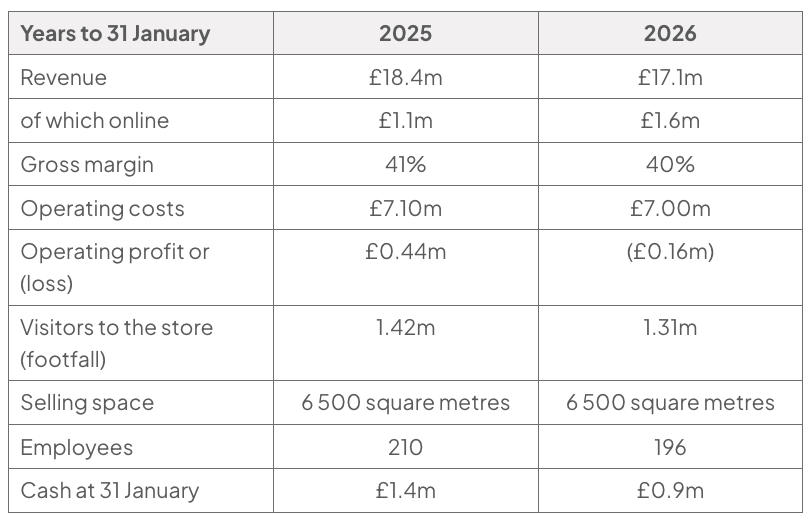
  • revenue fell to £17.1 million and the store made its first operating loss for eleven years

  • visitors to the store fell from 1.42 million to 1.31 million

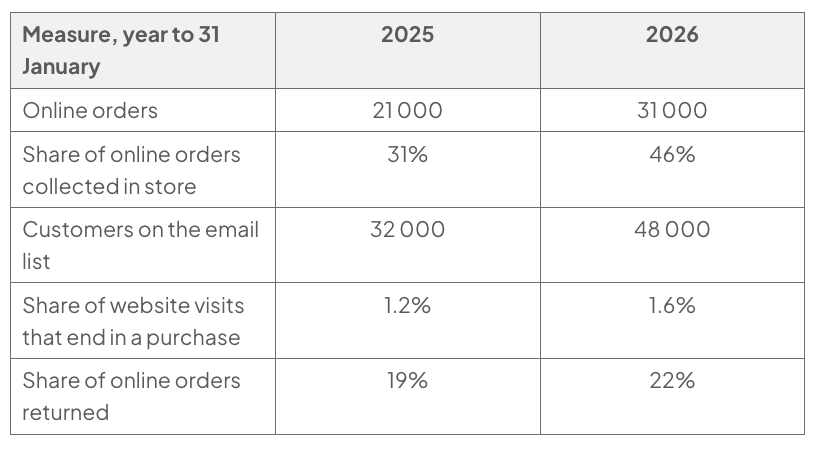
  • the share of online orders collected in store rose from 31% to 46%; customers who collect spend an average of £18 more in the store on the same visit

  • in a staff survey, 34% of employees felt prepared for the changes ahead

The board must choose between two plans to change the business in 2026. The Managing Director says: "We have never had to change this much, this quickly."

Source: Hartlake Department Store

Appendix D: Hartlake Department Store selected data

Selected data table for the years to 31 January 2025 and 2026, including revenue, online revenue, margins, costs, footfall, selling space, employees and cash.

Source: Hartlake Department Store

Appendix E: Digital performance

Table comparing Hartlake’s digital performance in the years to 31 January 2025 and 2026: online orders, email-list customers, website conversion and in-store collection increased, while returns also rose.
  • The website relaunch in 2025 cost £320 000.

  • Customers who collect online orders in store spend an average of £18 more in the store on the same visit.

  • 58% of in-store sales are to customers aged 55 or over; 71% of online sales are to customers under 45.

Source: Hartlake Department Store

Assess whether Hartlake Department Store should invest more in its digital strategy.

2
9 marks

Source A: Wickes

Wickes Group plc is a UK home improvement retailer listed on the London Stock Exchange. It became an independent company in 2021, when it separated from Travis Perkins. It has 230 stores and about 7 800 employees, and serves three groups of customers:

  • Tradespeople, through its TradePro membership scheme. Sales to TradePro members rose in 2025.

  • Do-it-yourself customers.

  • Design & Installation customers, whose kitchens and bathrooms it designs and fits.

It reports a "market-leading price position" against its wider peer group.

Wickes describes itself as "a digitally-led, service-enabled home improvement retailer". Two-thirds of its sales are digitally enabled, but 96% are fulfilled from its stores. Wickes has cut the time to prepare a Click & Collect order from 30 minutes to 15 minutes, and Wickes Rapid delivers orders of up to 800kg to a home or building site within three hours. Its strategy rests on seven "growth levers", including winning trade customers, digital capability and store investment.

Several rivals, including Homebase, have left the market since 2023. Homebase went into administration at the end of 2024, and Carpetright, CTD Tiles and Wilko have also left. Four of Wickes's five new stores in 2025 were former Homebase stores, and it employed 54 former Homebase staff.

In March 2026 the chief executive, David Wood, announced an ambition to reach 300 stores, creating more than 2 000 new jobs. Wickes plans 4 to 5 new stores in 2026, 7 to 9 in 2027 and at least 10 a year from 2028. It reports "ever-increasing demand for prime retail locations".

Source: Wickes Group plc, results for the year ended December 2025, annual report 2025 and half-year results 2026

Appendix A: Wickes financial data

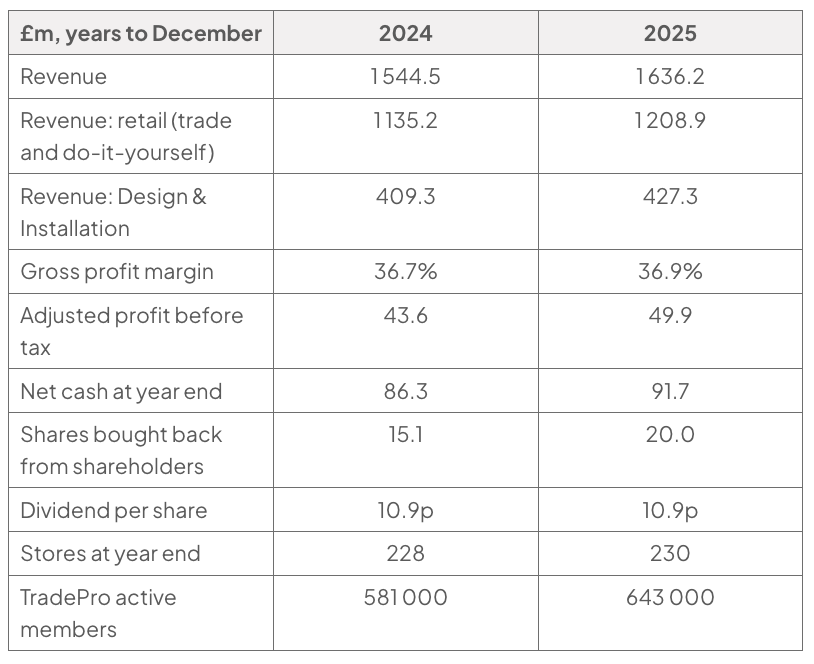
Table of Wickes financial data, comparing 2024 and 2025: revenue £1 544.5m and £1 636.2m; retail (trade and do-it-yourself) revenue £1 135.2m and £1 208.9m; Design & Installation revenue £409.3m and £427.3m; gross profit margin 36.7% and 36.9%; adjusted profit before tax £43.6m and £49.9m; net cash at year end £86.3m and £91.7m; shares bought back from shareholders £15.1m and £20.0m; dividend per share 10.9p in both years; stores at year end 228 and 230; TradePro active members 581 000 and 643 000.
  • 2024 figures are restated on the 2025 basis.

  • TradePro. Sales to TradePro members rose 9% in 2025; growth in members "was partially offset by a slight decline in average basket size".

  • Half year to June 2026. Revenue rose 2.1% to £865.3m. Like-for-like sales, from stores open in both periods, fell 0.3% in retail and rose 3.6% in Design & Installation. Retail prices were cut by 2.4%. Very heavy rain hit outdoor sales early in the year.

Source: Wickes Group plc

Appendix C: Digital and Design & Installation

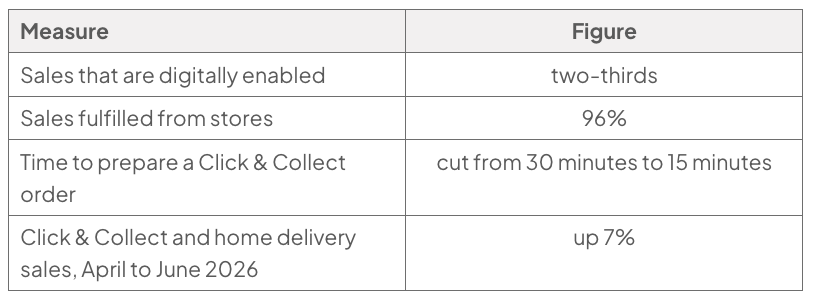
Table of Wickes digital measures: two-thirds of sales digitally enabled; 96% of sales fulfilled from stores; time to prepare a Click & Collect order cut from 30 minutes to 15 minutes; Click & Collect and home delivery sales up 7% in April to June 2026.
  • Wickes Rapid delivers orders of up to 800kg to a home or building site within three hours, from a range of more than 10 000 products.

  • Design & Installation. In 2024 revenue fell as customers cut back on large purchases. Wickes added about 160 Design Consultants, replaced two separate kitchen services with one, and replaced "a more cumbersome telephone booking system" with instant online booking.

  • 2026. "Orders for Wickes Bespoke Kitchens have been in slight decline, as customers are being more considered for larger purchases."

  • Plans changed in 2026. The plan to refit or refresh 15 to 20 stores in 2026 was cut to 12. A new order management system, planned in two phases in 2026 and 2027, will now be introduced "from 2027".

Source: Wickes Group plc

Assess whether Wickes's digital strategy is helping it to grow.

3
9 marks

Source A: AG Barr

A.G. BARR p.l.c. is a UK drinks company listed on the London Stock Exchange. It employs about 1 000 people and has factories at Cumbernauld, near Glasgow, and Milton Keynes. Its brands include:

  • IRN-BRU, the UK's third-biggest flavoured fizzy drink brand, 125 years old in 2026, with about 40% of sales outside Scotland

  • Boost energy and sports drinks, whose revenue rose 12% in 2025/26

  • Rubicon, Barr and MOMA oat drinks

In the 53 weeks to 31 January 2026, revenue rose 4.0% to £437.3 million. In early 2025 it raised some prices by between 1% and 11%, an approach it called "value over volume", and overall volume was "relatively flat". The chief executive, Euan Sutherland, aims to "double the size of the business".

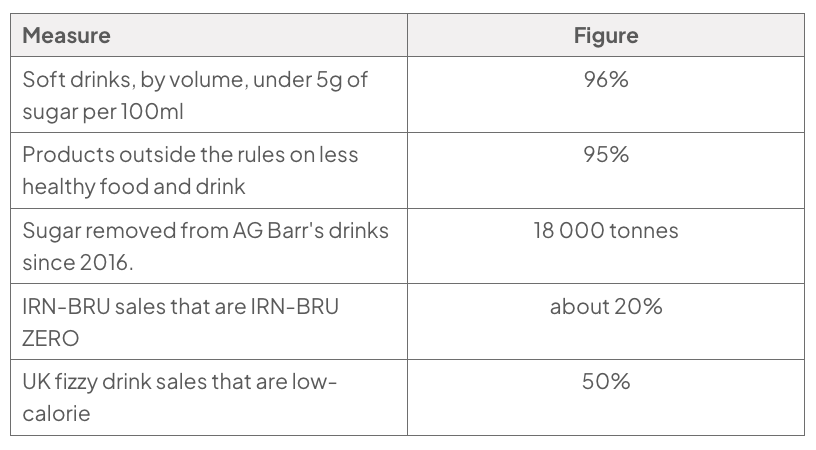
In 2018 the sugar in regular IRN-BRU was cut from 10.3g to 4.7g per 100ml, and 96% of AG Barr's soft drinks by volume contain under 5g of sugar per 100ml.

Soft drinks are closely regulated:

  • Sugar. The Soft Drinks Industry Levy applies to drinks with 5g or more of sugar per 100ml.

  • Advertising. Paid online advertising of less healthy food and drink has been banned since January 2026. AG Barr says it never advertises caffeinated or energy products to under-16s.

  • Energy drinks. The government plans to ban selling drinks with more than 150mg of caffeine per litre to under-16s in England from April 2027.

  • Packaging. A deposit return scheme for plastic bottles and cans is due in October 2027.

The company says: "We view regulation as a catalyst for innovation."

Source: A.G. BARR p.l.c., annual report and final results for the 53 weeks ended 31 January 2026, and interim results for the 26 weeks ended 1 August 2026

Appendix A: AG Barr financial data

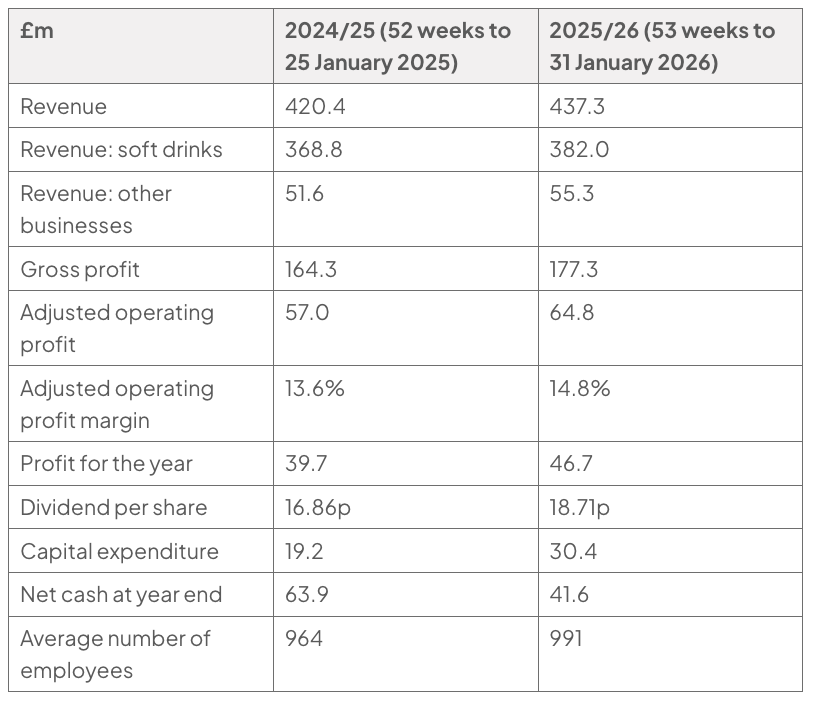
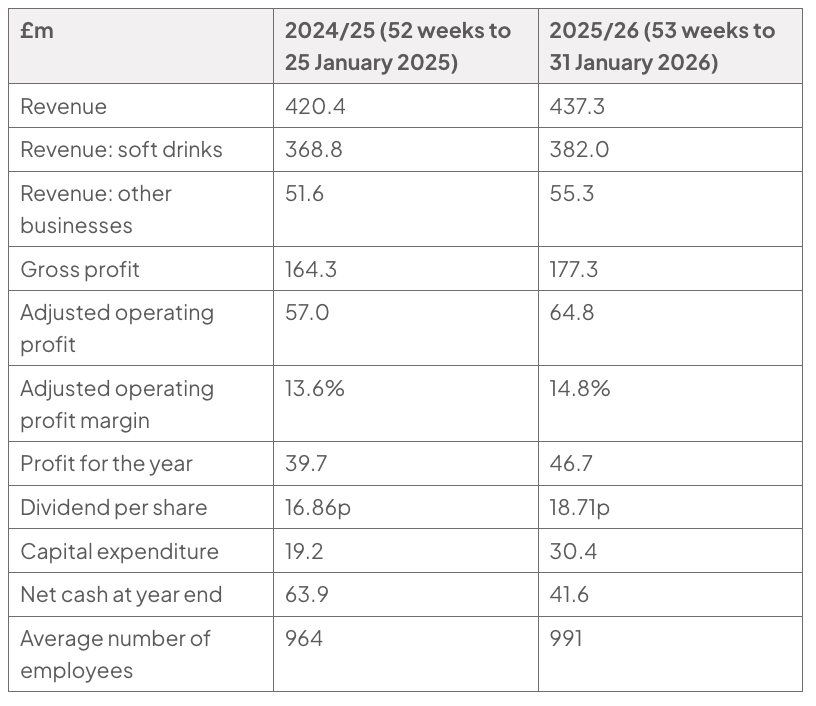
Table of AG Barr financial data in £m for 2024/25 (52 weeks to 25 January 2025) and 2025/26 (53 weeks to 31 January 2026): revenue 420.4 and 437.3; revenue from soft drinks 368.8 and 382.0; revenue from other businesses 51.6 and 55.3; gross profit 164.3 and 177.3; adjusted operating profit 57.0 and 64.8; adjusted operating profit margin 13.6% and 14.8%; profit for the year 39.7 and 46.7; dividend per share 16.86p and 18.71p; capital expenditure 19.2 and 30.4; net cash at year end 63.9 and 41.6; average number of employees 964 and 991.
  • Brands. IRN-BRU was 32% of revenue in 2025/26, down from 43% five years earlier. Boost revenue rose 12%. In July 2025 AG Barr bought 50.1% of Innate-Essence, a maker of health drinks, for £14.7 million.

  • Targets. Revenue growth of at least 4% a year and an operating margin of 14% to 16%.

  • Half year to 1 August 2026. Revenue rose 8.5% to £247.4 million. Supply problems cost an estimated £10 million of lost revenue. After acquisitions and capital spending, net cash of £41.6 million had become net debt of £47.0 million.

Source: A.G. BARR p.l.c.

Appendix B: Sustainability and digital

Table of AG Barr’s 2025/26 sustainability measures, covering emissions, recycled plastic and aluminium, water use, and recyclable packaging.
  • Targets. Net zero emissions across its whole supply chain by 2050; 100% recyclable packaging by 2027.

  • Water. The Milton Keynes site may be in an area of high water stress by 2030.

  • Deposit return scheme. AG Barr is a founding investing member of the organisation that will run the scheme, which it expects to improve the supply of recycled plastic.

  • Digital. A Chief Digital and Technology Officer joined in February 2026. The board wants to "accelerate its understanding and adoption of AI and digital transformation". Capital spending in 2025/26 focused on "supply chain optimisation and systems modernisation".

  • Marketing. The 2026 IRN-BRU summer campaign set "several records for the brand achieved across TV, digital and social channels". A MOMA digital campaign reached 10 million consumers.

Source: A.G. BARR p.l.c.

Assess whether AG Barr's investment in its systems and supply chain will help it achieve its growth ambition.

Calculate AG Barr's sales per employee in 2025/26 to support your answer. Give your answer to the nearest £100.

4
9 marks

Source B: Woolmere Data Services

Woolmere Data Services Limited was founded in Sheffield in 2009. It analyses customer data for retailers and leisure businesses, helping them understand what their customers buy and why. It employs 160 people, most of whom are either consultants, who analyse data and advise clients, or software engineers. It stores its clients' data on its own computer servers in Sheffield.

For most of its history Woolmere earned its revenue from consultancy projects, in which its analysts studied a client's data and presented their findings. In 2022 it launched Woolmere Insight, an online platform that clients pay for by annual subscription and use to run their own analysis. The number of subscription clients rose in 2025.

In 2025 Woolmere reorganised into teams built around the platform and announced the changes to staff by email. Consultants now spend part of their time supporting platform clients instead of leading projects.

Woolmere opened a small office in Dublin in 2024, and its revenue from clients in Ireland rose in 2025. Two of its UK clients, which also have stores in the United States, have asked whether Woolmere could support them there.

The company faces two main pressures:

  • Competition. Two large international software businesses sell platforms similar to Woolmere Insight.

  • Staff. Most of the employees who left in 2025 were consultants with more than five years' service.

Its board is considering where to expand outside the UK, whether to stop taking new consultancy projects, and whether to move its clients' data to a cloud computing provider.

Source: Woolmere Data Services

Appendix D: Woolmere Data Services selected data

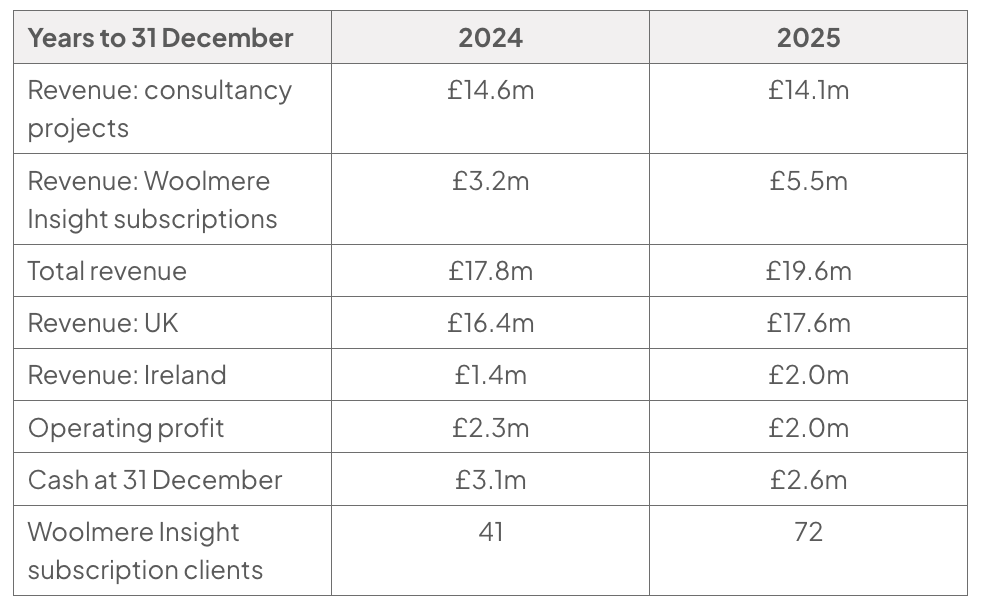
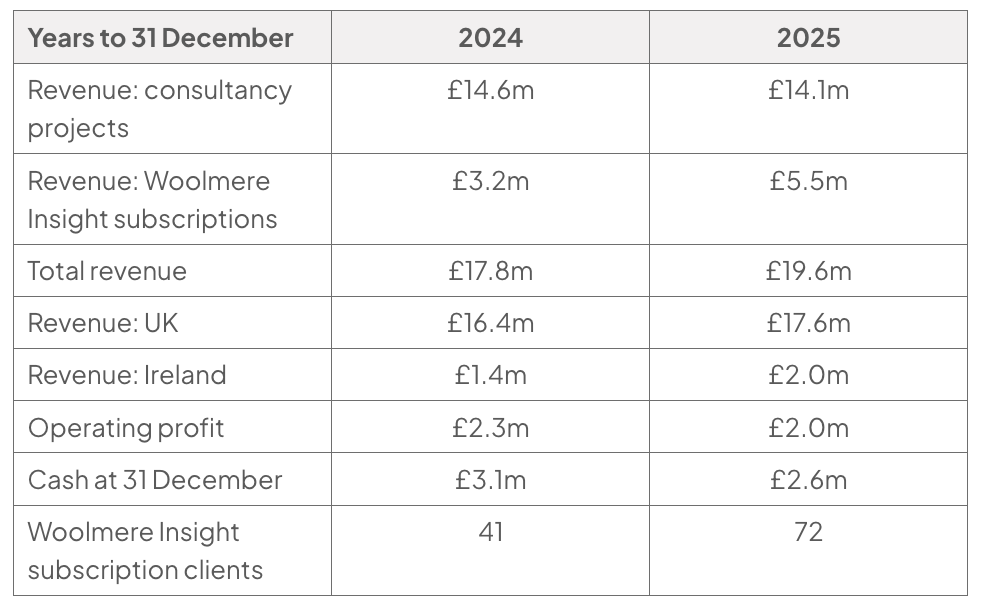
Table comparing 2024 and 2025 data: total revenue rose from £17.8m to £19.6m, while Woolmere Insight subscription revenue rose from £3.2m to £5.5m and operating profit fell from £2.3m to £2.0m.

Source: Woolmere Data Services

Appendix G: The future of Woolmere Insight

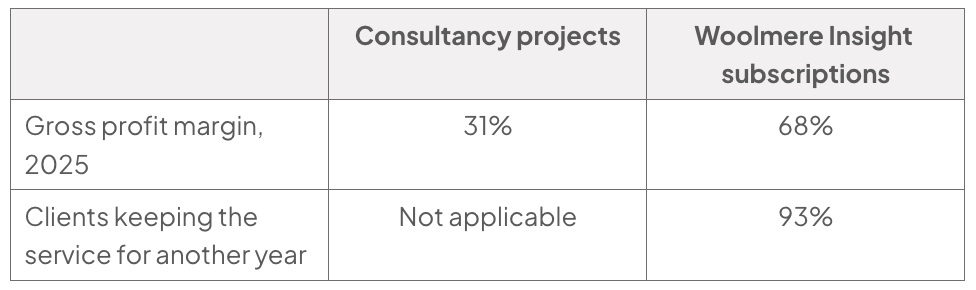
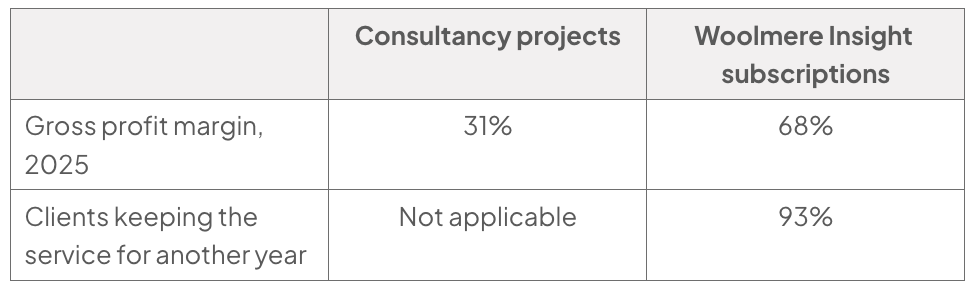
Table comparing consultancy projects with Woolmere Insight subscriptions: 2025 gross profit margins are 31% and 68%; clients keeping the service for another year are not applicable and 93%, respectively.
  • Proposal. The board is considering spending £2.4m over two years adding artificial intelligence tools to Woolmere Insight and taking no new consultancy projects after 2027.

  • Clients. In a survey, 58% of subscription clients said they still wanted advice from Woolmere's analysts alongside the platform.

  • Competitors. Two large international software businesses sell similar platforms.

  • Staff. If consultancy stopped, about 30 consultants would need to retrain for platform or client support roles.

Source: Woolmere Data Services

Assess whether Woolmere Insight has been the most important factor in Woolmere Data Services' growth.

Calculate Woolmere Data Services' operating profit margin in 2025 to support your answer. Give your answer to one decimal place.

5
9 marks

Source B: Quarrenden Drinks

Quarrenden Drinks Limited is a family-owned private limited company, founded in 1996 on a family farm near Tiverton, Devon. It employs 46 people and makes two types of drink, both with no added sugar:

  • pressed apple juice

  • lightly sparkling fruit drinks

The drinks are sold in glass bottles at premium prices to farm shops, delicatessens, cafés, independent grocers and two regional supermarket chains, and through the company's own website, which also offers a monthly subscription box. Some of the bottles delivered to cafés are returned, washed and refilled.

Quarrenden buys all its apples from 34 orchards in Devon and Somerset, under three-year contracts at a fixed price above the market price. Drinks with no added sugar are not charged the Soft Drinks Industry Levy.

The company faces three main pressures:

  • Costs. Quarrenden's costs rose sharply in 2025, including the cost of glass bottles, energy and wages. The National Living Wage and employers' National Insurance both rose in April 2025.

  • Health advice. NHS advice is to drink no more than 150ml of fruit juice and smoothies a day.

  • Customers. Both regional supermarket chains have asked suppliers for evidence of their social and environmental standards.

Its directors are considering how to respond, including raising all prices or moving the sparkling range from glass bottles to cans.

Source: Quarrenden Drinks

Appendix D: Quarrenden Drinks selected data

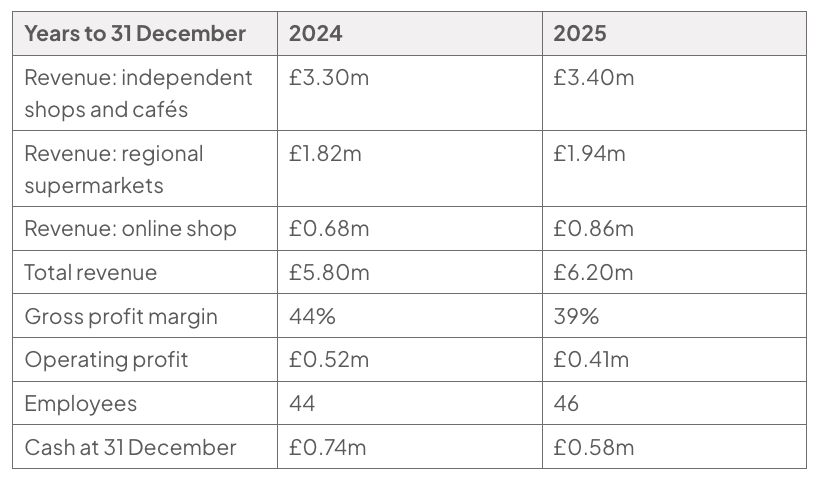
Table of Quarrenden Drinks’ selected data for 2024 and 2025, including revenue by channel, total revenue, margins, profit, employees and cash; 2025 online revenue is £0.86m and total revenue £6.20m.

Source: Quarrenden Drinks

Appendix F: The online shop

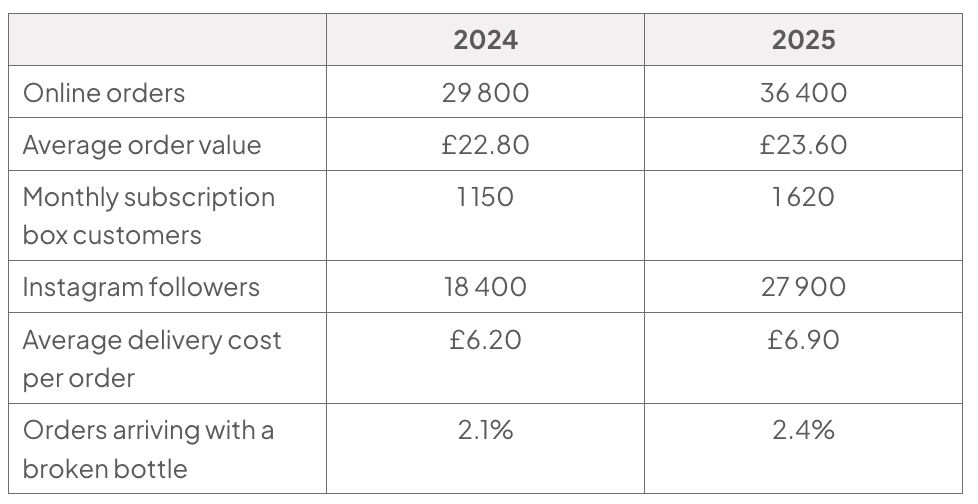
Table comparing 2024 and 2025: online orders 29 800 and 36 400; average order value £22.80 and £23.60; subscription customers 1 150 and 1 620; Instagram followers 18 400 and 27 900; delivery cost £6.20 and £6.90; broken-bottle orders 2.1% and 2.4%.
  • Proposal. A new website costing £85 000, with subscription management and a customer database.

  • Online customers pay £4.95 delivery on orders under £40.

Source: Quarrenden Drinks

Assess whether Quarrenden Drinks should invest £85 000 in a new website.

Calculate Quarrenden Drinks' operating profit margin in 2025 to support your answer. Give your answer to one decimal place.

6
9 marks

Source A: Just Eat Takeaway

Just Eat Takeaway.com (JET) runs online food delivery platforms in Europe, including Just Eat in the UK and Ireland, Lieferando in Germany and Thuisbezorgd in the Netherlands. Its headquarters are in Amsterdam. JET was formed in 2020 when Just Eat merged with Takeaway.com. In October 2025 JET was bought by Prosus, a Dutch-listed technology investor, for about €4.1 billion, and its shares were removed from the stock market. Roberto Gandolfo replaced the founder, Jitse Groen, as chief executive in January 2026.

Customers order from restaurants and shops through JET's apps and websites. Some orders are delivered by the restaurant itself and some by couriers working through JET.

JET has changed in three main ways:

  • Acquisitions. In 2021 it bought Grubhub, a US delivery business, for $7.3 billion; it sold Grubhub in January 2025.

  • Countries. Since 2022 it has left Norway, Portugal, New Zealand, France, Australia, Denmark and Bulgaria, and it now operates in 14 countries. When it left Denmark in April 2026, its customers there were directed to Uber Eats.

  • Technology. About 450 jobs were cut in September 2025, partly by automating customer service. An AI voice assistant was launched across Europe in August 2026; early UK users found what they wanted about 40% faster than with the text assistant.

In the UK, JET competes with Uber Eats and with Deliveroo, which DoorDash, a US delivery business, bought in October 2025.

Prosus wants JET to become "a true European tech champion" and says it is "trading short-term profitability" for growth.

Source: Just Eat Takeaway.com, results for 2024 and the half year to June 2025; Prosus; and press reports

Appendix A: Just Eat Takeaway financial data

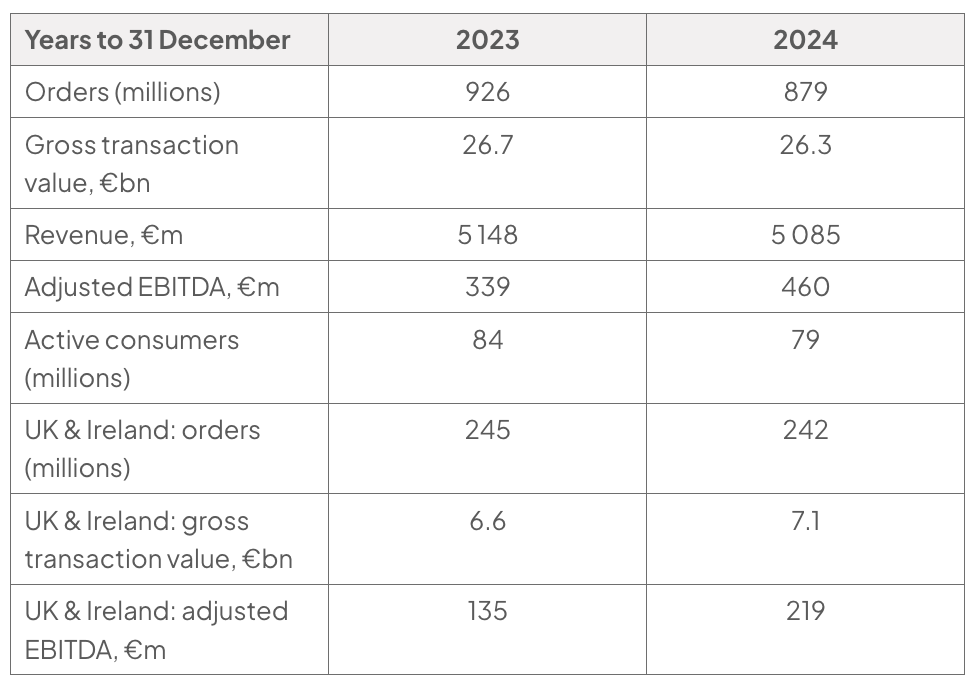
Table comparing JET’s financial data for 2023 and 2024: orders 926 million and 879 million; gross transaction value €26.7bn and €26.3bn; revenue €5 148m and €5 085m; adjusted EBITDA €339m and €460m; active consumers 84 million and 79 million; UK & Ireland orders 245 million and 242 million; UK & Ireland gross transaction value €6.6bn and €7.1bn; UK & Ireland adjusted EBITDA €135m and €219m.
  • Gross transaction value is the total value of orders placed through JET's platforms. Adjusted EBITDA is profit before interest, tax, depreciation and amortisation, excluding one-off items.

  • 2023 and 2024 include Grubhub. In 2024 JET reduced the value of Grubhub in its accounts by €1 002m.

  • Half year to June 2025. Orders 308 million, down from 330 million. UK & Ireland orders 114 million, down from 120 million, while UK & Ireland gross transaction value rose from €3.4bn to €3.6bn.

  • After the takeover. JET's orders fell for 55 months in a row before rising 0.1% in September 2026.

Source: Just Eat Takeaway.com and Prosus

Appendix C: Strategy, technology and competition

  • Digital. An AI voice assistant launched across Europe in August 2026; early UK users found what they wanted about 40% faster than with the text assistant. JET became the first in Europe to take orders through WhatsApp, in trials in the Netherlands and Spain in 2026. About 450 jobs, under 5% of staff, were cut in September 2025, partly by automating customer service.

  • Membership. Just Eat+ launched in the UK in July 2025 at £5.99 for 90 days of free delivery.

  • Groceries. UK grocery orders doubled in 2024. Partners include Tesco Whoosh and Superdrug.

  • Countries left. Norway and Portugal (2022), New Zealand and France (2024), Australia (2025), Denmark (April 2026, with customers directed to Uber Eats) and Bulgaria (September 2026).

  • Competition. DoorDash, a US delivery business, completed its £2.9bn purchase of Deliveroo in October 2025. Uber Eats also operates in the UK.

Source: Analyst, using Just Eat Takeaway.com, Prosus and press reports

Assess whether Just Eat Takeaway.com's digital strategy is working.

1
15 marks

Source A: Lancashire Cricket

Lancashire County Cricket Club Limited, known as Lancashire Cricket, was founded in 1864 and plays at Emirates Old Trafford in Manchester. It has men's and women's teams, hosts international matches, and runs a hotel and a conference and events business at the ground. It is not owned by shareholders: it is a registered society, owned by its members, who vote at its general meetings and elect some members of its Board.

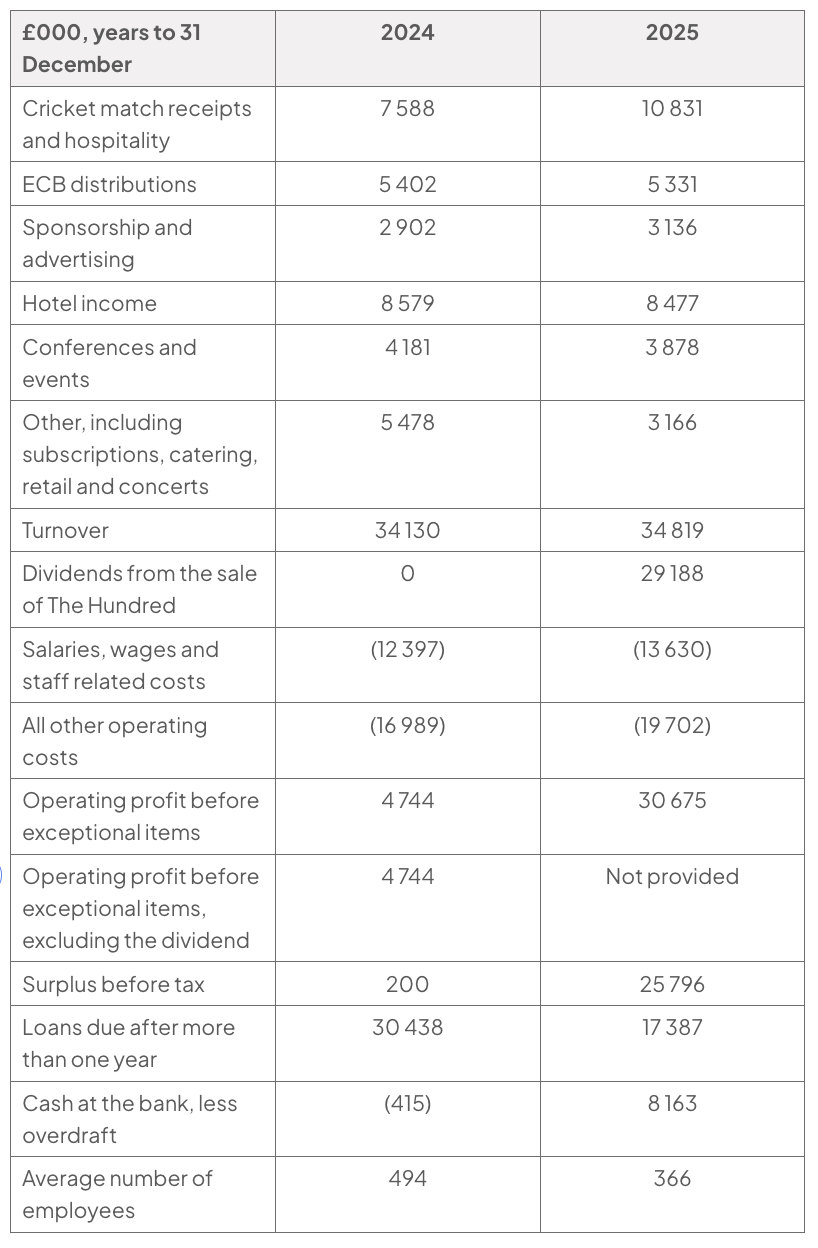
In 2025 Lancashire Women won their first two professional trophies, and Emirates Old Trafford hosted a five-day men's Test match against India. Turnover rose slightly, to £34.8 million. The Chief Executive said that "the primary challenge for the business now is not revenue generation" but operating costs, which have increased significantly since the pandemic. During the year the club outsourced its catering and retail operations.

In 2025 the England and Wales Cricket Board (ECB) sold stakes in the eight teams in The Hundred, a short-format competition. RPSG Group, an Indian business which also owns teams in the Indian Premier League and South Africa, bought 70% of Manchester Originals; Lancashire Cricket kept 30%, and the team was renamed Manchester Super Giants. The club received dividends of £29.2 million from the sale, repaid £13.3 million of loans, and expects further dividends over the next few years. Lancashire Cricket's surplus before tax was £25.8 million.

The club's £20 million second ground at Farington, near Preston, built in partnership with Lancashire County Council, was handed over to the club in early 2026.

Source: Lancashire County Cricket Club Limited, Annual Report and Financial Statements 2025

Appendix A: Lancashire Cricket financial data

Financial data table for Lancashire Cricket, in £000 for years ending 31 December 2024 and 2025, comparing income, costs, profits, loans, cash and average employees.

Source: Lancashire County Cricket Club Limited

Appendix B: Cricket, venue, costs and digital

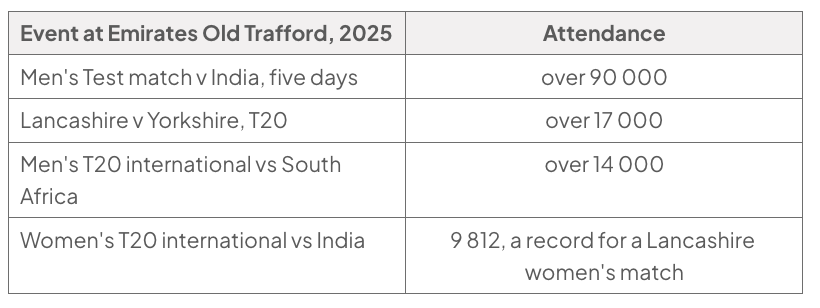
Table of 2025 attendances at Emirates Old Trafford: men’s Test v India, over 90,000; Lancashire v Yorkshire T20, over 17,000; men’s T20 v South Africa, over 14,000; women’s T20 v India, 9,812.
  • 2026 fixtures. Two men's T20 internationals and four matchdays of the ICC Women's T20 World Cup. The club expects international cricket "will be challenging financially compared to previous years". No concerts are planned; there were three sold-out concerts in 2024 and none in 2025.

  • Hotel. Revenue just below £8.5m, down just over 1%, with high occupancy but a slightly lower average room rate.

  • Conferences and events. "A very competitive market, with many companies slowing down spend"; revenue fell by just over £0.3m.

  • Costs. Since 2019 payroll has risen by £2.4m (22%) and utilities by £0.4m (56%). Business rates will rise by £0.2m in 2026 and a further £0.2m in 2027. The National Living Wage and employers' National Insurance contributions both rose in April 2025. The club gave staff a standard pay rise of 2% and says "the UK economy is not thriving".

  • The economy, September 2026. Bank Rate 3.75%; inflation 3.1%; unemployment 4.9%.

  • Digital. In July 2025 the club launched LancsTV, a streaming service built with StreamAMG, a Manchester company, showing all non-televised home men's and women's matches, interviews and archive footage. It is free, but viewers must register; members and ticket holders use the same login as for tickets and membership. A members-only area, LancsTV+, is planned. The Chief Executive said: "we have no plans to charge supporters to watch LancsTV". The club also updated its website in 2025.

  • Partnerships. Commercial partnership revenue is about £3m a year.

Source: Analyst, using Lancashire County Cricket Club Limited, the Bank of England, the Office for National Statistics and press reports

Appendix C: Owners, partners and The Hundred

  • Members. 6 470 members hold a 5p share that gives them a vote (2024: 6 609). The club had over 8 000 members of all kinds ahead of the 2026 season and wants to grow membership. A Members' Representative Group meets club officials to pass on members' views.

  • Governance in 2025. Two Special General Meetings of members were held, costing £68 000. The Chair resigned in August 2025 and an Interim Chair was appointed.

  • The ECB. Money from The Hundred "must be applied for and subsequently approved by the ECB Board", and may be used for debt repayment, cash reserves and activity that generates revenue. The club has agreed with the ECB to hold £5m as a cash reserve.

  • RPSG. Owns 70% of Manchester Super Giants; Lancashire Cricket owns 30%. In July 2026 RPSG and Lancashire Cricket bought the land behind Emirates Old Trafford to build a high-performance cricket centre, which will be used by Lancashire's teams and as a training base for RPSG's teams.

  • Lancashire County Council. Partner in the Farington ground, with a joint commitment to increase cricket and physical activity in schools and communities across the county.

  • Staff. The club lists "the mental health and wellbeing of all our staff after a very challenging 2025" as a key priority for 2026.

Source: Analyst, using Lancashire County Cricket Club Limited and press reports

Lancashire Cricket launched LancsTV, a free streaming service, in 2025, and its members and ticket holders use one login for tickets, membership and LancsTV.

Evaluate two ways Lancashire Cricket could use digital technology to increase its revenue and recommend which one it should choose first.

2
15 marks

Source A: Glastonbury Festival

Glastonbury Festival Events Limited organises the Glastonbury Festival of Contemporary and Performing Arts at Worthy Farm, a working dairy farm in Pilton, Somerset, where the festival has been held since 1970. The company is owned by Emily Eavis, who replaced her father, the festival's founder Michael Eavis, as the person with significant control in October 2024. Both are directors. The company employs an average of 105 people.

The company's objective is "to host an event that joyfully celebrates music and culture". It aims to keep ticket prices "as low as possible" so that the festival remains accessible, and it supports charities including Oxfam, Greenpeace and WaterAid.

The festival's licence allows up to 210 000 people on site. Tickets are sold online under three rules:

  • Registration. Everyone aged 13 or over must register before buying a ticket.

  • Photo tickets. Each ticket carries the holder's photo and cannot be transferred.

  • One ticket agent. Tickets are sold only through See Tickets and are "not available for sale on any secondary sales sites".

Every five or six years the festival takes a fallow year, with no festival, so that the farmland can recover. 2026 is a fallow year, and the company expects "a significant cost". Tickets for the 2027 festival went on sale in October 2026.

The company finances its operations through retained profits and paid no dividends. It describes its main risk as cancellation because of "extremely bad weather or a global pandemic". In the year to March 2025 it spent £3.5 million buying land to "protect the future of the Festival".

Source: Glastonbury Festival Events Limited, annual report and financial statements for the year ended 31 March 2025, and press reports

Appendix A: Glastonbury Festival financial data

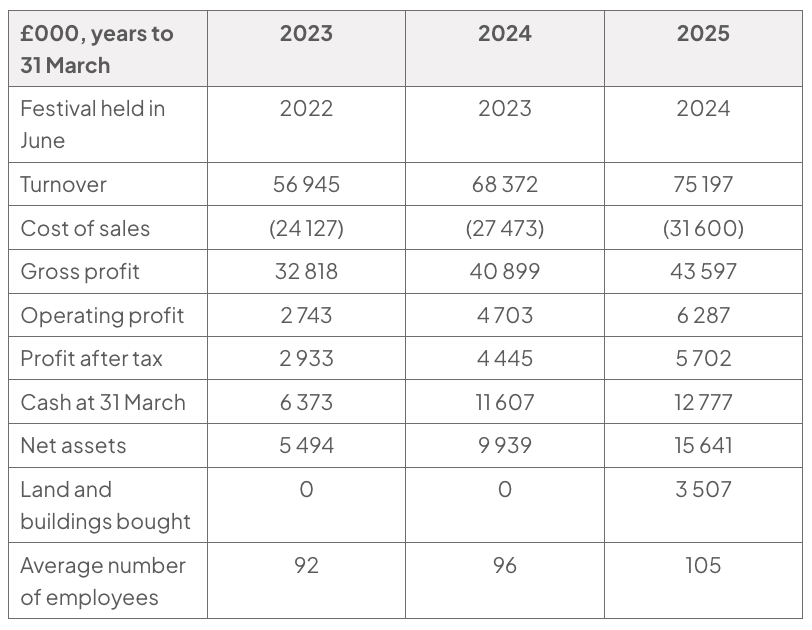
Table of Glastonbury Festival financial data in £000 for the years to 31 March 2023, 2024 and 2025, covering the festivals held in June 2022, 2023 and 2024: turnover 56 945, 68 372 and 75 197; cost of sales (24 127), (27 473) and (31 600); gross profit 32 818, 40 899 and 43 597; operating profit 2 743, 4 703 and 6 287; profit after tax 2 933, 4 445 and 5 702; cash at 31 March 6 373, 11 607 and 12 777; net assets 5 494, 9 939 and 15 641; land and buildings bought 0, 0 and 3 507; average number of employees 92, 96 and 105.
  • Charitable donations: £1.9m in 2023, £5.2m in 2024 (including £2m to NHS Somerset) and over £2.7m in 2025.

  • Cash. Since 2009 the company has kept its profits "to provide a float for the next year's Festival as well as mitigate the potential impact of unforeseen events". All tickets are paid for in advance, and most ticket money is held in a separate account until after the festival.

  • Covid. The festival was cancelled in 2020 and could not be held in 2021. The company says "the cash reserves were significantly depleted post COVID".

Source: Glastonbury Festival Events Limited

Appendix B: Tickets and the UK festival market

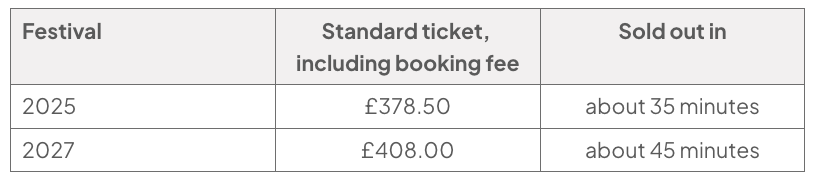
Table comparing Glastonbury standard ticket prices and sell-out times: 2025, £378.50, about 35 minutes; 2027, £408.00, about 45 minutes.
  • 2027 tickets went on sale on 4 October 2026, before any performers were announced. Buyers paid a £100 deposit, with the balance due in April 2027.

  • Capacity. The festival's licence allows up to 210 000 people on site, including staff and performers. The company describes "demand for tickets far outweighing supply".

  • Scale. Over 4 000 performances on more than 100 stages, and nearly 900 traders.

  • Performers' fees. Rod Stewart said he was paid about £120 000 to perform in 2025, and that bringing his band and equipment from America cost him about £300 000.

  • Other festivals. The Association of Independent Festivals reported in June 2025 that 39 UK festivals had been cancelled, postponed or closed that year, and 249 since 2019. Festival Republic, majority-owned by Live Nation, runs Reading & Leeds, Latitude and Wireless.

Source: Analyst, using Glastonbury Festival Events Limited, the Association of Independent Festivals and press reports

Appendix C: Digital ticketing and broadcasting

  • Registration. Everyone aged 13 or over must register before buying a ticket. Each ticket carries the holder's photo and cannot be transferred. Tickets are sold only through See Tickets and are "not available for sale on any secondary sales sites".

  • BBC coverage. "In the UK alone, 20 million people tune into the BBC's TV coverage of Glastonbury." In 2025 the BBC streamed more than 90 hours of performances live from five stages on iPlayer.

  • Artists. The company says performers "have seen huge increases in sales following their appearances as a result of global television audiences tuning in".

  • Paid livestream, May 2021. With no festival possible, Glastonbury sold £20 tickets for an online concert film, Live at Worthy Farm. On the night, many buyers' access codes were rejected and the start was delayed by about two hours. The organisers apologised, opened the stream to anyone with the link, and let ticket holders watch two repeat showings.

Source: Analyst, using Glastonbury Festival Events Limited, the BBC and press reports

Glastonbury's performances are watched by millions of people on the BBC, but the festival's own paid livestream in 2021 suffered technical problems.

Evaluate whether Glastonbury should develop its own paid streaming service or continue to rely on free coverage by the BBC.

3
15 marks

Source A: AG Barr

A.G. BARR p.l.c. is a UK drinks company listed on the London Stock Exchange. It employs about 1 000 people and has factories at Cumbernauld, near Glasgow, and Milton Keynes. Its brands include:

  • IRN-BRU, the UK's third-biggest flavoured fizzy drink brand, 125 years old in 2026, with about 40% of sales outside Scotland

  • Boost energy and sports drinks, whose revenue rose 12% in 2025/26

  • Rubicon, Barr and MOMA oat drinks

In the 53 weeks to 31 January 2026, revenue rose 4.0% to £437.3 million. In early 2025 it raised some prices by between 1% and 11%, an approach it called "value over volume", and overall volume was "relatively flat". The chief executive, Euan Sutherland, aims to "double the size of the business".

In 2018 the sugar in regular IRN-BRU was cut from 10.3g to 4.7g per 100ml, and 96% of AG Barr's soft drinks by volume contain under 5g of sugar per 100ml.

Soft drinks are closely regulated:

  • Sugar. The Soft Drinks Industry Levy applies to drinks with 5g or more of sugar per 100ml.

  • Advertising. Paid online advertising of less healthy food and drink has been banned since January 2026. AG Barr says it never advertises caffeinated or energy products to under-16s.

  • Energy drinks. The government plans to ban selling drinks with more than 150mg of caffeine per litre to under-16s in England from April 2027.

  • Packaging. A deposit return scheme for plastic bottles and cans is due in October 2027.

The company says: "We view regulation as a catalyst for innovation."

Source: A.G. BARR p.l.c., annual report and final results for the 53 weeks ended 31 January 2026, and interim results for the 26 weeks ended 1 August 2026

Appendix A: AG Barr financial data

Table comparing AG Barr’s 2024/25 and 2025/26 financial data in £ millions, including revenue, profits, margins, dividends, capital expenditure, net cash and average employees.
  • Brands. IRN-BRU was 32% of revenue in 2025/26, down from 43% five years earlier. Boost revenue rose 12%. In July 2025 AG Barr bought 50.1% of Innate-Essence, a maker of health drinks, for £14.7 million.

  • Targets. Revenue growth of at least 4% a year and an operating margin of 14% to 16%.

  • Half year to 1 August 2026. Revenue rose 8.5% to £247.4 million. Supply problems cost an estimated £10 million of lost revenue. After acquisitions and capital spending, net cash of £41.6 million had become net debt of £47.0 million.

Source: A.G. BARR p.l.c.

Appendix B: Health, regulation and the community

Two-column table headed “Measure” and “Figure”, listing five health and regulation measures with their corresponding percentages and tonnage.
  • IRN-BRU. In January 2018, before the sugar levy began, the sugar in regular IRN-BRU was cut from 10.3g to 4.7g per 100ml.

  • Sugar levy from January 2028. The threshold falls from 5g to 4.5g of sugar per 100ml, and oat and other milk-substitute drinks with added sugar will no longer be exempt. AG Barr says it is "considering the extent of any further reformulation".

  • Energy drinks. In July 2026 the government announced that selling drinks with more than 150mg of caffeine per litre to under-16s in England would be banned from April 2027, subject to Parliament.

  • Marketing. "We never advertise HFSS, caffeinated or energy products to under 16s."

  • Charity. AG Barr is moving from one national charity partner, given £50 000 a year, to one local charity at each of its four main sites, given £25 000 each a year. It also supports FareShare and local food banks.

Source: Analyst, using A.G. BARR p.l.c. and UK government announcements

Appendix C: Sustainability and digital

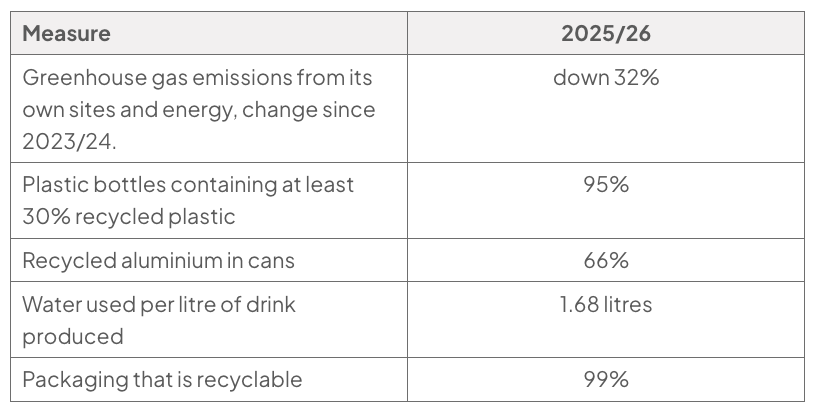
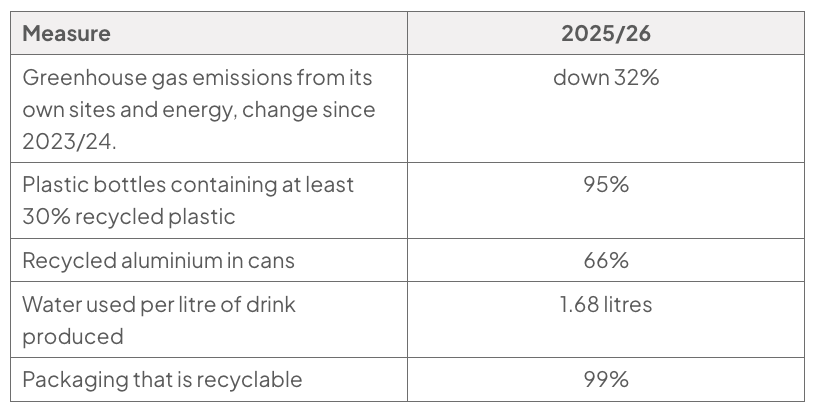
Table of AG Barr’s 2025/26 sustainability measures: emissions down 32%, 95% of plastic bottles contain at least 30% recycled plastic, cans use 66% recycled aluminium, water use is 1.68 litres per litre, and 99% of packaging is recyclable.
  • Targets. Net zero emissions across its whole supply chain by 2050; 100% recyclable packaging by 2027.

  • Water. The Milton Keynes site may be in an area of high water stress by 2030.

  • Deposit return scheme. AG Barr is a founding investing member of the organisation that will run the scheme, which it expects to improve the supply of recycled plastic.

  • Digital. A Chief Digital and Technology Officer joined in February 2026. The board wants to "accelerate its understanding and adoption of AI and digital transformation". Capital spending in 2025/26 focused on "supply chain optimisation and systems modernisation".

  • Marketing. The 2026 IRN-BRU summer campaign set "several records for the brand achieved across TV, digital and social channels". A MOMA digital campaign reached 10 million consumers.

Source: A.G. BARR p.l.c.

AG Barr has appointed a Chief Digital and Technology Officer, and its board wants to accelerate its adoption of artificial intelligence and digital transformation.

Evaluate whether AG Barr should rely mainly on digital transformation or on acquisitions to achieve its ambition to double the size of the business.

4
15 marks

Source B: Woolmere Data Services

Woolmere Data Services Limited was founded in Sheffield in 2009. It analyses customer data for retailers and leisure businesses, helping them understand what their customers buy and why. It employs 160 people, most of whom are either consultants, who analyse data and advise clients, or software engineers. It stores its clients' data on its own computer servers in Sheffield.

For most of its history Woolmere earned its revenue from consultancy projects, in which its analysts studied a client's data and presented their findings. In 2022 it launched Woolmere Insight, an online platform that clients pay for by annual subscription and use to run their own analysis. The number of subscription clients rose in 2025.

In 2025 Woolmere reorganised into teams built around the platform and announced the changes to staff by email. Consultants now spend part of their time supporting platform clients instead of leading projects.

Woolmere opened a small office in Dublin in 2024, and its revenue from clients in Ireland rose in 2025. Two of its UK clients, which also have stores in the United States, have asked whether Woolmere could support them there.

The company faces two main pressures:

  • Competition. Two large international software businesses sell platforms similar to Woolmere Insight.

  • Staff. Most of the employees who left in 2025 were consultants with more than five years' service.

Its board is considering where to expand outside the UK, whether to stop taking new consultancy projects, and whether to move its clients' data to a cloud computing provider.

Source: Woolmere Data Services

Appendix D: Woolmere Data Services selected data

Table comparing 2024 and 2025 data: consultancy revenue fell from £14.6m to £14.1m, while subscription revenue rose from £3.2m to £5.5m; total revenue rose, but profit and cash fell.

Source: Woolmere Data Services

Appendix E: People and change

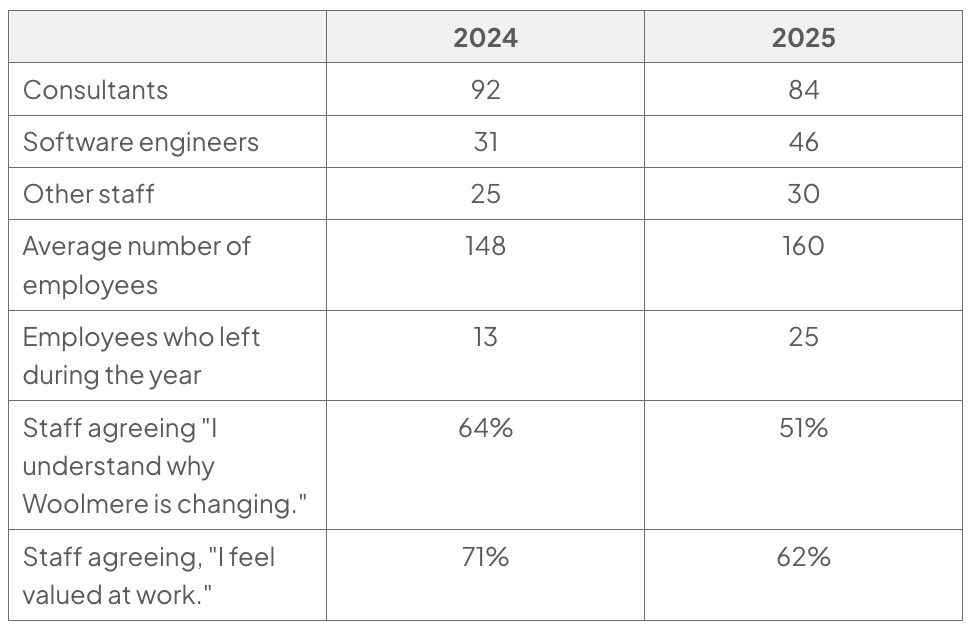
Table comparing Woolmere staff in 2024 and 2025: consultants 92 to 84, software engineers 31 to 46, other staff 25 to 30, average employees 148 to 160, and leavers 13 to 25; staff who understand why Woolmere is changing fell from 64% to 51%, and staff who feel valued fell from 71% to 62%.
  • Most of those who left in 2025 were consultants with more than five years' service.

  • Consultants now spend part of their time supporting platform clients instead of leading projects.

Source: Woolmere Data Services

Appendix G: The future of Woolmere Insight

Comparison table of consultancy projects and Woolmere Insight subscriptions: 2025 gross profit margins are 31% and 68%; 93% of subscription clients continue for another year, while consultancy retention is not applicable.
  • Proposal. The board is considering spending £2.4m over two years adding artificial intelligence tools to Woolmere Insight and taking no new consultancy projects after 2027.

  • Clients. In a survey, 58% of subscription clients said they still wanted advice from Woolmere's analysts alongside the platform.

  • Competitors. Two large international software businesses sell similar platforms.

  • Staff. If consultancy stopped, about 30 consultants would need to retrain for platform or client support roles.

Source: Woolmere Data Services

The board of Woolmere Data Services is considering investing £2.4 million in artificial intelligence tools for Woolmere Insight and taking no new consultancy projects after 2027.

Evaluate whether Woolmere Data Services should invest in the AI tools and take no new consultancy projects after 2027, or invest in the AI tools and keep offering consultancy.