Quality (AQA A Level Business): Exam Questions

Exam code: 7132

Syllabus Edition

First teaching 2026

First exams 2028

2 hours15 questions
1
6 marks

Source B: Warburtons

Warburtons is the largest family-owned bakery business in the United Kingdom and in 2025 it entered its 150th year. It is still owned by the Warburton family, bakes in 13 bakeries and employs just over 5 000 people.

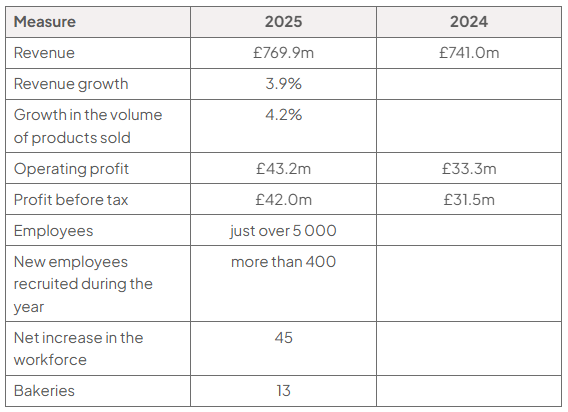
The year to 27 September 2025 was a record one. Revenue grew 3.9% to £769.9 million and the volume of products sold grew 4.2%. Operating profit rose 30%, from £33.3 million to £43.2 million, and profit before tax rose 33% to £42 million. During the year the company recruited more than 400 new employees, although after leavers the workforce grew by only 45. It also bought a former Rathbones bakery, which it expects to have running by September 2026.

Even after that jump in profit, Warburtons keeps only a few pence of every pound it takes. Bread is sold mainly through a handful of large supermarkets, which negotiate hard on price, so the company cannot pass higher costs on. Almost all of its improvement has to come from making bread more cheaply and wasting less of it.

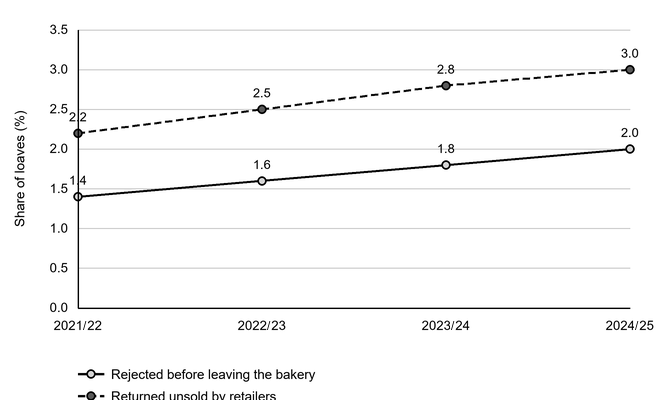
That is difficult, because a standard loaf has a shelf life of five days and the business is judged on getting it onto the shelf fast. Bread that is rejected at the bakery, or returned unsold by a retailer, cannot be sold at all. Over the last four years both of those figures have been rising, and its bakeries differ widely in how much bread each employee produces.

Source: Warburtons annual results for the year to 27 September 2025

Appendix G: Quality and waste at Warburtons

Line chart of loaf waste shares, showing both measures rising from 2021/22 to 2024/25: rejected before leaving the bakery 1.4% to 2.0%, and returned unsold by retailers 2.2% to 3.0%. Y-axis 0% to 3.5%.
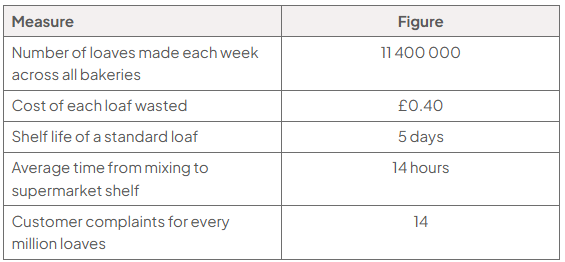
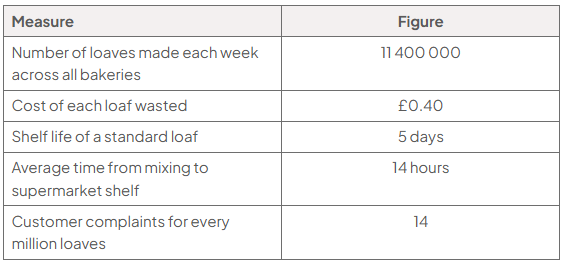
Table of bakery measures and figures: 11 400 000 loaves made each week; £0.40 cost per wasted loaf; a five-day shelf life; 14 hours from mixing to supermarket shelf; and 14 complaints per million loaves.

Source: Analyst

Analyse one way in which the rise in the share of loaves returned unsold by retailers might affect Warburtons' relationship with the supermarkets.

2
6 marks

Source B: Aldermoor Precision Ltd

Aldermoor Precision Ltd machines metal components to order for aerospace and medical equipment makers. It has one workshop in Hampshire, 42 employees and a small number of large customers, each of whom sends drawings and expects parts made to within a few hundredths of a millimetre.

In the year to March 2025 it made 92 400 components, had revenue of £3 696 000 and an operating profit of £369 600. The operating margin was 10%, down from 14% three years earlier.

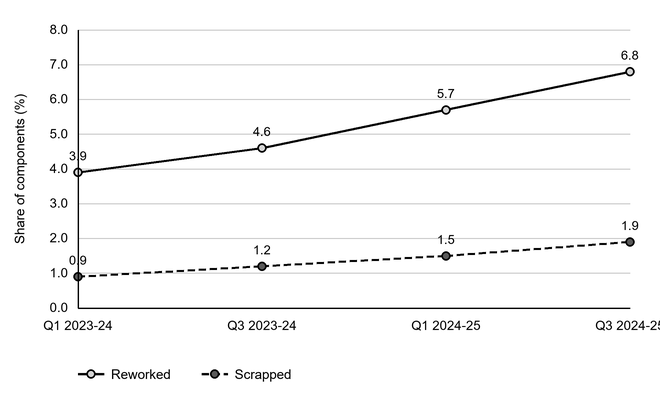
Nothing has gone obviously wrong. What has happened is that more components are being made twice. A part that is out of tolerance can sometimes be reworked, which uses machine time that was meant for the next job, and sometimes has to be scrapped, which loses the material as well. Both have been rising for two years, and because almost every job is made to a customer's drawing rather than held as inventory, a scrapped part usually means a late delivery too.

The managing director, Ruth Castellan, has two proposals on her desk. One is to buy a second computer-controlled machining centre, which would let the workshop take on more work. The other is to stop organising the workshop by type of machine, with all the lathes together and all the mills together, and instead group machines into cells, each cell making a family of similar parts from start to finish, with the operators trained to run every machine in their cell.

The first costs nearly four times as much as the second. The second means the workshop does more with fewer people.

Source: Aldermoor Precision Ltd

Appendix F: Components reworked and scrapped at Aldermoor Precision Ltd

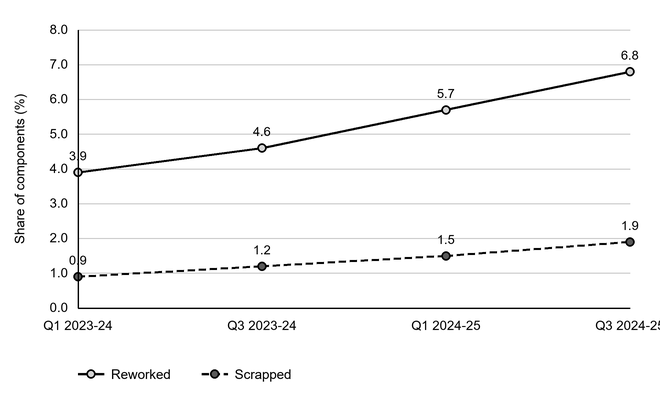
Line chart of the share of components reworked and scrapped: reworked 3.9% in Q1 2023/24, 4.6% in Q3 2023/24, 5.7% in Q1 2024/25 and 6.8% in Q3 2024/25; scrapped 0.9%, 1.2%, 1.5% and 1.9% in the same quarters.
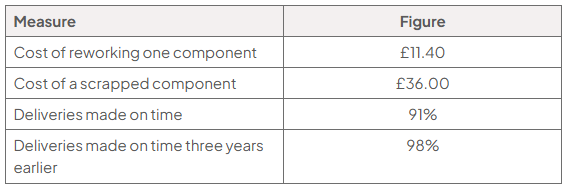
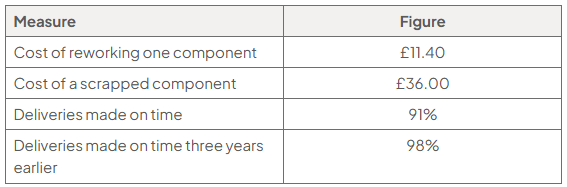
Table of Aldermoor Precision Ltd measures: reworking one component costs £11.40; a scrapped component costs £36.00; 91% of deliveries are made on time, against 98% three years earlier.

Source: Aldermoor Precision Ltd

Analyse one way in which the rise in components being scrapped might affect Aldermoor Precision Ltd's relationship with its aerospace customers.

3
6 marks

Source B: Nissan Sunderland

Nissan's plant in Sunderland is the largest car factory in the United Kingdom. It opened in 1986, has built more than 11 million vehicles, and for years has turned out roughly one car every two minutes. It employs about 6 000 people directly, and tens of thousands more work for the suppliers around it.

In 2025 the plant built 273 174 vehicles: 172 641 of the Qashqai family and 100 446 Jukes, plus a small number of others. It also makes the latest electric Leaf, and from 2027 it will add a battery-electric Juke, followed by a battery-electric Qashqai.

The difficulty is not whether Sunderland can build cars well. It is how many it is building. The plant was designed to make around 600 000 vehicles a year, so it is running at well under half of what it could do. Every year the factory carries the cost of a building, the machinery inside it and the people who keep it running, whether it makes 273 000 cars or 600 000.

In May 2026 Nissan announced it would bring production together onto a single line rather than running two, which would mean a smaller factory making much better use of itself. The alternative was to keep both lines and try to win enough new models to fill them.

Source: Nissan Sunderland Plant and Nissan Europe announcements, 2025 to 2026

Appendix G: Cost and quality at Sunderland

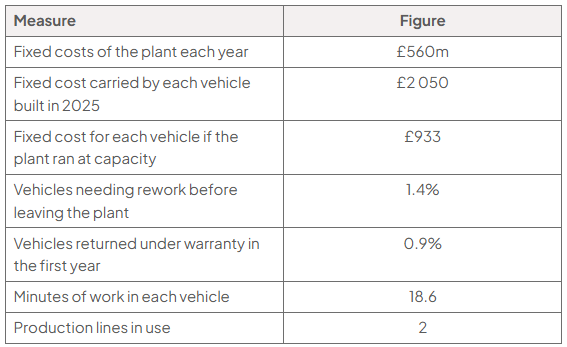
Two-column table headed “Measure” and “Figure”, listing Sunderland’s fixed costs, rework and warranty rates, work time and production lines: £560m, £2,050, £933, 1.4%, 0.9%, 18.6 and 2.

Source: Analyst

Analyse one way in which 1.4% of vehicles needing rework might affect Nissan Sunderland's efficiency.

4
6 marks

Source B: Toyota Manufacturing UK

Toyota Manufacturing UK builds the Corolla Hatchback and Corolla Touring Sports at Burnaston in Derbyshire, and the engines that go into them at Deeside in north Wales. Together the two plants employ about 3 000 people. Burnaston began building cars in December 1992 and built its five millionth British car, a Corolla, in October 2024.

A finished car leaves the Burnaston line roughly every 90 seconds, and about 150 000 cars a year are built there. Around 85% are exported, most of them to Europe, so the plant is judged against Toyota's other factories and has to win its work rather than be handed it.

Burnaston is run on the Toyota Production System. Anyone on the line may stop it by pulling a cord if something is not right, and it does not restart until the problem is understood. Teams meet in short standing huddles at the start of each shift, and improvements suggested by the people doing the job are expected rather than hoped for.

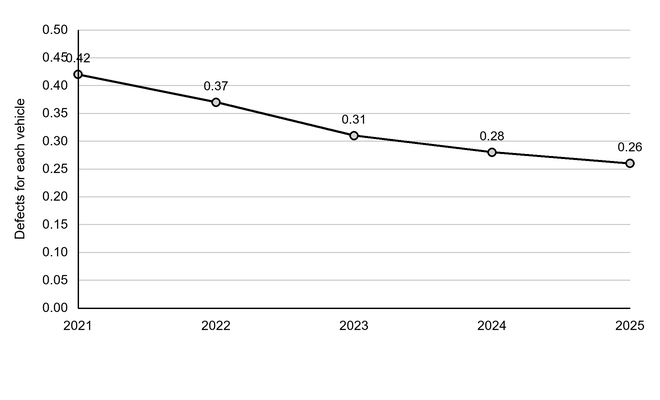
That makes the plant unusual in how much it measures. It records the time taken at every station, the number of cars that come off the line needing no further work, the defects found for each vehicle and the cost of putting them right. None of these figures are kept quiet: they are written up on boards the whole shift can see.

The pressure now is cost. European plants with newer lines and lower wages build the same model, and Burnaston has been asked to find a further saving on every car without spending heavily on new equipment.

Source: Toyota Manufacturing UK and Toyota Motor Europe

Appendix G: Quality at Burnaston

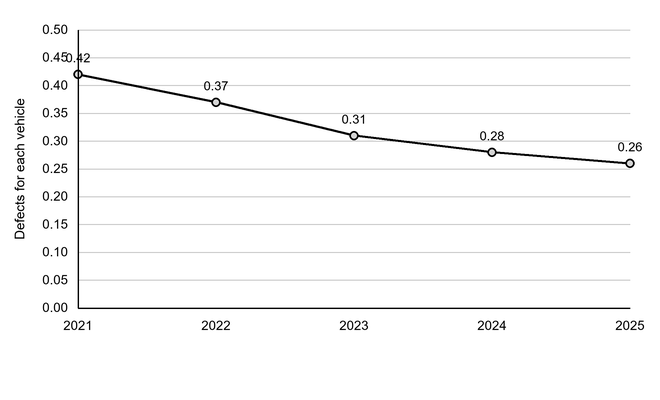
Line chart of defects found per vehicle, showing a steady fall from 0.42 in 2021 to 0.26 in 2025. The horizontal axis covers 2021 to 2025; the vertical axis ranges from 0 to 0.50 defects per vehicle.
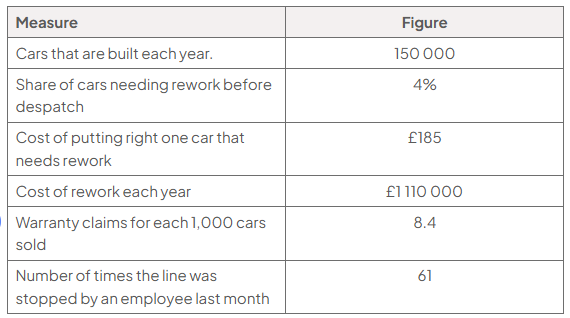
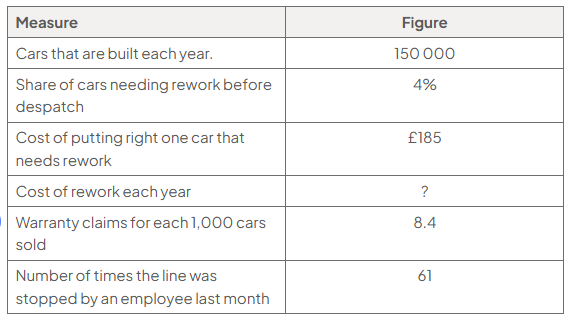
Two-column table of Burnaston production and quality measures; the figures include an annual rework cost of £1 110 000.

Source: Analyst

Analyse one way in which employees stopping the line 61 times last month might affect Toyota Manufacturing UK's costs.

5
6 marks

Source B: 2 Sisters Food Group

2 Sisters Food Group is one of Britain's largest food manufacturers. It supplies roughly a third of the poultry eaten in the country, also makes ready meals and bakery products, employs around 13 500 people across about twenty United Kingdom sites, and is privately owned as part of Boparan Holdings. In the year to 27 July 2024 turnover was £3.05 billion, up 0.5%, with a profit before tax of £35.5 million.

Poultry is one of the most heavily checked things made in Britain. Temperature is recorded continuously, every batch is inspected, and the sites are audited by their own quality teams, by the supermarket customers who buy from them, by the regulator and by independent certification bodies. Over a year that comes to more than a thousand separate audits.

Everything about the operation is measured because almost nothing about it can be put right later. A bird that is wrong cannot be reworked; it is taken out. A line that stops costs a shift's output, and a site stopped for a day costs hundreds of thousands of pounds. Sixty-eight per cent of sales go to four supermarket customers, and each of them can audit a site at five days' notice.

That leaves two numbers in tension. The sites run close to flat out and want to keep running, and the same sites have to be able to prove what happened to every bird. Stopping the line protects the second and costs the first.

The question in front of the operations board is what would improve what the sites can prove, rather than only what they produce.

Source: Boparan Holdings Limited annual results for the year ended 27 July 2024

Appendix G: Who checks the sites, and what they find

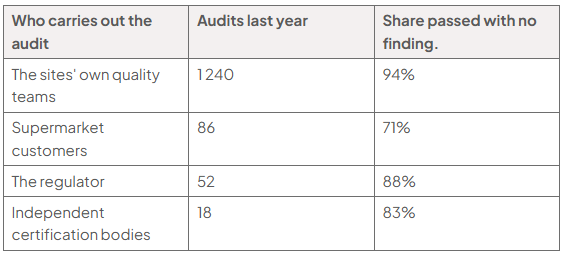
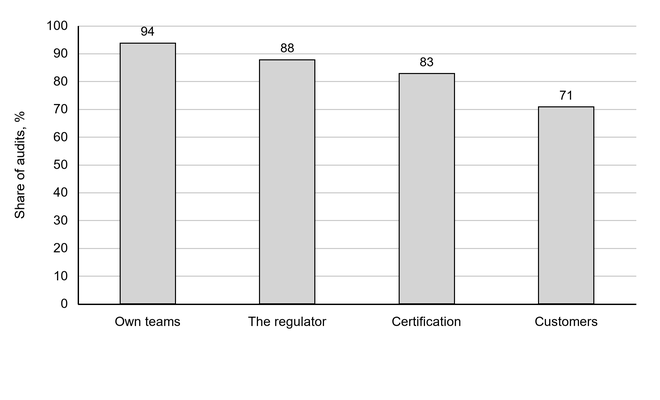
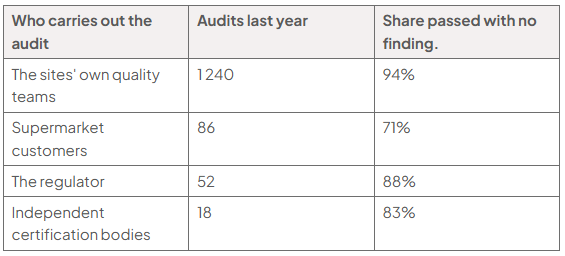
Table of audits last year and the share passed with no finding: the sites' own quality teams 1 240 audits, 94%; supermarket customers 86 audits, 71%; the regulator 52 audits, 88%; independent certification bodies 18 audits, 83%.
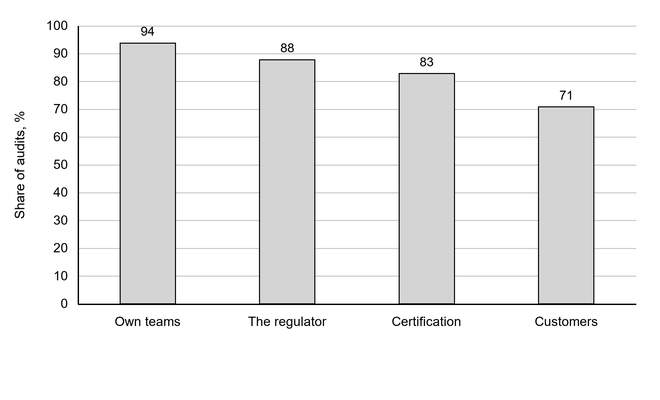
Bar chart of audits passed with no finding: own teams 94%, the regulator 88%, certification bodies 83%, and customers 71%. The vertical axis shows share of audits from 0% to 100%.

Audits in total: 1 396

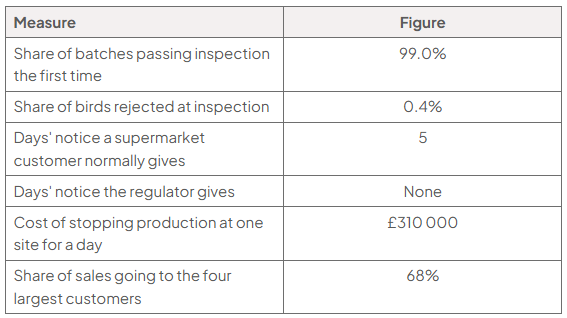
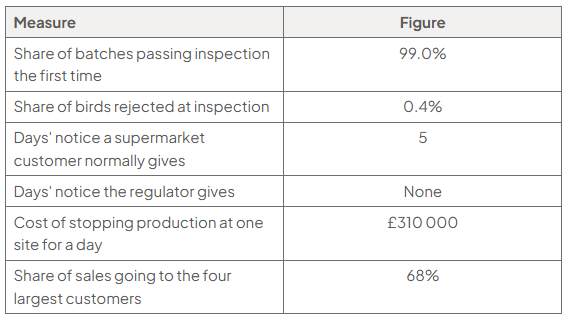
Table of operational measures: 99.0% of batches pass inspection first time, 0.4% of birds are rejected, customers give five days’ notice, the regulator gives none, a day’s stoppage costs £310 000, and 68% of sales go to four largest customers.

Source: Analyst

Analyse one way in which the regulator giving no notice of an audit might affect how 2 Sisters Food Group manages quality.

6
6 marks

Source B: Marchwood Precision Ltd

Marchwood Precision Ltd machines aluminium parts for aerospace customers from a single factory near Bristol. It delivers about 170 000 parts a year to nine customers, three of whom provide 64% of revenue. Revenue in the year to March 2025 was £19.35 million and operating profit £1.24 million. It employs 118 people and runs fourteen machines on two shifts.

Aerospace work is sold on paperwork as much as on metal. Every part leaves with a certificate saying what it was made from and who machined it, and those records have to be kept for eleven years. A part that is wrong cannot be quietly used up somewhere else; it is scrapped or sent back through the shop to be reworked.

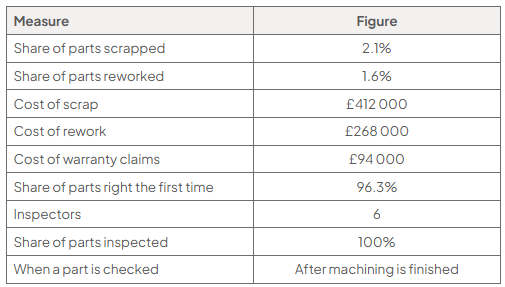
Last year 2.1% of parts were scrapped and 1.6% were reworked, which cost £412 000 and £268 000. A further £94 000 went on warranty claims. Six inspectors check every part, but they check it after machining is finished, so a mistake made in the first minute of a cut is found an hour later when nothing can be done about it.

The machines themselves are not the constraint. They could cut for 46 000 hours a year and actually cut for 34 500. Most of the gap is setting up: 62 setups a week at an average of 95 minutes each, which is about 98 hours a week when nothing is being made.

The board has agreed that quality has to improve before the next contract review, and is choosing between two ways of doing it.

Source: Marchwood Precision Ltd

Appendix F: What poor quality costs Marchwood

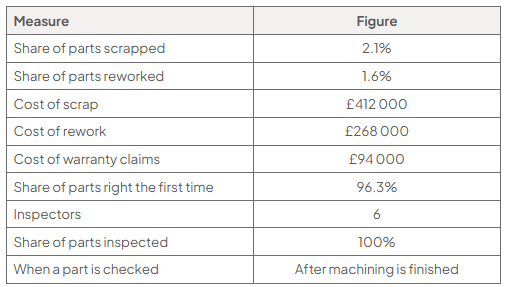
Table of Marchwood quality measures: 2.1% scrapped and 1.6% reworked; costs are £412,000, £268,000 and £94,000 for scrap, rework and warranty claims. Right first time is 96.3%; six inspectors check 100% after machining.

Source: Analyst

Analyse one way in which checking a part after machining is finished rather than while it is being cut might affect Marchwood Precision Ltd.

7
6 marks

Source B: Hallerton Cold Stores Ltd

Hallerton Cold Stores Ltd keeps frozen food for other people. It runs one store near Hull with 18 000 pallet spaces, holds it at about minus 24 degrees Celsius every hour of every day, and moves 1 900 pallets in and out daily. It employs 110 people, had revenue of £14.2 million in the year to March 2025 against operating costs of £12.4 million, and made an operating profit of £1.8 million.

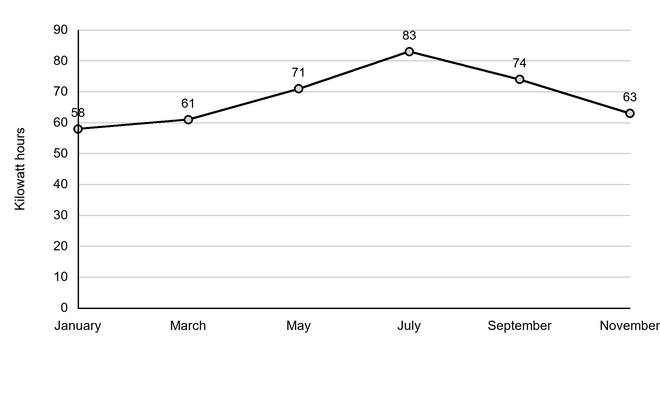
What makes the business unlike a warehouse is electricity. Keeping 18 000 pallet spaces that cold cost £4 464 000 last year, which is by a wide margin the largest thing the company spends money on, more than it spends on wages. The bill also moves with the weather: a pallet space uses about 83 kilowatt hours in July and 58 in January.

The store is nearly full. It runs at 92% of its pallet spaces on average, picks 97.8% of pallets inside the hour it promises, and has been outside its agreed temperature range three times in a year. The oldest refrigeration plant is nineteen years old.

Customers want more space than Hallerton has, so a second store is agreed in principle. Two things are not. One is where to put it: beside the existing store, where the grid connection exists and the night shift could be shared, or in the East Midlands, far closer to the three customers who provide over half the revenue. The other is what to build: the same again, or something that uses a third less electricity for every pallet space and costs several million pounds more.

Source: Hallerton Cold Stores Ltd

Appendix F: What the store is judged on

Energy used for each pallet space, kilowatt hours

Line chart of monthly energy used per pallet space, in kilowatt hours, rising from 58 in January to a peak of 83 in July, then falling to 63 in November; intermediate values are 61 in March, 71 in May and 74 in September.
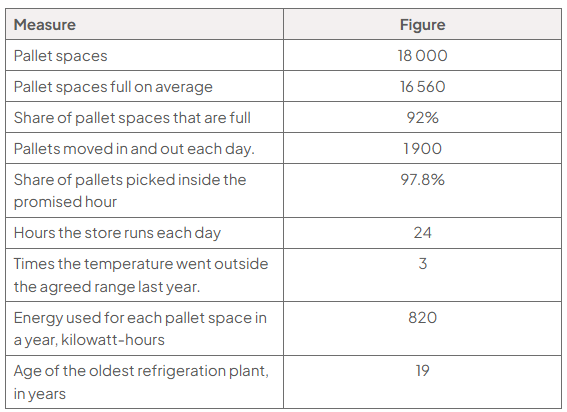
Table of store measures and figures: 18,000 pallet spaces, 92% full; 1,900 pallets moved daily; 97.8% picked within an hour; operates 24 hours; 3 temperature breaches; 820 kilowatt-hours per space yearly; oldest plant 19 years.

Source: Analyst

Analyse one way in which the store going outside its agreed temperature range three times last year might affect Hallerton Cold Stores Ltd.

1
9 marks

Source A: SHEIN

SHEIN is an online fashion retailer. It has nearly 10 000 employees, sells in over 150 countries and operates in over 20 languages.

SHEIN's annual revenue target for 2025 is $58.5 billion, up from $22.7 billion in 2022. That would exceed the existing combined sales of its main competitors, H&M and Zara.

The average price of an item sold by SHEIN is just £7.90. The company's website has over 600 000 items on sale. It adds 6 000 new items each day.

SHEIN has a lean production model. It only produces 100 to 200 pieces of any item when launched and responds with increased production only if demand justifies it. The company uses computer models to try and estimate future sales accurately and match production to demand more closely than its competitors. Through its on-demand production, SHEIN is able to consistently limit the amount of excess inventory to a level that is much lower than traditional retailers.

The company supports its suppliers with training and investment in advanced technology. SHEIN ships orders to its customers directly, mostly from one huge warehouse near Guangzhou in China. This means that deliveries to customers around the world are slower than those of some competitors who have warehouses in different countries.

The fast fashion business model that SHEIN adopts has been widely criticised. It has been suggested that 8% of global carbon emissions are produced by the fashion industry. Fast fashion businesses are also criticised for encouraging consumers to replace, rather than repair or reuse clothing. Fast fashion allows customers to buy cheap products which they then discard, before quickly buying something new. There have also been criticisms of conditions in some of SHEIN's suppliers' factories in China.

SHEIN has now decided to focus more on environmental sustainability. It states, "Our operations are guided by a sustainability mindset tackling waste and circularity at every stage". The company aims to optimise the efficiency of its processes to conserve water, energy and raw materials while minimising waste. In September 2022, as part of its sustainability approach, SHEIN committed to reducing absolute (total) greenhouse gas emissions by 25% by 2030, when those of the industry are predicted to rise by 45% by 2030.

SHEIN has strict quality standards. Its approach includes a quality-check process where products are examined when they arrive at the warehouse. Factors tested include tear-strength and whether the colour of an item will fade when washed. Departments within the business are treated as if they are customers as part of its quality assurance approach.

SHEIN's values for employees include being good team-players who work well in a collaborative environment.

If SHEIN was seeking to launch a new range of clothing in 2026, it might consider two new suppliers: Xpress and Reliont. Appendix A shows information on these suppliers. The expected orders for the product in the first year would total 2.4 million units.

Source: Shein, 2024

Assess how SHEIN's approach to quality might affect its profitability.

2
9 marks

Source B: Aldermoor Precision Ltd

Aldermoor Precision Ltd machines metal components to order for aerospace and medical equipment makers. It has one workshop in Hampshire, 42 employees and a small number of large customers, each of whom sends drawings and expects parts made to within a few hundredths of a millimetre.

In the year to March 2025 it made 92 400 components, had revenue of £3 696 000 and an operating profit of £369 600. The operating margin was 10%, down from 14% three years earlier.

Nothing has gone obviously wrong. What has happened is that more components are being made twice. A part that is out of tolerance can sometimes be reworked, which uses machine time that was meant for the next job, and sometimes has to be scrapped, which loses the material as well. Both have been rising for two years, and because almost every job is made to a customer's drawing rather than held as inventory, a scrapped part usually means a late delivery too.

The managing director, Ruth Castellan, has two proposals on her desk. One is to buy a second computer-controlled machining centre, which would let the workshop take on more work. The other is to stop organising the workshop by type of machine, with all the lathes together and all the mills together, and instead group machines into cells, each cell making a family of similar parts from start to finish, with the operators trained to run every machine in their cell.

The first costs nearly four times as much as the second. The second means the workshop does more with fewer people.

Source: Aldermoor Precision Ltd

Appendix F: Components reworked and scrapped at Aldermoor Precision Ltd

Line chart of the share of components reworked and scrapped: reworked 3.9% in Q1 2023/24, 4.6% in Q3 2023/24, 5.7% in Q1 2024/25 and 6.8% in Q3 2024/25; scrapped 0.9%, 1.2%, 1.5% and 1.9% in the same quarters.
Table of Aldermoor Precision Ltd measures: reworking one component costs £11.40; a scrapped component costs £36.00; 91% of deliveries are made on time, against 98% three years earlier.

Source: Aldermoor Precision Ltd

Appendix G: Why components fail inspection at Aldermoor Precision Ltd

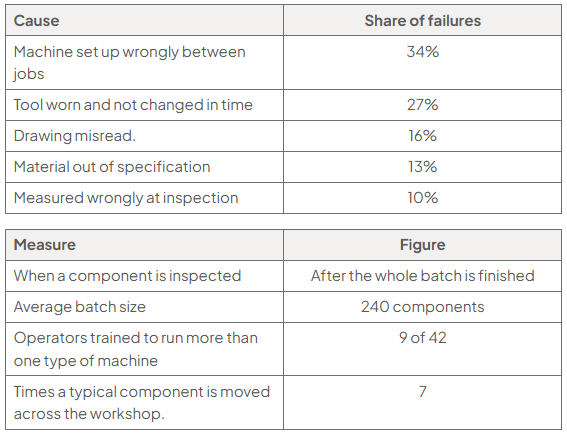
Tables show failure causes and shares: wrong machine set-up 34%, worn tool 27%, misread drawing 16%, out-of-spec material 13%, wrong measurement 10%; inspection follows each batch of 240, 9 of 42 operators run multiple machines, and components move seven times.

Source: Aldermoor Precision Ltd

Assess whether inspecting components only after the whole batch is finished is the right approach for Aldermoor Precision Ltd.

3
9 marks

Source B: Toyota Manufacturing UK

Toyota Manufacturing UK builds the Corolla Hatchback and Corolla Touring Sports at Burnaston in Derbyshire, and the engines that go into them at Deeside in north Wales. Together the two plants employ about 3 000 people. Burnaston began building cars in 1992 and built its five millionth British car, a Corolla, in October 2024.

A finished car leaves the Burnaston line roughly every 90 seconds, and about 150 000 cars a year are built there. Around 85% are exported, most of them to Europe, so the plant is judged against Toyota's other factories and has to win its work rather than be handed it.

Burnaston is run on the Toyota Production System. Anyone on the line may stop it by pulling a cord if something is not right, and it does not restart until the problem is understood. Teams meet in short standing huddles at the start of each shift, and improvements suggested by the people doing the job are expected rather than hoped for.

That makes the plant unusual in how much it measures. It records the time taken at every station, the number of cars that come off the line needing no further work, the defects found for each vehicle and the cost of putting them right. None of these figures are kept quiet: they are written up on boards the whole shift can see.

The pressure now is cost. European plants with newer lines and lower wages build the same model, and Burnaston has been asked to find a further saving on every car without spending heavily on new equipment.

Source: Toyota Manufacturing UK and Toyota Motor Europe

Appendix E: Toyota Manufacturing UK, published figures

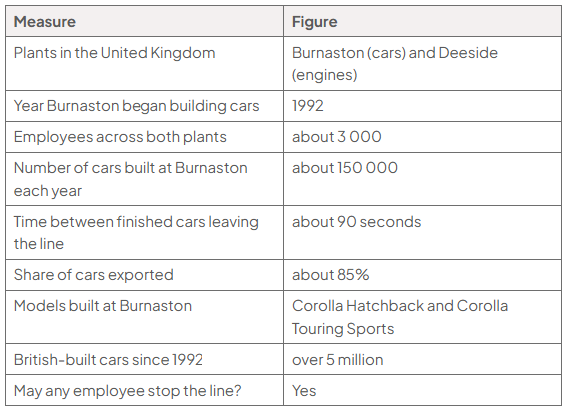
Table of Toyota Manufacturing UK published figures: plants in the United Kingdom, Burnaston (cars) and Deeside (engines); Burnaston began building cars in 1992; about 3 000 employees across both plants; about 150 000 cars built at Burnaston each year; about 90 seconds between finished cars leaving the line; about 85% of cars exported; models built at Burnaston, Corolla Hatchback and Corolla Touring Sports; over 5 million British-built cars since 1992; any employee may stop the line, yes.

Source: Toyota Manufacturing UK

Appendix G: Quality at Burnaston

Line chart of defects found per vehicle at Burnaston, falling each year from 0.42 in 2021 to 0.26 in 2025; the y-axis ranges from 0.00 to 0.50 defects per vehicle.
Table of Burnaston quality measures: 150 000 cars built yearly; 4% need rework; £185 per reworked car; annual rework cost not provided; 8.4 warranty claims per 1 000 cars; line stopped 61 times last month.

Source: Analyst

Assess the case for Toyota Manufacturing UK spending more on improving quality at Burnaston.

Calculate the cost of rework each year to support your answer.

4
9 marks

Source B: 2 Sisters Food Group

2 Sisters Food Group is one of Britain's largest food manufacturers. It supplies roughly a third of the poultry eaten in the country, also makes ready meals and bakery products, employs around 13 500 people across about twenty United Kingdom sites, and is privately owned as part of Boparan Holdings. In the year to 27 July 2024 turnover was £3.05 billion, up 0.5%, with a profit before tax of £35.5 million.

Poultry is one of the most heavily checked things made in Britain. Temperature is recorded continuously, every batch is inspected, and the sites are audited by their own quality teams, by the supermarket customers who buy from them, by the regulator and by independent certification bodies. Over a year that comes to more than a thousand separate audits.

Everything about the operation is measured because almost nothing about it can be put right later. A bird that is wrong cannot be reworked; it is taken out. A line that stops costs a shift's output, and a site stopped for a day costs hundreds of thousands of pounds. Sixty-eight per cent of sales go to four supermarket customers, and each of them can audit a site at five days' notice.

That leaves two numbers in tension. The sites run close to flat out and want to keep running, and the same sites have to be able to prove what happened to every bird. Stopping the line protects the second and costs the first.

The question in front of the operations board is what would improve what the sites can prove, rather than only what they produce.

Source: Boparan Holdings Limited annual results for the year ended 27 July 2024

Appendix F: What a poultry site measures

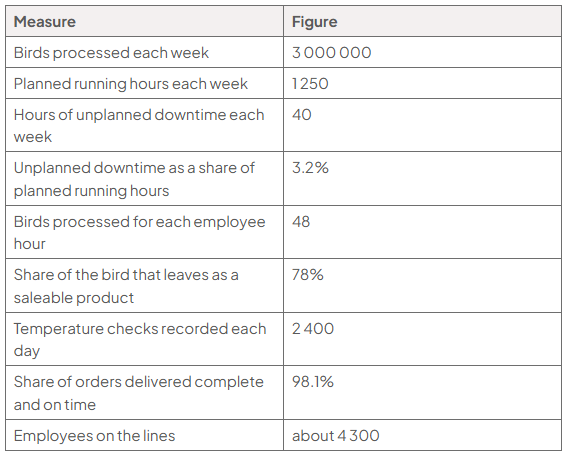
Table of what a poultry site measures: 3 000 000 birds processed each week; 1 250 planned running hours each week; 40 hours of unplanned downtime each week, which is 3.2% of planned running hours; 48 birds processed for each employee hour; 78% of the bird leaves as a saleable product; 2 400 temperature checks recorded each day; 98.1% of orders delivered complete and on time; about 4 300 employees on the lines.

Figures cover the sites in this report, not the whole group

Source: Analyst

Appendix G: Who checks the sites, and what they find

Table of audits last year and share passed with no finding: own quality teams, 1 240 and 94%; supermarket customers, 86 and 71%; regulator, 52 and 88%; independent certification bodies, 18 and 83%.

Share passed with no finding

Bar chart of audits passed with no finding: own teams 94%, regulator 88%, independent certification 83%, and supermarket customers 71%; vertical axis shows share of audits from 0 to 100%.

Audits in total: 1 396

Table of operational measures: 99.0% of batches pass inspection first time; 0.4% of birds are rejected; customers give five days’ notice, the regulator gives none; stopping costs £310 000 a day; 68% of sales go to four largest customers.

Source: Analyst

Assess whether being audited more than a thousand times a year makes 2 Sisters Food Group's products safer.

5
9 marks

Source B: Marchwood Precision Ltd

Marchwood Precision Ltd machines aluminium parts for aerospace customers from a single factory near Bristol. It delivers about 170 000 parts a year to nine customers, three of whom provide 64% of revenue. Revenue in the year to March 2025 was £19.35 million and operating profit £1.24 million. It employs 118 people and runs fourteen machines on two shifts.

Aerospace work is sold on paperwork as much as on metal. Every part leaves with a certificate saying what it was made from and who machined it, and those records have to be kept for eleven years. A part that is wrong cannot be quietly used up somewhere else; it is scrapped or sent back through the shop to be reworked.

Last year 2.1% of parts were scrapped and 1.6% were reworked, which cost £412 000 and £268 000. A further £94 000 went on warranty claims. Six inspectors check every part, but they check it after machining is finished, so a mistake made in the first minute of a cut is found an hour later when nothing can be done about it.

The machines themselves are not the constraint. They could cut for 46 000 hours a year and actually cut for 34 500. Most of the gap is setting up: 62 setups a week at an average of 95 minutes each, which is about 98 hours a week when nothing is being made.

The board has agreed that quality has to improve before the next contract review, and is choosing between two ways of doing it.

Source: Marchwood Precision Ltd

Appendix E: Marchwood Precision Ltd selected data, year to March 2025

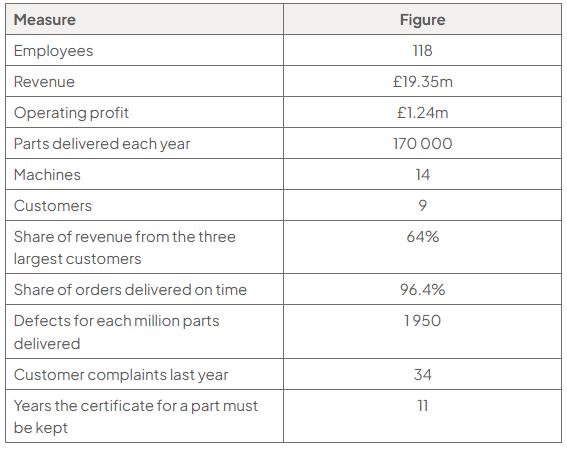
Table of Marchwood Precision Ltd selected data: 118 employees; revenue £19.35m; operating profit £1.24m; 170 000 parts delivered each year; 14 machines; 9 customers; 64% of revenue from the three largest customers; 96.4% of orders delivered on time; 1 950 defects for each million parts delivered; 34 customer complaints last year; the certificate for a part must be kept for 11 years.

Source: Marchwood Precision Ltd

Appendix F: What poor quality costs Marchwood

Table of poor-quality measures: 2.1% of parts scrapped (£412 000), 1.6% reworked (£268 000), and £94 000 in warranty claims; 96.3% right first time. Six inspectors check 100% after machining.

Source: Analyst

Assess the cost of poor quality to Marchwood Precision Ltd.

Calculate Marchwood Precision Ltd's operating profit margin to support your answer.

1
15 marks

Source B: Warburtons

Warburtons is the largest family-owned bakery business in the United Kingdom and in 2025 it entered its 150th year. It is still owned by the Warburton family, bakes in 13 bakeries and employs just over 5 000 people.

The year to 27 September 2025 was a record one. Revenue grew 3.9% to £769.9 million and the volume of products sold grew 4.2%. Operating profit rose 30%, from £33.3 million to £43.2 million, and profit before tax rose 33% to £42 million. During the year the company recruited more than 400 new employees, although after leavers the workforce grew by only 45. It also bought a former Rathbones bakery, which it expects to have running by September 2026.

Even after that jump in profit, Warburtons keeps only a few pence of every pound it takes. Bread is sold mainly through a handful of large supermarkets, which negotiate hard on price, so the company cannot pass higher costs on. Almost all of its improvement has to come from making bread more cheaply and wasting less of it.

That is difficult, because a standard loaf has a shelf life of five days and the business is judged on getting it onto the shelf fast. Bread that is rejected at the bakery, or returned unsold by a retailer, cannot be sold at all. Over the last four years both of those figures have been rising, and its bakeries differ widely in how much bread each employee produces.

Source: Warburtons annual results for the year to 27 September 2025

Appendix E: Selected data for Warburtons, year to 27 September 2025

Table of selected Warburtons measures for 2025 and 2024. Revenue: £769.9m in 2025 and £741.0m in 2024. Revenue growth: 3.9% in 2025. Growth in the volume of products sold: 4.2% in 2025. Operating profit: £43.2m in 2025 and £33.3m in 2024. Profit before tax: £42.0m in 2025 and £31.5m in 2024. Employees: just over 5 000 in 2025. New employees recruited during the year: more than 400 in 2025. Net increase in the workforce: 45 in 2025. Bakeries: 13 in 2025. No 2024 figure is given for revenue growth, volume growth, employees, recruitment, net increase in the workforce or bakeries.

Source: Warburtons

Appendix G: Quality and waste at Warburtons

Line graph of waste shares from 2021/22 to 2024/25: loaves rejected before leaving the bakery rise from 1.4% to 2.0%, while retailer returns rise from 2.2% to 3.0%.
Table of Warburtons measures: 11 400 000 loaves made weekly; each wasted loaf costs £0.40; shelf life is 5 days; mixing to shelf takes 14 hours; 14 complaints per million loaves.

Source: Analyst

Appendix H: Two ways of reducing waste at Warburtons

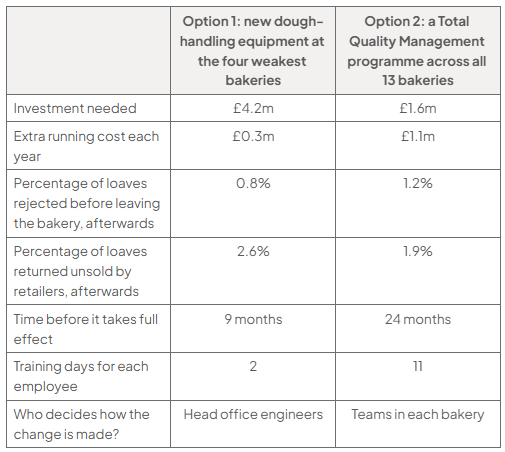
Comparison of Option 1 versus Option 2: investment £4.2m/£1.6m; annual running costs £0.3m/£1.1m; rejection 0.8%/1.2%; returns 2.6%/1.9%; effect 9/24 months; training 2/11 days; decisions by head office engineers/teams in each bakery.

Source: Analyst

Warburtons is considering two ways of reducing the amount of bread it wastes:

Option 1: new dough-handling equipment at the four weakest bakeries

Option 2: a Total Quality Management programme across all 13 bakeries

Evaluate both options and recommend which one Warburtons should choose.

Calculate the return on investment for Option 1 to support your answer.

2
15 marks

Source B: Marchwood Precision Ltd

Marchwood Precision Ltd machines aluminium parts for aerospace customers from a single factory near Bristol. It delivers about 170 000 parts a year to nine customers, three of whom provide 64% of revenue. Revenue in the year to March 2025 was £19.35 million and operating profit £1.24 million. It employs 118 people and runs fourteen machines on two shifts.

Aerospace work is sold on paperwork as much as on metal. Every part leaves with a certificate saying what it was made from and who machined it, and those records have to be kept for eleven years. A part that is wrong cannot be quietly used up somewhere else; it is scrapped or sent back through the shop to be reworked.

Last year 2.1% of parts were scrapped and 1.6% were reworked, which cost £412 000 and £268 000. A further £94 000 went on warranty claims. Six inspectors check every part, but they check it after machining is finished, so a mistake made in the first minute of a cut is found an hour later when nothing can be done about it.

The machines themselves are not the constraint. They could cut for 46 000 hours a year and actually cut for 34 500. Most of the gap is setting up: 62 setups a week at an average of 95 minutes each, which is about 98 hours a week when nothing is being made.

The board has agreed that quality has to improve before the next contract review, and is choosing between two ways of doing it.

Source: Marchwood Precision Ltd

Appendix E: Marchwood Precision Ltd selected data, year to March 2025

Table of Marchwood Precision Ltd selected data: 118 employees; revenue £19.35m; operating profit £1.24m; 170 000 parts delivered each year; 14 machines; 9 customers; 64% of revenue from the three largest customers; 96.4% of orders delivered on time; 1 950 defects for each million parts delivered; 34 customer complaints last year; the certificate for a part must be kept for 11 years.

Source: Marchwood Precision Ltd

Appendix H: Two ways of improving quality

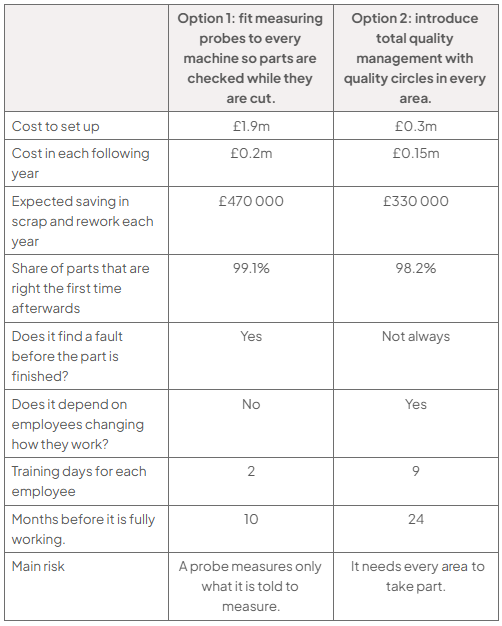
Comparison table of machine probes and TQM quality circles: probes cost £1.9m setup and £0.2m yearly, save £470 000, achieve 99.1% first-time quality; TQM costs £0.3m and £0.15m, saves £330 000 and achieves 98.2%.

170 000 parts are delivered a year. Scrap cost £412 000 and rework £268 000.

Source: Analyst

Marchwood Precision Ltd is considering two ways of improving quality:

Option 1: fit measuring probes to every machine so parts are checked while they are cut

Option 2: introduce total quality management with quality circles in every area

Evaluate both options and recommend which one Marchwood Precision Ltd should choose.

Calculate the scrap and rework cost for each part delivered to support your answer.

3
15 marks

Source B: 2 Sisters Food Group

2 Sisters Food Group is one of Britain's largest food manufacturers. It supplies roughly a third of the poultry eaten in the country, also makes ready meals and bakery products, employs around 13 500 people across about twenty United Kingdom sites, and is privately owned as part of Boparan Holdings. In the year to 27 July 2024 turnover was £3.05 billion, up 0.5%, with a profit before tax of £35.5 million.

Poultry is one of the most heavily checked things made in Britain. Temperature is recorded continuously, every batch is inspected, and the sites are audited by their own quality teams, by the supermarket customers who buy from them, by the regulator and by independent certification bodies. Over a year that comes to more than a thousand separate audits.

Everything about the operation is measured because almost nothing about it can be put right later. A bird that is wrong cannot be reworked; it is taken out. A line that stops costs a shift's output, and a site stopped for a day costs hundreds of thousands of pounds. Sixty-eight per cent of sales go to four supermarket customers, and each of them can audit a site at five days' notice.

That leaves two numbers in tension. The sites run close to flat out and want to keep running, and the same sites have to be able to prove what happened to every bird. Stopping the line protects the second and costs the first.

The question in front of the operations board is what would improve what the sites can prove, rather than only what they produce.

Source: Boparan Holdings Limited annual results for the year ended 27 July 2024

Appendix E: 2 Sisters Food Group, published figures

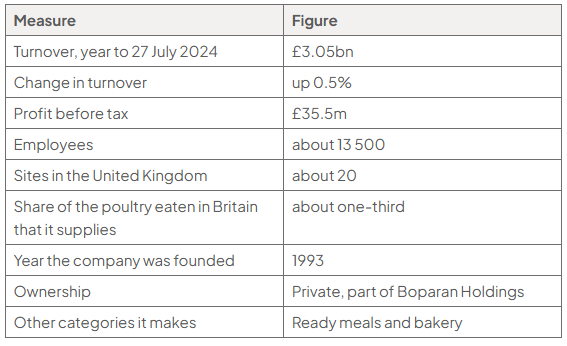
Table of 2 Sisters Food Group published figures: turnover in the year to 27 July 2024 £3.05bn, up 0.5%; profit before tax £35.5m; about 13 500 employees; about 20 sites in the United Kingdom; supplies about one-third of the poultry eaten in Britain; founded in 1993; privately owned, part of Boparan Holdings; also makes ready meals and bakery.

Source: Boparan Holdings Limited

Appendix G: Who checks the sites, and what they find

Table of audits last year and share passed with no finding: own quality teams, 1 240 and 94%; supermarket customers, 86 and 71%; regulator, 52 and 88%; independent certification bodies, 18 and 83%.

Share passed with no finding

Bar chart of audits passed with no finding: own teams 94%, regulator 88%, independent certification 83%, and supermarket customers 71%; vertical axis shows share of audits from 0 to 100%.

Audits in total: 1 396

Table of operational measures: 99.0% of batches pass inspection first time; 0.4% of birds are rejected; customers give five days’ notice, the regulator gives none; stopping costs £310 000 a day; 68% of sales go to four largest customers.

Source: Analyst

Evaluate two ways in which 2 Sisters Food Group could increase the share of supermarket customer audits its sites pass with no finding, and recommend which one it should do first.