Scale of Operations (AQA A Level Business): Exam Questions

Exam code: 7132

Syllabus Edition

First teaching 2026

First exams 2028

2 hours15 questions
1
6 marks

Source B: Farmoor Cycles

Farmoor Cycles is an independent bicycle retailer in the UK. It was established in Oxford in 2002 as a worker cooperative by a group of cycling enthusiasts. It now has two other shops in Birmingham and Manchester. The UK bicycle retail sector has a few large national chains that sell bikes, such as Halfords, Decathlon and Argos, as well as many small independent businesses. The entry threat to the industry is high.

The mission of Farmoor Cycles is to:

  • provide affordable bicycles for cyclists of all kinds

  • promote the benefits of cycling for cyclists of all kinds

  • build a fairer society through cooperative ownership.

The business states that 'we have the passion, specialist expertise and links with the local community that customers want'.

It values:

  • democracy

  • honesty

  • openness

  • social responsibility

  • caring for others.

The business is considering investing in a new inventory management system (Appendix C) which has a forecast life span of 4 years. It usually aims for an average rate of return on its investments of at least 10%. The current rate of interest for taking out a bank loan is 8%.

Appendix D: Farmoor Cycles' data
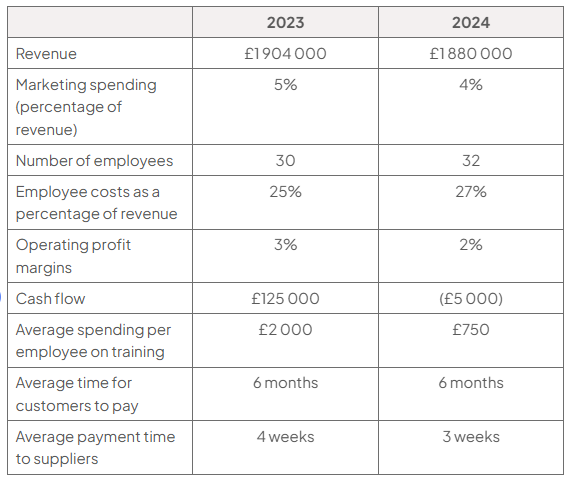
Table comparing 2023/2024: revenue £1,904,000/£1,880,000; marketing 5%/4%; employees 30/32; employee costs 25%/27%; operating margin 3%/2%; cash flow £125,000/(£5,000); training £2,000/£750; customer payment six months; supplier payment four/three weeks.

Appendix F: Farmoor Cycles’ marketing data (2024)

  • Online sales as a percentage of total sales: 15%

  • Store sales as a percentage of total sales: 85%

  • Spending on digital marketing as a percentage of revenue: 2%

  • Average cost per click-through from digital adverts to website: £7.80

  • Index of customer service rating (base year 2022=100): 82

Appendix G: UK bicycle retail industry data, 2024
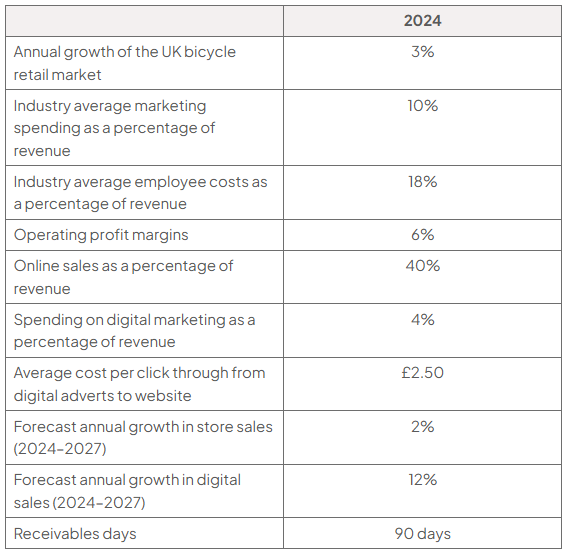
2024 UK bicycle retail industry data table: market growth 3%; marketing 10%; employee costs 18%; operating margin 6%; online sales 40%; digital marketing 4%; cost per click £2.50; store and digital growth 2% and 12%; receivables 90 days.

Analyse one reason why the size of bicycle retail chains might lead to a higher operating profit margin than small independent retailers.

2
6 marks

Source B: Portmeirion Group plc

Portmeirion Group plc makes and sells homeware and home fragrance. It is a public limited company listed on AIM, based in Stoke-on-Trent, and it owns six heritage brands: Spode, Portmeirion, Royal Worcester, Nambé, Pimpernel and Wax Lyrical. It has over 650 employees worldwide and the majority of them are in Stoke-on-Trent.

The last five years have been hard. Revenue reached £110.8 million in 2022 and then fell two years in a row, to £91.2 million in 2024, before holding at £91.1 million in 2025. Profit fell much further than revenue. Headline profit before tax was £8.0 million in 2022 and £1.0 million in 2024. The headline operating margin went from 7.8% in 2022 to 4.7% in 2023. Earnings for each share fell from 46.59p in 2022 to 8.04p in 2024, and the dividend from 15.50p to 1.50p. By the end of 2025 the group had net debt of £17.5 million, and although operations still generated cash, they generated only £0.5 million of it, against £2.1 million the year before.

The group sells in three main markets: the United Kingdom, North America and South Korea. North America is the largest of the three.

Portmeirion Group owns a factory in Stoke-on-Trent, but approximately 26% of its branded tableware is actually made there. The rest is bought in from suppliers, much of it in Asia. The company has a stated strategy called Made in Stoke-on-Trent and says it intends to increase the share it makes itself.

Something outside the business has pushed that plan along. When the United States introduced tariffs, orders that Portmeirion Group had sourced from Asia for the American market were cancelled, and the company decided to speed up parts of the Made in Stoke-on-Trent plan in response.

Source: Portmeirion Group plc annual results and interim statements, 2024 to 2026

Appendix H: Two ways of increasing the share made in Stoke-on-Trent

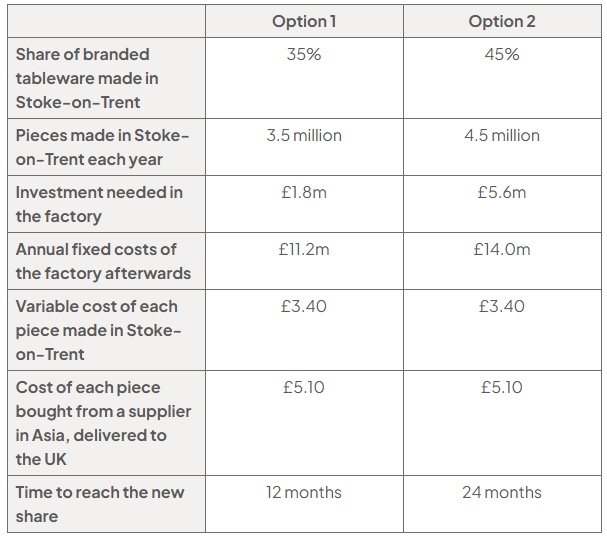
Table comparing Option 1 and Option 2: share made 35% and 45%; annual pieces 3.5m and 4.5m; investment £1.8m and £5.6m; fixed costs £11.2m and £14.0m; both costs per piece £3.40 made and £5.10 bought; time 12 and 24 months.

Source: Analyst

Portmeirion Group plc makes about 26% of its branded tableware in its own factory.

Analyse one way in which making a larger share of its tableware itself might create economies of scale for Portmeirion Group plc.

3
6 marks

Source B: Tata Steel UK

Tata Steel UK is part of the Indian multinational Tata Steel. Its largest site in Britain is Port Talbot in south Wales, which for decades made steel from raw materials in two blast furnaces.

On 25 April 2024 the company confirmed that it would close those blast furnaces and spend £1.25 billion on an electric arc furnace on the same site instead. Blast furnace number 5 closed at the end of June 2024 and blast furnace number 4 closed on 30 September 2024, ending the making of primary steel at Port Talbot. The change put up to 2 800 jobs at risk and around 2 500 roles have since gone.

The two kinds of furnace work in completely different ways. A blast furnace turns imported iron ore and coking coal into new iron, runs continuously and cannot easily be turned down. An electric arc furnace melts scrap steel using electricity, can be started and stopped far more easily, emits far less carbon dioxide and needs far fewer people. It also depends on being able to buy enough scrap steel and on having a large enough electricity supply.

Steel was expected to be made at Port Talbot again in 2027 or 2028, but delays to the electricity grid connection mean the electric arc furnace is now not expected to be running until late 2028 or early 2029. In the meantime Port Talbot imports steel from other Tata Steel sites and rolls it there.

Port Talbot was chosen as a steel town for reasons that no longer all apply. It has a deep-water port built for importing iron ore, and rolling mills that are still in use. It does not sit close to where most of Britain's scrap steel is collected.

Source: Tata Steel UK announcements, 2024 to 2026

Appendix F: A blast furnace compared with an electric arc furnace

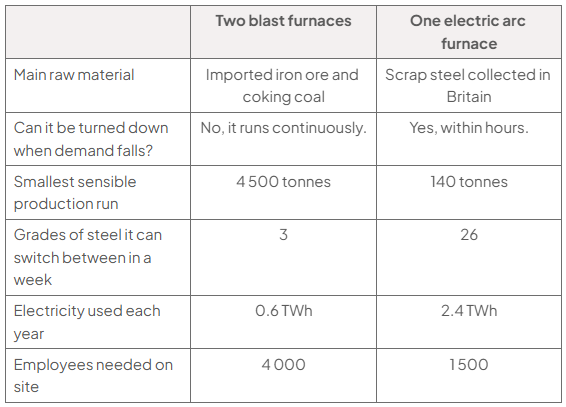
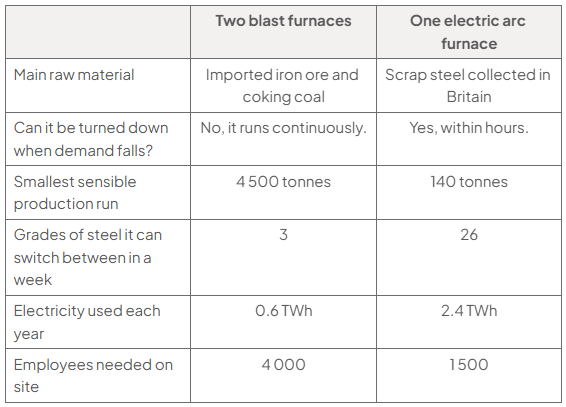
Comparison table: two blast furnaces versus one electric arc furnace. Blast furnaces use imported ore and coal, run continuously, and need 4,500 tonnes, 3 grades, 0.6 TWh and 4,000 staff; the arc furnace uses British scrap, 140 tonnes, 26 grades, 2.4 TWh and 1,500 staff.

Source: Analyst

Analyse one way in which replacing two blast furnaces with one electric arc furnace might affect the economies of scale Tata Steel UK enjoys at Port Talbot.

4
6 marks

Source B: Lush

Lush makes and sells fresh handmade cosmetics: bath bombs, soaps and shampoo bars, often sold loose and unwrapped. It is unusual among cosmetics companies because it makes almost everything it sells. Most beauty brands design a product and pay someone else to manufacture it. Lush manufactures and retails, and it says the freshness of what it makes is the reason people buy it.

In the year to 30 June 2025 turnover reached £736.2 million, up £63.5 million or 9.4%. Like-for-like turnover grew 8%, with retail shops up 7% and digital up 13%. The loss before tax narrowed sharply, from £52.1 million the year before to £6.7 million, and earnings before interest, tax, depreciation and amortisation returned to a profit of £28.4 million. A surge in the price of cocoa, which Lush uses in large quantities, held the result back.

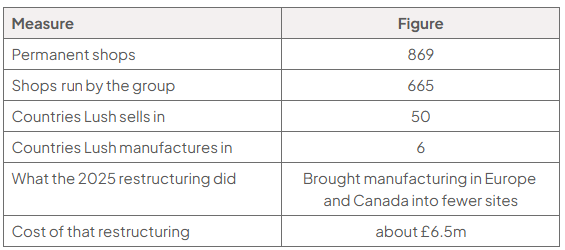
At the end of June 2025 the group had 869 permanent shops, 665 of them owned outright, selling in 50 countries. It manufactured in six countries. During the year it spent about £6.5 million restructuring, bringing manufacturing in Europe and Canada together into fewer sites.

That restructuring is the question the business keeps returning to. Making everything in a small number of large factories is cheaper for each product made. Making it close to the shops that sell it keeps it fresh, which is what Lush tells customers it is selling. The two pull against each other, and both have an environmental consequence, which matters to a company that has built its brand partly on that.

Source: Lush audited accounts for the year ended 30 June 2025

Appendix H: Two ways of organising Lush's manufacturing

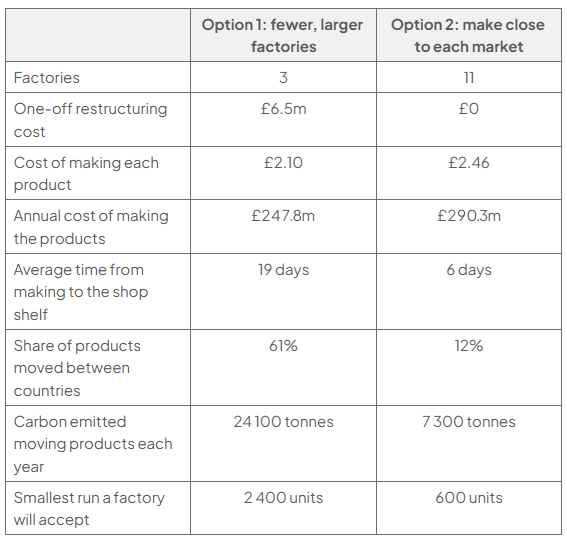
Products made each year = 118 million

Comparison table of two ways of organising Lush's manufacturing. Option 1, fewer, larger factories, against Option 2, make close to each market: 3 factories against 11; one-off restructuring cost £6.5m against £0; cost of making each product £2.10 against £2.46; annual cost of making the products £247.8m against £290.3m; average time from making to the shop shelf 19 days against 6 days; share of products moved between countries 61% against 12%; carbon emitted moving products each year 24 100 tonnes against 7 300 tonnes; smallest run a factory will accept 2 400 units against 600 units.

Source: Analyst

Analyse one way in which making its products in three large factories rather than eleven smaller ones might create economies of scale for Lush.

5
6 marks

Source B: Glanmor Dairy Ltd

Glanmor Dairy Ltd processes milk into cheese, butter and cream at a single creamery in Carmarthenshire. It employs 130 people, takes in 94 million litres of milk a year from 180 farms within about thirty miles, and in the year to March 2025 had revenue of £58 million and an operating profit of £2.3 million.

Milk is an unusual raw material. It arrives every day whether the creamery wants it or not, because cows do not stop. It cannot be stored for long before processing. And it is heavy and mostly water, so moving it is expensive: a tanker costs much the same to run whether the milk inside is worth a lot or a little.

The creamery is close to full. It can process 96 million litres a year and took 94 million last year, and the farms around it are producing more each year. Glanmor must either make its existing site bigger or build a second one.

If it builds a second creamery, where it goes matters. A site deep in the milk-producing country would sit close to the farms but a long way from the motorway network and from the supermarket depots that take the finished cheese. A site near the motorway would be the opposite: cheap to send the finished product out from, expensive to bring the raw milk into.

The managing director, Rhian Pugh, has asked for both questions to be answered: bigger here, or a second site, and if a second site, where.

Source: Glanmor Dairy Ltd

Appendix H: Two ways of handling more milk

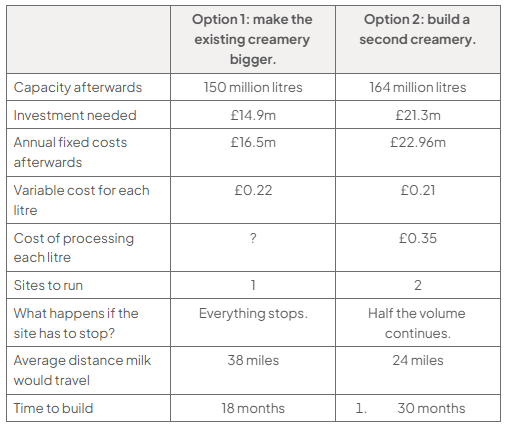
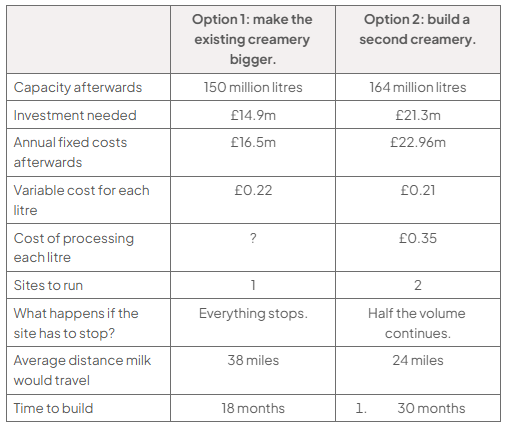
Comparison table of expanding the existing creamery versus building a second: capacity 150/164 million litres; investment £14.9m/£21.3m; fixed costs £16.5m/£22.96m; variable cost £0.22/£0.21 per litre; processing cost unknown/£0.35; sites 1/2; shutdown all/half; distance 38/24 miles; build time 18/30 months.

Source: Analyst

Analyse one way in which processing 150 million litres rather than 94 million might create economies of scale for Glanmor Dairy Ltd.

6
6 marks

Source B: Hallerton Cold Stores Ltd

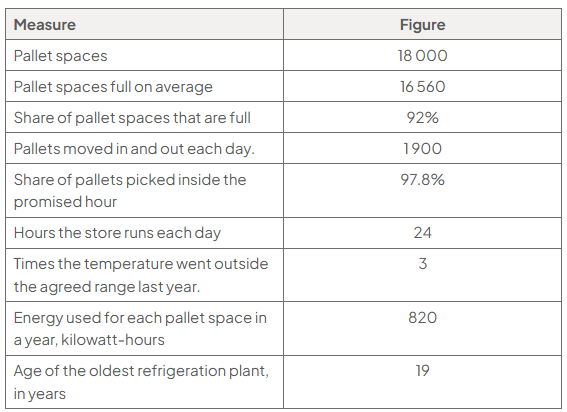
Hallerton Cold Stores Ltd keeps frozen food for other people. It runs one store near Hull with 18 000 pallet spaces, holds it at about minus 24 degrees Celsius every hour of every day, and moves 1 900 pallets in and out daily. It employs 110 people, had revenue of £14.2 million in the year to March 2025 against operating costs of £12.4 million, and made an operating profit of £1.8 million.

What makes the business unlike a warehouse is electricity. Keeping 18 000 pallet spaces that cold cost £4 464 000 last year, which is by a wide margin the largest thing the company spends money on, more than it spends on wages. The bill also moves with the weather: a pallet space uses about 83 kilowatt hours in July and 58 in January.

The store is nearly full. It runs at 92% of its pallet spaces on average, picks 97.8% of pallets inside the hour it promises, and has been outside its agreed temperature range three times in a year. The oldest refrigeration plant is nineteen years old.

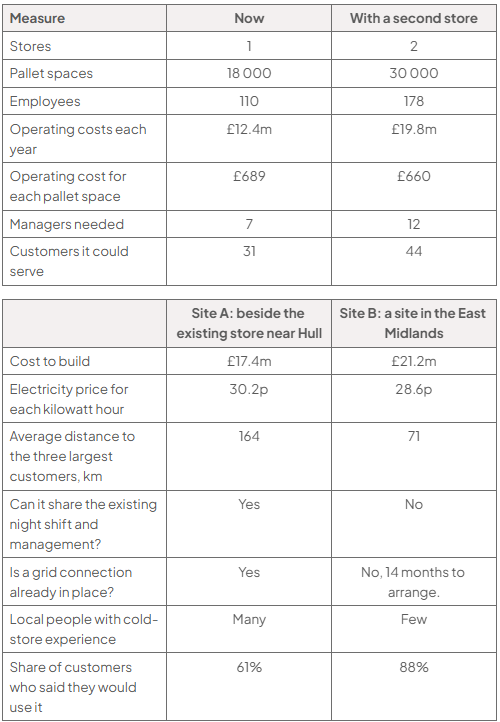
Customers want more space than Hallerton has, so a second store is agreed in principle. Two things are not. One is where to put it: beside the existing store, where the grid connection exists and the night shift could be shared, or in the East Midlands, far closer to the three customers who provide over half the revenue. The other is what to build: the same again, or something that uses a third less electricity for every pallet space and costs several million pounds more.

Source: Hallerton Cold Stores Ltd

Appendix G: A second store, and where it could go

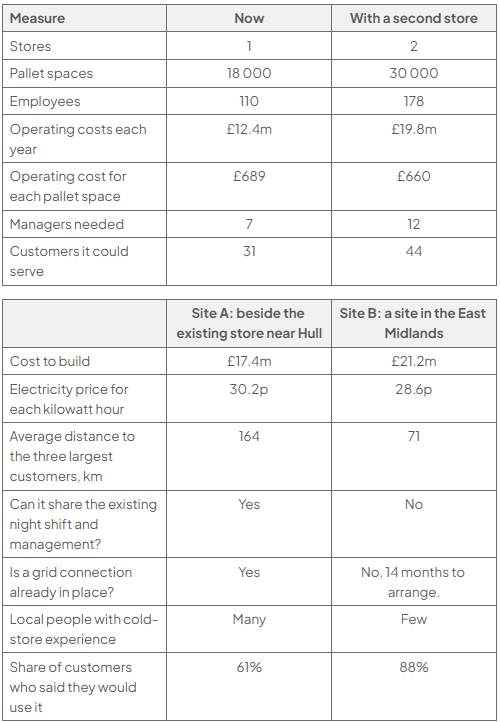
Two tables. Now and with a second store: stores, 1 now and 2 with a second store; pallet spaces, 18 000 and 30 000; employees, 110 and 178; operating costs each year, £12.4m and £19.8m; operating cost for each pallet space, £689 and £660; managers needed, 7 and 12; customers it could serve, 31 and 44. Site A, beside the existing store near Hull, and Site B, a site in the East Midlands: cost to build, £17.4m and £21.2m; electricity price for each kilowatt hour, 30.2p and 28.6p; average distance to the three largest customers, 164 km and 71 km; whether it can share the existing night shift and management, yes and no; whether a grid connection is already in place, yes for Site A and no for Site B, which needs 14 months to arrange; local people with cold-store experience, many and few; share of customers who said they would use it, 61% and 88%.

Source: Analyst

Analyse one way in which going from 18 000 to 30 000 pallet spaces might affect Hallerton Cold Stores Ltd's unit costs.

7
6 marks

Source A: Ryeworth Bakeries Ltd

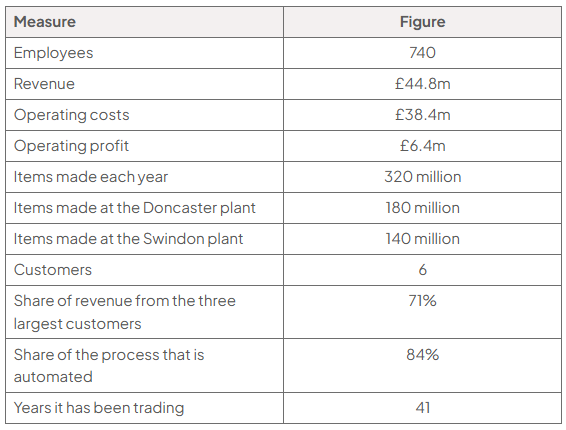
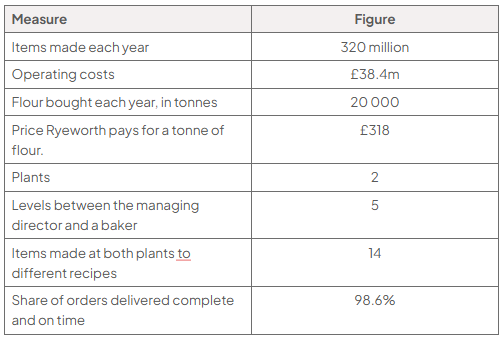
Ryeworth Bakeries Ltd bakes bread and morning goods for supermarkets from two plants, one in Doncaster and one in Swindon. It employs 740 people, makes about 320 million items a year, and in the year to March 2025 had revenue of £44.8 million against operating costs of £38.4 million, leaving an operating profit of £6.4 million. Six customers buy from it and the three largest provide 71% of revenue.

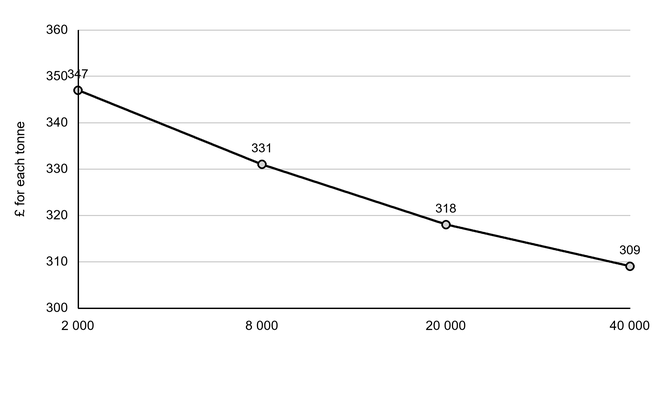
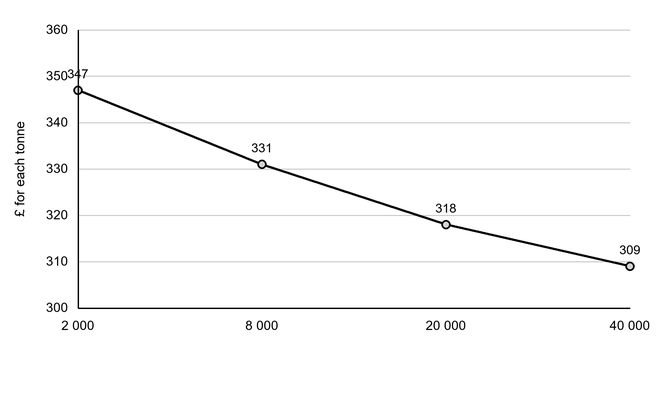
Size buys its inputs cheaply. Ryeworth takes 20 000 tonnes of flour a year and pays £318 a tonne; a baker buying 2 000 tonnes pays £347. On 20 000 tonnes that difference is worth more than half a million pounds a year.

Size has also bought it machinery that a smaller baker could not justify. Eighty-four per cent of the process is automated, a line that needed twenty-nine people ten years ago now needs eleven, and every batch of dough is tracked electronically, so a loaf can be traced back to the flour delivery it came from in four minutes rather than the six hours it used to take by hand.

What size has not bought is tidiness. There are now five levels between the managing director and a baker, and fourteen items are made at both plants to different recipes, because each plant developed its own. The oldest line is seventeen years old and causes 61% of the twenty-three unplanned stops the company has each week.

A supermarket has asked for 130 million more items a year. The board has to decide where to make them.

Source: Ryeworth Bakeries Ltd

Appendix B: What size does to Ryeworth's costs

Price paid for a tonne of flour, by the tonnage bought in a year

Line chart of flour price per tonne against annual tonnage bought: price falls from £347 at 2,000 tonnes to £331 at 8,000, £318 at 20,000 and £309 at 40,000 tonnes.
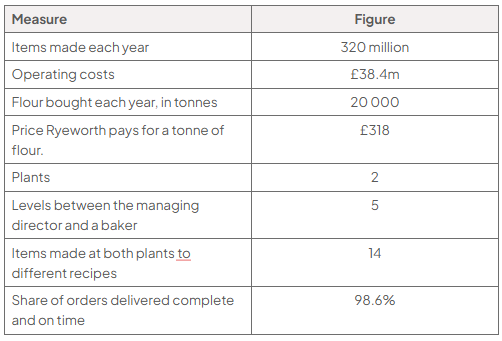
Table of Ryeworth Bakeries measures: 320 million items yearly; £38.4m operating costs; 20,000 tonnes of flour at £318 per tonne; two plants; five management levels; 14 differing recipes; 98.6% complete and on time.

Source: Analyst

Analyse one way in which buying 20,000 tonnes of flour a year rather than 2,000 might affect Ryeworth Bakeries Ltd.

1
9 marks

Source B: Tata Steel UK

Tata Steel UK is part of the Indian multinational Tata Steel. Its largest site in Britain is Port Talbot in south Wales, which for decades made steel from raw materials in two blast furnaces.

On 25 April 2024 the company confirmed that it would close those blast furnaces and spend £1.25 billion on an electric arc furnace on the same site instead. Blast furnace number 5 closed at the end of June 2024 and blast furnace number 4 closed on 30 September 2024, ending the making of primary steel at Port Talbot. The change put up to 2 800 jobs at risk and around 2 500 roles have since gone.

The two kinds of furnace work in completely different ways. A blast furnace turns imported iron ore and coking coal into new iron, runs continuously and cannot easily be turned down. An electric arc furnace melts scrap steel using electricity, can be started and stopped far more easily, emits far less carbon dioxide and needs far fewer people. It also depends on being able to buy enough scrap steel and on having a large enough electricity supply.

Steel was expected to be made at Port Talbot again in 2027 or 2028, but delays to the electricity grid connection mean the electric arc furnace is now not expected to be running until late 2028 or early 2029. In the meantime Port Talbot imports steel from other Tata Steel sites and rolls it there.

Port Talbot was chosen as a steel town for reasons that no longer all apply. It has a deep-water port built for importing iron ore, and rolling mills that are still in use. It does not sit close to where most of Britain's scrap steel is collected.

Source: Tata Steel UK announcements, 2024 to 2026

Appendix F: A blast furnace compared with an electric arc furnace

Comparison table: two blast furnaces versus one electric arc furnace, covering raw materials, flexibility, minimum production, grades, electricity and staffing. Values are 4,500 versus 140 tonnes, 3 versus 26 grades, 0.6 versus 2.4 TWh, and 4,000 versus 1,500 employees.

Source: Analyst

Appendix H: Port Talbot output, emissions and employees

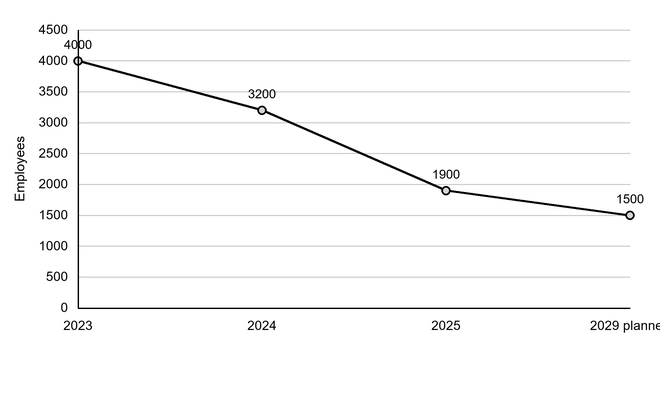
Line chart of Port Talbot employees on site, falling from 4,000 in 2023 to 3,200 in 2024, 1,900 in 2025 and 1,500 planned for 2029; y-axis ranges from 0 to 4,500 employees.
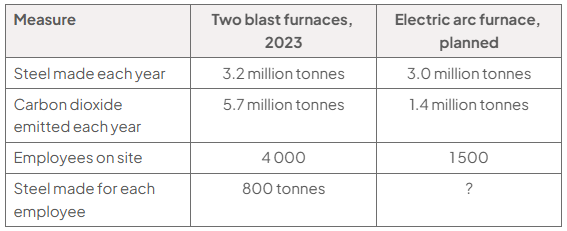
Table comparing two blast furnaces in 2023 with the planned electric arc furnace: steel output 3.2 versus 3.0 million tonnes, emissions 5.7 versus 1.4 million tonnes, employees 4,000 versus 1,500, and output per employee 800 tonnes versus unknown.

Source: Analyst

Assess the impact of the change at Port Talbot on Tata Steel UK's competitiveness.

Calculate the steel made for each employee under the electric arc furnace plan to support your answer.

2
9 marks

Source B: Lush

Lush makes and sells fresh handmade cosmetics: bath bombs, soaps and shampoo bars, often sold loose and unwrapped. It is unusual among cosmetics companies because it makes almost everything it sells. Most beauty brands design a product and pay someone else to manufacture it. Lush manufactures and retails, and it says the freshness of what it makes is the reason people buy it.

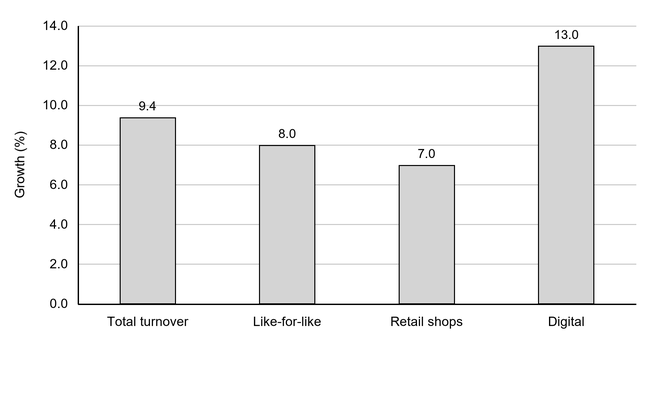
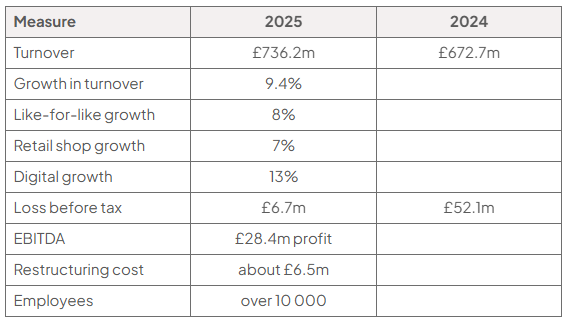
In the year to 30 June 2025 turnover reached £736.2 million, up £63.5 million or 9.4%. Like-for-like turnover grew 8%, with retail shops up 7% and digital up 13%. The loss before tax narrowed sharply, from £52.1 million the year before to £6.7 million, and earnings before interest, tax, depreciation and amortisation returned to a profit of £28.4 million. A surge in the price of cocoa, which Lush uses in large quantities, held the result back.

At the end of June 2025 the group had 869 permanent shops, 665 of them run by the group rather than franchised, selling in 50 countries. It manufactured in six countries. During the year it spent about £6.5 million restructuring, bringing manufacturing in Europe and Canada together into fewer sites.

That restructuring is the question the business keeps returning to. Making everything in a small number of large factories is cheaper for each product made. Making it close to the shops that sell it keeps it fresh, which is what Lush tells customers it is selling. The two pull against each other, and both have an environmental consequence, which matters to a company that has built its brand partly on that.

Source: Lush audited accounts for the year ended 30 June 2025

Appendix E: Selected data for Lush, year to 30 June 2025

Bar chart of Lush’s 2025 growth: total turnover 9.4%, like-for-like 8.0%, retail shops 7.0% and digital 13.0%. The vertical axis shows growth from 0 to 14 per cent.
Table of Lush's selected data for 2025 and 2024: turnover £736.2m in 2025 against £672.7m in 2024; growth in turnover 9.4%; like-for-like growth 8%; retail shop growth 7%; digital growth 13%; loss before tax £6.7m in 2025 against £52.1m in 2024; EBITDA £28.4m profit in 2025; restructuring cost about £6.5m; over 10 000 employees.

Source: Lush

Appendix F: Where Lush sells and where it makes

Table of Lush measures and figures: 869 permanent shops, 665 run by the group rather than franchised, sales in 50 countries, manufacturing in 6, restructuring into fewer European and Canadian sites, costing about £6.5m.

Source: Lush

Assess the impact of the scale of Lush's shop estate, 869 shops, on its profitability.

3
9 marks

Source B: Kielder Timber Products Ltd

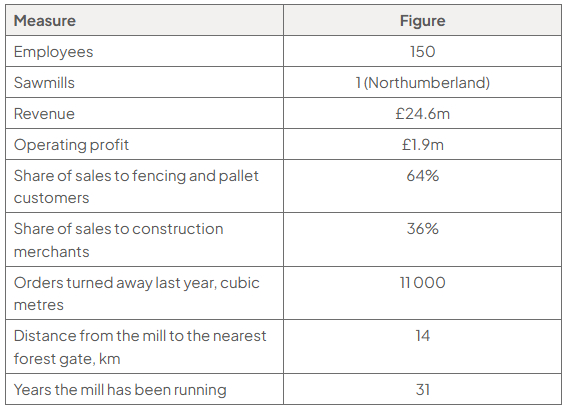
Kielder Timber Products Ltd runs a sawmill in Northumberland, fourteen kilometres from the nearest gate into the forest it buys most of its logs from. It cuts fencing, pallet wood and construction timber, employs 150 people and had revenue of £24.6 million in the year to March 2025, with an operating profit of £1.9 million.

The mill is full. It takes in 90 000 cubic metres of logs a year and runs for 110 hours out of a possible 112 every week. Whatever does not come out as sawn timber is sold on as chips and sawdust to a board mill and a biomass plant, so very little of the log is wasted, but the amount that leaves as timber is the number the directors watch.

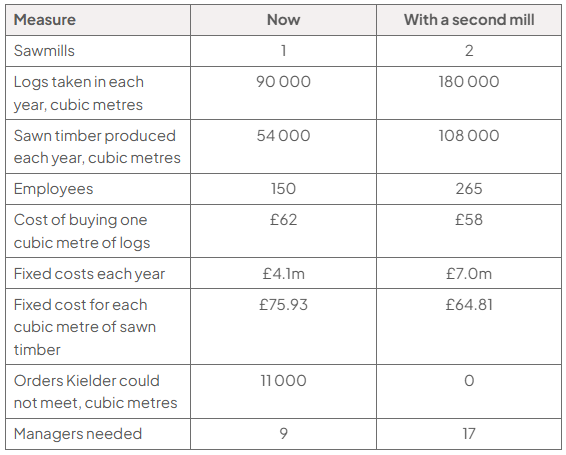
Demand is the problem rather than the solution. Housebuilding and fencing orders have grown every year since 2021, and last year Kielder turned away 11 000 cubic metres of orders it had no way of cutting. A second mill would roughly double what the company can produce, and would lower the cost of every cubic metre, because logs bought in larger quantities cost less and the fixed costs would be spread over twice the output.

Where to put it is the difficult part. One site sits beside the existing mill, a short haul from the forest and run by the team that is already there, but it is expensive to build and the planning application is being contested. The other is a former colliery site sixty-five kilometres south, cheaper to build, grant-aided, already consented and much closer to customers, but every log would travel five times as far to reach it.

Source: Kielder Timber Products Ltd

Appendix E: Kielder Timber Products Ltd selected data, year to March 2025

Table of Kielder Timber Products Ltd selected data: 150 employees; 1 sawmill, in Northumberland; revenue £24.6m; operating profit £1.9m; 64% of sales to fencing and pallet customers; 36% of sales to construction merchants; 11 000 cubic metres of orders turned away last year; 14 km from the mill to the nearest forest gate; the mill has been running for 31 years.

Source: Kielder Timber Products Ltd

Appendix G: What a second mill would change

Comparison table of Kielder’s current operation and a second mill: fixed cost per cubic metre falls from £75.93 to £64.81; log cost falls from £62 to £58, while output doubles from 54 000 to 108 000 cubic metres.

Source: Analyst

Assess whether a second mill would lower Kielder Timber Products Ltd's cost for each cubic metre of sawn timber.

4
9 marks

Source B: Hallerton Cold Stores Ltd

Hallerton Cold Stores Ltd keeps frozen food for other people. It runs one store near Hull with 18 000 pallet spaces, holds it at about minus 24 degrees Celsius every hour of every day, and moves 1 900 pallets in and out daily. It employs 110 people, had revenue of £14.2 million in the year to March 2025 against operating costs of £12.4 million, and made an operating profit of £1.8 million.

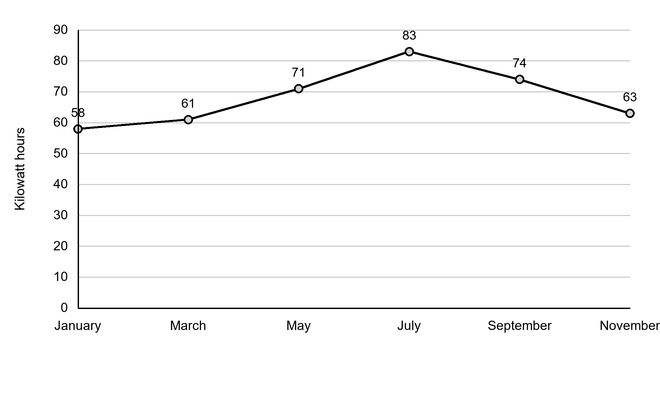
What makes the business unlike a warehouse is electricity. Keeping 18 000 pallet spaces that cold cost £4 464 000 last year, which is by a wide margin the largest thing the company spends money on, more than it spends on wages. The bill also moves with the weather: a pallet space uses about 83 kilowatt hours in July and 58 in January.

The store is nearly full. It runs at 92% of its pallet spaces on average, picks 97.8% of pallets inside the hour it promises, and has been outside its agreed temperature range three times in a year. The oldest refrigeration plant is nineteen years old.

Customers want more space than Hallerton has, so a second store is agreed in principle. Two things are not. One is where to put it: beside the existing store, where the grid connection exists and the night shift could be shared, or in the East Midlands, far closer to the three customers who provide over half the revenue. The other is what to build: the same again, or something that uses a third less electricity for every pallet space and costs several million pounds more.

Source: Hallerton Cold Stores Ltd

Appendix F: What the store is judged on

Energy used for each pallet space, kilowatt hours

Line chart of monthly electricity use per pallet space, rising from 58 kilowatt hours in January to 83 in July, then falling to 63 in November; the y-axis ranges from 0 to 90 kilowatt hours.
Store measures: 18 000 pallet spaces, 16 560 full on average (92%); 1 900 pallets moved daily, 97.8% picked within the promised hour; 24-hour operation; 3 temperature breaches; 820 kilowatt-hours per pallet space annually; oldest plant 19 years.

Source: Analyst

Appendix G: A second store, and where it could go

Two tables. Now and with a second store: stores, 1 now and 2 with a second store; pallet spaces, 18 000 and 30 000; employees, 110 and 178; operating costs each year, £12.4m and £19.8m; operating cost for each pallet space, £689 and £660; managers needed, 7 and 12; customers it could serve, 31 and 44. Site A, beside the existing store near Hull, and Site B, a site in the East Midlands: cost to build, £17.4m and £21.2m; electricity price for each kilowatt hour, 30.2p and 28.6p; average distance to the three largest customers, 164 km and 71 km; whether it can share the existing night shift and management, yes and no; whether a grid connection is already in place, yes for Site A and no for Site B, which needs 14 months to arrange; local people with cold-store experience, many and few; share of customers who said they would use it, 61% and 88%.

Source: Analyst

Assess whether a second store would make Hallerton Cold Stores Ltd more efficient.

5
9 marks

Source A: Ryeworth Bakeries Ltd

Ryeworth Bakeries Ltd bakes bread and morning goods for supermarkets from two plants, one in Doncaster and one in Swindon. It employs 740 people, makes about 320 million items a year, and in the year to March 2025 had revenue of £44.8 million against operating costs of £38.4 million, leaving an operating profit of £6.4 million. Six customers buy from it and the three largest provide 71% of revenue.

Size buys its inputs cheaply. Ryeworth takes 20 000 tonnes of flour a year and pays £318 a tonne; a baker buying 2 000 tonnes pays £347. On 20 000 tonnes that difference is worth more than half a million pounds a year.

Size has also bought it machinery that a smaller baker could not justify. Eighty-four per cent of the process is automated, a line that needed twenty-nine people ten years ago now needs eleven, and every batch of dough is tracked electronically, so a loaf can be traced back to the flour delivery it came from in four minutes rather than the six hours it used to take by hand.

What size has not bought is tidiness. There are now five levels between the managing director and a baker, and fourteen items are made at both plants to different recipes, because each plant developed its own. The oldest line is seventeen years old and causes 61% of the twenty-three unplanned stops the company has each week.

A supermarket has asked for 130 million more items a year. The board has to decide where to make them.

Source: Ryeworth Bakeries Ltd

Appendix A: Ryeworth Bakeries Ltd selected data, year to March 2025

Table of Ryeworth Bakeries Ltd selected data: 740 employees; revenue £44.8m; operating costs £38.4m; operating profit £6.4m; 320 million items made each year; 180 million items made at the Doncaster plant; 140 million items made at the Swindon plant; 6 customers; 71% of revenue from the three largest customers; 84% of the process is automated; 41 years trading.

Source: Ryeworth Bakeries Ltd

Appendix B: What size does to Ryeworth's costs

Price paid for a tonne of flour, by the tonnage bought in a year

Line graph showing flour price per tonne falling as annual purchases increase: £347 at 2 000 tonnes, £331 at 8 000, £318 at 20 000 and £309 at 40 000. Axes span £300 to £360 and 2 000 to 40 000 tonnes.
Table of Ryeworth Bakeries selected data: 320 million items yearly; operating costs £38.4m; 20 000 tonnes of flour at £318 per tonne; 2 plants; 5 management levels; 14 dual-recipe items; 98.6% complete and on time.

Source: Analyst

Assess the benefits to Ryeworth Bakeries Ltd of its scale of operations.

Calculate its operating cost for each item made to support your answer.

1
15 marks

Source B: Portmeirion Group plc

Portmeirion Group plc makes and sells homeware and home fragrance. It is a public limited company listed on AIM, based in Stoke-on-Trent, and it owns six heritage brands: Spode, Portmeirion, Royal Worcester, Nambé, Pimpernel and Wax Lyrical. It has over 650 employees worldwide and the majority of them are in Stoke-on-Trent.

The last five years have been hard. Revenue reached £110.8 million in 2022 and then fell two years in a row, to £91.2 million in 2024, before holding at £91.1 million in 2025. Profit fell much further than revenue. Headline profit before tax was £8.0 million in 2022 and £1.0 million in 2024. The headline operating margin went from 7.8% in 2022 to 4.7% in 2023. Earnings for each share fell from 46.59p in 2022 to 8.04p in 2024, and the dividend from 15.50p to 1.50p. By the end of 2025 the group had net debt of £17.5 million, and although operations still generated cash, they generated only £0.5 million of it, against £2.1 million the year before.

Portmeirion Group owns a factory in Stoke-on-Trent, but approximately 26% of its branded tableware is actually made there. The rest is bought in from suppliers, much of it in Asia. The company has a stated strategy called Made in Stoke-on-Trent and says it intends to increase the share it makes itself.

Something outside the business has pushed that plan along. When the United States introduced tariffs, orders that Portmeirion Group had sourced from Asia for the American market were cancelled, and the company decided to speed up parts of the Made in Stoke-on-Trent plan in response.

Source: Portmeirion Group plc annual results and interim statements, 2024 to 2026

Appendix D: Two ways of increasing the share made in Stoke-on-Trent

Table comparing Option 1 and Option 2: share made 35% and 45%; annual pieces 3.5m and 4.5m; investment £1.8m and £5.6m; fixed costs £11.2m and £14.0m; both costs per piece £3.40 made and £5.10 bought; time 12 and 24 months.

Source: Analyst

Portmeirion Group plc is considering two ways of increasing the share of its branded tableware made in Stoke-on-Trent. Appendix D shows information on both options.

Evaluate both options and recommend which one Portmeirion Group plc should choose.

Calculate the cost of making each piece in Stoke-on-Trent under Option 2 to support your answer.

2
15 marks

Source B: Glanmor Dairy Ltd

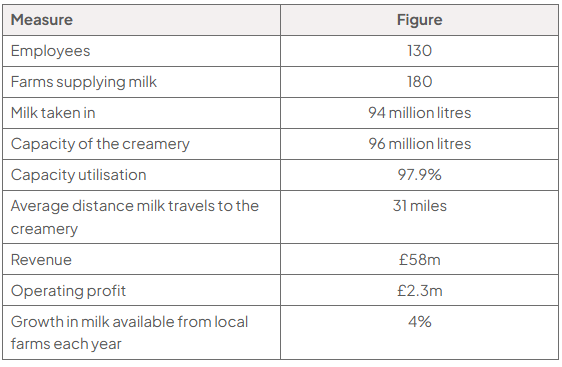
Glanmor Dairy Ltd processes milk into cheese, butter and cream at a single creamery in Carmarthenshire. It employs 130 people, takes in 94 million litres of milk a year from 180 farms within about thirty miles, and in the year to March 2025 had revenue of £58 million and an operating profit of £2.3 million.

Milk is an unusual raw material. It arrives every day whether the creamery wants it or not, because cows do not stop. It cannot be stored for long before processing. And it is heavy and mostly water, so moving it is expensive: a tanker costs much the same to run whether the milk inside is worth a lot or a little.

The creamery is close to full. It can process 96 million litres a year and took 94 million last year, and the farms around it are producing more each year. Glanmor must either make its existing site bigger or build a second one.

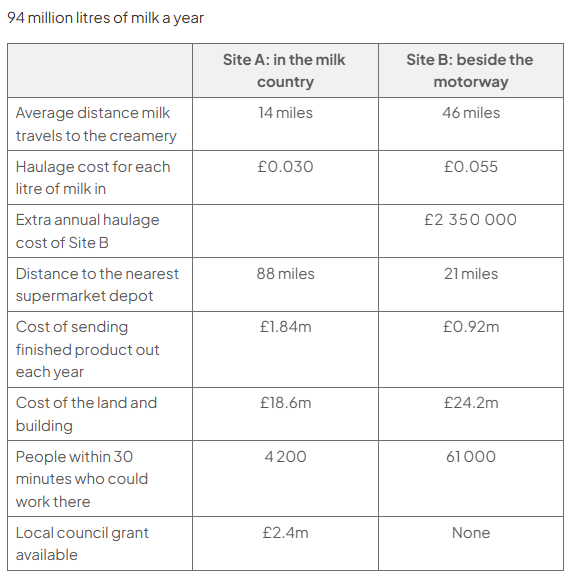
If it builds a second creamery, where it goes matters. A site deep in the milk-producing country would sit close to the farms but a long way from the motorway network and from the supermarket depots that take the finished cheese. A site near the motorway would be the opposite: cheap to send the finished product out from, expensive to bring the raw milk into.

The managing director, Rhian Pugh, has asked for both questions to be answered: bigger here, or a second site, and if a second site, where.

Source: Glanmor Dairy Ltd

Appendix E: Glanmor Dairy Ltd selected data, year to March 2025

Table of selected data: 130 employees; 180 supplying farms; 94 million litres taken in against 96 million litres capacity; 97.9% utilisation; 31-mile average distance; £58m revenue; £2.3m profit; 4% annual growth.

Source: Glanmor Dairy Ltd

Appendix F: Two possible sites for a second creamery

94 million litres of milk a year

Table comparing two sites for a creamery handling 94 million litres of milk a year, Site A in the milk country against Site B beside the motorway: average distance milk travels to the creamery 14 miles against 46 miles; haulage cost for each litre of milk in £0.030 against £0.055; extra annual haulage cost of Site B £2 350 000; distance to the nearest supermarket depot 88 miles against 21 miles; cost of sending finished product out each year £1.84m against £0.92m; cost of the land and building £18.6m against £24.2m; people within 30 minutes who could work there 4 200 against 61 000; local council grant available £2.4m against none.

Source: Analyst

Appendix H: Two ways of handling more milk

Comparison table: Option 1/Option 2: capacity 150/164 million litres; investment £14.9m/£21.3m; fixed costs £16.5m/£22.96m; variable cost £0.22/£0.21 per litre; processing cost per litre not provided/£0.35; one/two sites; all/half stops; 38/24 miles; 18/30 months.

Source: Analyst

Glanmor Dairy Ltd is considering two ways of handling more milk:

Option 1: make the existing creamery bigger

Option 2: build a second creamery

Evaluate both options and recommend which one Glanmor Dairy Ltd should choose.

Calculate the cost of processing each litre under Option 1 to support your answer.

3
15 marks

Source A: Ryeworth Bakeries Ltd

Ryeworth Bakeries Ltd bakes bread and morning goods for supermarkets from two plants, one in Doncaster and one in Swindon. It employs 740 people, makes about 320 million items a year, and in the year to March 2025 had revenue of £44.8 million against operating costs of £38.4 million, leaving an operating profit of £6.4 million. Six customers buy from it and the three largest provide 71% of revenue.

Size buys its inputs cheaply. Ryeworth takes 20 000 tonnes of flour a year and pays £318 a tonne; a baker buying 2 000 tonnes pays £347. On 20 000 tonnes that difference is worth more than half a million pounds a year.

Size has also bought it machinery that a smaller baker could not justify. Eighty-four per cent of the process is automated, a line that needed twenty-nine people ten years ago now needs eleven, and every batch of dough is tracked electronically, so a loaf can be traced back to the flour delivery it came from in four minutes rather than the six hours it used to take by hand.

What size has not bought is tidiness. There are now five levels between the managing director and a baker, and fourteen items are made at both plants to different recipes, because each plant developed its own. The oldest line is seventeen years old and causes 61% of the twenty-three unplanned stops the company has each week.

A supermarket has asked for 130 million more items a year. The board has to decide where to make them.

Source: Ryeworth Bakeries Ltd

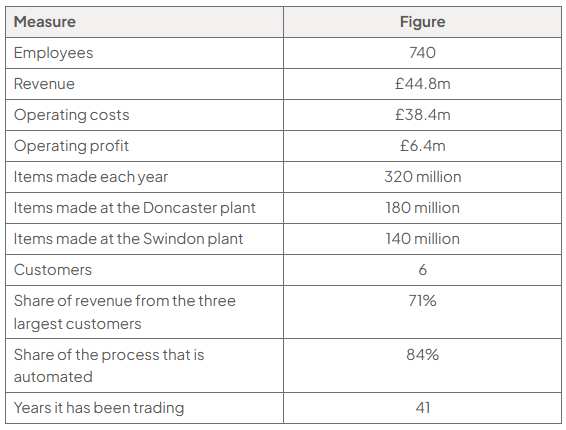
Appendix A: Ryeworth Bakeries Ltd selected data, year to March 2025

Table of Ryeworth Bakeries Ltd selected data: 740 employees; revenue £44.8m; operating costs £38.4m; operating profit £6.4m; 320 million items made each year; 180 million items made at the Doncaster plant; 140 million items made at the Swindon plant; 6 customers; 71% of revenue from the three largest customers; 84% of the process is automated; 41 years trading.

Source: Ryeworth Bakeries Ltd

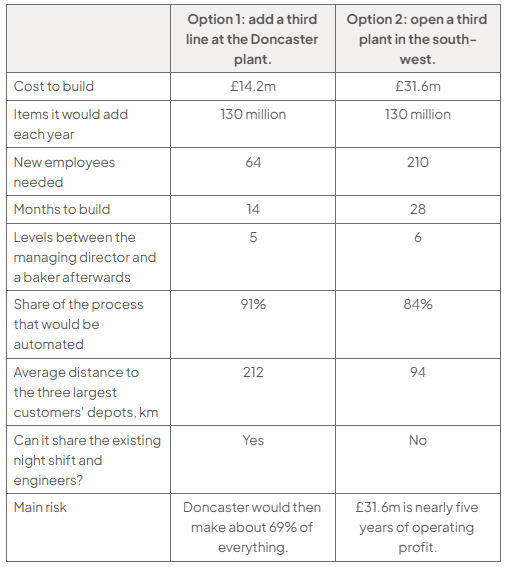
Appendix D: Two ways of making 130 million more items

Ryeworth would then make 450 million items a year, and its operating costs would be £49.5m. It costs 12p an item to make them now.

Comparison table of two options: Doncaster line: £14.2m, 64 staff, 14 months, 5 levels, 91% automated, 212 km, shares shifts; south-west plant: £31.6m, 210 staff, 28 months, 6 levels, 84%, 94 km, no. Risks: 69% at Doncaster; nearly five years’ profit.

Source: Analyst

Ryeworth Bakeries Ltd is considering two ways of making 130 million more items a year:

Option 1: add a third line at the Doncaster plant

Option 2: open a third plant in the south-west

Evaluate both options and recommend which one Ryeworth Bakeries Ltd should choose.

Calculate the operating cost for each item afterwards to support your answer.