Hitler's Appointment as Chancellor, 1933 (AQA A Level History: Component 2: Depth study): Revision Note
Exam code: 7042

Summary
Hindenburg won the 1932 presidential election to serve a second seven-year term
Chancellor Brüning's policies to deal with the effects of the Great Depression became deeply unpopular, and he resigned
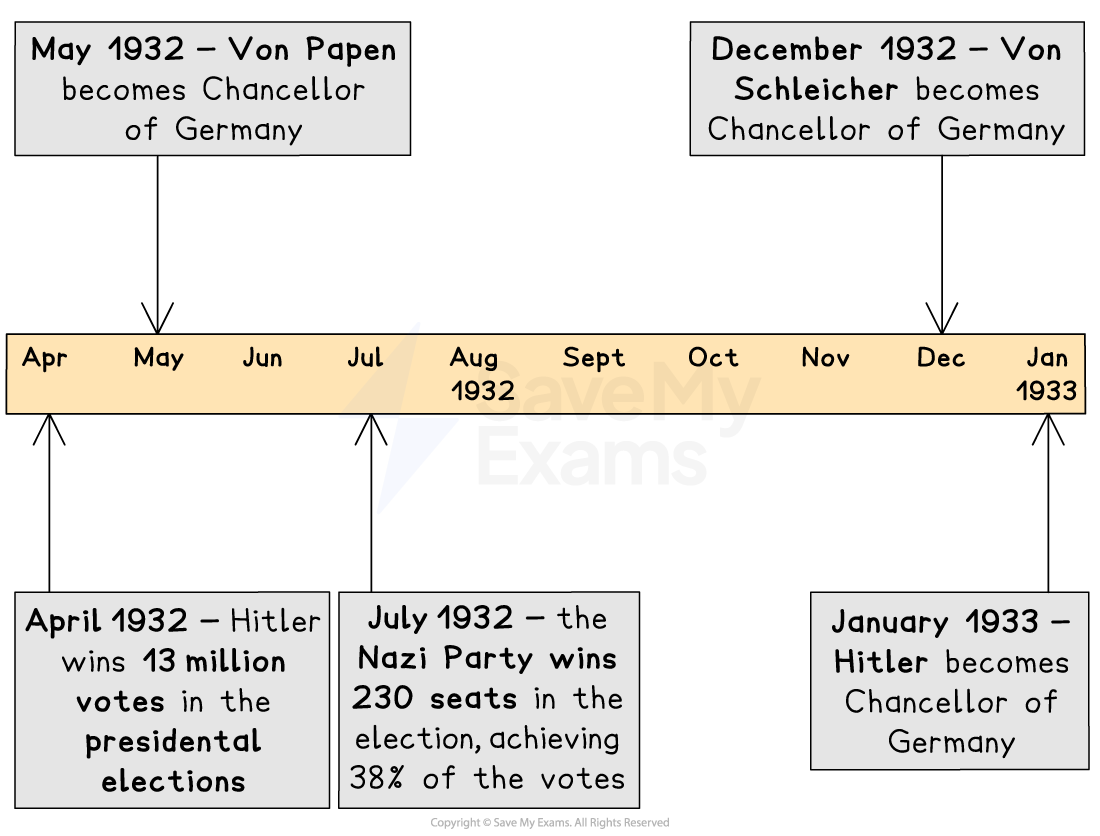
Hindenburg appointed von Papen as his replacement in May 1932
Elections were set for July 1932 in the hope that von Papen would win the necessary seats in the Reichstag
He failed, and the Nazis became the biggest party in the Reichstag
Further elections in November 1932 were equally unsuccessful, and Brüning resigned
The new Chancellor was von Schleicher, and he hoped to persuade the Nazis to form a coalition with him
Hitler refused, and von Schleicher struggled to get enough support to govern
Behind the scenes, politicians plotted against each other and tried to persuade the ageing Hindenburg to support their plans
With others, von Papen successfully persuaded Hindenburg to appoint Hitler as chancellor in January 1933
They believed that Hitler could be controlled and contained, but that they would be able to use the Nazi's popularity to help them govern
The role of President Hindenburg
In 1932, Hindenburg’s seven years as president had come to an end
Aged 84, Hindenburg was becoming increasingly frail
Moderate politicians persuaded Hindenburg to stand for re-election to stabilise the Weimar Republic
Hitler decided to enter the presidential election
In March 1932, the first round of presidential elections began
Hindenburg achieved 49.6%. This was not the 50% required to become president
Hitler achieved 30% of the votes
In April, the government repeated the election
The results of the election gave Hindenburg the presidency
Hitler increased his share of the votes to 36%
As President, Hindenburg was to play a key role in the appointment of the chancellors, including Hitler
Papen, Schleicher and the fall of Brüning
Chancellor Brüning's policies of raising taxes and lowering unemployment benefits had been disastrous at the polls
They angered both the employed and unemployed
Brüning lost support in the Reichstag and he resigned
Hindenburg chose von Papen as the new chancellor on 30th May 1932
Why was von Papen chosen?
Von Papen was chosen to be the new chancellor because he was a personal friend of Hindenburg
He also led the Centre Party, which would protect Hindenburg's interests
However, the Centre Party did not have a majority in the Reichstag
If von Papen was to govern, he was going to need the growing popular support of the Nazis to form a coalition
This marked the first time that the Nazis had been invited to become involved in government
At this stage, it was thought that the Nazis could be controlled, and their popularity in the elections could be taken advantage of
Hitler refused to become part of any coalition
The appointment of von Papen as chancellor was highly controversial because there had been no formal election
The German public called the government ‘the Cabinet of Barons’
This is because the coalition contained right-wing landowners, businessmen and officers
The upper classes now controlled the inner circle of the government
It was thought that their policies did not benefit the lower classes, who were the ones who were most struggling in the Great Depression
The July 1932 elections
Von Papen called for new Reichstag elections to be held in July 1932
He hoped his party would do well, and this would give his leadership legitimacy
The results were disastrous for von Papen and a success for Hitler and the Nazis
The Nazi Party received 37.4% of the vote
This was not the 50% needed to have a majority in the Reichstag
It was, however, a significant increase from the 18% they had received in 1930
Hitler demanded that Hindenburg appoint him as chancellor
Hindenburg ignored Hitler’s request and kept von Papen as chancellor
Hindenburg disliked Hitler and hoped public opinion would soon turn against the NSDAP
The November 1932 elections
Another round of elections was held in November 1932 in the hope that the government would win enough seats to enable it to govern
Although the Nazis actually lost votes, and their share was reduced to 33%, they were still the biggest party in the Reichstag
With no hope of achieving a majority, Hindenburg listened to those close to him and forced von Papen to resign
Why was von Schleicher chosen?
Von Schleicher was another member of Hindenburg's inner circle of friends and advisors
He convinced Hindenburg that he would be able to build a broad coalition that included members of the Nazis party and enjoy the support of the trade unions
Although von Schleicher was able to persuade senior Nazi Gregor Strasser to join his cabinet, he was unable to gain trade union support
Humiliated by Hitler, Strasser resigned from the NSDAP
Von Schleicher's attempts to win the support of the trade unions and working classes went down very badly with the wealthy big business owners and landowners
The 'Backstairs Intrigue', 1932–1933
The political chaos and rapid turnover of chancellors at this time have been put down to what is described as 'Backstairs Intrigue'
This is the scheming and political manoeuvring of rivals and advisors who surrounded President Hindenburg
Von Papen and von Schleicher, along with Hindenburg's son Oskar and a senior civil servant named Otto Meisner, plotted against each other
Many believe that it was this 'Backstairs Intrigue' that led to the appointment of Adolf Hitler as Chancellor
"It appears now that von Papen, whose downfall about two months ago was attributed to his successor, General von Schleicher, was chiefly instrumental in causing the latter’s own defeat. There can be no doubt now that von Papen’s secret meeting with Hitler about four weeks ago was a plot against von Schleicher’s chancellorship and that the attacks upon von Schleicher by the Landbund and the Hugenberg Nationalists which followed had been deliberately planned with a similar purpose in view.
The fact that von Papen was able to form the new Cabinet in such a brief space of time shows clearly that he had prepared the ground long before von Schleicher’s resignation."
An extract from a message sent by the US Ambassador to Germany to the US Secretary of State about the appointment of Hitler as chancellor in 1933.
Hitler's appointment as Chancellor, January 1933
Although Hitler was the leader of the biggest party in the Reichstag, he did not have over 50% of the seats
This meant that, although he could make it almost impossible for governments to govern, he could not be legally appointed chancellor if Hindenburg refused to
Von Papen was still angry about being forced to resign as Chancellor
He held talks with Hitler, Hindenburg and Meisner
Although Hindenburg remained suspicious of Hitler, he was persuaded by von Papen and Oskar Hindenburg that they would be able to control the poorly educated Austrian corporal
Von Schleicher, frustrated by being unable to pass anything through the Reichstag, requested that Hindenburg suspend the constitution to allow him to rule like a dictator
Hindenburg refused, and von Schleicher resigned
On 30th January 1933, Adolf Hitler was appointed Chancellor of Germany
Von Papen was appointed the vice-chancellor
"Hitler's long-cherished ambition to become Chancellor has at last been satisfied. President von Hindenburg appointed him Chancellor of the Reich at noon today – an hour which may prove a turning-point in the history of post-war Germany, and which at any rate marks another victory for the reactionary forces.
The Hitler Government is a coalition of Nazis and Hugenberg Nationalists, and although the latter are more numerous in the Cabinet, three of the most "strategic" posts are held by Nazis, and it is by no means certain that the Nazis will be the "prisoners" in this new Government.
The news of Hitler's appointment created a feeling of alarm and confusion almost everywhere. To the average German it marks a leap in the dark. Even many Conservatives completely in sympathy with the Hugenberg party have been shaking their heads. The "Deutsche Allgemeine Zeitung," an ultra-Conservative paper, believes it will be extremely difficult for the Nazis and the Nationalists in the Government to pull together."
An extract from a news story published in the Manchester Guardian on 31st January 1933
Why was Hitler appointed Chancellor in January 1933?
There are different views on why Hitler was appointed Chancellor in 1933
Some believe it was down to the scheming of short-sighted politicians who underestimated Hitler
They believe that it was the manoeuvrings of people who thought they could control Hitler that gave him the keys to power
Others argue that the Nazis had many very influential supporters in important positions in German society
They believe that Germany's elite favourably viewed Hitler and that they led him to power
Examiner Tips and Tricks
The strongest answers centre von Papen's role and the "backstairs intrigue", then link it to the July 1932 election result and fear of Communism. Weaker ones drift into a general 1920s "rise to power" story (Versailles, the constitution, Hitler's ideas) — examiners penalise this.
Get the sequence exact — Brüning (falls May 1932) → Papen → Schleicher → Hitler (30 Jan 1933). Muddling who called which election loses marks.

Unlock more, it's free!
Join the 100,000+ Students that ❤️ Save My Exams
the (exam) results speak for themselves:

Was this revision note helpful?
