Northern Ireland & the Good Friday Agreement (AQA A Level History: Component 2: Depth study): Revision Note
Exam code: 7042

Summary
After winning power in 1997, Labour restarted talks between the main Northern Irish parties and the British and Irish governments
The Irish Republican Army (IRA) renewed its ceasefire in July 1997, allowing Sinn Féin to enter the talks
Negotiations chaired by George Mitchell produced the Good Friday Agreement on the 10th April 1998
Voters in both Northern Ireland and the Republic of Ireland approved it in referendums on 22 May 1998
The Agreement created a power-sharing Assembly and Executive
It also established new cross-border and British-Irish bodies
Northern Ireland's constitutional position would depend on the consent of its people
Decommissioning paramilitary weapons became one of the main obstacles to making the settlement work
The IRA completed decommissioning in 2005
Devolved government had been suspended from October 2002
The St Andrews Agreement (2006) helped clear the way for power-sharing to return
The Democratic Unionist Party (DUP) and Sinn Féin entered government together on 8 May 2007
The key question asks whether the Good Friday Agreement brought lasting peace to Northern Ireland, or whether it left important parts of the conflict only partly resolved
The Northern Ireland peace process
What did Labour inherit?
Labour inherited a peace process that had stalled by 1997
The Downing Street Declaration (1993), issued by Major and the Irish Taoiseach, Albert Reynolds, and the 1994 ceasefires had created an opening for negotiations
Major's government had also held secret back-channel talks with the IRA, which became public in November 1993
The IRA ended its ceasefire in February 1996, and little progress was made before the 1997 election
Labour's large Commons majority gave Tony Blair more room to act than Major had enjoyed
Major had depended on unionist votes at Westminster, which limited how far he could push the negotiations
New Labour's approach, 1997
Blair made Northern Ireland an early priority
Mo Mowlam became Northern Ireland Secretary
Blair worked closely with the Irish Taoiseach, Bertie Ahern, who took office in June 1997
US President Bill Clinton continued to put pressure on the different sides to reach an agreement
The IRA renewed its ceasefire on 20 July 1997
This opened the way for Sinn Féin, which was closely associated with the IRA, to join the political talks
Sinn Féin accepted the Mitchell Principles on the 9th September, entering negotiations on the 15 September
The DUP and UK Unionist Party withdrew in protest and did not take part in the final negotiations
Blair also broke with previous practice by meeting Gerry Adams, the Sinn Féin leader, at Stormont in October 1997
The meeting was held in private, away from the cameras, to avoid angering unionists
In December 1997 Adams led the first Sinn Féin delegation to Downing Street since 1921
Why did the talks move forward?
The negotiations brought together several different groups
Former US senator George Mitchell chaired the multi-party talks
The British and Irish governments both took part
Northern Irish parties representing nationalist and unionist opinion were also involved
Important figures played different roles
David Trimble, leader of the Ulster Unionist Party (UUP), remained in the talks but refused to deal directly with Sinn Féin
John Hume, leader of the nationalist Social Democratic and Labour Party (SDLP), had long argued that republicans could be moved away from violence and into democratic politics
From 1988, he held private talks with Gerry Adams, which resumed in 1993 and produced joint statements on how the violence might be ended
Mo Mowlam worked to keep loyalist support for the process
In January 1998, she visited loyalist prisoners in the Maze prison to persuade them to continue backing the talks
The process therefore depended on cooperation between British, Irish, American, unionist and nationalist figures, rather than on one leader alone
The final negotiations
Mitchell set a deadline of the 9 April 1998 for a final agreement
Blair and Ahern became personally involved in the final stages of negotiation
Blair flew in for the final days, declaring, "I feel the hand of history upon our shoulder"
His side letter to Trimble on Good Friday, promising support for excluding parties that did not give up violence, kept the UUP in the deal
Talks continued beyond the deadline
An agreement was finally announced on Good Friday, 10 April 1998
“Blair could hardly have failed in Northern Ireland, could he? He owed much to those who had gone before. Much of the big thinking and preparation had preceded him. Was the search for peace there simply one of those ‘eye-catching initiatives’ with which we knew he liked to be associated? The answer, at least in terms of the ‘big picture’, must surely be ‘no’. Blair could certainly be inconsistent. His short-termism and lack of attention to detail infuriated many. And he was without doubt capable of saying different things to different people. However, from his earliest days as Opposition leader, Blair was telling anyone who would listen that he would be firmly on the side of those seeking an end to the conflict. He gave notice that he would be in it for the long haul. Blair’s great promise to the people of Northern Ireland was that, from this time on, their concerns would be addressed with a commitment on all sides to purely peaceful and democratic means”
Frank Millar, journalist and former general secretary of the Ulster Unionist Party (UUP), from an edited academic collection on the Blair years, Blair’s Britain, 1997–2007 (2007)
Approach: The source is useful because he had close knowledge of unionist politics and stresses that Blair inherited much of the earlier preparation for peace. He also credits Blair with persistence and with bringing different sides together
His account was written nearly ten years after the Agreement, so hindsight may shape his judgement. His claim that Blair “could hardly have failed” should be tested against the difficulties of the talks and the roles played by figures such as Mitchell, Ahern, Hume and Trimble
Examiner Tips and Tricks
Do not present the peace process as Blair’s achievement alone. A stronger answer would explain how different roles fitted together: Mitchell chaired the talks, Ahern worked with the British government, Clinton supported the process, while Hume, Trimble and Adams represented key groups within Northern Ireland
The Good Friday Agreement, 1998
The consent principle
The Agreement confirmed that Northern Ireland would remain part of the United Kingdom for as long as a majority of its people wanted
A united Ireland could happen only if a majority in both Northern Ireland and the Republic of Ireland agreed
The Republic of Ireland agreed to change Articles 2 and 3 of its constitution
These had previously claimed Northern Ireland
Britain agreed to repeal the Government of Ireland Act (1920)
This gave both communities something important
Unionists kept the principle that Northern Ireland would remain in the UK unless people voted otherwise
Nationalists gained a peaceful and democratic route towards a united Ireland
“The participants endorse the commitment made by the British and Irish Governments that, in a new British-Irish Agreement replacing the Anglo-Irish Agreement, they will: (i) recognise the legitimacy of whatever choice is freely exercised by a majority of the people of Northern Ireland with regard to its status, whether they prefer to continue to support the Union with Great Britain or a sovereign united Ireland; ... This agreement provides for a democratically elected Assembly in Northern Ireland which is inclusive in its membership, capable of exercising executive and legislative authority, and subject to safeguards to protect the rights and interests of all sides of the community”
The British and Irish governments and the Northern Ireland parties in the multi-party talks, text of the Agreement, 10 April 1998
Approach: The source is useful because it shows exactly what the British and Irish governments and the Northern Irish parties agreed to
Its main limitation is that it records promises and structures, not whether they worked successfully in practice. It is especially useful for showing how carefully the Agreement balanced unionist and nationalist concerns
The three strands
The Agreement was organised into three strands, each dealing with a different relationship:
within Northern Ireland
between Northern Ireland and the Republic of Ireland
between the British and Irish governments
Strand | What it created |
|---|---|
Strand One: Northern Ireland |
|
Strand Two: North and South |
|
Strand Three: Britain and Ireland |
|
Other provisions
The Agreement also dealt with some of the issues that had made the conflict so difficult to resolve
Prisoner release
Paramilitary prisoners from groups maintaining a complete ceasefire could qualify for early release
Qualifying prisoners were expected to be released within two years
Decommissioning
The parties promised to use their influence to achieve the decommissioning of paramilitary weapons within two years of the referendums
Decommissioning was not made a condition of entering government
This later became one of the main sources of dispute
Policing
An independent commission chaired by Chris Patten was set up to review policing
The Patten Report followed in September 1999
Rights and equality
New bodies were created to protect human rights and promote equality between the two communities
Who wanted what?
Nationalists/republicans: wanted a united Ireland
Sinn Féin and the SDLP supported Irish unity
Unionists/loyalists: wanted Northern Ireland to remain part of the United Kingdom
The UUP and DUP were unionist parties
The Good Friday Agreement accepted that Northern Ireland would stay in the UK unless a future majority voted for a united Ireland
The referendums, 22 May 1998
Voters in Northern Ireland and the Republic of Ireland voted on the Agreement on the same day
Northern Ireland
The people of Northern Ireland were asked to vote on this question: “Do you support the agreement reached in the multi-party talks on Northern Ireland and set out in Command Paper 3883?”
In simple terms: Do you support the Good Friday Agreement?
71.12% voted Yes
Republic of Ireland
The people of the Republic of Ireland were asked to vote on this question: “Do you approve of the proposal to amend the Constitution contained in the undermentioned Bill, the Nineteenth Amendment of the Constitution Bill, 1998?”
In simple terms: Do you agree to change the Irish Constitution so that a united Ireland could happen only with majority consent in both North and South?
94.4% voted Yes
Unionist opposition
Support for the Agreement was much stronger among nationalists than unionists
The DUP campaigned for a No vote
Some UUP members also opposed the Agreement
In the first Assembly election in June 1998, pro-Agreement unionists held a narrow lead over anti-Agreement unionists
Examiner Tips and Tricks
It is sometimes worth mentioning that unionists often called it the Belfast Agreement, while nationalists more often used Good Friday Agreement. Even the name can reveal how differently the settlement was viewed
Power-sharing and decommissioning
Forming the Executive
David Trimble of the UUP became First Minister and Seamus Mallon of the SDLP deputy First Minister in July 1998
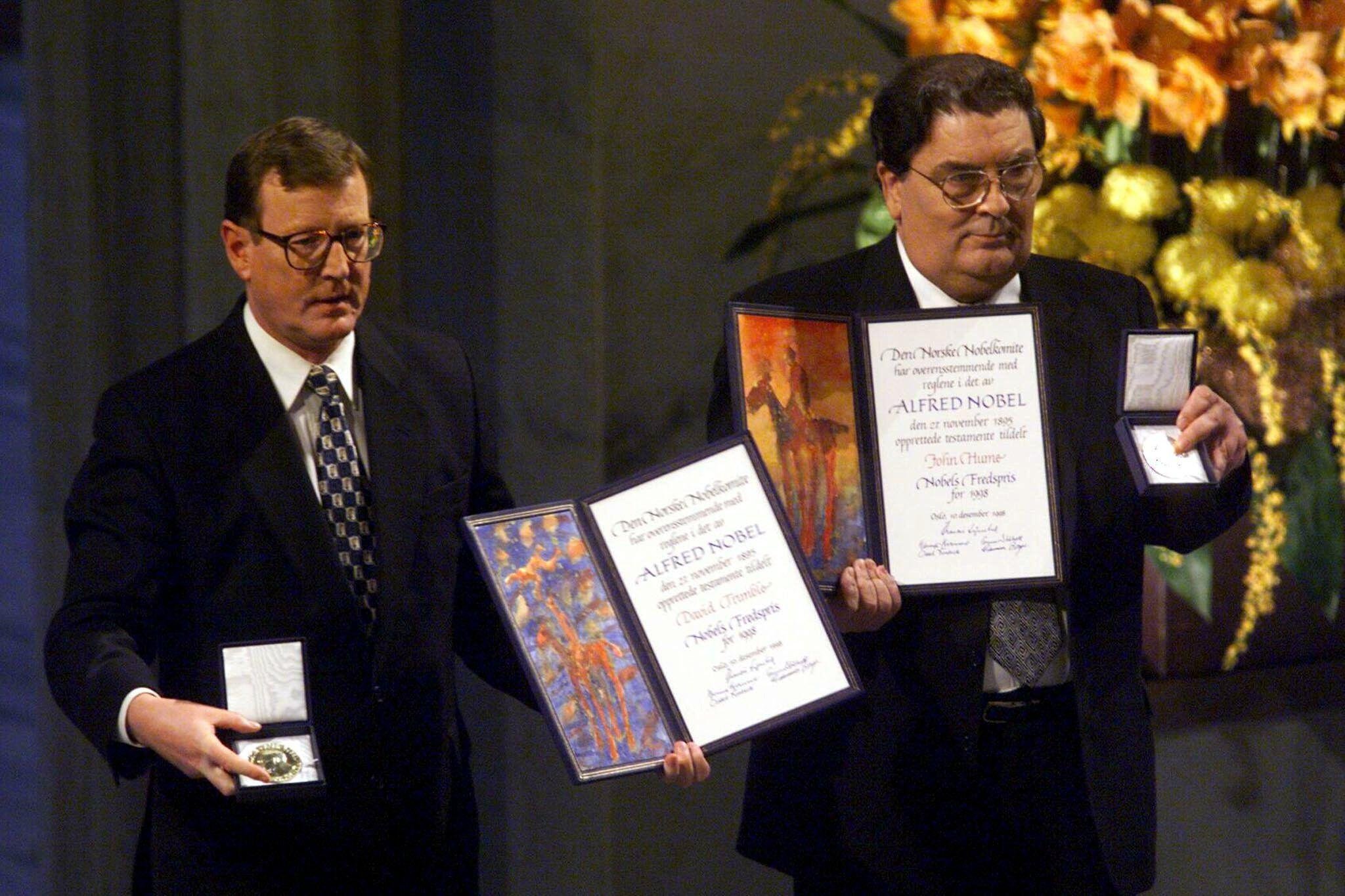
In October 1998, Trimble and John Hume were jointly awarded the Nobel Peace Prize for their part in the Agreement
Forming the full power-sharing Executive took more than a year
The UUP wanted IRA decommissioning before sharing power with Sinn Féin
A review chaired by George Mitchell helped break the deadlock in late 1999
Powers were transferred to the Assembly and Executive on the 2nd December 1999
Ministries were shared between the UUP, SDLP, DUP and Sinn Féin
Martin McGuinness of Sinn Féin became Education Minister
Why decommissioning caused problems
Decommissioning meant paramilitary groups putting their weapons permanently beyond use
Unionists wanted clear evidence that the IRA was giving up its weapons before they fully trusted Sinn Féin in government
Republicans argued that the Agreement did not require the IRA to disarm before Sinn Féin could enter the Executive
This disagreement became one of the main reasons why devolved government was repeatedly suspended
Suspensions of devolved government
Power-sharing was suspended several times:
February – May 2000: the Executive was suspended after the IRA failed to begin decommissioning
July 2001: Trimble resigned as First Minister over the lack of progress on IRA weapons
He returned in November 2001
August and September 2001: two short suspensions gave the parties more time to negotiate over weapons
From October 2002: devolution was suspended again after a police raid on Sinn Féin's Stormont offices over an alleged republican spy ring
After the 2002 suspension, Northern Ireland returned to Direct Rule from Westminster
This lasted until power-sharing was restored in May 2007
“There is no doubt in my mind that the necessary cross-community consensus which has existed, which supported the establishment of the Executive and of the institutions in Northern Ireland and north and south across the island of Ireland, and which is essential in creating those institutions and sustaining their existence, has been severely dented by the absence of credible progress on decommissioning, indeed, the absence of an unequivocal commitment to decommission, or a specific time frame in which decommissioning will occur”
Peter Mandelson, Secretary of State for Northern Ireland, speech opening the second reading of the Northern Ireland Bill, which gave the government power to suspend the institutions, 8 February 2000
Approach: The source is useful because it shows the government’s view that a lack of credible progress on IRA decommissioning was threatening the new Executive
Mandelson was defending a policy he was helping to carry out, so his explanation should be compared with other views on who was responsible for the deadlock
“I do not wish to apportion blame unduly, but I think that we must be clear about this. The simple truth is that the First Minister, the Secretary of State and I, along with the whole House, have been let down by Sinn Fein and the Provisional IRA. They have failed to deliver the decommissioning that it was understood would happen once the Executive was in place. It must be said that with the paramilitaries, whether republican or so-called loyalist, it has been all take and, to date, absolutely no give”
Andrew MacKay, Conservative spokesman on Northern Ireland, speech in the same Commons debate on the Northern Ireland Bill, 8 February 2000
Approach: The source is useful because he broadly supports the need for action but places the blame much more directly on Sinn Féin and the Provisional IRA for failing to deliver decommissioning
As an opposition spokesman, MacKay had more freedom to criticise the republican side directly than a government minister trying to keep the peace process together
IRA decommissioning
An independent commission led by John de Chastelain oversaw the process
The IRA put weapons beyond use in stages:
first acts of decommissioning in 2001, 2002 and 2003
the IRA formally ended its armed campaign in July 2005
full decommissioning was confirmed in September 2005
Some unionists remained doubtful because no photographs were taken of the final decommissioning
Loyalist decommissioning remained incomplete when power-sharing returned in 2007
The rise of the DUP and Sinn Féin
Support moved away from the more moderate UUP and SDLP
In the 2003 Assembly election, the DUP and Sinn Féin became the largest unionist and nationalist parties
The St Andrews Agreement was reached in October 2006
Sinn Féin agreed to support the Police Service of Northern Ireland
The DUP agreed to share power with Sinn Féin
Power-sharing returned on 8 May 2007
Ian Paisley of the DUP became First Minister
Martin McGuinness of Sinn Féin became deputy First Minister
Examiner Tips and Tricks
Do not treat each suspension as a separate crisis. The main issue running through the period was trust, especially whether unionists believed the IRA was genuinely giving up violence and weapons
Use decommissioning as the link between the events:
lack of progress on weapons increased pressure on Trimble and the UUP
repeated suspensions showed how difficult it was to keep power-sharing working
IRA decommissioning by 2005 helped create the conditions for the St Andrews Agreement
That gives you a much clearer argument than simply listing the suspensions in date order
How far did the Good Friday Agreement bring peace to Northern Ireland?
This question asks whether the Good Friday Agreement brought lasting peace to Northern Ireland, or whether it left important parts of the conflict only partly resolved
Some key evidence for each side is outlined below
Evidence that the Agreement brought peace
The Agreement helped move Northern Irish politics away from large-scale political violence
The main republican and loyalist groups largely maintained their ceasefires
The IRA later ended its armed campaign and completed decommissioning
Political disagreements were increasingly dealt with through elections and power-sharing
The devolved Assembly and Executive survived repeated crises
By 2007, the DUP and Sinn Féin were governing together despite having been bitter opponents
The Agreement also created a constitutional settlement that lasted
The consent principle remained accepted
The new North/South and British-Irish institutions continued
Policing was also reformed
The new Police Service of Northern Ireland was designed to gain support across both communities
Evidence that peace remained incomplete
Violence did not disappear completely
Dissident republicans rejected the Agreement
The Omagh bombing (1998) showed that groups opposed to the settlement could still carry out major attacks
Trust between the communities remained weak
Decommissioning took years to complete
Power-sharing repeatedly broke down and devolved government was suspended for long periods
Sectarian divisions also survived
Paramilitary punishment attacks continued
Disputes over parades and segregated communities remained
Political support shifted away from some of the parties that had negotiated the Agreement
The DUP and Sinn Féin replaced the UUP and SDLP as the largest unionist and nationalist parties
“I think Blair’s political horizons are fairly short-term, always. He’s actually got family connections with the province and maybe, knowing that, makes me too willing to take a favourable view of what he’s doing. There is something of the actor/manager about him, driven by the need always to win the next election. He’s also like a magpie, always randomly looking out for bright ideas. He’s not ideologically driven. But I do take the view that what we did in the talks is the basis of the solution to what people call ‘the Northern Ireland problem’. I was negotiating with the British, the Irish and the SDLP to get an agreement and trying to lock the Republicans further into the process as well. Because Blair was involved in bringing about the Agreement, then he is going to be seen as having made a huge contribution. But the judgement that people are going to make, about how Blair handled the implementation, is going to be a bit more variable”
David Trimble, leader of the Ulster Unionist Party (UUP), interviewed by Frank Millar, published in David Trimble: The Price of Peace (2004)
Approach: Trimble was leader of the Ulster Unionist Party and one of the main negotiators of the Agreement, speaking retrospectively in 2004
His reference to Blair's family connections is to Blair's mother, who came from an Ulster Protestant family in County Donegal, and Trimble admits this may make him too willing to view Blair favourably
The source is useful because he separates the Agreement itself from the problems of putting it into practice. He gives Blair credit for helping achieve the settlement, while also suggesting that implementation was much more difficult
Trimble had also lost support within unionism partly because of the Agreement, so his assessment reflects the pressures faced by a politician who had helped create the settlement but then had to defend it
Examiner Tips and Tricks
For a “how far?” question, decide what you mean by peace before you judge the Agreement
If peace means the end of large-scale political violence, the Agreement was highly significant. If it means stable government, full trust between communities and the disappearance of sectarian division, the record was much more mixed

Unlock more, it's free!
Join the 100,000+ Students that ❤️ Save My Exams
the (exam) results speak for themselves:

Was this revision note helpful?
