Privatisation, Deregulation & Council-House Sales (AQA A Level History: Component 2: Depth study): Revision Note
Exam code: 7042

Summary
Privatisation transferred major state-owned industries into private ownership
British Telecom (BT) was sold in 1984
British Gas followed in 1986, in one of the largest privatisations of the decade
Deregulation reduced controls on business and finance
The 'Big Bang' of 27 October 1986 transformed the London Stock Exchange
It expanded screen-based trading and opened the City to greater foreign competition
The Housing Act (1980) gave around 5 million council tenants the Right to Buy
Discounts ranged from 33% to 50%, later rising to as much as 70%
By 1987, more than 1 million council homes had been sold
Individual share ownership rose from 3 million in 1979 to 9 million in 1988
Critics argued that assets were sold too cheaply, that council housing was not replaced and that the gains were spread unevenly across regions and classes
The key question asks whether Thatcher reshaped ownership and the free market, or whether she accelerated changes that were already under way
Privatisation
Why did the Thatcher governments privatise?
Privatisation, also called denationalisation, became central to Thatcherite economic policy
Thatcherites argued that private businesses were more efficient than state-owned industries
Firms competing in a market were expected to improve and innovate
State monopolies faced less pressure to do so
Privatisation served several aims:
It raised money for the Treasury without increasing taxes
It reduced the size of the public sector
It reduced the role of the state in the economy
It widened share ownership
The government described this as 'popular capitalism'
Share offers were advertised to attract people who had not invested before
The same principle was also applied to some local government services
Councils increasingly contracted private firms to provide services such as refuse collection
Financial pressures on councils made contracting out more attractive as a way of cutting costs
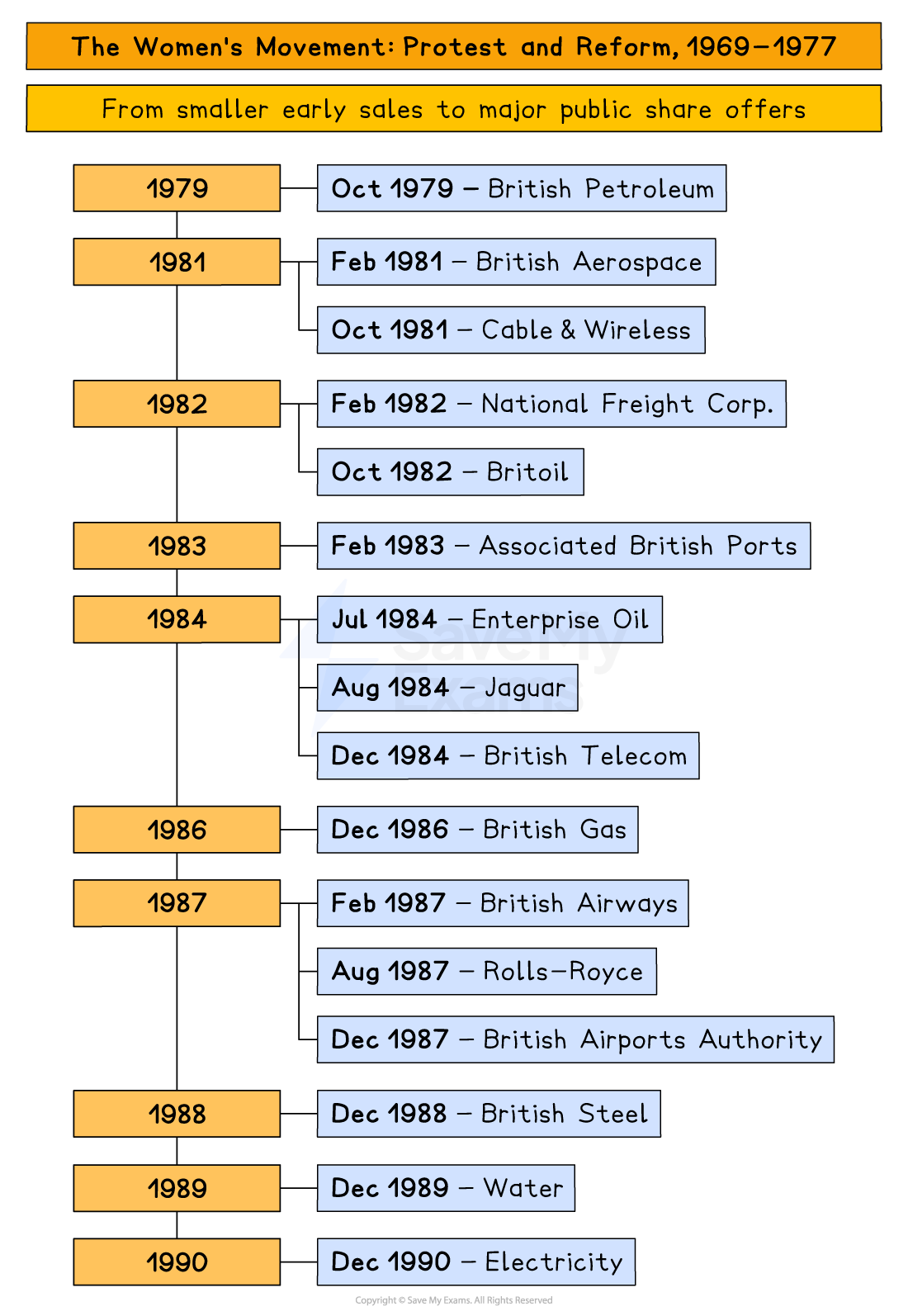
The privatisation programme, 1979–1990
Privatisation developed gradually rather than beginning as a large-scale programme
Early sales were cautious and often involved firms that already operated in competitive markets
Company | Date Sold |
|---|---|
British Petroleum | 1979 |
British Aerospace | February 1981 |
Cable and Wireless | October 1981 |
The National Freight Corporation | February 1982 |
Britoil | November 1982 |
Associated British Ports | February 1983 |
Enterprise Oil | July 1984 |
Jaguar | August 1984 |
British Telecom, 1984
The sale of British Telecom (BT) in 1984 changed the scale of privatisation
It was the largest share sale attempted anywhere in the world up to that point
Around 2 million people bought shares
Many were buying shares for the first time
The success of the sale made larger privatisations politically easier
Larger sales after 1984
British Gas was sold in December 1986
It became the biggest share offer in history at the time
The "Tell Sid" advertising campaign was aimed at people who had never owned shares
Around 4 million people applied
Roughly 1.5 million received shares in the first instance
As a result, further large sales followed
British Airways in February 1987
Rolls-Royce in May 1987
British Airports Authority in July 1987
British Steel was sold in 1988
National services were sold at the end of the decade:
Water was privatised in 1989
Electricity followed in 1990
Some Thatcherites wanted privatisation to go much further
Plans were discussed for coal, the railways and parts of the National Health Service (NHS)
None of these were carried out during the 1980s
“It is clear that the Bill will be widely welcomed by millions of people. They know that competitive free enterprise is a far better system than State monopoly. The Bill also stands as a clear testimony to the Conservative Party’s determination to roll back the frontiers of the State and to give people a real stake in the economy. That is what I call real public ownership”
Patrick Jenkin, Secretary of State for Industry, Parliamentary debate, second reading of the Telecommunications Bill, 29 November 1982
Approach: The source is useful for showing how the government justified privatisation. Jenkin presents private enterprise as more efficient than state monopoly and argues that wider share ownership would give ordinary people a direct stake in the economy
However, he was the minister responsible for taking the Bill through Parliament, so he was making the government’s case for the policy. The source is strongest for showing what ministers wanted privatisation to achieve, not whether those aims were actually met
Criticisms of privatisation
Critics argued that some public assets were sold for less than their real value
Share prices were sometimes set low to make sure an issue was fully taken up
Large first-day profits, therefore, went to buyers rather than the Treasury
Wider share ownership did not always last
Some small investors sold their shares quickly to take a profit
Critics argued that this weakened claims that a permanent share-owning democracy had been created
Privatisation also changed conditions for employees
Private companies could reduce staff to increase profitability
Job security became less certain
Long-term pension arrangements could also become less secure
Opponents argued that some state monopolies had simply become private monopolies
Regulators such as Oftel were created to control prices and enforce standards
Critics questioned whether regulation could replace genuine competition
“The Bill is yet another of the Government’s privatisation measures, and it is by far the largest and most far-reaching such measure ever proposed ... It will take from the British people a national asset that they have owned and to which they have contributed. We shall now see 51 per cent. of this national asset transferred to a minority of shareholders whose only criterion will be profit, not giving a national service”
Stan Orme, Shadow Secretary of State for Industry, Parliamentary debate, second reading of the Telecommunications Bill, 29 November 1982
Approach: The source is useful because it gives the Labour opposition’s case against privatisation. Orme argues that nationally owned assets would be transferred to a minority of shareholders and that profit would become more important than public service
He was speaking against the Bill, so his purpose was openly political. Used alongside Jenkin, the two sources are especially useful for comparing the arguments for and against privatisation at the time
Examiner Tips and Tricks
Do not treat privatisation as one policy that remained unchanged from 1979. The early sales were smaller and more cautious. The sale of BT in 1984 marked a clear change in scale
Keep your answer on privatisation and Right to Buy. Examiners only credit wider material on the 1980s economy, or the miners' strike, if you link it directly to these policies. Remember that coal had been nationalised by Attlee's Labour government in the 1946 Act, not by Thatcher, and it was not privatised until 1994.
Deregulation and the 'Big Bang', 1986
What did deregulation mean?
Deregulation was an important part of supply-side economics
The aim was to remove rules that made it harder for businesses to trade, expand, and hire workers
Controls on borrowing were reduced
This made credit easier to obtain for firms and households
Bus and coach services were deregulated
Private operators could compete on routes that had previously been more tightly controlled
The government also encouraged people to start their own businesses
The Loan Guarantee Scheme helped small firms borrow money
The Enterprise Allowance Scheme paid unemployed people £40 a week for up to a year while they established a business
Some public institutions were also given greater control over their own finances
Later reforms (1988–1990) also gave schools and hospitals more control over their own budgets
The 'Big Bang', 27th October 1986
The 'Big Bang' transformed the London Stock Exchange on 27th October 1986
Several long-standing rules were removed at the same time
Fixed minimum commissions on share trades were abolished
Firms now had to compete on price
The old division between brokers and jobbers was ended
Foreign banks were allowed to buy British firms and operate as stockbrokers in London
Trading also moved increasingly from the exchange floor to computer screens
Deals could be completed much more quickly
Larger volumes of shares could be traded
London could compete more directly with financial centres such as Wall Street in New York and Tokyo
The reforms weakened the old closed network of City firms
Competition became more open
Nigel Lawson, as Chancellor, supported the changes despite resistance from some established City interests
The impact on the City
The City of London strengthened its position as a major international financial centre
Foreign banks expanded their presence
Financial services became one of Britain's most important export industries
A new culture developed in the City
Traders and dealers were encouraged to take greater risks in return for greater rewards
The 'yuppie' became one of the best-known images of the decade
The term was used for young urban professionals associated with high salaries, finance, and conspicuous consumption
Criticisms of deregulation
Critics argued that lighter regulation encouraged greater financial risk-taking
Competition became more intense
Larger rewards encouraged more speculative behaviour
The global stock market crash of October 1987 followed almost exactly a year after the Big Bang
However, the crash was international
It cannot be explained simply as a consequence of British deregulation
Debate continued over whether the reforms made the financial system:
more competitive and efficient
or more exposed to instability
Examiner Tips and Tricks
Keep deregulation separate from privatisation. Privatisation changed who owned an industry. Deregulation changed the rules under which businesses operated
The sale of council houses
The Housing Act, 1980
The Housing Act (1980) gave around 5 million council tenants in England and Wales a legal Right to Buy their homes
The right came into force on 3 October 1980
Tenants received a discount of between 33% and 50% of market value
The size of the discount depended on how long they had been tenants
Later legislation increased the discounts
The Housing and Building Control Act (1984) raised the maximum discount on houses to 60%
The Housing and Planning Act (1986) raised the maximum on flats to 70%
Anyone who resold within five years had to repay some or all of the discount
Selling council houses was not a new idea
Councils had always been able to sell homes to their tenants
Horace Cutler, leader of the Greater London Council (GLC), had promoted large-scale sales from the late 1960s when he was its housing chairman
The important change in 1980 was that sale became a legal right
Councils could no longer choose whether to participate
Labour-controlled councils that delayed applications could be overruled by the Secretary of State
Within six months, seven authorities had been formally warned that the government might intervene
“... for those who rent or wish to rent, it marks a shift of policy direction in marked contrast to recent years and lays the basis for perhaps as profound a social revolution as any in our history. Certainly no single piece of legislation has enabled the transfer of so much capital wealth from the State to the people”
Michael Heseltine, Secretary of State for the Environment, Parliamentary debate, second reading of the Housing Bill, 15 January 1980
Approach: The source is useful for showing the government’s aims for the policy. Heseltine presents home ownership as a major social change rather than simply a housing reform
However, he was the minister responsible for promoting the Bill, so his description of a “social revolution” was designed to build support for the policy. It is stronger evidence for government intentions than for the results of Right to Buy
The scale of council house sales
Sales began quickly and reached a very large scale
167,123 homes were sold in England in 1982–83
More than 1 million council homes had been sold across the United Kingdom by 1987
Home ownership increased alongside the sales
Owner-occupation rose from around 55% of households in 1980 to 64% by 1987
The policy also raised money for the government
Sales produced roughly £18 billion
Right to Buy became politically difficult for Labour to oppose
Labour initially rejected the policy
It later dropped its opposition
Continuing to oppose a policy that had benefited many of its own traditional voters became electorally costly
The consequences for council housing
Right to Buy reduced the amount of housing available for rent
The most attractive properties tended to sell first
These were often houses with gardens rather than flats
Councils were left with a greater proportion of older and less desirable properties
Councils could not simply replace the homes they had sold
Much of the money raised had to be used to repay existing council debt
New council house building fell sharply during the decade
Waiting lists for council housing became longer
Temporary housing also became more common
Councils increasingly placed homeless families in bed-and-breakfast accommodation
This was often more expensive and provided poorer living conditions
The effects were uneven across Britain
Take-up was highest in more affluent areas and in the south
It was lowest where household incomes were lower
Areas where a large number of tenants could afford to buy therefore lost more of their council housing stock
“At least half of the corporation tenants will not be able to afford to buy their houses ... The pattern that will emerge in consequence is that the richer tenants will buy the better houses and the poorer tenants will be left with those that remain”
Roy Hattersley, Shadow Secretary of State for the Environment, Parliamentary debate, second reading of the Housing Bill, 15 January 1980
Approach: The source is useful because he predicted that wealthier tenants would be more able to buy the better council houses, leaving poorer tenants with the remaining stock. This can be tested against the later pattern of sales and the decline in the amount and quality of council housing available for rent
However, Hattersley was speaking as an opposition politician before the policy had taken effect. The source is therefore a prediction, not evidence of the results by itself
Examiner Tips and Tricks
Right to Buy works well for both sides of an argument. It widened home ownership and transferred substantial assets to individual households, but it also reduced the stock of council housing available to future tenants
The 'property-owning democracy'
What is a 'property-owning democracy'?
A property-owning democracy described a society in which more people owned their homes and held shares
The idea had roots in conservative thinking from the 1920s
Thatcher gave it a new economic and political importance
Wider ownership was meant to give people a direct stake in the economy
Homeowners and shareholders were expected to value:
stability
independence
self-reliance
There was also a political calculation
Owner-occupiers were thought more likely to vote Conservative than council tenants
Expanding ownership could, therefore, change voting behaviour as well as the economy
Ministers also presented ownership as a change in attitude
Owning property and shares was linked to independence from the state
This fitted the wider Thatcherite emphasis on individual responsibility
Spreading share ownership
Individual share ownership increased sharply during the 1980s
It rose from around 3 million people in 1979 to 9 million in 1988
Privatisation was the main reason for the increase
Large share offers such as BT in 1984 and British Gas in 1986 attracted many first-time investors
Employee share schemes in privatised companies also widened ownership
By the late 1980s, there were nearly as many individual shareholders as trade union members
Ministers used this comparison as evidence that Britain had changed socially as well as economically
However, much of this new ownership was quite limited
Many new shareholders owned shares in only one or two privatised companies
Some sold their shares quickly to make an immediate profit
“In the early 1960s he would have worked underground, led by a demagogue who once stood for election carrying the banner of the Young Communist League. He would have come home dirty on a bike to a house he did not own ... Now he works somewhere else, cleaner, safer, better paid, where he is not obliged to be a member of a union. Perhaps he is even in his own small business. He drives home in a smart car with a foreign name to the house he bought a couple of years ago ... He is using his British Telecom shares as collateral for a loan. His son is in college and wants to design cars for Toyota. And nobody takes their votes for granted any more”
Edwina Currie, Conservative MP for South Derbyshire, Life Lines: Politics and Health, 1986–1988, autobiography published in 1989
Approach: Edwina Currie was a Conservative MP and strong supporter of Thatcher. She published this account in 1989, looking back at how she believed the lives of her constituents had changed during the 1980s
The source is useful for showing how Thatcherite Conservatives wanted the idea of a property-owning democracy to be understood. Currie links home ownership, share ownership and small business with greater independence and a move away from traditional Labour loyalties
However, her example is deliberately constructed around one successful individual. It is therefore stronger evidence for the political message behind the policy than for how typical that experience was across Britain
The limits of the property-owning democracy
Ownership widened, but it did not spread evenly
Many new shareholders held only small amounts of stock
A large number sold their shares soon after buying them
Not everyone could benefit from Right to Buy
Around half of council tenants could not afford to purchase their homes even with the maximum discount
Tenants dependent on rate rebates or income support were effectively excluded
Those least able to buy were left in a shrinking rented sector
The gains from home ownership also varied by region
People who bought in areas where house prices rose quickly gained the most
Buyers in weaker housing markets gained far less
The policy, therefore, widened ownership without creating equal outcomes
Some households gained substantial assets
Others remained dependent on rented housing and had few opportunities to build wealth
Examiner Tips and Tricks
Treat 'property-owning democracy' as a political idea, not as a neutral description of Britain
Use the evidence to test how far the idea became reality. Share ownership rose sharply and more people bought their homes, but ownership was often shallow
How far did Thatcher reshape the British economy?
This question weighs the scale of the changes made after 1979 against the argument that the economy was already moving in the same direction
Some key evidence for each side is set out below
Evidence that Thatcher reshaped the economy
Ownership of major industries was permanently transferred out of state into private hands
Telecommunications, gas, airlines, and steel all moved to the private sector between 1984 and 1988
The balance of the mixed economy shifted sharply
Employment in nationalised industries fell from around 9% of the workforce to under 2% by 1990
Home ownership and share ownership both increased
Owner-occupation reached 64% by 1987
Individual share ownership tripled to 9 million by 1988
The Big Bang restored London as a global financial centre
Financial services became a leading export industry, allowing the City to compete with Wall Street
The post-war consensus on economic management was abandoned
No later government reversed the 1980s privatisations wholesale
The policies changed the political landscape as well as the economic one
Skilled workers who bought homes and shares became a new part of the Conservative electorate
Evidence that the changes were limited and had already begun
Britain was already shifting from manufacturing to services before 1979
Old labour-intensive industries were losing ground to foreign competition and new technology regardless of policy
Council house sales were not a Thatcherite invention
Councils had held the power to sell since long before 1980, and the GLC had promoted large sales in the late 1960s
Overall economic growth was not exceptional
Growth in GDP across the 1980s averaged 2.2%, no better than in the 1970s
Strong growth in the second half of the decade offset a severe recession in the first half
State monopolies were often replaced by private ones
New regulators such as Oftel were needed precisely because competition did not automatically follow the sale
The gains were spread unevenly by region and by class
Take-up of Right to Buy and of share offers was concentrated in more prosperous areas, widening existing divisions
Examiner Tips and Tricks
For a "how far?" question, distinguish between the scale of change and the origins of change. Deindustrialisation and the growth of services had already begun before Thatcher, but privatisation, Right to Buy and the Big Bang greatly increased the pace and scale of change

Unlock more, it's free!
Join the 100,000+ Students that ❤️ Save My Exams
the (exam) results speak for themselves:

Was this revision note helpful?
