Britain, Europe & the World, 1970-1979 (AQA A Level History: Component 2: Depth study): Revision Note
Exam code: 7042

Summary
Britain joined the European Economic Community (EEC) on 1 January 1973 at the third attempt under Edward Heath
The 1975 referendum confirmed that Britain would remain in the EEC
This was the first national referendum ever held in Britain
Britain remained an awkward member of the EEC
The budget contribution caused disagreement
The Common Agricultural Policy and fishing rights also created tension
Callaghan kept Britain out of the exchange rate mechanism in 1978
The special relationship with the United States came under pressure during Heath's premiership
Heath placed greater emphasis on Europe
Harold Wilson and Callaghan later repaired their special relationship
Détente and Richard Nixon's opening to China reshaped relations with the communist powers
Britain largely followed the American lead in its relations with both the USSR and China
The key question asks whether Britain's global position changed fundamentally in the 1970s or whether the older pattern of alliances and influence largely continued
Britain's entry into Europe, 1973
Why entry became possible
Britain had applied to join the EEC twice during the 1960s
French President Charles de Gaulle vetoed both applications
When negotiations reopened in 1970, entry was widely expected
Britain's application was likely to be accepted
Negotiations focused mainly on the terms of membership
Prime Minister Edward Heath strongly supported European cooperation
His first parliamentary speech had concerned the Schuman Plan, which led towards the creation of the EEC
He had visited Germany during the 1930s and had been disturbed by the Nazi regime
He believed European cooperation could help prevent another major European war
For Heath, membership had a political and moral purpose as well as an economic one
France no longer blocked British entry
De Gaulle had viewed Britain's close relationship with the United States with suspicion
His successor, Georges Pompidou, believed that the EEC needed Britain as much as Britain needed Europe
Economic pressures also pushed Britain towards Europe
Trade with the EEC was growing while trade with the Commonwealth declined
Heath believed that membership would make British industry more competitive
Much of the groundwork had already been completed
Heath had led Britain's negotiating team after the 1961 application
Ireland and Denmark negotiated entry at the same time
Divisions over entry in Parliament
Securing approval in the House of Commons proved more difficult
Some Conservatives opposed entry
Some wanted to protect Britain's links with the Commonwealth
Others believed membership would weaken British sovereignty
Enoch Powell strongly opposed the European Communities Bill
He voted against it at every stage
He refused to stand as a Conservative candidate in February 1974 and encouraged his supporters to vote Labour
Labour was also deeply divided
Roy Jenkins led a group of committed pro-European Labour MPs
Much of the Labour left opposed entry
Wilson was not strongly committed to either side and focused on maintaining party unity
Labour officially opposed Heath's terms rather than membership itself
Some Labour MPs supported the principle of joining but believed the negotiated terms were poor
Wilson promised:
renegotiation
a national referendum
Tony Benn played an important role in developing the referendum proposal
The Commons vote on 28 October 1971 was won with Labour votes
Sixty-nine Labour MPs voted with the Conservative government
A further 20 Labour MPs abstained
Britain, Ireland and Denmark joined the EEC on 1 January 1973
The original Six became the Nine
Examiner Tips and Tricks
Questions on entry may ask whether Britain joined because it could no longer claim to be a world power. Compare his leadership with other factors, including the departure of de Gaulle, the negotiations that began in 1961, and Britain's search for a new role after the decline of empire
The 1975 European referendum
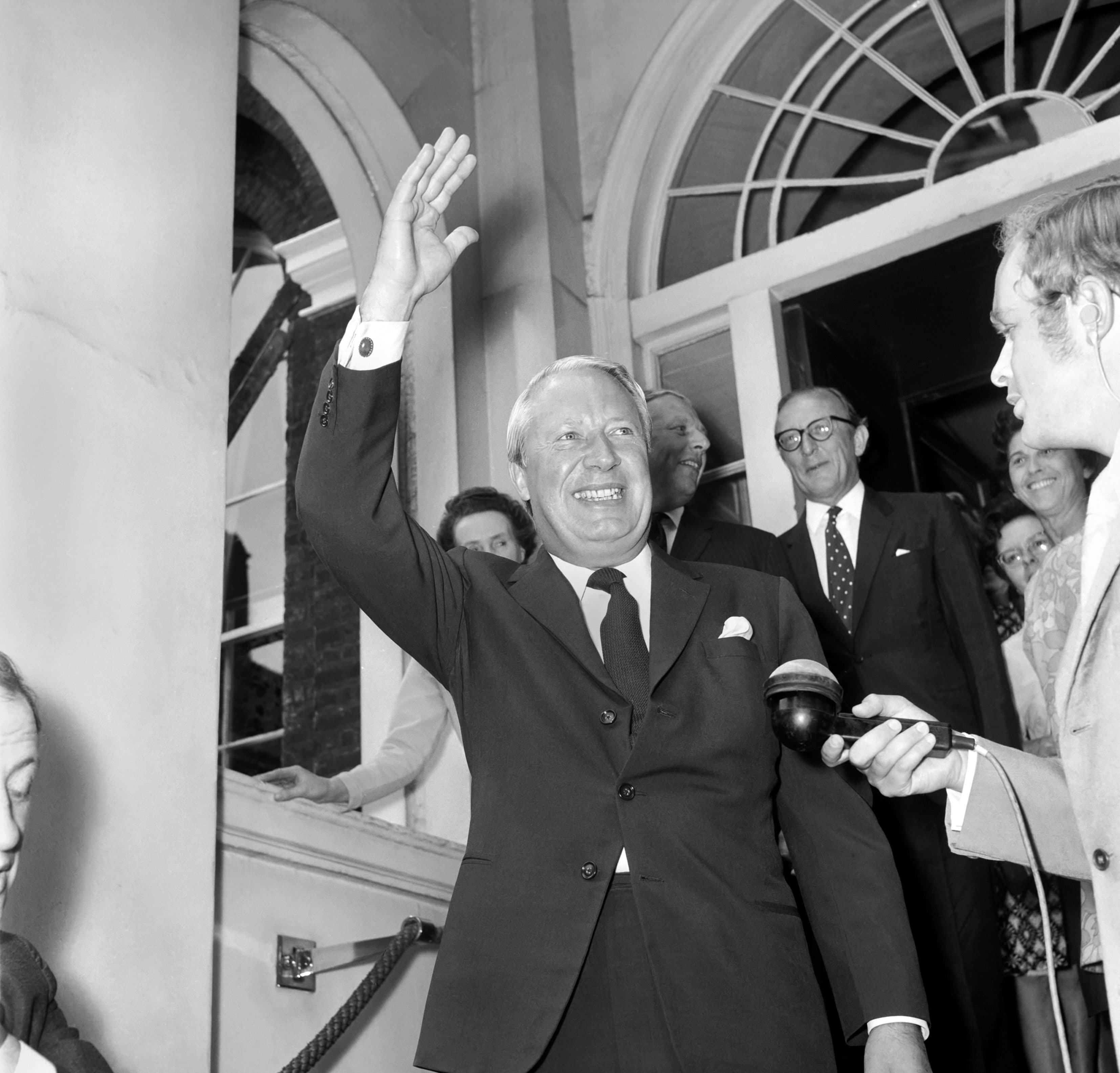
Why Wilson called a referendum
Labour returned to power in 1974
It promised to renegotiate the terms of EEC membership
It also promised to put the result to the public
Wilson's main aim was to hold the Labour Party together
The party was deeply divided over Europe renegotiation
He allowed ministers to campaign against government policy
This became known as the 'agreement to differ'
Wilson and Callaghan kept a low profile, but after the renegotiation the government recommended a 'Yes' vote
Ministers who disagreed could remain in the same cabinet
Normal collective responsibility was temporarily suspended
The 'Yes' campaign
Support for remaining in the EEC was much stronger by 1975 than it had been in 1971
The economic crisis of the mid-1970s made membership appear more important
The Yes campaign had strong backing
Most newspapers supported continued membership
Business leaders also supported it
A survey of 419 company chairmen found that only four wanted Britain to leave
Senior politicians from several parties joined the campaign
Roy Jenkins led the Labour supporters
Edward Heath represented the Conservatives
Jeremy Thorpe represented the Liberals
"I welcome this opportunity to launch the Conservative campaign to keep Britain in Europe. It is not surprising that I, as Leader of the Conservative Party, should wish to give my wholehearted support to this campaign, for the Conservative Party has been pursuing the European vision almost as long as we have existed as a Party. ... We are inextricably part of Europe. Neither Mr. Foot nor Mr. Benn nor anyone else will ever be able to take us “out of Europe”, for Europe is where we are and where we have always been. ... We must do this, even though we dislike referenda. We must support the Prime Minister in this, even though we fight the Government on other issues... If we fail and the British people vote ‘No’ to the European Community, they will read how there was a defeat for co-operation between nations, and how there was a victory for the tribunes of the Left. They will read how extremism won over commonsense”
Margaret Thatcher, newly elected leader of the Conservative Party. Public campaign speech opening the Conservative referendum campaign, with Edward Heath chairing, 16 April 1975
Approach: In this speech, Thatcher launched the Conservative campaign to remain in the EEC and appeared alongside Edward Heath
The source is useful because it shows that support for Europe remained official Conservative policy. It also shows Thatcher presenting EEC membership as part of Britain’s wider place in Europe. However, it was a campaign speech, so it was designed to win support for the Yes side
The 'No' campaign
The 'No' campaign brought together two different arguments
Labour opponents focused on workers and economic policy
Barbara Castle and Michael Foot argued that EEC membership would harm British workers
Other opponents focused on sovereignty
Tony Benn, Enoch Powell and Ian Paisley argued that Britain would lose control over its own laws and decisions
The campaign was divided between left and right
It did not present one clear case in the same way as the 'Yes' campaign
“For the British people, membership of the Common Market has already been a bad bargain. What is worse is that it sets out by stages to merge Britain, Germany and Italy and other countries into a single nation. This will take away from us the right to rule ourselves which we have enjoyed for centuries. The Common Market increasingly does this by making our laws and deciding our policies on food, prices, trade and employment, all matters that affect the lives of us all. As the system tightens, and it will, our right, by our votes, to change policies and laws in Britain will steadily dwindle. Those who want Britain in the Common Market are defeatists; they see no independent future for our country"
‘Why you should vote NO’ campaign leaflet, delivered to every home in Britain, 1975
Approach: The leaflet was delivered to homes across Britain during the 1975 referendum campaign. It argued that EEC membership threatened British sovereignty and would lead to greater European control over laws, prices and employment
The source is useful for showing the main arguments used by the No campaign. It was written to persuade voters, so its language was intended to create concern about the loss of national control
The result
Voters were asked the following question:
Do you think that the United Kingdom should stay in the European Community (the Common Market)?
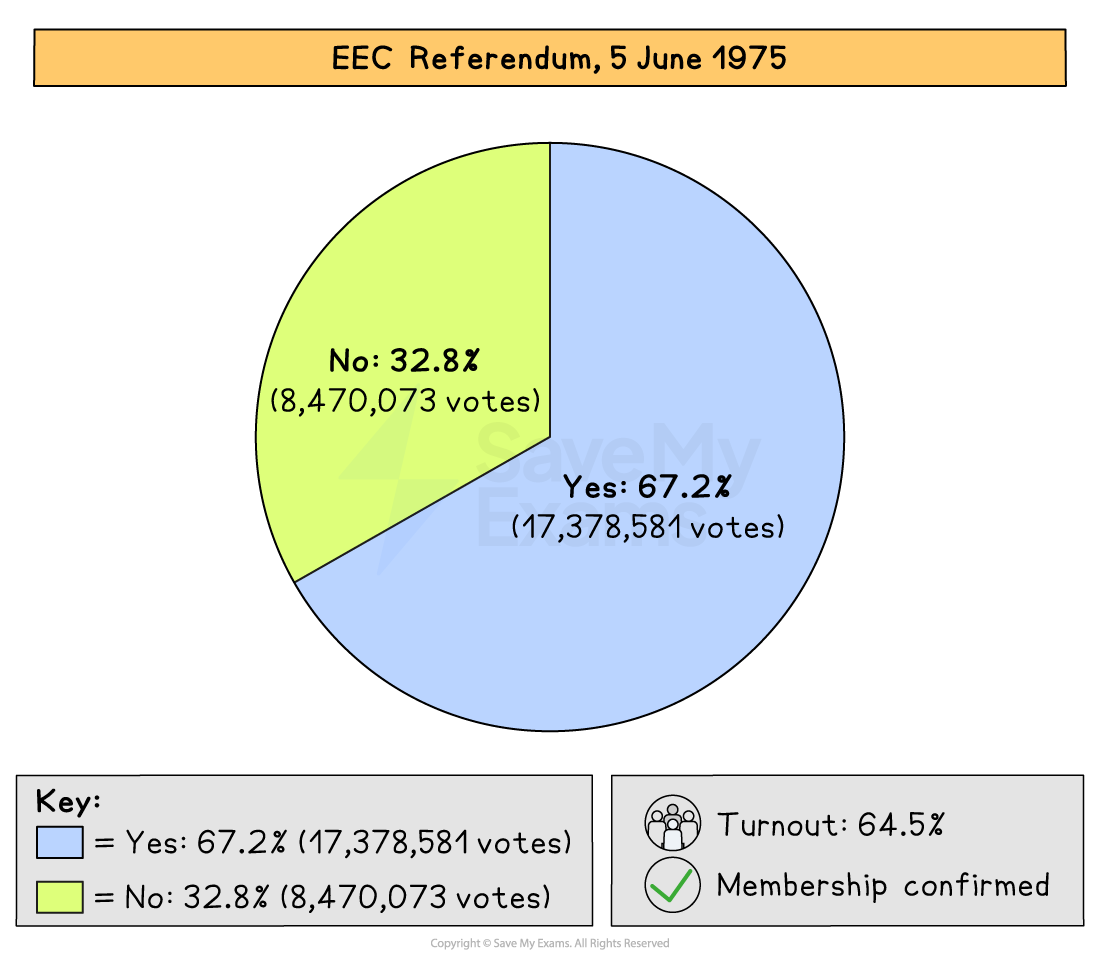
The referendum was held on 5 June 1975
Membership was confirmed
17,378,581 voted yes
This was 67.2%
8,470,073 voted no
This was 32.8%
Turnout was 64.5%
The result was a victory of more than two to one
It appeared to settle public opinion in favour of membership
It also allowed Wilson to avoid a major Labour split
However, the referendum also showed continuing uncertainty
The issue had been put to a national vote only two years after Britain joined
Examiner Tips and Tricks
Do not dismiss campaign material because it is one-sided. A leaflet or speech can show what each side believed would persuade voters
Keep the two campaigns separate:
The 'Yes' campaign stressed economic security and Britain's place in Europe
The 'No' campaign focused on sovereignty and national independence.
Relations with Europe
An 'uneasy' member
The 1975 referendum reduced the argument over membership, but it did not end it
Labour remained divided over Europe
Roy Jenkins, one of Labour's leading pro-Europeans, left Parliament to become President of the European Commission in 1977
Much of the Labour Party became more critical of European integration during the late 1970s
Some Conservatives also continued to oppose closer European integration
Britain's contribution to the EEC budget caused repeated complaints
Britain paid more into the Community budget than it received
In December 1978, Margaret Thatcher criticised Callaghan for failing to secure a reduction
She also reminded him that he had renegotiated the original terms in 1975
The Common Agricultural Policy
The Common Agricultural Policy attracted strong criticism in Britain
Farmers received guaranteed prices for their produce
This encouraged production even when food was not needed
This meant that surpluses developed
British critics argued that the system favoured less efficient producers
Many of these farmers were in France
British farmers who did not produce surpluses gained less from the system
In 1978, Callaghan warned the House of Commons that the policy could collapse under its own financial weight unless it was reformed
Fishing rights
Fishing rights remained unresolved at the end of the decade
British fishermen complained about the European fleet reducing fish stocks in British waters
Negotiations over a common fisheries policy were still continuing in December 1978
Staying outside the European Monetary System
The EEC agreed in December 1978 to create the European Monetary System
It was due to begin on 1 January 1979
Its exchange rate mechanism aimed to keep member currencies stable against one another
Callaghan decided that Britain would not join the exchange rate mechanism
The government argued that European economies had not become as similar as expected
Ministers feared that a fixed exchange rate could lead to:
deflation
higher unemployment
Britain still joined other parts of the system
Sterling was included in the new European currency unit
Britain also joined the Community credit arrangements
This created a pattern that continued in later years
Britain joined some forms of European cooperation
It stayed outside others
“I explained to the Council that I would not be recommending to the Cabinet that the United Kingdom should participate in the exchange rate mechanism when it begins to function. ... What happened was that national considerations of all the nine members prevailed over the attempt to bring about an international agreement. Britain was one of those that put its national interests in the forefront. On occasion that is necessary.”
James Callaghan, Labour prime minister. Statement to the House of Commons reporting the European Council meeting in Brussels, and his reply to the Leader of the Opposition, 6 December 1978
Approach: Callaghan made this statement to the House of Commons on 6 December 1978, after a meeting of the European Council in Brussels. He was explaining why Britain would not join the exchange rate mechanism
The source is useful because it shows how Callaghan defended Britain’s decision. He presents national interests taking priority as normal behaviour within the Community. However, he was also responding to criticism from the Opposition, so he had a reason to defend the decision and avoid presenting Britain as isolated
Examiner Tips and Tricks
Separate membership from enthusiasm. Britain joined the EEC in 1973 and voted to stay in in 1975, but arguments continued over budget, farming, fishing, and monetary cooperation
The state of the 'special relationship' with the USA
Heath's Europe-first approach
Heath placed greater emphasis on Europe than on the Atlantic Alliance
He rejected attempts by US National Security Adviser (later Secretary of State) Henry Kissinger to use Britain as a link between the United States and Europe
He argued that the United States should negotiate with the European community as a whole
This created tension with Washington
Kissinger complained that Heath dealt with the Americans in an unsentimental way
He also questioned whether the special relationship still existed
Personal relations were warmer than these disagreements suggested
Heath had a good relationship with President Richard Nixon
He supported American policy in Vietnam more openly than Wilson had during the 1960s
Nuclear co-operation continued, including work with the United States on upgrading Polaris
The Yom Kippur War, October 1973
The Yom Kippur War exposed the strain in Anglo-American relations
Egypt and Syria attacked Israel in October 1973
The United States began airlifting military supplies to Israel
The Americans asked to use NATO bases in Europe during the airlift
Britain and most other European states refused permission
They feared that Middle Eastern oil supplies would be cut
OPEC later raised prices and restricted oil supplies
Britain imposed an arms embargo on both sides
Foreign Secretary Sir Alec Douglas-Home said that Britain's European partners had adopted the same policy
Harold Wilson criticised the decision
He argued that it broke existing contracts
He also said it reversed Labour's policy from 1967
The dispute showed that Britain would not always follow the United States
Heath placed British and European interests ahead of American requests
“There are two prime reasons why I am convinced that our policy is right for the time being. First, it is the right policy overall because it limits the area and degree of military damage and casualties. If America and Russia adopted it, we should all applaud. I find that all our European partners are of the same mind and have adopted the same policy”
Sir Alec Douglas-Home, Conservative foreign secretary. Speech to the House of Commons opening a debate on the Middle East, three days before the government faced a possible rebellion on the issue, 18 October 1973
Approach: Douglas-Home was Conservative Foreign Secretary when he addressed the House of Commons on 18 October 1973. He was defending the government’s decision to restrict arms supplies during the Yom Kippur War
The source is useful because it explains the government’s public reasons for the embargo. Douglas-Home stresses the risk of greater military damage and points out that Britain’s European partners had adopted the same policy. However, he was defending a disputed decision in Parliament, so he had a reason to present the policy as cautious and widely supported
Wilson and Callaghan restore closer links
Wilson and Callaghan placed more importance on the Atlantic Alliance than Heath
Callaghan developed a close personal relationship with Henry Kissinger
He also worked closely with President Jimmy Carter
Nuclear cooperation continued
Callaghan began discussions with Carter in 1979 about replacing Britain's Polaris missiles with the American Trident system
The final decision was taken after Callaghan left office
Britain still acted independently when its interests differed from those of the United States
Withdrawal from East of Suez continued despite American concerns
The policy had begun in the 1960s and was completed during the 1970s
Examiner Tips and Tricks
Define the special relationship before judging whether it weakened. It included diplomatic cooperation, defence, nuclear weapons, intelligence, and personal links between leaders
Heath weakened the diplomatic side by putting Europe first; however, military and nuclear cooperation continued. Wilson and Callaghan restored closer political relations but Britain still followed its own policy when British and American interests differed
Attitudes to the USSR and China
A shared Cold War aim
Britain and the United States continued to work together despite disagreements elsewhere
Both wanted to limit the spread of communism
The USSR and China were the world's strongest communist states
British relations with both had often been tense during the Cold War
Relations with China improved during the 1970s, but relations with the USSR improved only slowly
In both cases, Britain largely followed changes first made by the United States
Relations with the USSR during détente
The 1970s brought détente
After the Cuban Missile Crisis, American and Soviet leaders increased direct contact
Regular meetings followed
Agreements were reached to limit the growth of nuclear weapons, Strategic Arms Limitation Talks (SALT)
Britain supported détente but remained suspicious of Soviet intentions
Western governments still feared Soviet influence in Eastern Europe
Britain also remained concerned about the treatment of political opponents inside the USSR
In 1971, Heath's government expelled 105 Soviet officials accused of spying (Operation Foot)
Relations with the USSR therefore did not improve under Heath
Britain signed the Helsinki Final Act in 1975
The murder of Georgi Markov increased these suspicions
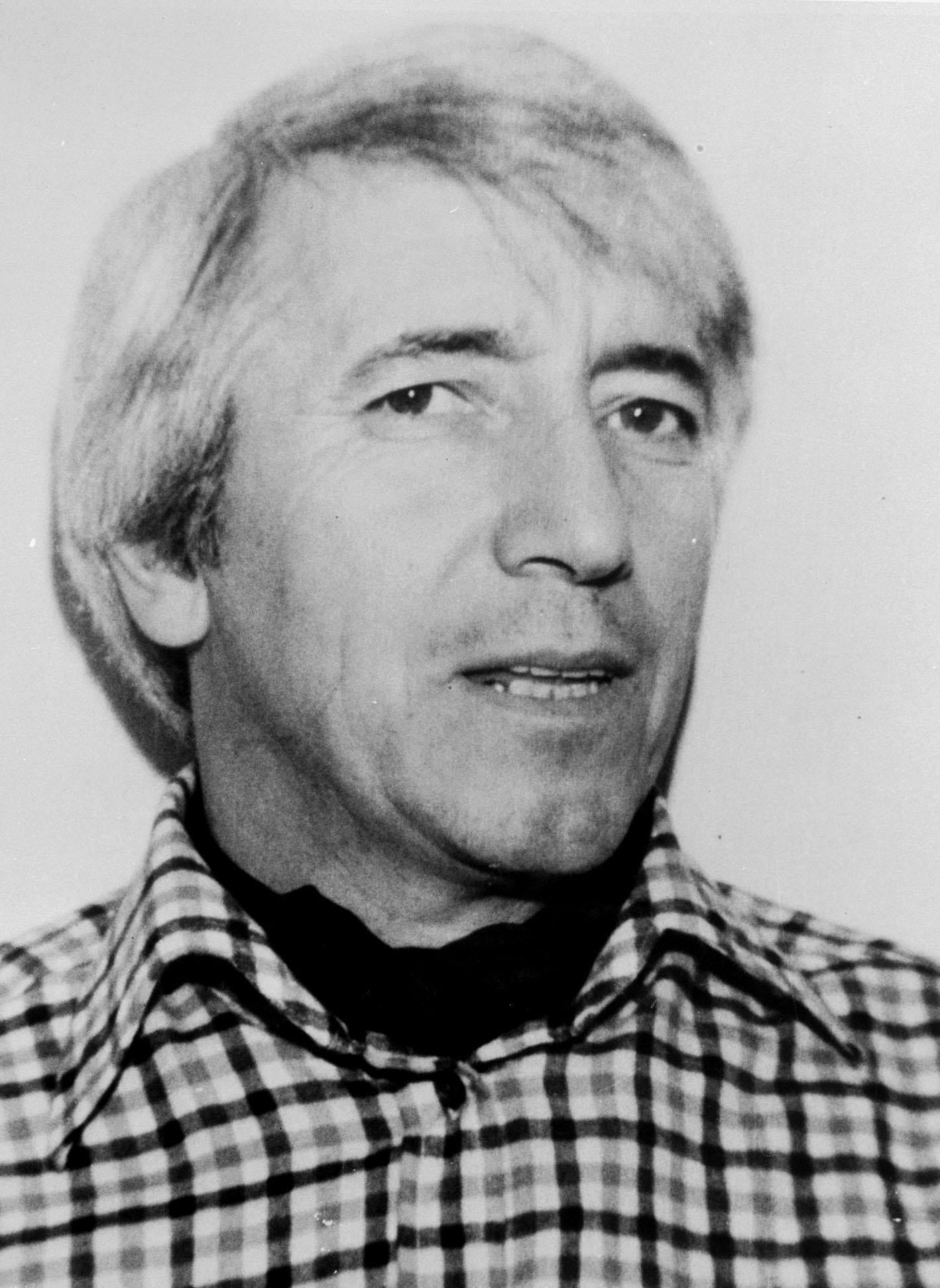
Markov was a Bulgarian writer who had defected to the West in 1969
He worked as a broadcaster for the BBC and Radio Free Europe, criticising Bulgaria's communist government
He was assassinated in London in 1978
A poisoned pellet was reportedly fired from an umbrella
The KGB was suspected, although this was never proved
“A British statesman, Palmerston, said that Britain had no eternal enemies and no eternal friends, only eternal interests. Even today, 100 years later, an element of that must exist because we are an international trading nation dependent upon links around the world. The two superpowers, the United States of America and the Soviet Union, have massive amounts of armaments and show a considerable degree of immorality in the way they exercise their power. The medium nations come next. I believe that the French are just a little too pushing in the pursuance of their ambitions. Nations like the United Kingdom are a potential example of how morality can show itself in international relations. The United Kingdom is important because in terms of history, international connections and even of power we are significant. In my view, it is extremely important that we should debate this matter and in particular look at the way Britain conducts herself”
Colin Jackson, Labour backbench MP for Brighouse and Spenborough. Speech in a House of Commons debate on foreign policy and morality, 9 February 1976
Approach: Colin Jackson was a Labour backbench MP speaking in the House of Commons on 9 February 1976. He argued that Britain should avoid treating either the United States or the Soviet Union as a permanent friend or enemy
The source is useful for showing how some British politicians viewed Britain’s place between the superpowers. Jackson presents Britain as an independent trading nation that should judge each issue separately. However, he was not a minister, so the speech shows an opinion about how Britain should behave rather than the government’s actual policy
China opens to the West
Relations with China had been tense before the 1970s
China had supported communist forces during the wars in Korea and Vietnam
Britain and China also disagreed over Hong Kong
Relations began to improve after China moved closer to the United States
Tension between China and the Soviet Union encouraged Mao Zedong to seek a better relationship with Washington
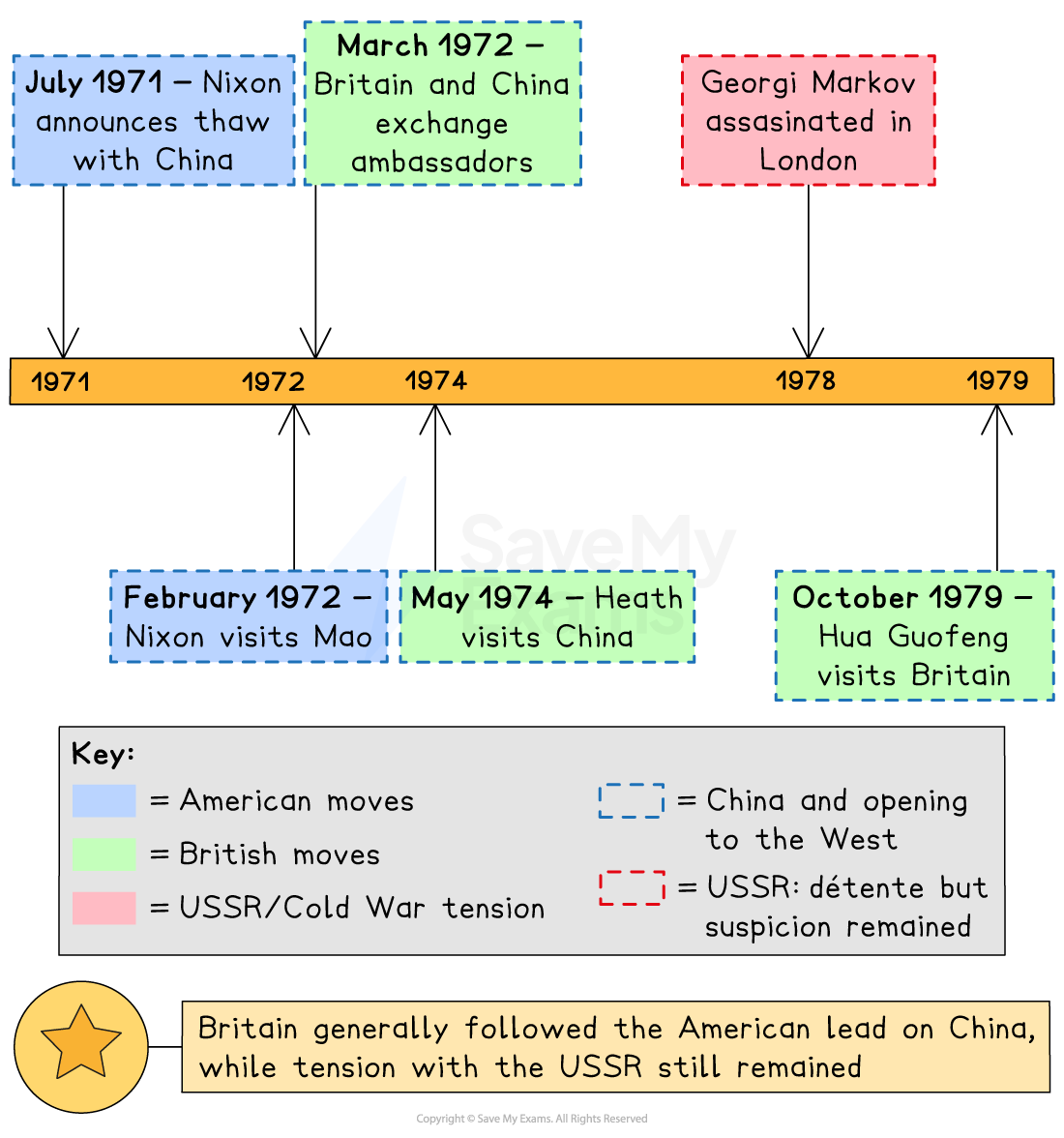
President Richard Nixon announced a thaw in relations between China and the United States in July 1971
He visited China in February 1972
He met Mao during the visit
Britain followed the American lead
Britain and China agreed to exchange ambassadors in March 1972
Edward Heath later developed a close personal link with China
He first visited China in May 1974, two months after leaving office
He met Mao during the visit
He was later awarded the title People's Friendship Envoy
This was the highest honour China gave to a foreign visitor
Relations continued to improve
Premier Hua Guofeng visited Britain in October 1979
He was the first Chinese leader to visit Britain since the Communist Revolution in 1949
Examiner Tips and Tricks
When writing about relations with the USSR and China in an essay, do not fall into the trap of listing visits. Instead, explain the wider pattern. Britain followed the American lead in opening relations with both the USSR and China, but it still tried to present itself as an independent power
How far did Britain's global position change in the 1970s?
This question weighs the loss of Britain's older world role against the new position it took inside Europe
Some key evidence for each side is outlined below
Ways Britain's global position changed
Britain joined the EEC in 1973
Trade, law, and diplomacy became more closely tied to Europe
The 1975 referendum confirmed membership through a national vote
Heath changed Britain's approach to the United States
He rejected the idea that Britain should act as an American go-between
He wanted the United States to deal with the European Community as a whole
Britain acted separately from the United States during the Yom Kippur War in 1973
It refused American use of NATO bases for the airlift to Israel
It followed the same line as most of its European partners
Withdrawal from East of Suez was completed
Britain closed its main bases in Singapore, Malaysia and the Persian Gulf, keeping garrisons only in Hong Kong and Brunei
Britain followed the American lead in its relations with the communist powers
This applied to both détente with the USSR and the opening to China
Britain no longer set the direction of Western policy
Ways Britain's position stayed the same
The Atlantic Alliance survived the disputes of 1973
Wilson and Callaghan rebuilt closer relations with the United States
Nuclear cooperation continued
Callaghan opened talks with President Carter about replacing Polaris with the American Trident system
Britain's nuclear deterrent, therefore, remained dependent on the United States
Britain remained a member of NATO
Its main European security commitments did not change
EEC membership did not produce full agreement with Europe
Disputes continued over the budget contribution
The Common Agricultural Policy, food prices and fishing rights also caused tension
Callaghan kept Britain outside the exchange rate mechanism in 1978
The government chose national control over closer monetary integration
Britain retained other parts of its international position
It kept its permanent seat on the United Nations Security Council
It also maintained links with the Commonwealth
Examiner Tips and Tricks
Take the answer across the whole decade. Do not stop at EEC entry or the 1975 referendum. Northern Ireland was a domestic issue, not foreign policy. Examiners report that weaker answers drift into it, or into Heath's domestic problems, when asked about Britain's international position
For a question like this, you could also choose to organise the evidence by theme, such as:
Europe
the United States
defence
the communist powers
Britain's remaining global links

Unlock more, it's free!
Join the 100,000+ Students that ❤️ Save My Exams
the (exam) results speak for themselves:

Was this revision note helpful?