Thatcher & Foreign Affairs, 1979-1987 (AQA A Level History: Component 2: Depth study): Revision Note
Exam code: 7042

Summary
Argentina invaded the Falkland Islands in April 1982
Thatcher sent a naval task force, with British forces retaking the islands by June
Victory in the Falklands strengthened Thatcher's position at home
The sudden political recovery became known as the Falklands factor
The special relationship with the USA was strengthened by Thatcher's close relationship with Ronald Reagan
However, the two governments still disagreed at times, including over Grenada in 1983
Thatcher took a strongly anti-Soviet position in the early 1980s
By 1984, she believed Mikhail Gorbachev was a Soviet politician the West could negotiate with
In Europe, Thatcher combined cooperation with a firm defence of British interests
She secured a permanent British budget rebate at Fontainebleau in June 1984
Britain signed the Single European Act in February 1986
The key question asks whether Thatcher restored Britain's international influence or whether the recovery in status was limited and largely symbolic
The Falklands War, 1982
Why did the Falkland Islands matter?
The Falkland Islands lie in the South Atlantic, around 300 miles east of the Argentine mainland
Britain had governed them since 1833
Most islanders wanted to remain British
Argentina also claimed the islands as the Malvinas
Its claim dated back to independence from Spain in 1816
Sovereignty over the islands remained disputed
By the 1970s, the Falklands had little strategic importance for Britain
British officials were willing to discuss their future with Argentina
However, the islanders' wish to remain British blocked any transfer of sovereignty
The road to invasion
In 1981, the government approved the withdrawal of HMS Endurance, the only British naval vessel permanently based in the South Atlantic
Defence Secretary John Nott proposed the withdrawal as a defence saving; Foreign Secretary Lord Carrington opposed it
Argentina's military government interpreted the decision as a sign that Britain might not defend the islands
On 2 April 1982, Argentine forces invaded the Falklands
Argentina was ruled by a military junta under General Leopoldo Galtieri
Carrington resigned after the invasion
He accepted responsibility for the failure to prevent it, even though he had opposed withdrawing HMS Endurance
Thatcher quickly announced that Britain would send a naval task force to retake the islands
She presented the decision as a defence of the islanders' right to self-determination
It was also a major political risk
Failure could have invited comparisons with the Suez Crisis of 1956
The campaign
The British task force sailed around 8,000 miles to the South Atlantic
Diplomatic efforts to find a settlement continued while the fleet travelled south
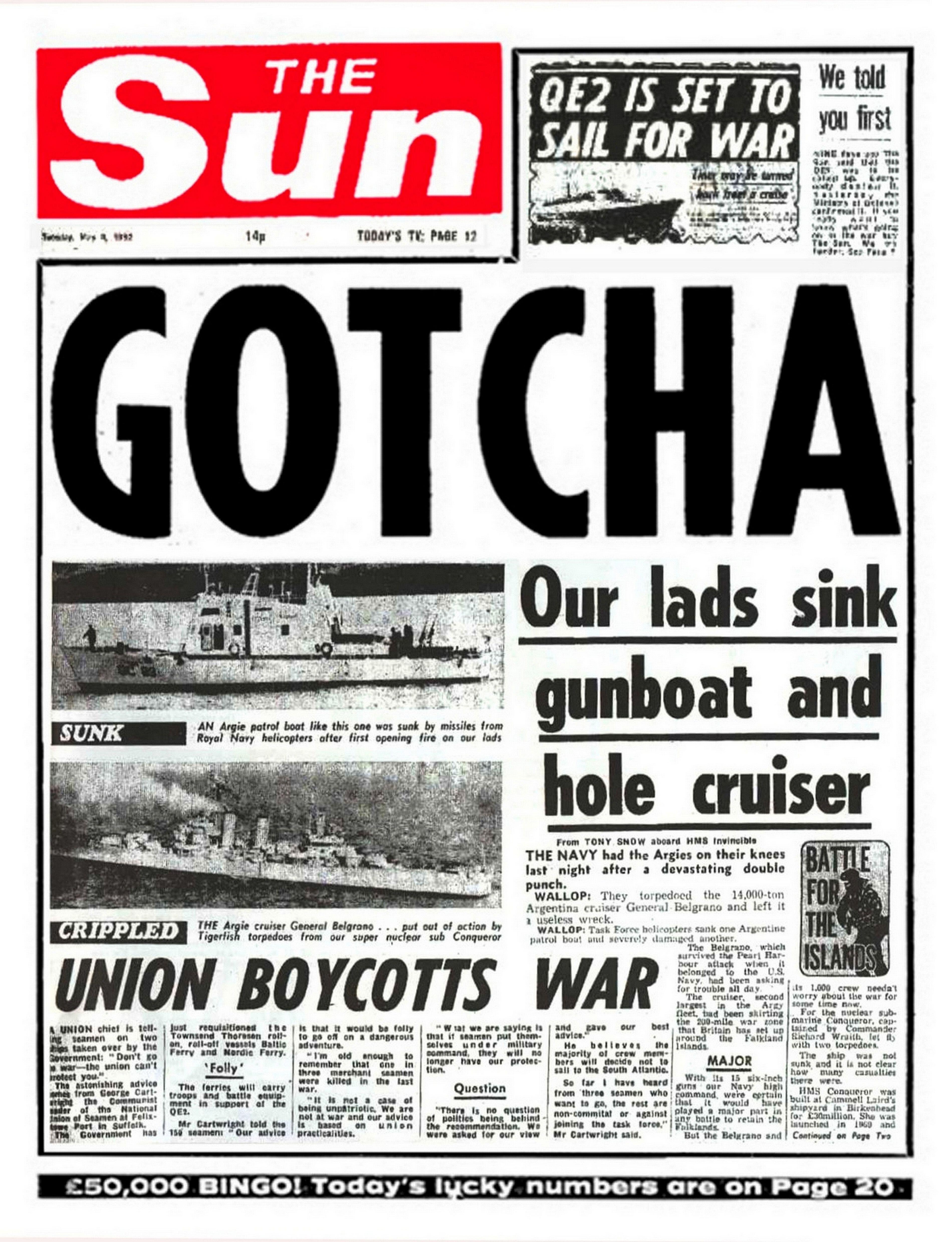
On 2 May 1982, the British submarine HMS Conqueror sank the Argentine cruiser General Belgrano
The sinking caused heavy loss of life
It also reduced the chances of a negotiated settlement
The decision was controversial because the Belgrano was outside the British exclusion zone and sailing away from it at the time
British losses also showed how difficult the campaign could be
On 4 May, an Argentine Exocet missile struck HMS Sheffield, which sank six days later
Argentina's supply of Exocets became an important concern for Britain
British troops landed at San Carlos Water on 21 May
Argentine forces surrendered on 14 June 1982
Britain had retaken the islands in just over two months
"We have ceased to be a nation in retreat. We have instead a newfound confidence, born in the economic battles at home and tested and found true 8000 miles away. And so today we can rejoice at our success in the Falklands and take pride in the achievement of the men and women of our task force. ... Britain found herself again in the South Atlantic and will not look back from the victory she has won”
Margaret Thatcher, Prime Minister, speech at a Conservative rally in Cheltenham, 3 July 1982
Approach: Thatcher gave this speech to a Conservative rally in Cheltenham on 3 July 1982, shortly after victory in the Falklands
The source is useful for showing how the government wanted the war to be remembered. Thatcher presents victory as proof that Britain had recovered its confidence and was no longer a “nation in retreat”
However, she was addressing party supporters immediately after a military victory. The speech is therefore much stronger evidence for the political message attached to the war than for whether Britain’s underlying international power had really increased
The impact at home
Victory transformed the government's political position
Before the invasion, the Conservatives had been performing badly in opinion polls
The surge in support after victory became known as the Falklands factor
The war also changed Thatcher's public image
Supporters presented the victory as evidence of decisive leadership and renewed national confidence
Critics objected to a triumphalist tone of some coverage
The Sun's "GOTCHA!" headline after the sinking of the Belgrano became one of the best-known example
The limits of the Falklands victory
The psychological effect of victory was much greater than its effect on Britain's long-term strategic position
The war did not reverse Britain's wider retreat from empire
Britain did not suddenly regain the military global reach it had possessed earlier in the century
Relations with Argentina remained damaged
In 1989, consular relations were restored
Full diplomatic relations were not restored until 1990
The conflict did strengthen Britain's determination to defend the wishes of remaining overseas territories
Any transfer of Gibraltar to Spain against the wishes of its population became much less likely
Examiner Tips and Tricks
Treat the Falklands as a major political and psychological turning point, but be careful about calling it a turning point in Britain’s actual global power
Separate impact from significance. The military victory had a major effect on Thatcher’s standing and national confidence, while its effect on Britain’s long-term strategic position was much more limited
Northern Ireland is domestic policy, not foreign policy. In a foreign-policy essay, credit comes only from the international side of the 1985 Anglo-Irish Agreement
The 'special relationship' with the USA
The bond between Thatcher and Reagan
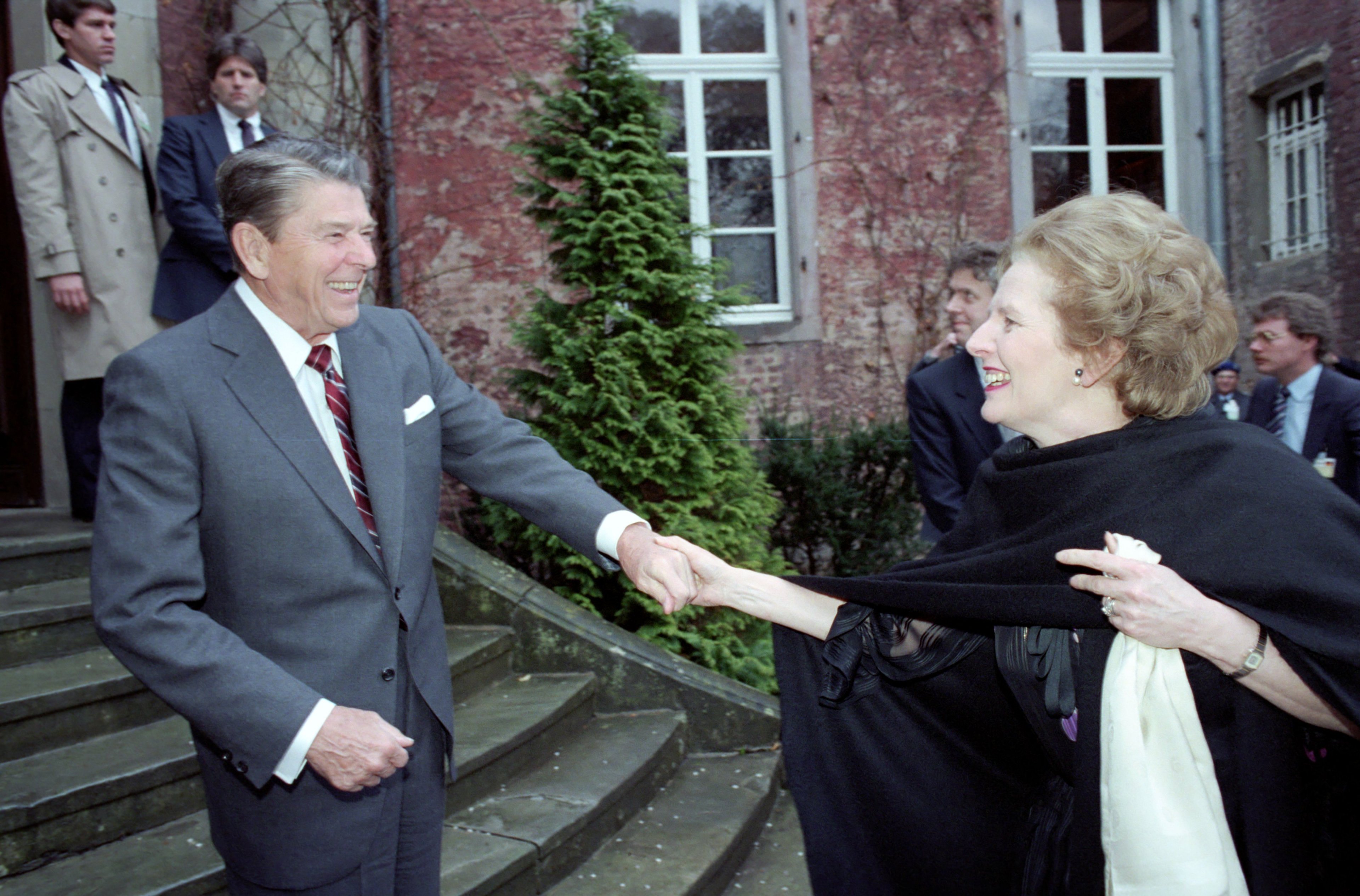
Thatcher and Ronald Reagan shared both a political outlook and a close personal relationship
Both supported:
free markets
lower taxation
deregulation
a firm line against the Soviet Union
Reagan was elected president in November 1980, taking office on 20 January 1981
He remained president throughout the rest of Thatcher's period up to 1987
Thatcher's view of the Anglo-American alliance was strongly shaped by the Second World War
She admired Winston Churchill
She saw American power as an important guarantee of European security
Their personal relationship strengthened the wider Anglo-American alliance
Thatcher later gave a eulogy at Reagan's funeral in 2004
“Dear Margaret: At his request, I have just talked with General Galtieri concerning the Falklands Island crisis. I wanted to relay to you a summary of that conversation. ... General Galtieri reaffirmed to me his desire to avoid conflict with your country, and his fears that conflict would cause deterioration in recently improving relations with the United States. He said that the advance of your fleet and the blockade of the islands were making his situation difficult. ... General Galtieri promised to deal honestly and seriously with Secretary Haig. ... Warm regards, Ron”
President Ronald Reagan, message to Margaret Thatcher, sent from the White House by the Cabinet Office line, 15 April 1982
Approach: This was a private message from President Reagan to Thatcher on 15 April 1982, during the Falklands crisis
The source is useful because it shows Reagan trying to mediate between Britain and Argentina while keeping Thatcher informed. It also shows that the United States was attempting to manage relations with both sides, rather than simply backing Britain from the start
Because the message was private correspondence between the two leaders, it is more candid than a public speech. However, it still gives only Reagan’s side of the discussion and needs to be compared with what the US government actually did during the crisis
American support during the Falklands
US support became important to Britain's campaign
Britain used the US-run airfield on Ascension Island, a British territory, as a staging point
American intelligence and supplies strengthened Britain at important stages
The contrast with Suez in 1956 was significant
At Suez, American pressure had helped force Britain to abandon the operation
In 1982, Washington eventually gave Britain strong support
This strengthened the Anglo-American alliance and reinforced the personal relationship between Thatcher and Reagan
Where did the two governments disagree?
The relationship between Thatcher and Reagan was close, but it was not free from disagreement
In 1983, the United States invaded Grenada
Grenada was a Commonwealth country
Thatcher objected to the invasion
Reagan went ahead despite her opposition
In 1986, Thatcher allowed American aircraft to use British bases for attacks on Libya
The decision was unpopular with many people in Britain
Thatcher accepted the domestic political cost because she believed supporting the United States mattered for the wider Anglo-American alliance
Thatcher was not simply following American policy
She also tried to influence Reagan
After meeting Mikhail Gorbachev in 1984, she encouraged Reagan to negotiate with him
Her access to Washington gave her an international profile greater than Britain's economic power alone might suggest
Examiner Tips and Tricks
For source questions, distinguish between private correspondence and public statements. Reagan’s message is useful because it shows what he was saying directly to Thatcher during the crisis, but it still represents only one side of the relationship
Moves to end the Cold War
The second Cold War, 1979–1985
Superpower tensions rose sharply again at the end of the 1970s
The Soviet invasion of Afghanistan in 1979 was seen in the West as a threat to its interests
Reagan famously described the USSR as an "evil empire"
The United States also committed itself to the Strategic Defence Initiative (SDI)
Soviet archives opened after 1991 and later showed that the USSR was already militarily overstretched
Western governments did not know this at the time
Britain supported the Western military build-up
Thatcher agreed to the deployment of American Cruise missiles
They were to be based at Greenham Common from 1983
The government also issued Protect and Survive
This gave advice on what civilians should do in the event of a nuclear attack
The deployment of Cruise missiles triggered major protest
Women established a permanent peace camp outside Greenham Common
CND membership increased
Large demonstrations were held in Britain and across Western Europe
“Had it not been for the magnanimity of the United States, Europe would not be free today. One thrust of Soviet propaganda is concerned to persuade the world that the West, and the United States in particular, is the arms-monger, not the Soviet Union. Nothing could be further from the truth. Until we negotiate multilateral disarmament we have no choice but to retain sufficient nuclear weapons to make it clear to any would-be aggressor that the consequences of an attack on us would be disastrous for them”
Margaret Thatcher, speech to the Conservative Party conference, 1981
Approach: Thatcher gave this speech to the Conservative Party conference in 1981, at the height of renewed Cold War tension
The source is useful for showing how Thatcher justified Britain’s support for nuclear deterrence. She presents the Soviet Union as the main threat and argues that Western strength was necessary to prevent conflict
However, this was a party conference speech aimed at winning support for government policy. It is therefore stronger evidence for Thatcher’s public argument than for the actual balance of power between East and West
The turn towards Gorbachev
Thatcher met Mikhail Gorbachev at Chequers in December 1984, before he became Soviet leader
She concluded that he was someone the West could negotiate with
Thatcher briefed Reagan on her assessment soon afterwards
Gorbachev became Soviet leader in March 1985
He introduced perestroika and glasnost
He was more willing than the ageing Soviet leadership before him to negotiate seriously over arms control and de-escalation
Superpower negotiations
Talks between the United States and USSR gathered pace after 1985
Reagan and Gorbachev met at the Reykjavik Summit in October 1986
Both showed a willingness to make major compromises
The summit ended without a final agreement
However, it opened the way to later arms-control deals
The Intermediate-Range Nuclear Forces Treaty (INF) was signed in Washington in December 1987
It eliminated ground-launched missiles with ranges between 500 and 5,500 km
By the end of 1987, the Cold War was still not over
However, a negotiated reduction in superpower tension had become much more realistic
“Margaret Thatcher’s policy towards East and Central Europe and the Soviet Union was a huge success. Of course it wasn’t all down to her; the Americans had by far the greatest role in relation to the Soviet Union. But she worked extremely closely with President Reagan, shared his outlook on almost everything, and indeed had briefed him from her very first meeting with Mr Gorbachev, that here was a different sort of man. ... So I can’t believe anyone can see this other than a great success for American, British and to some degree other European diplomacy, in which she played an extraordinarily prominent part”
Charles Powell, Thatcher’s private secretary and chief foreign policy adviser from 1984 to 1991, interview given to an international conference, 2007
Approach: Charles Powell was Thatcher’s private secretary and a close foreign-policy adviser from 1984 to 1991. He gave this retrospective assessment in 2007
The source is useful because Powell had direct access to Thatcher and saw her discussions with Reagan and Gorbachev at close range. He presents Thatcher as an important intermediary between Washington and Moscow
However, he was also a loyal former adviser writing twenty years later. His account, therefore, gives Thatcher a prominent role, and that needs to be weighed against the much greater power of the United States and USSR themselves
How important was Thatcher?
Thatcher was not the main architect of the end of the Cold War
Reagan and Gorbachev controlled the two superpowers
The major arms negotiations were still between Washington and Moscow
Her importance was limited but still real
She recognised early that Gorbachev was different from his predecessors
She encouraged Reagan to engage with him
Her standing in Washington gave her influence as an intermediary
Britain, therefore, played a supporting rather than a leading role
Thatcher's personal influence was greater than Britain's actual power in the superpower relationship
Examiner Tips and Tricks
A strong answer should separate Thatcher’s influence from Britain’s power. Britain was not directing the superpowers, but Thatcher could still matter because she had access to Reagan and recognised early that Gorbachev was different from previous Soviet leaders
Use December 1984 as your key turning point. Thatcher met Gorbachev before he became Soviet leader, judged that the West could negotiate with him, and then encouraged Reagan to engage. That gives you a precise example of influence without exaggerating Britain’s role
Thatcher as an international figure
From newcomer to stateswoman
Thatcher came to power in 1979 with little experience of foreign affairs
By 1987, she was one of the best-known political leaders in the world
Her standing in Washington gave her an international profile larger than Britain’s economic weight alone would suggest
Her reputation rested on a few clear qualities
A firm anti-communist line in the Cold War
A combative negotiating style, seen in the budget rebate battles with the European Economic Community (EEC)
A willingness to use force, shown in the Falklands War of 1982
The ‘Iron Lady’
The Soviet army newspaper Red Star first called Thatcher the Iron Lady in January 1976, while she was Leader of the Opposition
It was meant as an insult, after a speech in which she attacked Soviet military ambitions
Thatcher adopted the name with pride, and it stayed with her in government
The nickname gave her a strong following among opponents of communism in the Soviet bloc
She backed the Polish trade union Solidarity, which the communist government banned in 1982
On her visit to Moscow in 1987, she gave a 50-minute interview to Soviet journalists, broadcast uncut on Soviet television
Western leaders rarely had the chance to speak directly to a Soviet audience
Diplomacy beyond the superpowers
Thatcher’s government settled several long-running problems left over from the end of empire
Rhodesia had been in crisis since its white minority government declared independence in 1965
Thatcher had at first favoured recognising the existing government led by Bishop Abel Muzorewa
Foreign Secretary Lord Carrington persuaded her to back all-party talks at Lancaster House in London instead
The Lancaster House Agreement, signed on 21 December 1979, set up elections under British supervision
The country became independent as Zimbabwe on 18 April 1980, with Robert Mugabe as prime minister
Britain's 99-year lease on the New Territories, which made up most of Hong Kong, was due to end in 1997
Negotiations with China began when Thatcher visited Beijing in September 1982
Thatcher and Premier Zhao Ziyang signed the Sino-British Joint Declaration in Beijing on 19 December 1984
It agreed to return Hong Kong to China on 1 July 1997
China promised that Hong Kong would keep its own economic and legal system for 50 years, under the principle of ‘one country, two systems’
South Africa and the Commonwealth
Thatcher opposed economic sanctions against South Africa, where the white minority government enforced apartheid
She argued that sanctions would harm black South Africans and damage British trade
Most other Commonwealth leaders wanted tougher action
Her stance left Britain isolated within the Commonwealth
At a Commonwealth meeting in London in August 1986, she refused to accept mandatory sanctions, and the talks were acrimonious
In protest, 32 of the 59 nations eligible to compete boycotted the 1986 Commonwealth Games in Edinburgh
Partner or ‘poodle’?
Britain’s nuclear defence depended on the USA
In July 1980, Thatcher asked President Carter to supply Trident missiles to replace Britain’s ageing Polaris system
In March 1982, Reagan agreed to supply the more advanced Trident II instead
Critics argued that the special relationship had become one-sided
Labour’s Denis Healey called her ‘Reagan’s poodle’
Enoch Powell feared that Britain was becoming a satellite of the USA
Opponents pointed to the use of British bases for the American bombing of Libya in 1986 as evidence
Thatcher was often judged less critically abroad than at home
In the USA and Eastern Europe she was widely seen as a champion of freedom against communism
In Britain, her foreign policy divided opinion in the same way as her domestic policies
Examiner Tips and Tricks
This section is about reputation, so treat it as evidence of how Thatcher was seen, not proof of what Britain could do. A nickname such as ‘Iron Lady’ or ‘Reagan’s poodle’ tells you about the person using it as much as about Thatcher
Attitudes to Europe and divisions within the Conservative Party
The battle for the budget rebate
Thatcher's first major European priority was Britain's net contribution to the EEC budget
Britain paid considerably more into the Community budget than it received
Much of EEC spending went on the Common Agricultural Policy
Britain had a relatively small farming sector, so it received far less from the policy than countries such as France
Thatcher pressed the issue repeatedly at European summits
Her forceful negotiating style became known as 'handbag diplomacy'
It contrasted with the more measured approach usually associated with the Foreign Office
Agreement was finally reached at the Fontainebleau European Council on 25 and 26 June 1984
Britain received a permanent budget rebate
Britain would recover 66% of the difference between its share of VAT contributions and its share of community spending
The arrangement could only be changed with the unanimous agreement of all member governments
“I am glad to tell the House that the European Council reached agreement on a fairer and more soundly based system for the United Kingdom’s financial contribution to the Community. This is a successful culmination of our long and persistent efforts to correct the budget inequity and to put the United Kingdom’s refunds on a lasting basis. ... The outcome of the Council is good for Britain and good for the Community”
Margaret Thatcher, Prime Minister, statement to the House of Commons on the Fontainebleau European Council, 27 June 1984
Approach: Thatcher made this statement to the House of Commons on 27 June 1984, immediately after the Fontainebleau agreement
The source is useful for showing how the government wanted the rebate to be understood. Thatcher presents the settlement as a lasting success and as the result of years of pressure for a fairer British contribution
However, she was presenting her own negotiation to Parliament, so she had a clear reason to emphasise what had been achieved. Her claims should be tested against the actual terms of the rebate and whether Britain’s net contribution could still rise
“The acid test of whether the Prime Minister has obtained a good and just deal for Britain at the summit will be her answers to the following two questions. First, can she deny that Britain’s net contributions will rise as a result of the deal that she has accepted at Fontainebleau? ... On 21 March, on her return from the Brussels summit, the Prime Minister told us that the package offered there was an ad hoc arrangement which would have meant smaller rebates for Britain. ... Three months later, she swallowed those arrangements hook, line and sinker at Fontainebleau”
Neil Kinnock, Leader of the Opposition, response to the Prime Minister’s statement, House of Commons, 27 June 1984
Approach: Kinnock, as Leader of the Opposition, replied in the same Commons debate on 27 June 1984
The source is useful for showing how Labour challenged Thatcher’s claim of success. He focuses on whether the settlement would actually reduce Britain’s financial burden enough, rather than accepting the rebate at face value
However, he was responding as the opposition leader and had a political reason to question the government’s achievement. His criticism should therefore be tested against the terms of the Fontainebleau settlement itself
Cooperation as well as conflict
Thatcher's relationship with Europe was not simply confrontational
Britain cooperated closely with European partners where this suited its interests
Thatcher and French President François Mitterrand agreed the Channel Tunnel project in 1986
It became an important example of practical Anglo-French cooperation
Thatcher also strongly supported the creation of a European single market
Free movement of goods and services across the EEC fitted with her belief in competition and free trade
The Single European Act
Thatcher negotiated and supported the Single European Act
It was signed on 17 and 28 February 1986
It came into force on 1 July 1987
The Act set a target of 1992 for completing the single European market
Thatcher regarded this as one of its main attractions
However, the Act also increased European integration
It extended the use of majority voting
It referred to future monetary union
Some decisions, therefore, moved further away from the control of individual national governments
At the time this caused relatively little controversy
The Act passed through Parliament without major opposition
Divisions within the Conservative Party
Conservative opinion between 1979 and 1987 remained broadly pro-European
Most Cabinet ministers supported continued membership of the EEC
They also supported enlargement to Spain and Portugal
A larger European free market fitted many Thatcherite economic ideas
Signs of disagreement were beginning to appear, however
In 1984, more than 100 Conservative MPs signed an early day motion arguing that the case for increasing the EEC's 'Own Resources' had not been made
The Westland Affair of January 1986 exposed a wider disagreement about Britain's relationship with Europe and the United States
Defence Secretary Michael Heseltine supported a European consortium taking over the Westland Helicopter Company
Thatcher opposed direct government intervention and preferred the American company, Sikorsky
Heseltine walked out of a Cabinet meeting and resigned
Thatcher later described the affair as the closest she came to resignation herself
The major Conservative split over Europe came after 1987
Examiner Tips and Tricks
For the paired sources on Fontainebleau, do not simply decide that Thatcher is positive and Kinnock is negative. Look at what each is actually testing: Thatcher stresses the permanence and fairness of the rebate, while Kinnock questions whether it would reduce Britain’s financial burden enough
Thatcher's Bruges speech, which attacked a European "super-state", came on 20th September 1988, after this period. Do not use it as evidence for 1979–1987: examiners have penalised answers that misdate it
How far did Thatcher restore Britain's international standing?
This question weighs the evidence that Britain recovered influence and confidence in the world against the evidence that the recovery was narrow or largely symbolic
Some key evidence for each side is outlined below
Evidence that Britain's standing improved
The Falklands War strengthened Britain's international image
It challenged the idea that Britain was simply a power in decline
Thatcher's close relationship with Reagan gave her unusual access to the US government
She was able to influence discussion despite Britain's smaller economic weight
Her early judgement that Gorbachev was someone the West could negotiate with increased her diplomatic importance
In Europe, she could be confrontational but also effective
The budget rebate showed that she could secure concessions for Britain
By the mid-1980s, Thatcher herself had become a recognisable international figure
Her personal standing raised Britain's profile abroad
Evidence that the recovery was limited
Britain had not regained the global power it once held
The Falklands did not reverse the wider retreat from empire
The relationship with the United States remained unequal
Grenada showed that Thatcher could not always influence American decisions
Britain did not control the direction of the Cold War
The decisive negotiations were still between two superpowers
Thatcher's European successes also came with friction
Her style could strengthen Britain's bargaining position but it could also strain relations
Much of the recovery was, therefore, around prestige and confidence, rather than a major increase in economic or military power
Examiner Tips and Tricks
For a top-level judgement, ask who Britain could actually influence. Thatcher had access to Reagan and helped encourage dialogue with Gorbachev, but the major Cold War decisions still rested with Washington and Moscow. That distinction gives you a much sharper answer than simply saying Britain’s reputation improved

Unlock more, it's free!
Join the 100,000+ Students that ❤️ Save My Exams
the (exam) results speak for themselves:

Was this revision note helpful?
