The Beginning of the Northern Ireland 'Troubles' (AQA A Level History: Component 2: Depth study): Revision Note
Exam code: 7042

Summary
Northern Ireland remained part of the United Kingdom after the partition of Ireland in 1921
Protestants formed a unionist majority of roughly two-thirds, while Catholics formed a nationalist minority of roughly one-third
The Unionist Party controlled the Stormont parliament continuously from 1921
Catholics faced discrimination in housing, public employment and local government voting
NICRA, founded in 1967, campaigned for civil rights rather than Irish reunification
Its marches in 1968 faced loyalist counter-demonstrations and violence from the mainly Protestant Royal Ulster Constabulary (RUC)
Terence O'Neill introduced reforms in response to growing tension
These satisfied neither community, and he resigned in April 1969
The Battle of Bogside in August 1969 spread violence across Northern Ireland, leading to Harold Wilson's government deploying British troops
The key question asks why the 'Troubles' erupted in Northern Ireland, focusing on long-term discrimination, the failure of reform, rising sectarian tension and the response of the British government
The origins of the Northern Ireland conflict
Partition and the creation of Northern Ireland
Ireland was partitioned in 1921
Six counties in the north-east remained part of the United Kingdom as Northern Ireland
The other 26 counties became the Irish Free State and later the Republic of Ireland
The partition was strongly opposed by nationalists and was followed by civil war in the south
Northern Ireland had its own parliament at Stormont
Stormont controlled domestic affairs, including housing, policing and local government
Westminster retained ultimate authority but generally left these matters to the Northern Irish government
Politics was divided between two main communities
Unionists were mainly Protestant
They supported Northern Ireland's union with Britain
They represented roughly two-thirds of the population
Nationalists were mainly Catholic
They supported a united Ireland
They represented roughly one-third of the population
Discrimination under Stormont
The Ulster Unionist Party (UUP) governed Northern Ireland continuously from 1921
No effective opposition developed to challenge its control
Local government arrangements helped maintain unionist power
Electoral boundaries were changed to preserve unionist majorities; this is known as 'gerrymandering'
This included towns with large Catholic populations such as Londonderry, Dungannon and Armagh
Voting in local elections was linked to property ownership, which prevented many adults from voting
This led to demands for one person, one vote
Unionist-controlled councils also influenced access to housing and employment
Councillors allocated public housing in their own wards
Senior public appointments often went to unionist supporters
Many Catholics also distrusted the police
The RUC was mainly Protestant
The part-time B Specials reserve force was almost entirely Protestant
The Special Powers Act (1922) gave the police wide powers of arrest and search
"... the arrangement of ward boundaries for local government purposes has produced in the local authority a permanent Unionist majority which bears little or no resemblance to the relative numerical strength of Unionists and non-Unionists in the area ... there is very good reason to believe the allegation that these arrangements were deliberately made, and maintained ...”
The Cameron Commission, chaired by Lord Cameron, report published in 1969
Approach: The Cameron Commission, established by the Stormont government and reporting in 1969, found that local government boundaries had been deliberately drawn and maintained to protect unionist control.
The inquiry is useful because it was appointed by the Stormont government itself yet still criticised the political system. Its findings, therefore, provide strong evidence that discrimination was built into local government arrangements
Pressure builds during the 1960s
A growing Catholic middle class became less willing to accept discrimination
The Campaign for Social Justice was founded in 1964 to collect evidence of discrimination, particularly around Dungannon
NICRA followed in 1967, modelled partly on Britain's National Council for Civil Liberties
Terence O'Neill became prime minister of Northern Ireland in 1963
He introduced limited economic modernisation and tried to improve relations with the Republic of Ireland
In 1965, he met the Taoiseach, Seán Lemass
O'Neill's approach angered hard-line unionists
Ian Paisley opposed O'Neill's reforms for Catholics and his attempts to improve relations with the Republic of Ireland
The Ulster Volunteer Force (UVF) reformed in 1966 and carried out sectarian killings
Examiner Tips and Tricks
Do not describe the conflict simply as a religious dispute. Religion broadly identified the two communities, but the main disagreements concerned political power, Northern Ireland's constitutional future, and access to housing, employment and voting rights
Use the terms accurately. 'Unionist' and 'nationalist' describe constitutional aims, while 'loyalist' and 'republican' are more often used for those prepared to support or use force in defence of those aims
The civil rights movement, 1968
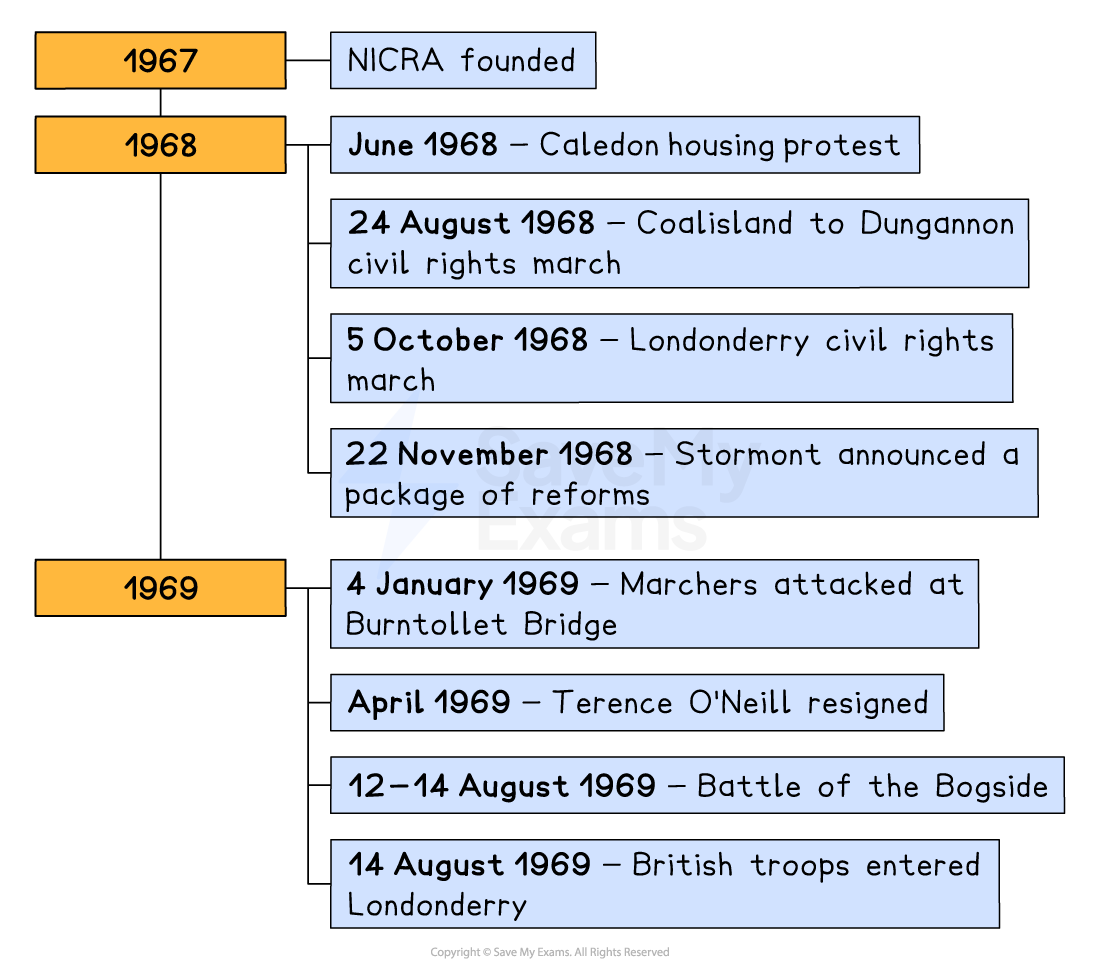
What did the movement demand?
NICRA campaigned for civil rights within Northern Ireland rather than for a united Ireland; these included:
one person, one vote in local elections
an end to gerrymandered electoral boundaries
fairer access to housing and public employment
repeal of the Special Powers Act
disbandment of the B Specials
The movement drew on the methods of the American civil rights movement
Campaigners used marches and adopted the anthem "We Shall Overcome"
Most supporters were Catholic, although the movement also attracted trade unionists, liberals, socialists and some Protestants
The marches of 1968
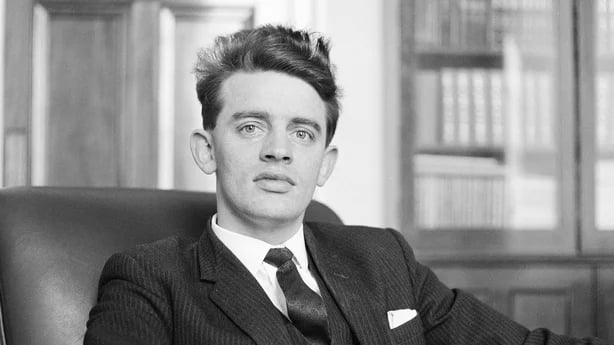
Austin Currie, c.1964. Photo: RTÉ Stills Library / RTÉ Archives.
A housing dispute in Caledon in June 1968 helped trigger wider protest
Nationalist Stormont MP Austin Currie occupied a council house that had been allocated to a young, unmarried Protestant woman ahead of Catholic families
His eviction was filmed and received national attention
The first major civil rights march took place from Coalisland to Dungannon on 24 August 1968
The police changed the route after unionist objections
The march ended without serious violence
A march planned in Londonderry on 5 October 1968, became a turning point
Minister of Home Affairs William Craig banned it from the Waterside and the city walls
Marchers continued, and the RUC used batons and water cannons against them
Television footage of injured protesters was shown internationally, bringing wider attention to Northern Ireland
Protest increased after October
Students at Queen's University, Belfast, formed the People's Democracy
Ian Paisley and Major Ronald Bunting organised counter-demonstrations
Some marches were banned or redirected because of the threat of clashes
Many Catholics believed the RUC would not protect them, while some unionists feared that republicans would use the civil rights campaign to weaken Northern Ireland's position within the United Kingdom
Reform and its limits
Stormont announced a reform programme on 22 November 1968
It followed a meeting at Downing Street in November 1968, where Wilson pressed O'Neill to speed up reform
Londonderry Corporation was to be replaced by a Development Commission
An ombudsman would investigate complaints against public bodies
The company vote was abolished, but "one person, one vote" in local elections was not introduced
O'Neill appealed directly to the public on television on 9 December 1968
He asked civil rights campaigners to stop marching so that reform could proceed
He also warned hard-line unionists that Westminster might intervene if Stormont failed to restore order
The appeal temporarily reduced protest, but it did not resolve the main disputes
Civil rights campaigners believed the reforms did not go far enough
Hard-line unionists believed O'Neill had already conceded too much
"In Londonderry and other places recently a minority of agitators determined to subvert lawful authority played a part in setting light to highly inflammable material. But the tinder for that fire in the form of grievances real or imaginary had been piling up for years”
Captain Terence O'Neill, Prime Minister of Northern Ireland. Television broadcast, 9 December 1968
Approach: O’Neill’s television broadcast was aimed at both civil rights campaigners and unionists. He presented reform as necessary but also described some protesters as agitators and warned against further disorder. This makes the source useful for showing the pressure he faced from both communities and his attempt to maintain support for Stormont
Examiner Tips and Tricks
Keep 1968 and 1969 distinct. In 1968, the civil rights movement was mainly a campaign for reform within Northern Ireland. It did not begin as a campaign for Irish reunification. The movement became connected to wider violence as marches met opposition from loyalists and force from the RUC, helping turn demands for reform into a broader political crisis.
The outbreak of violence and the deployment of troops, 1969
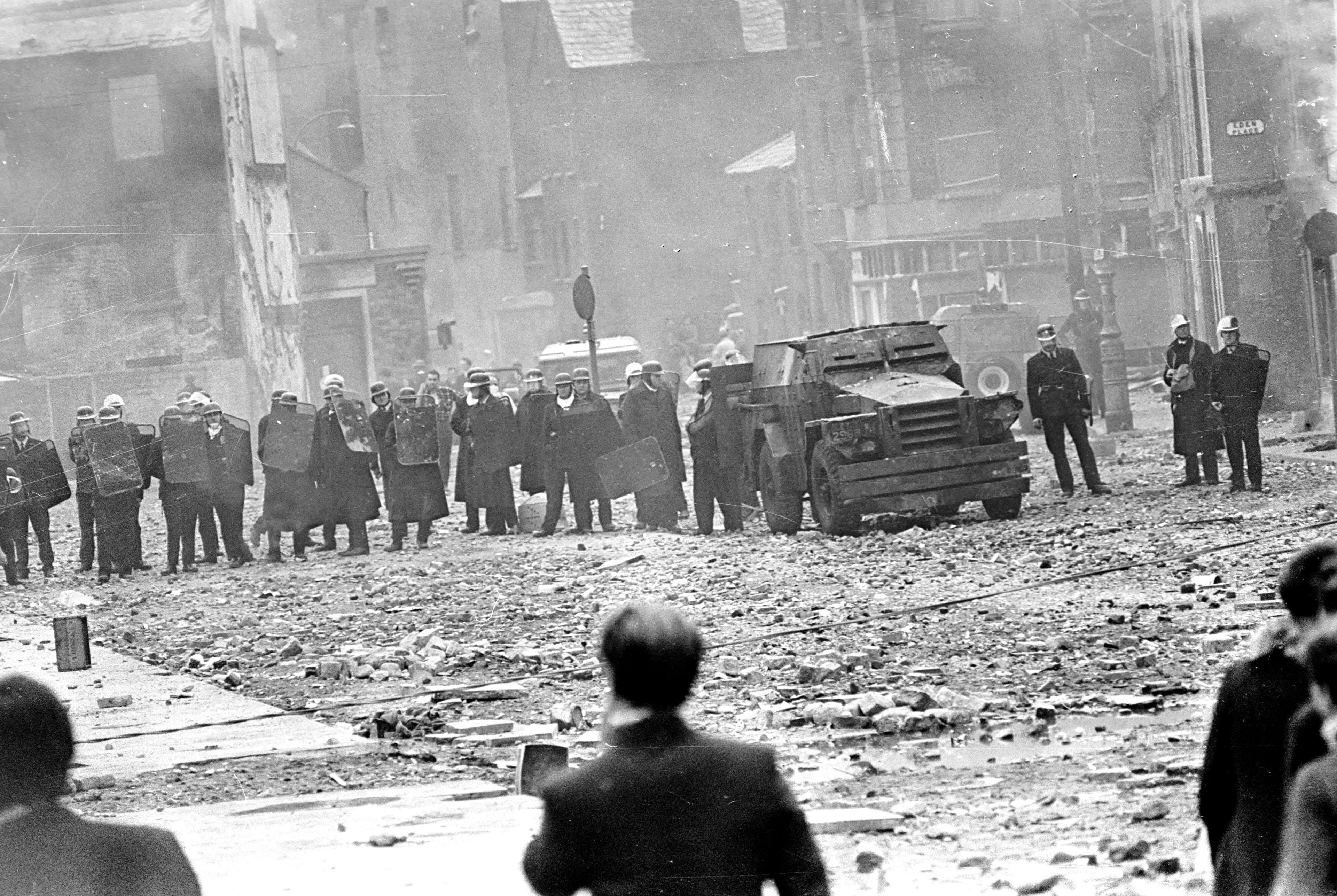
From protest to disorder
The People's Democracy march from Belfast to Londonderry, held from 1 to 4 January 1969, ended the temporary calm that had followed O'Neill's December appeal
On 4th January, loyalists attacked the marchers at Burntollet Bridge
Further rioting followed in Londonderry
Catholics accused the RUC of failing to protect the marchers and acting with the attackers
O'Neill's position continued to weaken
A general election in February 1969 failed to strengthen his support
He resigned in April 1969 and was replaced by James Chichester-Clark
The Battle of the Bogside
The annual Apprentice Boys march took place in Londonderry on 12 August 1969
Its route passed close to the mainly Catholic Bogside
Residents had already built barricades because they expected violence
Fighting began after clashes around the march
The RUC attempted to enter the Bogside
Residents resisted with stones and petrol bombs
The RUC used CS gas but could not take control of the area
The Battle of Bogside continued from the 12 to 14 of August
Violence then spread to other parts of Northern Ireland
Severe rioting took place in Belfast, where entire streets of houses were burned
Thousands of families were forced from their homes, most of them Catholic
Operation Banner
The RUC became unable to control the disorder, and the Stormont government requested military assistance
British troops entered Londonderry on 14 August 1969
Troops were deployed in Belfast the following day
The deployment was known as Operation Banner
Many Catholics initially welcomed the soldiers
They regarded the army as more neutral than the RUC and the B Specials
Some believed the troops would protect Catholic areas from loyalist attacks
The Downing Street Declaration of 19th August 1969 set out the response of the British and Northern Irish governments
The army commander took overall responsibility for security operations
Both governments promised to continue political reform
The deployment was presented as temporary
Home Secretary James Callaghan visited Londonderry and Belfast in August 1969
The B Specials were disbanded in 1970 following the Hunt Report
“The United Kingdom Government have ultimate responsibility for the protection of those who live in Northern Ireland when, as in the past week, a breakdown of law and order has occurred ... They emphasise again that troops will be withdrawn when law and order has been restored.”
Downing Street Declaration, a joint declaration between the British and Northern Ireland governments, 19 August 1969
Approach: The joint declaration presented the deployment of troops as a temporary response to the breakdown of law and order. It is useful for showing what the British and Northern Irish governments wanted the public to believe in August 1969. However, its promise that troops would be withdrawn once order was restored should be compared with the army’s continued presence in Northern Ireland.
What followed?
The violence of 1969 changed the nature of the conflict
Loyalist paramilitary organisations expanded
The Irish Republican Army (IRA) split at the end of the year
The Provisional IRA broke away from the Official IRA
It began an armed campaign against the British presence in Northern Ireland
The arrival of British troops did not end the conflict
It marked the beginning of a longer period of direct British involvement
Examiner Tips and Tricks
Do not assume that Catholics opposed the arrival of British troops from the beginning. Many initially welcomed them as protection from the RUC, the B Specials and loyalist violence. The later breakdown in relations is therefore important because attitudes towards the army changed over time
Why did the 'Troubles' erupt in Northern Ireland?
The 'Troubles' developed from a combination of long-term problems and short-term events between 1921 and 1969
Some evidence is outlined in the key factors below
Structural discrimination under Stormont
The Ulster Unionist Party governed Northern Ireland continuously from 1921, with little prospect of losing power
Local government boundaries were drawn to preserve unionist control, including in some towns with Catholic majorities
Property qualifications prevented many adults from voting in local elections
Unionist-controlled councils influenced the allocation of public housing and senior public appointments
The RUC and B Specials were overwhelmingly Protestant, while the Special Powers Act 1922 gave the authorities wide powers of arrest and search
These arrangements created long-term resentment among Catholics and nationalists, particularly over voting rights, housing, employment and policing
The civil rights movement and the failure of reform
NICRA campaigned for reforms that Stormont found difficult to grant without angering unionist supporters
O'Neill's reforms of November 1968 addressed some complaints but did not introduce one person, one vote in local elections
The reforms satisfied neither side
Civil rights campaigners believed they did not go far enough
Hard-line unionists believed O'Neill had already conceded too much
O'Neill's television appeal in December 1968 briefly reduced protest, but the underlying disputes remained unresolved
The failure to reach a settlement meant the demands for reform continued while opposition from unionists also increased
Growing mobilisation on both sides
Civil rights marches increasingly became points of confrontation
Some unionists viewed marches through particular areas as a challenge to their control
Loyalist counter-demonstrations led to bans, route changes and clashes
Ian Paisley and Major Ronald Bunting organised opposition to civil rights marches
The UVF reformed in 1966 and carried out sectarian killings
Republicans and left-wing activists also took part in the civil rights movement
Some unionists used their involvement to argue that the campaign was really intended to weaken Northern Ireland's position within the United Kingdom
As both communities became more organised, it became increasingly difficult to keep peaceful protest separate from wider sectarian conflict
The response of the British government
Westminster allowed Stormont to manage Northern Ireland's domestic affairs for almost 50 years
Wilson's government pressured O'Neill to introduce reform but did not directly take control
British troops were deployed only after order had broken down in August 1969
The Downing Street Declaration described the deployment as temporary and left the Stormont system in place
The British government, therefore, reacted to the crisis once violence had already spread, rather than addressing the underlying political problems before the breakdown of order
Examiner Tips and Tricks
Avoid a single-cause explanation. Separate the long-term conditions, such as discrimination under Stormont, from the short-term triggers of 1968 and 1969, including the civil rights marches, loyalist counter-demonstrations, the failure of reform and the Battle of the Bogside

Unlock more, it's free!
Join the 100,000+ Students that ❤️ Save My Exams
the (exam) results speak for themselves:

Was this revision note helpful?
