Industrial Relations & Labour's Decline, 1964-1970 (AQA A Level History: Component 2: Depth study): Revision Note
Exam code: 7042

Summary
Labour and the trade unions worked closely together after 1964
However, the relationship broke down from 1966 as major strikes hit the economy
Barbara Castle's white paper "In Place of Strife" (1969) proposed legal limits on strikes, including a 28-day cooling-off period and strike ballots
Union leaders, at least 50 Labour MPs and Home Secretary James Callaghan forced Harold Wilson to drop the plan in June 1969
Harold Wilson kept the party together in public, but rivalries with George Brown, James Callaghan and Roy Jenkins ran through the government
By 1970, both Conservative and Labour were questioning the post-war consensus on full employment and state planning
The key question weighs several factors: the breakdown in industrial relations, Labour's economic record, divisions inside the party and Conservative strength under Edward Heath
Industrial relations and the trade unions
Unions and the post-war consensus
Trade union influence formed an important part of the post-war consensus
Labour and Conservative governments after 1945 aimed to maintain full employment
Governments also tried to involve the unions in economic decision-making
Trade unions had broad public support
In opinion polls during the early 1960s, close to 60% of people viewed them favourably
Wilson's economic plans depended on cooperation with the unions
Trade union leader Frank Cousins became Minister of Technology in 1964
The prices and incomes policy relied on unions accepting limits on wage increases
The TUC agreed to a voluntary pay norm of 3.5% in 1965
The Trades Disputes Act (1965) restored legal protections removed by the Rookes v Barnard judgment (1964)
Relations break down, 1966–1967
Major strikes affected the economy and relations with the government
The National Union of Seamen held a long strike in 1966
This contributed to a sterling crisis
A national dock strike began in autumn 1967
It reduced exports
It worsened the balance of payments
Wilson's handling of the seamen's strike angered parts of the Labour left
The government opposed the strike
Wilson called the seamen's leaders "a tightly knit group of politically motivated men"
Frank Cousins resigned from the Cabinet in 1966
He opposed the government's prices and incomes policy
The Prices and Incomes Freeze introduced in 1966 did not prevent further disputes
Workers continued to strike for higher pay
The wildcat strike problem
A growing amount of industrial action began outside the control of national union leaders
These unofficial disputes became known as wildcat strikes
They were often organised by shop stewards (local union representatives)
National union leaders could not always control action at local level
Agreements made with union leaders were, therefore, difficult to enforce across every workplace
The Donovan Commission (Royal Commission on Trade Unions, 1965–1968) blamed unofficial strikes on weak bargaining at workplace level
Its report in 1968 rejected legal controls on strikes, but Castle's In Place of Strife went further
The Conservative opposition developed its own proposals for reform
Under Edward Heath, the party published the Fair Deal at Work in 1968
It proposed legal limits on trade union power
Strike activity continued to increase
By 1970, Britain was losing around 11 million working days a year to strikes, more than double the 1968 figure
Union confidence grew as membership rose from 10.2 million in 1964 to 11.2 million in 1970
New left-wing leaders such as Hugh Scanlon (AEU) and Jack Jones (TGWU) were less willing to compromise
Examiner Tips and Tricks
Do not treat strikes as a separate issue from Labour’s economic problems:
The seamen’s strike of 1966 added to pressure on sterling
The dock strike of 1967 reduced exports and worsened the balance of payments
Rising strike activity also made the government question whether voluntary cooperation with the unions was still working
Strong responses explain why industrial relations mattered to Labour’s wider record, rather than simply listing the main disputes
'In Place of Strife', 1969
Castle's white paper
Barbara Castle became Secretary of State for Employment and Productivity in April 1968
She began planning legal controls on unofficial strikes
Castle sat on the Labour left
She supported a strong trade union movement
She also believed unions needed to accept greater responsibility for industrial action
In January 1969, Castle published "In Place of Strife"
It was a white paper
This set out a proposed direction for government policy
It did not introduce a new law
The proposals could be changed or withdrawn before legislation reached Parliament
The main proposals
Proposal | Why did the unions object? |
|---|---|
A 28-day cooling-off period before a strike | The delay could reduce the immediate impact of industrial action |
Government power to settle demarcation disputes | Ministers would decide disagreements that unions had previously settled themselves |
Compulsory strike ballots before industrial action | Ballots could delay action and reduce the authority of workplace meetings |
An Industrial Board able to impose financial penalties on unions and workers who broke the rules | Trade union disputes would be brought into the legal system |
Castle's proposals also expected employers to follow agreements reached with unions
This was intended to make industrial relations rules apply to both employers and workers
Why did the plan collapse?
In Place of Strife received support from some voters and politicians
Opinion polls suggested that many voters approved of the proposals
Chancellor Roy Jenkins supported the white paper
Some Labour MPs also backed legal reform
Opposition from trade unions and within the Labour Party was stronger
Jack Jones of the Transport and General Workers' Union led the union campaign against the proposals
Over a million workers stopped work in protest on 1st May 1969
Home Secretary James Callaghan opposed the plan inside the Cabinet
At least 50 Labour MPs were prepared to vote against the government
Wilson withdrew In Place of Strife in June 1969
The Trades Union Congress (TUC) gave a "solemn and binding" undertaking to deal with unofficial strikes itself
This allowed the government to drop the proposals without losing a vote in the House of Commons
No new legal controls on strikes were introduced before Labour left office in 1970
Edward Heath introduced the Industrial Relations Act (1971)
Examiner Tips and Tricks
Remember that In Place of Strife was a 1969 white paper, not a law. Wilson withdrew it before it reached Parliament, following opposition from trade unions, Labour backbenchers and members of the Cabinet
Do not confuse it with Heath’s Industrial Relations Act (1971), which did become law
Labour divisions and the end of the post-war consensus
Wilson as a uniting leader
The traditional division between Labour's left and right became less visible after 1964
Nye Bevan died in 1960
Hugh Gaitskell died in 1963
This removed the established leaders of both wings
Wilson's modernisation programme gave the two wings a shared policy
The white heat of technology linked Labour with science and industrial change
Older disputes received less attention
This included the argument over Clause IV and nationalisation
He was also able to appeal to various sections of the Labour Party, including the left, centre and right
Wilson's appeal to the left of the Labour Party |
|
|---|---|
Wilson's appeal to the right of the Labour Party |
|
Rivalries at the top
Wilson faced tensions with several senior Labour politicians, although they did not form a united group against him
George Brown remained resentful after losing the Labour leadership election in 1963
Their relationship became increasingly difficult
Brown was moved to the Foreign Office after the 1966 election
Wilson was also suspicious of Roy Jenkins, a leading figure on the Gaitskellite right
During the sterling crisis of 1966, Jenkins supported devaluation
Wilson feared that Jenkins might be using the crisis to strengthen his own position
However, Jenkins and James Callaghan disagreed on several major issues
These included Europe, devaluation, liberal reform and trade union policy
Callaghan later opposed the union reforms supported by Jenkins
Discontent of the left
Criticism from the Labour left grew from 1966
Foreign and defence policy caused particular anger
British support for the United States over Vietnam became a major issue
Left-wing critics argued that Labour had continued several Conservative policies
They called for faster socialist reform
Discontent also spread outside Parliament
Trade union activists became more critical
Some members of local government and younger Labour supporters also became frustrated
"WHAT'S WRONG WITH OUR GOVERNMENT?
The short answer is plenty. No glimmer of changed strategy, an enlarged vision, since the election. Pathetic acceptance of Tory legacy in defence and foreign. We and our Labour government share the guilt for the continuance of the infamy of Vietnam."
Michael Foot, left-wing Labour MP, front-page article in Tribune, June 1966
Approach: The source is useful for showing the concerns of Labour’s left, especially over Vietnam and defence policy. However, it represents one section of the party and should be compared with evidence from ministers, the Labour right and government records
The consensus under strain
By 1970, parts of the post-war consensus were being questioned
Economic difficulties continued despite government planning
Poverty and other social problems remained
Relations between the government and the trade unions had also deteriorated
The failure of In Place of Strife showed the limits of voluntary cooperation
The Conservatives were beginning to question established economic policies
Heath and his shadow cabinet criticised close state planning
They also questioned whether full employment should remain the government's main economic priority
At the Selsdon Park conference in January 1970, they backed tax cuts, less state intervention and trade union reform
Examiner Tips and Tricks
When explaining why the post-war consensus was under strain, link political change to the problems governments were trying to solve:
economic planning had not prevented repeated financial difficulties
cooperation with the trade unions had become harder to maintain
by 1970, the Conservatives were beginning to question both state planning and the priority given to full employment
The loss of the 1970 election
Why did Labour expect to win?
The economic position had improved by 1970
Roy Jenkins had achieved a balance of payments surplus by 1969
Labour led in almost every opinion poll during the campaign
Wilson had won two general elections, while Heath had lost heavily in 1966, his only election as leader
Wilson was also more popular with the public than Heath, who was often described as "dull"
The economic recovery gave Labour confidence before the election
Wilson's government appeared to have moved beyond some of the difficulties of 1966–1968
Factors working against Labour
Labour's record included several setbacks between 1966 and 1969
Devaluation in 1967 affected its reputation for economic management
The withdrawal of In Place of Strife showed the level of opposition inside the Labour movement
Heath had developed a reputation for hard work and competence
Conservative policy had become clearer
The Fair Deal at Work offered proposals for trade union reform
The Conservatives promised less government involvement in the economy (laissez-faire)
Immigration remained a political issue
Enoch Powell's 1968 "Rivers of Blood" speech may have moved some voters towards the Conservatives
However, Heath dismissed Powell from the shadow cabinet due to this speech
Some voters were concerned about social change
Parts of the electorate associated Labour with the permissive society
The election result
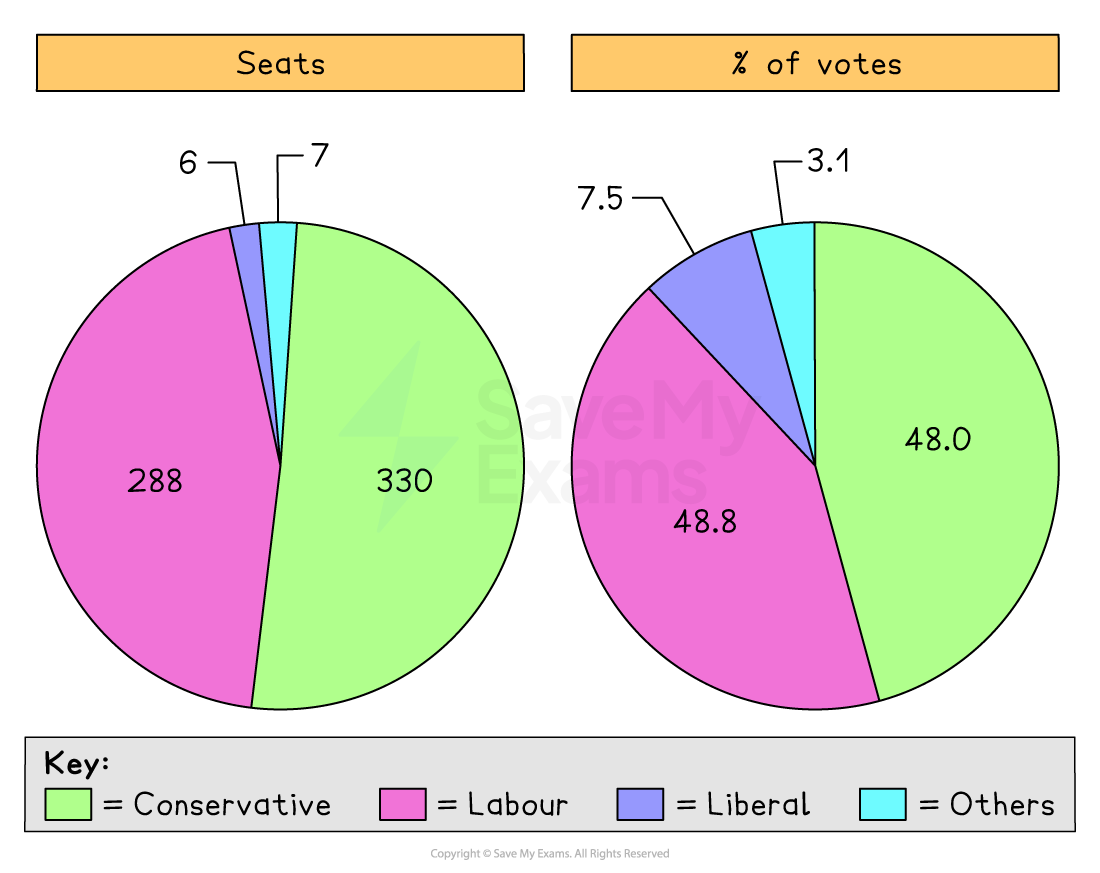
The final result differed from most opinion polls
The Conservatives won 330 seats
Labour won 288 seats
The Conservative majority was 30 seats
The Conservatives received 46.4% of the vote
Labour received 43.1%
Turnout fell to 72%
Some voters moved towards the Conservatives during the final days of the campaign
Some disillusioned Labour voters abstained
A fall in the Liberal vote helped the Conservatives win a number of marginal seats
Examiner Tips and Tricks
Do not simply describe the 1970 election result as unexpected. Explain why Labour lost despite leading in most opinion polls by considering its economic record, worsening industrial relations, the withdrawal of In Place of Strife, Conservative policies under Heath, concerns about immigration and social change and the late movement of voters towards the Conservatives
Why did Labour lose power in 1970?
Labour's defeat in 1970 was caused by a combination of political, economic and social factors, rather than one single issue
Some of the factors are listed below with key evidence
Industrial relations and In Place of Strife
Strike activity increased during the second half of the 1960s
The seamen's strike of 1966 affected confidence in sterling
The dock strike of 1967 reduced exports
The government did not improve industrial relations
In Place of Strife was withdrawn in June 1969
Union leaders, Labour MPs and members of the Cabinet opposed the proposals
Heath used trade union reform as part of the Conservative campaign
Labour's economic record
The government spent much of the period responding to economic crises
Sterling crises occurred in 1965, 1966 and 1967
The pound was devalued in 1967
Jenkins's recovery policies involved:
tax increases
reductions in government spending
The economic position had improved by the election
A balance of payments surplus had been achieved by 1969
Inflation remained high during 1969-1970
Unemployment rose above 500,000 (about 2.5%) after 1967
However, economic growth remained slow
Divisions within the Labour Party
Wilson maintained a public appearance of party unity for much of the period
Modernisation gave the left and right a shared policy
The deaths of Bevan and Gaitskell removed the leaders of the two established wings
Internal tensions remained
Wilson feared challenges from Brown, Callaghan and Jenkins
Callaghan opposed union reform from inside the Cabinet
The Labour left criticised the government over Vietnam, defence and the pace of reform
"Wilson had united the Labour Party as it had never been united since 1945. In normal circumstances approval and praise from the Left would almost certainly provoke an opposite reaction from the Right."
Paul Foot, a left-wing campaigner writing in the 1968 edition of the journal International Socialism
Approach: Paul Foot was a journalist and campaigner from the far left. His claim that Wilson had united Labour is useful for showing the party’s public appearance. The fact that the comment came from a left-wing critic makes the praise notable. However, it should be compared with evidence of Cabinet rivalries and criticism from within the party
Conservative policies under Heath
Heath had led the Conservatives since 1965
He had a reputation for hard work and competence
The Fair Deal at Work gave the Conservatives a clear policy on trade unions
The Conservatives questioned parts of the post-war consensus
They criticised close state planning and whether full employment should remain the main economic aim
Late polling in marginal seats showed movement towards the Conservatives
Social and cultural concerns
Some voters reacted against recent social change
Parts of the electorate connected Labour with the permissive society
Powell's speech kept immigration in public debate
Expectations of Labour had been high in 1964
Several plans for modernisation had not met their original targets by 1970
Examiner Tips and Tricks
Show how the factors were connected rather than treating each one separately. Strikes damaged exports and confidence in sterling, while divisions within Labour contributed to the withdrawal of In Place of Strife. Heath was then able to offer different policies on trade union reform and economic planning

Unlock more, it's free!
Join the 100,000+ Students that ❤️ Save My Exams
the (exam) results speak for themselves:

Was this revision note helpful?
