The 'Winter of Discontent' & the Fall of Labour, 1978-1979 (AQA A Level History: Component 2: Depth study): Revision Note
Exam code: 7042

Summary
James Callaghan led a minority government from 1976
The Lib-Lab Pact of 1977 helped keep Labour in office
After the pact ended, Labour depended on support from the nationalist parties
Labour's pay policy broke down in autumn 1978
The Trades Union Congress (TUC) rejected the 5% pay limit
Ford workers then secured a 17% pay settlement
The 'Winter of Discontent' (1978–1979) brought widespread strike action
Lorry drivers and public-sector workers disrupted transport, hospitals, schools, and refuse collection
The devolution referendums of 1 March 1979 failed: Scotland did not reach the 40% threshold and Wales voted No
The Scottish National Party (SNP) then withdrew its support from the government
Labour lost a vote of no confidence by 311 votes to 310 on 28 March 1979
It then lost the general election on 3rd May 1979
The key question considers several causes of Labour's fall:
the collapse of pay policy
the breakdown of relations with the unions
long-term economic weakness
the rise of New Right ideas
the loss of Labour's parliamentary support
Callaghan's leadership
Callaghan as prime minister (1976-1979)
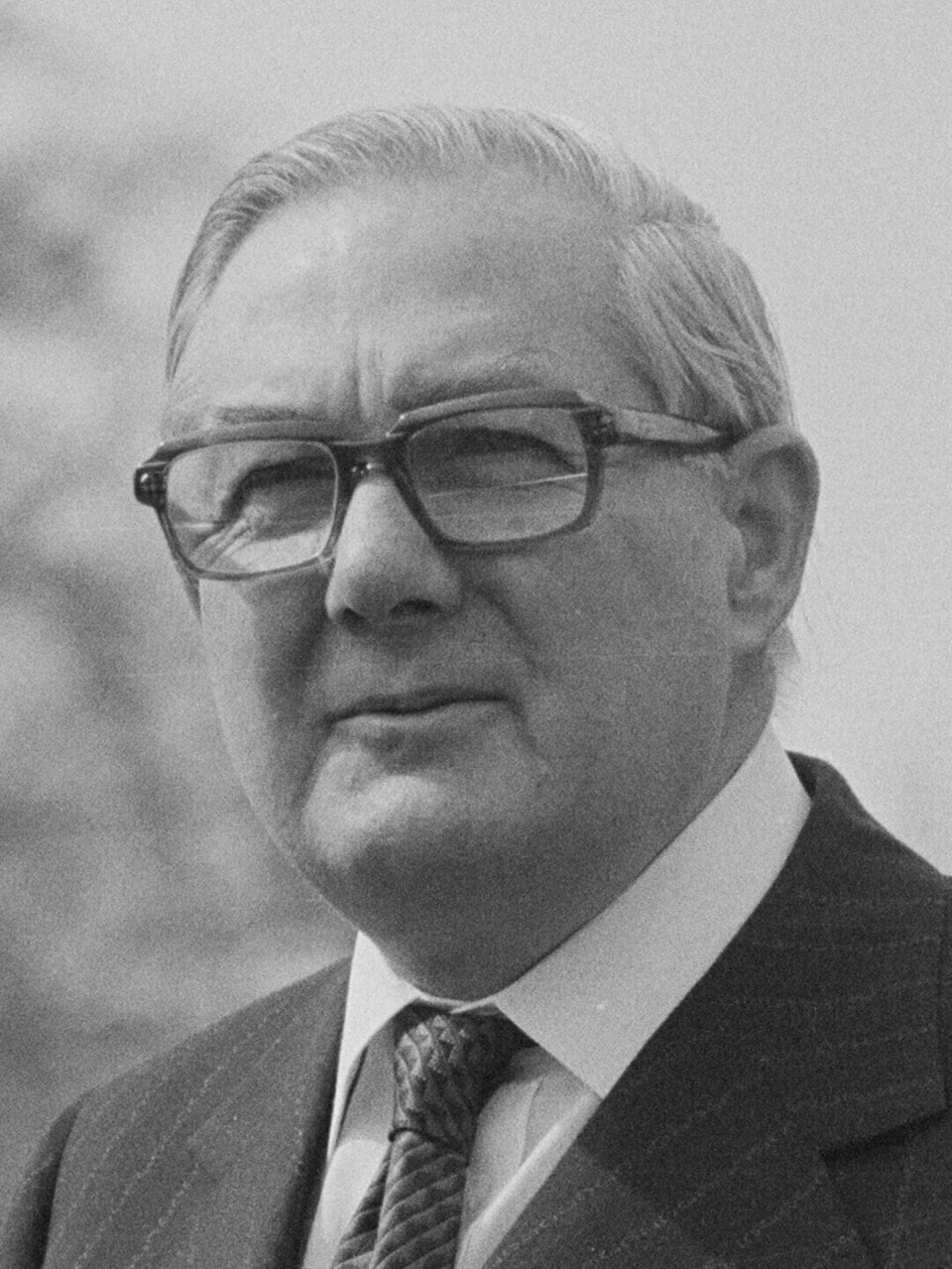
Marion S. Trikosko / U.S. News & World Report Collection, Library of Congress, Prints and Photographs Division, LC-DIG-ppmsca-53218. Public domain.
James Callaghan became prime minister in April 1976, following Harold Wilson's resignation
He was the only prime minister to have held all four great offices of state:
Chancellor of the Exchequer
Home Secretary
Foreign Secretary
Prime Minister
He brought long experience and close links with the trade unions
Callaghan led a minority government for most of his premiership
The Lib-Lab Pact of 1977 secured Liberal support for key Commons votes
When the pact ended, Labour relied on support from nationalist MPs
His government remained in office despite having no overall Commons majority
Callaghan's strengths and weaknesses
Strengths |
|
|---|---|
Weaknesses |
|
Callaghan and the trade unions
Callaghan's authority partly rested on his relationship with the unions
He had helped defeat 'In Place of Strife' in 1969
He had consistently opposed legal restrictions on trade union power
Union leaders had supported several years of voluntary pay restraint
In return, Labour introduced social reforms and repealed Heath's industrial relations legislation
By 1978, the relationship was under growing strain
Three years of pay restraint had reduced real wages
Lower-paid public-sector workers had fallen further behind
Jack Jones retired as leader of Transport and General Workers' Union (TGWU) in 1978
His successor, Moss Evans, was less willing to restrain wage demands
National union leaders were also finding it harder to control local disputes
They could agree pay restraint with the government but could not always secure the support of their members
Industrial unrest grew before the Winter of Discontent: mass picketing at the Grunwick film-processing plant (1976–1978) and a national firefighters' strike (November 1977–January 1978) tested the government's pay policy
The decision to delay the election
Callaghan was widely expected to call a general election in autumn 1978
Inflation had fallen below 10%
Unemployment had started to fall
Labour and the Conservatives were close in the opinion polls
At the TUC Congress on 5 September 1978, Callaghan suggested that an election might be called
Two days later he announced on television that there would be no election in 1978
Callaghan expected the economy to improve further
North Sea oil production was increasing
Another year of recovery might have strengthened Labour's position
The decision left the government facing the winter with its 5% pay policy already under pressure
Once the winter strikes began, Labour could not choose a good moment for an election until the crisis was over
Examiner Tips and Tricks
Do not describe Callaghan as simply passive. His patience, experience and union links helped him keep a divided minority government in office but those same qualities made him reluctant to confront the unions when the 5% pay policy collapsed
Judge the decision to delay the election using what Callaghan knew in September 1978. The economy was improving, and Labour remained competitive in the polls even though the decision later proved costly
The 'Winter of Discontent', 1978-1979
The 5% pay limit
In July 1978 the government introduced a 5% limit on pay increases for the coming year
This was the fourth stage of the incomes policy that had operated since 1975
Inflation was still around 8%, so a 5% rise led to a further fall in real wages
The policy lacked support
The TUC rejected the limit in autumn 1978
The Labour Party conference also voted against it
The government had no legal power to enforce the limit in private companies
Its main sanction was to withhold government contracts from employers that agreed larger pay rises
The Ford strike and the collapse of pay policy
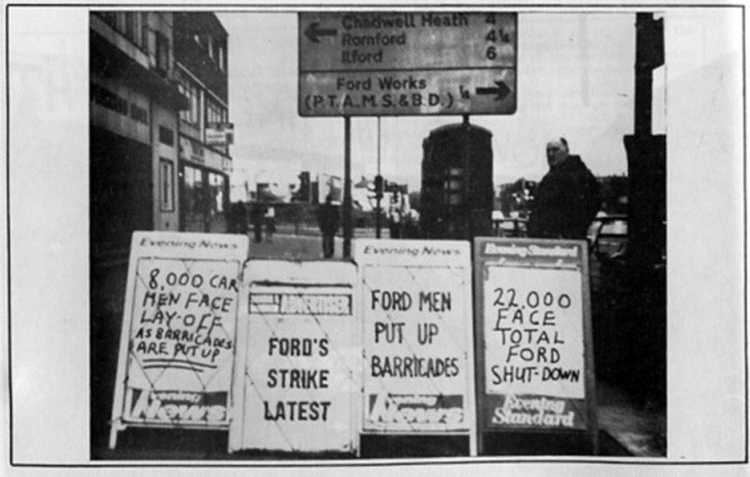
Ford strike, 1978. Photographer unknown; reproduced from a Red Notes publication. Image via Alexei Schwab/Flickr.
Ford workers rejected a 5% offer and began strike action in late September 1978
Around 57,000 workers were involved across Ford's British factories
After nine weeks Ford agreed to a 17% pay settlement in November 1978
The government initially planned to penalise Ford for breaking the limit
In December 1978, MPs voted against imposing the penalty
The government was left without an effective way to enforce the 5% policy
The Ford settlement became the figure against which other unions measured their own pay claims
Strikes in transport and distribution
Road haulage drivers in the TGWU began strike action in January 1979
They eventually secured pay rises of around 20%
Secondary picketing spread the effects of the dispute
Pickets targeted ports, depots and factories that were not directly involved in the original strike
Supplies of petrol, food, and industrial materials were disrupted
Because lorries carried goods between ports, factories, shops and fuel depots, the action affected large parts of the economy
Public-sector strikes
Public-sector workers followed the haulage drivers into dispute during January and February 1979
The National Union of Public Employees (NUPE) and other unions organised a National Day of Action on 22 of January 1979
Those taking industrial action included:
hospital ancillary workers
school caretakers
refuse collectors
grave diggers
The disruption became highly visible
Refuse remained uncollected in some areas
Army ambulances were held in reserve during the ambulance workers' dispute
A strike by grave diggers in Liverpool attracted widespread press attention
The effect of the winter weather
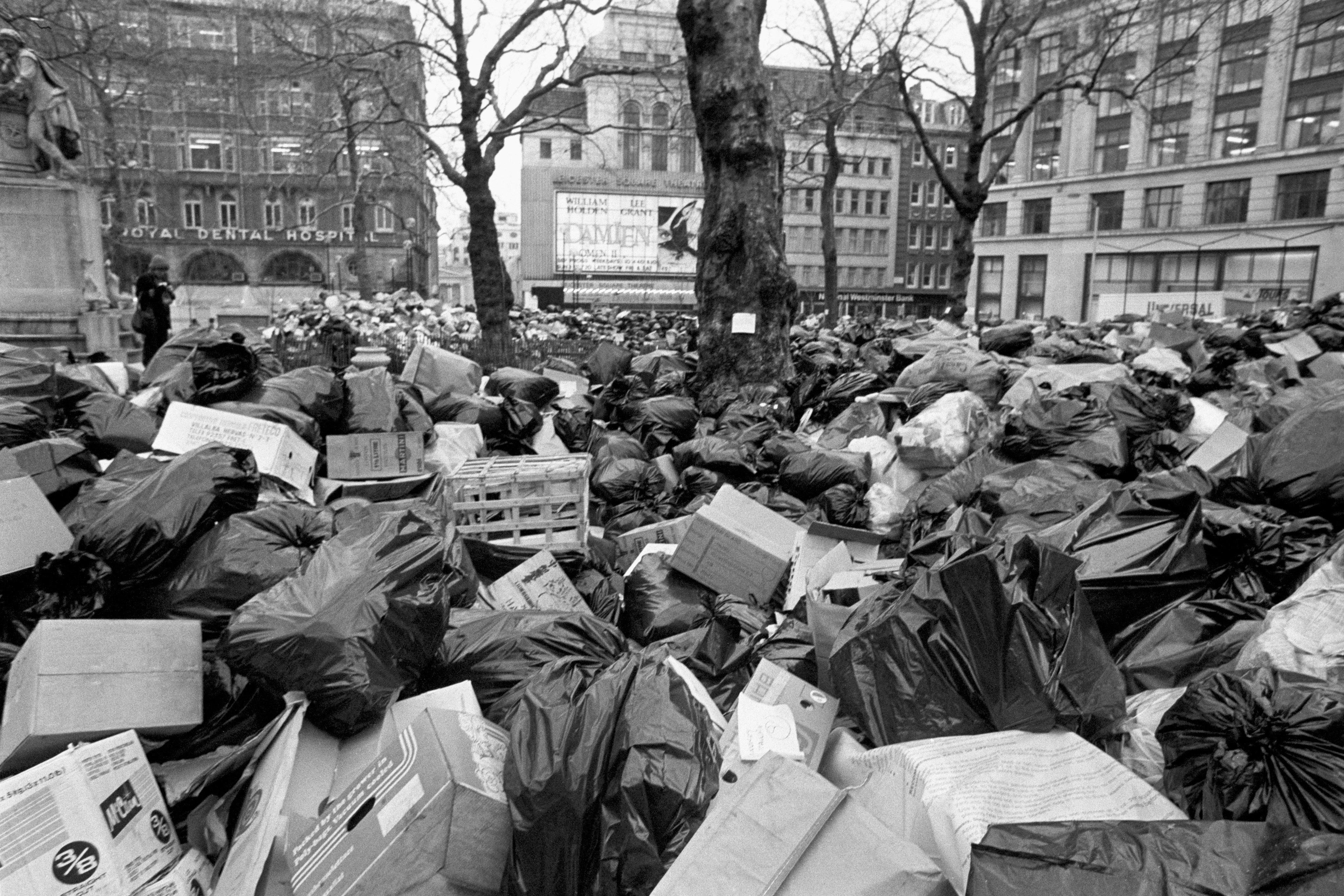
Britain experienced its coldest winter for 16 years
Snowstorms cut off some areas and added to transport problems
Uncollected refuse in Leicester Square and delays to burials in Liverpool became prominent images of the crisis
They received extensive television and newspaper coverage
How large were the disputes?
The strikes were smaller than the miners' disputes of 1972 and 1974
Most settlements reached by March 1979 averaged around 10%
Many of the strikes were unofficial
National union leaders did not always call or control the action
This showed the growing difficulty union leaders faced in securing the support of local members
The political impact was greater than the economic scale of the disputes
Images of picket lines, closed hospitals and uncollected refuse shaped public opinion
Labour appeared unable to maintain its pay policy or control industrial unrest
"If trade unions and their pickets are allowed to be above the normal laws of contract then a free society based on the law of contract will break down. It will be glum if Lancastrians during a water strike have to get appalling diseases, if Merseyside children during the social worker strike have to continue to be battered, if housewives in an island blockaded by lorry drivers have to go hungry, if patients deprived of ambulances and other emergency transport have to die, if many more firms have to go bust, many more workers have to become unemployed, more of Britain's exports and imports have to stay stuck at the docks, if sewage has to run in the streets, hyperinflation has to escalate, before Britain's politicians recognise the fact"
A comment written in The Economist on the Winter of Discontent, published on 20 January 1979
Approach: As a magazine that generally supported free market economics, it presented the strikes as a threat to contracts, public order, and the wider economy. Its examples show how opponents of the unions described the crisis but its dramatic predictions should be compared with the scale and eventual settlement of the disputes
Callaghan's return from Guadeloupe
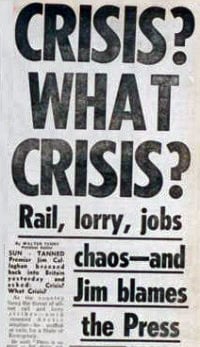
© News Group Newspapers Ltd / The Sun, 11 January 1979
Callaghan returned from an international summit in Guadeloupe on 10 of January 1979
He told reporters that he did not accept that Britain faced mounting chaos
The Sun reported his comments under the headline "Crisis? What crisis?"
Callaghan did not use those exact words
The headline, however, became closely associated with the government's response
By 1979, most national newspapers, including The Sun, the Daily Mail and the Daily Express, supported the Conservatives
"Thursday 4 January 1979
Up at 7:30 to get the papers: all the talk at the book store was about the utter hatred of unions and strikes, etc.: one day I think this loathing will be channelled into action...
Wednesday 10 January 1979
Saw the news: Callaghan arrived back from Guadeloupe saying 'There is no chaos', which is a euphemistic way of talking about the lorry drivers ruining all production and work in the entire country, but one admires his phlegm...
Monday 5 February 1979
The TV news was about strikes galore and the mounting refuse has caused the authorities to set rat bait down and spray the stuff with disinfectant!"
Extracts taken from The Kenneth Williams Diaries published in 1993
Approach: Kenneth Williams was a well-known comic actor and broadcaster who kept detailed private diaries. He was not a politician or trade unionist, but he held strongly right-wing views and followed the news closely
His entries from January and February 1979 are useful for showing how the Winter of Discontent appeared to an ordinary member of the public through newspapers and television. However, his political views shaped what he noticed, so he focused on disorder, strikes and hostility towards the unions rather than giving a balanced account of the disputes
Examiner Tips and Tricks
Separate the scale of the strikes from their political impact. The action was smaller than the miners' strikes that had challenged Heath, but images of disrupted hospitals, refuse collection, and transport caused much greater public concern
Do not claim that union leaders controlled all the unrest. Many disputes were unofficial, showing that national leaders were losing influence over local members
The collapse of the Labour government
The loss of parliamentary support
The Lib-Lab Pact had kept Labour's minority government in office from March 1977
The 13 Liberal MPs agreed to support the government in important Commons votes
In return Labour consulted the Liberals and agreed to continue with plans for devolution
Liberal leader David Steel ended the pact in the summer of 1978
The agreement was not renewed
Labour then depended increasingly on support from the nationalist parties
The Scottish National Party (SNP) expected the government to introduce devolution for Scotland
This made the outcome of the devolution referendum important to Labour's survival
The devolution referendums, 1 March 1979
Voters in Scotland and Wales were asked whether they supported the government's plans for devolved assemblies
These assemblies would take responsibility for some domestic matters
Westminster would remain the UK Parliament
The Scotland Act (1978) and the Wales Act (1978) required referendums before devolution could take effect
Labour backbencher George Cunningham added a clause to the Scotland Act
At least 40% of the whole electorate had to vote in favour
This meant that abstentions counted in practice against devolution
Results
Nation | Yes | No | Outcome |
|---|---|---|---|
Scotland | 51.6% | 48.4% | A majority of those voting supported devolution, but the 'yes' vote represented only 32.9% of the electorate, below the required 40% |
Wales | 20.3% | 79.7% | Devolution was rejected by roughly four votes to one |
The government did not bring the Scotland Act into force
The SNP withdrew its support
SNP MPs then backed a motion of no confidence against the government
The vote of no confidence, 28 March 1979
Conservative leader Margaret Thatcher tabled a motion of no confidence
The Conservatives, Liberals and SNP voted against the government
Plaid Cymru voted with Labour
The party had secured a compensation scheme for quarry workers suffering from dust-related diseases
The government lost by 311 votes to 310
This was the first time since 1924 that a government had been defeated in a confidence vote
Callaghan announced that Parliament would be dissolved and a general election held
“The minority parties have walked into a trap. If they win, there will be a general election. I am told that the current joke going around the House is that it is the first time in recorded history that turkeys have been known to vote for an early Christmas.”
James Callaghan, Prime Minister, speaking in the House of Commons during the no-confidence debate, 28th March 1979
Approach: Callaghan's reference to the minority parties voting for an early Christmas was aimed particularly at the SNP and Liberals, warning that an election might cost them seats
The source is useful for showing Callaghan's tactics during the debate. However, it was a final attempt to discourage opposition MPs from bringing down the government rather than a detailed explanation of why Labour had lost its parliamentary support
The general election, 3 May 1979
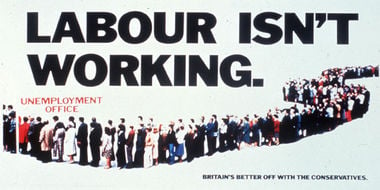
The Conservatives based their campaign on:
trade union power
unemployment
law and order
The Saatchi and Saatchi poster "Labour isn't working" attacked Labour's unemployment record
Press coverage of the Winter of Discontent continued throughout the campaign
Most national newspapers were hostile towards Labour
The result was a clear Conservative victory
Results
Party | Seats | Share of the Vote |
|---|---|---|
Conservative | 339 | 43.9% |
Labour | 269 | 36.9% |
Liberal | 11 | 13.8% |
Others | 16 | 5.4% |
The Conservatives won a majority of 43
Labour's share of the vote fell by just over two percentage points, from 39.2% in October 1974 to 36.9%
The Conservative share rose more sharply
This was helped by falling Liberal and SNP support
Large numbers of skilled and unskilled workers voted Conservative for the first time
“THIS ELECTION is about the future of Britain, a great country which seems to have lost its way.
During the industrial strife of last winter, confidence, self-respect, common sense, and even our sense of common humanity were shaken. At times this society seemed on the brink of disintegration ...
[B]y heaping privilege without responsibility on the trade unions, Labour have given a minority of extremists the power to abuse individual liberties and to thwart Britain’s chances of success. One result is that the trade union movement ... is today more distrusted and feared than ever before”
Adapted from The Conservative Party general election manifesto, 1979
Approach: The extract comes from the 1979 Conservative general election manifesto, written to persuade voters to remove Labour from office. It presents the Winter of Discontent as evidence that Labour had allowed trade unions too much power and that the country had lost confidence and direction
The source is useful for showing how the Conservatives framed the election campaign. However, it was designed to win voters, so its language exaggerates Labour's responsibility and does not give a full account of the economic or industrial problems
Examiner Tips and Tricks
Do not move straight from the Winter of Discontent to the election result. Labour fell because it lost the parliamentary support needed to remain in office and the failed devolution settlement was central to that process
Why did the post-war consensus break down by 1979?
The post-war consensus had been weakened throughout the 1970s
By 1979 both the economic policies and political agreements that had supported it were breaking down
The factors below contributed to the breakdown of the post-war consensus
The failure of incomes policy
Pay restraint had been the main method used to control inflation since 1975
The government's 5% pay limit collapsed in 1978
It was rejected by the TUC
It was also rejected by the Labour Party conference
Ford workers secured a 17% settlement, setting a precedent
In December 1978, MPs prevented the government from penalising firms that broke the limit
The policy could no longer be enforced
Both main parties concluded that national incomes policies had failed
No later British government attempted a similar national pay policy
The breakdown of cooperation with the unions
The consensus assumed that governments, employers, and trade unions could work together
This approach had continued under Labour's 'Social Contract'
By 1979, national union leaders could no longer guarantee the support of their members
Many of the strikes during the Winter of Discontent were unofficial
The government could no longer rely on union leaders to deliver wage restraint
Labour had won the elections of 1974 partly by claiming it could work more successfully with the unions than the Conservatives
The disputes of 1978 to 1979 weakened that claim
Long-term economic weakness
Stagflation had challenged the economic aims of the post-war consensus throughout the 1970s
Full employment and low inflation could no longer be maintained together
The 1976 IMF loan was followed by reductions in public spending
This weakened the belief that governments could manage the economy through higher spending
British productivity remained below that of several major competitors
Both Labour and the Conservatives used this to argue that existing economic policies needed to change
The rise of New Right ideas
Free market ideas gained support during the 1970s
Monetarism offered a different explanation for inflation
It focused on the supply of money rather than wage demands alone
The Centre for Policy Studies, founded by Keith Joseph and Margaret Thatcher in 1974, promoted:
lower government spending
reduced state intervention
greater reliance on the market
Callaghan also questioned an important part of the consensus
In his 1976 Labour Party conference speech, he rejected the idea that governments could spend their way out of recession
A Labour prime minister had, therefore, publicly challenged a policy associated with earlier post-war governments
The loss of Labour's parliamentary support
The post-war consensus had operated within a mainly two-party political system
Labour's parliamentary position weakened after 1974
Its majority of three disappeared by 1976
The Lib-Lab Pact ended in 1978
Labour then depended on support from nationalist MPs
The growth of the Scottish National Party (SNP) and Plaid Cymru weakened the traditional two-party pattern in Scotland and Wales
The failed devolution referendums led the SNP to withdraw its support
Labour lost the vote of no confidence on 28 March 1979
Conservative victory in May 1979 brought to power a government that openly rejected several parts of the post-war consensus
“There are, I believe, four main things that have contributed to Britain’s decline in the last five years. First, far too little attention has been given to wealth creation and far too much to wealth distribution. ... The second reason for the decline is that the Government have concentrated far too much power in the hands of the centralised State and left too little with the individual citizen. ... The third reason for our problems is that the balance between power and responsibility in the trade union movement needs to be restored. ... The fourth reason for our decline, this pervades the whole life of the community, is the Government’s position on the rule of law. ... The Government have doubled prices, doubled dole queues, doubled debt, diminished our defences and undermined public respect and confidence in the law”
Adapted from Margaret Thatcher, Leader of the Opposition, speech opening the no-confidence debate, House of Commons, 28 March 1979
Approach: Thatcher gave this speech while opening the no-confidence debate on the 28th March 1979. As leader of the opposition she wanted MPs to remove the Labour government and prepare the ground for a Conservative election campaign. Her emphasis on excessive government power, trade union influence, defence and law and order shows the main New Right criticisms of the post-war consensus
However, the speech was intended to defeat the government, so it presents Britain's problems in a way that supports a Conservative case for change
Examiner Tips and Tricks
You could also consider whether wider social and cultural changes weakened the consensus. People were becoming less willing to accept traditional authority, while individual choice became more important. The growth of nationalism in Scotland and Wales also made the old two-party system less stable. These points are best used as an extra factor alongside the stronger economic and industrial causes

Unlock more, it's free!
Join the 100,000+ Students that ❤️ Save My Exams
the (exam) results speak for themselves:

Was this revision note helpful?