Stresemann & Germany's International Position (AQA A Level History: Component 2: Depth study): Revision Note
Exam code: 7042

Summary
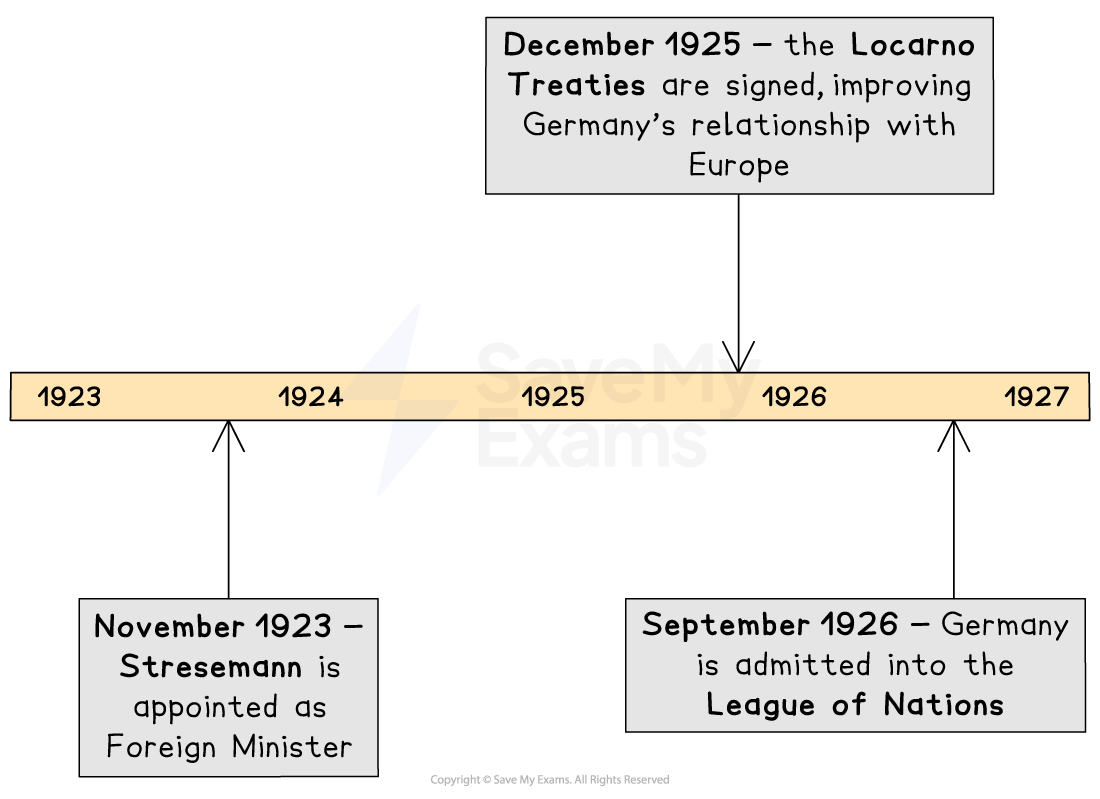
Gustav Stresemann became German Foreign Minister in 1923 and had several clear aims
Improving Germany's reputation and influence
Removing the foreign troops that were stationed in Germany
Reversing key parts of the Treaty of Versailles
He went about trying to achieve these aims by diplomatic methods rather than trying to build up Germany's armed forces and using threats
The Locarno Pact of 1925 greatly improved relations between Germany and the other European nations
It settled Germany's western borders and seemed to reduce the possibility of future wars
It also led to Germany being admitted to the League of Nations and being viewed as an equal again
At the same time, Germany was improving relations with the Soviet Union and secretly bypassing the parts of the Treaty of Versailles that limited Germany's military power
The Treaty of Berlin led to German aircraft being built and pilots being trained in the USSR
The extent to which Stresemann achieved his aims is debated by historians
Stresemann's foreign policy aims
In November 1923, Stresemann had lost his position as chancellor
The coalition government he led collapsed when the SPD decided it no longer wanted to work with Stresemann’s party, the DVP
Stresemann became Foreign Minister under the new government
As Foreign Minister, he had a number of foreign policy aims:
Restore Germany to the position of being a Great Power
Recover some of the lands lost to Poland and Czechoslovakia as part of the Treaty of Versailles
Reduce the burden of reparations
See foreign troops leave the Rhineland
He was unable to achieve these aims militarily, so he set about improving relations with other countries
He hoped to achieve many of his aims through peaceful cooperation with other nations, especially Britain and France
The Locarno Pact, 1925
The Locarno Pact was actually a series of agreements between Germany, Britain, France, Italy and Belgium
The nations met in Locarno, Switzerland, on 16th October and signed the pacts in London on 1st December 1925
All nations entered the agreements as equals
This was a contrast to the Treaty of Versailles, which was widely viewed as a diktat in Germany
The terms of the Locarno Pact
France and Germany promised to keep peace with each other
Germany accepted its western borders as stated in the 1919 Treaty of Versailles
This infuriated the extremist parties in Germany
All members promised to keep the Rhineland demilitarised
The members also promised to explore the possibility of admitting Germany into the League of Nations
Impact of the Locarno Pact
Stresemann considered the Locarno Pact as his greatest achievement because it:
Reduced the possibility of future wars
Improved the reputation of the Weimar Republic nationally and internationally
In 1926, the Nobel Peace Prize was awarded to Stresemann and French foreign minister Aristide Briand
"At the moment of initialling the treaties that have here been drafted will you allow me to say a few words in the name of the Chancellor and in my own. The German delegates agree to the text of the final protocol and its annexes, an agreement to which we have given expression by adding our initials. Joyfully and wholeheartedly we welcome the great development in the European concept of peace that has its origin in this meeting at Locarno, and as the Treaty of Locarno, is destined to be a landmark in the history of the relations of States and peoples to each other. We especially welcome the expressed conviction set forth in this final protocol that our labours will lead to decreased tension among the peoples and to an easier solution of so many political and economic problems."
From a speech by Gustav Stresemann after the initialling of the Locarno Treaty 16th October, 1925
Examiner Tips and Tricks
Locarno's limit IS the argument. Germany accepted her western borders as final but refused to do the same in the east - which is why the Pact both restored her standing and alarmed Poland. Students who write that Locarno 'settled Germany's borders' lose the balance the question is testing.
Germany and the League of Nations
What was the League of Nations?
The League of Nations was a forum where countries could discuss problems before resorting to armed conflict
Woodrow Wilson, the American President, played a leading role in the creation of the League of Nations
It was based on his 14 Points
Part 1 of the Treaty of Versailles established the League
The League came into existence on 10th January 1920
The first council meeting was on 16th January
The first assembly in November 1920
For a country to join the League of Nations as a member, it had to receive two-thirds of the members’ votes
A country could leave the League if it gave two years' notice
Why was Germany originally not a member of the League of Nations?
Objections from France had initially prevented Germany from being a member of the League of Nations
Clemenceau, the French Prime Minister, believed that Germany had started the First World War
He did not believe that Germany deserved a place at the table with the other nations of the world
What caused Germany to join the League of Nations?
As a result of the Locarno Pact, representatives from the League of Nations Council met with Stresemann to discuss membership
The Council settled serious disputes between countries
In September 1926, it agreed to accept Germany as a member
It was also granted a permanent Council seat
Impacts of joining the League of Nations
Joining the League had positive and negative impacts on Germany
Positive impacts
Boosted German citizens’ confidence in the Weimar Republic
Gained support for moderate parties
Negative impacts
Some people did not want anything to do with the League of Nations
It was associated with the hated Treaty of Versailles
Created anger among extremist parties
“On the question of Germany’s entry into the League I would make the following observations:
In my opinion there are three great tasks that confront German foreign policy in the more immediate future. In the first place the solution of the Reparations question in a sense tolerable for Germany, and the assurance of peace, which is an essential premise for the recovery of our strength.
Secondly, the protection of Germans abroad, those 10 to 12 million of our kindred who now live under a foreign yoke in foreign lands.
The third great task is the re-adjustment of our eastern frontiers; the recovery of Danzig, the Polish corridor, and a correction of the frontier in Upper Silesia. In the background stands the union with German Austria, although I am quite clear that this not merely brings no advantages to Germany, but seriously complicates the problems of the German Reich.
If we want to secure these aims, we must concentrate on these tasks… The question of a choice between east and west does not arise as a result of our joining the League. Such a choice can only be made when backed by military force. That, alas we do not possess… German policy will be one of finesse and the avoidance of great decisions.”
In a letter dated September 7th 1925, Gustav Stresemann outlines the interests for Berlin in German admittance to the League of Nations
The Treaty of Berlin, 1926
Weimar Germany and the Soviet Union were very different countries, but shared some similar circumstances
They were both rebuilding from the First World War
Both had lost territory to Poland, which they wanted to regain
Both were excluded from the League of Nations (at the time the Treaty of Berlin was signed)
With few other countries willing to do business with them, Weimar Germany and the Soviet Union began to cooperate
This began with the Treaty of Rapallo in 1922, but was renewed by the Treaty of Berlin in 1926
These treaties restored diplomatic and trade relations between the two countries that had been severed since the outbreak of war in 1914
They were also important for Germany as they enabled it to circumvent some of the disarmament clauses of the Treaty of Versailles
Germany built aircraft, which it was specifically banned from having, in the USSR
It also trained pilots and developed new weapons in the Soviet Union
How successful was Stresemann's foreign policy?
Historians disagree over whether Stresemann was successful in achieving his foreign policy aims
Some argue he achieved an enormous amount in a short time and restored Germany's reputation
Historians who support this view argue that Stresemann managed to normalise Germany's relations with its wartime enemies, secured the beginning of Allied withdrawal from Rhineland (though it was not fully evacuated until 1930, after his death) and took Germany into the League of Nations
Others argue he failed in his stated aim to reverse some of the key aspects of the Treaty of Versailles
Stresemann failed to achieve his stated aim of regaining land lost to Poland and Czechoslovakia
Examiner Tips and Tricks
On a foreign policy question, resist writing a 'Golden Years' essay. Examiners repeatedly penalise students who spend paragraphs on cabaret, cinema and the Bauhaus in an answer about Germany's international position. Stay on the diplomacy.

Unlock more, it's free!
Join the 100,000+ Students that ❤️ Save My Exams
the (exam) results speak for themselves:

Was this revision note helpful?
