The Opposition: Labour's Divisions & the SDP (AQA A Level History: Component 2: Depth study): Revision Note
Exam code: 7042

Summary
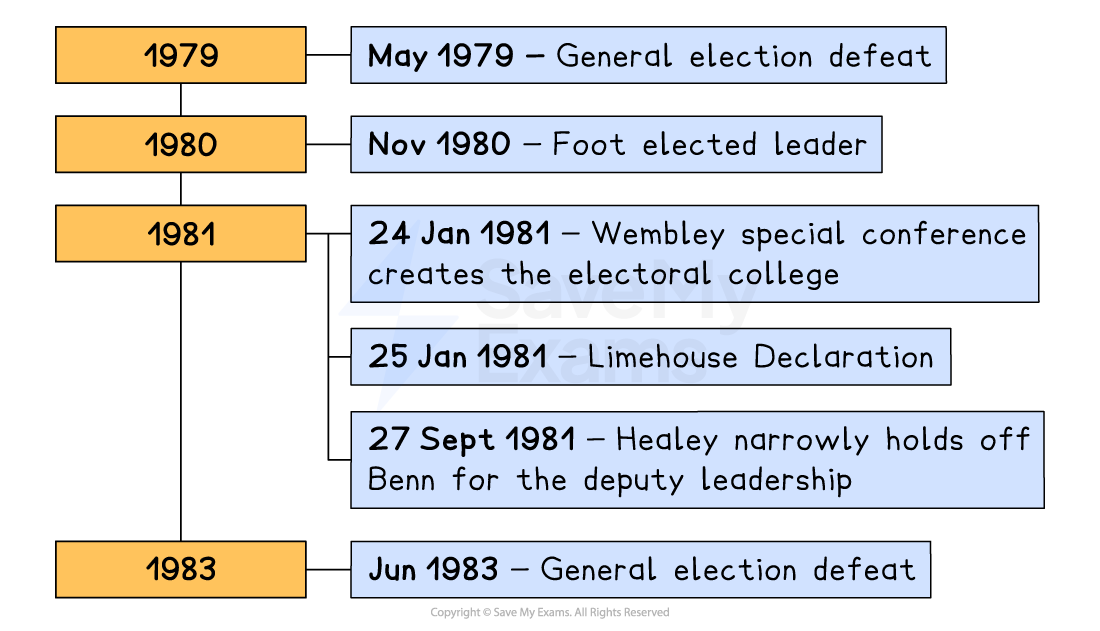
After Labour's defeat in 1979, the party moved sharply to the left
Michael Foot became leader in 1980
More influence passed to trade unions and party activists
Four senior Labour moderates, known as the Gang of Four, broke away
They issued the Limehouse Declaration in January 1981
The Social Democratic Party (SDP) was launched in March 1981
The SDP later joined the Liberals in the SDP-Liberal Alliance
The Alliance won several important by-elections
For a time, it also led the opinion polls
In the 1983 general election, the Alliance won 25.4% of the vote but only 23 seats
Its support was spread too thinly under first-past-the-post (FPTP)
Labour and the Alliance split the anti-Conservative vote, allowing the Conservatives to win large majorities on a falling share of the vote
Neil Kinnock replaced Foot in 1983, confronted the hard left of the party and expelled Militant Tendency supporters in Liverpool in 1986
The key question asks why the opposition remained weak during the 1980s
Important factors include Labour's internal divisions, the split in the anti-Conservative vote, the electoral system, the Alliance's weaknesses and Conservative strength
Internal Labour divisions
The impact of the 1979 defeat
Labour's defeat in 1979 pushed the party sharply to the left
Many activists blamed the Callaghan government's pay policy and the Winter of Discontent
The left argued that Labour had lost because it had governed too cautiously, not because its policies had been too radical
Party policy moved away from the positions Labour had followed in government
The party backed unilateral nuclear disarmament
The party supported withdrawal from the European Economic Community (EEC)
Further nationalisation was proposed
These policies later became central to Labour's 1983 manifesto
The 1980 leadership election
James Callaghan resigned as Labour leader in October 1980
Michael Foot defeated Denis Healey by 139 votes to 129 in November
Foot came from the Bevanite left
He supported unilateral nuclear disarmament
Healey came from the centre-right of the party and had been the favourite
This was the last Labour leadership election decided only by MPs
Moderates later used the result as evidence that influence was shifting away from the parliamentary party
Changing the party rules
Labour's left also pushed through major constitutional changes
Mandatory reselection meant MPs had to win approval from their constituency party before each general election
This gave local activists more influence over sitting MPs
A special conference at Wembley on 24 January 1981, created an electoral college for choosing the Labour leader
Trade unions received 40% of the votes
Labour MPs received 30%
Constituency Labour parties received 30%
Moderates feared that the changes reduced the influence of Labour MPs
They also argued that a small number of powerful union leaders could have too much influence over who led the party
The 1981 deputy leadership contest
Tony Benn challenged Healey for the deputy leadership in April 1981
The campaign lasted almost six months
It was fought through newspapers, television and constituency meetings
The result was announced at the Brighton conference on 27 September 1981
Healey won 50.4%
Benn won 49.6%
The margin was less than one percentage point
The result showed how deeply divided Labour had become
Healey accused Benn's supporters of organised heckling during the campaign
The Bennites had come very close to winning the second-most-senior position in the party
Militant Tendency and entryism
Militant Tendency was a Trotskyist group operating inside the Labour Party
It practised entryism
This meant joining an existing political party and trying to change it from within
It took its name from the newspaper Militant
Militant Tendency built its support in some key local areas
It was particularly influential in Liverpool
Derek Hatton, a leading Militant supporter, became deputy leader of Liverpool City Council in 1983
Liverpool's Militant-led council later confronted the Conservative government over spending and rate-capping
Its slogan was "Better to break the law than break the poor"
"Growing up on a working-class estate in Liverpool, I was already aware of the class struggle. So many workers were being thrown out of work at that time, it felt like everything was collapsing around you. I started going to Young Socialist meetings and got recruited into Militant Tendency. Militant was proper Labour. It was all about believing the working class can run things. It seemed to me for the first time in my short life that there was hope. That's where I was coming from. I was at the huge demo outside Liverpool Town Hall in March 1984 against Thatcher's rate-capping. About 50,000 people packed the city centre. I spoke from the top of the Town Hall steps about youth unemployment and how the council was prepared to fight and do something about government cuts. To be honest with you, we had a kind of arrogance, a sure belief we knew what needed to be done. But we were betrayed by the leadership of the Labour movement"
From reminiscences given in an interview for a book on Militant Tendency by Mike Hogan in Liverpool, 2012
Approach: Mike Hogan was a left-wing Labour activist in Liverpool during the early 1980s and had been involved with Militant Tendency. He gave this interview in 2012, many years after the events he describes
The source is useful for showing why Militant appealed to some young working-class activists in Liverpool. Hogan links unemployment, class politics and local campaigning to a sense that Labour could challenge Thatcher’s policies
However, it is a personal recollection written with hindsight. Hogan also ends by describing a later sense of betrayal by the Labour leadership, so his memory of the early movement may be shaped by how the conflict eventually ended
Kinnock's counter-attack
Labour had already begun acting against Militant Tendency before Kinnock became leader
In February 1983, the National Executive Committee expelled five members of the Militant editorial board
Neil Kinnock replaced Foot as Labour leader in October 1983
He pushed the campaign against the hard left much further
At the 1985 Labour Party Conference in Bournemouth, Kinnock publicly attacked the Militant-led Liverpool council
He criticised its handling of council finances and its treatment of council workers
Militant supporters in Liverpool, including Derek Hatton, were expelled during 1986
The expulsions were upheld at that year's conference
Kinnock also criticised Arthur Scargill for failing to hold a national strike ballot during the 1984–1985 miners' strike
This illustrates that he was prepared to challenge figures on the Labour left as well as Thatcher
"I'll tell you what happens with impossible promises. You start with far-fetched resolutions. They are then pickled into a rigid dogma, a code, and you go through the years sticking to that, outdated, misplaced, irrelevant to the real needs, and you end in the grotesque chaos of a Labour council – a Labour council – hiring taxis to scuttle round a city handing out redundancy notices to its own workers ... you can't play politics with people's jobs and with people's services"
Neil Kinnock, leader of the Labour Party condemning the Militant Tendency-controlled Liverpool City Council at the Labour Party Conference in Bournemouth on 1 October 1985
Approach: The source is useful because it shows Kinnock trying to reassert control over Labour and distance the party from the hard left. His audience included both Labour delegates in the hall and voters watching through television coverage, so the speech was also intended to improve Labour’s public image
However, it was a highly political intervention in an internal party struggle. It therefore shows Kinnock’s case against Militant rather than a neutral account of the dispute
Examiner Tips and Tricks
Do not exaggerate Militant's influence. It was powerful in particular areas, especially in Liverpool, but it did not control the Labour Party nationally
A useful line of argument is that Labour's divisions were about both policy and who should control the party. The left wanted a more radical programme, while rule changes also shifted influence away from MPs and towards unions and activists
The formation of the SDP, 1981
Why did the split happen?
Labour's move to the left after 1979 alarmed many of its moderate MPs
They opposed policies such as unilateral nuclear disarmament, withdrawal from the EEC and further nationalisation
They were also concerned that new party rules were giving more power to trade unions and constituency activists
Roy Jenkins had already argued for a new centre party
In his Dimbleby Lecture on 22 November 1979, he called for a realignment of British politics
He argued that the two-party system left many moderates without a political home
Three senior Labour moderates reached a similar conclusion during 1980
David Owen, Shirley Williams and Bill Rodgers published an open letter in The Guardian on 1 August 1980
They warned that Labour was moving away from parliamentary democracy and its commitment to Europe
The special Labour conference at Wembley on 24 January 1981 became the immediate trigger
It created the new electoral college for choosing the party leader
Owen had also failed to secure one member, one vote
The moderates believed the party was moving beyond their influence
The Limehouse Declaration
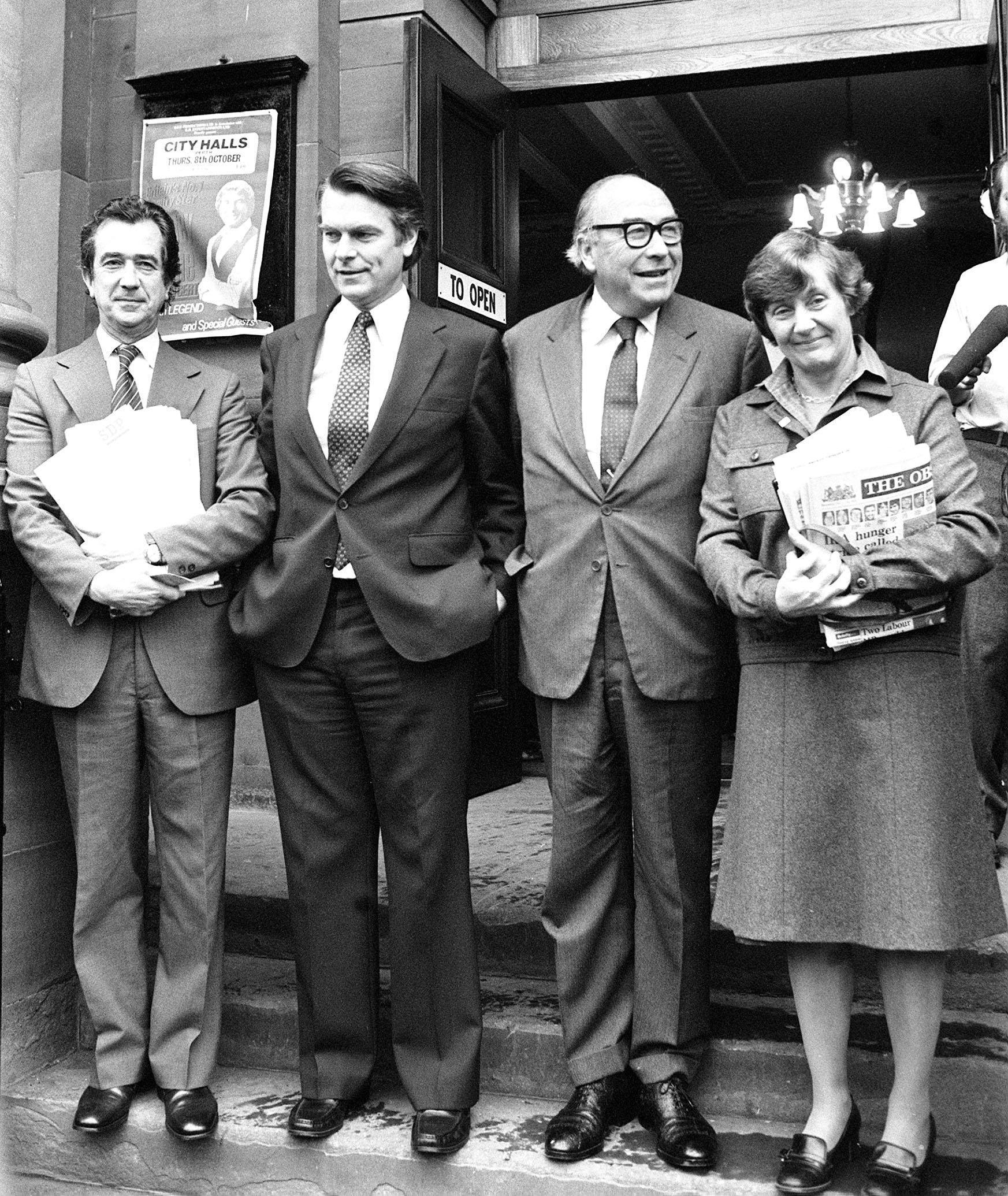
On 25th January 1981 four senior Labour figures issued the Limehouse Declaration:
Roy Jenkins
David Owen
Shirley Williams
Bill Rodgers
The four became known as the Gang of Four
All had held Cabinet offices in Labour governments between 1974 and 1979
The declaration announced plans for a Council for Social Democracy
It did not immediately create a new political party
This allowed the group to build support before making a complete break with Labour
Nine Labour MPs joined the council the following day
The declaration called for:
parliamentary democracy
a more equal society
economic recovery
rejection of political extremism
a new centre ground in British politics
"The calamitous outcome of the Labour Party Wembley conference demands a new start in British politics. A handful of trade union leaders can now dictate the choice of a future Prime Minister. The conference disaster is the culmination of a long process by which the Labour Party has moved steadily away from its roots in the people of this country and its commitment to parliamentary government. We propose to set up a Council for Social Democracy. Our intention is to rally all those who are committed to the values, principles and policies of social democracy. We seek to reverse Britain's economic decline. We want to create an open, classless and more equal society, one which rejects ugly prejudices based upon sex, race or religion... We do not believe in the politics of an inert centre merely representing the lowest common denominator between two extremes. We want more, not less, radical change in our society, but with a greater stability of direction... We recognise that for those people who have given much of their lives to the Labour Party, the choice that lies ahead will be deeply painful. But we believe that the need for a realignment of British politics must now be faced"
The Limehouse Declaration, presented by Shirley Williams, David Owen, Bill Rodgers and Roy Jenkins to the Press Association, 25 January 1981
Approach: The Limehouse Declaration was issued publicly by Roy Jenkins, David Owen, Shirley Williams and Bill Rodgers on 25 January 1981, one day after Labour’s Wembley conference. All four were former Labour Cabinet ministers and were preparing to break with the party
The source is useful for showing how the Gang of Four justified the split. It presents Labour’s move to the left and the new electoral college as threats to parliamentary democracy. However, it was written to win support for their breakaway, so it gives the founders’ case rather than a balanced account of Labour’s problems
Launching the SDP
The Social Democratic Party was formally launched on 26 March 1981
It began with 14 MPs
13 were former Labour MPs
Christopher Brocklebank-Fowler had previously been a Conservative
Membership grew rapidly to about 65,000 by the end of 1981
Across 1981 and 1982, a total of 28 Labour MPs defected to the SDP
Many later lost their seats at the 1983 general election
Some had built their support while standing as Labour candidates
Those voters did not automatically switch their support to the SDP
The SDP deliberately positioned itself in the political centre
It supported:
a mixed economy
membership of the EEC
NATO
multilateral nuclear disarmament
Electorally, it also supported:
proportional representation
more decentralised decision-making
The SDP's policies were close enough to those of the Liberal Party to make cooperation possible within months
Examiner Tips and Tricks
Separate the long-term causes from the immediate trigger. Labour's move to the left had been developing since 1979, while the Wembley conference of January 1981 pushed the Gang of Four towards a formal break
The SDP-Liberal Alliance
Forming the Alliance
The SDP and Liberal Party agreed to work together within three months of the SDP's launch
They published a joint statement, A Fresh Start for Britain, on 16 June 1981
The two parties agreed not to compete with each other for the same voters
The partnership gave both parties something they lacked on their own
The Liberals brought local organisation and long experience of fighting by-elections
The SDP brought nationally known politicians with Cabinet experience and strong press coverage
David Steel, the Liberal leader, believed the Alliance could challenge the two main parties
At the Liberal Assembly in September 1981, he told activists to return to their constituencies and "prepare for government"
The by-election breakthrough
The Alliance performed strongly in a series of by-elections between 1981 and 1983
By-election | Date | Result |
|---|---|---|
Warrington | 16th July 1981 |
|
Croydon North West | 22nd October 1981 |
|
Crosby | 26th November 1981 |
|
Glasgow Hillhead | 25th March 1982 |
|
Bermondsey | 24th February 1983 |
|
Darlington | 24th March 1983 |
|
Alliance support in the opinion polls reached around 50% in December 1981
For several months, it competed with the two established parties for the lead
The momentum did not last
Support fell during 1982
The Darlington by-election in March 1983 convinced many in the SDP that the breakthrough had stalled
The Conservative recovery after the Falklands War also reduced the Alliance's opportunity
The Alliance at the 1983 election
The Alliance won 25.4% of the vote in 1983
It gained only 23 seats
The Liberals won 17
The SDP won 6
Labour won 27.6% of the vote and 209 seats
Only 2.2 percentage points separated Labour and the Alliance
Yet Labour won 186 more seats
The gap was largely caused by first-past-the-post (FPTP)
Alliance support was spread widely across the country
It often finished second without winning in a constituency
Labour's support was more concentrated in areas where it could still win seats
The result showed that a large national vote did not automatically produce parliamentary representation
"It is doubtful whether the Government can claim any true mandate in the real sense of the word. They have returned to office with less popular support than they had in 1979 and with the lowest support of any Conservative Government since that headed by Mr. Bonar Law 60 years ago. Now that we in the alliance parties have secured a quarter of the popular vote, we are at least entitled... to greater consideration in the House than traditionally has been the case...The real argument for electoral reform... is that the political map of the country is swamped by blue in the south and red the further north one goes, and we are truly creating a far more divided society than we have seen on any previous occasion in British post-war politics"
David Steel, Leader of the Liberal Party and joint leader of the Alliance. Debate on the address, 22 June 1983
Approach: David Steel was Leader of the Liberal Party and joint leader of the Alliance when he spoke in the House of Commons on 22nd June 1983, shortly after the general election
The source is useful for showing how Alliance leaders explained the gap between their share of the vote and their number of seats. Steel argues that the result gave the Alliance a case for electoral reform and presents the existing system as unfair
However, his party had just won around a quarter of the vote but fewer than 4 per cent of the seats, so he had a clear political reason to criticise first-past-the-post. The source is therefore strongest for showing the Alliance’s own explanation of its limited parliamentary success
The Alliance in 1987
The Alliance remained an important national force
It won 22.6% of the vote in 1987
It secured 22 seats
This represented a decline from 1983
Its vote share fell from 25.4% to 22.6%
Labour recovered some support under Neil Kinnock
The Alliance, therefore, remained a major third force
However, it had failed to replace Labour as the main opposition to the Conservatives
Tensions inside the Alliance
Relations between the two leaderships were often difficult
David Steel led the Liberals
David Owen led the SDP from 1983
The press called them the "Two Davids"
Steel favoured closer cooperation between the two parties
Owen wanted the SDP to keep a clearer, separate identity
Particularly with regard to defence and nuclear weapons
The partnership also caused practical problems
The parties had to agree which one would contest each constituency
This sometimes produced disputes at local level
Voters were, therefore, offered a joint programme, but two parties and two leaders
This made it harder for the Alliance to present itself as a clear alternative government
The Liberals and SDP eventually merged in 1988
Examiner Tips and Tricks
Do not describe the Alliance simply as a failure. It won around a quarter of the national vote in 1983 and briefly challenged the two-party system. The better question is why this support produced so little parliamentary power
Separate external problems from internal weaknesses. The electoral system and Conservative recovery worked against the Alliance, while tensions between Steel and Owen made it harder to present a united alternative
The weakness of the opposition
Labour's 1983 campaign
Labour entered the 1983 general election with a programme that reflected the party's move to the left since 1979
The manifesto promised:
unilateral nuclear disarmament
withdrawal from the EEC
further nationalisation
abolition of the House of Lords
Labour MP Gerald Kaufman later described the manifesto as "the longest suicide note in history"
The phrase came from within Labour itself, showing how divided the party remained over the programme
Labour won only 27.6% of the vote
This was the lowest share since 1918
The party lost 60 seats
Michael Foot resigned after the defeat
Neil Kinnock replaced him as leader in October 1983
"I do not need to say to you, I hope, that I understand the scale of the defeat which we suffered at the general election. I am deeply ashamed that we have permitted power to rest with such a government as we have in Britain at this time. I am not one of those who believe that you can blame the election defeat solely upon the media or newspapers. But I think a very strange picture has been presented to our country. That is what it was: a landslide victory won by deception. People talk about the manifestos on which the election was fought. I am not saying that our own manifesto was word perfect or idea perfect even, but I tell you this, I am not in favour of casting it aside. I say that the more people look at what we actually said, the more people actually read what was in the manifesto, the more, I believe, they will come back to it"
Michael Foot, speaking at the Labour Party conference, October 1983
Approach: Foot gave this speech to the Labour Party Conference in October 1983, after resigning as leader following the election defeat. He accepted the scale of Labour’s defeat but rejected the idea that the manifesto alone was responsible
The source is useful for showing how Foot defended Labour’s programme after the election. However, he had led the party into the defeat, so he had a reason to resist arguments that his policies or leadership were mainly to blame. The source is therefore strongest for showing how Labour’s left explained the result
The problem of leadership
Foot was highly experienced
He was first elected as an MP in 1945
He was respected in Parliament as a writer and a strong debater
He struggled to present himself effectively to a wider electorate
Press coverage of Foot and Labour was often hostile
Opinion polls regularly placed Thatcher ahead of him on leadership qualities
Television had become increasingly important in election campaigns
Foot's strengths in parliamentary debate did not always transfer easily to television
The split anti-Conservative vote
Labour and the SDP-Liberal Alliance together won around 53% of the vote in 1983
The Conservatives won 42.4%
Yet they secured an overall majority of 144
The anti-Conservative vote was divided between two rival opposition forces
Labour won 27.6%
The Alliance won 25.4%
Under first-past-the-post (FPTP), this division helped the Conservatives
In many constituencies, Labour and Alliance candidates both attracted substantial support
A Conservative candidate could therefore win without receiving half of the vote
The electoral system increased the effect of the split
The Alliance finished only 2.2 percentage points behind Labour nationally
It still won 186 fewer seats
Labour's changing electoral base
Labour could no longer rely as strongly on the voters who had supported the party since 1945
Traditional working-class communities were shrinking as heavy industry declined
Trade union membership was also falling
Some traditional Labour voters moved towards the Conservatives
Council house tenants who bought their own home were a notable group
Others voted Alliance or stopped voting altogether
Labour's image also became a problem
Some voters increasingly associated the party with trade union power and the political left
The Labour Party was sometimes seen as distant from the concerns of ordinary voters
Labour-controlled councils could also damage the party nationally
The dispute in Liverpool attracted national attention
It reinforced criticism of the party's hard left
Right-wing newspapers attacked Labour councils, such as Ken Livingstone's Greater London Council (GLC), as the "loony left"
Examiner Tips and Tricks
Keep opposition weakness separate from Conservative strength. Labour’s divisions and the split anti-Conservative vote help explain why the opposition struggled. Thatcher’s leadership, economic recovery and the Falklands help explain why the Conservatives were able to benefit from that weakness
Why was the opposition to Thatcher so ineffective?
This question asks for the reason behind the weakness of the opposition between 1979 and 1987
Some key factors are outlined below with evidence for each
Labour's internal divisions
The party fought two leadership contests and a rule-change battle in under three years
The 1980 leadership election and the 1981 deputy leadership contest were both decided by narrow margins
The Wembley electoral college shifted power towards unions and activists
The divisions were argued out in public rather than settled privately
Conference debates and heckling were reported nationally and filmed for television
Kinnock's confrontation with Militant kept the split visible into 1986
Energy spent on internal disputes was energy not spent on opposing the government
The formation and impact of the SDP
The breakaway removed a generation of experienced moderates from Labour
Two former Cabinet ministers in the Commons (Owen and Rodgers) and 26 other Labour MPs left, while Jenkins and Williams led the breakaway from outside Parliament
Their departure left the Labour left in a stronger position inside the party
The SDP took votes from Labour rather than only from the Conservatives
Its appeal was strongest among the moderate voters Labour needed to win back
The split gave the Conservatives a divided opposition to face at two general elections
The electoral system
First-past-the-post punished the Alliance severely
In 1983, it took 25.4% of the vote and 3.5% of the seats
Labour took barely two points more, but won nine times as many seats
The system also concealed the weakness of the Conservative position
The Conservatives won a majority of 144 in 1983 on a lower share of the vote than in 1979
A proportional voting system would have produced a very different Parliament
The Alliance's own weaknesses
The partnership never fully resolved its double leadership
Steel and Owen differed publicly, particularly over defence
Local negotiations over which party fought which seat caused friction
The Alliance had no regional stronghold to build on
Its support was even and shallow across the country
Its peak came early and was not sustained
Polling of around 50% in December 1981 had fallen well back before the 1983 campaign began
Conservative strengths
The government recovered ground from a low point in early 1982
Inflation was falling and the economy had begun to grow again
The Falklands factor transformed Thatcher's standing
The Conservatives had the support of the national press
Policies such as council-house sales attracted voters who had previously backed Labour
"The opposition itself was divided between Labour and the new SDP, which claimed to have truly broken the mould of British two-party politics. But we were the mould breakers. I always felt that the leaders of the SDP would have done better to stay in the Labour Party and drive out the Far Left. SDP support had peaked by 1983. As for Labour, it had continued its unstoppable leftward shift. Michael Foot is a highly principled and cultivated man, and was invariably courteous in our dealings. In debate and on the platform he has a kind of genius. But the policies he adopted were not only catastrophically unsuitable for Britain, they also provided an umbrella beneath which sinister revolutionaries, intent on destroying the institutions of the state and the values of society, were able to shelter. The more the public learned of Labour's policies and personnel the less they liked them. There was no doubt that in the extreme form adopted under Michael Foot's leadership Labour was easier to beat"
Margaret Thatcher, The Downing Street Years (1993)
Approach: Thatcher wrote this account in The Downing Street Years, published in 1993, several years after the events. She argues that Labour’s move to the left and the formation of the SDP made the opposition easier to defeat
The source is useful because Thatcher directly explains how she understood the weakness of her opponents. However, she was writing a memoir about governments she had led, so she had a reason to present Conservative success as the result of Labour’s mistakes as well as her own leadership
Her explanation should therefore be compared with other factors, especially the electoral system, the Alliance’s weaknesses and Conservative economic recovery
Examiner Tips and Tricks
This type of question is best answered by assessing a variety of factors. Do not simply list everything that went wrong for Labour; group them
A strong answer should explain the links between the factors. For example, Labour's divisions helped create the SDP, the SDP split the anti-Conservative vote, and first-past-the-post (FPTP) then made that split much more damaging
Take the answer through to 1987. An answer that ends with the 1983 election misses Labour’s partial recovery under Kinnock and the fact that the Alliance still failed to replace it as the main opposition

Unlock more, it's free!
Join the 100,000+ Students that ❤️ Save My Exams
the (exam) results speak for themselves:

Was this revision note helpful?
