The Impact of the Great Depression, 1929 (AQA A Level History: Component 2: Depth study): Revision Note
Exam code: 7042

Summary
When the US stock exchange crashed in 1929, it triggered a global economic recession
Germany was reliant on American loans and was badly affected
Millions of Germans became unemployed
The Chancellor, Heinrich Brüning, increased taxes and cut unemployment payments
His policies were deeply unpopular and opposed in the Reichstag
To pass his acts, Brüning began to bypass the Reichstag and use the emergency decree, Article 48
This damaged people's belief in democracy, but did not improve the economic situation
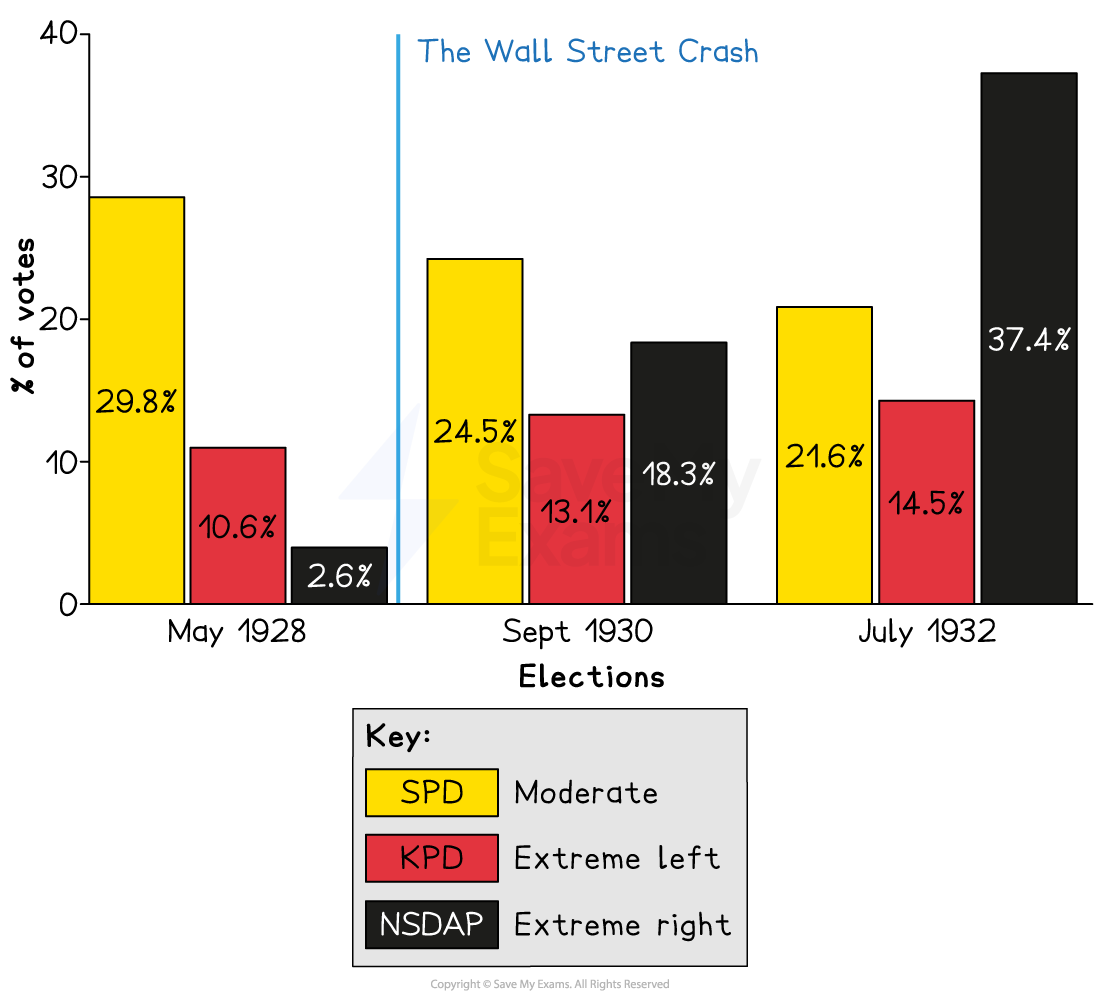
People began to abandon the moderate political parties and vote in increasing numbers for the extremist parties like the communist KPD and the Nazis
The Wall Street Crash and its impact on Germany
Wall Street is the name used to describe America's stock exchange
It is named after the street in New York where it is located
By 1929, the USA’s economy was growing at such a rapid rate that stockbrokers began to speculate that the market would decline
Americans from all areas of society bought shares in the 1920s
Working-class Americans could not afford for their share prices to drop too far
Share prices began to fall
Shareholders rushed to sell their shares before their value dropped too significantly
Between 24th and 30th October 1929, the USA’s economy collapsed
The 24th was known as ‘Black Thursday’
People sold 13 million shares
Prices plummeted due to the number of shares available
Shares that were worth $20,000 on the morning of 24 October 1929 were worth $1,000 by the end of the day
By 30th October 1929, investors had lost $4 billion
This event became known as the ‘Wall Street Crash’, and it triggered a global economic depression
The economic and social impact of the depression
The economic issues triggered an employment crisis
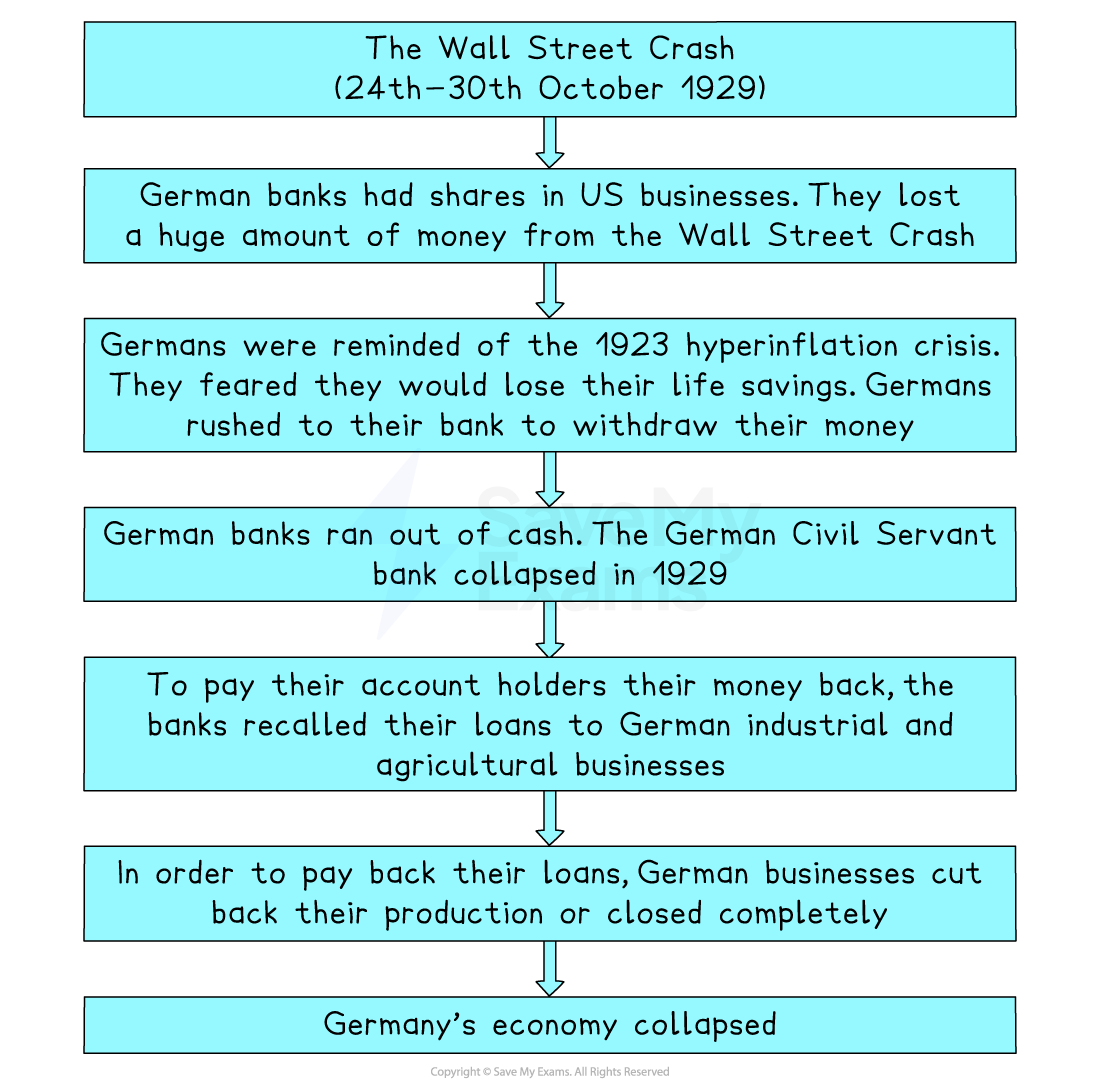
German banks recalled loans
This forced businesses to close and workers to lose their jobs
Other countries stopped purchasing German goods, which increased unemployment
Unemployed workers did not spend money on goods or services
This resulted in even more companies having to make redundancies
By September 1931, 4.3 million German workers were unemployed
Over 40% were factory workers
Half of all 16 to 30-year-olds did not have paid work
By January 1933, unemployment hit 6.1 million people
How were Germans affected by unemployment?
The workers
The workers had to pay increased taxes to support the unemployed
Businesses were forced to cut the real income of workers
The value of wages was 70% of the 1928 average wages
The savers
When share prices fell, the value of savings dropped
If people became unemployed, they did not have any savings to survive on
The unemployed
The government had to cut unemployment benefits
This increased the hardship for the unemployed
In Berlin, the arrests for theft rose by 24%
Without work, many people felt a deep sense of despair and experienced a loss of identity and purpose
"The unemployed had to do a lot to get their benefits. They stood in endless lines in every kind of weather at the unemployment offices. There they stood and waited until it was their turn. Unemployment became a tragedy for many. Not only because of the poverty that mutely sat at their table at all times. Not working, doing nothing, producing nothing – work that not only provided food, but also, despite all the harassment and drudgery, was satisfying, developed skills, and stimulated thinking; work, a human need – was not available; and wherever it was lacking, decay, malaise, and despair set in."
From the autobiography of Lea Grundig, Gesichte und Geschichte, published in 1964. Grundig was a communist and an active member of the KPD. She was also an artist and a painter.
The homeless
Many unemployed workers established makeshift houses
Homelessness increased violence on the streets, particularly among unemployed young men
Working Women
Many women with jobs reported increased resentment towards them
Many of them felt as if they were being seen as taking men's jobs
"Women have become unpopular. An uncomfortable atmosphere is gathering around all working women. Along the entire spectrum from left to right, the meaning of women’s employment and their right to it are suddenly being questioned. At the moment, it is not even the old discussion over so-called ‘equal rights’ or ‘equal pay for equal work’ that occupies the foreground. Suddenly, we are obliged to counter the most primitive arguments against the gainful employment of women."
From an article titled ‘Twilight for Women’, by Hilde Walter that was published in July 1931. Walter was a journalist and former social worker who wrote for the left-wing magazine Die Weltbühne
The political impact: Elections and governments
People blamed the Weimar government for the economic crash
The decision to link Germany's economy to the USA through the Dawes and Young Plans had proved to be disastrous
The economic disaster of hyperinflation had occurred just six years earlier
Increasing numbers of German people began to believe that the Weimar Republic could not be trusted with the economy and began to look for alternatives
Extremist parties offered those alternatives
The Nazi Party promised to reverse the Treaty of Versailles and make Germany strong again
The KPD promised to improve the workers' living conditions and tackle unemployment
Brüning's government and policies
From 1930 to 1932, the Chancellor of Germany was Heinrich Brüning
He was the leader of the Centre Party from 1929
The Centre Party was Germany’s moderate party
It was neither left-wing nor right-wing
Brüning’s policies to tackle unemployment were controversial
He attempted to raise taxes on workers
This was ineffective when levels of unemployment increased
He began to cut the salaries of public workers and decrease unemployment benefits
This was meant to ensure that the government could afford to make benefit payments to the unemployed
However, it angered both employed and unemployed people
What impact did Brüning’s policies have?
The Reichstag did not approve of Brüning’s policies
This marked the end of moderate parties working together in the Reichstag
In July 1930, the Reichstag voted against Brüning’s measures
Brüning began to use Article 48 to bypass the Reichstag in an attempt to rescue Germany’s economy
This emergency power allowed him to get President Hindenburg to approve his policies rather than the Reichstag
In 1932, the Reichstag met only 13 times
From 1930-32, the Reichstag passed 29 bills
In the same period, Brüning used Article 48 115 times
By doing this, Brüning greatly weakened the Weimar Republic
People started to lose faith in democracy
An increasing number of the German public started to believe that the Weimar government was inefficient and corrupt
The autocratic government that Hitler campaigned for did not seem so different to how Brüning was acting
Using Article 48 made the chancellor look like a dictator
Perhaps most importantly, the measures that Brüning implemented did nothing to improve Germany’s economy
How damaging was the depression to Weimar democracy?
There is a debate amongst historians over how much damage the Great Depression caused to the Weimar Republic
Some argue that it struck a fatal blow that it was never going to recover from
They believe the Depression caused deep psychological damage and not only put millions of people out of work, but it also made millions of people turn against the idea of democracy
Others argue that the Weimar Republic faced much greater threats, such as the strategy and appeal of Adolf Hitler
They reason that the Depression alone cannot explain the enormous increase in popularity of the Nazis
They argue that other extremist parties, such as the KPD, did not see the same increase in popularity as the Nazis
Examiner Tips and Tricks
Section B questions rarely ask about the Depression on its own — they ask how far it explains the Nazi rise or the collapse of democracy. Use it as the trigger that made extremism electorally viable, then weigh it against Nazi tactics, propaganda and elite intrigue.
Be precise about Article 48: it was Brüning's reliance on presidential decree — not the Depression itself — that examiners credit as reducing out parliamentary democracy before Hitler.

Unlock more, it's free!
Join the 100,000+ Students that ❤️ Save My Exams
the (exam) results speak for themselves:

Was this revision note helpful?
