The Weimar Constitution (AQA A Level History: Component 2: Depth study): Revision Note
Exam code: 7042

Summary
The new republic that was created after the abdication of the Kaiser was formed by politicians and the Army working together
A National Assembly was formed, and elections were held in January 1919 to select the new government
Moderate parties were voted into power
Friedrich Ebert was elected as the first President
Over the next six months, the constitution of the new republic was written
Many people have praised the Weimar constitution for its freedoms and rights - including the universal right to vote
However, others have criticised the constitution and argued it placed too much power in the hands of the president
The establishment of the Weimar Republic
Despite the Kaiser's abdication, the civil servants who had helped run the government continued their work
They collaborated with the army and the new workers' councils that had formed since the end of the war
Chancellor Friedrich Ebert allied with the head of the Army, General Groener, to keep the Weimar Government in power
In return, Ebert promised not to reform the Army to keep the Weimar government in power
This deal, known as the Ebert-Groener Pact, traded government support for army autonomy
Businesses kept their land and property
The state did not nationalise their businesses
This helped Germany’s economy recover and won the support of big business owners
Ebert promised more worker rights to gain the approval of trade unions
This concession was formalised in the Stinnes-Legien Agreement which recognised the unions in return for industrial peace
An example of this was guaranteeing an eight-hour working day
Ebert announced there would be elections to choose a National Assembly
The assembly would be responsible for writing the German Constitution
Under the Kaiser, Germany did not have a written Constitution
This was so the Kaiser could create and change laws as he pleased
The creation of a Constitution would signify the start of democracy
It would hold the new government and the German people accountable for following the rules
On 19 January 1919, Germany elected the National Assembly that would write the new constitution
The SPD won 38% of the vote, and the Centre Party gained 20%
These were both moderate parties
82% of enfranchised people voted
Ebert was elected as Germany’s first President by the National Assembly in February 1919
From 1925 onwards, the President was elected by the people every seven years
The National Assembly also met in February 1919 to write the Constitution
They met in the town of Weimar because of the unrest in Berlin
This is why the republic that was created became known as the ‘Weimar Republic’
The Constitution took six months to complete and was passed by 262 votes to 75
The Constitution outlined each elected official's power and responsibilities in the Weimar government
“Workers, Soldiers, Fellow Citizens – the Free People’s State is here! Kaiser and Crown Prince have abdicated! Fritz Ebert, the president of the Social Democratic Party, has been appointed chancellor, and he forms new governments in the Reich as well as in Prussia, composed of men who enjoy the trust of the working people in the cities and on the countryside, of workers and soldiers. So public administration has been handed over to the people. A National Assembly will meet soon to discuss the new constitution.
Workers, soldiers, citizens! The victory of the people has been achieved, it may not be dishonoured or endangered by rashness. The economy and traffic have to be allowed to continue uninterrupted, in order to secure the popular government under all circumstances. Follow all instructions of the new people’s government and of their officials. It acts in closest cooperation with the workers and soldiers.
The German Republic shall thrive!”
An extract from the Berlin People's Gazette, published in November 1918. The Berlin People's Gazette was the newspaper of the Social Democratic Party (SPD)
The terms of the Weimar Constitution
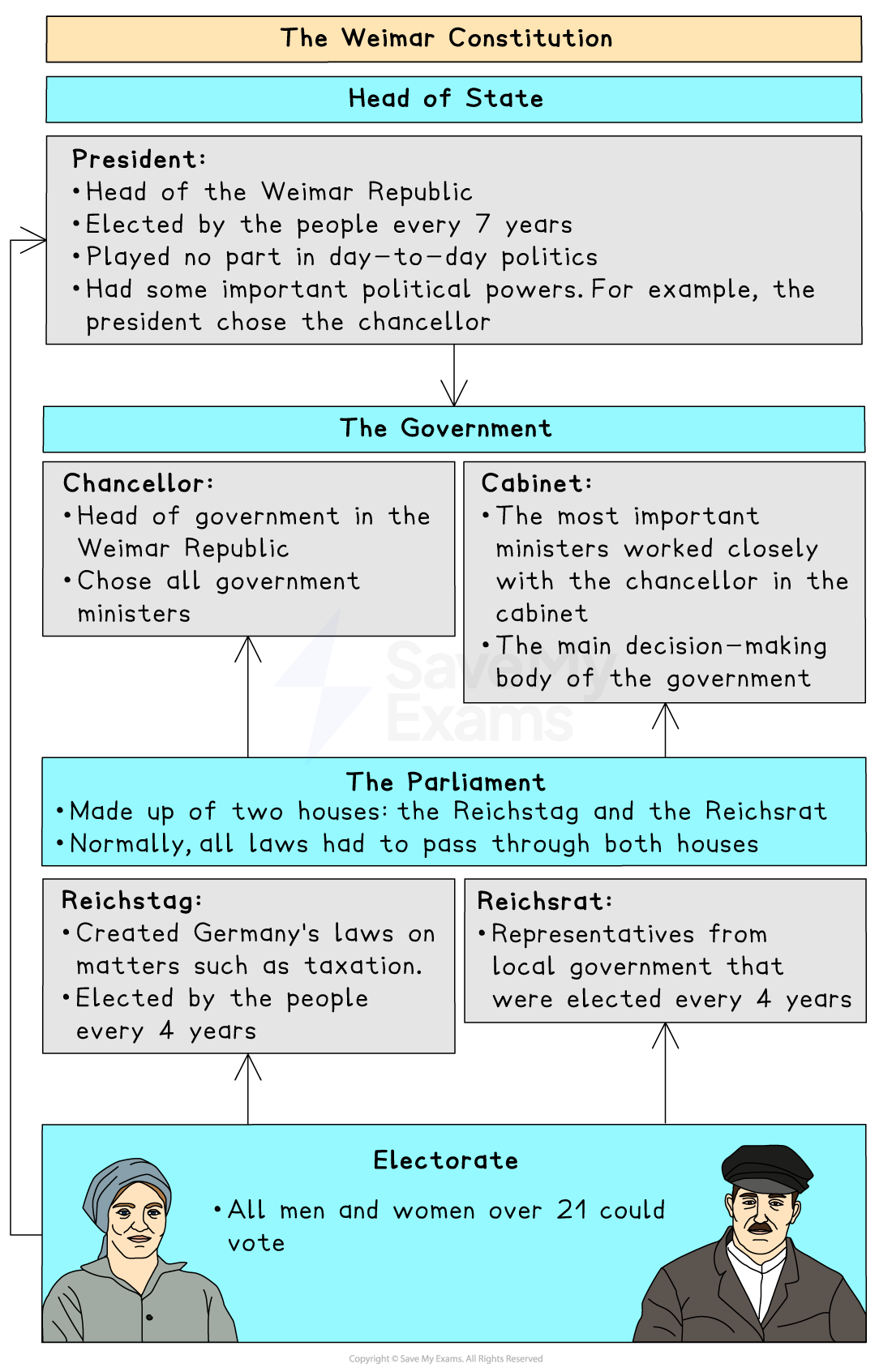
The strengths of the Weimar Constitution
The Weimar Constitution had several strengths:
All German people over 20, including women, gained the right to vote as well as many other rights
Proportional representation ensured the Reichstag represented smaller parties
One seat was equivalent to 60,000 votes
The system was designed to protect against anyone taking too much power
For example, the president chose the chancellor but the public elected the president every seven years
The Reichstag (elected chamber) and the Reichsrat (unelected chamber) worked together
The Reichsrat could challenge laws unless two-thirds of the Reichstag voted against the Reichsrat’s intervention
The Länder retained power over schools and the police
“The Imperial Government welcomes through me the Constituent Assembly of the German nation. With a special warmth I greet the women. They are appearing today for the first time with equal rights in the parliament of the German people.
The provisional government owes its authority to the Revolution. It will return that authority into the hands of the National Assembly.
The German people is free, remains free, and shall govern itself for all future."
Part of Friedrich Ebert's address to the National Assembly as it opened in February 1919.
The weaknesses of the Weimar Constitution
The Weimar Constitution also had several serious weaknesses:
Frequent elections bred voter fatigue in the mid-1920s
Though turnout rose sharply during the crisis years after 1930
The use of proportional representation meant no single party won a majority in the Reichstag
There were nine coalition governments between 1919 and 1923 alone
This meant policies lacked vision and took longer to pass
Article 48 gave the President the power to rule by emergency decree without the Reichstag, usually at the Chancellor's request
Ebert used the emergency article 63 times from 1923 to 1924
The abuse of Article 48 continued into the 1930s
The new Constitution did not subdue the extremist political parties
They continued to violently attack the Weimar Republic
The government relied on force to maintain power
How democratic was the Weimar constitution?
The Weimar Constitution has been looked at in different ways
Some historians argue that it guaranteed Germany's citizens more rights and freedoms than people living in Britain or France
They believe the Weimar Constitution was extremely democratic and ensured that everyone could vote and that very few votes were wasted
Others have argued that it was flawed from the start and that Article 48 of the Constitution meant that the President could bypass democracy whenever they felt like it
Examiner Tips and Tricks
The strengths and weaknesses of the Weimar constitution are a favourite topic of examiners. Ensure you are able to describe both and clearly explain your views on this foundation stone of the Weimar Republic that was to play such an important role in Hitler's path to power.
One past source question asked students to weigh attitudes to the Weimar Constitution in 1918-23 - so learn the constitution as a live political argument, not a diagram.

Unlock more, it's free!
Join the 100,000+ Students that ❤️ Save My Exams
the (exam) results speak for themselves:

Was this revision note helpful?
