Economic Recovery under Stresemann, 1924–1928 (AQA A Level History: Component 2: Depth study): Revision Note
Exam code: 7042

Summary
Stresemann helped bring the immediate economic crisis of hyperinflation to an end with the introduction of a new currency and a central bank
The longer-term problems of the reparations and the lack of investment in German industry were targeted with the Dawes Plans and Young Plans
These led to a recovery for Germany's industries and improved relations with other countries
However, the recovery did not stretch to the countryside, where Germany's farmers continued to struggle
The decision to continue to repay the reparations and extend the period over which they were paid caused great anger amongst Germany's right-wing parties and their supporters
Gustav Stresemann and the end of hyperinflation
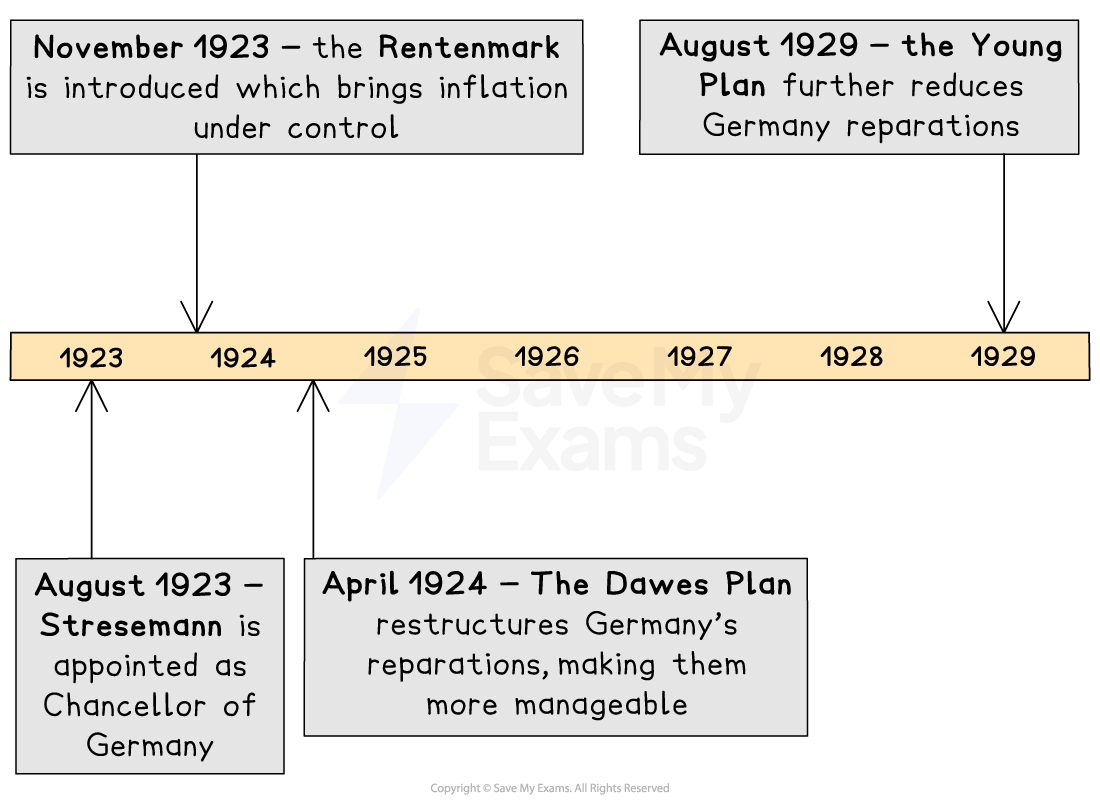
Gustav Stresemann became Chancellor in August 1923
Stresemann was a nationalist
Initially, he did not like the Weimar Republic
After the assassination of Rathenau, Germany’s foreign minister, Stresemann’s opinion of the government changed
He established the DVP (People’s Party), a moderate right political group
As chancellor, Stresemann had three aims for Germany:
Bring inflation under control
Regain Europe’s respect
Minimise the support for extremist parties
The creation of the Rentenmark
Germany’s currency, the mark, was beyond saving:
The largest note was 100,000,000,000,000 (100 trillion) marks
The government believed there were 400.3 billion trillion marks in circulation
In November 1923, Stresemann created a new currency called the Rentenmark
One Rentenmark was the equivalent of a trillion marks
Stresemann established a new state-owned bank called the Rentenbank
The German public brought marks into the Rentenbank to transfer them into Rentenmarks
The Rentenmark was backed by a mortgage on German land and industrial assets, because Germany's gold reserves had been exhausted
This gave people confidence the new currency had real value behind it
In August 1924, the Reichsbank (Germany's central bank since 1876) was reorganised
It was made independent of government under the Dawes Plan, with Hjalmar Schacht as its president
A new currency, the Reichsmark, replaced the Rentenmark
The new currency allowed German businesses to trade with foreign countries
These measures brought the chaos of hyperinflation to a close
The Dawes Plan, 1924
Since 1919, Germany had been unable to meet the reparations payments stated in the Treaty of Versailles
Hyperinflation in 1923 led the Allies to consider reducing Germany’s reparation bill
The USA was in a position to help Germany
The USA experienced a boom in their economy. Britain and France were repaying their wartime loans. As a result, the USA had a surplus of money in their economy
Charles G. Dawes, an American banker, created a plan for Germany
The Dawes Plan did not reduce the total reparations bill — only the annual payments
The total was only reduced later, by the Young Plan
Stresemann called off the passive resistance in the Ruhr in September 1923
This was a precondition of the Dawes Plan
The terms and impacts of the Dawes Plan
Terms of the Dawes Plan | Impact of the term |
|---|---|
The temporary reduction of annual reparation payments to £50 million a year | Reparations became more manageable The Allies trusted that Germany would meet their reparation payments |
A guarantee of US bank loans for German industry | The Dawes Plan opened with an American loan of 800 million marks and triggered a wave of private US investment totalling roughly 25 billion gold marks by 1930 - more than twice what Germany paid in reparations. |
"The finding of the experts, which is known as the Dawes Report, has recently been made and published. It shows a great deal of research and investigation, and a broad comprehension of the requirements of the situation. It has been favorably received by the Reparations Commission. It is gratifying to understand that the Allies are looking upon it with full sympathy, and Germany has expressed a willingness to cooperate in the execution of the plan. There appears to be every reason to hope that the report offers a basis for a practical solution of the reparations problem. I trust that it may commend itself to all the European governments interested as a method by which, through mutual concessions, they can arrive at a stable adjustment of the intricate and vexatious problem of reparations, and that such an outcome will provide for the restoration of Germany and the largest possible payments to the other countries.
A situation at once both intricate and difficult has been met in a most masterful way. Our countrymen are justified in looking at the result with great pride. Nothing of more importance to Europe has occurred since the Armistice."
Part of a speech given by the US President Calvin Coolidge, 22nd April 1924.
Recovery in industry and agriculture
The Dawes Plan and the investment it brought helped Germany's industry to recover
German factories became more efficient and expanded into new areas such as motor vehicles and aircraft
Exports increased
The wages for industrial workers increased, and there were fewer strikes
However, farmers continued to struggle with high debts
This was made worse by low prices for agricultural produce
Rural incomes did not increase after the Dawes Plan, and many farmers were forced to give up their farms
The Young Plan and the reparations issue
The Allies believed that they could provide Germany with more help
In February 1929, the Allies established a committee to reduce Germany’s reparations further
An American banker called Owen Young led the committee
In June 1929, the committee agreed upon the Young Plan
The terms and impacts of the Young Plan
Terms of the Young Plan | Impact of the term |
|---|---|
Reduction of the total reparations bill from £6.6 billion to £1.85 billion | The government was able to lower taxes on German citizens Citizens could spend more, boosting German industry and creating more jobs This gave the government more money to spend The reduction of the reparation bill caused some anger in Britain and France |
The Allies extended the time that Germany had to repay their reparation debts. Reparations had to be fully repaid by 1988 | There was less pressure on Germany to pay off the reparations debt. This improved relations between Germany and the Allies France decided to leave the Rhineland in 1930 |
"It is a very notable contribution to stability and to progress, and I think the American people should be gratified at the contribution which Messrs. Young, Morgan and Lamont have made to bring it to a successful conclusion."
The response of US President Herbert Hoover to a question from a reporter about the Young Plan in May 1929.
The Nationalists united to organise a campaign against the Young Plan and to demand that the government repudiate the War Guilt clause of the Treaty of Versailles
Hitler was given a prominent role in the campaign andstated in his speeches that Weimar's agreement to extend the reparations deadline was ‘passing on the penalty to the unborn’
In 1929, the nationalist campaign led to a referendum
Only 13.8% of people voted
This was well below the 50% threshold needed
Of the voters, only 15% were against the Young Plan
How complete was Germany's economic recovery, 1924–1928?
Historians disagree over the extent of Germany's recovery between 1924 and 1928
Some argue the recovery was genuine and Germany had turned a corner
They believe Germany had made fundamental steps to improve the economy
Others argue that the recovery did not help all parts of German society and was overly reliant on foreign investment
They believe that not all Germans benefited from the investment of the Dawes Plan and that serious issues remained
Examiner Tips and Tricks
Be precise about what each plan did. The Dawes Plan (1924) did NOT reduce the total reparations bill - it only rescheduled the annual payments and brought in US loans. Only the Young Plan (1929) cut the total, from £6.6bn to about £1.85bn. Students who blur the two lose marks for the extent of recovery.

Unlock more, it's free!
Join the 100,000+ Students that ❤️ Save My Exams
the (exam) results speak for themselves:

Was this revision note helpful?
