Mass Media & Cultural Change, 1964-1970 (AQA A Level History: Component 2: Depth study): Revision Note
Exam code: 7042

Summary
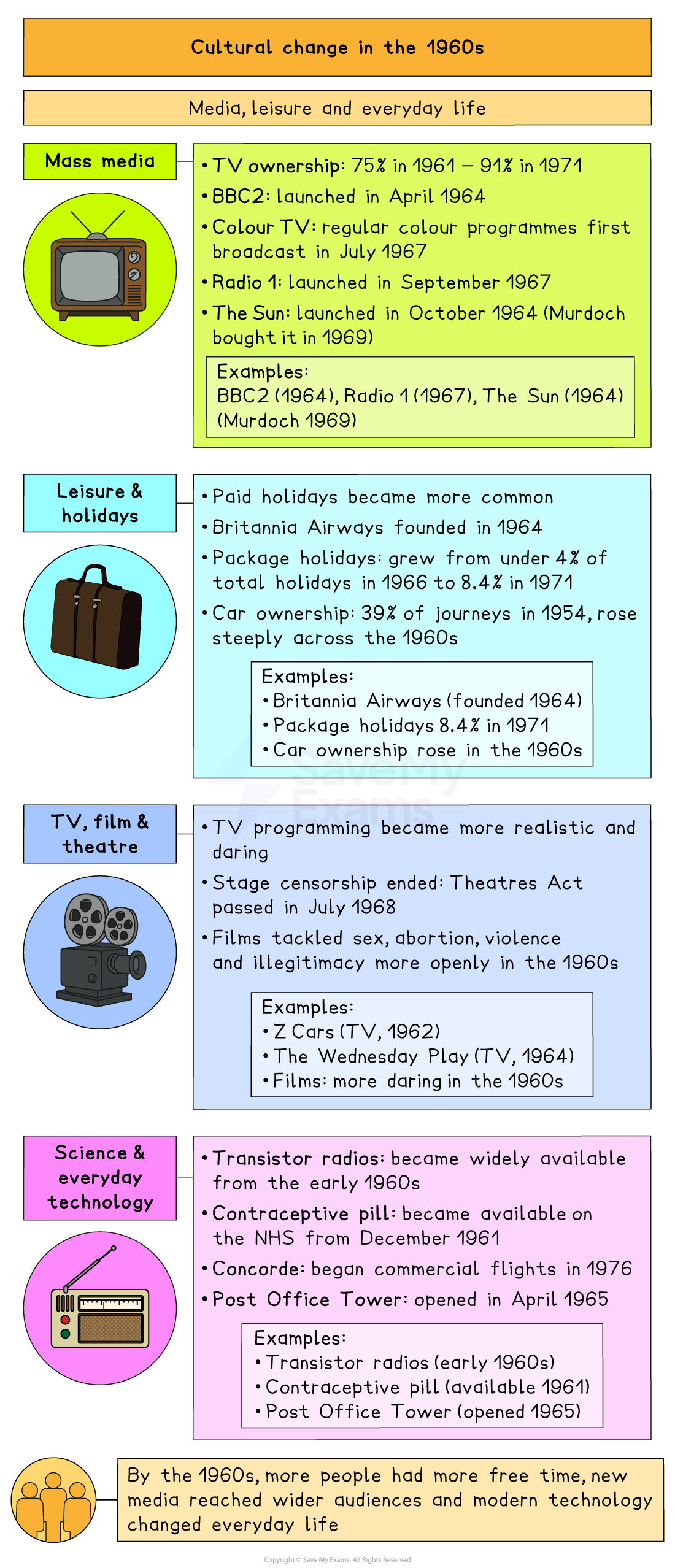
Television became widely available: the share of the population with a television at home rose from 75% in 1961 to 91% by 1971
Under Hugh Greene, the BBC introduced more satire, realistic drama and popular programming
BBC2 launched in 1964, with colour television following in 1967
Pirate radio stations broadcast pop music from ships until the Marine Broadcasting Offences Act (1967)
The BBC then launched Radio 1
More free time, rising car ownership and cheaper air travel changed how people spent their weekends and holidays
The Theatres Act (1968) ended the Lord Chamberlain's power to license plays
Film and television also included more adult and controversial content
The key question asks whether the media drove cultural change in Britain or reflected changes that were already taking place
The expansion of the mass media
The expansion of television in households
Television ownership rose sharply during the 1960s
75% of the population had a television at home in 1961
This had increased to 91% by 1971
Television brought the same news and entertainment into homes across Britain
It reduced the isolation of some distant communities
It became more popular than cinema as a source of entertainment
The number of television channels increased
ITV had launched in 1955, bringing commercial advertising into family homes
BBC2 launched in April 1964
It began to use regular colour broadcasting in July 1967
Hugh Greene and the changing BBC
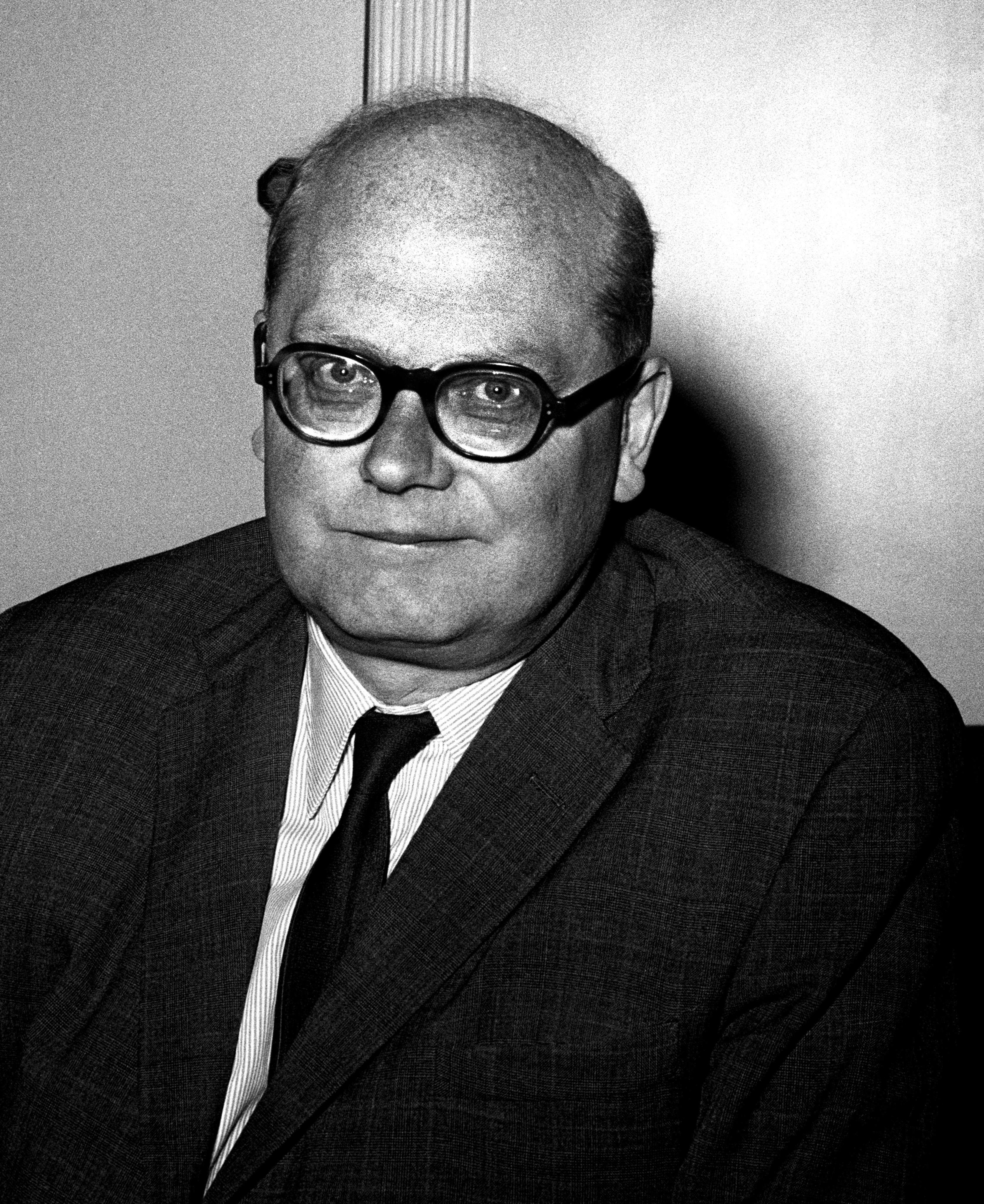
Hugh Greene served as Director-General of the BBC from 1960 to 1969
More BBC funding was moved from radio to television
Rules on satire, nudity and swearing were relaxed
That Was The Week That Was (1962–63) used satire to mock politicians and the "Establishment"
News presentation changed and more popular programmes were commissioned
Programmes dealt more openly with contemporary social issues
Z Cars, first broadcast in 1962, presented a more realistic view of policing
Steptoe and Son, also launched in 1962, was an unconventional sitcom
The Wednesday Play, first broadcast in 1964, covered subjects such as mental illness, alcoholism and homelessness
Some episodes included language and nudity that were controversial at the time
Radio, pirate stations and Radio 1
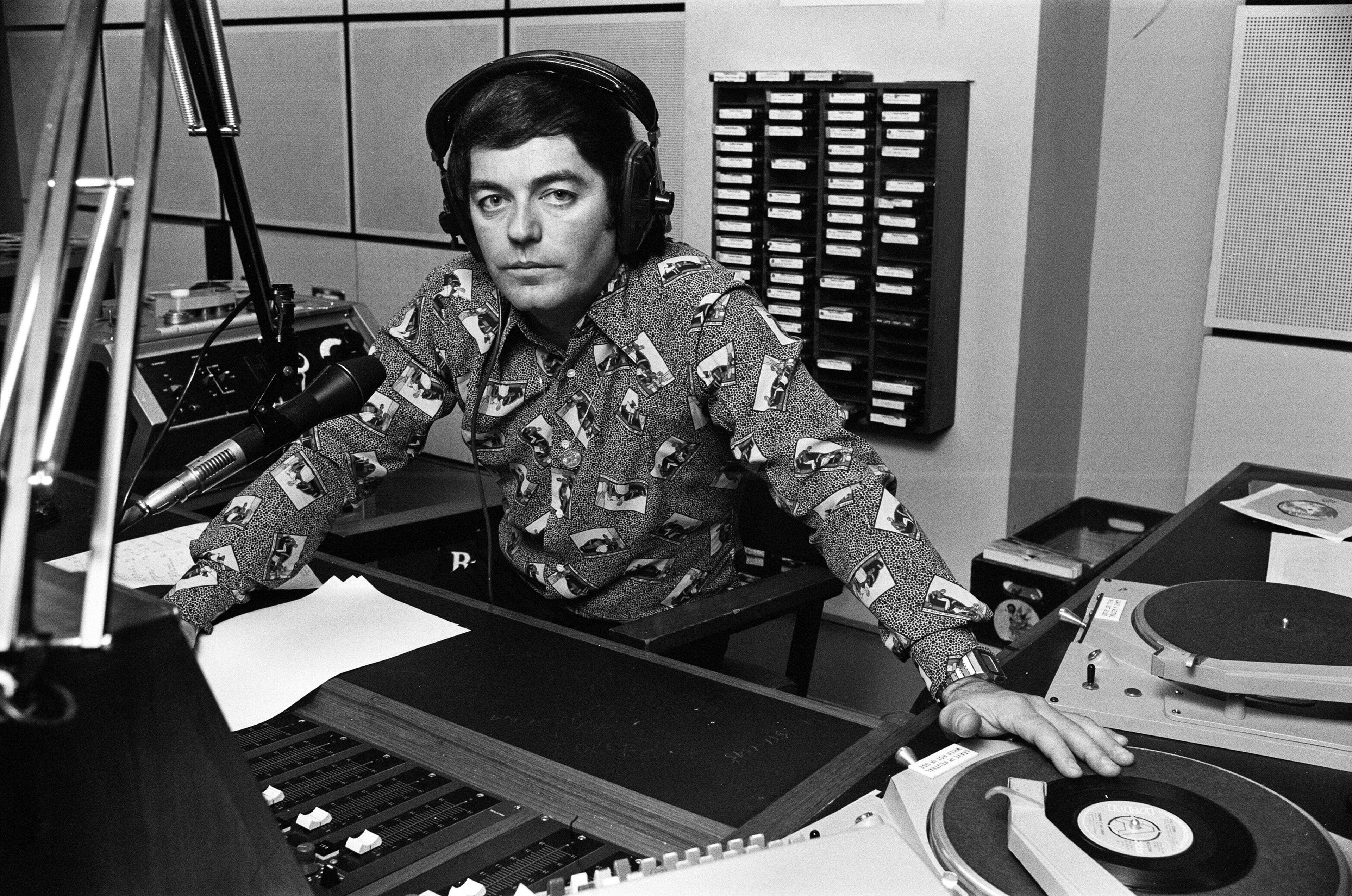
Credit Line: Trinity Mirror / Mirrorpix
Radio remained popular as it became portable and more personal
Cheap transistor radios, car radios and earphones allowed people to listen away from home
Teenagers no longer had to listen to the programmes chosen by their parents
Stations could target different audiences
At the start of the 1960s, the BBC had only three radio stations
Radio Caroline began broadcasting pop music from a ship outside British territorial waters in 1964
Other pirate stations followed and attracted large numbers of young listeners
The government introduced the Marine Broadcasting Offences Act in August 1967
It became illegal to supply or advertise on offshore pirate stations
The BBC launched Radio 1 as an alternative
It hired former pirate radio presenters, including Tony Blackburn
“The Postmaster-General has explained with some relish the plans by which he means to sink the pirates. He seems less conscious of the fact that he is at the same time and at one blow depriving 20 million unoffending people in England and Wales, and especially in Scotland, of a programme they enjoy ... when, for purely electoral reasons, the pirate radio system has had over two and a half years to build up a huge audience, which is now to be left high and dry with no reasonable replacement, we have the right to protest on their behalf"
Paul Bryan, a Conservative front-bench MP, speaking on the second reading of the Marine, &c., Broadcasting (Offences) Bill, House of Commons, 15 February 1967
Approach: Paul Bryan opposed the closure of the pirate radio stations because they had attracted a large audience that the BBC did not serve. As a Conservative frontbencher criticising Labour government policy, he had a clear political purpose. However, his speech is useful for showing the popularity of pirate radio and concerns that listeners would lose access to pop music
Newspapers and magazines
Some commentators expected television to replace newspapers and magazines
Advertising income and readership initially fell
However, the print media adapted and remained widely read
The Sun replaced the Daily Herald in 1964
It described itself as the newspaper "of the age we live in"
Rupert Murdoch bought The Sun in 1969
It adopted a more popular style and its circulation grew rapidly
Examiner Tips and Tricks
When assessing the importance of the mass media, consider both sides: television, radio and newspapers spread new programmes and ideas, but they also responded to changes in society that were already taking place
Growth in leisure activities
Increased time for leisure
Leisure time increased during the 1960s
Fewer people were expected to work on Saturday mornings, creating a longer weekend
Paid holidays became more common
Leisure also became an important part of the economy
Businesses made money by providing equipment, facilities and services for people's free time
Leisure at home
The home remained the main setting for leisure
By 1969, television accounted for 23% of all leisure time
Television encouraged the growth of home-based hobbies
DIY and gardening programmes presented by figures such as Barry Bucknell and Percy Thrower became popular
Cookery, needlework and knitting also remained common
Live entertainment attracted smaller audiences
Theatre attendance declined, especially outside the major cities
Crowds at football matches and other live events also fell
Cars and weekend activities
Car ownership increased rapidly during the 1960s
Technological improvements made cars more affordable
Cars already accounted for 39% of journeys in 1954, and their share rose further during the 1960s
Travel by bus, coach and train declined
Greater access to cars widened the range of leisure activities
Caravanning, golf and sailing gained larger followings
Shopping became a leisure activity as mass production and advertising expanded
Holidays and the growth of mass tourism
Leisure travel began to develop into mass tourism
Britannia Airways (renamed from Euravia in 1964) flew holidaymakers to destinations including Spain, Malta, Bulgaria and North Africa
Package holidays increased from under 4% of all holidays in 1966 to 8.4% in 1971
Overseas travel introduced some British tourists to new foods and customs
Foreign holidays remained beyond the reach of many families
Air travel was still expensive, so overseas holidays were mainly taken by the middle classes
Examiner Tips and Tricks
Consider who benefited from the growth of leisure. Television reached most homes, but foreign package holidays were still taken by a much smaller part of the population. This shows that leisure opportunities expanded unevenly
The impact of scientific developments
Major scientific and technological projects
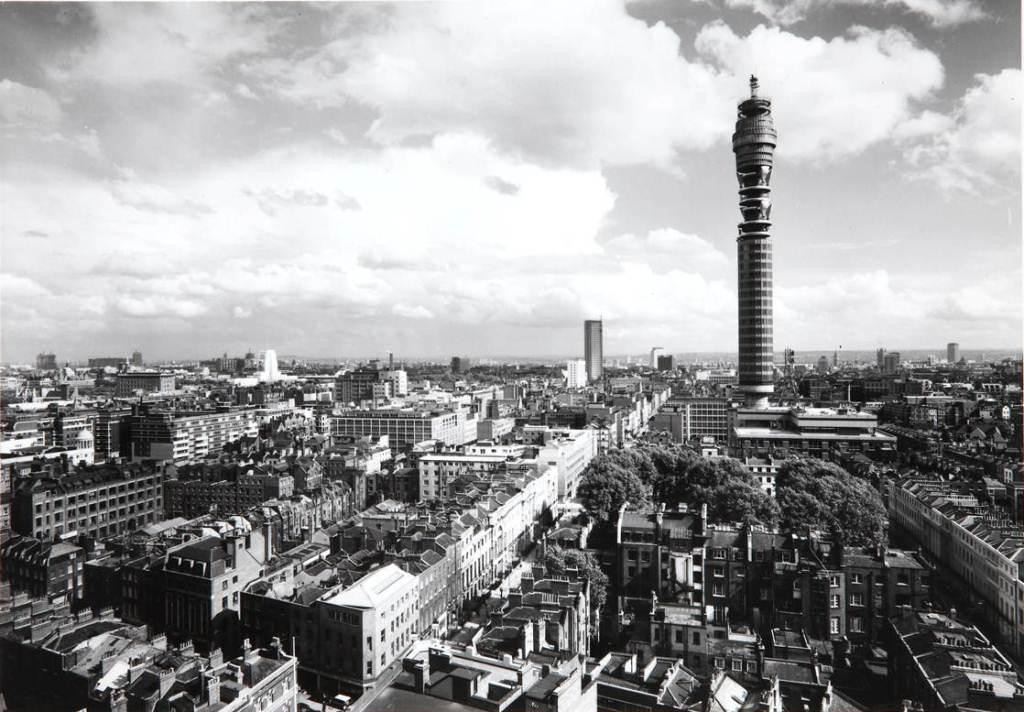
The 1960s saw rapid developments in science and technology
The first person travelled into space in 1961
The United States landed astronauts on the moon in 1969
Harold Wilson's government made scientific development an important part of its plans to modernise Britain
The Anglo-French Concorde project continued despite economic difficulties and limits on government spending
The Post Office Tower opened in 1965 to improve telecommunications
At the time, it was the tallest building in Britain
Technology in everyday life
New technology changed daily life in many homes
Household appliances became cheaper and more widely owned
This reduced the time spent on some domestic tasks
Transistor radios became cheaper and portable
Young people could listen to music away from the family radio
New synthetic fabrics widened the range of affordable clothing
They also influenced changing fashions during the 1960s
Medical developments
Medical developments also affected personal and family life
The contraceptive pill gave women greater control over pregnancy
The National Health Service (Family Planning) Act (1967) allowed local authorities to provide contraceptives and contraceptive advice
These services were made available regardless of whether a woman was married
Examiner Tips and Tricks
Separate high-profile scientific projects from changes that affected everyday life. Concorde, the space race and the Post Office Tower showed technological ambition, while household appliances, portable radios and contraception had a more direct effect on daily routines
The reduction in censorship
The Lord Chamberlain and the stage
Until 1968, new plays had to be licensed before they could be performed in public
The Lord Chamberlain's Office could demand the removal of material it considered inappropriate or immoral
Theatre owners could be prosecuted if they staged a play without making the required changes
The Royal Court Theatre in London became an important centre of opposition to theatrical censorship
Edward Bond's play Saved was refused a licence for public performance in 1965
Another of Bond's plays, Early Morning, was banned in 1968 and closed after two performances
Bond's plays were criticised for their violence and sexual content
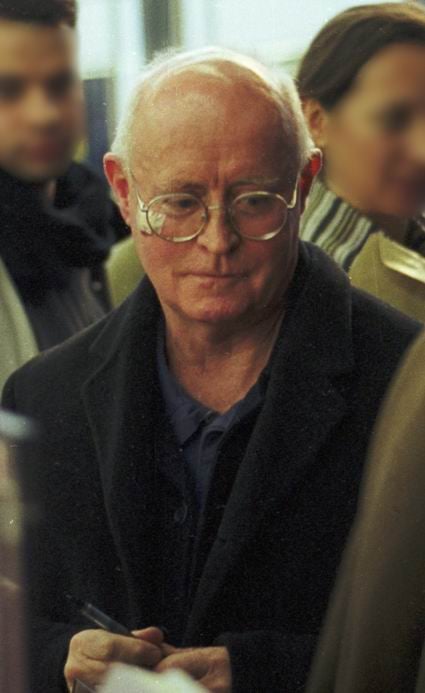
The Theatres Act (1968)
Labour backbencher George Strauss introduced a bill to end theatrical censorship
The actor Laurence Olivier also gave evidence in favour of reform
The Theatres Act (1968) ended the Lord Chamberlain's power to license plays
Plays no longer needed approval before they could be performed
Theatre owners could still be prosecuted if a production broke the law
The end of censorship allowed more explicit material to appear on stage
In 1968, 13 members of the cast of the musical Hair stood naked on stage for around 30 seconds
Film and television
Films continued to be classified by the British Board of Film Censors
However, films became more open in their treatment of adultery, abortion, illegitimacy, violence and sex
Examples included Darling (1965), Alfie (1966), and Here We Go Round the Mulberry Bush (1968)
Television also dealt with subjects that had previously been avoided
Kenneth Tynan became the first person to use the "f-word" on British television in 1965
The ITV soap Coronation Street included storylines about failed marriages
By the end of the decade, screen violence and sexual content had become more open, although films and television remained regulated
Opposition to changing standards
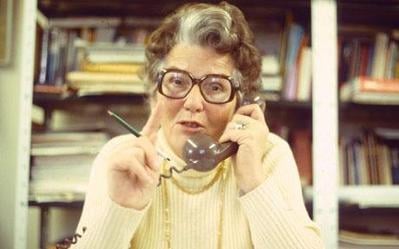
Mary Whitehouse became the best-known campaigner against changes in television and popular culture
She launched the Clean Up TV campaign in 1964
In 1965, she founded the National Viewers' and Listeners' Association
The organisation soon had around 100,000 members
Whitehouse argued that television was contributing to declining moral standards
Her campaign focused particularly on the BBC under Hugh Greene
The Clean Up TV petition attracted hundreds of thousands of signatures
Her campaign gained wide public support but had little effect on BBC programming
Greene defended the BBC's right to reflect changes in society
He rejected calls for broadcasters to return to older standards
"The immediate object of this campaign is to restore the BBC to its position of respect and leadership in this country. The BBC says it should show the work of playwrights which write of the world in which they live. If that is the world in which they live then I am truly sorry for them. But it is not our world and it is not the world of the vast majority of the people in this country and we don't want it in our homes. If violence is constantly portrayed as normal on the television screen it will help to create a violent society. I am not narrow-minded or old-fashioned. But I am square, and proud of it, if that means having a sense of values"
Mary Whitehouse addressing a meeting in the Birmingham Town Hall, attended by over 3,000 on the 5 May 1964
Approach: Mary Whitehouse delivered this speech at a public meeting in Birmingham in May 1964, at the start of her campaign against changes in television. As a campaign speech, it was designed to persuade an audience that the BBC was failing in its responsibilities and that stronger moral standards were needed
This makes the source useful for showing:
how opponents of cultural change presented their arguments
the language used to describe television as a threat to family life and social order
the strength of concern among organised moral campaigners in the mid-1960s
However, Whitehouse was trying to build support for her campaign, so she had reason to emphasise the dangers of violence and changing standards. Her claim to represent the views of the “vast majority” cannot be accepted without other evidence, such as opinion polls, audience figures or membership of her organisation
"I believe that broadcasters have a duty not to be diverted by arguments in favour of what is, in fact, disguised censorship. I believe we have a duty to take account of the changes in society, to be ahead of public opinion rather than always wait upon it"
Sir Hugh Greene, Director-General of the BBC. Hugh Greene gave this address in Rome in February 1965, five years into his time as Director-General of the BBC. It was published in 1969 in his own collection The Third Floor Front (1969)
Approach: Hugh Greene gave this address in Rome in 1965 five years into his time as Director-General of the BBC. He was defending the BBC’s record against criticism from campaigners such as Whitehouse and explaining why broadcasters should respond to social change
This makes the source useful for showing:
how senior BBC leaders justified more open programming
the belief that broadcasting should reflect changing attitudes rather than preserve older standards
the confidence of reformers in the mid-1960s
However, Greene was defending policies introduced under his leadership, so he had reason to present them positively. The source tells us more about how the BBC explained its decisions than about how audiences responded to them. It should, therefore, be compared with viewing figures, complaints, press reactions and campaigns such as Whitehouse’s
Examiner Tips and Tricks
When judging the value of each source, do not stop at saying that Whitehouse opposed change while Greene supported it. Compare the different positions from which they spoke. Whitehouse was an outside campaigner trying to create pressure on the BBC, while Greene was the head of the BBC defending decisions already made
This affects their value. Whitehouse is stronger evidence for organised opposition to cultural change, while Greene is stronger evidence for the thinking behind BBC policy. Together, they show that reduced censorship remained contested, but neither source alone proves what most people thought about changing television standards.
How far did the media transform British culture?
This question asks whether the media caused cultural change or mainly reflected changes that were already happening
Some evidence for each side is outlined below
How the media changed British culture
By 1971, television had reached almost every home
It brought the same news, entertainment and advertising to a national audience
This helped create a more shared popular culture
Under Hugh Greene, the BBC introduced more satire, realistic drama and programmes dealing with subjects that had previously been avoided
Pirate radio and later Radio 1 gave young people greater choice over what they listened to
Portable radios also allowed them to listen separately from their parents
The Theatres Act (1968) ended the Lord Chamberlain's power to license plays
Film and television also became more open in their treatment of sex, violence and social problems
Newspapers adapted to changing audiences
Under Rupert Murdoch, The Sun adopted a more popular style from 1969
The scale of Mary Whitehouse's campaign shows that changes in broadcasting were widely noticed and debated
Limits to the media's impact
Reduced censorship often allowed the media to show changes that were already taking place
It did not necessarily create those changes
Traditional leisure activities remained popular
Gardening, cookery and knitting continued throughout the decade
Foreign travel and package holidays were still mainly available to a minority by 1970
The image of the 'Swinging Sixties' was centred largely in London
Many people elsewhere in Britain did not experience the same level of cultural change
Surveys suggested that many young people still held relatively traditional attitudes towards sex and marriage
Mary Whitehouse attracted substantial support
"To me the evening was a bore. It was noisy, it was ugly and quite desperately unfunny. As for the much discussed nudes, there were some bare looking skins at one point in the shadows at the back of the stage, but if that's all it amounts to, some people are going to be disappointed. The company have enormous vitality and a great sense of rhythm. This, added to their infantile desire to flout established standards, may earn them a success. But I doubt it"
William A. Darlington, chief theatre critic of the Daily Telegraph for 48 years, reviewing the musical Hair in 1968, the year he retired
Approach: Darlington belonged to an older generation of critics whose careers had developed under the system of theatrical censorship abolished in 1968. His description of Hair as noisy, ugly and unfunny may therefore reflect not only his judgement of the production, but also his discomfort with the new styles and standards appearing at the end of his career
This makes the review useful evidence of a generational divide over cultural change. However, it cannot show how audiences in general responded. The popularity of Hair suggests that many theatre-goers did not share Darlington’s reaction
Examiner Tips and Tricks
Focus on the difference between what the media made visible and what it directly caused. Television and radio spread new styles and ideas quickly, but evidence of continued traditional attitudes shows that exposure did not always lead to immediate change. Strong answers also separate social change (how people lived and behaved) from cultural change (media, arts and entertainment), saying which kind of change each piece of evidence shows

Unlock more, it's free!
Join the 100,000+ Students that ❤️ Save My Exams
the (exam) results speak for themselves:

Was this revision note helpful?
