The Fall of Thatcher & Major's Rise, 1987-1990 (AQA A Level History: Component 2: Depth study): Revision Note
Exam code: 7042

Summary
Margaret Thatcher won a third term in June 1987 with a majority of 102, but her political position weakened steadily from this point onwards
The Lawson Boom brought rapid growth, boosted further by interest-rate cuts after the October 1987 stock market crash, but it ended in a balance of payments deficit approaching £20 billion and inflation of 10.9% by 1990
The poll tax introduced in Scotland in 1989 and in England and Wales in April 1990 led to mass non-payment protests and a sharp decline in support for the government
Europe became a major source of Conservative division after Thatcher's Bruges Speech of September 1988, contributing to the resignations of Nigel Lawson and Sir Geoffrey Howe
Howe's resignation speech on the 13th November 1990 helped trigger Michael Heseltine's leadership challenge
Thatcher resigned on the 22nd November 1990, after failing to win outright on the first ballot
Thatcher left a lasting legacy: her economic reforms created a new consensus, but her party remained divided over Europe
The key question weighs several factors:
economic problems
the poll tax
divisions over Europe
Thatcher's leadership style
the Conservative Party's fear of losing the next election
Third-term problems
A third election victory, 1987
The Conservatives won the June 1987 general election with a majority of 102
It was Thatcher's third successive victory
Her position appeared secure
The result was built on a combination of Conservative strengths and opposition weaknesses
Why did the Conservatives win in 1987?
Conservative Strengths |
|
|---|---|
Opposition Weaknesses |
|
Despite the strong position, problems began to build almost immediately after 1987
Economic overheating, the poll tax, divisions over Europe, and growing doubt over her style of leadership all weakened her position
None was enough on its own to bring Thatcher down
It was their combined effect that made her increasingly vulnerable by 1990
The Lawson Boom and the 1987 crash
The stock market crashed in October 1987
Interest rates were cut to protect the economy
This added further momentum to the boom
Chancellor Nigel Lawson cut the top rate of income tax from 60% to 40% in the 1988 Budget
Combined with easier credit after the Big Bang of 1986, this encouraged rapid growth
Consumer spending, borrowing and house prices all rose sharply
The period became known as the Lawson Boom
Strong domestic demand also increased imports
By late 1989, the balance of payments deficit was running at an annual rate approaching £20 billion
Inflation and interest rates
Inflation rose sharply as the boom continued
It reached 10.9% by 1990
This was still below the roughly 22% peak of 1980
However, it was politically damaging because low inflation had been one of Thatcher's central economic aims
Interest rates were raised to control inflation
They reached 15% in October 1989
Higher mortgage repayments hit many of the homeowners the Conservatives had encouraged to buy during the 1980s
This threatened support among the voters the party had previously attracted
“As the new Chancellor faces the task of steering British economic policy over the next year or so, I beg him to abandon the foolish notion that a balance of payments deficit now running at an annual rate approaching £20 billion does not matter provided that it can be financed. We know to our cost the price of such financing, interest rates of 15 per cent. which are doing such deadly damage to business and industry and causing such misery for home owners from one end of the country to the other”
John Smith, Shadow Chancellor of the Exchequer, House of Commons debate on economic policy, 31st October 1989
Approach: John Smith was Shadow Chancellor when he spoke in the House of Commons on 31st October 1989, only days after Lawson resigned
The source is useful for showing how Labour attacked the government’s economic record. Smith links the balance of payments deficit and high interest rates to the pressures facing businesses and homeowners
However, he was an opposition politician speaking during a period of growing economic difficulty, so he had a clear reason to emphasise the government’s failures. His claims should be tested against the economic figures themselves
“There is no difficulty at all about a diagnosis of the economic problem that we face at present. As a result of over two years of exceptional growth on a scale which no one expected, least of all the Opposition, we have seen the re-emergence of inflationary pressures. They are evident both in rising domestic prices and in the growth of imports. Let me be quite clear about the main priority before us. It is progressively to reduce inflation and bring the economy back to the path of steady growth”
John Major, Chancellor of the Exchequer, House of Commons debate on economic policy, 31st October 1989
Approach: John Major had become Chancellor of the Exchequer only days before his Commons statement on 31st October 1989
The source is useful because Major accepts that inflation and imports had become serious problems. At the same time, he defends the government’s wider record by presenting these difficulties as the result of unusually rapid growth rather than failed policy
Because he had just inherited the Treasury, he could acknowledge some of the problems without taking full responsibility for creating them. That makes the source useful for showing how the government tried to explain the economy after Lawson’s departure
Political warning signs
The economic difficulties fed into a wider loss of political confidence
The Conservatives trailed Labour in the opinion polls during 1990
A particularly serious warning came at the Eastbourne by-election in October 1990
The seat had been held by Ian Gow, who was assassinated by the IRA in July
The Liberal Democrats won the by-election
Conservative MPs concluded that if Eastbourne could be lost, very few seats could still be regarded as safe
Examiner Tips and Tricks
Do not treat the economy as a single failure. The important sequence is boom, overheating, inflation, high interest rates, and political damage. That chain gives you a much stronger explanation than simply listing economic problems
The poll tax backlash
Why did the backlash grow?
The poll tax (Community Charge) reached England and Wales on the 1st April 1990, one year after its introduction in Scotland
Many households received bills that were much higher than expected
The government had suggested that nobody would pay more than £3 a week above their old rates bill, provided their council stayed within Whitehall spending guidelines
In practice, many councils set charges above the government's assumed level
The government had based its calculation on an assumed charge of £278
Both Conservative and Labour councils ended up setting higher charges in many areas
The Transitional Relief Scheme did not fully solve the problem
Relief was calculated against the government's assumed charge rather than the actual bill
Anyone whose council charged more than that assumed figure received no relief for the extra amount
“The saga of the poll tax has been increasingly marked by a desperate search for expedients and bolt holes and by increasingly implausible resort to inventions and fictions to try to mask and to conceal what has been done ... That is why so many people will now be required to pay more than the £3 a week extra that they were told was their maximum increase”
Bryan Gould, Shadow Secretary of State for the Environment, House of Commons debate on the community charge, 26th March 1990
Approach: Bryan Gould was Shadow Secretary of State for the Environment when he spoke in the Commons on 26th March 1990, just before the first bills arrived in England and Wales
The source is useful because it captures Labour’s central criticism at the point when the policy was beginning to unravel. Gould argues that the government had made promises about the likely cost of the tax which it could not keep
However, he was speaking as the opposition spokesman and had a clear political reason to emphasise failure. His claims should therefore be tested against the actual bills being set by councils
“We are debating a transitional relief scheme which, despite the accusations of the Opposition, has not been changed one jot from the moment when we announced it, although its scope has increased ... The level of the community charge depends much on the spending decisions of a local authority”
David Hunt, Minister for Local Government and Inner Cities. House of Commons debate on the community charge, 26th March 1990
Approach: David Hunt was Minister for Local Government and Inner Cities in the same debate on 26th March 1990
The source is useful because it shows how the government defended the policy once criticism intensified. Hunt argues that local councils, not central government, were responsible for much of the variation in charges
However, that defence also exposed a weakness in the policy. The government had presented the Community Charge as a clearer and more accountable system, yet ministers were now blaming councils for the high bills voters actually received
Trouble on the government's own benches
Opposition inside the Conservative Party became increasingly public
Emma Nicholson told ministers that in one of what she called the "lowest-spending boroughs in England", almost nobody would qualify for relief
Sir Rhodes Boyson warned that the arrangements did not go far enough for pensioners or for Conservative voters in high-spending boroughs
This criticism mattered because it came from Thatcher's own MPs
Backbenchers were worried not just about the design of the tax but about the electoral damage it would cause
By 1990, some Conservatives were beginning to question whether Thatcher could still lead them to victory at the next election
Trafalgar Square, 31 March 1990
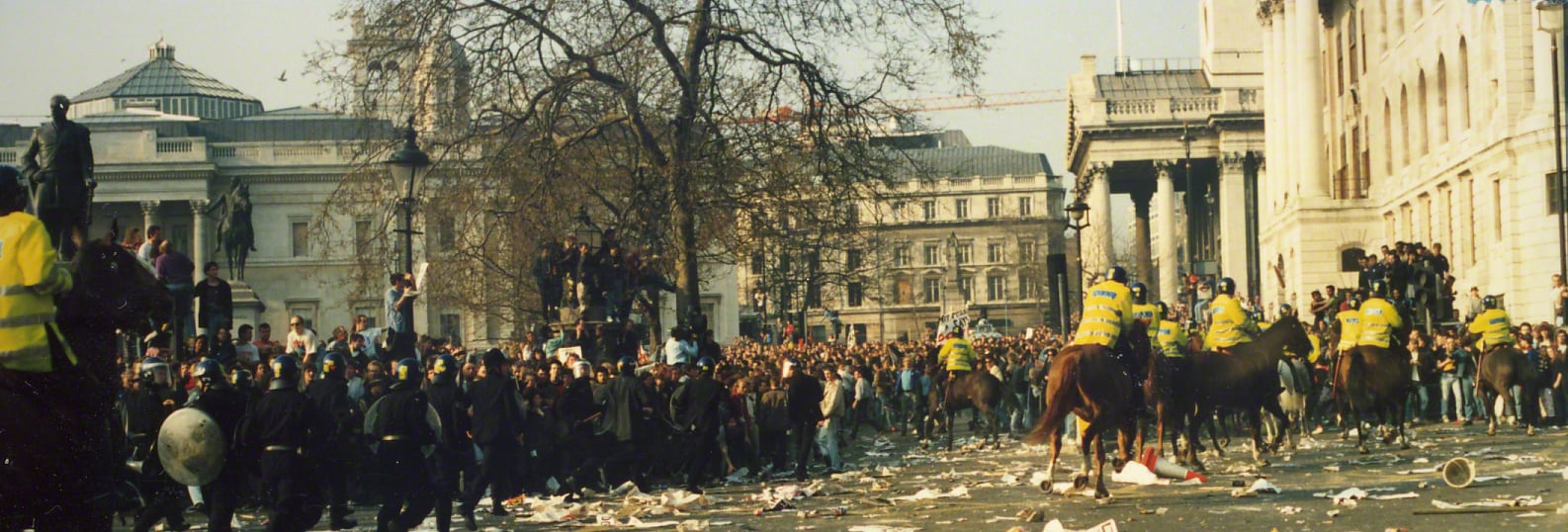
A national anti-poll tax demonstration in central London ended in serious rioting
Police estimated the crowd at 40,000 while organisers claimed 200,000
339 people were arrested
Hundreds of police officers and members of the public were injured, although the exact totals vary between accounts
The political effect was more important than the disorder itself
The riot made the poll tax appear not just unpopular but increasingly unworkable
Government support in the opinion polls fell sharply afterwards
The political cost
Ministers responded by using charge capping to limit what councils could set
This created a contradiction at the heart of the policy
The tax had been sold as a way of making councils more accountable to local voters, yet the central government was now intervening directly in local charges
Thatcher still refused to abandon or fundamentally redesign the tax
Her refusal was increasingly interpreted by some Conservative MPs as evidence that she would not change course even when a policy was causing serious political damage
By late 1990, the poll tax had become one of the strongest arguments used by Conservatives who wanted a new leader before the next general election
Examiner Tips and Tricks
Do not stop at saying the poll tax was unpopular. The stronger point is that it damaged Thatcher because it created three problems at once: high bills for voters, rebellion among Conservative MPs and growing doubts about her judgement
Use the Conservative criticism carefully. Backbenchers such as Nicholson and Boyson are especially useful because their objections cannot be dismissed as routine opposition attacks
Divisions over Europe
The Bruges Speech, 1988
Thatcher's government had agreed to the Single European Act in 1986, but she became increasingly concerned about the direction of European integration afterwards
She argued that the Act was being used to move power away from national governments and towards Brussels
She set out her position in a speech at the College of Europe in Bruges on the 20th September 1988
Thatcher rejected federalism, instead arguing for a Europe based on strong nation-states
The speech was aimed partly at Jacques Delors, President of the European Commission, who wanted deeper integration
“Let me be quite clear. Britain does not dream of some cosy, isolated existence on the fringes of the European Community. Our destiny is in Europe, as part of the Community. But to try to suppress nationhood and concentrate power at the centre of a European conglomerate would be highly damaging ... Europe will be stronger precisely because it has France as France, Spain as Spain, Britain as Britain, each with its own customs, traditions and identity. It would be folly to try to fit them into some sort of identikit European personality”
Margaret Thatcher, Prime Minister, speech to the College of Europe, Bruges, 20 September 1988
Approach: Thatcher gave this speech publicly at the College of Europe in Bruges on 20 September 1988
The source is useful because it sets out her European position clearly. She does not argue that Britain should leave the Community. Instead, she argues that European cooperation should not come at the expense of national sovereignty
Because this was a major set-piece speech, it was intended to influence opinion both at home and abroad. It therefore shows how Thatcher wanted her position to be understood, but it also helped deepen divisions with ministers and European partners who favoured closer integration
The political effect of Bruges
The speech sharpened divisions inside the Conservative Party
It encouraged the formation of the Bruges Group in February 1989, with Thatcher as its president, and the group quickly became a focus for Eurosceptic opinion among Conservatives
Conservative Eurosceptics associated with it included Bill Cash, Norman Tebbit and Nicholas Ridley
Ministers, including Geoffrey Howe and Nigel Lawson, became increasingly uneasy because Thatcher appeared to be retreating from positions they had previously agreed on
Europe, therefore, became a Cabinet issue as well as a foreign policy issue
Disagreement over Europe now divided senior Conservatives openly, although the Westland affair of 1986 had already exposed tension over Britain's European ties
Madrid and the resignation of Lawson
At the Madrid summit in June 1989, Howe and Lawson pressed Thatcher to agree on the conditions under which Britain might join the Exchange Rate Mechanism (ERM)
Thatcher agreed to conditions rather than a fixed date
Soon afterwards Howe was moved from the Foreign Office
Thatcher increasingly relied on her personal economic adviser, Alan Walters, who opposed ERM membership
Lawson believed he could not run economic policy while Walters had the Prime Minister's ear
He resigned on the 26 October 1989
Walters resigned on the same day
John Major then moved from the Foreign Office to the Treasury after only three months as Foreign Secretary
“No one, however long he has held the post, lightly gives up the great office of Chancellor of the Exchequer. Certainly I did not ... for our system of Cabinet government to work effectively, the Prime Minister of the day must appoint Ministers whom he or she trusts and then leave them to carry out the policy. When differences of view emerge, as they are bound to do from time to time, they should be resolved privately and, whenever appropriate, collectively”
Nigel Lawson, former Chancellor of the Exchequer. Personal statement to the House of Commons, 31 October 1989
Approach: Lawson explained his resignation to the House of Commons on 31 October 1989
The source is useful because it shows that the dispute was not only about technical economic policy. Lawson presents it as a problem of Cabinet government, arguing that ministers could not work effectively if the Prime Minister relied on outside advisers against them
However, Lawson was defending his own decision to resign. His account should therefore be compared with Thatcher’s explanation of the dispute and with the wider arguments over ERM membership
The Meyer challenge and entry into the ERM
Thatcher's weakening position became clearer in December 1989 when Sir Anthony Meyer challenged her for the Conservative leadership
He was widely regarded as a stalking horse candidate rather than a serious alternative
Thatcher won comfortably, but around 60 MPs either voted for Meyer or abstained
The results showed that an open challenge to her leadership was now possible
Britain eventually joined the ERM on the 8 October 1990
Major and Douglas Hurd had pressed for entry
Thatcher accepted the decision reluctantly
Rome and the Commons statement, October 1990
Tension over monetary union was already visible in July 1990, when Nicholas Ridley resigned from the Cabinet after calling it "a German racket designed to take over Europe"
At the Rome European Council in October 1990, European leaders agreed on a timetable for further economic and monetary union
Thatcher found herself increasingly isolated from other member states
On the 30 October 1990, she reported back to the Commons and rejected the proposals in uncompromising terms
Her outright rejection went further than the Cabinet's agreed position, which had offered the hard ECU as an alternative to a single currency
Geoffrey Howe resigned on the 1 November 1990
Examiner Tips and Tricks
Do not describe Thatcher as simply anti-European. That is too crude for this period. She had supported the Single European Act and remained committed to Community membership, but she became increasingly hostile to federalism and deeper political integration. Date the Bruges Speech precisely: September 1988. Placing it in or before 1987 breaks the chain from Bruges to the resignations of Lawson in 1989 and Howe in 1990
The fall of Thatcher, 1990
Howe's resignation speech
Sir Geoffrey Howe had served Thatcher continuously since 1979 as Chancellor, Foreign Secretary and Deputy Prime Minister
His resignation on the 1 November 1990 removed one of the last senior figures from Thatcher's original team
Howe then made a resignation speech in the Commons on the 13 November 1990
He argued that Thatcher's increasingly hostile approach to Europe was damaging Britain's ability to negotiate effectively
He ended by inviting other MPs to consider their own response
This was widely interpreted as an invitation to challenge Thatcher's leadership
“It was remarkable, indeed, it was tragic, to hear my Right Honourable Friend dismissing, with such personalised incredulity, the very idea that the Hard ECU proposal might find growing favour among the peoples of Europe ... It is rather like sending your opening batsmen to the crease only for them to find, the moment the first balls are bowled, that their bats have been broken before the game by the team captain.”
Adapted from Sir Geoffrey Howe, former Deputy Prime Minister. Resignation speech to the House of Commons, 13 November 1990
Approach: Howe delivered this speech publicly in the House of Commons on 13 November 1990, less than two weeks after leaving the government
The source is useful because it shows how far relations inside the Cabinet had broken down. Howe had been one of Thatcher’s longest-serving and most loyal ministers, so his public criticism carried far more weight than an attack from the opposition
However, this was also a resignation speech. Howe was explaining and defending his own decision to leave, so his account should be read as a case against Thatcher’s leadership as well as evidence of genuine Cabinet division
The Heseltine challenge and the first ballot
Michael Heseltine announced his leadership challenge on the 14 November 1990
He had resigned over the Westland affair in 1986 and had remained one of Thatcher's most prominent Conservative critics
The first ballot took place on the 20 November
Thatcher won 204 votes to Heseltine's 152
However, Conservative leadership rules required her to secure:
a majority of votes cast
and a lead of 15% of those entitled to vote
She fell four votes short of the required margin
A second ballot was therefore deemed necessary
Thatcher was initially determined to continue
She publicly stated that she would fight on
The Cabinet and Thatcher's resignation
Thatcher returned from a summit in Paris and met senior Cabinet ministers individually
Most told her that she was unlikely to win the second ballot
The private meetings were important
Ministers did not have to oppose her collectively in front of their colleagues
Thatcher therefore heard the same warning repeatedly from some of the people whose support she needed the most
She announced her resignation on the 22 November 1990
This allowed other Cabinet ministers to enter the leadership contest
While Thatcher remained a candidate, they would have found it much harder to stand against her
“During the past 11 years, this Government have had a clear and unwavering vision of the future of Europe and Britain’s role in it. It is a vision which stems from our deep-seated attachment to parliamentary democracy and commitment to economic liberty, enterprise, competition and a free market economy ... The fact is that Britain has done more to shape the Community over the past 11 years than any other member state ... With all this, we have never hesitated to stand up for Britain’s interests”
Adapted from Margaret Thatcher, Prime Minister. Final speech to the House of Commons as Prime Minister, November 1990
Approach: This extract comes from Thatcher’s final speech to the House of Commons as Prime Minister in November 1990
The source is useful for showing how Thatcher defended her record at the moment she left office. She presents her European policy as consistent with parliamentary democracy, economic freedom and British national interests.
However, this was a final public defence of her premiership. It is therefore stronger evidence for how Thatcher wanted her record remembered than for why she had actually lost the support of senior ministers and Conservative MPs
Major's rise
John Major and Douglas Hurd entered the second ballot against Heseltine
Major had been Thatcher's preferred successor and was generally seen as closer to her politically than Heseltine
The second ballot took place on the 27 November 1990
Major won 185 votes
Heseltine received 131
Hurd received 56
Major was still two votes short of an outright majority
Heseltine and Hurd withdrew rather than fight another round
Major, therefore, became Conservative Leader and Prime Minister
Why did the fall happen so quickly?
Howe's resignation did not create all of Thatcher's problems
The poll tax, economic difficulties, and divisions over Europe had already weakened her
What changed in November 1990 was that those problems became a leadership crisis
Howe made public the depth of Cabinet discontent
Heseltine provided MPs with an alternative candidate
The first ballot showed that Thatcher could no longer rely on enough of her own MPs
Her fall was therefore not an electoral defeat
She had won three general elections in a row
She was removed because Conservative MPs and ministers no longer believed she could unite the party and win again
Examiner Tips and Tricks
The strongest analytical point is the difference between a cause and a trigger. Europe, the poll tax and economic problems weakened Thatcher over time. Howe’s speech and Heseltine’s challenge turned that weakness into an immediate contest for the leadership
Thatcher's legacy
What had changed by 1990?
Thatcher left office, having changed the direction of British politics and the economy
Many of her policies were not reversed by later governments, including Labour after 1997
This is why historians often describe her as creating a new consensus to replace the post-war consensus
The role of the state in the economy had been reduced
Major industries such as British Telecom, British Gas and British Airways had been privatised
Share ownership had grown, as ordinary people bought shares in privatised companies
Trade union power had been weakened
Laws introduced in the 1980s required secret ballots before strikes and restricted picketing
The defeat of the miners' strike (1984–1985) showed that the government would not back down to union pressure
Union membership fell from over 13 million in 1979 to under 10 million by 1990
Home ownership had risen
Over a million council tenants had bought their homes under the Right to Buy
This helped build support for the Conservatives among working-class voters
Taxation had shifted
The top rate of income tax had fallen from 83% to 40%
The government placed more emphasis on indirect taxes, such as value added tax (VAT)
The political centre had moved to the right
By 1990, Labour's policy review had dropped nationalisation of privatised industries and accepted much of the market economy
New Labour later kept most of Thatcher's trade union laws and privatisations
What did she leave unresolved?
Thatcher also left problems that her successor had to deal with
The economy was entering recession
The Lawson Boom had ended in high inflation and interest rates of 15%
Britain had joined the ERM only weeks before her resignation, leaving Major to manage its consequences
The poll tax remained in place
It was still deeply unpopular, and non-payment was widespread
The Conservative Party was divided over Europe
The Bruges Speech and the resignations of Lawson and Howe had exposed a split that continued under Major
Social and regional divisions had widened
Unemployment had stayed above 3 million for much of the mid-1980s
The decline of manufacturing hit northern England, Scotland and Wales hardest, deepening the north-south divide
A divided legacy
For the Country |
|
|---|---|
For the Conservative Party |
|
Examiner Tips and Tricks
Separate Thatcher's legacy for Britain from her legacy for the Conservative Party. Her economic changes proved lasting and were largely accepted by New Labour, which is why this period is called "towards a new consensus". Her legacy to her own party was more damaging: the divisions over Europe that helped bring her down continued to weaken Major's government throughout the 1990s.
Why did Thatcher fall from power in 1990?
This question weighs several factors against each other
None explained Thatcher's fall on its own, so the strongest answers should show how they reinforce one another
Economic problems
The economic reputation that had helped Thatcher win in 1987 had weakened badly by 1990
Inflation reached 10.9%, undermining the government's long-standing claim to have brought it under control
Interest rates of 15% hit homeowners and small businesses particularly hard
The balance of payments deficit approached £20 billion a year
The Lawson Boom, fuelled further by interest-rate cuts after the 1987 stock market crash, ended in overheating that damaged confidence in the government's economic management
The poll tax
The Community Charge (poll tax) became one of the most unpopular policies of Thatcher's premiership
Its flat-rate structure was widely criticised because people on very different incomes could face the same basic charge
Mass non-payment made the tax increasingly difficult to enforce
The Trafalgar Square disorder of March 1990 turned opposition to the tax into a national political crisis
Thatcher's refusal to abandon or fundamentally redesign the policy became part of the problem
Some Conservative MPs concluded that replacing Thatcher might be the only way to remove the tax before the next election
Divisions over Europe
Europe increasingly divided Thatcher from senior members of her own government
Her Bruges Speech of 1988 sharpened disagreement over the direction of European integration
Nigel Lawson resigned in October 1989, partly due to Thatcher continuing to rely on Alan Walters, who opposed ERM membership
Geoffrey Howe resigned in November 1990 after further disputes over Europe
These resignations were especially damaging because Lawson and Howe were major figures in Thatcher's governments
Their departure suggested that disagreement had reached the centre of the Cabinet
Howe's resignation speech then helped to trigger Michael Heseltine's leadership challenge
Leadership style and party self-interest
Thatcher's increasingly dominant style created resentment inside the government
Ministers complained that decisions were being taken outside Cabinet
Her reliance on personal advisers added to the feeling that senior ministers were being ignored
There were also signs before 1990 that some Conservative MPs were willing to challenge her
Sir Anthony Meyer's leadership challenge in December 1989 attracted support or abstention from around 60 MPs
By 1990, electoral survival had become a major concern
Labour led in the opinion polls
The loss of Eastbourne to the Liberal Democrats in October 1990 showed that even apparently safe Conservative seats could be vulnerable
Many MPs, therefore, judged Thatcher less by her past victories than by whether she could win the next general election
“Within the folklore of the Conservative Party a myth has taken root which so confounds reason and reality that psychoanalysts may understand it better than historians. The myth is that in a moment of inexplicable folly and conspiracy, even madness, Conservative MPs ejected a leader at the height of her powers, presiding over a healthy party, a calm nation and a benign set of outside circumstances. It really was not like that. In the autumn of 1990 the British economy was in deep-seated trouble; huge internal disputes were raging over Europe; the poll tax, hated by millions, had proved unworkable; the party was far behind Labour in the opinion polls; and within the parliamentary Conservative Party a sense of exasperation with the leadership was obvious”
John Major, Prime Minister 1990 to 1997, written in his autobiography, John Major: The Autobiography, published in 1999
Approach: John Major published this account in 1999, nine years after Thatcher’s resignation and after serving as Prime Minister himself
The source is useful because Major rejects the idea that Thatcher was suddenly destroyed by a single act of betrayal. Instead, he identifies several pressures already weakening her position, including the economy, Europe, the poll tax and declining parliamentary support.
However, Major had benefited directly from Thatcher’s fall and became her successor. His account therefore has a personal stake in presenting the leadership change as the result of wider problems rather than simply the actions of ambitious Conservative MPs
Examiner Tips and Tricks
Do not rank the four factors as if they operated separately. The stronger argument shows the connections between them. The poll tax damaged the polls, poor polls frightened Conservative MPs, Europe removed senior allies, and Thatcher’s leadership style made those disagreements harder to contain

Unlock more, it's free!
Join the 100,000+ Students that ❤️ Save My Exams
the (exam) results speak for themselves:

Was this revision note helpful?
