Blair & New Labour in Power, 1997-2007 (AQA A Level History: Component 2: Depth study): Revision Note
Exam code: 7042

Summary
Tony Blair led Labour to three successive general election victories in 1997, 2001 and 2005
He remained Prime Minister until June 2007
Blair governed in a more presidential style, relying on a small circle of advisers and tightly controlled media presentation and party messaging
New Labour drew on the Third Way, accepting the market economy while arguing that government should still promote greater social justice
Domestic policy focused on education, health, crime and social exclusion
Rising public spending was combined with greater use of targets and performance measures
New Labour also faced growing criticism
Critics on the left argued that it had accepted too much of the Thatcherite settlement
Rural protests, top-up fees and political scandals created further difficulties
The key question asks how far New Labour's domestic programme was successful, or whether it ultimately fell short of its promises
Tony Blair: character and ideology
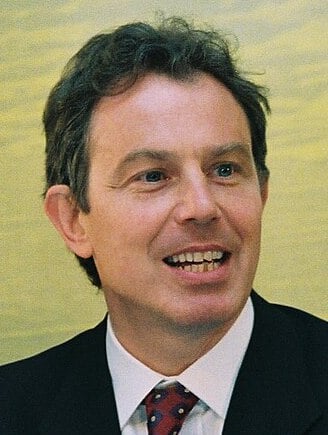
Blair in office, 1997–2007
Tony Blair became Prime Minister on 2 May 1997, aged 43
He was the youngest prime minister since Lord Liverpool in 1812
Labour's landslide victory gave him a majority of 179
Blair then won two further general elections
Labour's majority fell from 167 in 2001 to 66 in 2005
The smaller majority in 2005 partly reflected anger over the Iraq War
Blair resigned on 27 June 2007
He was succeeded by Gordon Brown
Blair's leadership and character
Charismatic
Blair was a confident performer who was comfortable with television and the press
After the death of Diana, Princess of Wales, in 1997, he described her as the "people's princess"
The phrase helped present him as someone who understood the public mood
Modern
Blair was closely linked to the image of Cool Britannia
This promoted Britain as youthful, creative and forward-looking
His informal style helped reinforce the idea that New Labour was different from older forms of politics
In touch with ordinary voters
Blair presented himself as relatable despite a relatively privileged background
He attended Fettes College and Oxford
However, he was the MP for Sedgefield in the North East, wore casual clothes and played in a rock band at university
Presidential
Blair relied heavily on a small circle of advisers rather than always working through the full Cabinet
Critics called this the "sofa cabinet"
Unelected advisers, especially Alastair Campbell, gained considerable influence
The Butler Review (2004) later criticised the informal way some decisions were taken
Media-focused
Presentation was central to Blair's style of government
Labour used professional communication teams and tightly controlled its message
Critics accused the government of relying too heavily on spin doctors
Scandals weakened Blair's promise to restore trust
In 1997, Labour returned a £1 million donation from Bernie Ecclestone after controversy over Formula One's exemption from a tobacco advertising ban
From 2006, the cash-for-honours inquiry damaged the government's image, although Blair was not charged
Clear priorities
Blair set out a small number of simple aims for government
He famously promised "education, education, education"
He also pledged to be "tough on crime, tough on the causes of crime"
Blair's ideology
Blair believed New Labour had to keep modernising to remain relevant
He argued that social and economic change since 1979 meant Labour could not simply return to older policies
He accepted much of the market-based economy created under Thatcher and Major
Instead, Blair drew on the Third Way
This aimed to find a middle path between Old Labour state socialism and Thatcherism
His politics also stressed:
community
individual responsibility
Blair and Brown
Blair and Chancellor Gordon Brown had a close but increasingly difficult relationship
Their rivalry dated back to the 1994 Labour when Brown agreed not to stand against Blair for the Labour leadership
Brown became a powerful figure inside government
His control over economic policy gave him influence over much of domestic policy
His popularity within Labour also made him difficult for Blair to remove
Tension increased after 2001
Brown expected Blair eventually to stand aside
Blair's supporters wanted him to remain Prime Minister
In 2004, Blair said he would not fight a fourth general election
By 2006, pressure over the succession led him to promise to leave office within a year
Blair's strengths and weaknesses
Strengths |
|
|---|---|
Weaknesses |
|
“As I stand here before No. 10 Downing Street, I know what this country has voted for today. It is a mandate for New Labour. We ran for office as New Labour, we will govern as New Labour. This is not a mandate for dogma or for doctrine, or a return to the past, but it was a mandate to get those things done in our country that desperately need doing for the future of Britain. A new Labour Government that remembers that it was a previous Labour Government that formed the welfare state and the National Health Service. It shall be our job to modernise it for a modern world. We will work in partnership with business to create the dynamic economy, the competitive economy of the new century and new age. It will be a government that seeks to restore trust in politics in this country. That cleans it up. And it shall be a government that gives this country strength and confidence in leadership both at home and abroad, particularly in Europe.”
Tony Blair, Prime Minister, speech outside 10 Downing Street on his first day in office, reported in The Irish Times, 2 May 1997
Approach: The source is useful because it shows how Blair wanted New Labour to be understood in government. He presents it as modern, reforming and focused on public services while also working with business.
However, this was a statement of intent, not evidence that those promises had already been achieved. Its value is therefore strongest when compared with what the government later delivered.
Examiner Tips and Tricks
Be careful with the word “presidential”. It was a criticism of Blair’s style, not a literal description of the British system. A stronger answer explains what looked presidential, such as reliance on advisers and tighter control from Downing Street, while recognising that Blair still depended on Cabinet, Parliament and his party.
The 'Third Way'
Origins of the Third Way
The Third Way was presented as a middle path between two older political approaches
Old Labour:
greater state ownership
higher taxation
stronger trade unions
Thatcherism and the New Right:
free markets
smaller state
weaker trade unions
Its best-known thinker was the sociologist Anthony Giddens
He became director of the London School of Economics in 1997
His book The Third Way: The Renewal of Social Democracy (1998) set out many of its ideas
Similar thinking influenced other centre-left governments
Blair developed a close relationship with US President Bill Clinton
The two took part in meetings of centre-left leaders promoting this approach internationally
Key ideas
Accepting the market economy
New Labour no longer aimed to replace capitalism with widespread state ownership
It accepted the free market
Combining economic growth with social justice
Blair argued that a successful economy should help widen opportunity
Economic growth could provide the money needed to reduce poverty and improve public services
The emphasis was more on equality of opportunity than equality of outcome
An enabling state
The belief that the government should help people improve their own opportunities
Education, training and welfare-to-work schemes were intended to help people become more independent
Blair argued that the quality of a public service mattered more than whether it was delivered by the public or private sector
This helped justify greater private-sector involvement in public services, including schemes such as the Private Finance Initiative (PFI)
Rights and responsibilities
Receiving support from the state also brought duties
People claiming welfare were expected to take active steps towards employment
The same principle appeared in New Labour policies on crime and anti-social behaviour
The Third Way in practice
New Labour kept several important parts of the Thatcherite settlement
It retained the trade union laws introduced during the 1980s
It did not restore privatised industries to state ownership
It did not raise the basic or higher rates of income tax
However, New Labour also introduced policies that differed from Conservative governments
A national minimum wage was introduced from April 1999
Britain signed the Social Chapter of the Maastricht Treaty in 1997
Public spending on areas such as health and education rose substantially, particularly after 2000
The Third Way therefore mixed continuity with change
It accepted many market reforms introduced under Thatcher and Major
But it also used government action and public spending to pursue social goals
How different was the Third Way from Thatcherism?
Critics on the left argued that New Labour had accepted too much of the free-market settlement
Some described it as neo-liberalism with a more moderate image
Supporters argued that it represented a modern form of social democracy
Markets were accepted, but government still had a responsibility to reduce inequality and improve public services
Others questioned whether the Third Way was a clear ideology at all
It could also be seen as a flexible political approach designed to attract a broad range of voters
“The Labour election victory in 1997 took place at a moment of great political opportunity. Thatcherism had been rejected by the electorate. But 18 years of Thatcherite rule had radically altered British society. There was, therefore, a fundamental choice of direction for the incoming government. One was to offer an alternative radical strategy to Thatcherism, attuned to the shifts that had occurred in the 1970s and 1980s. The other choice was, of course, to adapt to Thatcherite, neo-liberal terrain. New Labour is difficult to characterise. The fact is that New Labour is a hybrid regime, composed of two strands. However, one strand, the neo-liberal, is in the dominant position. The other strand, the social democratic, is subordinate. At the moment, the resistance to the New Labour project is coming mainly from the backwash of the invasion of Iraq. We need to build the different, particular points of opposition (the war, private-public initiatives, opposition to privatisation) into a more substantive critique in order that a more coherent vision can emerge from the left.”
Stuart Hall, left-wing academic and political commentator, article in the left-leaning newspaper The Guardian, 2003
Approach: The source is useful because Hall argues that New Labour combined social democratic and neo-liberal ideas, but that the free-market side was dominant. This supports the criticism that Blair adapted Labour to much of the Thatcherite settlement rather than replacing it
However, Hall was writing from the political left and wanted New Labour to move further away from Thatcherism, so his judgement should be tested against policies such as the minimum wage, higher public spending and the Social Chapter
“I don’t accept the simplistic idea that New Labour was just a continuation of Thatcherism. Labour’s policies involved extensive government intervention in economic life. And there was a genuine preoccupation with increasing social justice, a notion alien to Margaret Thatcher and her guru Milton Friedman. Yet Blair and Brown should have made it much clearer than they did that recognising the virtues of markets is quite different from being powerless before them. Market fundamentalism should have been more explicitly criticised ... The other parties have had to respond to the agenda that New Labour set”
Anthony Giddens, sociologist and architect of the Third Way, article in the left-wing journal the New Statesman, written shortly after Labour lost the 2010 general election, 17 May 2010
Approach: The source is useful because he rejects the idea that New Labour simply continued Thatcherism, pointing instead to government intervention and greater concern with social justice
However, Giddens was defending ideas he had helped develop, so he had a clear interest in presenting the Third Way as distinctive. His argument should be tested against policies that New Labour retained from the Thatcher period
Examiner Tips and Tricks
Hall and Giddens give contrasting interpretations of the same issue. Hall argues that the neo-liberal side of New Labour was dominant, while Giddens argues that New Labour was not simply Thatcherism continued. Use specific policies to test both interpretations rather than dismissing either because of their political position
Domestic and public service policies
Pledges, priorities and targets
New Labour entered government with five key pledges from the 1997 election campaign
Cut class sizes to 30 for 5–7-year-olds
Fast-track punishment for persistent young offenders
Cut NHS waiting lists by 100,000
Get 250,000 under-25s off benefit and into work
No rise in income tax rates and low inflation
By 2001, the government claimed that all five had been met
However, critics argued that some targets encouraged organisations to focus on what was measured rather than on wider needs
For example, hospitals could prioritise patients whose treatment helped meet waiting-list targets
Blair became frustrated with what he saw as the slow pace of public-service improvement
In 2001, he created the Prime Minister's Delivery Unit to monitor progress
Government departments were given numerous targets covering areas such as exam results and National Health Service (NHS) waiting times
During Labour's second and third terms, reform placed greater emphasis on choice and competition
Parents and patients were offered more choice over schools and hospitals
Critics on the Labour left argued that this brought too many market-style ideas into public services
Education
Education was one of Blair's main domestic priorities
Primary schools introduced dedicated literacy and numeracy hours
Infant class sizes were limited to 30
New Labour combined extra investment with continued measurement of school performance
It retained league tables and Ofsted inspections introduced under the Conservatives
Specialist schools were encouraged
From 2000, the government developed academies, which operated independently of local councils
The first academies opened in 2002
Higher education also expanded
In 1999, Blair set a target for 50% of young people to enter higher education
Tuition fees of up to £1,000 a year were introduced in 1998
The Higher Education Act (2004) introduced top-up fees of up to £3,000 a year
This was controversial as Labour's 2001 manifesto had promised not to introduce them
The bill passed its second reading by only 316 votes to 311
Health
Spending on the NHS rose sharply, particularly after 2000
The NHS Plan of July 2000 linked increasing funding to reform and performance targets
It promised 7,500 more consultants, 20,000 more nurses and 100 new hospital schemes
New Labour also changed how some hospitals were managed
Foundation hospitals, introduced from 2003, received greater freedom from central government control
Many Labour MPs opposed the policy as they believed it introduced too much competition into the NHS
By the mid-2000s, there were signs of improvement
Waiting times fell
However, critics argued that too many targets could make hospitals focus more on meeting targets than on patients' wider needs
“Our task is instead to provide both the money and the reform to make the health service and its founding principle live on and prosper in the 21st century ... By 2005, booked appointments will have taken the place of the old waiting lists”
Tony Blair, Prime Minister, statement to the House of Commons launching the NHS Plan, 27 July 2000
Approach: The source is useful because it shows New Labour’s approach to public services: more funding was linked directly to reform, targets and measurable improvements
However, this was a government announcing its own programme, so the promises should be compared with what actually happened to NHS staffing, spending and waiting times
“It was therefore already known that the plan would contain more targets even though the current targets have not been met, and more pledges even though the current pledges have not been met. The only difference between the contents of this statement and the pledges in the Labour manifesto of four years ago is that the Prime Minister has set the targets so far in the future that he will not be held to account for whether or not they are met”
William Hague, leader of the Opposition, reply to the Prime Minister’s statement in the House of Commons, 27 July 2000
Approach: The source is useful because it shows the Conservative criticism that New Labour relied too heavily on targets and pledges, including some that had not yet been achieved
As the opposition leader, Hague had a clear reason to attack the government’s record, but his criticism is useful for identifying one of the main arguments surrounding New Labour’s public-service reforms
Crime, welfare and social exclusion
Blair’s promise to be “tough on crime” shaped New Labour’s approach
Anti-Social Behaviour Orders (ASBOs) were introduced in 1998
Crime measured by the British Crime Survey fell by around a third between 1997 and 2007
Although public fear of crime remained high
New Labour also tried to tackle the social causes of crime and poverty
The Social Exclusion Unit was created in 1997
Sure Start centres provided support for families with young children
The New Deal, tax credits and the national minimum wage aimed to make employment more financially worthwhile
In 1999, Blair set the long-term aim of ending child poverty by 2020
Social reform also extended personal freedoms
Civil partnerships were introduced
Section 28 was repealed
Rural discontent
New Labour faced criticism that its politics did not understand the concerns of rural communities
In 2000, rising fuel prices contributed to blockades of fuel depots by farmers and lorry drivers
The foot-and-mouth outbreak of 2001 created a further crisis
More than six million animals were slaughtered in attempts to control the disease
The outbreak caused major disruption and hardship to farmers
Opposition to government countryside policies became highly visible
The Countryside Alliance organised the Liberty and Livelihood March in London in September 2002
Around 400,000 people took part, protesting over hunting and wider concerns about rural life
The Hunting Act (2004) banned hunting wild mammals, such as foxes, with dogs
Examiner Tips and Tricks
When assessing New Labour’s domestic record, separate inputs from outcomes. More money, more staff and more targets show what the government put into a service; falling waiting times, exam results or crime rates show what actually changed
Also distinguish between investment and reform. New Labour did not simply spend more on public services. It combined higher spending with targets, inspections, greater choice and, in some areas, more private-sector involvement. That combination is central to judging how distinctive its domestic programme really was
How successful was New Labour's domestic programme?
This question asks whether New Labour's domestic programme was primarily a success, or whether it fell short of its promises
Some key evidence for each side is presented below
Evidence that the programme was successful
New Labour delivered many of the core promises it had made in 1997
Public services received much greater attention and investment
Education, health and crime were all treated as major government priorities
There were clear improvements in some measurable outcomes
NHS waiting times fell
School results improved and participation in higher education increased
Recorded crime also fell over the period
New Labour introduced reforms that became a lasting part of British society
The minimum wage, civil partnerships and the repeal of Section 28 were not reversed by later Conservative governments
The government also retained broad electoral support for much of the period
Labour won three successive general elections, suggesting that its domestic programme remained acceptable to many voters
Evidence that the programme fell short
New Labour's heavy use of targets created problems
Critics argued that schools, hospitals and other services could focus too much on meeting government targets rather than wider needs
Higher spending did not always produce improvements at the same rate
Critics questioned whether the NHS became more productive as quickly as spending increased
PFI also allowed new hospitals and schools to be built while creating long-term repayment costs
Some reforms caused political opposition
Top-up fees broke an earlier manifesto promise and produced a large Labour rebellion
Rural protests showed that some communities felt ignored by the government
New Labour also struggled to reduce some deeper inequalities
The gap between rich and poor began to widen in some areas
Progress towards reducing child poverty was slower than the government had hoped
University expansion mainly benefited middle-class students
Blair's promise to restore trust in politics was also weakened
Spin, donations controversies and later scandals damaged the government's image
“The truth is that there is just one good thing I can say about this Prime Minister, but it is a very big thing indeed. Britain is a nicer place than when he entered Downing Street nearly ten years ago. His premiership has helped to make it so. Tony Blair has placed his personal stamp on a genuinely new era for Britain, an altered culture, a permanent change in our national mood. Without any shadow of doubt, Mr Blair will leave a happier country than he found. Concrete examples are legion: civil partnerships, the scrapping of the ‘section 28’, the minimum wage (towards which I was at first sceptical), childcare provision, the ‘social inclusion agenda’, relaxations on licensing hours, the reclassification of cannabis, a relentless campaign of oratory and example on religious tolerance, and a brave opening of the doors to Eastern European labour from the new EU members. That at least is a legacy of which he should be proud”
Matthew Parris, former Conservative MP and newspaper columnist, opinion column in The Times, 23 December 2006
Approach: The source is useful because his praise carries extra weight: as a critic of Blair, he still accepts that New Labour helped create a more liberal and tolerant Britain
However, most of the examples he chooses are social reforms, so the source says much less about New Labour’s record on the NHS, education, inequality or the use of targets
Examiner Tips and Tricks
A strong answer should ask three separate questions:
What changed?
How far did outcomes improve?
What problems remained?
That keeps the judgement focused and avoids turning the answer into a list of policies

Unlock more, it's free!
Join the 100,000+ Students that ❤️ Save My Exams
the (exam) results speak for themselves:

Was this revision note helpful?
