Political Instability & Extremism, 1919–1924 (AQA A Level History: Component 2: Depth study): Revision Note
Exam code: 7042
Summary
The Weimar Republic faced several significant challenges and problems between 1919 and 1924
There were violent attempts to overthrow the Republic from both extreme left-wing and extreme right-wing groups
The first came in 1919 when the communist Spartacists seized control of key buildings in Berlin
It was violently crushed, and its leaders were killed
The second came in 1920 and was from right-wing ex-soldiers known as the Freikorps
This failed after a general strike brought Germany and Berlin to a standstill
Its leader, Wolfgang Kapp, fled the country but was arrested upon his return
The final attempt to seize power from the Republic came from the Nazi Party in 1923
It was triggered by the hyperinflation crisis and led by Adolf Hitler
The putsch collapsed when the Bavarian state police opened fire on the marchers, and the army did not come over to Hitler
The Republic was vulnerable to criticism and attacks because proportional representation often led to coalition governments
This led to compromises and no clear direction for those in charge
The Spartacist Uprising, 1919
The Spartacist League began as an anti-war faction of the Social Democratic Party of Germany (SPD)
Due to their opposition to the war, they helped establish the Independent Social Democratic Party of Germany (USPD)
In December 1918, they branched away from the USPD
They founded the KPD (Communist Party of Germany)
Rosa Luxemburg and Karl Liebknecht led the Spartacists
Spartacist comes from the name Spartacus, the leader of a slave revolt in Ancient Rome
The Spartacists started an uprising on 4th January 1919
This uprising was triggered by events within the Weimar government
Chancellor Ebert sacked Emil Eichhorn, Berlin’s police chief
Eichhorn was popular amongst the workers
Luxemburg and Liebknecht saw this as an opportunity to challenge the Weimar government
By 6th January, Berlin was in chaos
Luxemburg and Liebknecht had encouraged the workers to go on a general strike
Over 100,000 workers protested on the streets
The Spartacists had taken control of the government’s newspaper and various telegraph offices across Berlin
Chancellor Ebert did not know what to do
The First World War had weakened the Reichswehr
There were too many protestors on the streets
Ebert turned to another organisation to defeat the Spartacist Uprising
He ordered the Reichswehr to organise the Freikorps units to fight the Spartacist Uprising
The Freikorps held extreme right-wing opinions and hated communists
The Spartacist Uprising ended on 13th January 1919
The Freikorps and Reichswehr were fighting mainly unarmed communist workers
On 15th January, both Luxemburg and Liebknecht were brutally killed by the Freikorps
The Kapp Putsch, 1920
The Freikorps was a dangerous organisation
After the army released them from military duty in November 1918, they kept their weapons
They held extreme right-wing beliefs
This did not match the government’s moderate approach to politics
After they had repressed the communists, Ebert feared the power of the Freikorps
The Freikorps believed that the government had committed a ‘dolchstoss' by signing the armistice and the Treaty of Versailles
There were roughly 250,000 Freikorps members by March 1919
In March 1920, Ebert planned to disband the Freikorps units in Berlin
Fearing unemployment, 5,000 Freikorps members attempted to overthrow the government
They announced Wolfgang Kapp, a right-wing politician, as their leader
Ebert attempted to use General Seeckt, the head of the Reichswehr, to stop the Freikorps. General Seeckt saw the Freikorps as fellow soldiers and refused to attack them
The Freikorps successfully captured Berlin
Forcing the Ebert government to retreat to Dresden, and then later Stuttgart
At this point, Kapp and the Freikorps made a critical error. Kapp and Lüttwitz proclaimed a new government with Kapp as Reich Chancellor
"We are strong enough not to have to begin our rule with arrests and other violent measures. But we will strike down any revolt against the new order with ruthless determination. We will not rule according to theories, but according to the practical needs of the state and the nation as a whole.
According to the best German tradition the state must stand above all the struggles of occupational groups and parties. The state is the impartial judge in the current struggle between capital and labour. We reject every class preference, whether for the right or the left. We recognize only German citizens. Every German citizen who in this difficult hour gives to the fatherland what belongs to the fatherland can count on us.
Let each person do his duty! Today work is the most noble duty for everyone. Germany is to be a moral working community! The colours of the German Republic are black–white–red!”
An extract from a speech by Wolfgang Kapp in 1920, in which he proclaimed a new government with himself as Reich Chancellor
The workers, with the Weimar government’s encouragement, called for a general strike
Berlin lost gas, electricity and water supplies
There was no public transportation
After four days, Kapp left Berlin
He could not govern the city without essential services
He and his conspirators fled to Sweden
By 1922, Kapp returned to Germany to stand trial for conspiracy and treason
He died before the trial began
The Establishment of the Nazi Party
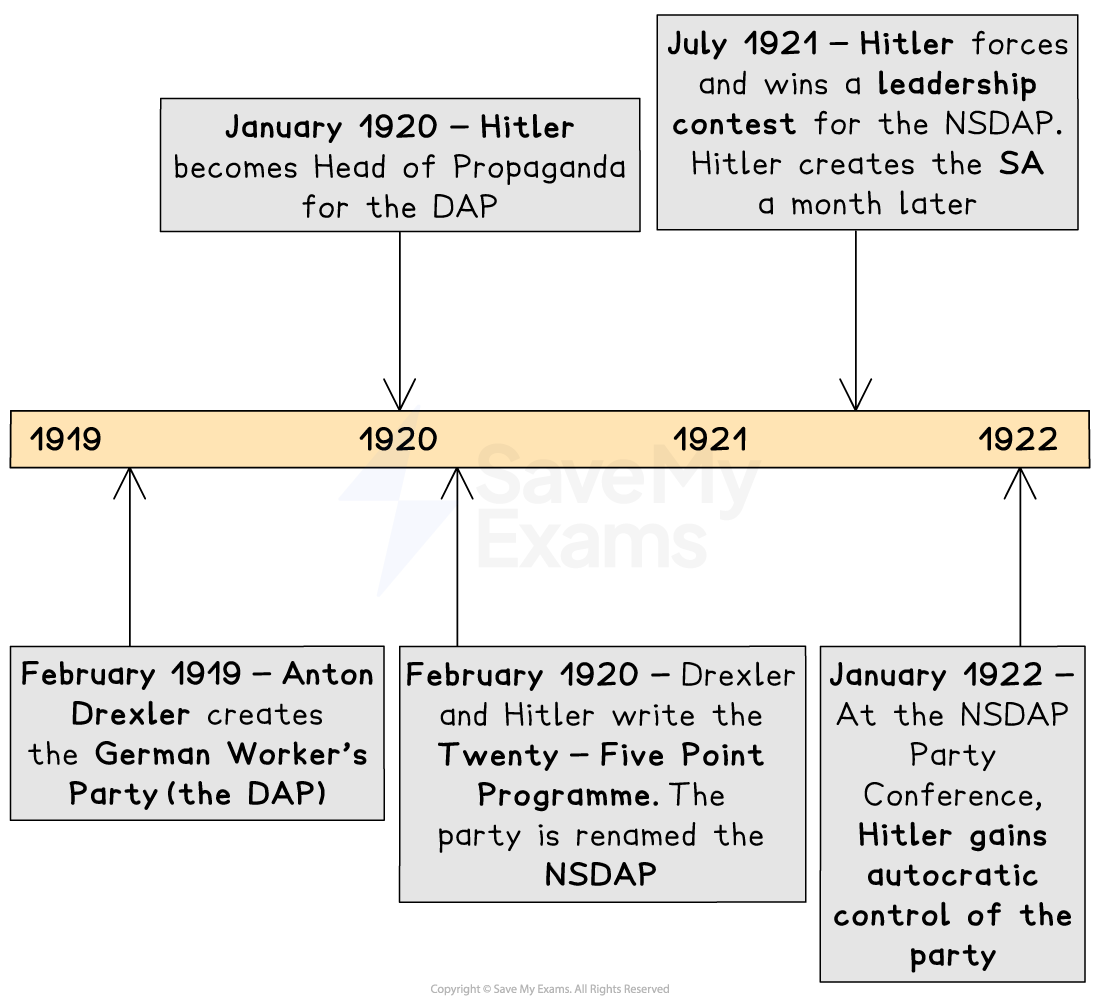
Anton Drexler founded the German Workers Party (DAP) in February 1919
Drexler was a railway mechanic from Munich
In September 1919, the DAP had 23 members
It was a right-wing party that targeted the working classes
The Army hired Hitler to spy on political parties in Munich
The Weimar Republic had struggled to survive threats from extremist parties
As an ex-soldier, Hitler desperately needed the work
The majority of Germany’s armed forces had been made unemployed after the Treaty of Versailles restricted the German army to 100,000 soldiers
Hitler attended his first meeting of the DAP on 12th September 1919
The ideas discussed at the meeting aligned with Hitler’s personal beliefs
On 19th September 1919, Hitler signed up as a member
This went against his government assignment
By 1920, the DAP had changed its name to the National Socialist German Workers’ Party (the NSDAP or Nazi Party)
Hitler implemented his takeover of the NSDAP by 1921 in five ways:
Changing the party’s policies to the Twenty-Five Point Programme
Hitler’s personal appeal
Developing the party’s organisational structure
Forcing a change of leadership and choosing members for key positions
Creating the NSDAP’s private army, the SA (Sturmabteilung)
When Hitler became responsible for the DAP’s propaganda, he realised the party needed an official document stating its policies
The DAP already spoke on key issues such as:
The removal of Weimar politicians who had signed the Treaty of Versailles
The rewriting of the Weimar Constitution and restrictions on democracy
The blaming of the Jewish people for all of Germany’s issues
In January 1920, Hitler and Drexler wrote the Twenty-Five Point Programme, which formalised the aims of the DAP
This laid out the party's anti-democracy, anti-capitalist, anti-semitic and ultra-nationalist beliefs
The Munich Putsch, 1923 (Beer Hall Putsch)
The hyperinflation crisis triggered the Munich Putsch and was one of the political consequences of the invasion of the Ruhr
Hitler hoped and believed that Germans were so angered and humiliated by the occupation of the Ruhr by French and Belgian soldiers that they would join his uprising
It was also inspired by Mussolini's successful 'March on Rome' which led to the Italian fascist dictator seizing power
On 8th November 1923, Adolf Hitler attempted to seize power in Germany
Events of the Munich Putsch
Hitler plotted with Kahr, the Bavarian State Commissioner, and Lossow, the Bavarian army commander, to take over Munich
4th November 1923
Kahr and Lossow decided not to go ahead with the revolution
8th November 1923
Hitler and 600 members of the Sturmabteilung (SA) stormed into a meeting of the Bavarian government
The meeting was being held at a beer hall called Burgerbraukeller
Hitler jumped on a table and fired a gun
He then made a speech stating that he was taking over Munich and marching on Berlin
Hitler took Kahr, Seisser and Lossow (the leaders of the Bavarian government) into a side room
Kahr and Lossow had previously plotted with Hitler to take over Munich
At gunpoint, he made the men agree to his plan
He made Erich Ludendorff Head of the Army
Kahr, Seisser and Lossow asked Ludendorff if they could return home
Ludendorff released the men
They went to warn Ebert of Hitler's putsch
9th November 1923
Hitler realised the Bavarian leaders had betrayed him
At midday, 1,000 SA and 2,000 volunteer supporters continued the putsch
They marched to the centre of Munich
Göring (leader of the SA) and the SA had not taken control of the main army barracks
Police and the army formed a barricade
The police opened fire on the SA and the supporters of the putsch
An estimated 15-16 Nazis were killed as well as four police officers
Göring was shot in the thigh
Ludendorff was arrested
11th November 1923
Hitler was arrested
1924
At the trials following the putsch, Ludendorff and Hitler were tried for high treason
Ludendorff, a war hero, was found not guilty (acquitted)
Hitler was sentenced to five years in prison
He served only nine months of this sentence
His speeches at the trial persuaded the judges not to deport him to Austria
"The Bavarian Ministry is removed. I propose that a Bavarian government shall be formed consisting of a Regent and a Prime Minister invested with dictatorial powers. I propose Herr von Kahr as Regent and Herr Pohner as Prime Minister. The government of the November :white_check_mark: Criminals and the Reich President are declared to be removed. I propose that, until accounts have been finally settled with the November criminals, the direction of policy in the national Government be taken over by me. Ludendorff will take over the leadership of the German National Army, Lossow will be German Reichswehr Minister, Seisser Reich Police Minister.... I want now to fulfil the vow which I made to myself five years ago when I was a blind cripple in the military hospital: to know neither rest nor peace until the November criminals had been overthrown, until on the ruins of the wretched Germany of today there should have arisen once more a Germany of power and greatness, of freedom and splendour."
An extract from the speech given by Adolf Hitler at the Burgerbraukeller, 8th November 1923.
Problems of Coalition Government
Proportional representation meant achieving over 50% of the vote was difficult
Numerous moderate parties reluctantly joined together to gain a majority in the Reichstag and form governments
These coalition governments were slow to pass legislation and make decisions
Coalition partners had to agree with one another before they could command the majority needed to pass a law, which made legislation slow
The extreme left and extreme right parties attacked the coalition governments in the Reichstag
The extremists had the power to cause disruption
How stable was the Weimar Republic by 1924?
The issue of the stability of the Weimar Republic has divided the opinions of historians
Some argue that the Republic had weathered the storms of hyperinflation and attempts to overthrow it from the political Left and Right
They believe the attempts to overthrow the Republic had failed and that the economic problems were solved
Others argue that the structural and constitutional problems of the Republic remained and that the stability was a temporary illusion
They believe the problems of proportional representation and weak coalition governments remained unsolved
Examiner Tips and Tricks
Don't treat the Spartacist Uprising, Kapp Putsch and Munich Putsch as three 'crises' in a list. Examiners reward candidates who spot the difference in how the Weimar state responded to left vs right-wing extremism. The Spartacist uprising was crushed by Freikorps violence with Ebert's backing. By contrast, the ringleaders of the Kapp Putsch and the Munich Putsch received more lenient treatment.

Unlock more, it's free!
Join the 100,000+ Students that ❤️ Save My Exams
the (exam) results speak for themselves:

Was this revision note helpful?
