Society in the 1970s (AQA A Level History: Component 2: Depth study): Revision Note
Exam code: 7042

Summary
Second-wave feminism reached its height during the 1970s
Three Acts passed in 1975, and the Equal Pay Act (1970) coming into force, changed women's legal position
Immigration continued despite the Immigration Act (1971)
Race became a more serious social and political issue in Britain than it had been in the 1960s
The National Front was described as Britain's fourth-largest political party by 1977
The Anti-Nazi League and Rock Against Racism organised opposition to it
Youth subcultures, including skinheads and punks, worried many older people
Football hooliganism became known as the "English disease"
Environmentalism developed from separate campaigns into organised pressure groups
The key question asks whether British society changed fundamentally in the 1970s or whether older inequalities and divisions largely persisted
The progress of feminism and the Sex Discrimination Act, 1975
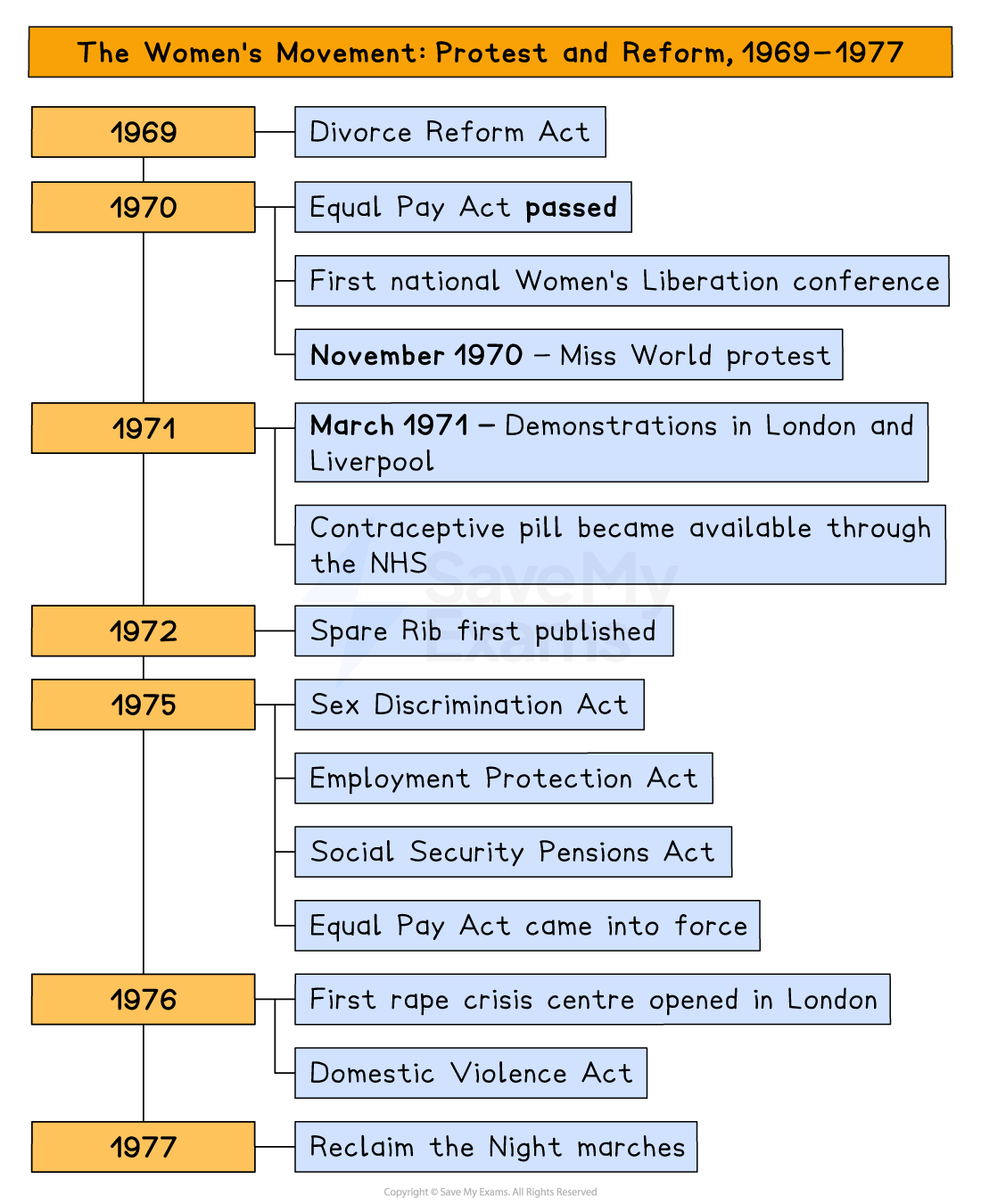
The Women's Liberation Movement
The 1970s were the height of second-wave feminism, which had developed during the 1960s
The first National Women's Liberation Conference was held at Ruskin College, Oxford, in February 1970
It agreed four demands: equal pay, equal education and opportunity, 24-hour nurseries, and free contraception and abortion on demand
Women's liberation groups then spread across the country
Campaigners used protest to draw attention to women's position
Protesters disrupted the Miss World contest in November 1970
Demonstrations in London and Liverpool in March 1971 demanded equal pay and free 24-hour nurseries
Feminists disagreed over what women's liberation required
Germaine Greer's The Female Eunuch (1970) became one of the movement's best-known books
Black and Asian women formed their own groups, such as the Brixton Black Women's Group (1973), arguing that the movement overlooked race
Radical feminists identified patriarchy as the main cause of women's oppression and campaigned for reproductive rights
Socialist feminists argued that women's inequality was linked to social class and economic dependence
The movement developed its own media
The feminist magazine Spare Rib published its first issue in 1972
It became one of the best-known publications linked to the movement
"In the counter culture there were all classes and races, but by the end of the 60s the so-called freedoms were no longer freeing. It turned out that women didn't really have a voice and what had been freeing was imprisoning because women were more objectified. People were very frightened of feminism. We were always seen as such a threat. We really wanted to change the relationship between work and home, but we didn't really have answers.
When we started Spare Rib we wanted to reach out to other women who had been repressed. At that time even pop music was male-dominated. I remember going to the Isle of Wight festival in 1970, and Joni Mitchell and Joan Baez were the only two women performing in the whole festival. All the others were men"
Co-founder of Spare Rib Marsha Rowe, being interviewed for a modern feminist website in 2008
Approach: In this later interview, Rowe describes the counterculture as male-dominated and argues that its supposed freedoms did not give women an equal voice
The source is useful for showing why some women believed that a separate feminist movement was needed. However, it is a retrospective interview by an activist closely involved in the movement, so it is stronger for showing how feminists understood the period than for showing what all women thought at the time
Campaigns on violence and reproductive rights
Feminists campaigned for greater control over fertility
Contraception, including the pill, became free on the National Health Service (NHS) for all women, married or single, in 1974
It became more accepted and widely used
Violence against women became a major campaign issue
Erin Pizzey opened the first women's refuge in Chiswick, London
Rape crisis centres began opening from 1976
The Domestic Violence and Matrimonial Proceedings Act (1976) allowed women to apply for court orders restraining violent partners
Reclaim the Night marches were held across Britain in 1977
They followed the murders committed by the Yorkshire Ripper
Campaigners demanded that women should be able to use public spaces without fear
The legislation of 1975
The Sex Discrimination Act (1975) was the main law passed that year to tackle discrimination against women
It made discrimination on the grounds of sex or marital status unlawful in:
employment
education
access to goods, services and premises
The Act created the Equal Opportunities Commission
It monitored the Sex Discrimination Act and the Equal Pay Act
It could bring legal proceedings against employers
Three other Acts affecting women were passed or came into force in 1975
The Employment Protection Act (1975) introduced paid maternity leave and made dismissal due to pregnancy unlawful (in force 1976–77)
The Social Security Pensions Act (1975), introduced by Barbara Castle, improved pension rights for women whose contributions had been limited by caring responsibilities
The Equal Pay Act (1970) finally came into force five years after it was passed
Its passage had been influenced partly by the requirements of Britain's entry into the European Economic Community (EEC)
How far did women's position improve?
Several changes increased women's legal and financial independence
From 1971, women could take out a mortgage without a male guarantor
Women's pay rose from 59% of men's pay in 1970 to 70% by 1977
The United Nations established International Women's Day in 1977
Women were under-represented in senior and managerial jobs
Enforcement remained limited
The Equal Opportunities Commission launched only nine investigations between 1976 and 1983
Only 10% of workplace sex discrimination claims succeeded
Discrimination was often difficult to prove
Employers found ways around the Equal Pay Act
Women's jobs could be made slightly different from men's jobs, preventing direct comparison
Trade unions remained dominated by men
The Trades Union Congress (TUC) did not publish its charter, Equality for Women within Trade Unions, until 1979
Examiner Tips and Tricks
Use the pay figures carefully. The rise from 59% to 70% shows progress but it also shows that women's earnings remained below men's. This allows you to show both change and continuity in the same point
Race and immigration
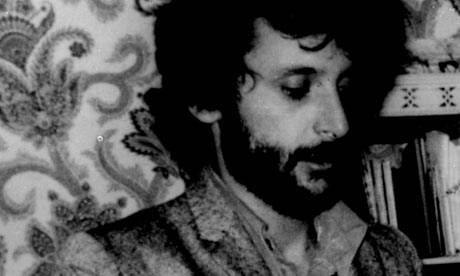
Unknown photographer / Wikimedia Commons (public domain).
Immigration and settlement after 1971
The Immigration Act (1971) tightened entry into Britain
Migrants from the New Commonwealth generally needed either a work permit for a specific job or a parent or grandparent born in Britain:
a guaranteed job
a parent or grandparent born in Britain
The Act took effect in 1973
Those entering under it did not automatically gain the right to settle permanently
Events overseas still brought new arrivals
Idi Amin expelled Uganda's Asian population in 1972
Around 28,000 Ugandan Asians came to Britain as an exception to the Act
Migration from the Indian subcontinent continued
This included migrants from Bangladesh after its separation from Pakistan in 1971
By 1974, over one million New Commonwealth immigrants had settled in Britain
Around 435,000 came from India and Pakistan
Around 325,000 came from the West Indies
Around 150,000 came from Africa
Settlement often developed where family and cultural networks had already existed
Brick Lane in London later became known as Banglatown
Leicester received many East African Asians
Political representation remained limited
Only 10 ethnic minority councillors were elected in the 1974 London borough elections
This had risen to 35 by 1978
The National Front and racial violence
The National Front grew during the 1970s
It was founded in 1967
It supported the repatriation of immigrants
It had up to 20,000 members by 1976
It achieved some electoral support
Martin Webster won 16% of the vote in the West Bromwich by-election in May 1973
By 1977, the National Front was described as Britain's fourth-largest political party
However, it never won a parliamentary seat
The National Front often marched through areas with a large immigrant population
These marches frequently met counter-protests
Violence sometimes followed
Racial violence increased
The Trades Council of East London recorded over 100 incidents, including two murders, between January 1976 and August 1978
Assaults and robberies of Asian and Afro-Caribbean people rose by a third
Blair Peach, an Anti-Nazi League supporter, was fatally injured during a protest in Southall in April 1979
He was a teacher from New Zealand
The Metropolitan Police later accepted that one of its officers had probably struck him
The rise of the National Front increased pressure on the main parties
By the late 1970s, the Conservatives promised tighter immigration controls
"By the end of this century there would be four million people of the New Commonwealth or Pakistan here. Now that is an awful lot, and I think it means that people are really rather afraid that this country might be rather swamped by people with a different culture. The British character has done so much for democracy, for law, and done so much throughout the world. If there is any fear that it might be swamped, people are going to react and be rather hostile to those coming in. If you want good race relations, you have got to allay people's fears on numbers, so we do have to hold out the prospect of an end to immigration, except, of course, for compassionate cases. Therefore we have got to look at the numbers who have a right to come in"
Margaret Thatcher, Leader of the Opposition. Television interview with Gordon Burns for World in Action, Granada Television, recorded 27th January 1978, broadcast 30th January 1978
Approach: Thatcher argued that immigration numbers should be reduced and warned that many people feared being “swamped” by a different culture
The source is useful for showing how immigration had become a major electoral issue. It also shows how the Conservatives tried to attract voters concerned about immigration. However, Thatcher was speaking to a television audience and wanted to gain political support, so her language was chosen to influence public opinion rather than give a neutral account
Policing and the 1976 Notting Hill Carnival
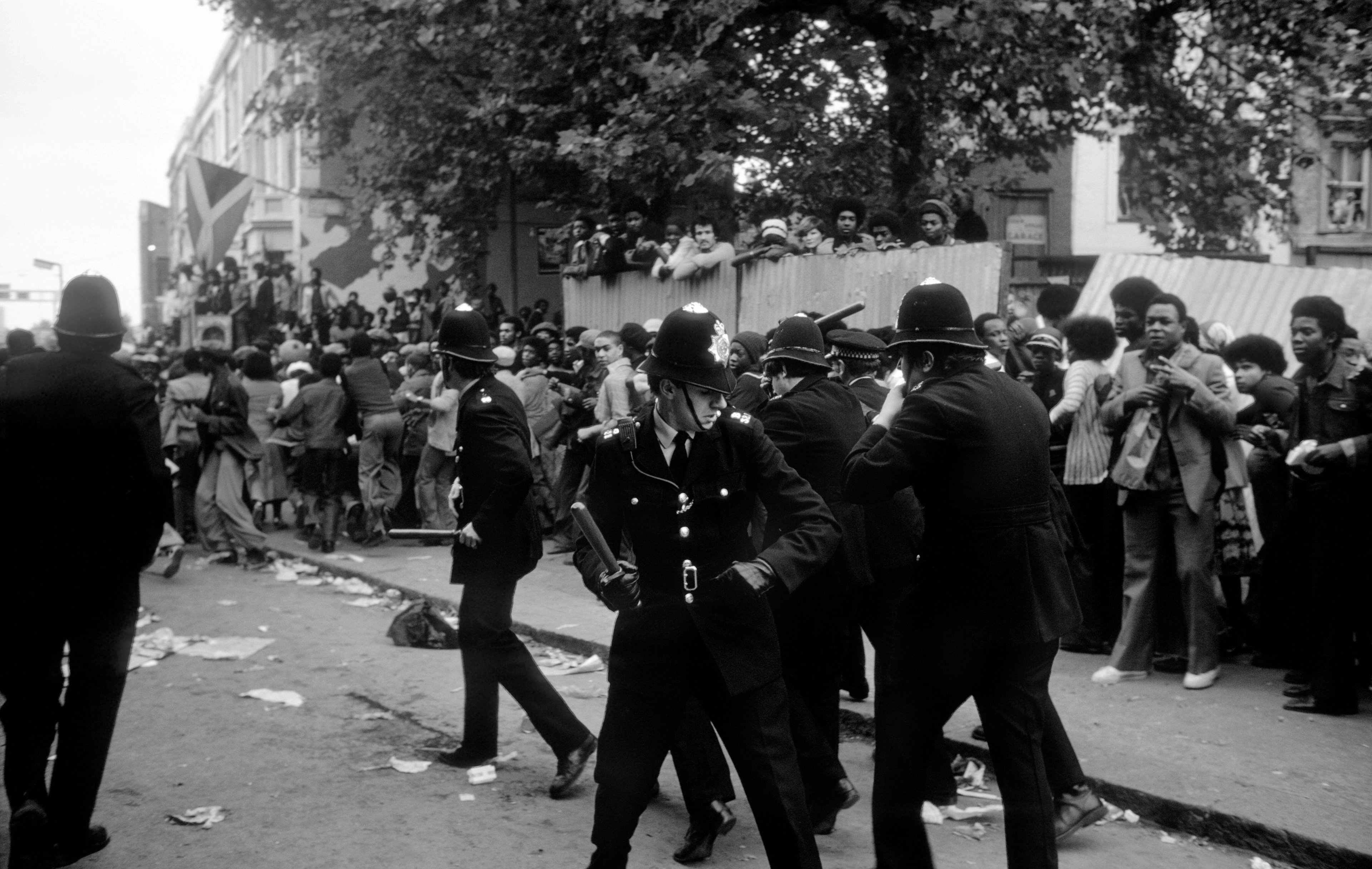
Alamy/2XAACXC
Relations between the police and black communities worsened during the 1970s
Ethnic minorities were poorly represented in the police
In 1976, only around 70 of roughly 22,000 Metropolitan Police officers came from an ethnic minority background
Many young black people believed that the police treated them as suspects rather than protecting them
Complaints focused particularly on the use of stop and search
Serious disorder took place at the 1976 Notting Hill Carnival
More than 300 people were injured
Some newspapers and politicians called for the carnival to be banned
Accounts disagreed over how the disorder began and who was responsible
"There was a smell in the air of trouble brewing, based on the fact or fiction that there were pickpockets in crowds. The police took a consistently heavy-handed approach to any large group of black people. I got there at 10 am and it was very peaceful. There were a lot of white and black people mixing together, and no problems. Then a young black guy jumped on top of another black guy. A fight started, and it was used as the excuse for the police to charge. It was extraordinary; there were women and children, and the police moved in with their batons out, pushing, shoving, and beating people. In reports the next day, there was no indication about what had actually happened; the riot was blamed on 'troublemakers'"
Adapted from Robert Golden, photographer covering the Carnival for Socialist Worker. Written account, 2013, of the Notting Hill Carnival of 1976
Approach: Golden was present when the disorder began and described the police using batons against a crowd
The source is useful because it is an eyewitness account of police conduct. However, Golden was working for a left-wing newspaper that was critical of the police, so his account should be compared with other witnesses and official evidence. Additionally, it was published in 2013, many years after the event
Legislation and anti-racist campaigning
The Race Relations Act (1976) extended earlier laws
It outlawed indirect discrimination
This included cases where discrimination was hidden behind apparently neutral rules
The Act created the Commission for Racial Equality
It would carry out investigations
It could require witnesses to appear in these investigations
Anti-racist organisations grew in response to the National Front
Rock Against Racism was founded in 1976
It followed comments made by guitarist Eric Clapton in support of Enoch Powell
The Anti-Nazi League was formed in 1977
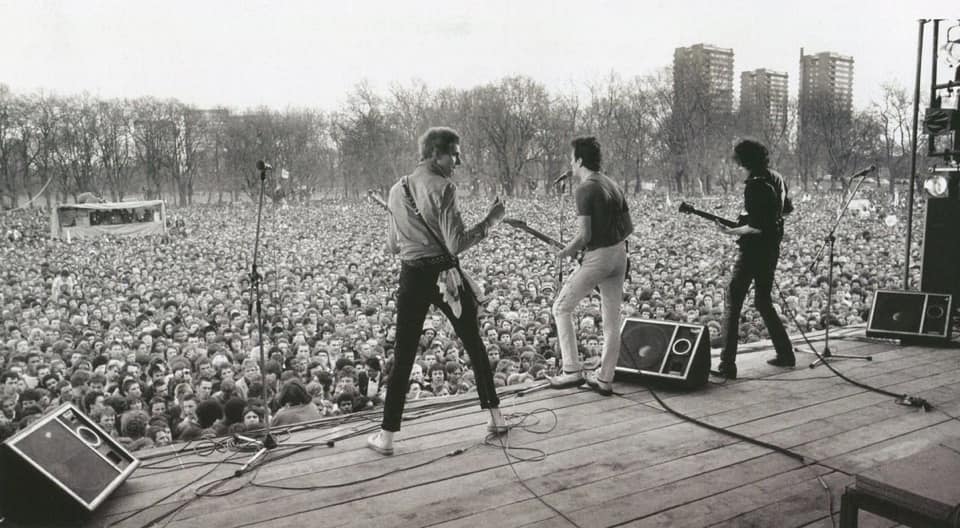
Around 100,000 people joined in a march from Trafalgar Square to a concert in Victoria Park on 30th April 1978
Migrant workers also organised their own campaigns
The Grunwick dispute was led mainly by Asian women workers
They campaigned for trade union recognition
The dispute showed immigrant workers acting for themselves rather than being represented by others
Change and continuity in popular culture
Black Britons became more visible in public life
Viv Anderson became the first black footballer to play for England in 1978
Reggae and ska became more popular
Local authorities began to adopt policies of multiculturalism
Open racism continued
Black footballers faced crowds who made monkey noises and threw bananas
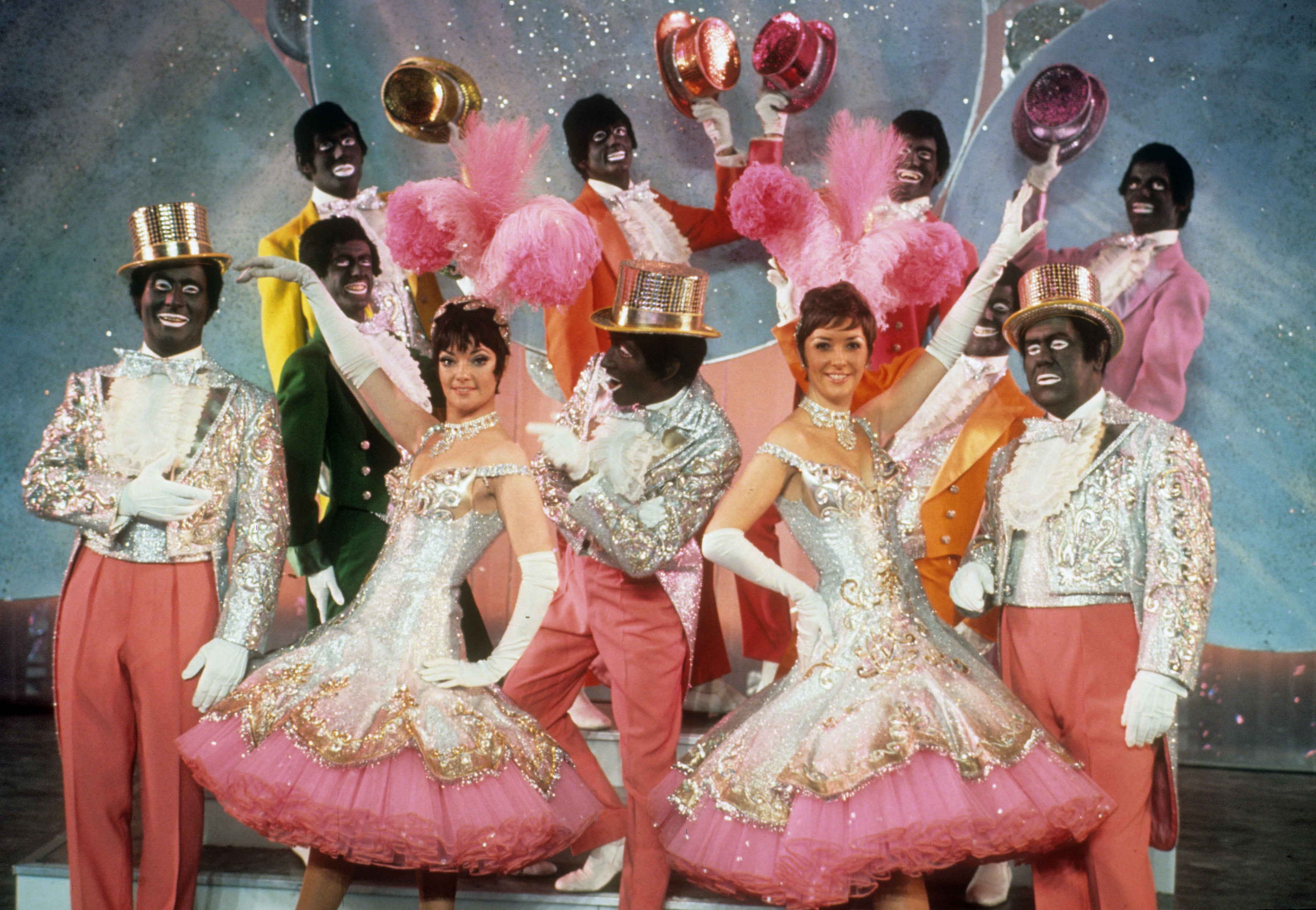
The Black and White Minstrel Show, which used white performers in blackface, continued until 1978
In 1980, the Commission for Racial Equality warned that racial prejudice and discrimination remained widespread
Examiner Tips and Tricks
Avoid a simple judgement of race relations, either improved or worsened. The Race Relations Act (1976), multicultural policies, and anti-racist campaigns show change, while the National Front, racial violence, and poor ethnic minority representation in the Metropolitan Police and complaints about stop and search show continuity.
Youth
Skinheads
Skinhead style developed from the mod scene at the end of the 1960s
It was mainly associated with working-class young people
Early skinheads drew heavily on Jamaican music and culture
Many skinheads remained apolitical
The movement changed during the 1970s
By the late 1970s some had become linked to the National Front
Some also took part in football hooliganism and attacks on people from ethnic minority backgrounds
Punk
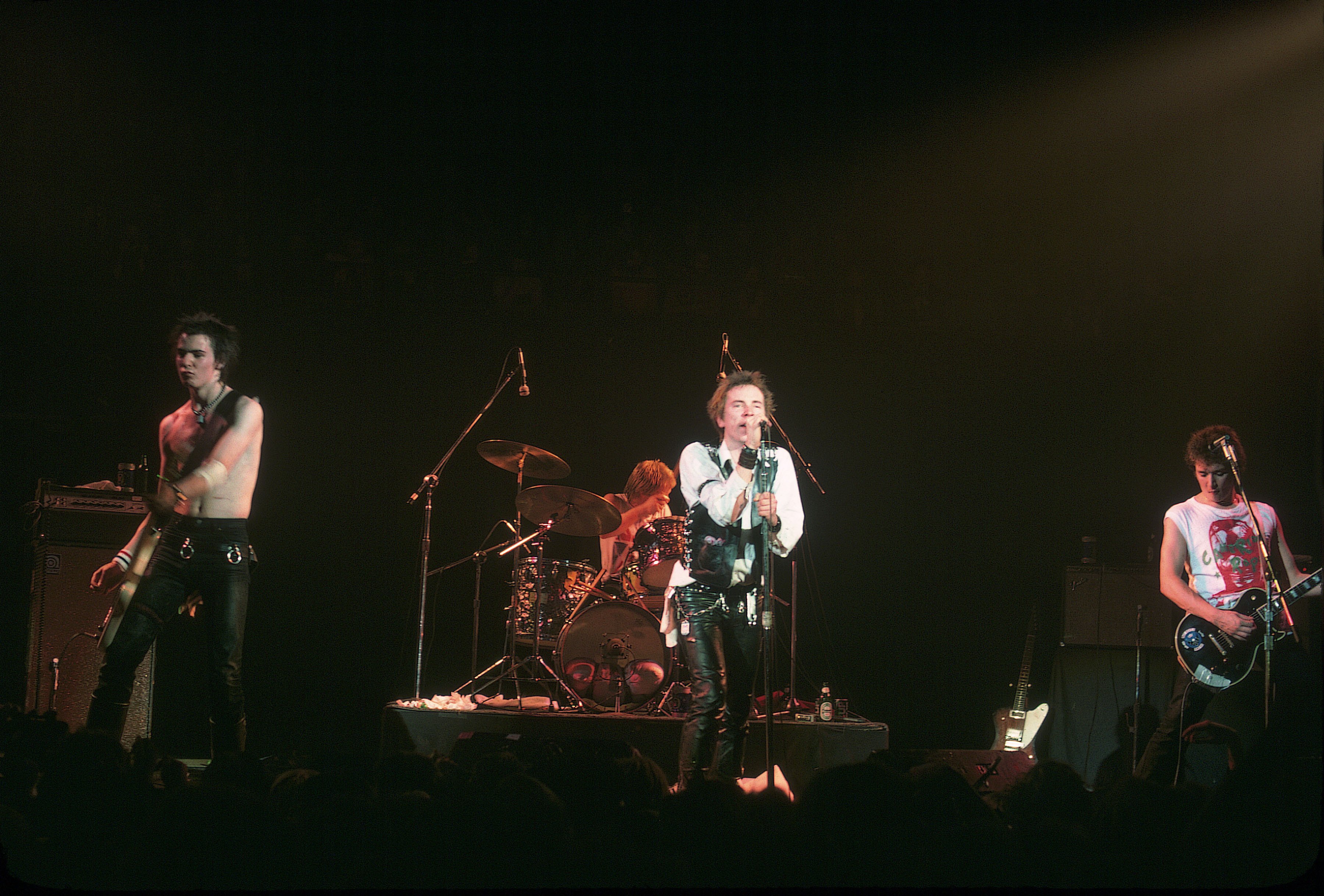
Punk emerged in 1975 and 1976
It was influenced by American bands such as the New York Dolls, who rejected commercialised popular music
British bands included the Sex Pistols, The Clash, The Damned and the Buzzcocks
Punk music rejected the polished sound of mainstream pop and rock
Songs were usually short, fast and built around simple guitar chords
Vocals were often shouted or delivered aggressively
The emphasis was on energy and attitude rather than technical skill
Its ideas were often described as nihilistic
Punks rejected the optimism and alternative lifestyles associated with the hippie movement
Punk fashion was designed to shock
Clothing included ripped T-shirts, leather trousers and safety pins
Vivienne Westwood and Malcolm McLaren sold punk clothing from their shop on the King's Road in London
The Sex Pistols were managed by Malcolm McLaren and fronted by Johnny Rotten
Concerts could be confrontational
Performers and audiences sometimes spat at one another
Scuffles were common
Punk created a moral panic
The Sex Pistols swore during a live television interview
The Daily Mirror responded with the headline “The Filth and the Fury!”
The Sex Pistols released "God Save the Queen" in 1977 during the Silver Jubilee
The BBC and commercial radio stations refused to play it
It still reached number two in the charts
Youth, race and politics
Young people took different sides in the racial conflicts of the decade
Some skinheads were attracted to the National Front
Many more young people joined Rock Against Racism and the Anti-Nazi League
Music became part of this political divide
Punk bands such as The Clash drew on reggae and ska
Anti-racist concerts brought punk and reggae performers together
"As the park slowly filled up, one could float through three generations of the left.
At the outskirts there were couples who might have been in Trafalgar Square when Bevan spoke against the Suez invasion. Their sensible footwear had been lent on the Aldermaston March.
The middle group was the generation of 1968. They had henna on for the occasion, even if it did remind them of a commune they'd rather forget. They quite liked Tony Benn's speech.
Finally, there were the front-line punks. This was their Grosvenor Square. The punks didn't like any of the speakers but knew exactly what the music was saying"
Adapted from David Widgery, a left-wing writer and activist writing about attending a Rock Against Racism concert in April 1978 in his book Beating Time, published in 1986
Approach: Widgery presents the concert as a meeting of three generations of protest:
the Campaign for Nuclear Disarmament marches of the 1950s
the protesters of 1968
the punks of the late 1970s
The source is useful for showing how protesters understood Rock Against Racism as a new stage in left-wing protest. However, Widgery was closely involved in the movement, so his account reflects the enthusiasm of a committed participant
Football hooliganism
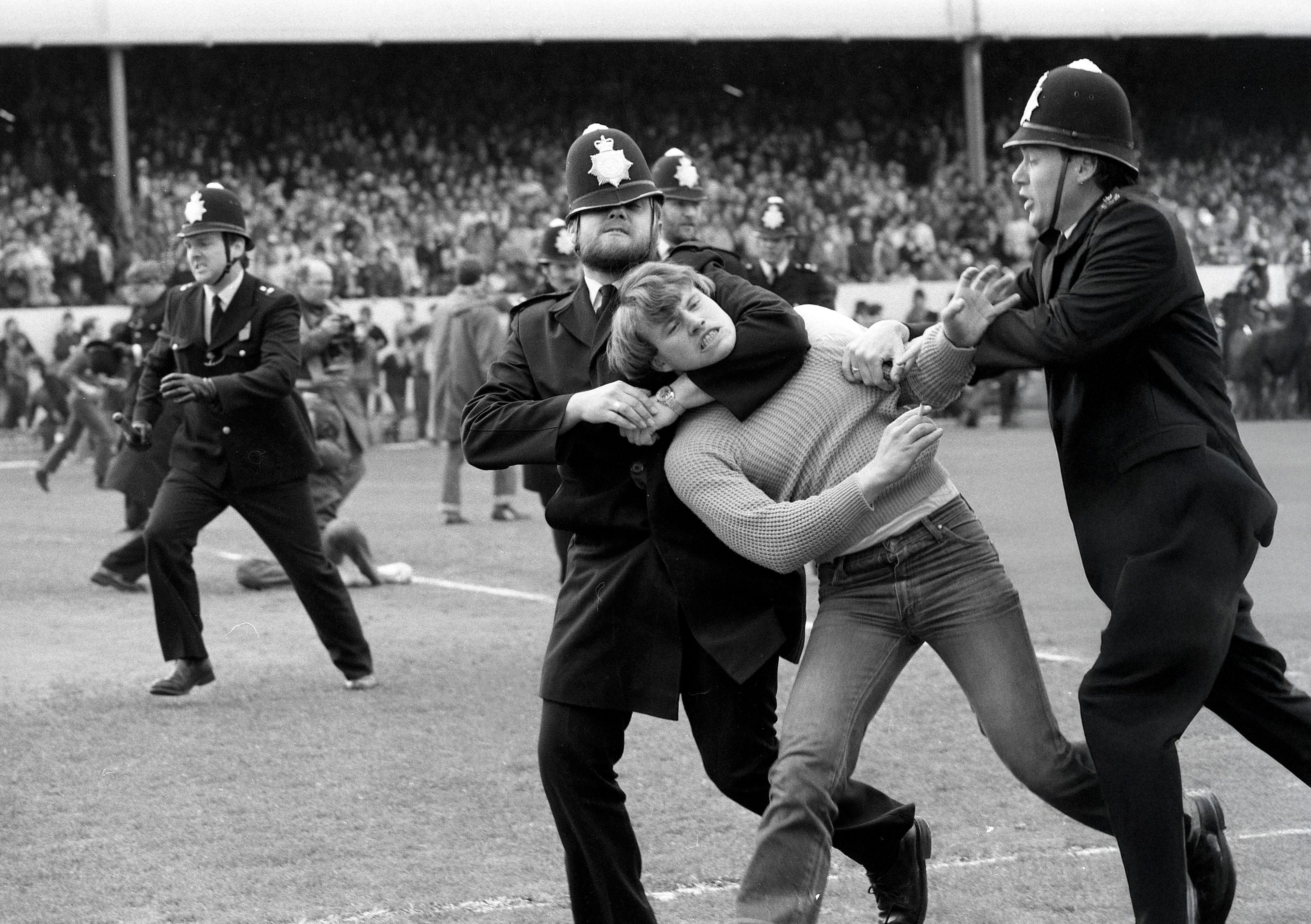
Football hooliganism was already a problem in 1970 and became more serious during the decade
Organised hooligan groups developed around particular football clubs
One example was the Chelsea Headhunters
Violence sometimes made areas around football grounds unsafe for visiting supporters
On match days, some areas became no-go zones for fans of other clubs
The problem became so closely associated with Britain that it was known abroad as the "English disease"
“I have been saddened and sickened by the way in which violence off the field had marred the enjoyment not only of adults who go to football matches, but of boys, of the age that I was when I started going to matches, who go to games with their parents. Football has little future if the coming generation, which is not violent, is frightened away from matches by this sort of behaviour"
Brynmor John, Minister of State at the Home Office, speaking in the House of Commons, 25th March 1977
Approach: John separates the violent minority from a wider group of football supporters. He argues that hooliganism was frightening families and children away from matches
The source is useful for showing how the government presented football violence as a threat to the future of the sport. However, as a minister answering criticism in Parliament, John had a reason to sound concerned while avoiding the suggestion that all young supporters were violent
Examiner Tips and Tricks
Remember that most young people were neither punks, skinheads, nor football hooligans. These groups attracted attention because they were highly visible, but they represented only a minority of the younger generation.
Environmentalism
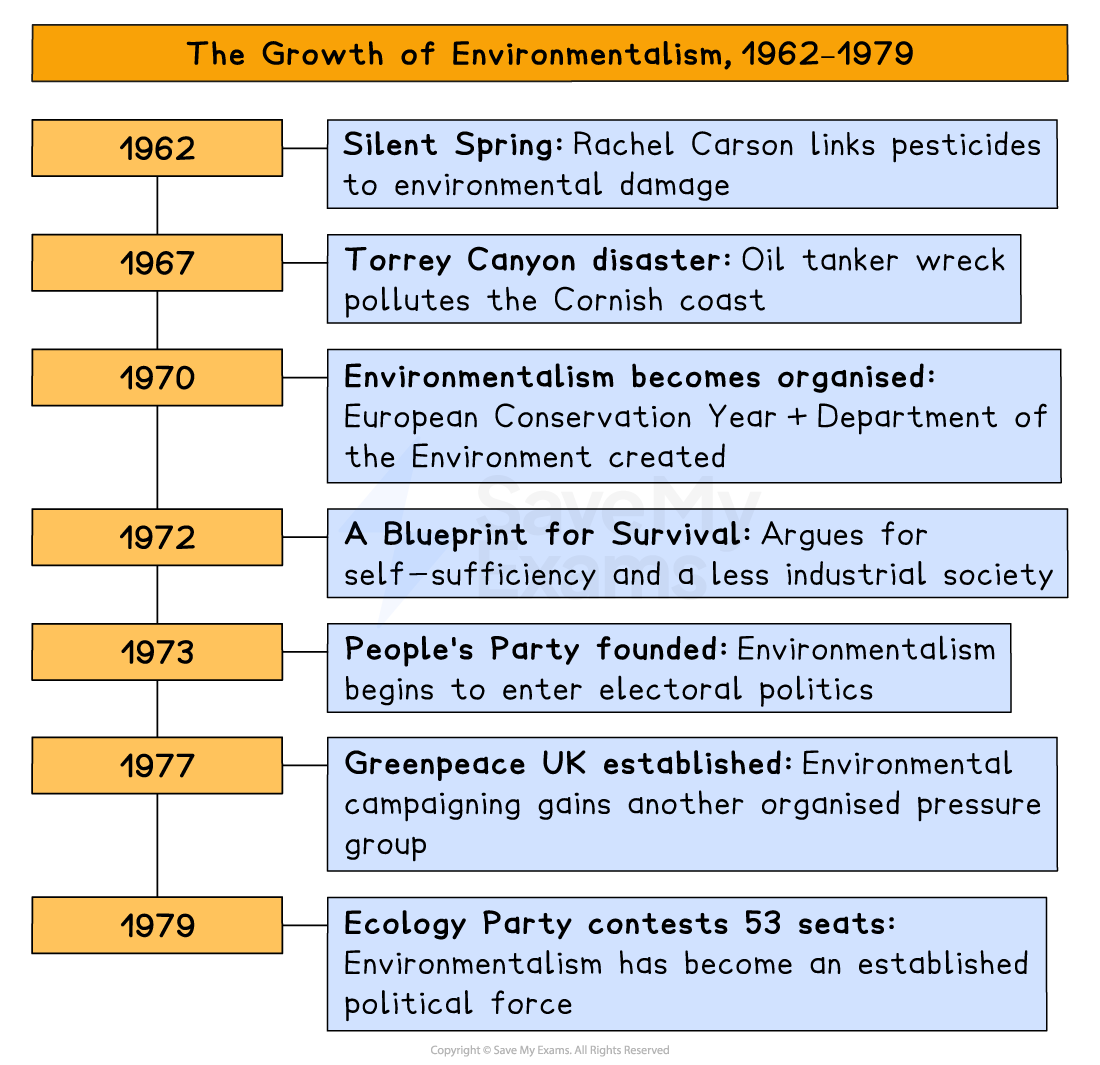
The growth of environmental campaigning
Environmentalism brought together concerns that had previously been treated separately:
industrial pollution
wildlife protection
organic farming
radiation and nuclear waste
The word ecology became widely used to describe the health of the natural environment
Photographs of Earth taken from space presented the planet as fragile
This changed how environmental problems were understood
Environmental ideas also developed from the counterculture of the 1960s
The counterculture had criticised consumerism and commercialisation
Some campaigners questioned whether scientific and economic progress always improved people's lives
Publications and events that raised awareness
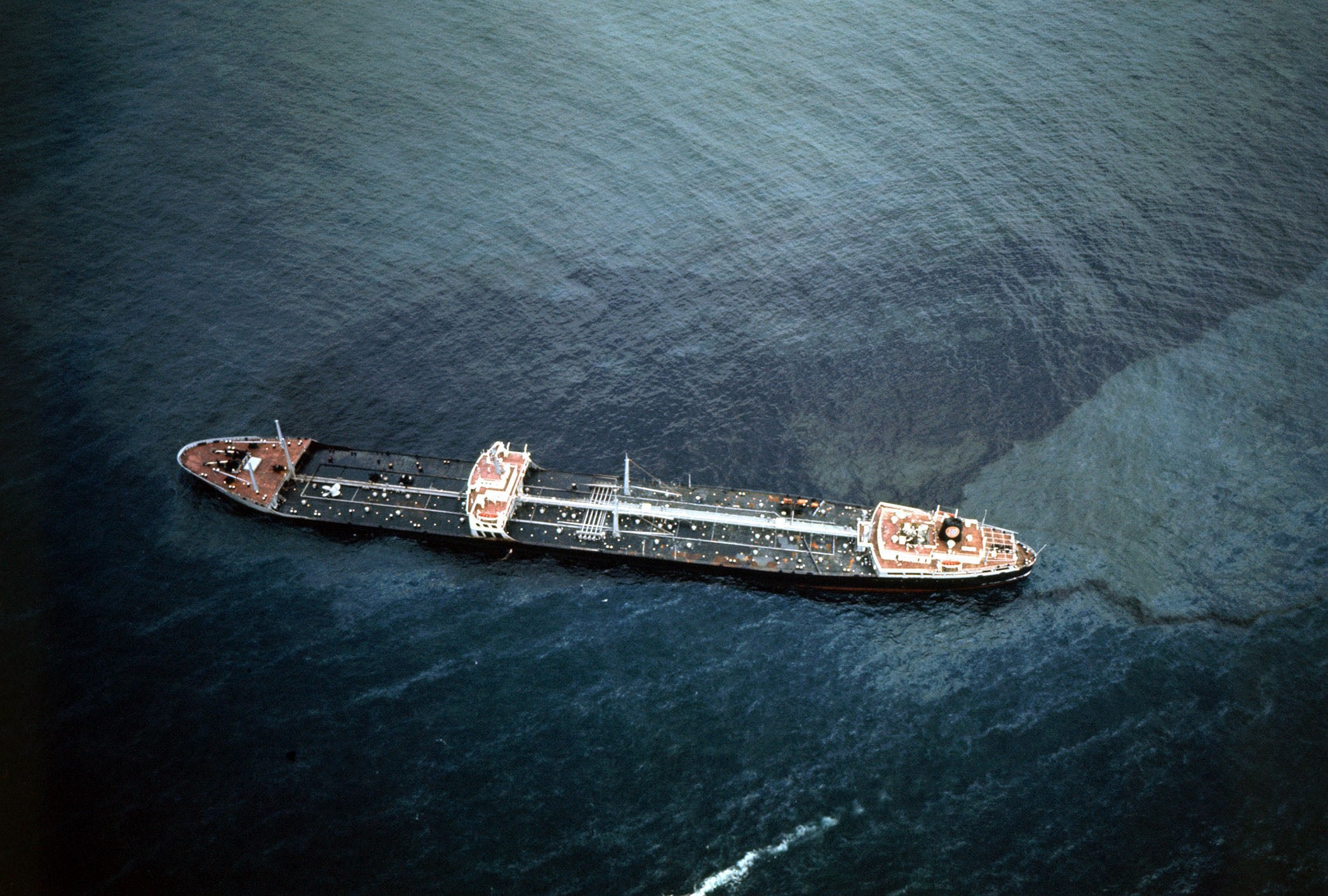
Rachel Carson's Silent Spring, published in 1962, linked pesticides such as DDT to the decline of birds and other wildlife
It had an international impact
The Hunt Saboteurs Association was formed in 1963
It used direct action against fox hunting
The oil tanker Torrey Canyon was wrecked off the Cornish coast in 1967
The resulting oil spill increased concern about marine pollution
Paul Ehrlich's The Population Bomb, published in 1968, warned about the effects of overpopulation
Teddy Goldsmith's A Blueprint for Survival, published in 1972, argued for:
greater self-sufficiency
less industrial production
a society less dependent on continual economic growth
Pressure groups and direct action
1970 was named European Conservation Year
Environmental campaigns became more organised
Friends of the Earth was founded in the United States in 1969
It later expanded into Britain and France
Greenpeace was founded in Vancouver in 1971
It first campaigned against US nuclear weapons testing in Alaska; its campaigns against whaling began in 1975
Greenpeace UK followed in 1977
Anti-nuclear protest changed its focus
Earlier campaigns had opposed nuclear weapons
During the 1970s, campaigners increasingly opposed nuclear power
Their concerns included radioactive waste and the risk of accidents
There were five incidents at the Sellafield nuclear plant between 1957 and 1979
The partial meltdown at Three Mile Island in Pennsylvania in 1979 increased international concern about nuclear safety
Animal rights and direct action
Animal rights became part of the environmental movement
In 1975, there was public anger after it emerged that beagles in laboratories had been made to smoke for research
The Animal Liberation Front was formed in 1976
Its supporters carried out direct action against laboratories
In 1982, a group calling itself the Animal Rights Militia sent letter bombs to party leaders, including Margaret Thatcher
Direct action divided environmental campaigners
Some supported lawful protest and pressure group activity
Others defended more confrontational methods
Environmentalism in popular culture
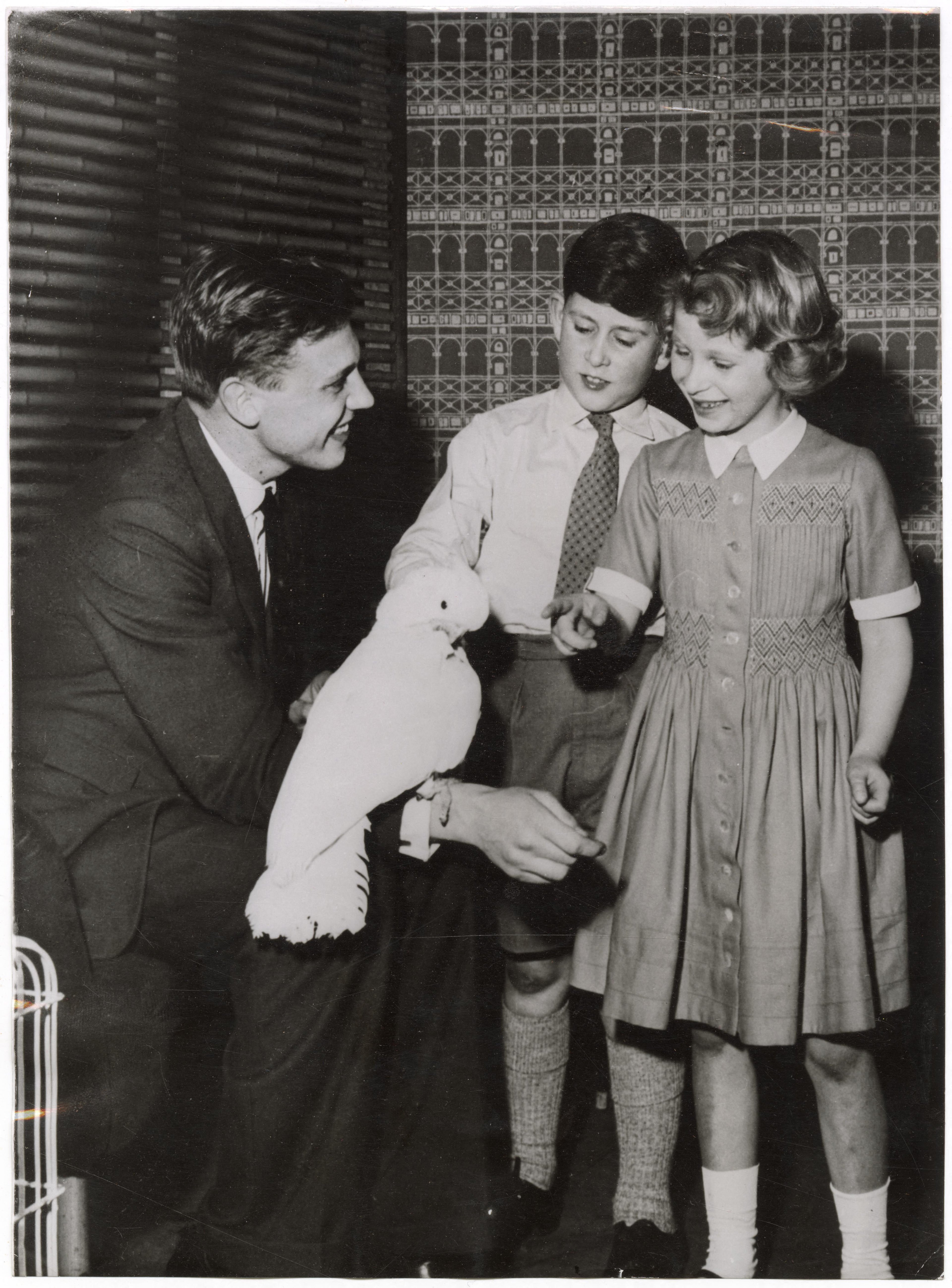
Television brought environmental issues to a large audience
Many programmes were produced by the BBC Natural History Unit in Bristol
David Attenborough's Life on Earth was broadcast in 1979
It used new colour filming techniques
It attracted audiences around the world
James Lovelock's Gaia theory gained attention in the same year
It presented Earth as a single self-regulating system
Environmental concerns also appeared in fiction and comedy
Richard Adams's Watership Down, published in 1972, followed rabbits whose warren was destroyed for a housing development
The television sitcom The Good Life, first shown in 1975, followed a couple attempting self-sufficiency in suburbia
Environmentalism enters politics
Government structures changed at the beginning of the decade
The Department of the Environment was created in 1970
The Royal Commission on Environmental Pollution was also established in 1970
MPs disagreed about whether these new bodies amounted to a real environmental policy
“This is a problem which no country has yet solved, but what is much more disturbing in our case is that there is a striking lack of evidence that the Government have seriously tried to solve this problem in a systematic manner. It is this lack, as I believe it to be, of a clear, coherent and comprehensive strategy on which I want to concentrate today”
Michael Meacher, Labour backbench MP for Oldham West. Speaking in the House of Commons, 22nd December 1972
Approach: Meacher argued that the government lacked a clear and organised environmental policy
The source is useful for showing that environmental policy was being challenged in Parliament by the early 1970s. However, Meacher was an opposition MP criticising the government, so he had a reason to emphasise failures and overlook measures already introduced
“I must say at the outset that the hon. Gentleman’s description of this country’s environmental policy as being characterised by odd outbursts of action rather than a total approach is utterly at variance with the facts. ... What does he suppose was in the mind of my right hon. Friend the Prime Minister when he set up the Department of the Environment, bringing together for the first time in any country all the necessary machinery to have a total approach?”
Eldon Griffiths, Under-Secretary of State for the Environment. Replying in the House of Commons, 22nd December 1972
Approach: Griffiths was replying to Meacher in the same debate as above. He defended the government’s record by pointing to the creation of the Department of the Environment and its attempt to bring different responsibilities together
The source is useful for showing how the government presented its environmental policy. However, Griffiths was defending his department, so he had a reason to stress coordination and progress
The Control of Pollution Act (1974) covered:
waste disposal
water pollution
noise
air pollution
A green political party also emerged
The People's Party was founded in 1973
Five candidates stood in the February 1974 general election
It became the Ecology Party in 1975
It stood 53 candidates in the 1979 general election
The party won no seats
However, environmentalism had gained a permanent place in British politics by the end of the decade
Examiner Tips and Tricks
The two parliamentary sources are useful when compared. Meacher argues that government policy lacked direction, while Griffiths points to new institutions and coordination. Use the evidence from the decade to test both claims rather than choosing one source without explanation.
How much did British society change in the 1970s?
British society changed in important ways during the 1970s
However, new laws and campaigns did not remove older inequalities, prejudice or social tension
Some key evidence for each side is outlined below
Areas of change
Women's legal position changed significantly
The Sex Discrimination Act, Employment Protection Act and Social Security Pensions Act all passed in 1975
The Equal Pay Act (1970) also came into force that year
Women gained greater financial independence
Women's pay rose from 59% of men's pay in 1970 to 70% by 1977
Women could obtain mortgages without a male guarantor
Race relations law became stronger
The Race Relations Act (1976) covered indirect discrimination
It also created the Commission for Racial Equality, which had powers to investigate complaints
Anti-racist campaigning grew into a mass movement
Around 100,000 people joined the Rock Against Racism march and concert in April 1978
Some local authorities began adopting multicultural policies
Environmentalism entered national politics
The Department of the Environment was created in 1970
The Ecology Party stood 53 candidates in the 1979 general election
Youth culture widened the boundaries of public expression
The Sex Pistols' "God Save the Queen" was banned by the BBC but still reached number two in 1977
Punk fashion, music, and language challenged older ideas about respectability
Limits to change
Laws supporting women were often weakly enforced
The Equal Opportunities Commission launched only nine investigations between 1976 and 1983
Only 10% of workplace sex discrimination claims succeeded
Employers could avoid equal pay requirements
Women's jobs were sometimes given different titles or duties so they could not be directly compared with men's work
The TUC did not publish its equality charter until 1979
Organised racism became more visible
The National Front had up to 20,000 members
By 1977 it was described as Britain's fourth-largest political party
This growth came one year after the Race Relations Act (1976)
Racial violence and distrust of the police continued
Assaults and robberies of Asian and Afro-Caribbean people rose by a third
Blair Peach was killed during an anti-National Front protest in 1979
In 1980, the Commission for Racial Equality reported that racial prejudice and discrimination remained widespread
Environmentalism gained influence but little direct political power
The Ecology Party won no seats in 1979
Ministers were still criticised for lacking a clear environmental strategy
Concern about youth behaviour was not new
Most young people were not punks, skinheads, or football hooligans
Earlier post-war decades had produced similar fears about youth culture
Examiner Tips and Tricks
Avoid treating each theme separately. The same decade produced both reform and opposition. Strong answers use this contrast to show that legal change did not always lead to equal treatment in everyday life.

Unlock more, it's free!
Join the 100,000+ Students that ❤️ Save My Exams
the (exam) results speak for themselves:

Was this revision note helpful?
